Darwin's Natural Heir
Edward O. Wilson turned a lifetime among ants into a theory of the whole living planet. In 1992 he named Costa Rica's biodiversity institute the prototype the rest of the world should follow.
The story Bert Hölldobler chose to tell when his closest collaborator died took place in a small park in San José, on the evening before a flight back to Boston. Edward O. Wilson, then in his late seventies, spotted a trail of ants at the park entrance. He dropped to his hands and knees with a glass aspirator and started collecting workers along the line they had laid down. He crawled toward the nest. Park visitors stared. A young embracing couple disentangled and moved away. Police arrived, because, in Hölldobler's words, the behavior of an old man on his knees with a tube in his mouth was "so suspicious" as to require inquiry. By the end of the evening Wilson had identified six or seven species of Pheidole new to science in this one municipal park. He and Hölldobler never made it to the restaurant Wilson had been describing in mouthwatering superlatives all day.
Hölldobler put the scene at the front of Wilson's PNAS obituary in February 2022, six weeks after Wilson died. It captures the thing that organized his entire life: a total, almost childish absorption in animals two millimeters long. Out of that absorption Wilson built a career on a single wager, that if you looked closely enough at the smallest living things you would find rules that scaled all the way up to the planet. The wager paid out. It produced the theory that told the world how large a nature reserve has to be, and the word, biodiversity, that told governments what was at stake inside one. The same wager produced a darker inheritance: a conviction that human social behavior runs on the same evolutionary rules as an ant colony's. That idea drew the fiercest attack of his career, and, his own archive would later reveal, led him in private to support the science of racial difference. Costa Rica belongs to the constructive half of the record. Wilson did not write about the country often, and he visited it rarely. But he named it, in print, the prototype the rest of the world should follow, and the country built much of what he only theorized.
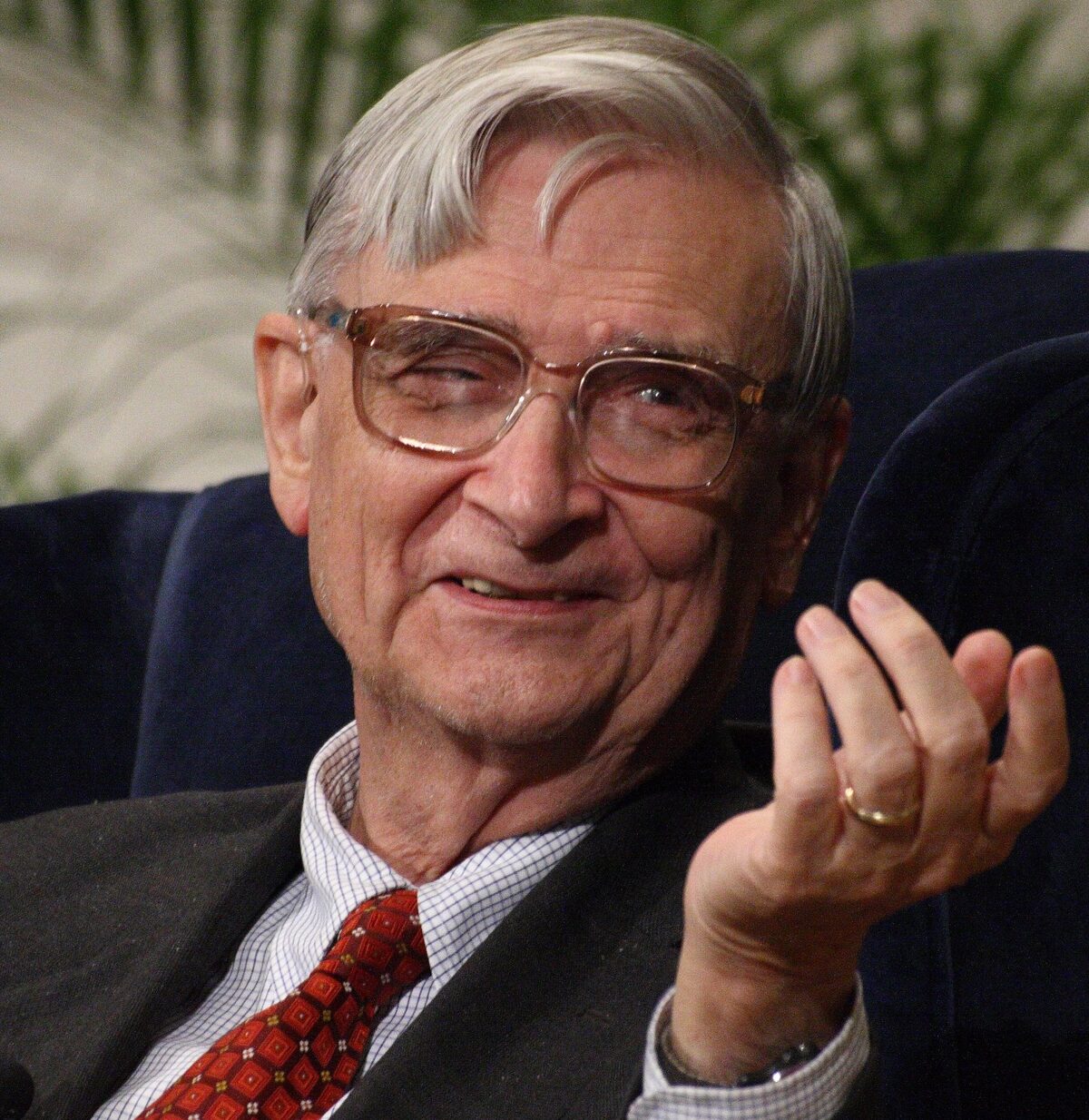
The Boy Who Looked Down
Edward Osborne Wilson was born in Birmingham, Alabama, on June 10, 1929, the only child of a federal-government accountant who was a chronic alcoholic and a mother who divorced him when the boy was seven. That same year, while the divorce was pending, his parents sent him to board with a family at Paradise Beach, Florida. He was fishing in the surf and hauled in a pinfish. "One of its spines pierced the pupil of my right eye," he wrote. The pain was excruciating, but he did not stop fishing and did not tell anyone, because he was anxious to stay outdoors. A few months later the right pupil clouded over with a cataract, and a surgeon in Pensacola removed the lens while someone held him down and dripped ether into a gauze cone over his face. He called it "a terrifying nineteenth-century ordeal." He attended fourteen schools in eleven years across Alabama and the Florida Panhandle.
What remained was a left eye with vision of 20/10 and no depth perception. He could not be the ornithologist he had planned to become; tracking a bird in flight needs stereoscopic vision, and an adolescent hearing loss would later rule out birdsong identification too. The hardware he had was suited to small, slow, close things. "The attention of my surviving eye turned to the ground," he wrote. "I would thereafter celebrate the little things of the world, the animals that can be picked up between thumb and forefinger and brought close for inspection." On a wooded slope in Rock Creek Park in Washington he pulled bark off a rotting stump and found citronella ants underneath, short, fat, brilliant yellow, smelling of lemon. "What netherworld had I briefly glimpsed?" he asked. "What strange events were happening deep in the soil?" He noticed butterflies and ants, he later wrote, "more than other kids did, and took an interest in them automatically."
By eighteen he intended to specialize in flies. A wartime shortage of insect pins forced him to switch to ants, which could be kept in glass vials. He corresponded with Marion R. Smith, a myrmecologist at the National Museum of Natural History, who suggested he survey the ants of Alabama. The survey produced his first scientific contribution, the discovery of the first colony of imported fire ants in the United States, near the port of Mobile. He took a B.S. and an M.S. at the University of Alabama, transferred to Harvard in 1951, and finished a PhD in 1955 on a revision of the ant genus Lasius. He stayed on the Harvard faculty for the next forty-one years.
The Rules That Scale
Wilson was, by his own account, a poor mathematician. As a tenured professor in his early thirties he had sat through two years of undergraduate math courses to remedy the deficiency, with little success, and he later called the theoreticians he worked with his "intellectual prosthesis." He had the elements of a theory of biogeography, the species-area curves in his files and his idea of a balance of species, but not the mathematics to assemble them. Robert MacArthur, a Princeton ecologist less than a year younger than him and a gifted mathematician with a deep love of birds, supplied it. The two of them worked out a quantitative theory of why islands hold the species they do. The number of species on an island, they proposed, settles at the equilibrium between two curves, one falling and one rising. Immigration of new species falls as more arrive, because fewer of the next arrivals are new. Extinction rises as more species are present, because each new species offers another candidate for local disappearance. Where the two curves cross is the number of species the island can sustain. Increase distance from the source area, and the immigration curve falls. Decrease area, and the extinction curve rises. Either change lowers the equilibrium.
Their species-area equation, S = CAz, with z usually between 0.20 and 0.35, turned this into arithmetic: cut an island to a tenth of its area and you lose roughly half its species. MacArthur and Wilson published a preliminary paper in Evolution in 1963 and the full book, The Theory of Island Biogeography, with Princeton in 1967. To test it, Wilson and his graduate student Daniel Simberloff did something audacious. "There was only one way to solve the problem," Wilson wrote. "Miniaturize the system!" They hired an exterminator, tented six small mangrove islets in the Florida Keys, fumigated them to kill every arthropod, and watched the islands recolonize. Within 250 days the species counts had returned, with distance from the mainland predicting the rates. The first chapter of the 1967 book had shown a four-panel figure of the shrinking woodland of Cadiz Township, Wisconsin, between 1831 and 1950, with the comment that the same principles applied "to formerly continuous natural habitats now being broken up by the encroachment of civilization." It was an aside. They did not yet know what they had written.
MacArthur did not live to see what the rest of the work would become. He died of renal cancer in 1972 at age 42. The night before he died he and Wilson spoke for an hour by telephone, Cambridge to Princeton, about the future of ecology and the merits of various colleagues, with the calm, Wilson wrote, of a man who had a hundred years to live. Decades later, writing a new preface for the Princeton Landmarks reissue, Wilson acknowledged where the book had actually landed. "In a way that MacArthur and I failed to appreciate," he wrote, "the book has had a major impact on conservation biology." Habitat fragmentation was insularization. The Cadiz Township figure became canonical. The SLOSS debate over reserve design (Single Large or Several Small) ran on their math. The Mesoamerican Biological Corridor, the corredores biológicos that SINAC would later draw on a map of Costa Rica, the fragmentation experiment that Tom Lovejoy would run in the Amazon beginning in 1979: all of it ran downstream of two crossing curves in a 1963 paper.
The New Synthesis
In 1971 Wilson published The Insect Societies, a synthesis of everything known about ants, bees, wasps, and termites, and closed it with a proposal: the same evolutionary logic that explained an ant colony could be extended to the social behavior of all animals. Four years later he made good on it. Sociobiology: The New Synthesis (1975) ran from microbes to mammals and defined a new discipline, "the systematic study of the biological basis of all social behavior." It was an extension of Darwinian thinking on the scale of the Modern Synthesis of the 1930s. For twenty-six chapters it was celebrated. The trouble was the twenty-seventh, on humans, which opened by asking the reader to "consider man in the free spirit of natural history, as though we were zoologists from another planet completing a catalog of social species on Earth." In that light, Wilson wrote, the humanities and social sciences "shrink to specialized branches of biology." He meant the chapter, he later admitted, as "a catalyst dropped among reagents already present and ready to combine."
The reaction combined. Fifteen Boston-area scientists, teachers, and students formed the Sociobiology Study Group, allied with the activist organization Science for the People. Two of its most prominent members were Wilson's own colleagues at the Museum of Comparative Zoology, Stephen Jay Gould and Richard Lewontin, whose office sat directly below Wilson's own. On November 13, 1975, they published an open letter, "Against 'Sociobiology,'" in The New York Review of Books. It charged that theories like Wilson's "tend to provide a genetic justification of the status quo," and linked them to the past American sterilization laws "and also for the eugenics policies which led to the establishment of gas chambers in Nazi Germany." Wilson, a registered liberal who had thought he was writing population biology, was stunned. "I had been blindsided by the attack," he wrote. "In the liberal dovecotes of Harvard University, a reactionary professor is like an atheist in a monastery." His defense was that genes account for as little as ten percent of human behavior, the rest environmental, and that describing a tendency is not endorsing it.
The dispute turned physical once. On February 15, 1978, at the annual meeting of the AAAS, Wilson sat on stage with his leg in a cast when about eight demonstrators rushed the platform, one placard painted with a swastika. A young woman picked up a pitcher of water and poured it over his head while the group chanted, "Wilson, you're all wet!" He described his own reaction as "calm, dare I say icy cold, as I let the protestors' anger wash over me," and the episode as "the only occasion in recent American history on which a scientist was physically attacked, however mildly, simply for the expression of an idea." Gould, from the same stage, condemned the disruption, quoting Lenin on an "infantile disorder." Wilson knew the placard-wavers were not his real problem. "It was the grown-up intellectuals I knew I had to worry about," he wrote. Of Lewontin he was almost admiring: "the only person who could make MacArthur sweat," "stage-cast for the role of contrarian," "an intellectual who preached social change from the temple of hard science." Out of the same period came On Human Nature (1978), the humane companion volume in which Wilson argued that the genes hold culture "on a leash." It won the Pulitzer Prize. The charge that his science gave cover to racism he treated, for the rest of his public life, as a slander. His private papers would complicate that.
The Unity of Knowledge
The synthesizing impulse did not stop at human behavior. Wilson had spent his career making one field after another, the island biogeography he built with MacArthur, the chemical ecology he opened by decoding ant pheromones with the Harvard mathematician William Bossert, the sociobiology he assembled on his own, and he came to see the fragmentation of knowledge itself as the next problem to solve. In Consilience: The Unity of Knowledge (1998) he argued that the natural sciences, the social sciences, and the humanities would eventually rest on a single shared foundation of explanation, with biology at its base. He took the word from the Victorian philosopher William Whewell, who had defined consilience as a "jumping together" of knowledge across disciplines. Culture, ethics, and art were not exempt from biological explanation, Wilson held; they were shaped by what he called epigenetic rules, inherited biases in how the mind develops, and could be studied like anything else in nature.
It was the boldest claim of an unusually bold career, and not everyone wanted it. Philosophers and social scientists read Consilience as biological imperialism, the same charge sociobiology had drawn, now aimed at the whole of culture. Wilson was unmoved. He had written, in On Human Nature, that "the evolutionary epic is probably the best myth we will ever have," and he meant it as a working faith, a secular successor to the Baptist Christianity he had left behind in Alabama. This was the work that earned him the name that followed him to the end. The Guardian called him Darwin's natural heir, and the obituaries repeated it. Along the way he had gathered the National Medal of Science and the Crafoord Prize, which the Royal Swedish Academy of Sciences created to honor the disciplines the Nobel leaves out.
The Little Things That Run the World
Through all of it, the grand syntheses and the fights they started, the ant work never stopped, and it was the steadiest thing he did. In 1990 Wilson and Hölldobler published The Ants, 732 pages, which won Wilson his second Pulitzer and remains the only Pulitzer-winning work of professional science. Then he climbed what ant taxonomists had called the Mount Everest of their discipline, too big to attempt: the genus Pheidole. The 2003 monograph, Pheidole in the New World, ran to 794 pages, recognized 624 species in the Western Hemisphere, and described 337 of them new to science, sixteen years of part-time work in his home laboratory, drawing specimens while listening to classical music and soft rock. Of the roughly 450 ant species Wilson described in his career, 354 were Pheidole.
Costa Rica supplied a measurable share of those names. When Fernando Zara and Harold Fowler reviewed the monograph in 2005 in UCR's Revista de Biología Tropical, they calculated that Costa Rica held 113 of the 624 New World Pheidole species, 18.1 percent of the hemispheric total, behind only Brazil and Mexico. Normalized for area, Costa Rica ranked first in the world, more Pheidole per unit of land than anywhere else on Earth. The reviewers attributed the result, drily, to "the high collecting effort in Costa Rica and Panama, two countries well studied by Wilson." The names carry the geography. Pheidole laselva Wilson 2003, type locality Costa Rica, Heredia, La Selva, named for the field station where it was collected. Pheidole texticeps, Pheidole iracunda, Pheidole browni, Pheidole boltoni, several with holotypes from eight kilometres north of Volcán Barva at 1,830 metres. Pheidole nasutoides, the termite-mimic ant, described by Hölldobler and Wilson in Psyche in 1992 from Costa Rican material, a species that has shaped its body to look like the soldier of a termite colony, presumably to walk through termite galleries without being attacked.
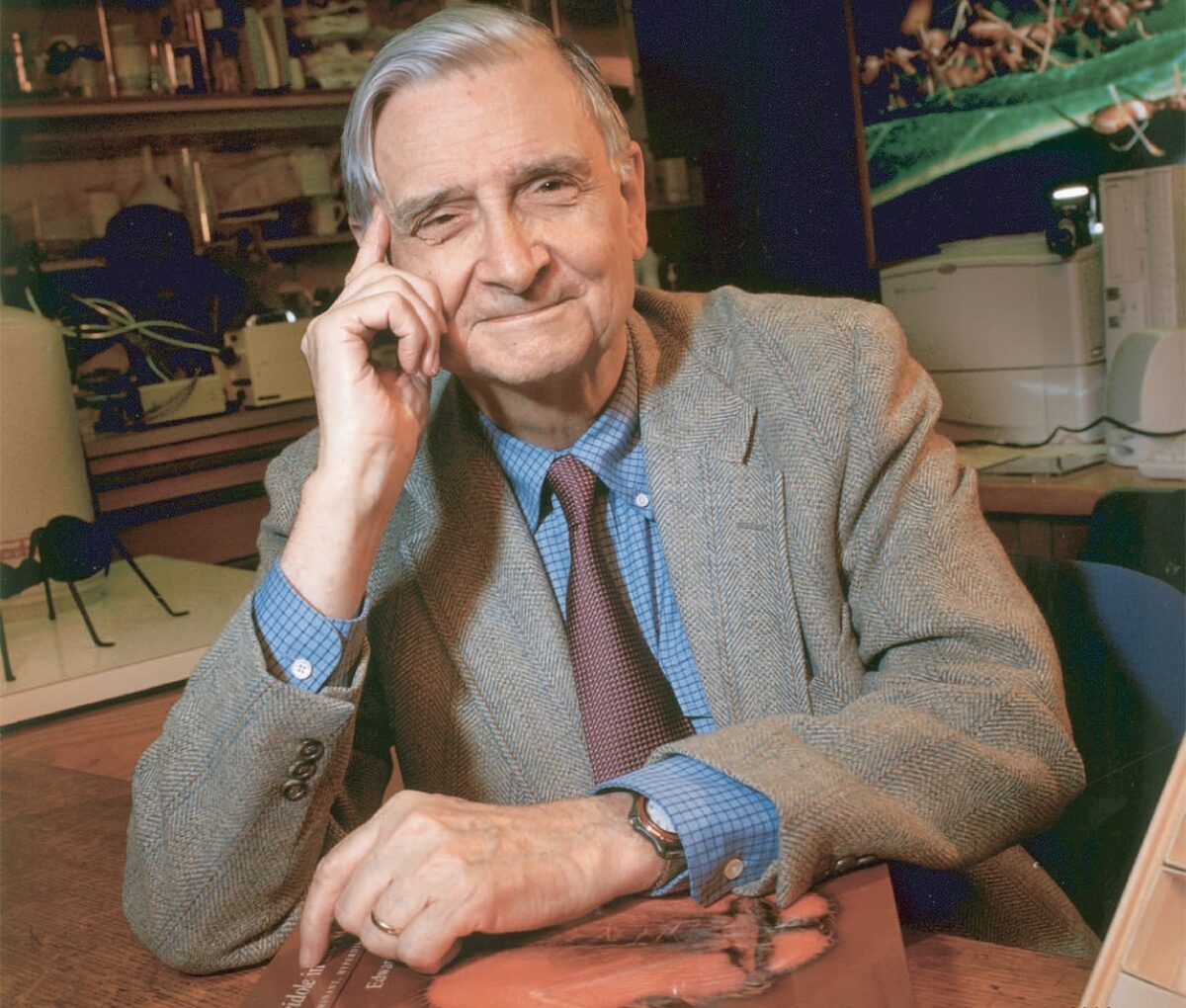
The only Costa Rica field trip Wilson narrated in his autobiography happened in 1985. "We drove north from San José to La Selva, the field station of the Organization for Tropical Studies," he wrote, and spent two weeks working on Prionopelta, a primitive ponerine ant whose colonies had never been observed in life. The trip showed the two men's opposite temperaments. When Hölldobler pointed at flecks of cocoon silk in a nest gallery, Wilson dismissed them: "Nothing, just trash, I answered." Hölldobler persisted, "No, no, look: the pieces are lined up as a smooth layer on the gallery walls," and proved the ants were using silk as wallpaper to control humidity, a technique unknown in ants. He then found the gland in the workers' hind legs that lays their foraging trails. "From two weeks of data gathered in the La Selva forest we wrote five scientific articles," Wilson wrote. He called Hölldobler "the younger brother I never had" and "the most honest scientist I have ever known."
Costa Rica was not always generous to him. In The Creation (2006), Wilson recalled four days "tramping through a Costa Rican rainforest" in search of Thaumatomyrmex, the "wonderful ant" whose mandibles look like a pitchfork and which is, he wrote, among the rarest ants in the world. He wanted to know what the mandibles were for. "Frustrated and depressed, I found not a single worker." He flew home and published an appeal in Notes from Underground, the ant biologists' newsletter, listing the things he wanted to know before, as he put it, going up to that Great Rainforest in the Sky. Two young Brazilian entomologists supplied the answer, later confirmed by a German colleague: Thaumatomyrmex hunts polyxenid millipedes, slipping the tines of its mandibles through the millipede's defensive bristles to pierce the body. They were, Wilson wrote, "porcupine huntresses." The anecdote is his own joke at his expense. Even Wilson, four days in country, came back with nothing.
Biophilia and the Word for the Loss
If sociobiology was the dangerous half of Wilson's claim that humans are animals, biophilia was its tender half. Biophilia (1984) defined a word he had coined for "the innate tendency to focus on life and lifelike processes," the idea that humans carry an inherited affinity for the living world because we evolved inside it. The book opens not in Costa Rica but in Surinam, on March 12, 1961, with the young Wilson standing in an Arawak village looking south across the forest and tracing a single chain of life: "Sunlight to leaf to caterpillar to ant to anteater to jaguar to maggot to humus to termite to dissipated heat." From biophilia he drew a conservation ethic rooted in biology rather than sentiment, and ended the book on a question that became the through-line of the rest of his life: "Is it possible that humanity will love life enough to save it?"
The word that carried that ethic into policy arrived the next year, and it was not Wilson's. In 1985 Walter G. Rosen of the National Academy of Sciences wrote "biodiversity" into a memorandum while planning a conference. The National Forum on BioDiversity took place in Washington from September 21 to 24, 1986, and Wilson gave the opening address. He edited the proceedings into a 521-page volume, BioDiversity (1988), the first book to put the word in its title; the press shorthand attached his name to it permanently, and he is still loosely called the father of biodiversity, though he always credited Rosen. In 1987, at the opening of the invertebrate exhibit at the National Zoo, he coined the phrase that summed up his life's subject: "the little things that run the world." If humans vanished, he said, the planet would heal; "but if invertebrates were to disappear, I doubt that the human species could last more than a few months."
Costa Rica entered Wilson's 1988 volume primarily through Daniel Janzen. Chapter 14, "Tropical Dry Forests: The Most Endangered Major Tropical Ecosystem," argued that the dry forest, more than the rainforest, was the most threatened of the great tropical forest types; only about two percent of the original Mesoamerican cover survived. Janzen anchored the chapter at the 11,000-hectare Santa Rosa National Park in Guanacaste, where he estimated 13,000 insect species and 175 breeding birds, and thanked Álvaro Ugalde by name for help on the manuscript. His closing line: "The people of Costa Rica have inspired me to believe there is still a chance." Wilson's own opening chapter estimated 76,000 square kilometres of tropical forest lost each year, "greater than the area of West Virginia or the entire country of Costa Rica," and an extinction rate of about 17,500 species a year, a thousand to ten thousand times the pre-human background.
The Prototype in San José
In 1992 Wilson published The Diversity of Life, the book that gathered his conservation argument into one place. Its premise was that a country owns a third kind of wealth, as real as the material and the cultural and far more carelessly spent.
Three pages later he named the working example. Costa Rica's National Institute of Biodiversity, INBio, founded outside San José in 1989, was, he wrote, the prototype: "perhaps odd that a developing nation should lead the way in such a concerted scientific enterprise, but others will follow."
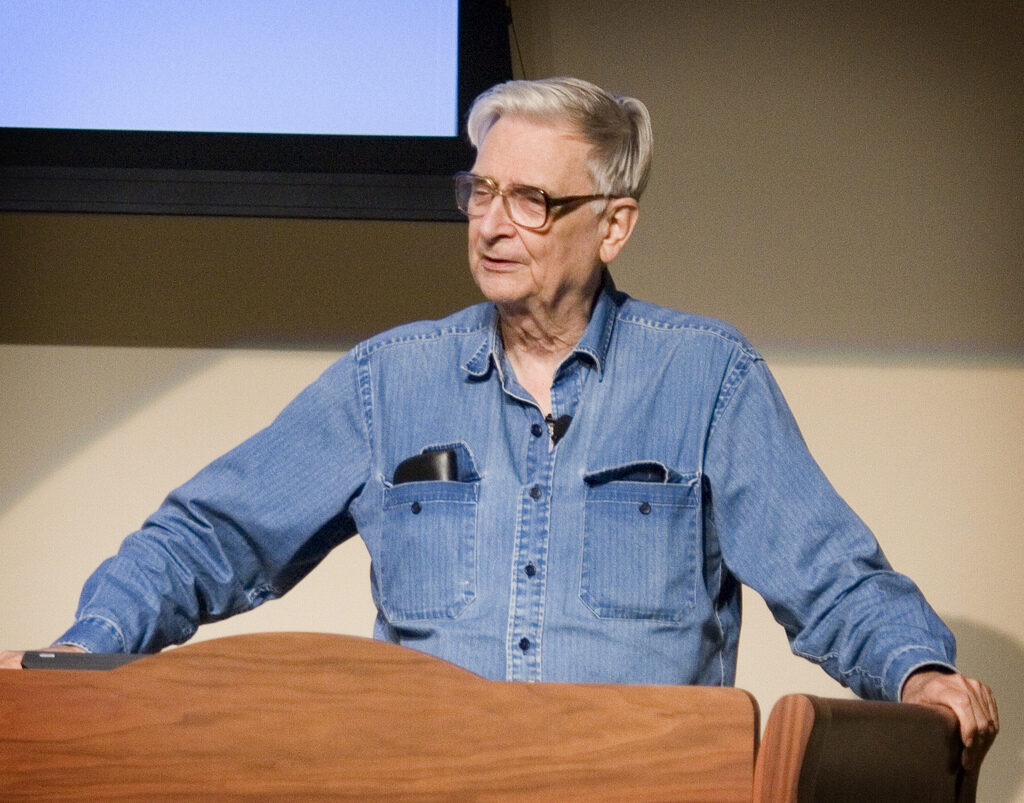
Wilson's only date-anchored public appearance in Costa Rica came in August 2007. On Wednesday the 22nd, at two in the afternoon, he stood at the lectern of the auditorium of the Ciudad de la Investigación at the University of Costa Rica to give the keynote of the Cátedra Rafael Lucas Rodríguez Caballero, the lecture series named for the UCR botanist who had co-founded the Organization for Tropical Studies in 1963. The occasion was the fiftieth anniversary of UCR's Escuela de Biología; the title was "Biodiversity and the Three Dimensions of the Future of Biology." UCR's news office reported that he told the audience half of all species on Earth could be lost by the end of the century, and singled out Costa Rica's conservation effort. The country, he said, "has become a leader in both philosophy and practice," and Costa Ricans "can be proud of setting an example, even for industrialized countries." He cited one extinct Costa Rican species, a red frog he said had existed for almost a million years, probably the Holdridge toad, Incilius holdridgei, or one of the harlequin frogs of the genus Atelopus that vanished from the country's cloud forests during the chytrid epidemic of the 1980s and 1990s.
The following afternoon, Thursday, August 23, at four o'clock in the auditorium of the Facultad de Educación, Wilson sat down at a long table for a roundtable on "The Future of Biodiversity in Costa Rica." Four Costa Rican biologists and policymakers sat with him: Pedro León Azofeifa, then coordinator of the Iniciativa Paz con la Naturaleza of President Óscar Arias; Jorge Lobo, of UCR's Escuela de Biología; Rodrigo Gámez, director of INBio; and Álvaro Ugalde, director of the Área de Conservación Osa. The roundtable sat inside a particular policy moment: Arias's Paz con la Naturaleza initiative had launched only weeks earlier, committing Costa Rica to becoming the first developing country to pledge carbon neutrality. The men at the table ran much of the apparatus Wilson had spent a career theorizing, the inventory institute, the conservation areas, the national climate commitment.
Of the five men in that room, three are now dead. Ugalde died in February 2015 in a car accident on the Osa Peninsula. Wilson died in Burlington, Massachusetts, on December 26, 2021, four and a half months after his wife Irene. Gámez died in 2025. The most documented direct encounter between Wilson and senior Costa Rican conservation leadership left no transcript and no video that this research has located, only two UCR News articles and the memory of the biologists in the auditorium. The San José park anecdote that Hölldobler chose for the obituary almost certainly belongs to this trip; it is the only date-anchored visit late enough for the police to have read Wilson as elderly. Hölldobler never gave the year, only the scene.
Half-Earth
Wilson's late-career synthesis began with The Future of Life (2002), which opens as a letter to Henry David Thoreau and lays out the framework he called HIPPO, the drivers of extinction in order of severity: Habitat loss, Invasive species, Pollution, Population, Overharvesting. It distinguished a "natural economy," the free services of living ecosystems, from the "market economy" that ignores them. The argument culminated in Half-Earth: Our Planet's Fight for Life (2016), which took the species-area math from 1967 and applied it to the planet itself. Protect half of Earth's surface, Wilson argued, through linked parks, reserves, marine zones, and corridors, never a single contiguous wilderness, and "more than 80 percent of the species would be stabilized." Anything less slid the planet toward what he named the Eremocene, "the Age of Loneliness, … basically the age of people, our domesticated plants and animals, and our croplands all around the world as far as the eye can see."
By then Costa Rica had become one of the closest national-scale demonstrations of the proposal. The country had reached roughly 31 percent protected terrestrial cover, well above the 15 percent global baseline Wilson cited for 2015, and it co-chaired the High Ambition Coalition that negotiated the global 30x30 target, with Half-Earth as its acknowledged intellectual antecedent. Wilson's own book names the country only once, in passing. It had quietly built much of what he was proposing.
He stayed combative to the end, including with himself. For most of his life Wilson had explained the self-sacrifice of worker ants by kin selection, the idea that an animal preserves its genes by helping close relatives. In 2010, at 81, he co-authored a Nature paper with Martin Nowak and Corina Tarnita that rejected kin selection's primacy and re-embraced group selection, and he built The Social Conquest of Earth (2012) around it: "selfish individuals beat altruistic individuals, while groups of altruists beat groups of selfish individuals." Much of the field, including Richard Dawkins, rejected the reversal; Dawkins called the book impossible to recommend, and Wilson waved him off as "a journalist." The fight was a smaller version of the one he had been having since 1975, over how far evolution reaches into social life. He never stopped insisting that it reaches all the way.
The Last Refuge
Wilson donated his personal papers to the Library of Congress in instalments between 1990 and 2015, 95,000 items in 284 archival boxes, 120 linear feet, plus 975 digital files. The materials span 1931 to 2015, with the bulk falling between 1950 and 2007. The named-correspondents index reads like a roster of twentieth-century biology: William L. Brown, his Harvard mentor; Robert MacArthur; Daniel Janzen; Thomas Lovejoy; Ernst Mayr; Robert Trivers; Stephen Jay Gould. He donated them at the Library's request and seems never to have considered them anything other than open historical material. He was right that they were historical. He may not have reckoned with what else was in them.
Among them are four folders labelled "Rushton, John Philippe." Stacy Farina of Howard University and Matthew Gibbons, who had been working through the Wilson Papers since September 2021, read those folders and published "'The Last Refuge of Scoundrels': New Evidence of E. O. Wilson's Intimacy with Scientific Racism" in Science for the People in February 2022, weeks after Wilson's death. The piece documented, with photographic reproductions of typed letters, that in 1986 Wilson had sponsored a paper by J. Philippe Rushton in the Proceedings of the National Academy of Sciences after a split review, one referee strongly favourable and one strongly negative. In a 1987 letter declining to sponsor a follow-up paper on racial differences, Wilson wrote that he had "a couple of colleagues here, Gould and Lewontin, who would use any excuse to raise the charge again," and that he was "the wrong person to sponsor the article, although I'd be glad to referee it for another, less vulnerable member of the National Academy." In a 1990 letter defending Rushton's promotion at the University of Western Ontario, Wilson wrote: "the answer is fear of being called racist, which is virtually a death sentence in American academia if taken seriously. I admit that I myself have tended to avoid the subject of Rushton's work, out of fear." And to his Harvard colleague Bernard Davis he wrote of "our favorite anti-racists of the Left" and that "anti-racism is the last refuge of scoundrels." The archive also holds correspondence with Arthur Jensen and Richard Herrnstein.
The shape of it is the thing. In 1975 Gould and Lewontin had charged, in public, that Wilson's biology of human behavior would furnish cover for racism, and Wilson had spent decades treating the charge as a political slander he had never earned. The folders show that in the same years, in private, he was quietly furnishing exactly that cover, for exactly the people his critics feared, while naming Gould and Lewontin as the reason he had to do it discreetly. Wilson never raised the subject of race in his published scientific work; the private support was archival, the public reckoning posthumous. In April 2022 the E.O. Wilson Biodiversity Foundation Board issued a statement rejecting "Professor Wilson's support of Rushton," calling the correspondence "hurtful and harmful," and committing to diversity, equity, and inclusion work. The reckoning is real, and it has to be carried alongside the conservation legacy.
What the Small Things Were Worth
Wilson died at ninety-two. Hölldobler's obituary in PNAS gave the count of named species plainly and moved on. The small things he had spent seventy years on were the same small things that had given him a way of looking that scaled up: from a Pheidole worker dragging a hind-leg pheromone gland along a forest-floor trail to the species-area equation that explained why half the planet had to be protected if the rest was to keep its species. It was one method, run at every magnitude. It gave him island biogeography, sociobiology, biophilia, Half-Earth. It also gave him the blind certainty that the rules he found in nature ran cleanly through human beings, which is the certainty the Rushton folders record at its worst.
What he left conservation was larger than the names. He carried the word biodiversity out of a 1986 conference into the language of governments, helped found conservation biology as a working discipline, and spent his last decades insisting that the little things run the world and that a nation's biological wealth is as real as its material and cultural wealth. Above all he gave the movement its central piece of arithmetic: protect enough of the planet's area and most of its species persist; let the area shrink and the species follow it down. He had found that rule in the comings and goings of ants on islands. He scaled it to the Earth, called the target Half-Earth, and lived to see its nearer, negotiated descendant, the global pledge to protect thirty percent of land and sea by 2030.
The people who turned those ideas into working institutions were mostly not in Cambridge. In Costa Rica, Daniel Janzen grew a national park back from cattle pasture, Rodrigo Gámez built the inventory institute Wilson had called the prototype, and Mario Boza and Álvaro Ugalde defended a park system for forty years. Wilson supplied the theory and the words; others supplied the ground. What the small things were worth, in the end, was a way of seeing that began with a boy turning one ruined eye toward the dirt and ended with the case for keeping half the living planet alive.
References & Further Reading
Wilson's principal books
The foundational text on species-area relationships and habitat-island dynamics. Wilson's 1999 preface admits the book's unintended role in conservation biology.
The book that founded sociobiology and triggered the decade-long controversy. Source for the discipline's definition and the Chapter 27 "zoologists from another planet" framing.
The humane companion to Sociobiology and Wilson's first Pulitzer (1979). Source for the "genes hold culture on a leash" formulation.
Defines biophilia, "the innate tendency to focus on life and lifelike processes," and opens with the 1961 Surinam rainforest scene. Also the source of Wilson's account of his last conversation with Robert MacArthur.
Proceedings of the September 1986 National Forum on BioDiversity. The first book to use "biodiversity" in its title; Daniel Janzen's chapter 14 on Santa Rosa is the Costa Rica thread through the volume.
The single most essential Wilson book for the Costa Rica relationship. Contains the "three forms of wealth" passage (p. 311), the "INBio is the prototype" passage (p. 314), the INBio-Merck account (p. 320), and the Guanacaste National Park description (p. 339).
Wilson's autobiography. Source for the eye injury, the citronella ants, the sociobiology wars and the 1978 AAAS water-pitcher incident, and the 1985 La Selva field trip with Hölldobler.
Wilson's argument that the sciences, social sciences, and humanities will ultimately unify on a common, biology-grounded foundation of explanation. The fullest statement of the synthesizing ambition that earned him the "Darwin's natural heir" epithet.
The HIPPO framework, the natural-economy versus market-economy argument, and Wilson's second extended account of the 1991 INBio-Merck bioprospecting agreement.
Sixteen years of revisionary taxonomy yielding 624 New World Pheidole species, 337 new to science. Costa Rica holds roughly 113 of them.
An open letter to a Baptist pastor proposing that science and religion unite to save the natural world. Source for the four-day Thaumatomyrmex search in a Costa Rican rainforest.
Wilson's late re-embrace of group selection over kin selection, the basis of his public dispute with Richard Dawkins.
Wilson's late-career thesis: set aside half of Earth for the rest of life, with the species-area equation as the analytical spine. Defines the Eremocene, the Age of Loneliness.
The sociobiology controversy and the Rushton archive
The open letter by the Sociobiology Study Group accusing Wilson's work of providing a genetic justification of the status quo and linking it to eugenics.
Archival investigation drawing on four "Rushton, John Philippe" folders in Wilson's Library of Congress papers. Reproduces the 1987, 1990, and Davis letters discussed in the article.
The Foundation's Board statement rejecting Wilson's support of Rushton and committing the Foundation to diversity, equity, and inclusion work.
Obituaries and tributes
Wilson's principal scientific obituary, written by his closest collaborator. Opens with the San José park Pheidole anecdote and recounts their joint Costa Rica research trips.
The NYT obituary covering Wilson's life, the sociobiology controversy, biodiversity advocacy, and the late-career Half-Earth proposal.
Wilson's Nature obituary documenting his career arc from ant taxonomy to global conservation policy.
National Geographic obituary recording the 2019 interview in which Wilson said: "I believe that we're on the edge of a new era, in which value is extended to saving the rest of nature."
The Costa Rica record
UCR's announcement of Wilson's August 22, 2007 keynote and August 23 roundtable. Lists the panelists Pedro León, Jorge Lobo, Rodrigo Gámez, and Álvaro Ugalde.
UCR's post-event coverage of the keynote. Source for Wilson's "Costa Rica has become a leader in both philosophy and practice" quote and the extinct red frog reference.
The definitive Costa Rican retrospective on INBio. Cites The Diversity of Life twice and quotes Wilson's "prototype" framing back at him; documents the 2015 transfer of the collections.
Costa Rica's flagship tropical-biology journal reviewing Wilson's Pheidole monograph. Source for the Costa Rica species count (113 of 624 New World species) and the worldwide first-per-area ranking.
The earliest documented Costa Rican academic engagement with Wilson's biodiversity framing, published the same year as the volume it reviews.
The institutional history of OTS, including its 1963 founding by Rafael Lucas Rodríguez Caballero and Jay M. Savage. Wilson is recorded in the broader Harvard founding circle.
The 1992 description of one of the most striking Pheidole species Wilson named from Costa Rican material.
Organizations & archives
The Half-Earth Project's national-scale snapshot of Costa Rica, listing the country at approximately 31% protected terrestrial cover.
The OTS station in Sarapiquí, Heredia, where Wilson and Hölldobler spent two weeks in 1985 on Prionopelta, and where many of the Costa Rica-type Pheidole species in Wilson's 2003 monograph were collected.
The full archival finding aid for Wilson's personal papers: 95,000 items, 284 boxes, 120 linear feet, span 1931–2015. Includes named-correspondents and subject indexes.
Related Coalición Floresta profiles
The U.S. ecologist who became Wilson's primary Costa Rica-side intellectual collaborator: chapter 14 of Wilson 1988, the All-Taxa Biodiversity Inventory at ACG, and the Janzen correspondence file in Wilson's LOC archive.
The founding director of INBio, the institution Wilson named "the prototype." Co-author of the 2024 retrospective; the senior Costa Rican panelist on the 2007 UCR roundtable.
The co-founder of Costa Rica's national park system. Acknowledged by name in Janzen's 1988 BioDiversity chapter; one of the four Costa Rican panelists at Wilson's 2007 UCR roundtable.
Wilson's contemporary; co-popularizer of "biological diversity"; named correspondent in Wilson's LOC papers; designer of the BDFFP fragmentation experiment that empirically tested MacArthur and Wilson 1967.
The first director of Costa Rica's Departamento de Parques Nacionales (1970), and later director of the Mesoamerican Biological Corridor project.
Costa Rica's first environment minister; architect of the early payments-for-environmental-services framework that turned national policy toward Wilson's "make conservation profitable" thesis.
Three-time environment minister and head of the Global Environment Facility; builder of much of the financial machinery that kept Costa Rica's protected areas funded.
The Swiss botanist whose 1887 mapping work began the scientific cataloguing of Costa Rican biota that the country's later institutions extended into the Wilson-era biodiversity vocabulary.