Seven Dollars an Acre
Amos Bien heard chainsaws destroying rainforest around a biological station in Sarapiquí, calculated that the cattle ranchers replacing it earned seven dollars per acre per year, and spent the rest of his life proving that the forest was worth more standing.
In 1983, a biologist named Amos Bien was working at a field station in the Caribbean lowlands of Costa Rica when he began hearing chainsaws. Every day, the sound came from a different direction. Low-income farmers in the Sarapiquí region were clearing rainforest to become cattle ranchers, following the logic that had governed rural Costa Rica for decades: forest was waste, pasture was progress, and the government would reward you for "improving" the land.
Bien did a calculation. Five acres of cut forest were needed to support a single cow. The per-acre return to a small-scale Costa Rican cattle rancher came to roughly seven dollars a year. "All this rain forest is being cut," he said, "so people can make a pittance."
He decided to test whether the forest was worth more standing. The experiment he built became Rara Avis, frequently described as the world's first eco-lodge. The economic logic he articulated there became the intellectual foundation for a global sustainable tourism certification system. And the lodge itself, after three decades of battling mud and termites and three hundred inches of annual rainfall, closed in 2020 and is listed for sale at three million dollars.
Ellis Island to Sarapiquí
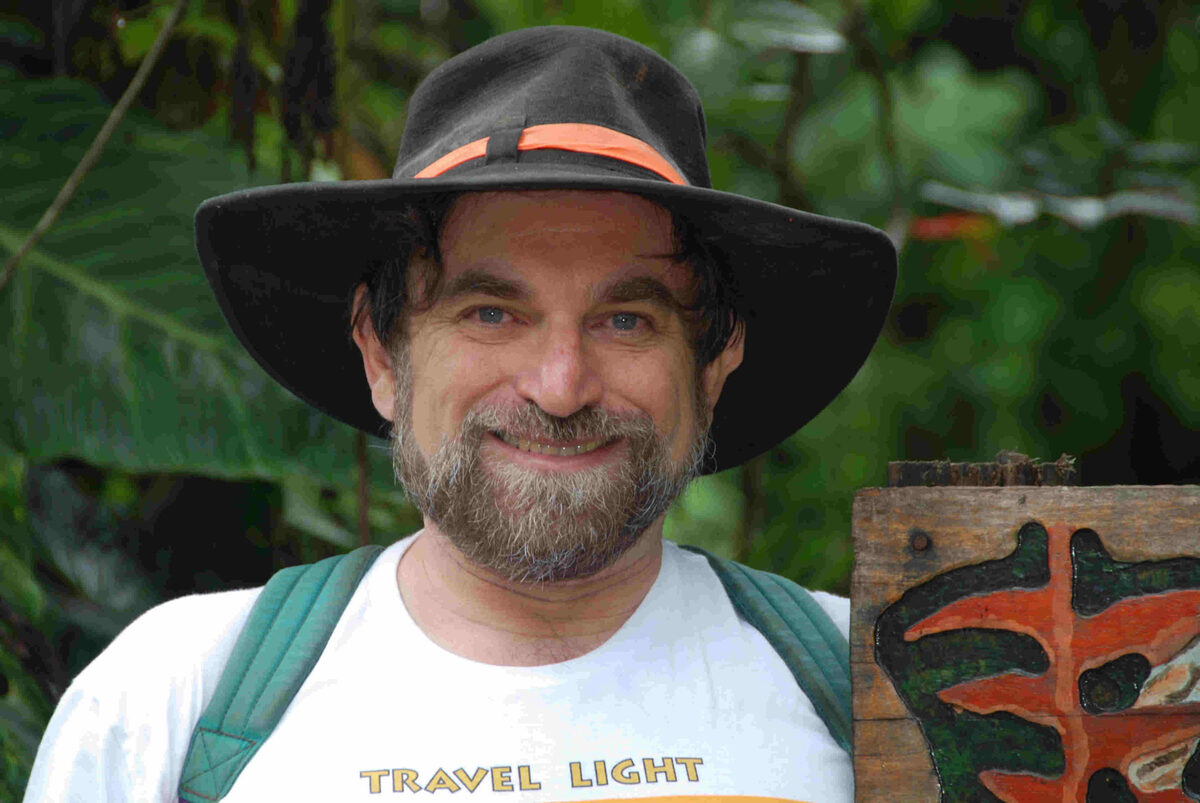
Amos Bien was born on February 12, 1951, in New York City, into a Yiddish-speaking Jewish family with roots in Austria, Russia, and Ukraine. His paternal grandfather, Joe Bien, had come from Limburg, Austria, around age eleven with his whole family. They had some money and established a clothing business in New York. Joe married Beatrice Waldman from Yancherudnia, Russia. He became an expert cloth cutter who would study the Paris fashions in the Fifth Avenue shop windows and copy them in his workshop. The guards at the fashion shops knew to watch for him. In the Great Depression, he lost everything when his bank closed, and after that he worked as just a cutter, cutting patterns by hand through stacks of fabric until he retired around seventy. His son Saul became an orthodontist and an innovator in the field in New York. On the maternal side, his grandfather Abraham Schneider arrived at Ellis Island on June 5, 1906, at age twenty-four. Abraham's future wife, Ethel Ida Tracht, arrived five months later at age twenty. They had survived pogroms. Ethel's family had run a specialty laundry in Jmerinka, pressing clothes for the aristocracy; they were among the few Jewish families permitted to live there because of those skills. In Brooklyn, her brother started a laundry with what the family had brought from Russia. Ethel, who had wanted to attend university herself but never could, insisted that all three of her children earn doctorates.
Bien studied biology at the University of Chicago, graduating in 1973. While an undergraduate, he co-founded the Hyde Park-Kenwood Recycling Center, his earliest known environmental activism. Then he did something unexpected: he took a job as a systems programmer at Metropolitan Life Insurance Company in Manhattan. From 1975 to 1977, he worked as a software developer at GTE Information Systems. He spent roughly four years in the corporate software industry before returning to graduate school in ecology, a detour that gave him something most field biologists lacked: an instinct for systems, spreadsheets, and how institutions actually make decisions about money.
He earned a master's degree in ecology and evolution from SUNY Stony Brook in 1982. His thesis addressed leafy liverwort substrate preferences in Costa Rican rainforests, and his field research focused on epiphyllous liverworts, the kind that grow on living leaves, at La Selva Biological Station. He first came to Costa Rica around 1979 as a graduate student, working as a research assistant to the biologist Barbara Bentley in Sarapiquí. In 1980 he served as station manager at La Selva, where he "developed practical skills in infrastructure maintenance," a polite way of saying he learned how to keep a research station running in a place where the jungle consumed everything that wasn't actively defended.
He first lived in rural Sarapiquí, where he learned Spanish. When he later moved to San José, nobody could understand his rural Spanish. He stayed. His son Pablo later attributed it to the gentleness of the people and a sense that the country was moving in the right direction with its values. He married Damaris Reyes, a Costa Rican woman whose father had migrated from El Salvador, and became a Costa Rican citizen. They had three children: Pablo, Samantha, and Natasha.
The Former Prison
By 1983, Costa Rica had lost most of its forest. The country that was 75 percent jungle in the 1940s was down to 26 percent, losing 50,000 hectares a year, and the forest above Las Horquetas de Sarapiquí was in the crosshairs of logging interests. Working with locals and sympathetic funders, Bien began building Rara Avis there in April 1983. From 1984 to 1985, he was in Ecuador's Amazon, teaching ecology for the School for Field Studies. What became of the project in his absence is unclear.
His proposition was specific and testable. The academic literature later described it as an "ecotourism hypothesis": that intact rainforest, used for tourism and sustainable forest products, could generate more income per acre than the same land cleared for cattle. "Finding market solutions to environmental problems," he said, "is the only way we will succeed."
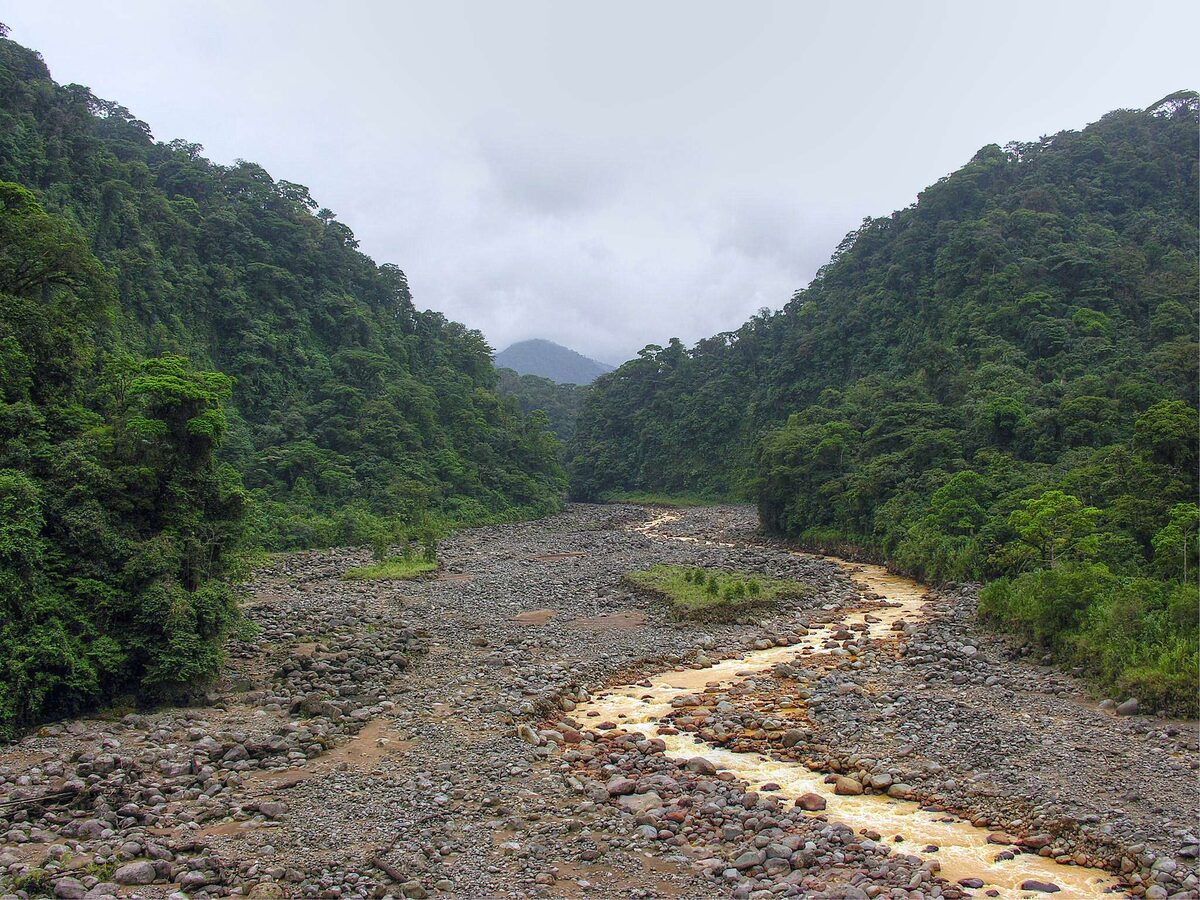
In 1986, Bien formed a Costa Rican corporation, Rara Avis S.A., and purchased a 485-hectare property near Las Horquetas de Sarapiquí using bank loans and a family inheritance. The land sat on the Atlantic slopes of the Cordillera Central at roughly 700 meters elevation, bordering Braulio Carrillo National Park on two sides. Over 95 percent of it was primary old-growth forest. That April, President Monge signed Executive Decree No. 17003 MAG expanding Braulio Carrillo to the boundaries of Rara Avis and La Selva Biological Station, creating a continuous conservation corridor from the volcanic highlands to the Caribbean lowlands.
Reaching Rara Avis required a tractor-pulled trailer on a rough muddy trail from Las Horquetas, in a region that receives three hundred inches of rainfall annually. Three-quarters of the way up the slope sat El Plástico, a former penal colony where prisoners had slept under plastic tarps, converted into a twenty-nine-bed residence and field lab for students and researchers. The main lodge, at roughly two thousand feet, was a two-story structure of native manu wood with kerosene lamps, hot showers fed by a jungle stream, and a separate kitchen where a cook prepared meals on a charcoal stove.
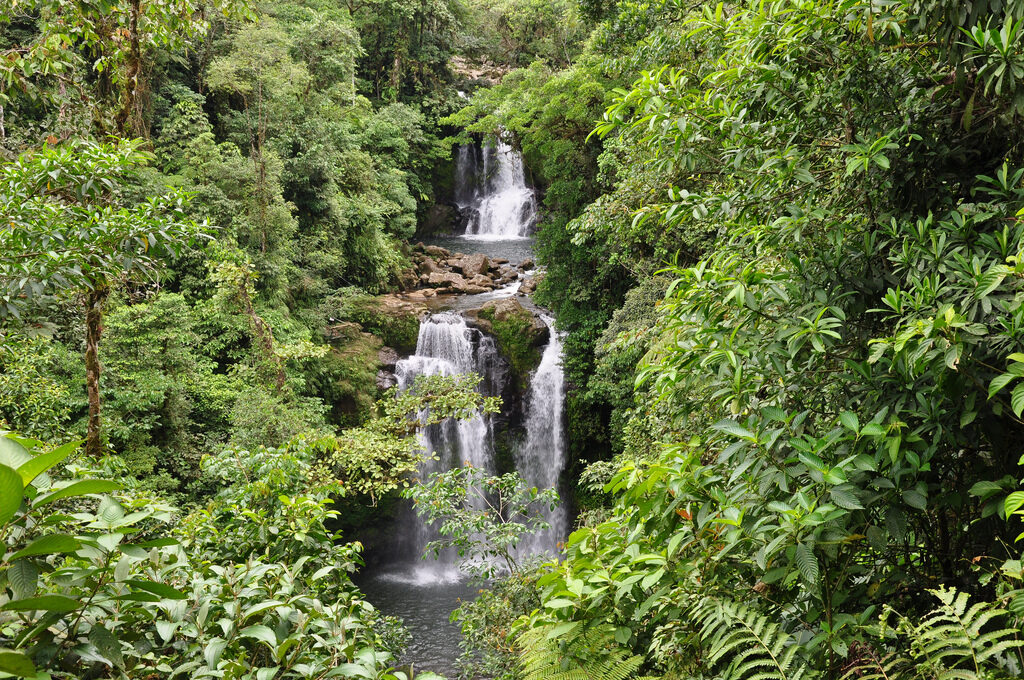
That same year, the biologist Donald Perry and the engineer John Williams built an Automated Web for Canopy Exploration at Rara Avis, using prize money from a 1984 Rolex Award for Enterprise. The device was a radio-controlled aerial tram that traveled a thousand-foot cable over a forested canyon and waterfall. National Geographic's "Explorer" program featured it. The story landed on the front page of the New York Times. Simon & Schuster published Perry's book Life Above the Jungle Floor, and cover stories followed in Scientific American and Smithsonian. Rara Avis went from a remote experiment in the mud to an internationally known destination.
In 1987, the conservation footprint expanded when Rara Avis members found environmentally conscious buyers to purchase an additional thousand hectares of neighboring land from a sawmill consortium. Together with the properties Selvatica and Terra Folia, Rara Avis eventually formed a conservation block of almost four thousand acres. The project turned profitable in 1990, generating revenue from ecotourism and rain forest products: wicker, tree seedlings, ornamental plants, and hothouse moths. At its peak, guests slept in the corridors during high season.
Community inclusion was central. "If the chainsaw wielders were not part of the project," Bien said, "then it would never work." He employed mostly community residents and sourced food locally. By 1992, the lodge had fourteen full-time and four part-time employees, and workers received an equity stake in the business after two years. In 1991, with funding from the World Wildlife Fund, a butterfly chrysalis project was launched at Rara Avis and expanded to surrounding communities, giving families income from living forest rather than cleared land. Bien provided student scholarships, free tours for local school children, and in-kind donations to the local clinic and schools. Rara Avis also became a training ground where an early generation of Costa Rica's naturalist guides learned their craft and went on to train subsequent generations across the country.
Perry's canopy innovations at Rara Avis set the stage for the more than two hundred canopy-exploring businesses operating in Costa Rica today: ziplines, walkways, bridges, and trams. Perry himself later built the commercial Rain Forest Aerial Tram near Braulio Carrillo in 1994, a separate venture. The peer-reviewed academic literature, assessing the project decades later, concluded that "the continued survival of the enterprise as a business alongside its success in conserving the property bore out Bien's ecotourism hypothesis."
Four Thousand Criteria
Rara Avis proved the economic argument on 485 hectares. The problem was the rest of the world. By the 1990s, the term "ecotourism" had become a marketing label applied indiscriminately. Bien acknowledged this directly: "Eco-tourism could be considered as a 'well-meaning' term, which was devised with the best of intentions," but there was plenty of "green-washing" in the tourism industry. As early as 2007, the journalist Martha Honey, surveying Costa Rica's tourism sector, described what was being sold as ecotourism as "a mixture of three rather distinct phenomena: 'greenwashing' scams, ecotourism 'lite' and real ecotourism," all "jousting to capture pieces of the tourist market."
Bien's response was characteristically systematic. Individual eco-lodges weren't enough. The problem required measurable, enforceable, global standards. He had spent four years writing software and understood that systems needed specifications. In 1995, he founded and served as president of the Costa Rican Private Nature Reserve Organization (Red Costarricense de Reservas Naturales), which grew to unite more than 213 private reserves protecting over 82,000 hectares. He served as president of the Tropical Science Center, Costa Rica's oldest environmental organization and owner of the Monteverde Cloud Forest Reserve. He became a founding member of CONAGEBIO, the National Commission for Regulation of Access to Biodiversity, and served as Costa Rica's representative to the UN Convention on Biological Diversity and the Johannesburg Summit on Sustainable Development in 2002.
In 2006, the United Nations Foundation chose Bien to design global sustainable tourism criteria. Over eighteen months, he worked with more than 160 stakeholders and analyzed over 4,000 existing criteria from certification programs around the world to develop the first global sustainable tourism standard. The Global Sustainable Tourism Criteria were announced at the IUCN World Conservation Congress on October 6, 2008, in Barcelona, by Ted Turner of the UN Foundation, alongside the Rainforest Alliance, UNEP, and UNWTO. More than 80,000 people had been invited to comment during the development process.
Bien remained Technical Director of the Global Sustainable Tourism Council until 2014. In 2011, he spearheaded the development of sustainable tourism criteria specifically for destinations rather than hotels and tour operators, and oversaw the selection of pilot destinations. He authored the Inter-American Development Bank's Tourism Sustainability Scorecard, guiding tourism projects seeking IDB funding to address sustainability across design, construction, and operations. He wrote the IUCN's 112-page guide for environmental authorities of Central America and the Dominican Republic. He served on the ISO Technical Committee on Tourism, was Director of International Programs for The International Ecotourism Society, and worked as a lead assessor for Accreditation Services International on FSC forest management certifications.
The former GSTC Executive Director Erika Harms wrote that Bien was "the right person to help build what is known today as the Global Sustainable Tourism Council." His mantra, she recalled, was always the same: "Finding market solutions to environmental problems is the only way we will succeed." He advocated for systems enabling "the majority of the people to seek sustainable practices, rather than the perfect system for a few that could pay."
Three Hundred Inches of Rain
The canopy tramway, the attraction that had put Rara Avis on the map, stopped operating around 1996, approximately ten years after its construction. Its loss was described as the reserve losing "a major attraction." The exact circumstances of cessation are poorly documented. Visitor numbers peaked that year and began a long decline.
The road was the deeper problem. The fifteen-kilometer track from Las Horquetas to Rara Avis could not be driven by normal vehicles. The trip took approximately three hours and required a truck for the first portion and a tractor-pulled cart for the remainder. The road received no maintenance from local or national government for at least ten years. In later years it became "virtually impassable even by tractor." On at least one occasion, conditions deteriorated so badly that the tractor could no longer pull the cart, and thirteen guests had to cover the remaining four kilometers on foot in pitch darkness through a downpour.
Bien himself described "the continuing need for education about and immersion in the world's wild spaces, the struggle to maintain this place as the road washes away and the termites feed on the wooden buildings." Solar panels that once provided electricity needed replacement and remained non-functional. Reviews from visitors in the mid-2010s documented the slow decay: facilities "neglected by the owners," "not sufficiently staffed," a single guide spread so thin that only one guided walk per day could be offered. The place had "faded from its apparent former glory."
Amos Bien died on November 19, 2017, at age sixty-six, after a long struggle with cancer. He died in Washington, D.C., while visiting relatives. He had survived considerably longer than medical predictions. Even in the hospital during his final illness, he was mentoring his doctor's son on environmental practices at school. He was survived by two sisters, three children, and four grandchildren.
Rara Avis closed in 2020 during the COVID-19 pandemic, after research activity had already slowed following Bien's death. It is listed for sale at three million dollars. The infrastructure has deteriorated since closure. Together with its neighboring properties, it still forms a conservation block of almost four thousand acres of primary forest bordering Braulio Carrillo, harboring 367 bird species, 47 mammal species, and over 500 tree species.
A visitor who had spoken with Bien toward the end observed that the reserve "is a dream, but between today's economics and Amos' passing years, it is in need of a new force, a young vigor to raise the funds that will maintain it, bring in the ever more discerning tourist, and oversee its future." A farmer who allowed logging on his land in Costa Rica earned the equivalent of more than $100,000 for a single week of logging. For conserving the same forest, he would earn just over $3,000 in five years through payment for environmental services. "Extraction and destruction," said Jurgen Stein of Selva Bananito, another pioneering eco-lodge, "bring more money than conservation."
The Global Sustainable Tourism Council stated after his death that "every single member of the GSTC was touched by the work of Amos Bien." He was described as "probably one of the first social entrepreneurs." His theory of forest regeneration was precise and patient: "With three elements in place, soil, trees, and animals, which act as seed carriers, a rain forest will regenerate. It takes 30 years to regrow, 100 years to become mature, and 200 years to be considered fully mature." The arithmetic he spent his life on was never simple.
Resources & Further Reading
Academic
Peer-reviewed academic history of Costa Rica's ecotourism pioneers, including Bien, Michael Kaye, Glenn Jampol, and Jack Ewing. Source for the "ecotourism hypothesis" framing and employee equity details.
Overview by the chair of the Global Ecotourism Network situating Rara Avis among the first wave of Costa Rican eco-lodges.
Bien's own academic chapter using Rara Avis as a case study for the economics of private conservation reserves.
Key Articles
Early profile of Rara Avis, including the seven-dollars-per-acre calculation, the El Plástico conversion, and forest product revenue. Source of the "make a pittance" and forest regeneration quotes.
Martha Honey's analysis of greenwashing, ecotourism "lite," and real ecotourism in Costa Rica. Source of the "chainsaw wielders" quote and the "three distinct phenomena" framing.
Bien's son Pablo recounts the family's immigration history from Ellis Island to Costa Rica. Companion piece to the SoundCloud audio interview with Amos Bien.
Seven-minute audio interview in which Bien recounts his family's immigration from Austria, Russia, and Ukraine. Primary source for Joe Bien's garment district career, the Fifth Avenue fashion copying, and Ethel Tracht's specialty laundry in Jmerinka.
Investigation of the structural economics undermining conservation tourism in Costa Rica today. Source of the $100,000-per-week logging vs. $3,000-in-five-years PES comparison.
Biographical database entry with career timeline: University of Chicago degree, software positions at Metropolitan Life and GTE, SUNY Stony Brook ecology master's, teaching at the School for Field Studies in Ecuador, and institutional roles.
Memorials
Former GSTC Executive Director Erika Harms on Bien's role building the global sustainable tourism standards. Source of the "right person" and "market solutions" quotes.
Official GSTC obituary with institutional biography and the statement that "every single member of the GSTC was touched by the work of Amos Bien."
Botanical community obituary with details on Bien's liverwort research, his arrival in Costa Rica, and the founding of Rara Avis.
Personal tribute describing Bien as "probably one of the first social entrepreneurs" and recounting his mentoring of a doctor's son while hospitalized.
Farewell from the SCLC, where Bien served as a founding board member.
Organizations
The organization Bien helped build as Technical Director, managing the global standards for sustainable tourism certification.
The private nature reserve network Bien founded in 1995, uniting more than 213 reserves protecting over 82,000 hectares. Original domain no longer active; link via Internet Archive.
Current stewardship page for the Rara Avis property, with history, biodiversity data, and information on the conservation block.
Conservation property listing with sale details, facility descriptions, and biodiversity inventory.
Related Profiles
The agronomist who proved ecotourism could be Costa Rica's largest earner of foreign capital, building the institutional framework Bien's private-sector model complemented.
Costa Rica's first environmental lawyer, who created the payment-for-environmental-services system that formalized the economic logic Bien demonstrated at Rara Avis.
The ecologist who proved conservation succeeds when communities become partners, the same principle Bien built into Rara Avis through employee equity and community inclusion.
Books
Contains Bien's chapter on environmental certification for tourism in Central America, including the CST program and regional certification efforts.
Perry's account of his canopy research at Rara Avis. The Rolex-funded aerial tram he built there brought international attention to Bien's eco-lodge and launched the canopy tourism industry.
Audio
Audio recording of Bien discussing his Yiddish-speaking family, the immigration history, and his grandfather's career in orthodontics.