Part VI: The Economic Reality—Can Costa Rica Grow Without Mass Tourism?
Everyone has opinions about Costa Rica's economic future. Fewer have looked at the data. Before debating airports and development, it's worth checking the numbers.
What Costa Rica's Economy Actually Looks Like
Use the buttons above to switch between GDP and employment views. The services sector dominates both, but the proportions shift notably. Services generate 75 percent of GDP but only employ 67 percent of workers. Agriculture generates just 4 percent of GDP but still employs 13 percent of the workforce. Tourism directly contributes about 6 percent of GDP but employs 8 percent of workers, roughly 183,000 jobs. Medical devices alone employ about 51,000 workers. The sectors that create the most GDP per worker are not the same as those that employ the most people, which matters for any discussion of growth and poverty.
The most dramatic gap appears in "Other Services," which generates 17 percent of GDP but employs only 9 percent of workers. This category captures Costa Rica's highest-productivity knowledge economy: information technology and software services (which alone represent 7 percent of GDP according to CINDE), professional and technical services, corporate headquarters functions, and shared services centers. Over 350 multinational companies operate in Costa Rica, many with regional headquarters that generate substantial revenue with minimal headcount. Services sector output per employee has grown 84 percent since 2005. Workers in Free Trade Zone services earn double the national average wage. Each worker in "Other Services" generates roughly 1.9 times the GDP of an average Costa Rican worker. This productivity differential is the knowledge economy in action: a software engineer or regional finance director creates economic value that agricultural workers cannot match through labor alone. The chart makes this structural reality visible.
Tourism in Economic Context
This series has been about tourism from the beginning. We examined how Costa Rica invented ecotourism, how carrying capacity sets hard limits on sustainable visitation, how the Guanacaste model extracts value rather than creating it, and how mass tourism proponents frame their arguments. Now we need to place tourism in its proper economic context. What does the sector actually contribute? How does it compare to the alternatives? The answers may surprise you.
Understanding Tourism's "Eleven Percent"
You may have heard that tourism contributes 11 percent to Costa Rica's economy. The World Travel and Tourism Council publishes this figure annually. But this number requires careful interpretation. The 11 percent is not a separate slice alongside the 75 percent for services. It is a vertical cut through horizontal layers, counting the tourism-related portion of many different sectors.
Tourism Satellite Accounts, the methodology behind this figure, distinguish three types of contribution. Direct contribution (4-6 percent of GDP) counts spending within tourism industries themselves: hotels, airlines, tour operators, restaurants serving tourists. This portion is already embedded within the Services slice of the pie chart. Indirect contribution adds supply chain effects: the construction company building a hotel, the agricultural supplier providing food to a resort restaurant, the government agency promoting tourism abroad. Induced contribution counts what tourism employees spend on rent, groceries, education, and transportation. When a hotel worker buys school supplies for her children, that spending counts toward tourism's total impact.
This explains why you cannot add 75 percent services plus 11 percent tourism. Tourism is a demand-side phenomenon, defined by who buys, not by what is sold. A hotel room sold to a tourist counts as tourism GDP. The same room sold to a business traveler counts as business services GDP. The restaurant meal served to a vacationer is tourism; the identical meal served to a local is not. The 11 percent figure represents tourism's total economic footprint spread across multiple sectors, not an independent contribution sitting alongside other industries.
The High-Value Advantage
Within that tourism contribution, Costa Rica captures unusually high value per visitor. The average tourist spends $2,062 per trip, with daily spending ranging from $206 to $295. This positions Costa Rica as a premium destination compared to regional competitors:
| Country | Daily Spending | vs. Costa Rica |
|---|---|---|
| Costa Rica | $206-295 | - |
| Panama | ~$71 | 3-4x lower |
| Nicaragua | ~$44 | 5-7x lower |
Costa Rica captures four to seven times more value per visitor than its Central American neighbors. This high-value positioning reflects a deliberate strategy: "high value, low volume" tourism that preserves ecological assets while generating substantial revenue. Costa Rica's economic success creates a monetary challenge that makes this strategy necessary. The Colón appreciated significantly against the US dollar in 2023-2024, driven by record foreign direct investment exceeding $4.3 billion, tourism receipts, and export revenue. Currency strength makes budget competition with Nicaragua or Honduras impossible; Costa Rica must deliver value that justifies the premium. Tourism also attracts substantial foreign direct investment: $600 million in 2024, representing 12-14 percent of total FDI with 14 greenfield tourism projects launched that year. The conservation brand attracts premium visitors willing to pay premium prices.
Costa Rica's National Chamber of Tourism wants to nearly double the country's tourism industry. Their ten-year strategy targets 5.2 million annual visitors by 2035, up from 2.8 million in 2024. The plan projects $11 billion in revenue and 300,000 new jobs. It is, by any measure, an aggressive bet on mass tourism as the path to national prosperity.
The pressure behind such plans comes from places like the Osa Peninsula, where the poverty rate stands at 35 percent. Osa, Golfito, and Corredores cantons rank 74th, 67th, and 75th out of 82 Costa Rican cantons on the Human Development Index. The government's own 2024 Rural Development Plan for the region documents that HDI actually declined for Golfito and Corredores between 2018 and 2019, suggesting stagnation or regression despite existing tourism infrastructure. In the Brunca region, 23.8 percent of families live in poverty—more than double the Central Valley's 10.8 percent. These regional disparities persist despite national improvements. When ACOSA director Paula Mena argued for doubling Corcovado's visitor capacity, she was responding to real economic pressure that demands real solutions.
The data complicates simple narratives. Liberia canton, gateway to Peninsula Papagayo's luxury resorts, ranks 34th of 82 Costa Rican cantons on the Human Development Index. Santa Cruz, home to Tamarindo, ranks 57th. Both outperform Golfito (67th) and Osa (74th). By this measure, Guanacaste's mass tourism delivers higher absolute development than Osa's ecotourism model.
But absolute rankings hide a troubling pattern. When COVID-19 collapsed international travel in 2020, Liberia, Tilarán, Hojancha, Bagaces, and La Cruz experienced the sharpest HDI declines of any Costa Rican cantons. The very places that tourism had lifted highest fell furthest when the industry contracted. Osa's HDI barely moved. This suggests mass tourism creates fragile prosperity—higher peaks but deeper troughs—while ecotourism provides stability without transformation. Neither model has eliminated poverty in the regions where it operates. After four decades of resort investment, Guanacaste's tourism cantons still rank below the national average. After three decades of ecotourism, Osa's poverty rate remains at 35 percent. The question is not which model produces better outcomes, but whether either model can deliver what its advocates promise.
The High-Tech Growth Engine
Neither tourism model has solved regional poverty. Mass tourism produces higher absolute development rankings but also sharper volatility during shocks. Ecotourism preserves ecosystem integrity but has not transformed Osa's economic conditions after decades of implementation. This framing, however, may miss the larger point. The debate over tourism capacity obscures a more fundamental question about Costa Rica's economic trajectory: what has actually driven the country's growth over the past three decades, and does that growth require expanding tourism at all?
The answer is hiding in plain sight. While tourism debates dominate headlines, a quiet revolution in high-tech manufacturing and knowledge services has generated vastly more economic value than either mass tourism or agriculture. Medical devices became Costa Rica's number one export in 2025, generating $9 billion—44 percent of all goods exports. This single sector now exceeds the entire agricultural sector combined. Employment has increased 127 percent since 2017, with 18 percent annual growth continuing. Major corporations including Boston Scientific, Medtronic, and Abbott operate clean manufacturing facilities producing surgical instruments, catheters, and diagnostic equipment.
The environmental impact approaches zero. These are clean facilities producing sophisticated medical equipment for global markets. No deforestation. No water contamination. No habitat fragmentation. No carrying capacity limits because the sector does not depend on ecosystem services. Just high-wage employment scaling upward at 18 percent annually while contributing nothing to environmental degradation. Costa Rica now ranks as the second-largest high-tech exporter in Latin America after Mexico and eighth globally in medical device exports. This happened while forest cover increased from 21 percent to 60 percent. Whether conservation attracts investment or simply does not deter it, the outcome is clear: clean manufacturing and forest recovery occurred simultaneously.
The Companies Behind the Numbers
The transformation began in 1987 when Baxter International opened Costa Rica's first medical device manufacturing plant in Cartago. At the time, the country had no high-tech manufacturing sector. Baxter's pioneering investment catalyzed everything that followed. The company became the first in Central America to achieve ISO 9002, ISO 14001, and OHSAS 18001 certifications, establishing the quality standards that would attract dozens of competitors. Baxter now employs over 1,200 workers manufacturing IV administration sets exported to 60 countries.
Boston Scientific illustrates what compound growth looks like in practice. The company established its first plant in Heredia in 2004 with just 17 employees. Today it operates four facilities across Heredia, Alajuela, and Cartago with approximately 8,200 employees, making it the largest medical device employer in the country and one of the largest exporters. The company manufactures minimally invasive devices for endoscopy, urology, peripheral intervention, electrophysiology, interventional cardiology, and neuromodulation. Vice President Luis Javier Serrano cited "highly qualified human talent" and the ability to develop "manufacturing, logistics, corporate services, and R&D in one location" as key factors driving continued expansion. From 17 to 8,200 in twenty years: that is 18 percent annual growth made visible.
The sector now includes over 90 multinational companies employing over 54,000 workers, with 13 of the world's top 20 OEM medical device manufacturers present. Costa Rica ranks as Latin America's second-largest medical device exporter and the fifth-largest supplier to the United States.
| Company | CR Employees | Est. | Type |
|---|---|---|---|
| Boston Scientific | ~8,200 | 2004 | US Multinational |
| Philips | 2,850-3,000 | 2011 | Dutch Multinational |
| Baxter | 1,200+ | 1987 | US Multinational (Pioneer) |
| Edwards Lifesciences | 1,100+ | 2016 | US Multinational |
| Hologic | ~1,100 | 2002 | US Multinational |
| Establishment Labs | ~1,023 | 2004 | Costa Rican (NASDAQ) |
| Abbott | 1,000+ | 2010 | US Multinational |
| Medtronic | 600+ | 2017 | US/Ireland Multinational |
One name on that list stands apart. Establishment Labs is not a multinational choosing Costa Rica. It is Costa Rica choosing the world. Founded in 2004 by entrepreneur Juan José Chacón-Quirós, it is the only Costa Rican-headquartered medical device manufacturer and the only publicly traded Costa Rican tech company on NASDAQ (ticker: ESTA). The company operates FDA-compliant manufacturing facilities in the Coyol Free Zone producing Motiva silicone breast implants sold in over 80 countries, generating approximately $211 million in annual revenue. Its third facility, the Sulàyöm Innovation Campus, is named from the indigenous Bribri language meaning "the place in the mountains at the center of the world." The name captures something the tourism debates miss: Costa Rica is not just a destination. It is a place capable of building global companies.

Knowledge Services and IT
Knowledge-intensive services represent the largest component of Costa Rica's export economy. Total services exports reached $16.1 billion in 2024, representing 17 percent of GDP. Business services—shared services centers, finance and accounting operations, business process outsourcing—account for $6.7 billion of that total, or 42 percent of services exports. ICT services add another $2.4 billion. More than 420 services companies operate under the Free Trade Zone regime, employing 119,982 workers—60 percent of all FTZ employment. Costa Rica ranks first per capita in the Americas for business services exports. Companies like Microsoft, IBM, Amazon, Hewlett Packard Enterprise, and VMware maintain regional operations. In 2024, Brenntag, the global chemical distribution leader, chose Costa Rica for its Americas finance shared services center. Universities grant more than 2,600 computer science diplomas annually to feed the pipeline.
Aerospace and Precision Manufacturing
Aerospace manufacturing demonstrates another dimension of conservation-compatible growth. Costa Rica has developed the largest collection of AS9100 and Nadcap certified aerospace companies outside the United States. The cluster includes specialized firms in electronics, metalworking, and precision manufacturing producing components for global aerospace markets. Like medical devices, aerospace manufacturing requires clean facilities, skilled labor, and zero tolerance for environmental contamination. The sector generates high-value exports without ecosystem impact.
Intel's history in Costa Rica illustrates why sector selection matters. The company arrived in 1998, eventually employing more than 3,500 people and investing nearly $1 billion between 2020 and 2023. Intel trained thousands of workers in semiconductor production and quality control, creating a skilled workforce that attracted other manufacturers. But semiconductor assembly is "footloose" manufacturing—it follows subsidies. When the Trump administration repealed CHIPS Act incentives in 2025, Intel closed its assembly operations and eliminated 1,400 jobs. The company retained 2,000 engineering and services positions, but the assembly work moved to locations offering better tax treatment.
Medical devices and aerospace manufacturing operate differently. Both benefit from Free Trade Zone incentives, but regulatory certifications create switching costs that semiconductor assembly lacks. Obtaining FDA approval for a medical device manufacturing facility takes years; AS9100 aerospace certification requires extensive documentation and auditing. These barriers to entry are also barriers to exit. A medical device company cannot easily relocate production without re-certifying its entire quality management system. The investment in certification locks companies to their facilities in ways that tax incentives alone cannot. The 1,400 workers Intel displaced possess precision manufacturing skills directly transferable to these stickier sectors, which continue growing at 18 percent annually.
The Free Trade Zone Regime
None of this transformation happened by accident. Costa Rica deliberately constructed a legal framework to attract exactly this kind of investment. The Free Trade Zone Regime, known locally as Zona Franca, designates specific industrial parks as operating outside the national customs territory. Companies that establish operations within these zones receive substantial tax exemptions in exchange for investment commitments and job creation. The system creates a structured pathway from multinational interest to permanent local employment.
The regime evolved through three decades of policy development. The first industrial free zone, Parque Industrial y Zona Franca Cartago, opened in 1985. Zona Franca Alajuela followed in 1986 under domestic investors. Baxter established the first medical device plant in 1987. But it was Law 7210, passed at the end of 1990, that consolidated these experiments into a coherent national framework. The law formalized the tax incentives, investment requirements, and operational rules that would govern the regime going forward. It was reformed substantially in 2010 by Law 8794 to comply with World Trade Organization guidelines, adjusting the incentive structure while preserving the core mechanism.
The mechanics are straightforward. A company wanting to operate in a Free Trade Zone must invest a minimum of $150,000 in fixed assets, completing the investment within three years. Companies operating outside designated parks face a higher threshold of $2 million. In exchange, they receive substantial benefits: 100 percent exemption on import duties for capital goods, components, and raw materials; 8-year income tax exemption for operations in the Greater Metropolitan Area; and up to 12 years for operations outside it. The total savings approach 43 percent across VAT and income tax combined. On-site customs clearance accelerates import and export processes.
The system includes built-in limitations. Manufacturing companies can only sell 25 percent of their production to the local market; the rest must be exported. The logic is straightforward: if tax-exempt FTZ companies could sell freely in the domestic market, they would undercut local businesses paying full taxes. The restriction protects domestic industry while ensuring the tax incentives generate foreign exchange earnings rather than simply displacing local producers. Service companies serving clients outside the free zones can derive only 50 percent of sales from those clients. The regime requires meticulous bookkeeping and regular compliance verification. The incentives are substantial but temporary, designed to attract new investment rather than grant permanent advantages.
The employment impact has been substantial. One in five formal jobs created since 2015 comes from the Free Trade Zone regime, representing 9.2 percent of total private sector employment. Direct formal employment in free zone companies exceeds 90,000 workers, with indirect employment reaching at least 50,000 more. These are not seasonal positions like tourism jobs. They are year-round careers with benefits, training, and advancement pathways. The regime creates what economists call a "dual economy": the free zone sector grew at 11.9 percent while the rest of the economy grew at 3.4 percent. This divergence explains part of Costa Rica's inequality challenge, but it also demonstrates where the actual growth is occurring.
International recognition reinforced this trajectory. Costa Rica's 2021 OECD membership signaled commitment to best-practice governance, driving reforms in competition policy, public administration transparency, and environmental regulation. Trade agreements expanded market access: CAFTA-DR opened the US market, while the EU Association Agreement provides European access. These frameworks create the predictable legal environment that multinational manufacturers require.
Agriculture's Declining Share
Agriculture was the backbone of Costa Rica's economy for over a century. Coffee cultivation began in the early 1800s and by mid-century had become the nation's primary export, funding the construction of the National Theater and establishing Costa Rica's place in global trade. When American railroad entrepreneur Minor C. Keith received 800,000 acres of tax-free land in 1884 as payment for building the railroad to Limón, he began planting bananas along the route. His enterprise merged with Boston Fruit Company in 1899 to form the United Fruit Company, which by 1930 controlled 90 percent of banana imports to the United States. By 1913, coffee and bananas comprised nearly all Costa Rican exports. The phrase "banana republic" originated in this era, describing nations whose economies and governments were dominated by a single export crop and the foreign company that controlled it.
That era is over. Agriculture contributed 26 percent of GDP in 1960, fell to 16 percent by 1990, and reached 4 percent by 2022—an 85 percent decline in economic share over six decades. The sector still occupies 35 percent of national territory, but generates less GDP than medical devices manufactured in a handful of industrial parks. Employment followed a similar trajectory: 25 percent of the workforce in 1990, 20 percent in 2000, and 13 percent today. Perhaps most telling: Costa Rica's agricultural sector is now almost entirely export-oriented while the country imports 55 percent of the food sold in its supermarkets, including 100 percent of its wheat, yellow corn, and soybeans. The nation that built its identity on agricultural exports now imports most of what it eats.
The deforestation history is inseparable from agricultural expansion. Cattle ranching drove forest cover from 75 percent of national territory in the 1940s down to 21 percent by 1987—the lowest point in Costa Rica's modern history. At peak destruction in the late 1970s, 55,000 hectares of forest disappeared annually. When Payment for Ecosystem Services launched in 1997, conservation became economically competitive. Forest cover has since recovered to 60 percent. But while cattle pressure declined, industrial monocultures expanded into the gap. Pineapple cultivation grew from 5,500 hectares in 1995 to over 60,000 hectares today. Satellite monitoring documented 5,560 hectares of forest illegally converted to pineapple between 2000 and 2015, plus 3,824 hectares planted in protected areas and 16,385 hectares of wetland encroachment identified by 2017. Banana plantations occupy 51,000 hectares, with industry sources acknowledging 4,677 hectares of direct forest clearing during the last major expansion and research suggesting 35 percent of current plantations were forested at purchase.
Export revenue obscures the environmental cost. Bananas generate $1.7 billion annually with 57 pesticide applications per hectare per year and 2,775 kilograms of fertilizer products (total application weight). Pineapples generate $1.4 billion with 25 kilograms of pesticides per hectare per cycle; the sector's forest destruction released an estimated 1.2 million tonnes of CO2. Palm oil occupies 60,000 hectares on land originally cleared by United Fruit a century ago, poisoned by copper sulfate, and now locked into monoculture that employs one-third the workers the banana industry once did. Total agricultural exports reach $3.5 billion—less than half what medical devices alone contribute—while consuming 35 percent of national territory and driving ongoing habitat loss.
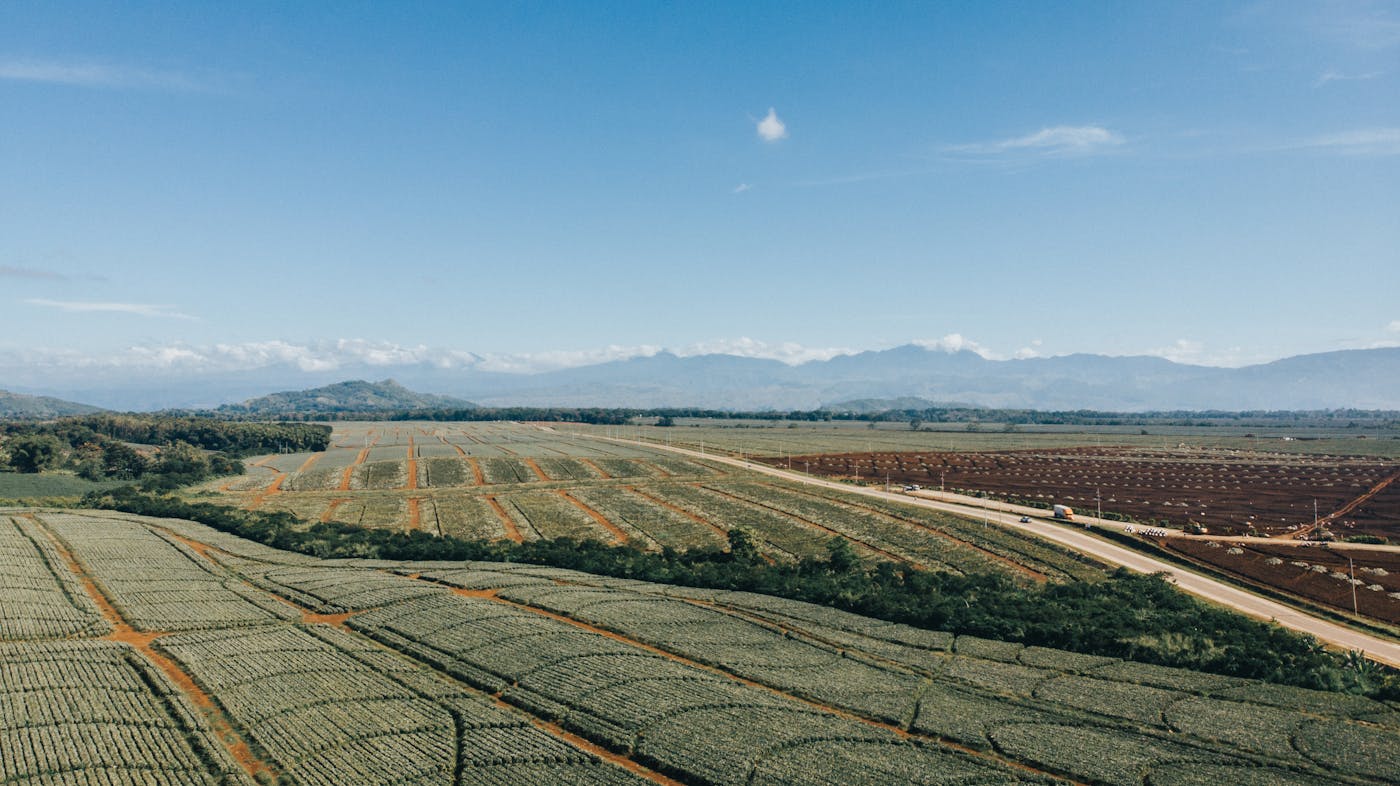
Sustainable alternatives exist but remain marginal. Coffee occupies 22,961 farms across the country, more than any other crop. Seventy percent is classified as shade-grown, but Costa Rica's definition is weak—a single tree species distributed across a farm qualifies. Only 0.4 percent of coffee production is certified organic. Aquiares Estate demonstrates what genuine sustainability looks like: 600 hectares of shaded coffee, 200 hectares of protected rainforest, Rainforest Alliance certified since 2003, carbon neutral since 2016, acting as a wildlife corridor between national parks with 130 bird species documented. Such operations remain exceptions.
Jobs, Skills, and Geography
Costa Rica's economic transformation is also a geographic one, and it follows patterns established centuries ago. When the Spanish founded Cartago in 1563, they chose the fertile Central Valley for its mild climate and volcanic soils. The capital shifted to San José in 1823 after a brief civil conflict, but power never left the meseta central. By the early nineteenth century, the overwhelming majority of Costa Rica's 60,000 people resided in the Central Valley, which had become the political and social center. The coffee elite that funded the National Theater lived there. The railroad that Minor C. Keith built connected that valley to the coast. Today, the pattern continues: the Greater Metropolitan Area—San José, Alajuela, Heredia, and Cartago—concentrates education, infrastructure, and the high-tech economy that drives national growth.
The education gap reflects this history. In San José, 31 percent of the population has at least some higher education; in Liberia, Guanacaste, the figure is 14 percent. Over 60 percent of students in the GAM have computer access at home; in the northern region, only 23 percent do. These disparities compound across generations. The medical device companies and software firms that anchor the high-tech economy require engineers, bilingual professionals, and workers with technical certifications. They cluster in the GAM because that is where trained workers live, and workers train in the GAM because that is where the jobs are. The virtuous cycle that creates prosperity in the Central Valley does not extend to peripheral regions.
Government planners understand this geography. The Costa Rican Tourism Institute explicitly targets rural development through community tourism programs, training 2,120 workers in peripheral regions and channeling grants through the Rural Development Institute to 29 rural territories. The Brunca region—which includes the Osa Peninsula—has the nation's highest multidimensional poverty rate at 34 percent, nearly double the Central Valley's 18 percent. When policymakers seek economic tools for these regions, tourism is the obvious answer: it goes where nature is, and nature is outside the GAM. But tourism wages rarely exceed the minimum, tourism employment is seasonal, and tourism careers offer limited advancement. This is the core tension: the growth engine that actually reduces poverty concentrates in the Central Valley, while the sector promoted for peripheral regions keeps workers near subsistence.
The Talent Bottleneck
The path out exists. Manufacturing entry requirements are a high school diploma and conversational English—approximately half of production assemblers in Costa Rica's medical device sector have only this level of education. The Instituto Nacional de Aprendizaje partners with manufacturers to create direct pipelines from classroom to factory floor. Medtronic's 90-hour machining course placed 23 of 27 interns into permanent positions. Edwards Lifesciences runs programs specifically targeting vulnerable populations. A production assembler starts at $950-1,050 monthly compared to $570-690 for hotel housekeeping. After ten years, the manufacturing worker earns $2,000-2,700 monthly with pension contributions and a pathway to engineering roles. The tourism worker makes perhaps $800 during high season, if the hotel is busy, if they have not been replaced by someone younger. The cumulative difference over a decade approaches $72,000. Both paths require showing up on time, working hard, and learning new skills. The difference is which sector has room to grow.
But a young person from Osa or Limón can only access this path by leaving. The manufacturing jobs and training programs are in the Central Valley, where the infrastructure is. This is not about Costa Ricans in peripheral regions lacking ability or work ethic. It is about where the country has chosen to concentrate its economic infrastructure and educational institutions. The result is predictable: talented youth leave for opportunities in the GAM, peripheral regions lose human capital, and the divide compounds. What begins as a geographic concentration of historical infrastructure becomes a self-reinforcing cycle. The communities that most need economic alternatives lose the very people who might build them.
Tourism as Wealth Transfer
Medical device factories cannot relocate to Drake Bay. Software companies will not establish operations in Tortuguero. The infrastructure required for precision manufacturing—stable power, fiber optic connectivity, proximity to the international airport—exists in the GAM and nowhere else. But travelers seeking pristine nature will journey precisely to these remote locations, bringing spending power into communities that the knowledge economy does not reach. In Guanacaste's Pacific Northwest, the Osa Peninsula, the Caribbean coast of Limón, tourism is often the only viable alternative to subsistence agriculture or fishing.
This geography creates a genuine dilemma—not a false choice, but a real tension without easy resolution. Tourism functions as a wealth transfer mechanism, channeling money from international markets into rural peripheries that lack other economic options. The 4-6 percent direct tourism contribution carries social weight far beyond its GDP share: a similar percentage in manufacturing would concentrate in the Central Valley, doing nothing for coastal poverty. For communities in peripheral regions today, the practical comparison is not between tourism and high-tech manufacturing. It is between tourism and nothing.
The dilemma is that accepting this framing risks making it permanent. If policymakers treat peripheral regions as tourism zones by default, they underinvest in the education and infrastructure that might someday attract other industries. The path from Osa to a medical device career is achievable—a high school diploma and conversational English—but it currently requires relocating to the GAM, where the jobs are. Tourism fills the gap today. The policy question is whether it must remain the only option, or whether deliberate investment could create alternatives that do not yet exist.
An Alternative Investment
The analysis so far has presented data. This section presents an argument: that if the government is determined to make a $100 million infrastructure investment in the former United Fruit lands it owns in the Brunca region, alternative uses of that investment could produce better economic outcomes than the Palmar Sur airport. The specificity that follows is intentional—vague alternatives are easy to dismiss, while concrete proposals invite scrutiny. Whether this particular allocation makes sense is debatable; that alternatives exist at all is the point.
Panama is building a $4-5 billion railway from Panama City to Paso Canoas on the Costa Rican border, with construction beginning in 2026. The 475-kilometer line will carry passengers at 180 km/h, cutting travel time from twelve hours to three. INCOFER has confirmed discussions with private companies studying an extension into Costa Rican territory. The old Ferrocarril de Golfito once connected Palmar Sur through Piedras Blancas to the Panama border—the rail corridor already exists. President Chaves has called the railway connection "profitable and interesting."

This creates an economic opportunity that no airport can match. Palmar Sur sits at the junction of the Inter-American Highway and the old rail corridor, 45 minutes from the Osa Peninsula. A rail connection to Panama City would make it a logistics hub rather than a transit point. Costa Rica's Free Trade Zone law requires only $100,000 minimum investment for facilities outside the Greater Metropolitan Area—far lower than the $150,000 required within the GAM. Companies establishing operations there would receive the same tax benefits as those in Heredia or Alajuela: full income tax exemption for eight to ten years, no import duties, no sales tax.
Compare the alternatives. Costa Rica is spending $100 million on the Palmar Sur airport to bring more tourists to an ecosystem already under carrying capacity pressure. That same $100 million could fund: a Free Trade Zone industrial park ($15-20 million), an expanded UCR Sede del Sur campus with engineering and technical programs ($10-15 million), an INA vocational training center dedicated to manufacturing skills ($5-10 million), fiber optic infrastructure connecting to the GAM backbone ($10-15 million), and still leave $40-50 million for rail corridor rehabilitation. The airport creates seasonal jobs at minimum wage. The alternative creates year-round careers at twice the wage, with benefits and advancement, while generating the educated workforce that attracts further investment.
The airport faces constraints beyond economics. In 2025, the National Museum discovered over 1,000 pre-Columbian vestiges beneath the proposed site—ceramics, lithic tools, and settlement traces from 800-1550 AD. The highest archaeological density appears precisely where the runway would cut through Fincas 9 and 10, home to 350 farming families who settled these former United Fruit lands after 1984. Many lack formal title but have cultivated the land for forty years. They would receive market-rate compensation, but displacement is permanent. An industrial park avoids these complications: its 25-45 hectare footprint is roughly 30 to 60 times smaller than the airport's 1,500-hectare requirement, allowing siting that preserves both archaeological deposits and minimizes community disruption. The Free Trade Zone model can adapt to constraints. Airport infrastructure cannot.
This is not hypothetical. UCR already operates the Sede del Sur in Golfito, created in 2019 and currently serving 750 students with plans to expand to 1,000. The Universidad Nacional invested $9 million in its Brunca Region campus in Pérez Zeledón. INA already runs 57 training centers nationwide. The institutional framework exists. What is missing is the strategic decision to invest in manufacturing infrastructure rather than tourism infrastructure—to treat the Brunca region as an emerging economic zone rather than a permanent periphery.

Where the Numbers Leave Us
This tour through Costa Rica's economy reveals a picture that rarely appears in tourism debates. The famous "11 percent" tourism contribution is not a separate slice of GDP but a vertical accounting cut through multiple sectors. Meanwhile, high-tech manufacturing and knowledge services have quietly assembled an economic engine that dwarfs tourism: $9 billion in medical devices alone, $16.1 billion in knowledge service exports, growth rates of 13-18 percent annually. The strong Colón, driven by successful exports and foreign investment, makes Costa Rica expensive in dollar terms compared to Nicaragua or Honduras; high-value tourism is not merely preferable but necessary because budget competition is impossible. Colonial geography divided the country into an educated Central Valley driving this high-tech growth and peripheral regions targeted for tourism jobs. Neither mass tourism in Guanacaste nor ecotourism in Osa has eliminated regional poverty after decades of implementation. Manufacturing careers pay roughly twice tourism wages with year-round stability. And alternative development paths exist: the Panama railway could transform the Southern Zone's economic prospects for a fraction of the planned airport's cost.
The data says conservation-compatible sectors already outperform tourism and will continue pulling ahead. Yet CANATUR wants to nearly double arrivals to 5.2 million by 2035. A $100 million airport remains planned for the Southern Zone. Guanacaste continues expanding resort capacity. Political incentives favor visible construction over gradual educational investment. Security concerns drive urgency as youth unemployment feeds cartel recruitment. The numbers point one direction; policy momentum pushes another.
Costa Rica solved the conservation-versus-development problem twice. Ecotourism pioneers in the 1980s proved that forests could be worth more standing than cleared. Then, while everyone argued about airports and hotels, the high-tech economy quietly outgrew tourism entirely. One solution is under attack. The other remains invisible. The final article in this series asks whether evidence will matter when it conflicts with political power.
Key Sources & Resources
Tourism Strategy & Targets
-
Costa Rica Launches Ambitious Plan to Attract 5 Million Tourists
Canatur's National Tourism Strategy: 5.2 million visitors by 2035, $11 billion revenue, 300,000 jobs. Announced November 2025 amid 1.8% decline in arrivals.
-
Costa Rica Wants More Tourists, But How Many More Should It Receive?
Tourism Minister William Rodríguez: "Costa Rica will eventually need to define how many tourists it wants and can receive." Current ratio: 0.5 visitors per inhabitant (vs 1.8 in Spain).
Poverty & Inequality Data
-
World Bank Poverty Data - Costa Rica
Official poverty statistics showing national poverty rates from 1994-2019, documenting how poverty remained at 20-21% for 25 years despite GDP per capita doubling.
-
INEC Poverty Statistics 2025
Most recent poverty data showing 15.2% national rate with significant regional disparities: Brunca region 23.8%, Huetar Caribbean 24.9%, Central Valley 10.8%.
-
Stanford University: Osa/Golfito Socioeconomic Report (PDF)
Detailed analysis of development disparities in the Brunca region, with Osa poverty rate approximately 35%.
-
INDER: Rural Development Plan Osa-Golfito-Corredores 2024-2030 (PDF)
Official government planning document for the Brunca region. Documents HDI decline for Golfito and Corredores 2018-2019, Knowledge Index scores (0.655-0.707), over 1,300 service-sector MIPYMEs, and strategic infrastructure priorities including electricity, water, roads, and education alongside airport development.
-
Human Development Index by Canton (Wikipedia/UNDP)
Complete HDI rankings for all 82 Costa Rican cantons based on UNDP data. Liberia ranks 34th, Santa Cruz 57th, Golfito 67th, Osa 74th. Guanacaste cantons showed the greatest HDI decline 2019-2020.
-
World Bank: Why Poverty and Inequality Are Not Declining in Costa Rica
Analysis showing labor income contribution to household income in poorest quintile declined from 70% (2010) to 55% (2021), explaining why GDP growth doesn't automatically reduce poverty.
-
Costa Rica GINI Coefficient Data
Historical inequality trends: 34.4 (1986, most equitable), peaked at 51.8 (2002), currently 46.7 (2023) showing worsening then partial improvement.
-
How Inequality in Costa Rica Is Splitting It In Two
Analysis of education disparities: San José 31% higher education vs Liberia 14%. Computer access 60%+ in GAM vs 23% in northern regions. Documents "two Costa Ricas" phenomenon.
-
Harvard ReVista: Youth Unemployment Crisis in Costa Rica
23% youth unemployment, 55.4% for young women. Skill-labor market mismatch especially acute in rural areas with limited educational resources.
-
ICT Tourism Development Programs
Official Costa Rican Tourism Institute programs for rural development: 2,120 workers trained in peripheral regions, community tourism initiatives, INDER grants to 29 rural territories.
-
Costa Rica History: Colonial Period to Independence
Historical context: Cartago founded 1563, capital moved to San José 1823. By early 19th century, 60,000 population concentrated in Central Valley as political and social center.
-
OECD Education at a Glance 2024: Costa Rica
38% of 25-34 year-olds have not completed upper secondary education (2023), 24 percentage points above OECD average. Costa Rica ranks 4th highest among 45 OECD/partner countries for share without high school completion.
-
Harvard ReVista: The Evolution of Education in Costa Rica
Documents declining secondary completion rates in the last decade, reaching "critical proportions" during and after pandemic. 28% of 15-19 year-olds enrolled in general upper secondary, 14% in vocational—among lowest in OECD.
Conservation-Compatible Economic Sectors
-
Medical Devices Become Costa Rica's Top Export
$9 billion exports (44% of goods exports), 18% annual growth, 127% employment increase since 2017. Clean manufacturing with zero environmental impact.
-
CINDE: Costa Rica, a Global Magnet for Medical Devices
Official investment agency analysis: 90+ companies, 54,000+ workers, 13 of top 20 global OEMs present. Baxter pioneered in 1987; Boston Scientific grew from 17 employees (2004) to 8,200 today. CINDE 2020 data: life sciences sector (57 companies, dominated by medical devices) represented close to 6% of GDP and 28% of exportable added value.
-
Boston Scientific Becomes Largest Medical Device Employer
From 17 employees in 2004 to 8,200 across four facilities in Heredia, Alajuela, and Cartago. Produces minimally invasive devices for endoscopy, cardiology, and neuromodulation.
-
Establishment Labs (ESTA) - NASDAQ
Only Costa Rican-headquartered medical device company on NASDAQ. Founded 2004, $191M revenue, exports Motiva implants to 80+ countries. Named new campus "Sulàyöm" from Bribri language.
-
CINDE: Digital Technologies Sector
450+ multinational companies total, 169 in digital technology sector including Microsoft, IBM, Amazon, HPE, VMware. Knowledge-intensive services = 58% of service exports, 13% annual employment growth.
-
A Prolific IT Services Market Is Emerging in Costa Rica
ICT service exports: $2.1B annually (doubled over 5 years). IT services 7% of GDP. Includes software development, BPO, data analytics, design services. 118,000 tech jobs created 2016-2020.
-
Medical Devices, Aerospace and Advanced Manufacturing in Costa Rica
Costa Rica has largest collection of AS9100 and Nadcap certified aerospace companies outside US. Aerospace cluster includes electronics, metalworking, precision manufacturing for global markets.
-
Costa Rican Aerospace Cluster Takes Off
Aerospace cluster development with companies in electronics, metalworking, specialized services. Zero environmental impact from precision manufacturing operations.
-
Intel to Close Costa Rica Assembly Facility in Global Restructuring
July 2025 closure eliminated 1,400 assembly/test manufacturing jobs after CHIPS Act repeal. Intel invested $1B 2020-2023, retains 2,000 engineering/services employees. Raises questions about stable vs volatile sectors.
-
Costa Rica Economy Overview and Key Sectors
Finance and insurance grew 7.7% (Q4 2024), 5.7% (Q1 2025). Services sector 63-68% of GDP. Financial sector assets = 145% of GDP, minimal physical infrastructure requirements.
-
Medical Tourism Market Data
70,000+ medical tourists annually contributing $437M. Patients receive care at 45-65% lower costs than US while combining treatment with nature tourism.
-
Ecotourism Benefits in Osa Peninsula (Peer-Reviewed)
Ecotourism workers earn 1.9x income of non-tourism workers. Demonstrates authentic ecotourism reduces poverty while operating within carrying capacity limits.
-
Costa Rica Electricity Generation Mix
98%+ clean electricity sustained since 2014 (72% hydropower, 15% geothermal). Attracts clean manufacturing investment and reinforces conservation brand.
-
Free Trade Zone Regime in Costa Rica
Legal overview of Law 7210 (1990): $150K minimum investment, 8-12 year tax exemptions, 100% import duty exemption. Explains the legal framework enabling clean manufacturing growth.
-
History of Costa Rica's Free Trade Zone Regime
First free zone opened 1985 in Cartago. 1 in 5 formal jobs since 2015 from FTZ regime. 9.2% of private sector employment, 90,000+ direct jobs.
-
PWC: Costa Rica Tax Credits and Incentives
Professional tax analysis of Free Trade Zone benefits: total savings approach 43% across VAT and income tax. Details on investment requirements and limitations.
Destructive Agriculture & Fishing
-
Environmental Impacts of Pineapple Plantations
Costa Rica exports 45% of global pineapples ($1B annually) but 5,569 ha illegal deforestation (2000-2015), 20kg pesticides/ha, water contamination affecting 6,000 people.
-
Pesticide Use in Banana Plantations (Peer-Reviewed)
57.5 pesticide applications/year, 2,775 kg/ha fertilizer products (total weight including carriers). Documents cancer risks, neurobiological effects, aquatic ecosystem impacts.
-
A Brief History of African Palm Production in Costa Rica
United Fruit Company introduced African palm in 1940s when Fusarium wilt devastated bananas. Copper sulfate contamination made soil toxic for bananas; palm tolerates heavy metals. Employment fell from 11,000 (1973) to 4,000 (late 1980s).
-
World Bank: Agriculture GDP Share 1960-2024
World Development Indicators showing agriculture, forestry, and fishing declined from 26.35% of GDP (1960) to 15.8% (1990) to 4.1% (2022). Documents six-decade transformation from agricultural to services/knowledge economy.
-
USDA: Costa Rica Food Imports (Exporter Guide 2018)
USDA Foreign Agricultural Service report stating "market analysts inform that already 55 percent of all food products sold in supermarkets are imported from abroad with 32 percent of these imports being from the United States." Consistent figure cited in FAS reports from 2012-2019.
-
Costa Rica's African Palm Oil Crisis: Environmental & Indigenous Impact
60,000 hectares producing 1 million tons annually. 8 environmental violations filed 2010-2021. Indigenous displacement, biodiversity destruction from monoculture expansion.
-
The Impacts of Oil Palm on Recent Deforestation and Biodiversity Loss (PLOS One)
Peer-reviewed study showing land conversion for palm disrupts ecosystems, reduces species richness, alters ecological dynamics. In Costa Rica, protected areas and 1996 deforestation ban limited new forest clearing for palm.
-
Fishing Fuel Subsidies Fund Poaching
$62M subsidized fuel since 2015, 108 subsidized boats caught poaching in Marine Protected Areas, 90% hammerhead shark population decline before 2023 ban.
Infrastructure & Regional Development
-
How Panama's New Railway to Paso Canoas Will Transform Costa Rica
Panama's $4-5 billion railway to the Costa Rica border: 475 km, 14 stations, 180 km/h passenger speed. Construction begins 2026. INCOFER studying Costa Rica extension.
-
How the New Railway from Panama City to Paso Canoas Will Transform Costa Rica
Technical studies complete September 2025. 475km line, 180 km/h passenger speeds, 3-hour travel time Panama City to border. Costa Rica Railway Institute exploring San José-Paso Canoas link to facilitate trade integration through Panama ports.
-
Panama-Costa Rica Railway Set for 2026 Construction Start
AECOM leading design, construction starting January 2026 on Panama Pacifico-Divisa stretch. Binational cooperation discussions between INCOFER and Panama Railway.
-
CINDE: Costa Rica Free Trade Zones
Free Trade Zone requirements: $100,000 minimum investment outside GAMA, $150,000 inside GAMA. Full income tax exemption 8-10 years, no import duties or sales tax.
-
Costa Rica Production Sector Salaries
Manufacturing wage data: Machine Operators 4.1-9.3M CRC/year, Foremen 4.5-12.3M CRC/year, Operations Supervisors up to 16.5M CRC/year.
-
Costa Rica Tourism & Hotel Sector Salaries
Hotel wage data: Chambermaids 3.5-7.4M CRC/year, Receptionists 4.2-8.1M CRC/year, Shift Managers 5.4-11.9M CRC/year. Entry level 0-2 years: ~5.9M CRC/year.
-
The Economic Impact of Airports
Airport employment ratios: 2-4 jobs per 1,000 passengers across direct roles (pilots, ground crews, security, retail). Used for calculating direct airport employment from projected passenger volumes.
-
Hotel Staff-to-Room Ratios by Region
Hospitality employment benchmarks: 0.7-1.0 employees per room in developing countries, up to 2.0 in luxury segments. Staff-to-room ratios used for projecting hotel employment from tourism growth.
-
Zone Profile: Coyol Free Zone
Coyol Free Zone covers 107 hectares with 316,737 m² of industrial buildings housing 34 companies and 24,588 jobs. Approximately 3 hectares per company including green space (19% of park). Used for manufacturing footprint calculations.
-
Guanacaste Airport (Wikipedia)
Liberia Airport covers 243 hectares (600 acres) handling 550,000 passengers annually. Terminal expansion created approximately 100 new jobs. Used as benchmark for regional airport footprint and employment comparisons.
-
Coyol Free Zone: Medical Device Sector Employment
Medical device sector employs 58,884 workers across 86 companies (average ~685 per facility). Coyol alone accounts for 24,588 jobs (41.75% of sector). Used for projecting manufacturing employment from new facilities.
Economic Transformation & Tourism Data
-
Costa Rica GDP Per Capita PPP
Historical data: $10,920 (1991) to $26,973 (2024), 147% increase. Economy more than doubled while forest cover recovered from 21% to 60%.
-
Agriculture Sector GDP Contribution 1990-2022
Visualization showing decline from 15.8% (1990) to 4.1% (2022), a 75% reduction as economy transformed toward services (now 68% of GDP).
-
Tourism Sector Growth and Jobs 2024
$5.4B revenue (8.2% of GDP), 183,016 direct jobs + 366,032 indirect = 549,048 total jobs (23% of economically active population). Includes all tourism types.
-
Property Prices Surge 400% in Guanacaste
National University Observatory data documenting 400% price increases (2020-2023) driven by foreign investment and mass tourism development.
-
FDI Reaches Historic High in 2024
$4.3 billion FDI (14% increase). Manufacturing accounts for 67.4%, tourism 13.9%. Demonstrates conservation attracts clean manufacturing investment.
Tourism Methodology & Economic Analysis
-
WTTC Economic Impact Report 2024 - Costa Rica
World Travel and Tourism Council report explaining Tourism Satellite Account methodology: direct (4-6%), indirect (supply chain), and induced (employee spending) contributions totaling 11% of GDP.
-
BCCR Tourism Satellite Account (Official)
Costa Rica's Central Bank official tourism accounting data, the primary source for government tourism statistics and economic impact calculations.
-
OECD Costa Rica Economic Snapshot
Organisation for Economic Co-operation and Development analysis of Costa Rica's economic structure, policy reforms, and governance improvements following 2021 membership.
-
US State Department 2024 Investment Climate Statement
Comprehensive analysis of Costa Rica's dual economy, 40% informal labor market, FDI patterns, and economic challenges. Source for labor market polarization data.
-
UN Tourism: Investing in Costa Rica
United Nations tourism investment analysis: $600 million tourism FDI in 2024, 14 greenfield tourism projects, 12-14% of total foreign direct investment.
-
Central America Tourist Spending Comparison
Regional comparison showing Costa Rica's $206-295 daily tourist spending vs Nicaragua ($44) and Panama ($71). Source for high-value tourism strategy data.
-
Mastercard Advisors: Average Tourist Spending Per Trip
Mastercard Advisors analysis (September 2025) based on ICT and BCCR data showing international tourists spent average of $2,062 per trip in 2024. Calculation verified: $5.4B total tourism revenue / 2.66M arrivals = ~$2,030 per visitor. Costa Rica leads Central America in per-visitor spending.
-
Trading Economics: Costa Rica GDP Growth
Historical GDP growth trajectory data tracking Costa Rica's economic transformation from agricultural to services and knowledge-intensive manufacturing.
-
Costa Rica Accelerates Rise in Global Services Economy
Business services sector analysis: 42% of service exports, growing knowledge-intensive services within the dominant services sector.
-
The Benefits of Outsourcing to Costa Rica
Shared services sector analysis: services sector output per employee has grown 84% since 2005, 350+ multinationals with shared services operations, wages for FTZ services workers double the national average.
-
World Bank Development Indicators: Economic Structure
Official World Bank data on Costa Rica's economic composition (2024): services 69%, industry 20%, agriculture 4% of value-added GDP. Comparable data for regional and global benchmarking.
-
GDP Methodology: Market Prices vs. Value-Added
This article reports GDP at market prices (services 75%, industry 21%, agriculture 4%) rather than value-added GDP (services 69%, industry 20%, agriculture 4%). The 6 percentage point difference represents net product taxes (taxes on products minus subsidies), which we distributed proportionally across sectors. This approach is justified because product taxes are generated by economic activity in each sector, and allows the pie chart to total 100%. Both GDP measures are correct—market prices include taxes while value-added excludes them. UK ONS explains: "GDP at market prices = GDP at basic prices + taxes on products - subsidies on products."
-
BCCR: GDP by Economic Activity (Producto Interno Bruto por Actividad Económica)
Banco Central de Costa Rica official national accounts tables showing GDP breakdown by economic sector. 2019-2024 data shows: wholesale/retail trade 10-11%, transport/storage 4.2%, information/communications 5.5%, financial services/insurance 6.1-7%, real estate 8%, professional/scientific/technical services 9.3%, public administration 3.6-4.2%. Base year updated from 2017 to 2022 in November 2025.
-
UN Statistics: Costa Rica Value Added by Industries (ISIC Rev. 4)
United Nations National Accounts Main Aggregates Database with detailed sector breakdown using international ISIC classification. 2024 data confirms: public administration 3.59% of GDP, professional/scientific/technical activities 9.31% of GDP. Provides internationally comparable sector classifications.
-
SUTEL: Telecommunications Sector Statistics Costa Rica
Superintendencia de Telecomunicaciones (SUTEL) official data showing telecommunications sector revenues at approximately 2% of GDP (2021-2023). Sector has declined from 3.3% (2012) due to price reductions following market liberalization, even as usage expanded dramatically.
Employment by Economic Sector
-
Employment by Economic Sector in Costa Rica (World Bank/ILO)
World Bank and ILO modeled employment estimates showing broad sector distribution: services 67%, industry 20%, agriculture 13% (2022-2023). INEC Q4 2024 data shows 72.6% in commerce/services, 18.5% in industry, 8.9% in agriculture, reflecting declining agricultural employment.
-
ICT: Tourism Employment 2024
Instituto Costarricense de Turismo official data: 183,016 direct tourism jobs (7.7% of workforce) in 2024, increase of 19,767 positions from 2023. Direct and indirect combined: 549,048 jobs (23% of economically active population). Highest annual tourism employment since 2010.
-
La Nación: Public Sector Employment (INEC Q1 2024)
INEC data showing 309,208 public sector employees in Q1 2024, up from 275,102 in Q1 2023. Represents approximately 14% of total employed population (2.23 million). 83% of unionized workers are in the public sector.
-
CINDE: Life Sciences Employment
Nearly 51,000 employees in life sciences sector (92 companies) in 2022, representing approximately 2.3% of employed population. Sector grew 127% since 2017. 13 of top 30 global medtech companies present in Costa Rica.
-
CORBANA: Banana Industry Employment
Corporación Bananera Nacional reports 40,000-42,200 direct jobs in banana production (approximately 1.9% of workforce), with nearly 100,000 indirect jobs. Generates 76% of employment in Limón province and 83% in Huetar Caribe region.
-
CANAPEP: Pineapple Industry Employment
National Chamber of Pineapple Producers reports 30,000-32,000 direct jobs (approximately 1.4% of workforce). 40,000 hectares under production, representing 10% of Costa Rica's total exports. At least 70% of workforce is of Nicaraguan origin.
Seasonal Employment & Tourism Layoffs
-
Cayuga Collection: Why We Don't Fire Our Staff in Low Season
Documents industry norm: "In many hotels and resorts, employees get laid off in late April or early May. In some cases up to 50% of the staff." High season (Dec-Apr) is 5 months; low season layoffs last 7 months.
-
Trouble in Paradise: Costa Rica's Ecotourism Problem
Analysis of seasonal employment: "Hotels immediately fire their workers" when tourist numbers decline. In Quepos, tourism accounts for 85% of local jobs; "steady jobs and steady incomes are a rarity."
-
Tico Times: Costa Rica Tourism Crisis as 22,000 Jobs Lost
2025 data: Tourism employment fell from 189,093 to 166,923. CANATUR reports "more than half of members will start cutting personnel as low season starts." Coastal communities report 20% drop in tourism employment.
Security Crisis & Youth Unemployment
-
InSight Crime: As Security Crisis Deepens, Costa Rica Struggles
Analysis of Costa Rica's security crisis: 880 homicides in 2024 (second-most violent year), 70% drug-trafficking related. Documents youth unemployment-crime correlation.
-
Tico Times: Costa Rica Fights Drug Trafficking as Transit Hub
June 2025 cocaine seizure in Sierpe de Osa (1.2 tons). Youth unemployment at 18%, poverty at 23% creating gang recruitment conditions. 5,000 active gang members.
-
CBS News: Drug Trafficking Blamed as Homicides Soar
In Limón, "young unemployed men make up the majority of casualties." Union leader quote: "If there are no jobs... for many the closest thing to a job is being a hit man."
-
UNESCO: INA Costa Rica Vocational Training
Instituto Nacional de Aprendizaje offers free vocational training including tourism, manufacturing, and technical skills. Major challenge: reducing youth unemployment through job training.
Conservation Success
-
Conservation Pays - Forest Recovery Commentary
Forest cover recovered from 21% (1980s) to ~60% today, 25% of land protected. Demonstrates conservation-compatible growth works economically.
-
Forest Law No. 7575 (1996)
Legal framework banning forest conversion and establishing Payment for Ecosystem Services program, foundational to conservation-compatible growth trajectory.