A Blueprint for the Southern Zone
The government wants to spend $40 to $105 million on an international airport at Palmar Sur. It would displace 350 farming families, sit on a flood delta, and border a UNESCO World Heritage Site. Here is an alternative: a plan of five investments that together accomplish the same stated goals at comparable cost, without threatening a single protected area and without uprooting a single farming community.
We are not advocates of mass tourism. We are not advocates of additional international airports. The evidence from Guanacaste shows what airport-driven resort development produces: 70-80% economic leakage, seasonal employment at half the wages of manufacturing, housing displacement, and environmental damage. We have documented this record in detail.
But ICT and successive administrations keep lobbying for an international airport in the southern zone. The project has 0% progress after 15 years. The Mideplan Project Bank lists it as suspended. No master plan has been contracted. Financing has never been secured. The most recent cost estimate is $42 million for a Category B facility, though international media widely reported a $105 million figure in February 2023 that may have been conflated with a separate expansion of the Liberia airport. The government's own sequence places the master plan after archaeological rescue, environmental studies, and a Heritage Impact Study, none of which have been completed.
The chosen site would displace approximately 350 farming families who have lived on the former banana company fincas for over 40 years, most without formal title. It sits on the floodplain of the Río Térraba, Costa Rica's largest river, which has flooded catastrophically in 1916, 1954, 1955, 1988, 1996, 2010, 2017, and 2020. It is three kilometers from the Térraba-Sierpe National Wetlands, the largest mangrove system on Central America's Pacific coast. It overlaps with four archaeological sites in the Diquís Delta, a UNESCO World Heritage Site.
If the government is determined to spend $40 to $105 million on the southern zone, is there a plan that maximizes the wins? What follows is an alternative: five proposals that accomplish the same stated goals without threatening a single protected area, without uprooting a single farming community, and at a comparable or lower cost. Each one strengthens a different constituency. Together they represent a different theory of development for the southern zone: one that builds on existing assets rather than bulldozing communities to create new ones from scratch.
Expand the Quepos Airport: A Win for Tourism
Quepos/La Managua is Costa Rica's fourth-busiest airport. It sits at the doorstep of Manuel Antonio National Park, the country's most-visited park, which drew an average of 400,000 visitors per year from 2012 to 2022. Nearly a quarter of all air travelers to Costa Rica head to the Central Pacific region. The airport currently handles only domestic flights on small turboprops.
The runway, renovated in 2021 for $2.7 million, measures approximately 1,340 meters. A Boeing 737-800 or Airbus A320 needs roughly 2,400 meters for full-payload operations in tropical sea-level conditions. The gap is about 1,060 meters of additional runway, plus widening from the current 11 meters to the ICAO-required 45 meters for aircraft of that class.
The airport is surrounded on multiple sides by Palma Tica palm plantation. The land is flat, cleared, and used for commercial agriculture. There are no wetlands, no forests, and no archaeological sites in the expansion zone. An extended runway would thread the needle between the suburban neighborhoods of Barrio Lourdes and San Martín, and some families would likely need to be bought out, but these are recent suburban properties, not fincas that have been settled for forty years. Route 616 may need to be rerouted to the north. The broader Quepos region was home to the indigenous Quepo people, and one archaeological site (San Cristóbal) was investigated east of the airport in the 1980s, but the airport land itself, under intensive banana and palm cultivation since the 1930s, has not yielded significant finds. The nearest UNESCO archaeological designation is the Diquís Stone Spheres, 120 kilometers to the southeast. Compare this with Palmar Sur, where 2,800 test pits across the proposed footprint recovered over 1,000 pre-Columbian artifacts and the Finca 6 museum is 500 meters from the runway.
The flood risk comparison is equally telling. The Río Naranjo, which passes near the airport, drains a watershed of 323 square kilometers with an estimated average discharge of approximately 24 cubic meters per second. The Río Térraba, which flanks the Palmar Sur site, drains 5,080 square kilometers with an average discharge of 325 cubic meters per second: more than thirteen times the flow from a watershed nearly sixteen times larger. The Palmar Sur site sits on an active alluvial delta that has flooded catastrophically at least twelve times since 1916. The government has already spent 2.5 billion colones on a dike system including 10.5 kilometers for Palmar Sur, 3.7 kilometers for Ciudad Cortés, and river dredging, and the comprehensive estimate runs to 10.6 billion colones. The old United Fruit Company levee, built after the devastating 1955 flood, fractured in four places during Tropical Storm Nate in 2017. The Quepos airport sits at 26 meters elevation on former plantation land. No comparable flood history exists there. A berm and improved drainage for a river carrying 24 cubic meters per second is a fundamentally different engineering problem than a dike system for a river carrying 325.
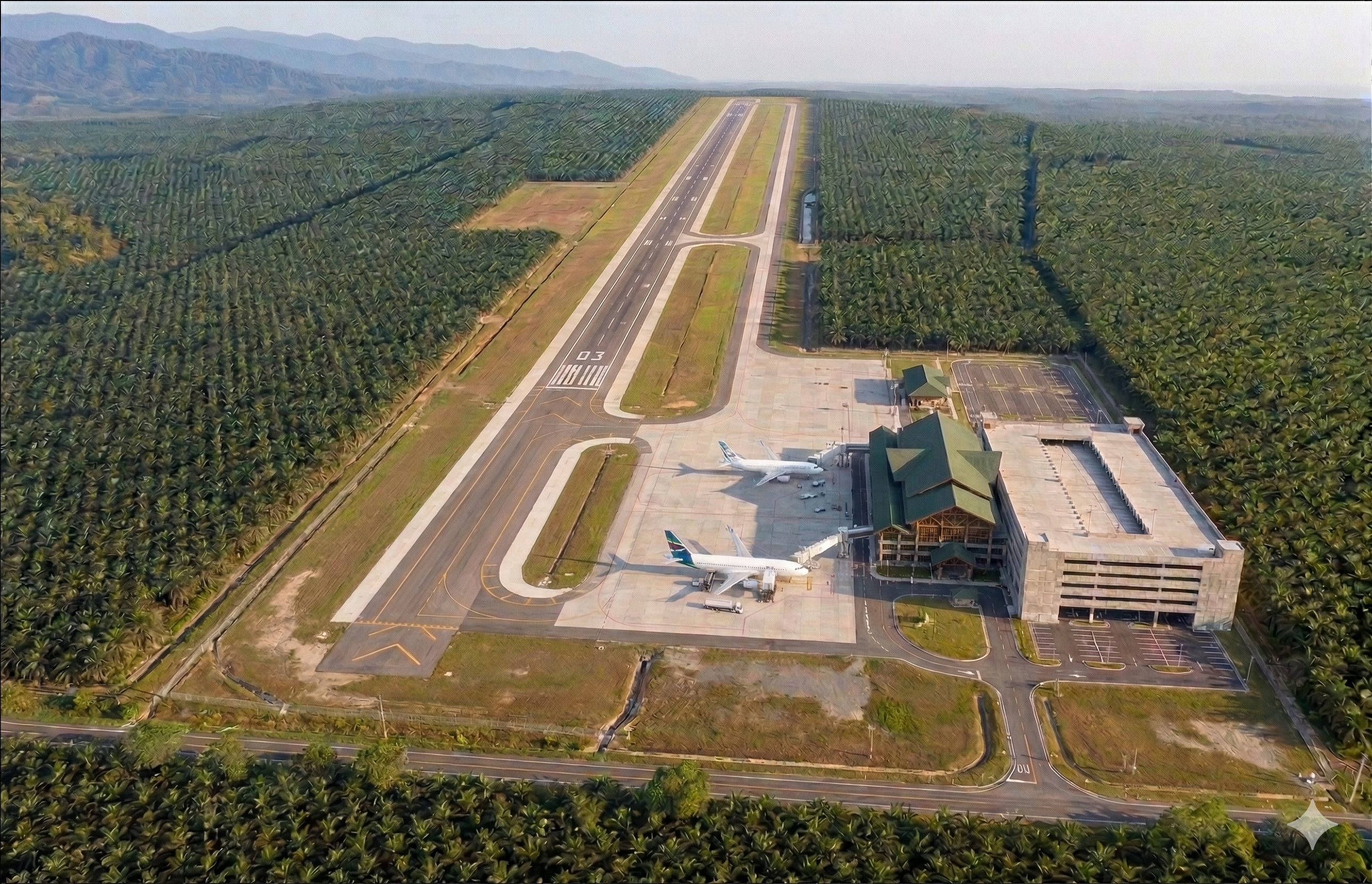
A 200-hectare acquisition of adjacent palm plantation would provide ample room for the runway extension, new terminal, long-stay parking, and a buffer zone to minimize disturbance to surrounding communities. At current palm plantation prices of $8,000 to $20,000 per hectare, the land costs $1.6 to $4 million. Long-stay parking is what turns a regional airport into infrastructure for the entire southern zone. A resident of Pérez Zeledón or Ciudad Cortés could drive to Quepos, leave a car for a week, and fly out. The airport would serve the same geography the Palmar Sur project claims to serve, without the displacement or the flood risk.
A rough cost estimate for the full expansion: $25 to $55 million. That includes land acquisition ($1.6-4 million), suburban property buyouts, runway extension and widening ($10-20 million), an international terminal with customs and immigration ($5-15 million), an instrument landing system and navigation aids ($2.5-5 million), taxiway, apron, and fuel facilities ($3-7 million), and access road improvements ($1-3 million). Because the extension runs into adjacent palm land, the existing runway could remain operational throughout most of the construction. The Palmar Sur project would face higher versions of these same costs. A brand new runway on a flood delta rather than an extension of an existing one. A terminal, navigation, taxiway, access roads. And on top of that, the resettlement of 350 families, a comprehensive dike system for a river carrying 325 cubic meters per second, archaeological rescue across four sites, and the construction from scratch of the tourism receiving infrastructure (hotels, roads, services) that Quepos already has. The Quepos estimate includes everything. The Palmar Sur estimate leaves most of it out.
Quepos has over 100 hotels, Marina Pez Vela, a hospital, banking services, regular bus connections, and three domestic airlines. Decades of organic tourism development have produced exactly the kind of receiving infrastructure that a new airport in the Diquís Delta would need to build from scratch, at a cost that dwarfs the airport itself. A Stanford/INOGO study noted that the Osa region's ecotourism market is dominated by small businesses. Building the equivalent of Quepos's tourist economy around Palmar Sur would take decades and billions of additional investment.
Quepos is also naturally contained. Manuel Antonio National Park forms a permanent green boundary to the southwest. Thousands of hectares of palm plantation create an agricultural buffer to the east and north. The municipality adopted a zoning plan (Plan Regulador) in December 2016 with integrated SETENA Environmental Fragility Indices. Compare this with the experience of Guanacaste after the Daniel Oduber Airport opened in 1995: uncontrolled development, water pollution severe enough to strip Tamarindo of its blue flag certification, water shortages from rapid real estate speculation, and a shift from ecotourism to resort tourism that the hospitality industry itself has identified as unsustainable. The Palmar Sur project would build an international airport next to the Osa Peninsula, home to an estimated 2.5% of the world's biodiversity, inviting the same pattern in a place where the ecological stakes are incomparably higher.
Every dollar spent at Palmar Sur buys less than the same dollar at Quepos. At Palmar Sur, a dollar builds a runway on a flood delta. At Quepos, it extends a runway on dry land. At Palmar Sur, a dollar builds a terminal where no tourist economy exists. At Quepos, it connects to 100 hotels, a marina, and a national park that already draws 400,000 visitors a year. Quepos is not the southern zone. But it is two hours from Pérez Zeledón and an hour and fifteen minutes from Ciudad Cortés, and that is a different proposition from four to six hours to Alajuela. If the government is determined to build an international airport south of the capital, the site already exists.
Complete the Connection from Manuel Antonio to the Savegre Highlands: A Win for Conservation
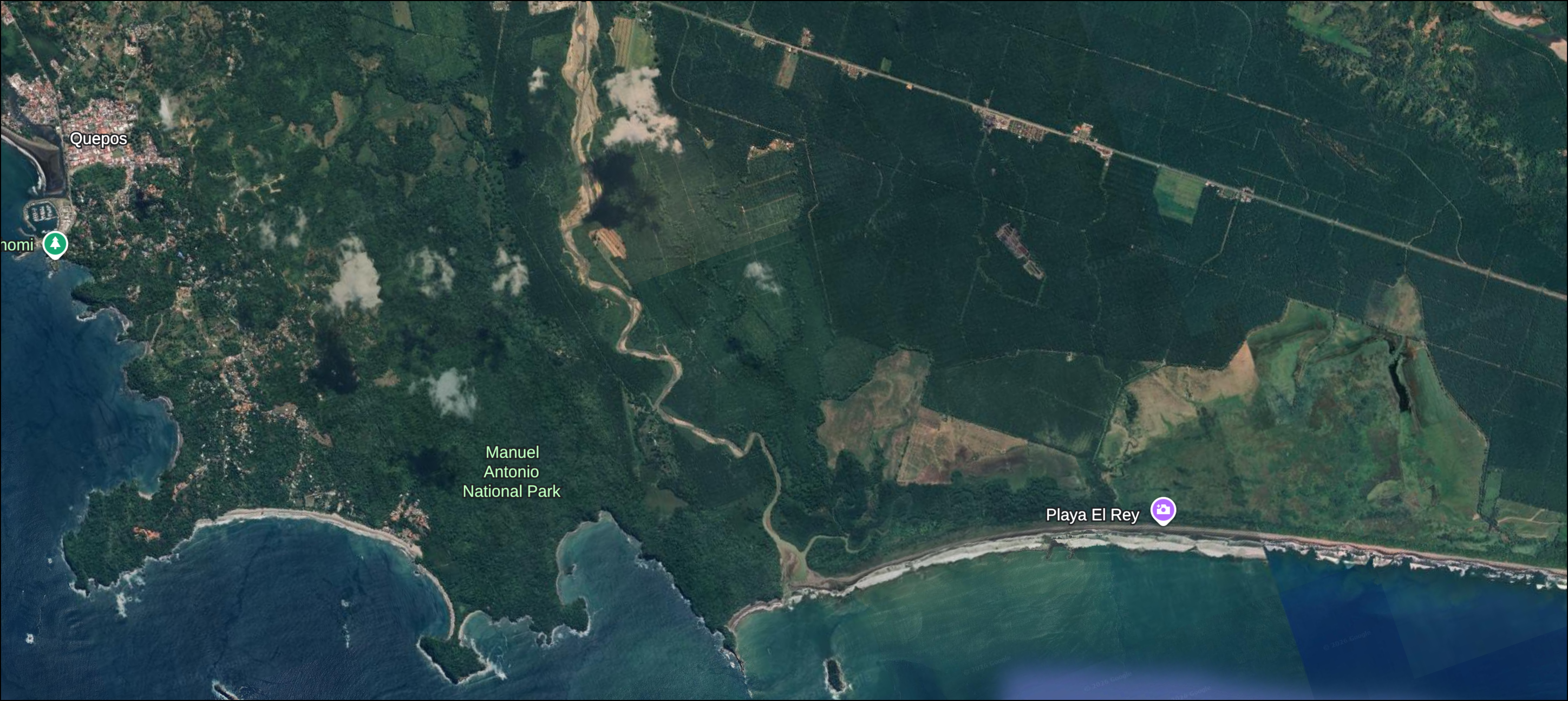
Manuel Antonio National Park is becoming an ecological island. At 1,983 terrestrial hectares, it is one of Costa Rica's smallest national parks, surrounded by oil palm plantations, hotels, and development on three sides, with the ocean on the fourth. A 2012 study in Landscape Ecology documented the paradox: between 1985 and 2008, regional forest fragmentation actually decreased (driven by tourism-related reforestation on abandoned pasture), but the park itself became more isolated as oil palm filled the lowland corridors that once connected it to the wider forest.
The grey-crowned Central American squirrel monkey (Saimiri oerstedii citrinellus), found only along the Central Pacific coast, has collapsed from an estimated 200,000 in 1983 to approximately 1,500 individuals. Oil palm plantations have split the remaining population into genetically isolated fragments. Baird's tapir was extirpated from the area in 1957; a reintroduction project in the lower Savegre is underway, but corridor connectivity through the lowlands is essential for any viable population. Ocelots require 28 to 45 square kilometers of home range. The entire park is 19.8 square kilometers. The damage extends to trees. Cascante and colleagues found that isolated Samanea saman in Costa Rican forest fragments produced seedlings with lower germination rates and less biomass than trees in connected populations. The adults looked healthy. Their offspring were weaker. Without connectivity, the park loses species faster than anyone can count them: Haddad and colleagues (2015) found that fragmentation reduces biodiversity by 13 to 75 percent, and the losses worsen over time.
The park does have a narrow coastal strip extending southeast from the main peninsula, reaching toward El Paso de Portalón at the mouth of the Río Savegre. But much of the Portalón lowland is itself palm plantation, and as a corridor, the strip has two problems. First, the Río Naranjo cuts across it. Squirrel monkeys cannot cross open water. The Titi Conservation Alliance has installed over 130 rope bridges in the Quepos area precisely because rivers and roads fragment monkey habitat into isolated troop territories. Larger mammals may be able to ford the river, though American crocodiles have been documented in the Manuel Antonio area, particularly in the brackish water near river mouths. Second, the strip hugs the coast with no inland depth. It protects 14 kilometers of beach, but a coastal fringe does not provide the forest habitat that ocelots, tapirs, or peccaries need, and palm plantation and the Costanera Sur highway block any path uphill to the Savegre highlands.
The proposal: dramatically enhance the Río Naranjo corridor. The corridor's designated area covers 22,450 hectares, but the most direct route up the Río Naranjo valley passes through palm plantation and the rapidly urbanizing outskirts of Quepos. Palm monoculture supports none of the pollinators or seed dispersers that native trees depend on for gene flow, and urbanization is narrowing the route further. A wilder alternative exists within the same designation: the coastal strip running southeast to the Río Savegre, where it connects to the Paso de la Danta corridor and the Savegre highlands beyond. Widen that strip by acquiring approximately 1,300 hectares of adjacent palm plantation and cattle pasture, extending the corridor inland and connecting it to the Savegre River bridge.
Build wildlife bridges across the Río Naranjo so terrestrial mammals can cross. String canopy-level monkey bridges so squirrel monkeys and other arboreal species can move between isolated troop territories without descending to the ground. Fence the Costanera Sur highway for at least five kilometers in each direction from the Savegre River bridge, and route wildlife under the bridge. The data on fencing length is specific: Banff National Park's system of crossing structures and 82 kilometers of highway fencing reduced wildlife-vehicle collisions by 80% overall; sections of at least five kilometers achieve 80% or greater reduction, while sections under five kilometers average only 50%. Reforestation costs can be kept low: plant pockets of diverse native species and let the corridor recruit from Manuel Antonio's genetic bank to the west and the Savegre highland forest it will connect to in the east. The Pacific lowlands regenerate aggressively once the palm is removed.
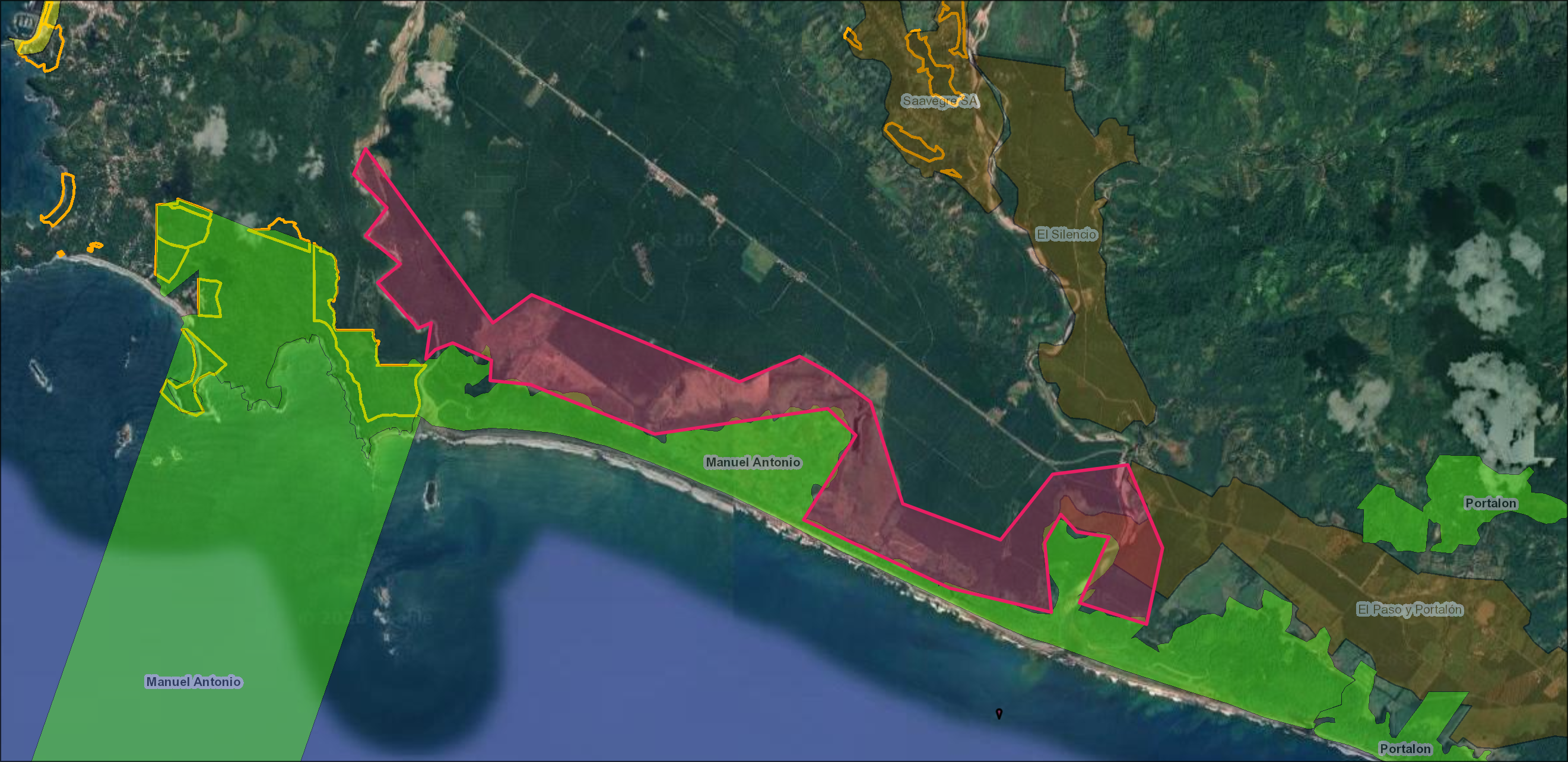
The funding mechanism for exactly this kind of land acquisition already exists. Ley 9885 (2020) reformed Manuel Antonio's governance and created a fideicomiso funded by 50% of the park's entrance fees. Thirty percent of the fideicomiso is earmarked for purchasing private lands within the park. The same provision authorizes spending on lands in "strategic geographic zones and interrelated biological corridors" in the Quepos-Parrita and Los Santos subregions that contribute to the conservation of Manuel Antonio. The Río Naranjo corridor is precisely such a zone. The law was written for this, though an unconstitutionality challenge (expediente 20-020914-0007-CO) has suspended its final acts pending resolution by the Sala Constitucional.
This corridor is survival infrastructure. It is the difference between Manuel Antonio functioning as a zoo that slowly degrades over decades and a connected ecosystem with functioning genetic interchange from sea level to 3,000 meters. The Palmar Sur airport would work in the opposite direction. Its runway would sit two to three kilometers from the Térraba-Sierpe National Wetland, a Ramsar site containing the largest intact mangrove forest on Central America's Pacific coast. The runway is only the catalyst: in Guanacaste, development radiated outward from the Daniel Oduber airport in a wave that municipalities with plans 19 to 42 years out of date could not contain. At Palmar Sur, that wave would push directly against the wetland. This proposal closes a gap in the corridor network instead of opening one.
Train People for the Jobs That Already Exist: A Win for Workers
Medical devices account for 48% of Costa Rica's goods exports, reaching $9.2 billion as of October 2025. More than 100 companies from the United States, Germany, Ireland, Sweden, Japan, and Spain operate manufacturing facilities in the country. Fourteen of the world's top 30 medtech companies maintain operations here. The sector employs over 60,000 people directly and hires approximately 1,500 new workers per year.
Almost all of this is concentrated in the Greater Metropolitan Area. The Coyol Free Zone in Alajuela alone hosts 34 companies and accounts for 52.2% of Costa Rica's medical device exports. The La Lima Free Zone in Cartago has 17 multinationals and 8,500 employees. Johnson & Johnson recently installed a 205,000-square-foot plant in Grecia. The expansion frontier of Costa Rica's most successful export industry extends west into the Central Valley. It has never reached the southern zone.
The Brunca region has a poverty rate of 30.6%, average schooling of 8.3 years, an employment rate of 50% (the lowest in the country), and a skill mismatch rate of 42% (the highest).
Here is a fact that should reframe the conversation: INA's course for medical device manufacturing operators, "Buenas prácticas en la manufactura de dispositivos médicos" (120 hours), requires completion of sixth grade and a minimum age of 18. Approximately 80% of positions in the sector are operational roles. The majority of the Brunca region's working-age population, including those without a high school diploma, is not categorically excluded from this workforce. They are excluded by geography. The training infrastructure does not exist where they live.
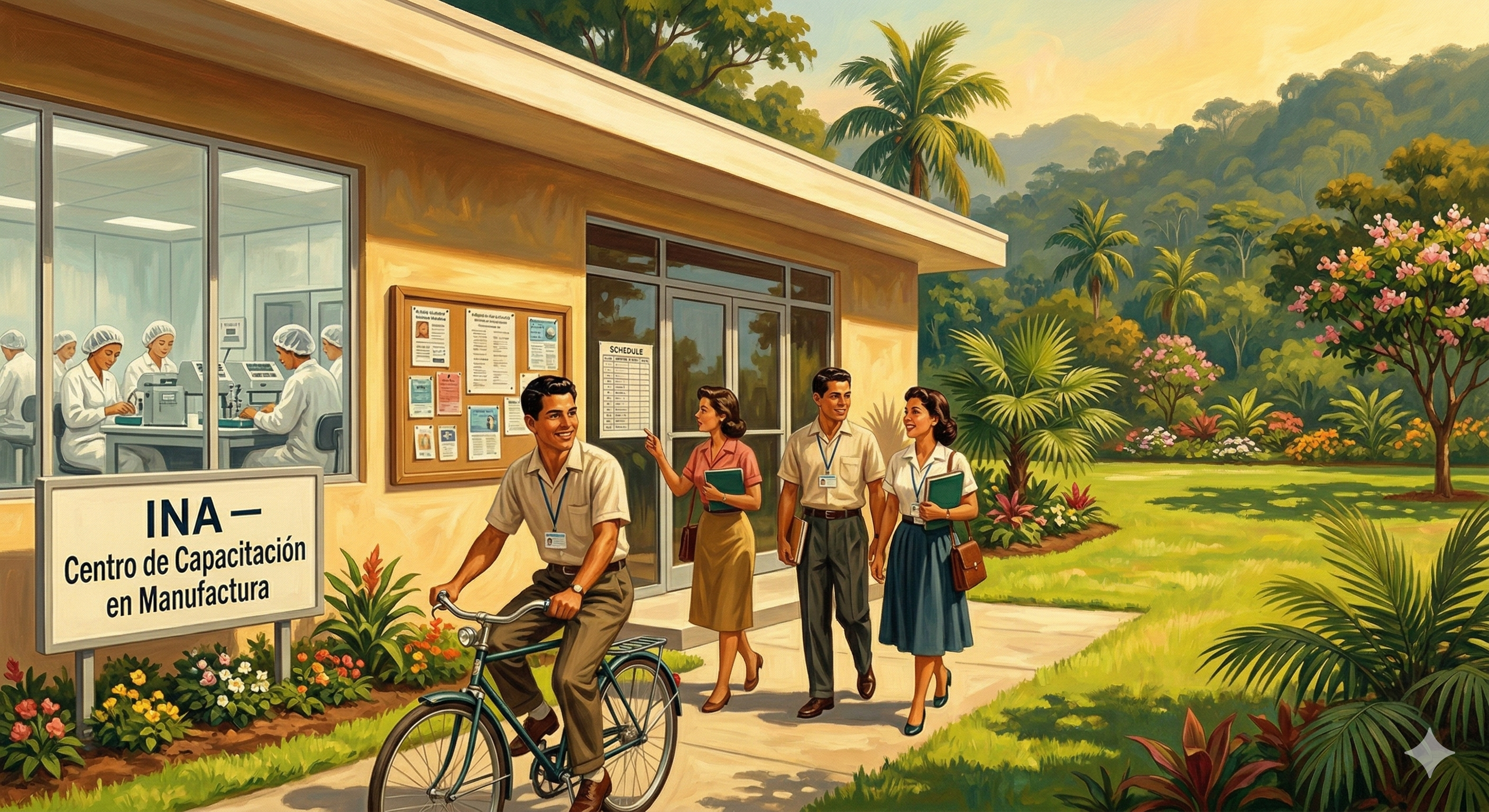
INA's Brunca Regional Unit operates four centers: San Isidro de El General, Río Claro, Coto Brus, and Osa. Between them they offer agriculture, forestry, food processing, commerce, languages, and computer science. The San Isidro center recently received a 2.741 billion colones investment in remodeled facilities. The Coto Brus center projects training for 1,800 people in 2025 through 77 programs. None of the four has a cleanroom. None offers manufacturing training. INA inaugurated its first cleanroom training facility in January 2025 in San Ramón, with capacity for 350 trainees per year. Build the second in Pérez Zeledón and the third at the Río Claro center in Golfito canton.
The government should pay trainees a scholarship while they train. The legal mechanism already exists: Article 21 of Ley 7210 provides that the Ministry of Labor pays trainees a monthly stipend equal to the minimum wage for three to six months during INA-coordinated courses. After training, the participating company is obligated to hire the trainee. This program is underutilized. Ley 9728 (2019) established a German-inspired dual vocational training system in which students split time between educational centers and training companies and receive INA-administered scholarships. The first cohort in 2022 involved eight companies, three vocational schools, and 34 trainees. Neither program has reached the Brunca region.
Does paid vocational training actually lift people out of poverty? Colombia's Jóvenes en Acción program tested this with a randomized controlled trial. The program targeted unemployed youth aged 18-25 from the bottom fifth of the income distribution. It did not require secondary education. Trainees received a daily stipend. Eight years later, participants had 11.5% higher formal-sector employment and 12% higher formal earnings than the control group. That may sound modest, but for a population starting from informal work and extreme poverty, a permanent 12% earnings increase from a short training course is a structural shift. A follow-up found that family members of trainees were 35% more likely to enroll in higher education. The effects compound across generations.
| Tourism (Guanacaste) | Manufacturing (Zona Franca) | |
|---|---|---|
| Average monthly wage | ₡418,000 | ₡947,000 |
| Informality rate | 59% | 0% |
| Seasonal layoffs | Up to 50% for 7-8 months | None |
| COVID-19 impact | Arrivals dropped 98.7% | Exports grew 8% |
| 2025 crisis | 22,170 jobs eliminated | Sector grew 18.1% |
| Career structure | Waiter, housekeeper, guide | Operator → lead → supervisor → manager |
| Economic leakage | 70-80% (all-inclusive model) | 15% of GDP, 265,000 jobs |
Tourism has lifted economies across Costa Rica, but the southern zone also needs steady, resilient jobs with career progression. A training pipeline connected to the manufacturing sector that already dominates Costa Rica's export economy is a direct mechanism for creating them. Construction jobs end when the runway is poured. A workforce trained for cleanroom assembly, quality inspection, and production supervision compounds over decades. The people exist. The jobs exist. The legal framework exists. What is missing is a cleanroom in Pérez Zeledón.
Build a Free Trade Zone at Paso Canoas: A Win for the Brunca Zone Economy
Once the vocational training pathway is established, the next step is to bring the jobs to the region. Youth out-migration from Pérez Zeledón and the southern cantons is well documented, driven by the search for economic conditions that do not exist locally. A free trade zone in the Brunca region would stem that drain to the GAM.
Panama is building a railway. The planned line spans 475 kilometers from Panama City to Paso Canoas, the Costa Rican border crossing, with 14 stations. Passenger trains are designed for speeds up to 137 kilometers per hour, freight trains up to 100. The United Kingdom has offered five billion pounds in financing, with approximately 3.5 billion allocated for construction. AECOM holds a $4.17 million contract for technical advisory services and has advanced key sections to 20% engineering design. Costa Rica and Panama signed a memorandum of understanding in March 2026 to coordinate cross-border rail development.
The first phase targets the 193-kilometer segment from Panamá Pacífico to Divisa, the flattest terrain. The border connection at Paso Canoas is a later phase. Realistically, the railway will not reach the border for 12 to 15 years. The free trade zone needs to function without it in the interim, and the infrastructure to do so is already being built.
Puerto Armuelles, 75 kilometers from Paso Canoas in Panama's Chiriquí province, is undergoing a $21.2 million rehabilitation as a multipurpose port across 35 hectares. The first phase was 39% complete as of June 2025, with a logistics park backed by two Japanese maritime companies in the second phase. It will be operational while the railway is still under construction. A new $33 million IDB-funded integrated border control center at Paso Canoas, inaugurated in February 2024, already processes approximately 200 cargo trucks and 800 individuals daily. It is expected to boost Costa Rica's annual trade earnings by approximately $95 million.
This is the transport argument that makes Paso Canoas competitive with the GAM. Manufacturers need to move goods to ports. Costa Rica's existing free trade zones in the Central Valley suffer from geography: finished products must be trucked over the Cordillera Central to reach Limón on the Caribbean or Caldera on the Pacific. A free trade zone at Paso Canoas has Puerto Armuelles 75 kilometers away by road, operational now. When the Panamanian railway reaches the border, it connects to the Panama Canal, the single most important logistics chokepoint in the Western Hemisphere. Short-term: a port. Long-term: a rail link to a port and a canal. No zona franca in the GAM can offer that.
Costa Rica's legal framework was amended in 2022 with exactly this kind of development in mind. Ley 10234 created 11 new incentives specifically for free trade zone investment outside the Greater Metropolitan Area. For manufacturers in strategic sectors with 100 or more employees: 0% income tax for 12 years, then 15% for years 13-18, then the general rate. Total exemption from FODESAF payroll contributions for the first five years. Banco Popular contribution reduced to 0.25% for ten years. INDER authorized to provide land and promote public-private alliances in rural territories. Minimum investment threshold of $100,000 in a park (compared to $150,000 inside the GAM). A new manufacturing park outside the GAM needs only three committed tenants to qualify, compared to six inside the GAM.
A provision in the PROCOMER regulations allows up to 50% of a company's committed investment to go toward public infrastructure: roads, bridges, sewage, energy and data lines, educational centers, community centers, and human capital. The cost of building the zone's infrastructure can count toward the investment threshold that qualifies the company for tax benefits.
Seize a palm plantation block in Corredores canton. Rural land in the area costs $5 to $40 per square meter, among the cheapest in Costa Rica. Palma Tica controls approximately 40% of the national palm area, with Corredores as one of its operating divisions. The palm industry in the southern zone has been documented dredging gullies, destroying wetlands, and working without MINAE permits. The plantations apply an estimated 6.6 kilograms of pesticides per hectare per year, predominantly glyphosate and paraquat. Research at the Térraba-Sierpe wetland documented nitrate levels in the Río Sierpe spiking 500% during palm fertilization months, with over 800 hectares of mangrove displaced by invasive vegetation fed by nutrient runoff. Converting a block of corporate palm monoculture to an industrial park is an environmental upgrade.
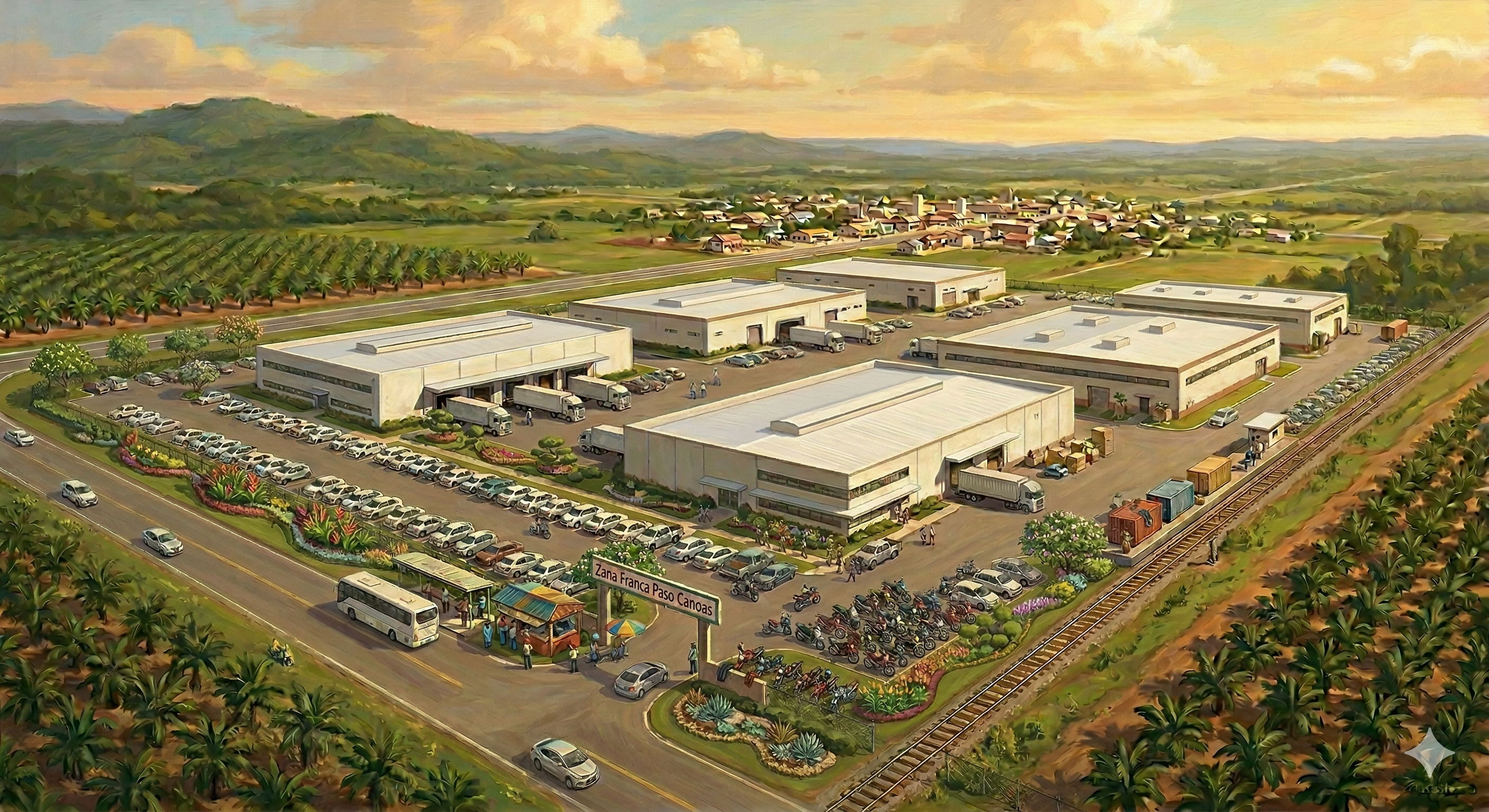
No free trade zone park currently operates anywhere in the Brunca region. Golfito has a duty-free shopping depot, not a manufacturing zone. Pérez Zeledón has a handful of individual FTZ-regime companies — a BPO firm, a trout producer, a safety equipment manufacturer — but no industrial park. Seventy-five zona franca companies already operate outside the GAM nationally, generating more than 10,000 jobs. The FTZ regime contributes 15% of GDP, generates 265,000 jobs, accounts for 65% of goods exports, and concentrates 74% of foreign direct investment. Workers in zonas francas earn an average of $2,319 per month, nearly double the national average. The southern zone has none of this.
The Brunca region has 14.9% unemployment, a poverty rate above 30%, and nearly 70% of the population without secondary education. The raw labor supply exists. Paso Canoas is within 90 minutes of Palmar Sur, an hour of Golfito, 20 minutes of Ciudad Neily, and two hours and fifteen minutes of Puerto Jiménez. Several towns across the Brunca zone are within daily commuting range, and for younger workers the longer hauls are viable with weekend trips home. What does not exist is the demand signal: a manufacturing facility that hires from across the region, trains through the mechanisms described in the previous section, and pays the zona franca wage premium.
The comparison with the Palmar Sur airport is direct. The airport promises to bring economic development to the southern zone through tourism. Its theory of change requires international visitors to fly in, find hotels that do not yet exist, visit parks that may already be at capacity, and generate service-sector jobs at service-sector wages. A free trade zone connected to Panama's port infrastructure creates manufacturing jobs at manufacturing wages. Medical devices, agroindustrial processing, electronics assembly: these are the sectors driving Costa Rica's economy, and the legal framework to extend them to the border is already on the books.
Give the Families Their Land: A Win for the People of Palmar Sur
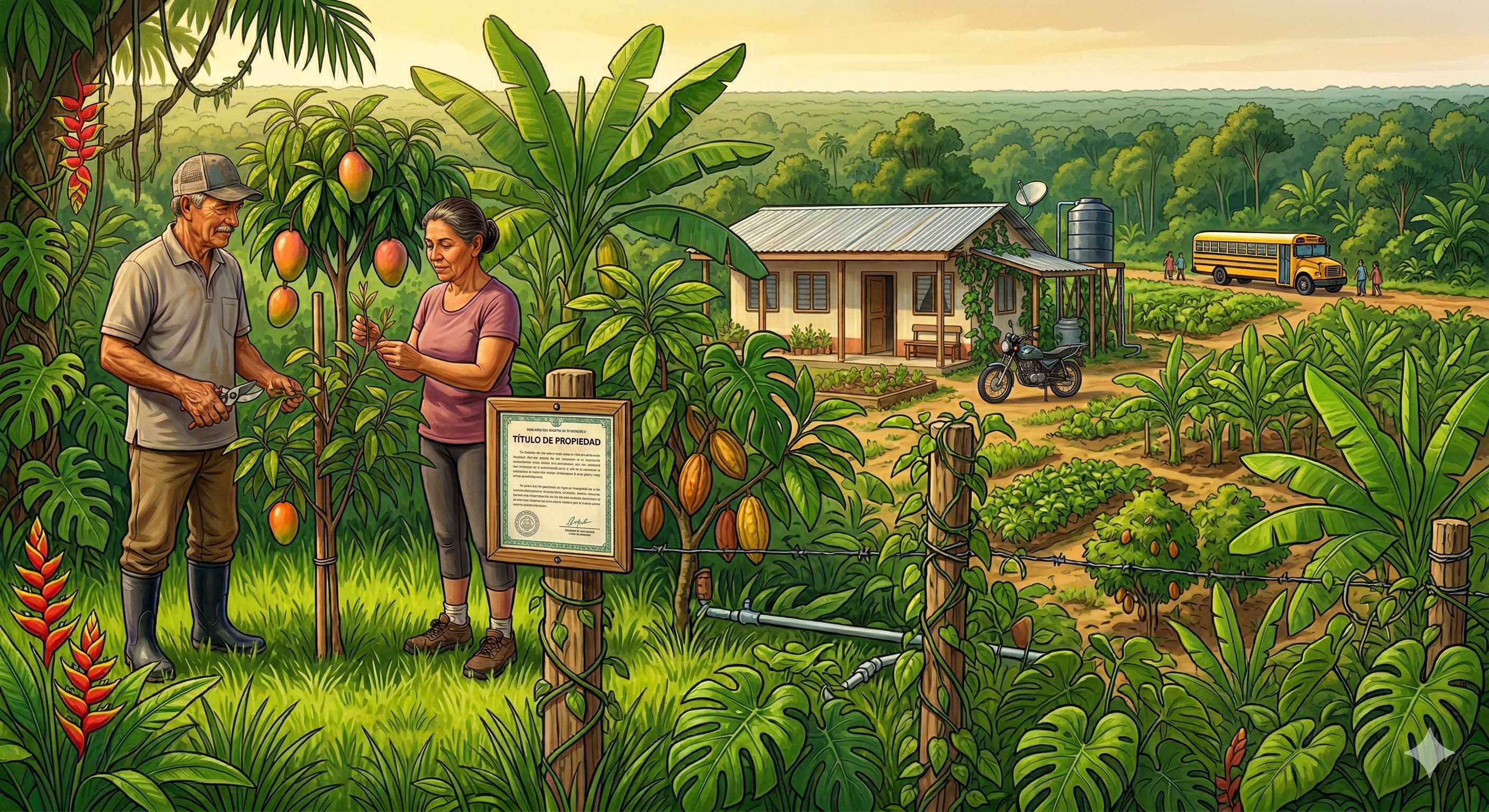
Whatever happens with the airport, one obligation is clear. Three hundred and fifty families have farmed the fincas at Palmar Sur for over forty years. The state called them caretakers and then tried to evict them, started a titling process and then suspended it, told them after Tropical Storm Nate that they could only plant annuals because an airport that may never be built might one day require their removal. INDER purchased Finca 10 in 2003 and began parcelization. Twenty-two years later, the families still have no title.
A legislative bill (Expediente 22.953), "Ley que autoriza al Poder Ejecutivo recuperar terrenos de Palmar Sur y autorización al Estado para que los done a la Municipalidad de Osa," was archived on March 12, 2026, having expired without committee action. The bill would have resolved the tangled ownership chain that dates to the government's purchase of the banana company lands in the 1980s. The political system treated these families as a problem to be managed rather than people with rights.
Title the land. INDER's maximum cost for titling is approximately six million colones ($11,000) per family, payable over 25 years. Titling all 350 families would cost roughly $3.85 million. That is less than four percent of the $105 million airport budget. Less than ten percent of the $42 million estimate.
The economic literature is unambiguous. Galiani and Schargrodsky's natural experiment in Buenos Aires found that families who received title invested 40% more in their housing. Their children completed secondary school at significantly higher rates. A systematic review by Lawry and colleagues found approximately 40% productivity gains from titling in Latin America. An India randomized controlled trial confirmed that titled farmers recovered the full cost of titling through welfare gains. The benefits do not operate through credit access, as Hernando de Soto originally proposed. They operate through tenure security: people who know they will not be evicted invest in their land, invest in their children, and plan for the future.
Then invest in the schools. Half of Brunca adults aged 25 to 39 did not complete secondary school. Osa canton's secondary exclusion rate is 5.2%, more than double the national average. Palmar district has two secondary schools for approximately 10,000 people. Only 33% of Osa's public secondary schools had internet in 2021, compared with 78% nationally. Zero students graduated from industrial or agricultural technical programs. The Defensoría de los Habitantes reported in February 2026 that rural schools operate with budgets up to five times smaller than urban institutions.
The answer is: give their children a path that does not dead-end at a sixth-grade education. Build the schools. Fund the teachers. Connect the internet. Set up the INA vocational programs described in Section III. A comprehensive package of land titling, school investment, vocational training, and agricultural extension would cost an estimated $7 to $14 million: seven to thirteen percent of the airport's $105 million price tag.
These families cannot be left in limbo for another generation. If the government builds the airport, they must receive full compensation and genuine relocation. If it does not, they must receive title to the land they have worked since 1984. The blueprint in this article renders the airport unnecessary. Give them the land.
What the Southern Zone Looks Like in Ten Years
Under the current plan: a runway on a floodplain, if it is ever built. A decade of legal battles over displacement and archaeological protection. Development pressure radiating outward toward Corcovado. Seasonal service-sector jobs at half the wages of manufacturing, if the tourists come. If they don't, a runway in a field. And 350 families still waiting for title.
Under this blueprint: international flights landing in Quepos, feeding a tourism economy that already exists. The Río Naranjo corridor dramatically enhanced, with 1,300 hectares of palm and pasture returning to forest, wildlife bridges across the river, and a fenced highway, connecting Manuel Antonio to the Savegre and Talamanca highlands before the park becomes an island. Cleanroom-trained workers in Pérez Zeledón and Golfito earning zona franca wages in manufacturing. A free trade zone at Paso Canoas, positioned for the day the Panama railway reaches the border, already exporting through Puerto Armuelles. And the families at Palmar Sur, titled, invested in, their children in schools with internet and vocational programs.
Costa Rica can put $100 million into a single runway on a flood delta and hope the rest follows. Or it can spread the same money across five investments that already have infrastructure, legal frameworks, and demand underneath them. One is a bet. The other is a plan.
Resources & Further Reading
Related Articles
The companion investigation: the full record of the Palmar Sur airport project, from the banana company's departure in 1984 through SETENA's rejection, the Procuraduría's legal findings, and the government's 2023 revival.
The science of genetic narrowing in fragmented forests. How isolated populations lose evolutionary potential even when the adults appear healthy. The research underlying Section II's corridor argument.
What happened when Costa Rica built an international airport next to a tourism destination: 70-80% economic leakage, foreign ownership of coastal land, water crises, and a poverty rate that doubled despite the boom.
Alternative development models that prioritize local ownership, community benefit, and environmental sustainability over resort-scale extraction.
Key Studies
Two old-growth palm trees contributed 56% of the genes in a 24-year-old secondary forest at La Selva. Foundational evidence for the genetic impoverishment of regrowth after fragmentation.
Global synthesis finding that fragmentation reduces biodiversity by 13 to 75 percent, with losses worsening over time as the extinction debt is paid.
Natural experiment in Buenos Aires: titled families invested 40% more in housing; children completed secondary school at higher rates. Tenure security drives the effect, not credit access.
Primary study of the 33 crossing structures at Hacienda Barú on Route 34. Camera traps documented 21 species of terrestrial vertebrates using four aerial crossings and 29 underpasses.
Identified 2,375 potential climate adaptation corridors throughout Central America. Found that existing corridors in Costa Rica were not designed to encompass the wide elevational gradients necessary to facilitate species range shifts under climate change.
Found two genetically distinct squirrel monkey populations separated by oil palm, with an effective population size as low as 150 to 500 individuals. Manuel Antonio is the largest national park within the subspecies' range, though smaller refuges like Hacienda Barú also overlap with it.
Eight-year follow-up of Colombia's Jóvenes en Acción program. Participants had 11.5% higher formal-sector employment and 12% higher formal earnings. Internal rate of return: 19% for women, 30% for men.
Eleven years after Jóvenes en Acción, family members of trainees were 35% more likely to enroll in higher education and 38% more likely to remain enrolled. Intergenerational human capital spillovers from vocational training.
Systematic review finding approximately 40% productivity gains from land titling in Latin America. The evidence operates through tenure security rather than credit access.
Data Sources & Reports
The integrated border control center at Paso Canoas: $33 million IDB-funded, inaugurated February 2024. Processes 200 cargo trucks and 800 individuals daily. Expected to boost Costa Rica's annual trade earnings by $95 million.
Acoustic study from the Osa Peninsula: "the characteristic morning and evening choruses are entirely abolished" on oil palm plantations. Research by Dr. Jenna Lawson.
44 crossing structures and 82 kilometers of highway fencing reduced wildlife-vehicle collisions by 80% overall and 96% for elk and deer. Over 150,000 mammal crossings documented between 1996 and 2016.
312,902 hectares spanning seven protected areas from Manuel Antonio to Quetzales National Park. Harbors 20% of Costa Rica's flora, 54% of its mammals, and 59% of its birds.
Overview of Ley 9728's German-inspired dual vocational training system. The first cohort in 2022 involved eight companies, three vocational schools, and 34 trainees.
Four pre-Columbian chieftainship settlement sites in the Diquís Delta, inscribed as a World Heritage Site in 2014. The proposed airport footprint overlaps with this designation.
Costa Rica's medical device sector: 100+ companies, 14 of the world's top 30 medtech firms, over 60,000 direct employees. Source data for the workforce training section.
National FTZ regime data: 15% of GDP, 265,000 jobs, 65% of goods exports, 74% of foreign direct investment. Average worker salary: 947,000 colones per month.
FONAFIFO pays approximately $64 per hectare per year for forest conservation and roughly $2,500 per hectare over 16-year reforestation contracts with native species.
In 71% of expropriation cases, the property owner accepts the administrative appraisal without going to court.
Journalism & Reporting
The displacement of approximately 350 farming families at Palmar Sur, the banana company's departure in 1984, and the community opposition to the airport project.
The Diquís Delta as an active alluvial floodplain, the 2024 archaeological evaluation, and the environmental fragility of the Palmar Sur site.
CNE Report 894-f flood chronology, the United Fruit Company levee's fracture during Tropical Storm Nate, and the 10.6 billion colones comprehensive dike estimate.
Medical devices account for 48% of Costa Rica's goods exports, reaching $9.2 billion as of October 2025.
The planned 475-kilometer railway, UK financing of five billion pounds, AECOM's $4.17 million advisory contract, and the Puerto Armuelles port rehabilitation.
INA inaugurated its first cleanroom training facility in San Ramón in January 2025, with capacity for 350 trainees per year in medical device manufacturing.
Palma Tica (Grupo Numar) controls approximately 24,800 hectares and processes 80% of Costa Rica's raw palm oil. Approximately 40% of the national palm area.
Costa Rican Legislation
Created 11 new incentives for rural FTZ investment: 0% income tax for 12 years, reduced payroll contributions, lower investment thresholds, and INDER land provisions.
Companies request INA training for prospective employees; the Ministry of Labor pays trainees a minimum-wage stipend for 3-6 months; the company is obligated to hire.
Created a fideicomiso funded by 50% of park entrance fees. Thirty percent earmarked for purchasing lands within the park and in strategic biological corridors in the Quepos-Parrita and Los Santos subregions.
German-inspired dual training system in which students split time between educational centers and training companies. INA-administered scholarships.
Establishes the expropriation process: declaration of public interest, administrative appraisal within one month, owner notification with five business days to accept or contest.
Defines three corridor types, requires participatory Local Committees with SINAC, NGO, municipal, and private sector representation.