Aguacatillo de Mez
Ocotea meziana — A wild avocado relative named for Carl Mez, the 23-year-old German botanist who wrote the first monograph on American laurels in 1889. This species ranges from the cloud forests of Monteverde to the lowland rainforests of the Osa Peninsula.
In 1945, Caroline Kathryn Allen described a new laurel from Zarcero in Costa Rica's Central Valley. She named it for Carl Mez, the German systematist whose 1889 Lauraceae Americanae remained the standard reference for New World laurels half a century later. The type specimen (Austin Smith H 359) was deposited at the Field Museum in Chicago. Today Ocotea meziana is known from wet forests across Central America, from Honduras south to Panama, spanning elevations from near sea level to over 2,400 meters.
Identification
Leaves
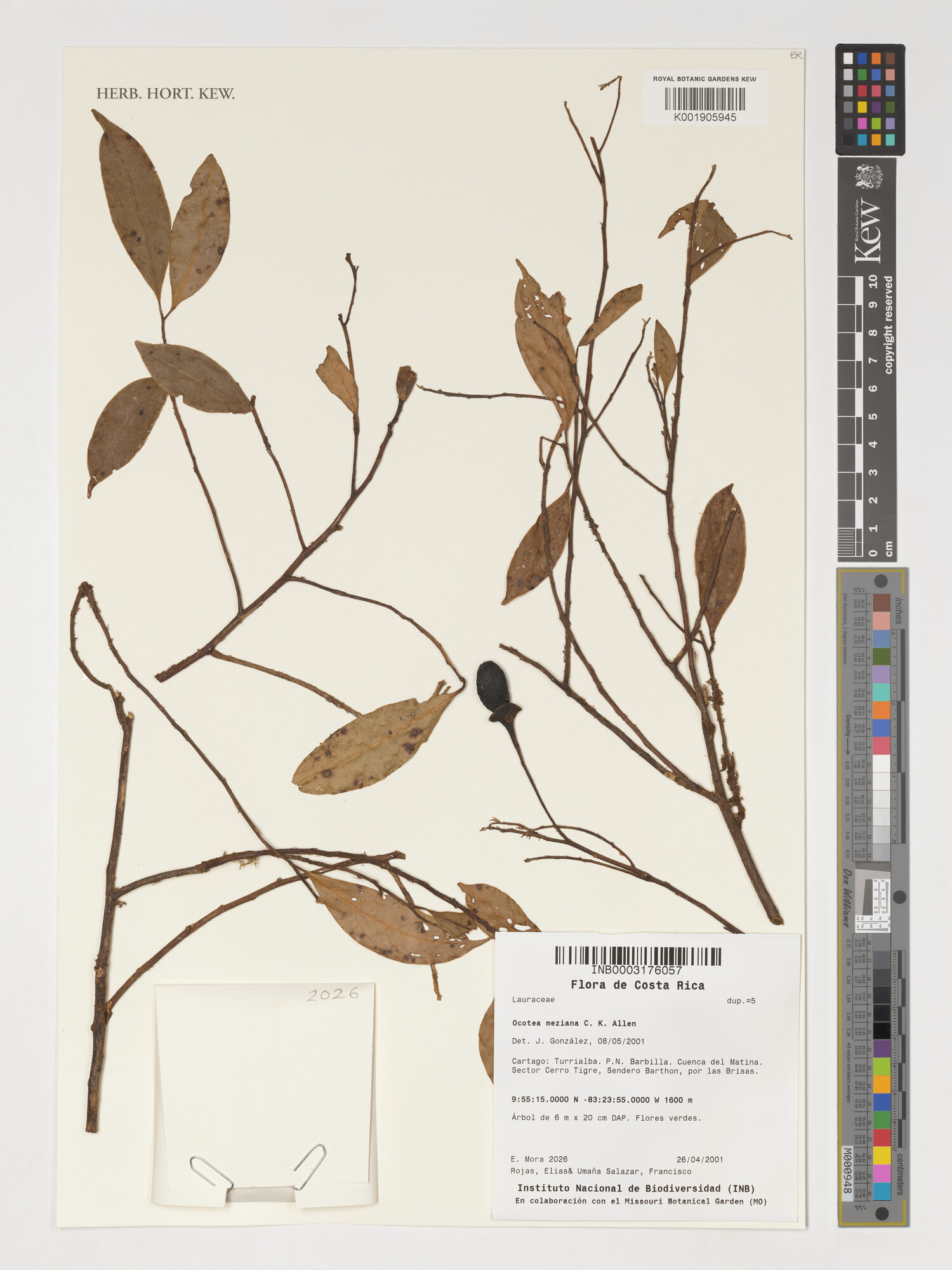
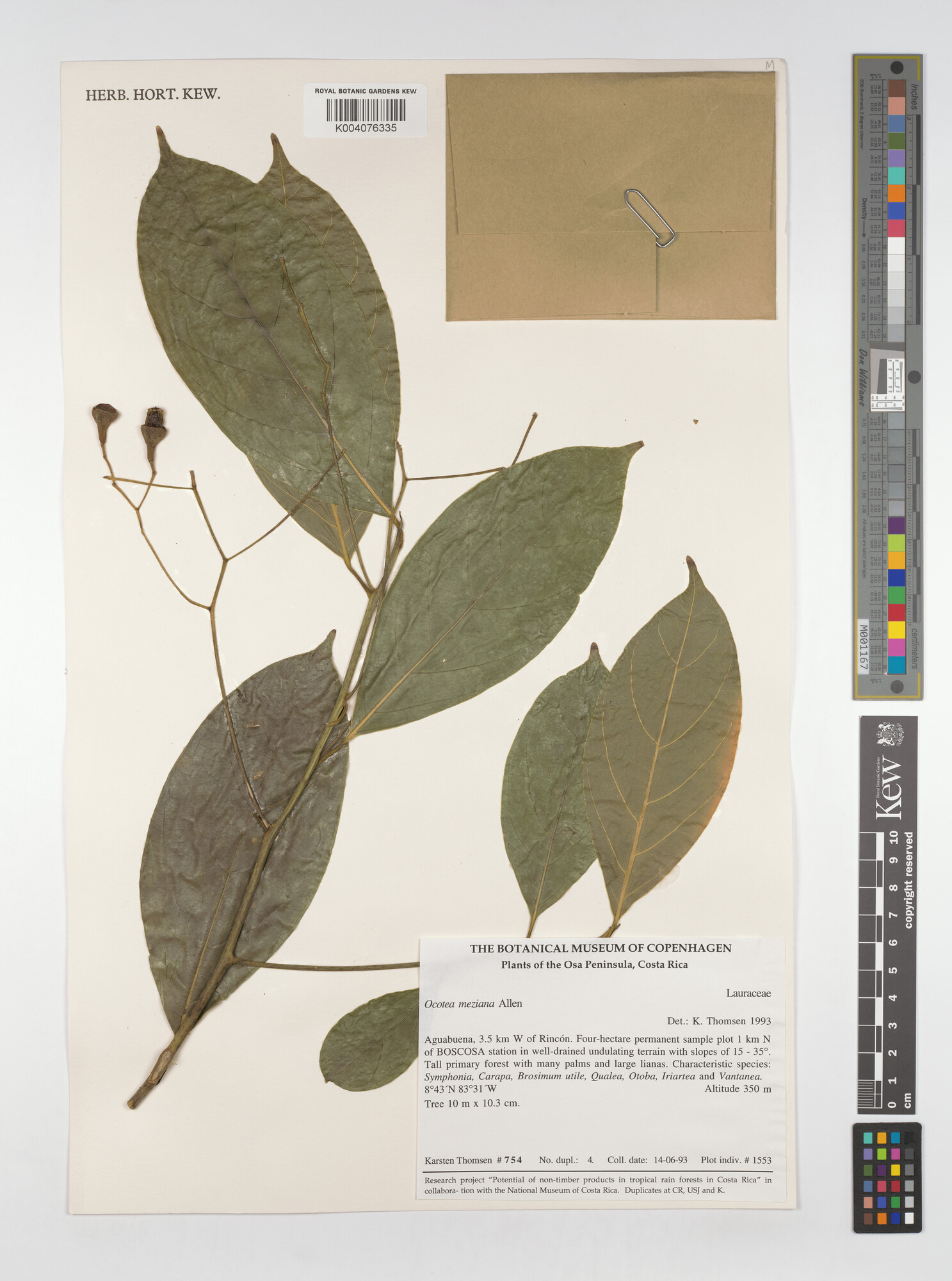
Like most laurels, O. meziana has alternate, simple leaves with entire margins. The leaves are elliptic to oblong-elliptic, typically 8–15 cm long and 3–6 cm wide, with a leathery texture. The upper surface is dark green and glossy; the underside paler, sometimes with fine hairs along the midrib. When crushed, the foliage releases the characteristic spicy-aromatic scent of the Lauraceae, produced by oil cells embedded in the leaf tissue.
Flowers
The small, cream-colored flowers are arranged in axillary panicles (branched clusters arising from leaf axils). Each flower has six tepals (petal-like structures typical of Lauraceae) and nine fertile stamens arranged in three whorls. The innermost whorl of stamens bears glands at the base, a diagnostic feature in Ocotea. Flowering in Costa Rica occurs primarily during the rainy season, from May to October.
Fruits
The fruit is a single-seeded drupe (fleshy fruit with a stone), ellipsoid, about 1.5–2 cm long when mature. Like other Ocotea species, the fruit sits in a cupule (cup-shaped structure) at the base. The cupule and pedicel (fruit stalk) often turn red or orange as the fruit ripens, contrasting with the dark drupe and helping to attract frugivorous birds.
Distribution
GBIF records show 415 occurrences of O. meziana, with the majority (360) from Costa Rica. The species also occurs in Panama (25 records), Honduras (13), Nicaragua (7), and Brazil (2). Within Costa Rica, specimens cluster in three main regions: Guanacaste and the Área de Conservación Guanacaste (including Parque Nacional Guanacaste and Estación Pitilla), the Central Volcanic Cordillera (Monteverde, San Ramón, Vara Blanca), and the Brunca region (Osa Peninsula, Carara, Coto Brus).
The elevation range is remarkably broad: from near sea level on the Caribbean coast to over 2,400 meters on montane slopes, with a mean of about 960 meters. This ecological amplitude suggests the species tolerates a wide range of rainfall and temperature regimes, from lowland rainforest to premontane and lower montane wet forest.
Ecology
As a member of the Lauraceae, O. meziana likely shares the ecological relationships that define its family in Central American forests. Laurel fruits are the primary food source for resplendent quetzals, three-wattled bellbirds, black guans, emerald toucanets, and mountain robins. These frugivores swallow the drupes whole and regurgitate or defecate the seeds, providing crucial dispersal services.
Research on the closely related Ocotea endresiana at Monteverde found that bellbirds disperse seeds to particularly favorable microsites. Unlike other frugivores that scatter seeds near the parent tree, bellbirds carry fruits to exposed perches on dead snags at gap edges, where they regurgitate the seeds. These gap environments offer more light and reduced pathogen pressure, increasing seedling survival rates.
Essential Oil Chemistry
A 2007 study by Takaku, Haber, and Setzer analyzed leaf essential oils from ten Ocotea species collected in Monteverde. They found that O. meziana produces an oil dominated by sesquiterpenes, with 19 identified volatile compounds. The major constituents are germacrene D (50.6% of total oil) and β-caryophyllene (13.2%), followed by smaller amounts of cadinenes, valencene, elemol, and α-cadinol. Monoterpenes such as α-pinene, β-pinene, limonene, and eucalyptol make up only about 4% of the oil.
Related research by Wright and colleagues examined the cytotoxic properties of Ocotea essential oils against human cancer cell lines, including MCF-7 breast cancer cells. While O. meziana was not the most active species tested, the sesquiterpenoid-rich profile of laurel essential oils has generated interest in their potential pharmaceutical applications.
Taxonomic History
Carl Christian Mez (1866–1944) was just 23 years old when he published Lauraceae Americanae, monographice descripsit in Berlin in 1889. The work, written entirely in Latin, described and keyed the laurels of the New World based on herbarium specimens, as Mez never traveled to the tropics. His thesis under Urban at Friedrich-Wilhelm University in Berlin had focused on Lauraceae morphology, and the monograph that followed became the foundational reference for the family in the Americas for over fifty years. Mez later became professor at Halle (1900) and Königsberg (1910), where he pioneered the use of serology to study plant relationships. But his 1889 laurel monograph remained his most influential work. The epithet meziana honors his contribution to Lauraceae systematics.
Caroline Kathryn Allen (1904–1975) described Ocotea meziana in 1945 in the Journal of the Arnold Arboretum. Trained at the Arnold Arboretum under E.D. Merrill, Allen devoted her career to Lauraceae taxonomy, ultimately describing over 275 new species. She was also an accomplished botanical illustrator who drew the microscopic dissections that distinguished Ocotea, Nectandra, and Pleurothyrium. The type specimen (Austin Smith H 359) was collected at Zarcero in Costa Rica's Central Valley and is deposited at the Field Museum in Chicago.
Conservation Outlook
Ocotea meziana is not currently assessed by the IUCN Red List. Its broad geographic range (Honduras to Panama) and wide elevational tolerance (10–2,400 m) suggest it is not immediately threatened with extinction. However, the species depends on intact forest and on the large frugivorous birds that disperse its seeds. Two of its likely dispersers face conservation concerns: the resplendent quetzal is Near Threatened, while the three-wattled bellbird is Vulnerable.
In Costa Rica, many O. meziana populations occur within protected areas: Parque Nacional Guanacaste, Estación Pitilla, the Monteverde reserves, Reserva Biológica Carara, and Parque Nacional Corcovado. Maintaining forest connectivity between these sites allows frugivores to track seasonal fruit availability and ensures continued seed dispersal across the landscape.
Resources & Further Reading
Species Information
Kew's authoritative record with nomenclature, distribution, and native range.
Missouri Botanical Garden's database with publication details and type specimen data.
Distribution map and 415 occurrence records across Central America.
Taxonomy & Nomenclature
Modern treatment of Mesoamerican Ocotea with keys and species descriptions.
The foundational monograph on New World laurels by Carl Mez.
Chemistry & Ecology
Chemical analysis identifying 19 volatile compounds in O. meziana leaf oil.
Classic study on how bellbirds provide superior seed dispersal for Ocotea in Monteverde.
Related Reading
Browse all wild avocado relatives in our tree taxonomy guide.
A critically endangered laurel endemic to Costa Rica's Tilarán mountains.