Mangle Rojo
Rhizophora mangle — The iconic mangrove with arching prop roots that stride into the sea. This keystone species creates nursery habitat for hundreds of fish species while its dense root tangles protect Costa Rica's coastlines from storms and erosion.
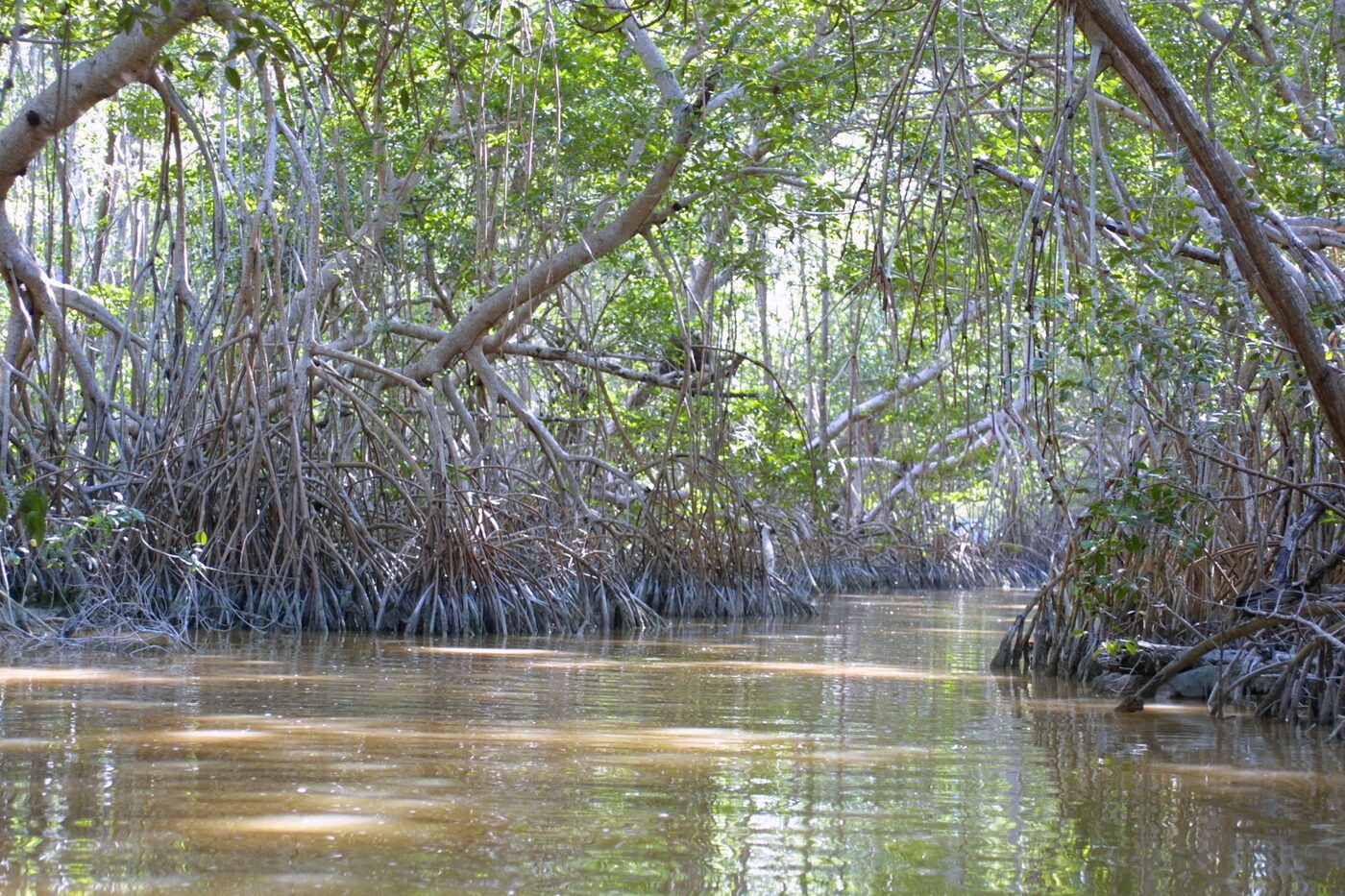
Where the Río Sierpe empties into Golfo Dulce, the water runs dark with tannins beneath a cathedral of green. Here, in one of the largest mangrove systems in Central America, the red mangrove has built an entire world from water and air. Its arching prop roots rise from the murky shallows like the ribs of some vast organic architecture, each root anchoring the tree while producing more roots that drop into the water to anchor themselves. A single tree becomes a forest; a thousand roots become one interconnected organism walking slowly seaward.
Peer beneath the water's surface and you enter a different realm. Among the root tangles, juvenile snappers and barracuda dart through dappled light. Barnacles encrust the submerged wood. Crabs scuttle along aerial roots, and in the canopy above, a bare-throated tiger heron watches for prey. The red mangrove is more than a tree: it is the foundation of an ecosystem, the nursery of the sea, and one of the most effective carbon sinks on Earth.
Identification
Taxonomy & Nomenclature
Carl Linnaeus first described the red mangrove in his Species Plantarum of 1753, giving it the name Rhizophora mangle that it retains today. The genus name derives from Greek: rhizo meaning "root" and phoros meaning "bearing," aptly describing the tree's most distinctive feature. The species epithet mangle comes from a Taíno word for these coastal trees, adopted into Spanish during the colonial era. The Rhizophoraceae family, commonly called the Red Mangrove family, contains about 147 species in 15 genera, but only four genera within the tribe Rhizophoreae are true mangroves: Rhizophora, Kandelia, Ceriops, and Bruguiera.
Under the modern APG IV classification system, Rhizophoraceae is placed within the order Malpighiales, sister to the Erythroxylaceae (the coca family). This represents a significant change from the older Cronquist system, which placed the mangrove family in its own order, Rhizophorales. Molecular studies have revealed that the mangrove lineage diverged from its terrestrial relatives approximately 56.4 million years ago during the Paleocene-Eocene Thermal Maximum, an extreme global warming event. After this divergence, mangrove species within Rhizophoraceae diversified rapidly over about 10 million years.
Physical Characteristics
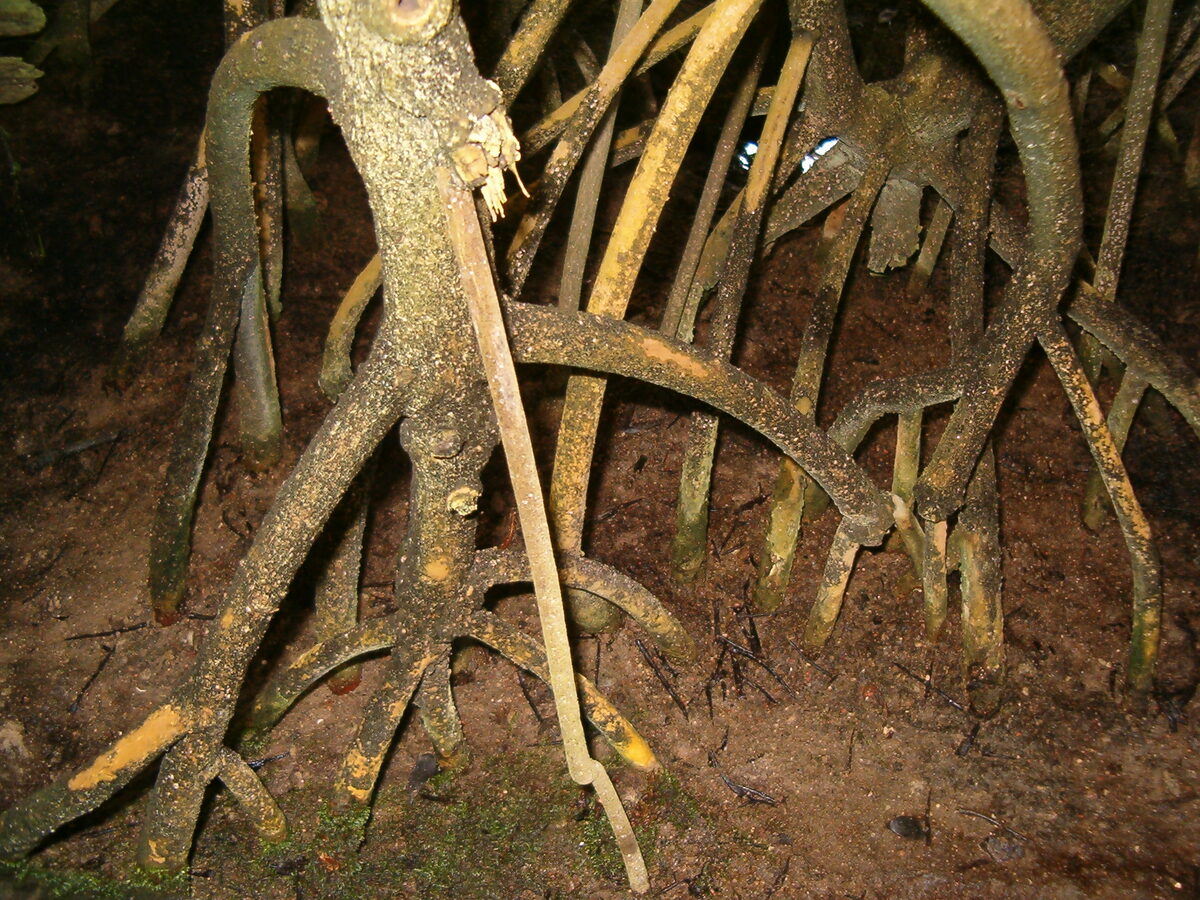
Prop roots: The defining feature of the red mangrove is its elaborate system of prop roots, technically called rhizophores. These adventitious aerial roots arch outward from the trunk and lower branches, curving downward until they reach the water or mud below. Once anchored, they produce more roots that extend further, creating an ever-expanding tangle that can make a single tree appear as a small forest. These roots serve multiple functions: structural support in the unstable substrate, gas exchange through specialized lenticels, and creation of habitat for marine life. A mature tree may be supported by thousands of interlocking prop roots.
Trunk and bark: The bark is gray and irregularly furrowed on mature trees. When wet or freshly cut, the inner bark reveals a distinctive reddish-pink tone that gives the species its common name. This inner bark is rich in tannins that have historically been used for leather tanning and dyeing.
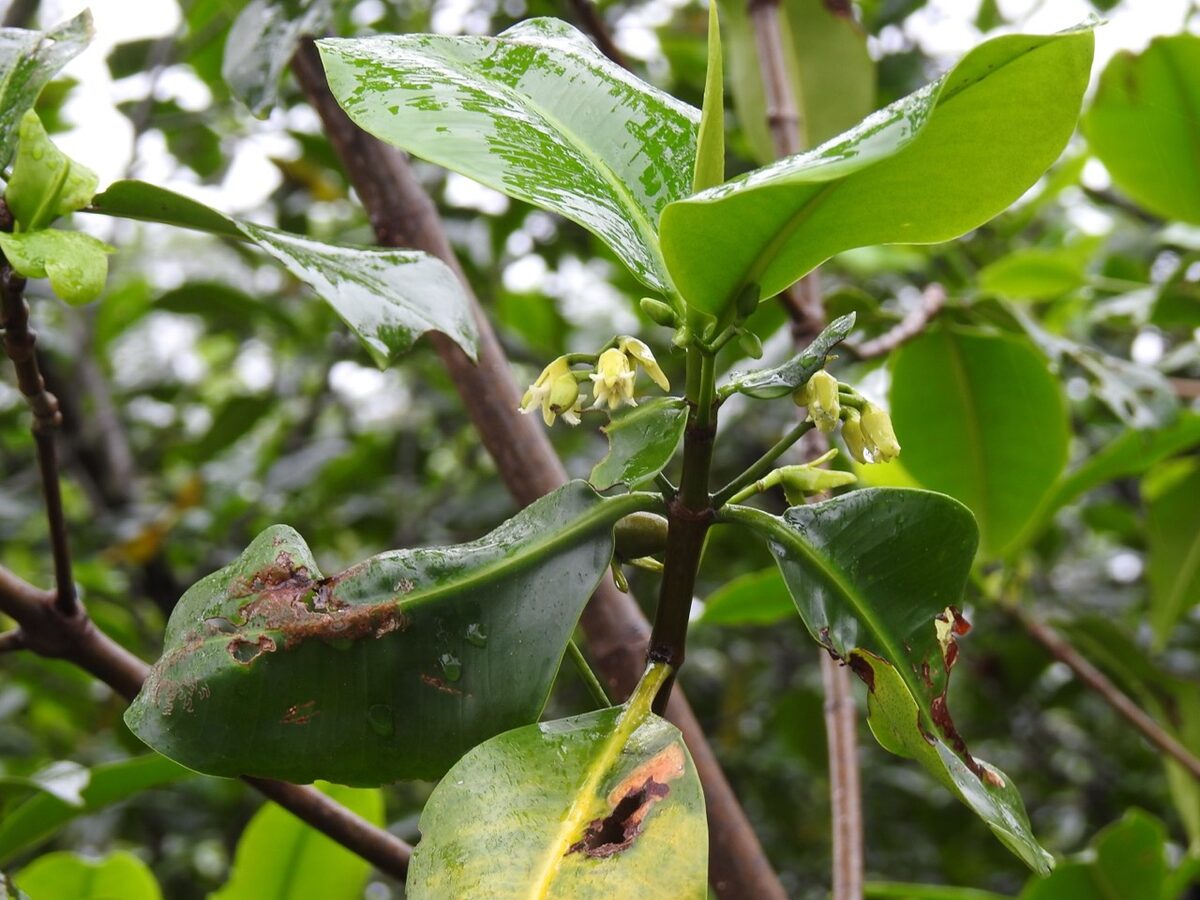
Leaves: The leaves are opposite, elliptic to oblong, 5-15 cm long and 2.5-6 cm wide, with a leathery texture. They are medium to dark green on the upper surface and paler beneath. A key identification feature distinguishes the red mangrove from its close relative Rhizophora racemosa: the underside of R. racemosa leaves displays numerous small corky warts that appear as black spots, while R. mangle leaves have smaller, less prominent dots or lack them entirely. This subtle difference is important in Costa Rica, where both species co-occur in the Golfo Dulce region.
Flowers: Small, yellowish-white flowers appear in clusters of 2-4 on branched stalks. They are pollinated by wind or insects. In Costa Rica, flowering typically occurs from October through December, with fruit development continuing through March.
Viviparous Reproduction
The red mangrove's most remarkable adaptation is its viviparous reproduction. Unlike most flowering plants, whose seeds fall to the ground before germinating, the red mangrove's seeds germinate while still attached to the parent tree. The embryo develops into a long, pencil-shaped structure called a propagule, which can reach 15-50 cm in length before detaching. This green, cigar-like propagule hangs from the tree, its pointed end weighted with stored starches, while its radicle (embryonic root) continues to develop.
When the propagule finally drops, it may fall point-first into the mud below, immediately anchoring itself. More often, it falls into the water and floats horizontally, carried by tides and currents. A red mangrove propagule can remain viable while drifting for up to one year, during which time changes in its density cause it to gradually shift from horizontal to vertical orientation. When it finally lodges against a suitable substrate, roots emerge within days, and a new tree begins to grow. This remarkable dispersal mechanism allows the red mangrove to colonize distant shores and establish new populations across ocean basins.

Habitat & Distribution
The red mangrove has an amphi-Atlantic distribution, occurring naturally on both sides of the tropical Atlantic Ocean. In the Americas, it ranges from Florida and Bermuda through the Caribbean, Mexico, and Central America to Brazil. On the Pacific coast, it extends from Mexico to Peru. In Africa, it grows from Senegal to Cameroon. This widespread distribution makes it the most common and representative species of Neotropical mangroves.
In Costa Rica, 99% of mangrove forests are concentrated on the Pacific coast, with only 1% along the Caribbean. The Pacific mangroves benefit from higher precipitation and greater freshwater and sediment inputs from rivers draining the Talamanca Mountains. Key locations for red mangrove populations include:
- Térraba-Sierpe National Wetland: Central America's largest mangrove system at over 30,000 hectares. Designated a RAMSAR Wetland of International Importance in 1995, it hosts extensive red mangrove populations along channel edges and in the lower intertidal zones.
- Golfo Dulce: At the mangroves of Playa Blanca, Escondido, and Rincón de Osa, R. mangle co-occurs with R. racemosa, with the latter often dominant. Studies here have documented complex structural variation across sites.
- Gulf of Nicoya: The Tempisque and Bebedero rivers create dynamic estuarine conditions where mangroves colonize newly formed sediment banks.

Mangrove Zonation
In Costa Rica's mangrove forests, different species arrange themselves in distinct zones based on their tolerance to flooding and salinity. The red mangrove typically occupies the outermost position, growing in the deepest water with the highest salinity. Its prop roots allow it to anchor in soft, waterlogged substrates where other trees would simply tip over. Moving landward, the black mangrove (Avicennia germinans) appears in the mid-intertidal zone, followed by the white mangrove (Laguncularia racemosa) in areas with more freshwater influence. The buttonwood (Conocarpus erectus) marks the landward edge, seldom flooded by tides.
However, this classical zonation pattern is not always evident. In the high-rainfall mangroves of Golfo Dulce, researchers have noted an absence of clear zonation, likely due to the abundant freshwater inputs that reduce the salinity gradient from sea to land. Here, species distribution appears driven more by microhabitat conditions than by distinct coastal-to-interior zones.
Ecological Importance
Mangrove forests are among the most productive ecosystems on Earth, and the red mangrove is their principal architect. Its contribution to coastal ecosystems is difficult to overstate: it creates physical structure, generates food for marine food webs, sequesters carbon, protects coastlines, and filters water flowing from land to sea.
Nursery Habitat
The tangled prop roots of the red mangrove create a protected underwater labyrinth that serves as critical nursery habitat for countless marine species. A global analysis estimated that mangrove forests support an annual abundance of over 700 billion juvenile fish and invertebrates worldwide. In Florida, studies have shown that 75% of game fish and 90% of commercial fish species depend on mangroves at some stage of their life cycle. While comparable data for Costa Rica is limited, the pattern is likely similar: species like snook, snapper, tarpon, and barracuda spend their vulnerable juvenile stages sheltered among mangrove roots before moving to deeper waters as adults.
Food Web Foundation
Red mangrove leaves that fall into the water are rapidly colonized by bacteria and fungi, creating a nutrient-rich detritus that forms the foundation of the mangrove food web. This decomposed organic matter is flushed into estuaries by outgoing tides, supporting shrimp, crabs, small fish, and ultimately the larger predators that depend on them. A single hectare of healthy mangrove forest can produce several tons of leaf litter annually, making these ecosystems net exporters of organic carbon to adjacent marine waters.
Carbon Sequestration
Mangroves are remarkably efficient at capturing and storing carbon. Their waterlogged, anoxic soils trap organic matter and prevent decomposition, locking away carbon for centuries or millennia. This "blue carbon" storage makes mangroves up to ten times more effective at sequestering carbon per hectare than upland tropical forests. As climate change accelerates, the carbon storage capacity of mangrove forests becomes increasingly valuable. When mangroves are destroyed, this stored carbon is released back into the atmosphere, making their conservation doubly important.
Coastal Protection
The dense tangle of red mangrove prop roots dissipates wave energy, reducing erosion and protecting inland areas from storm surge. Communities behind healthy mangrove forests experience reduced flooding and storm damage. Studies have shown that mangroves can reduce wave heights by up to 66% over 100 meters of forest. In an era of rising seas and intensifying tropical storms, this natural infrastructure provides protection that would cost millions to replicate with artificial seawalls.
Wildlife Relationships
The red mangrove, along with its companion mangrove species, supports a remarkable diversity of wildlife. Over 300 bird species have been recorded in the Térraba-Sierpe mangroves alone, along with 55+ fish species, numerous crabs and invertebrates, reptiles including crocodiles and caimans, and mammals ranging from monkeys to otters.
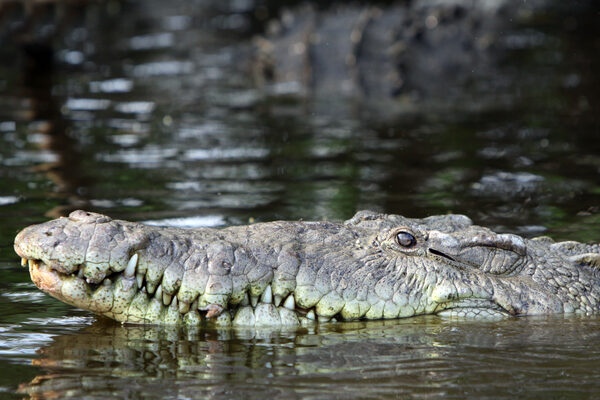

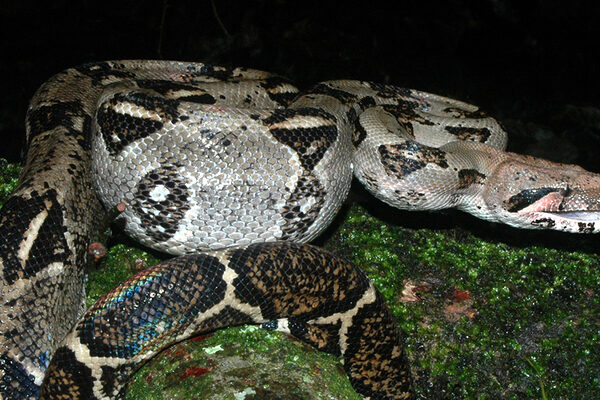
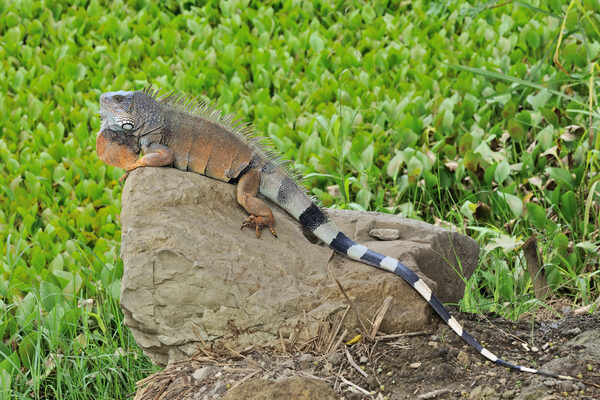
Photos: Tomas Castelazo (crocodile), Bernard Gagnon (caiman), William L. Farr (boa), Cayambe (iguana) via Wikimedia Commons.
Mangrove Crabs
Crabs are the dominant invertebrates in mangrove ecosystems and play essential roles in nutrient cycling. The large ucidid crab Ucides cordatus is the primary litter-consuming species in Neotropical mangroves, processing more than 70% of leaf litter production. Its burrows, which can reach 2 meters deep, aerate the sediment and increase nutrient turnover. The mangrove tree crab Aratus pisonii lives in the canopy itself, feeding on fresh leaves. Research shows its consumption can constitute over 90% of all herbivory on mangrove leaves. Fiddler crabs (Uca spp.) are smaller deposit feeders whose burrowing benefits mangrove trees: experiments have shown that fiddler crab activity increases mangrove height by 27% and trunk diameter by 25% compared to crab-exclusion areas.
Co-occurring Mangrove Species
Costa Rica hosts eight species of mangrove trees from four different plant families, creating one of the most diverse mangrove assemblages in Central America. In addition to the red mangrove, these include:
- Rhizophora racemosa — Often co-dominant with R. mangle in Golfo Dulce; distinguished by numerous black corky warts on leaf undersides.
- Rhizophora harrisonii — A species or hybrid found in some Pacific mangroves.
- Avicennia germinans (Black mangrove) — Occupies the mid-intertidal zone; has pneumatophores and secretes salt through leaf glands.
- Avicennia bicolor — A second black mangrove species found in the region.
- Laguncularia racemosa (White mangrove) — Pioneer species that colonizes new mud banks; secretes salt through petiole glands.
- Pelliciera rhizophorae (Tea mangrove) — A rare species important for the endemic Mangrove Hummingbird.
- Conocarpus erectus (Buttonwood) — Marks the landward fringe of the mangrove, seldom flooded by tides.
Conservation
Although the red mangrove is classified as Least Concern globally by the IUCN, the mangrove ecosystems it anchors face serious threats worldwide. Costa Rica has lost significant mangrove area to coastal development, aquaculture, and pollution, though the rate of destruction has slowed in recent decades due to legal protections.
Threats
- Shrimp farming: Historically the major cause of mangrove deforestation. Mangroves were cleared to build evaporation ponds. Studies show that aquaculture ponds built where mangrove once stood have lost up to 90% of their ecosystem carbon.
- Agricultural development: Expansion of rice, oil palm, sugar cane, and cattle ranching into coastal areas.
- Pollution: Agricultural runoff carrying pesticides and excess nutrients degrades water quality and can smother mangrove roots.
- Climate change: Sea level rise poses the greatest long-term threat. Mangroves may be unable to migrate landward where human development blocks their path. Increased storm intensity and changing rainfall patterns also affect mangrove health.
- Illegal cutting: Despite legal protection, enforcement is inconsistent and illegal harvesting for firewood and charcoal continues in some areas.
Protection and Restoration
Costa Rica has designated several mangrove areas as protected wetlands. The Térraba-Sierpe National Wetland was established as a Forest Reserve in 1977 and recognized as a RAMSAR Wetland of International Importance in 1995. Cutting mangroves is prohibited under Costa Rican law, though enforcement remains a challenge. Restoration efforts are underway in several areas, using propagules of red, black, and white mangroves to restore damaged sites. These projects demonstrate that mangrove ecosystems can recover if given protection and time.
The value of intact mangrove forests extends far beyond their boundaries. A single hectare of mangrove in Costa Rica generates an estimated $8,700 annually in ecosystem services, including coastal protection, water filtration, nursery habitat for fisheries, timber, and carbon storage. This economic value, combined with the unique biodiversity that depends on these forests, makes a compelling case for continued conservation and restoration of Costa Rica's mangrove ecosystems.
For anyone visiting the Osa Peninsula or the Pacific coast, a boat trip through the mangroves offers an unforgettable glimpse into one of the world's most productive ecosystems. Watch for the arching prop roots of the red mangrove striding into the water, and look closely for the pencil-like propagules hanging from the branches. In these coastal wetlands, where forest meets sea, the mangle rojo has been building worlds for millions of years, one root at a time.
Key Sources & Resources
Species Information
General overview of the species with information on distribution, ecology, and uses.
Species profile for the Osa Peninsula region of Costa Rica.
Detailed species fact sheet covering identification, ecology, and wildlife value.
Community observations, photographs, and distribution data.
Costa Rica Mangroves
Overview of Costa Rica's mangrove ecosystems and species zonation.
Information about Central America's largest mangrove wetland and its biodiversity.
Official RAMSAR documentation for this Wetland of International Importance, designated in 1995.
Scientific study on mangrove structure at Playa Blanca, Escondido, and Rincón de Osa.
Mangrove Ecology
Detailed information on mangrove ecosystems and associated wildlife.
Species profile with conservation and ecological information.