Mangle Blanco Mangle Blanco
A stilt-rooted forest tree that only looks like a mangrove. Arawakia weddelliana is one of the more common members of the Clusiaceae in Costa Rica's wet forests, recognizable by its narrow, nearly stalkless leaves crowded in rosettes, with so many fine, closely set veins that they are almost impossible to see. It bleeds white latex, and it carries a very recent name: the genus Arawakia was erected in 2019. Un árbol de bosque con raíces zancudas que solo parece un mangle. Arawakia weddelliana es uno de los miembros más comunes de las Clusiaceae en los bosques húmedos de Costa Rica, reconocible por sus hojas angostas, casi sin pecíolo, agrupadas en rosetas, con tantas venas finas y apretadas que son casi imposibles de ver. Sangra látex blanco, y lleva un nombre muy reciente: el género Arawakia se erigió en 2019.
The Costa Rican name for this tree, mangle blanco, white mangrove, comes from its habit of standing on stilt roots, propped above the forest floor on a cone of woody legs in the way of a mangrove on a tidal flat. It is not a mangrove. The true white mangrove of the coast is an unrelated plant, and the name is borrowed, applied to this forest tree for the look of its roots. What it really is, is a member of the Clusiaceae, the family of the wild mangosteens, and a common one in the wet forests of the country: among the more frequently collected of its family, found from the lowlands well up into the foothills on both slopes, and especially common in the southern Pacific forests of the Brunca, on the Osa Peninsula and around the Golfo Dulce. El nombre costarricense de este árbol, mangle blanco, viene de su costumbre de pararse sobre raíces zancudas, alzado sobre el suelo del bosque en un cono de patas leñosas a la manera de un mangle en un fangal de marea. No es un mangle. El verdadero mangle blanco de la costa es una planta no emparentada, y el nombre es prestado, aplicado a este árbol de bosque por el aspecto de sus raíces. Lo que realmente es, es un miembro de las Clusiaceae, la familia de los mangostanes silvestres, y uno común en los bosques húmedos del país: entre los más colectados de su familia, presente desde las tierras bajas hasta bien entrado el pie de monte en ambas vertientes, y especialmente común en los bosques del Pacífico sur de la Brunca, en la Península de Osa y alrededor del Golfo Dulce.
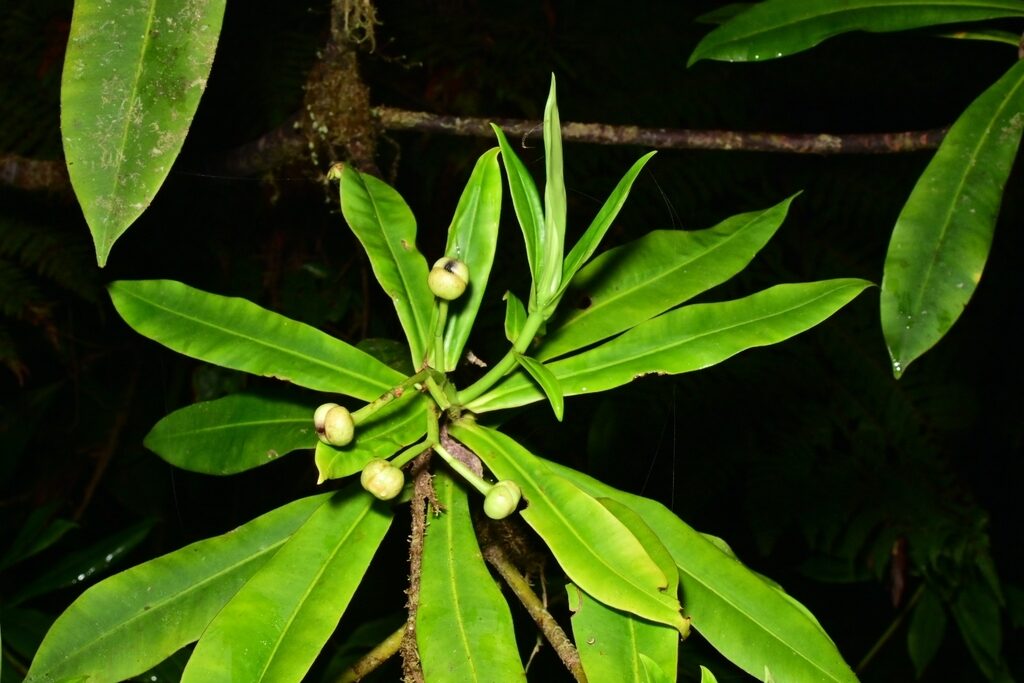
Once you have looked at one, it is hard to mistake. The leaves are long and narrow, widest near the tip, leathery and shiny, and they sit almost directly on the twig with no real stalk, crowded into rosettes at the ends of the branches. Run a thumb along the blade and the veins are a puzzle: there are dozens of them, fifty to a hundred or more on each side of the midrib, packed a millimeter or two apart and so faint they nearly disappear. No other tree in its family in Costa Rica looks quite like it. Una vez que se ha visto una, es difícil confundirla. Las hojas son largas y angostas, más anchas cerca del ápice, coriáceas y lustrosas, y se asientan casi directamente sobre la ramita sin un verdadero pecíolo, agrupadas en rosetas en los extremos de las ramas. Pase un dedo por la lámina y las venas son un acertijo: hay decenas, de cincuenta a cien o más a cada lado del nervio central, apretadas a uno o dos milímetros de distancia y tan tenues que casi desaparecen. Ningún otro árbol de su familia en Costa Rica se ve igual.
Identification Identificación
Habit Hábito
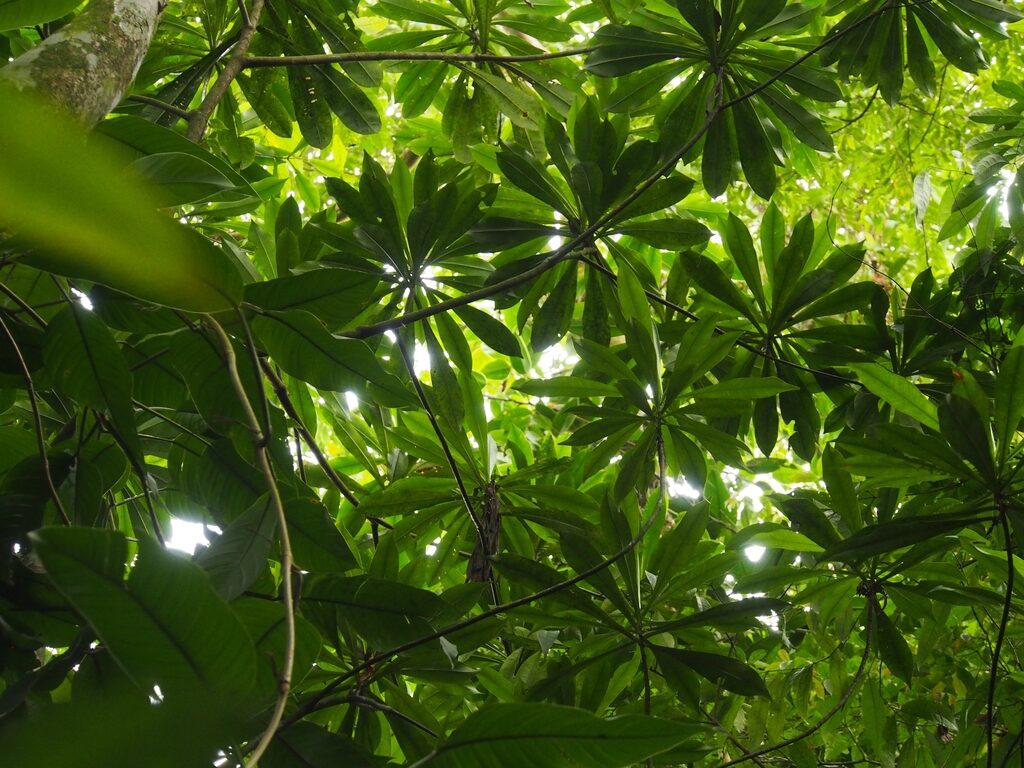
The plant ranges from a shrub of a meter or two to a tree of about 20 meters, and it sometimes begins life as an epiphyte before reaching the ground. Often it stands on stilt roots, the feature behind the folk name. Cut, it runs a white latex, which is itself a useful detail: the Clusiaceae are famous for yellow or orange resin, and the white latex of this species sets it apart from its relatives, several of which bleed bright yellow. The tree is dioecious, the male and female flowers borne on separate plants. La planta va de un arbusto de uno o dos metros a un árbol de unos 20 metros, y a veces comienza su vida como epífita antes de alcanzar el suelo. A menudo se sostiene sobre raíces zancudas, el rasgo tras el nombre popular. Al cortarse, suelta un látex blanco, que es en sí un detalle útil: las Clusiaceae son célebres por su resina amarilla o anaranjada, y el látex blanco de esta especie la distingue de sus parientes, varios de los cuales sangran amarillo brillante. El árbol es dioico, con las flores masculinas y femeninas en plantas separadas.
Leaves Hojas
The leaves are the surest mark. Each blade is 11 to 25 centimeters long but only 2.5 to 5 wide, narrowly oblanceolate to almost spatula-shaped, tapering gradually to a base that meets the twig with little or no stalk, the margins rolled slightly under. They are stiff and glabrous, drying brown with a reddish cast. The venation is the giveaway: instead of a handful of clear side veins, there are fifty to a hundred or more on each side of the midrib, set only a millimeter or two apart and so fine they are hard to make out, all running to a vein that loops just inside the margin. Among the Costa Rican Clusiaceae, that combination, narrow stalkless leaves with crowded, near-invisible veins, belongs to this tree alone. Las hojas son la marca más segura. Cada lámina mide de 11 a 25 centímetros de largo pero solo de 2.5 a 5 de ancho, angostamente oblanceolada a casi espatulada, que se estrecha gradualmente hacia una base que se une a la ramita con poco o ningún pecíolo, los márgenes algo revolutos. Son rígidas y glabras, y se secan de color pardo con un tono rojizo. La venación es la pista: en vez de unas pocas venas laterales claras, hay de cincuenta a cien o más a cada lado del nervio central, dispuestas a apenas uno o dos milímetros y tan finas que cuesta distinguirlas, todas dirigidas a una vena que se curva justo por dentro del margen. Entre las Clusiaceae costarricenses, esa combinación, hojas angostas y sésiles con venas apretadas y casi invisibles, pertenece solo a este árbol.
Flowers Flores
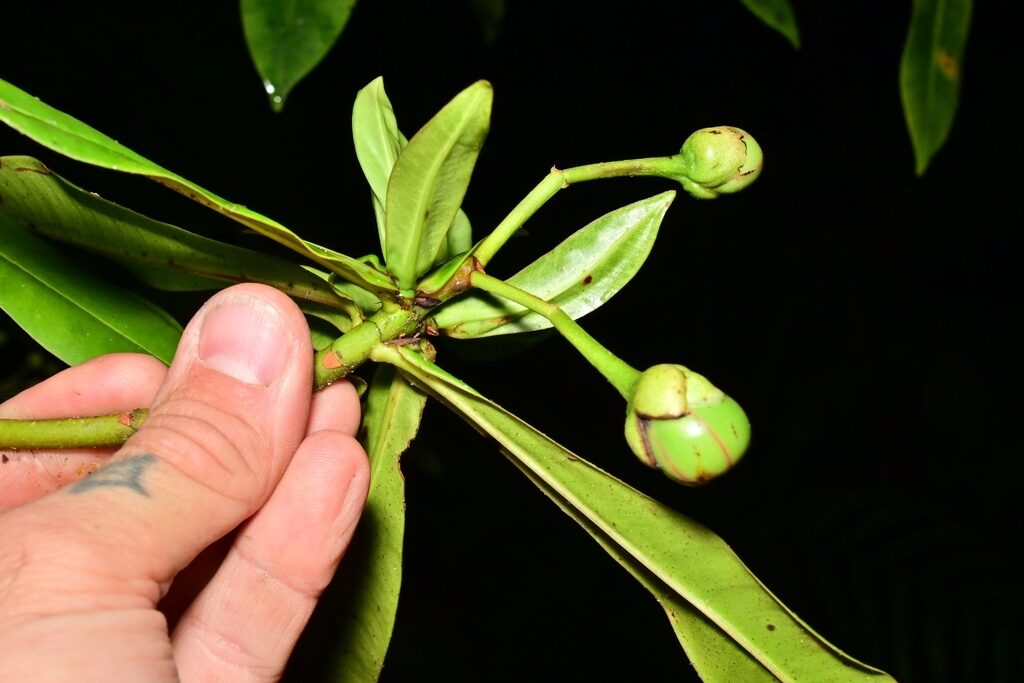
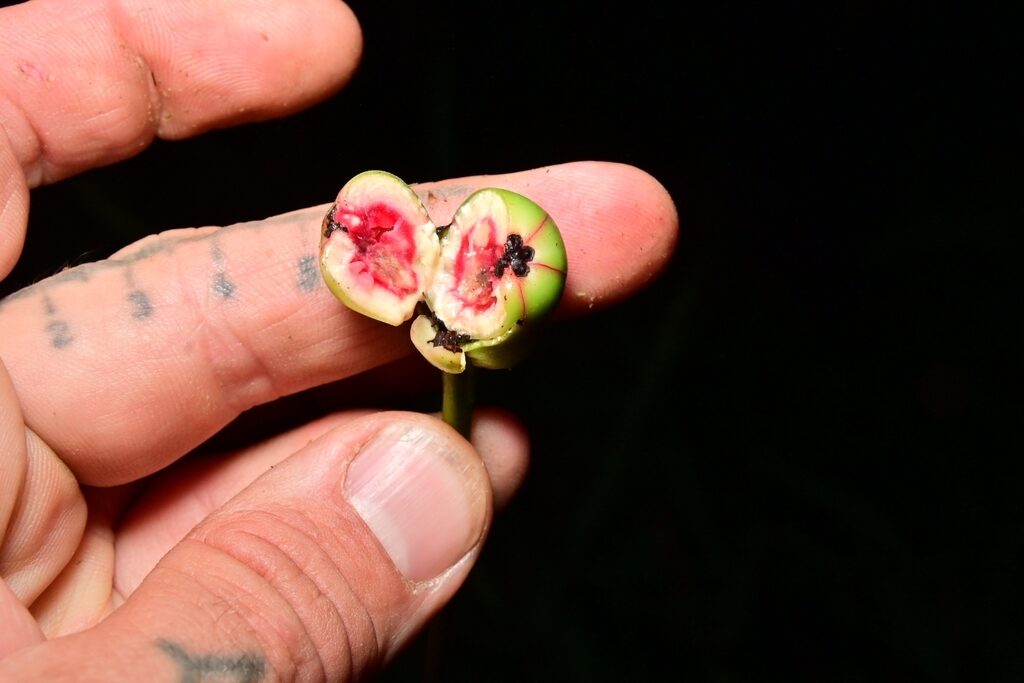
The flowers are small and held in erect clusters about 5 to 11 centimeters long. In bud they are round, 7 to 10 millimeters across, with the outer sepals separate and persisting into fruit; the petals are pale green to whitish. Cut a bud open and the inside is a deep wine-red, the color the whole group carries in its flower and fruit. Flowering in Costa Rica runs across much of the year, recorded from January to April, July to September, and November. Las flores son pequeñas y se llevan en racimos erectos de unos 5 a 11 centímetros de largo. En botón son redondas, de 7 a 10 milímetros de diámetro, con los sépalos externos separados y persistentes hasta el fruto; los pétalos son de verde pálido a blanquecino. Abra un botón y el interior es de un rojo vino intenso, el color que todo el grupo lleva en flor y fruto. La floración en Costa Rica se extiende por buena parte del año, registrada de enero a abril, de julio a setiembre y en noviembre.
Fruit Fruto
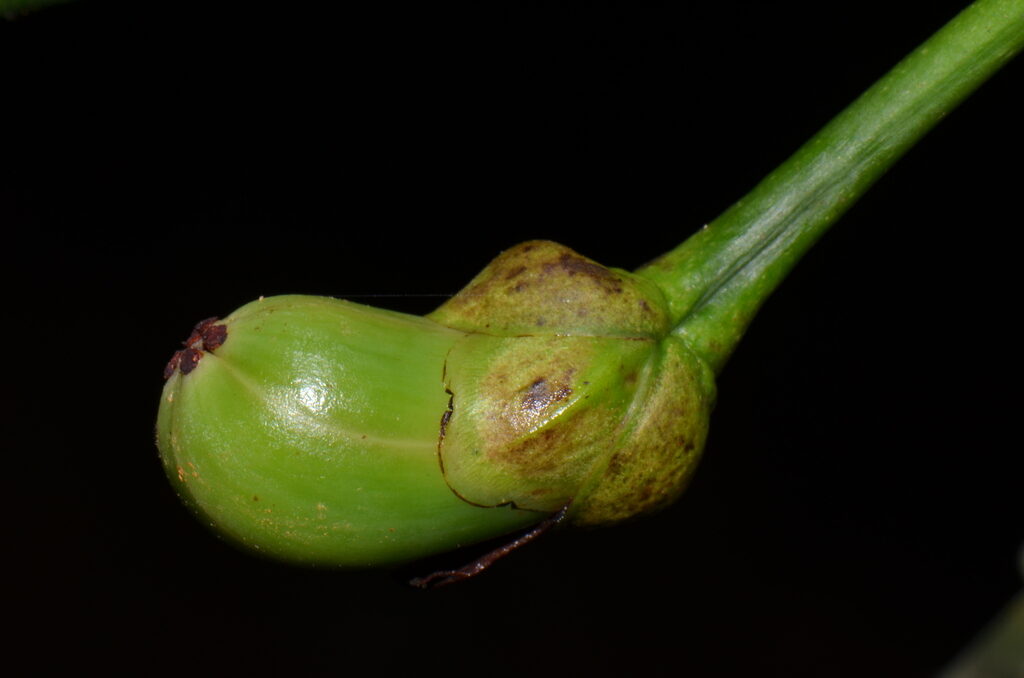
The fruit is a green to green-purple capsule, pear-shaped and 3 to 4 centimeters long. When ripe it splits, the valves bending back to reveal the wine-red inside and the seeds, each about a centimeter and a half long and wrapped in a fleshy orange aril. That bright aril against the red is the tree's offer to the birds it relies on to carry the seeds away, the standard exchange across the mangosteen family. El fruto es una cápsula verde a verde-púrpura, piriforme y de 3 a 4 centímetros de largo. Al madurar se abre, con las valvas dobladas hacia atrás que revelan el interior rojo vino y las semillas, cada una de cerca de centímetro y medio de largo y envuelta en un arilo carnoso anaranjado. Ese arilo brillante contra el rojo es la oferta del árbol a las aves de las que depende para llevarse las semillas, el intercambio habitual en la familia del mangostán.
Distribution Distribución
The species ranges from southeastern Nicaragua south through Costa Rica and Panama and on across northern and Andean South America to Bolivia, the Guianas, and western Brazil. In Costa Rica it grows on both the Caribbean and Pacific slopes, in very wet and pluvial forest from near sea level to about 1,200 meters, locally higher. Its Costa Rican record is large, more than 160 collections from nearly a hundred localities, and a good third of those localities lie in the Brunca region of the south: the Osa Peninsula and Corcovado, the Golfo Dulce forests around Piedras Blancas and La Gamba, and the ridges of the Fila Costeña and the Talamanca foothills. It is a common tree of these wet southern forests. La especie se distribuye desde el sureste de Nicaragua hacia el sur por Costa Rica y Panamá y a través del norte y los Andes de Sudamérica hasta Bolivia, las Guayanas y el oeste de Brasil. En Costa Rica crece en ambas vertientes, la caribeña y la pacífica, en bosque muy húmedo y pluvial desde cerca del nivel del mar hasta unos 1.200 metros, localmente más alto. Su registro costarricense es amplio, más de 160 colecciones de cerca de cien localidades, y una buena tercera parte de esas localidades queda en la región Brunca del sur: la Península de Osa y Corcovado, los bosques del Golfo Dulce alrededor de Piedras Blancas y La Gamba, y las crestas de la Fila Costeña y el pie de monte de Talamanca. Es un árbol común de estos bosques húmedos del sur.
One caution for anyone counting from a database: the global figures for this name pool together populations from across South America that recent botanists would split into several species, so the raw country totals run higher than a strict reading of the Costa Rican tree would give. Una advertencia para quien cuente desde una base de datos: las cifras globales de este nombre agrupan poblaciones de toda Sudamérica que los botánicos recientes separarían en varias especies, de modo que los totales crudos por país resultan más altos de lo que daría una lectura estricta del árbol costarricense.
Ecology Ecología
Because the tree is dioecious, every fruiting individual depends on pollen carried from a separate male tree, though what does the carrying has not been recorded for this species; the small greenish flowers give little away, and no pollinator study exists for it. The seed side is clearer in outline if not in detail: the orange aril is the classic reward of a bird-dispersed seed, and across the mangosteen family these arillate seeds are taken by fruit-eating birds. No one has published the birds for this particular tree, so the dispersal is read from the fruit rather than from observation. The stilt-root habit, shared with several of its relatives, lets the tree hold itself up in wet, unstable, or waterlogged ground, and sometimes it starts as an epiphyte and sends roots down to the forest floor. Como el árbol es dioico, cada individuo fructífero depende del polen traído desde un árbol masculino aparte, aunque qué lo trae no se ha registrado para esta especie; las pequeñas flores verdosas revelan poco, y no existe un estudio de polinización para ella. El lado de la semilla es más claro en su forma si no en su detalle: el arilo anaranjado es la recompensa clásica de una semilla dispersada por aves, y en toda la familia del mangostán estas semillas ariladas son consumidas por aves frugívoras. Nadie ha publicado las aves para este árbol en particular, de modo que la dispersión se lee del fruto más que de la observación. El hábito de raíces zancudas, compartido con varios de sus parientes, le permite sostenerse en suelo húmedo, inestable o anegado, y a veces comienza como epífita y baja raíces hasta el suelo del bosque.
Taxonomic History Historia Taxonómica
This tree has carried more than one name, and the change is recent enough that most Costa Rican books still use the old one. It was described in 1860 by Jules Planchon and José Triana, in their monograph of the mangosteen family, as Tovomita weddelliana. The epithet honors Hugh Algernon Weddell, the Anglo-French botanist who explored the Andes and is remembered above all for his work on the cinchona trees, the source of quinine, in the same South American highlands the type material came from. Este árbol ha llevado más de un nombre, y el cambio es lo bastante reciente como para que la mayoría de los libros costarricenses todavía usen el antiguo. Fue descrito en 1860 por Jules Planchon y José Triana, en su monografía de la familia del mangostán, como Tovomita weddelliana. El epíteto honra a Hugh Algernon Weddell, el botánico anglo-francés que exploró los Andes y es recordado sobre todo por su trabajo sobre los árboles de quina, la fuente de la quinina, en las mismas tierras altas sudamericanas de donde vino el material tipo.
For a century and a half it sat in the genus Tovomita. Then, in 2019, a study by Lucas Marinho and colleagues that read whole chloroplast genomes across the group found that Tovomita as it stood was not a single natural lineage: the weddelliana group fell well apart from the core of the genus, closer to Clusia and its kin. To set the boundaries straight, the authors lifted the eighteen species of that group into a new genus, Arawakia, with this tree as its type. They named it for the Arawak peoples, whose homelands, from the Greater Antilles down through the Amazon and the Andean slopes, trace much the same map as the trees. Durante un siglo y medio estuvo en el género Tovomita. Luego, en 2019, un estudio de Lucas Marinho y colegas que leyó genomas completos de cloroplasto en todo el grupo halló que Tovomita tal como estaba no era un único linaje natural: el grupo de weddelliana quedaba bien apartado del núcleo del género, más cerca de Clusia y sus parientes. Para enderezar los límites, los autores elevaron las dieciocho especies de ese grupo a un nuevo género, Arawakia, con este árbol como su tipo. Lo nombraron por los pueblos arawak, cuyos territorios, de las Antillas Mayores hasta la Amazonía y las laderas andinas, trazan más o menos el mismo mapa que los árboles.
The botanical databases have not fully settled around the change. Kew's Plants of the World Online accepts Arawakia but takes a broad view of this species, folding the whole eighteen-species complex into one widespread A. weddelliana with dozens of synonyms; the global biodiversity backbone accepts the genus but keeps the species narrow; and World Flora Online has not adopted the new genus at all, keeping the tree as Tovomita weddelliana. The Costa Rican plant comes out the same either way; only its address changes. The family itself, the Clusiaceae, also goes by the older name Guttiferae. Las bases de datos botánicas no se han asentado del todo en torno al cambio. Plants of the World Online de Kew acepta Arawakia pero toma una visión amplia de esta especie, fundiendo todo el complejo de dieciocho especies en una sola A. weddelliana de amplia distribución con decenas de sinónimos; la base global de biodiversidad acepta el género pero mantiene la especie en sentido estrecho; y World Flora Online no ha adoptado el nuevo género en absoluto, y mantiene el árbol como Tovomita weddelliana. La planta costarricense resulta la misma de cualquier modo; solo cambia su dirección. La familia misma, las Clusiaceae, lleva también el nombre antiguo de Guttiferae.
Similar Species Especies Similares
Several Costa Rican relatives share the stilt-rooted, narrow-leaved look. The closest in habit is Tovomita longifolia, the mangle dulce, which also stands on stilt roots but parts ways on the details: its leaves are clearly stalked and elliptic, with a handful of well-spaced, visible side veins, and it bleeds cream to bright yellow latex rather than white. Tovomita stylosa has long styles and stalked leaves. Beyond the genus, the great swamp tree Symphonia globulifera, the cerillo, raises a far taller cone of stilt roots and gives off bright yellow latex and small red flowers. The sure mark of mangle blanco is the set of narrow, nearly stalkless leaves with their crowded invisible veins, on a stilt-rooted tree that bleeds white. Varios parientes costarricenses comparten el aspecto de raíces zancudas y hojas angostas. El más cercano en hábito es Tovomita longifolia, el mangle dulce, que también se sostiene sobre raíces zancudas pero difiere en los detalles: sus hojas son claramente pecioladas y elípticas, con unas pocas venas laterales visibles y bien espaciadas, y sangra látex de crema a amarillo brillante en vez de blanco. Tovomita stylosa tiene estilos largos y hojas pecioladas. Más allá del género, el gran árbol de pantano Symphonia globulifera, el cerillo, levanta un cono mucho más alto de raíces zancudas y despide látex amarillo brillante y pequeñas flores rojas. La marca segura del mangle blanco es el conjunto de hojas angostas, casi sésiles, con sus venas apretadas e invisibles, en un árbol de raíces zancudas que sangra blanco.
Conservation Outlook Perspectiva de Conservación
The IUCN Red List assesses the species as Least Concern, the rating its wide range and local abundance support. It is common across the Isthmus and into South America, well represented in Costa Rican collections, and it grows in many of the country's protected wet forests, including Corcovado and Piedras Blancas national parks and the Golfo Dulce Forest Reserve on and around the Osa. As with many common forest trees, the worthwhile questions left are biological: who pollinates the small wine-hearted flowers, which birds carry the orange-arilled seeds, and how the populations now lumped under one name across two continents will sort out as botanists keep looking. For the Costa Rican mangle blanco, the name on the label may keep shifting; the stilt-rooted tree with the hidden veins will be the same one in the forest. La Lista Roja de la UICN evalúa la especie como de Preocupación Menor, la categoría que respaldan su amplio rango y su abundancia local. Es común por todo el Istmo y hacia Sudamérica, bien representada en las colecciones costarricenses, y crece en muchos de los bosques húmedos protegidos del país, entre ellos los parques nacionales Corcovado y Piedras Blancas y la Reserva Forestal Golfo Dulce en la Osa y sus alrededores. Como en muchos árboles comunes del bosque, las preguntas que quedan valen por lo biológico: quién poliniza las pequeñas flores de corazón vino, qué aves llevan las semillas de arilo anaranjado, y cómo se ordenarán las poblaciones hoy agrupadas bajo un solo nombre a través de dos continentes a medida que los botánicos sigan mirando. Para el mangle blanco costarricense, el nombre en la etiqueta puede seguir cambiando; el árbol de raíces zancudas y venas ocultas será el mismo en el bosque.
Resources & Further Reading Recursos y Lecturas Adicionales
Species Information Información de la Especie
Plants of the World Online entry for the accepted name, with range and synonymy (a broad species concept). Entrada de Plants of the World Online para el nombre aceptado, con rango y sinonimia (un concepto amplio de especie).
Global occurrence records and the IUCN Least Concern assessment. Registros globales de ocurrencia y la evaluación UICN de Preocupación Menor.
Taxonomy & Nomenclature Taxonomía y Nomenclatura
Nomenclatural data, including the basionym Tovomita weddelliana. Datos nomenclaturales, incluido el basónimo Tovomita weddelliana.
The phylogenetic study (Molecular Phylogenetics and Evolution 134) that erected the genus Arawakia. El estudio filogenético (Molecular Phylogenetics and Evolution 134) que erigió el género Arawakia.
Related Reading Lecturas Relacionadas
On the cinchona explorer for whom the species is named. Sobre el explorador de la quina en honor a quien se nombra la especie.
Biography of the Anglo-French botanist (1819-1877). Biografía del botánico anglo-francés (1819-1877).