Mangle Negro
Avicennia germinans — The black mangrove sends pencil-like breathing roots called pneumatophores up through the mud, allowing it to survive in oxygen-starved sediments. Named for the medieval Persian polymath Ibn Sina, this species produces a prized honey and occupies the critical middle zone in Costa Rica's mangrove forests.
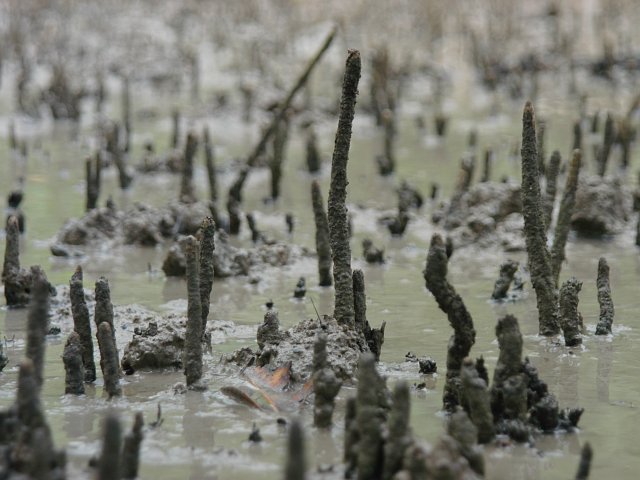
Walk through a mangrove forest at low tide and you will encounter a strange landscape: thousands of finger-like projections rising from the mud, each about the height of a pencil. These are pneumatophores, the breathing roots of the black mangrove. While other trees would suffocate in the oxygen-depleted muck of tidal mudflats, the black mangrove has evolved a remarkable solution. Its horizontal root system sends up vertical snorkels that pierce the sediment surface, drawing oxygen directly from the air and channeling it down to the submerged roots below.
Look closer at the leaves and you may notice a white crust forming on their surfaces. Like its relative the white mangrove, the black mangrove excretes salt through specialized glands, expelling the sodium that would otherwise poison its tissues. These salt crystals give mature leaves a grayish-white appearance. Between its breathing roots below and salt-shedding leaves above, the black mangrove has mastered life at the boundary of land and sea.

The Middle Zone
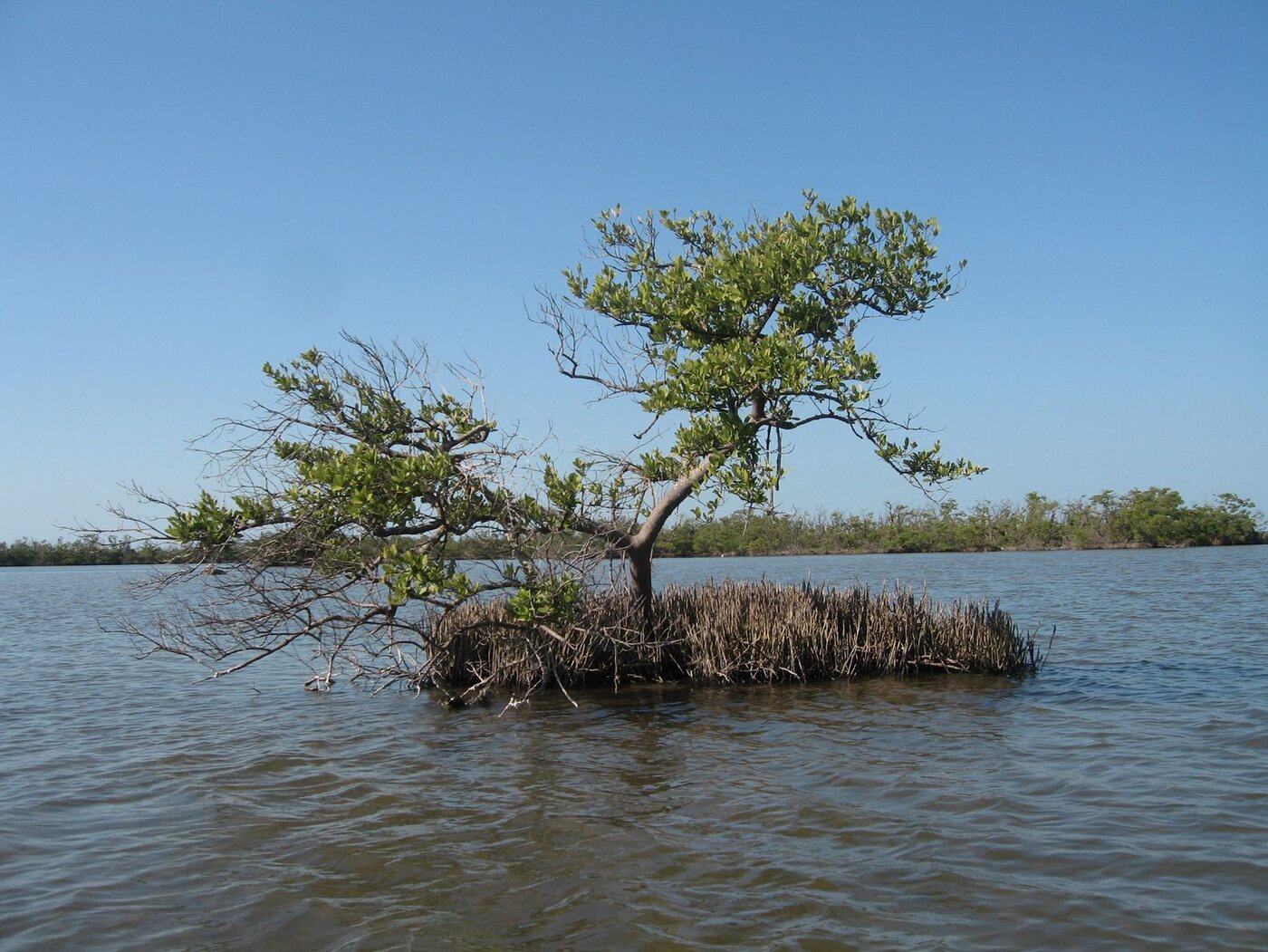
In Costa Rica's mangrove ecosystems, species arrange themselves in distinct bands based on their tolerance to flooding and salinity. Moving inland from the water's edge, the red mangrove (Rhizophora mangle) stands in the deepest water with its arching prop roots. Behind it, occupying the middle zone, grows the black mangrove with its forest of pneumatophores. Further inland still, where freshwater influence increases, the white mangrove (Laguncularia racemosa) takes over. This zonation reflects millions of years of evolutionary specialization: each species has found its niche in the gradient between ocean and land.
The black mangrove is a major component of Costa Rica's Pacific coast mangroves, including the Gulf of Nicoya and the Térraba-Sierpe wetland system. In the wetter southern Pacific, where annual rainfall is high and freshwater input remains fairly constant year-round, black mangroves can grow into tall trees. In the drier northern Pacific around Guanacaste, the same species may grow as a low shrub. This plasticity allows Avicennia germinans to thrive across a remarkable range of conditions.
Identification
Taxonomy & Nomenclature
The genus Avicennia honors one of the greatest minds of medieval Islamic science: the Persian polymath Abu Ali al-Husayn ibn Abd Allah ibn Sina (980-1037 CE), known in the West as Avicenna. His encyclopedic works on medicine, philosophy, and natural history profoundly influenced European thought for centuries. Linnaeus, an admirer of Avicenna's contributions to natural philosophy, selected this name when he formally described the genus in his Species Plantarum of 1753.
The species epithet germinans comes from the Latin verb germinare, meaning "to sprout" or "to germinate." This name refers to the species' distinctive reproductive strategy: cryptovivipary, in which the embryo begins to develop while the fruit is still attached to the parent tree. The propagules are already partially germinated when they fall, giving them a head start in the race to establish themselves in the shifting tidal environment.
The taxonomic placement of Avicennia has been contentious. Historically, botanists placed it in the verbena family (Verbenaceae), and some later proposed a separate monogeneric family, Avicenniaceae. Modern molecular phylogenetic studies have resolved this debate by showing that Avicennia is nested within the Acanthaceae (bear's breeches family), where it now resides in the subfamily Avicennioideae. The genus contains about eight species worldwide, with A. germinans being the primary species in the Americas.
Distinguishing Features
The black mangrove is readily identified by its pneumatophores: vertical, pencil-like projections that rise 10-30 cm above the mud surface, emerging from horizontal cable roots that may extend several meters from the trunk. These breathing roots allow gas exchange in the anaerobic sediment, with specialized tissue (aerenchyma) conducting oxygen down to the submerged root system.
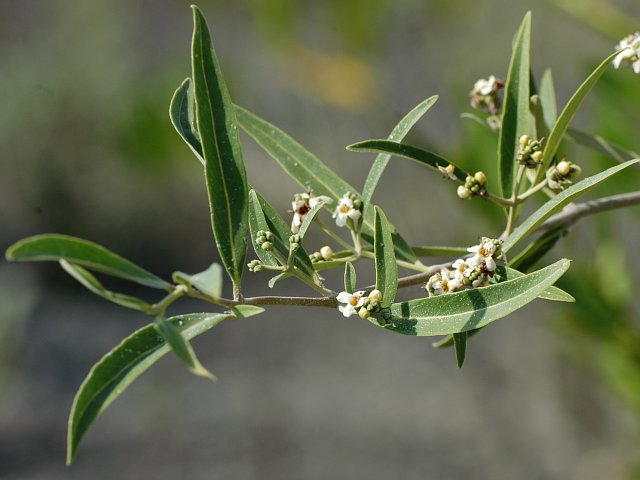
The leaves are simple, opposite, and measure 5-8 cm long by 2-3 cm wide. They are thick and leathery with a dark green upper surface and a distinctive gray-green to whitish lower surface covered in fine hairs. Salt crystals often encrust the upper leaf surface, a visible sign of the plant's salt-secreting glands. The bark is dark gray to brown, smooth on young trees but becoming thick and fissured with irregular flattened scales on mature specimens.

Salt Tolerance
The black mangrove employs a two-pronged strategy to deal with the salt that would kill most plants. First, its roots filter out a remarkable proportion of salt before water enters the plant: studies suggest the roots can exclude roughly 90% or more of the salt from seawater. Second, the salt that does enter the plant is actively excreted through specialized glands on the leaf surfaces.
Each salt gland consists of about 8 secretory cells arranged in a pit on the upper leaf surface. The process is metabolically expensive, requiring energy from the plant's mitochondria. Salt solution accumulates in subcuticular spaces until it bursts through the cuticle, releasing droplets that evaporate and leave behind the characteristic white crystals. Research has shown that salt secretion increases with environmental salinity, demonstrating active regulation. At moderate salinity, increased secretion helps the plant sustain relatively high rates of carbon assimilation, though under hypersaline conditions, even this sophisticated mechanism becomes overwhelmed.
Reproduction
The black mangrove flowers mainly in the warmer months, and nearly year-round in the tropical parts of its range, producing small, fragrant white to pale yellow flowers with four petals arranged in dense clusters at branch tips. The flowers are strongly scented, attracting a diverse array of pollinators including bees, wasps, flies, and butterflies. In Florida, black mangrove nectar supports a significant beekeeping industry, producing a distinctive honey with amber color and hints of caramel.
After pollination, the fruit develops as a flattened, lima bean-shaped capsule about 2-3 cm long. Unlike the red mangrove with its dramatic elongated propagules, the black mangrove practices cryptovivipary: the embryo germinates inside the fruit while still on the tree, but does not rupture the fruit coat until after dispersal. When the propagule falls into the water, it floats with remarkable buoyancy. Studies have shown that propagules in full-strength seawater (36 ppt) can remain buoyant for over 110 days, enabling long-distance dispersal by ocean currents, though establishment success declines the longer a propagule drifts.
Once stranded on suitable sediment, the propagule quickly establishes, roots taking hold within days. The cotyledons are thick and bright green, folding double as they emerge. Young trees begin flowering after several years of establishment, though in stressed conditions they may remain shrubby for much longer.
Ecology
Black mangrove forests provide crucial ecosystem services. Their dense pneumatophore networks trap sediment, building land and protecting coastlines from erosion. The complex root habitat shelters juvenile fish, crabs, shrimp, and countless invertebrates. Studies estimate that mangrove forests support an annual abundance of over 700 billion juvenile fish and invertebrates globally, with many commercially important species depending on mangroves during their early life stages.
The black mangrove also excels at carbon sequestration. Mangrove forests sequester carbon at rates up to ten times greater than upland tropical forests, with much of this carbon locked in their extensive root systems and the sediments they accumulate. A single hectare of mangrove forest provides valuable ecosystem services, including coastal protection, fisheries support, and carbon storage.
Human Uses
Throughout its range, the black mangrove has served human communities in numerous ways. The hard, heavy wood is extremely durable even when submerged, making it valuable for marine construction, boat ribs, pilings, and wharves. The bark contains about 12.5% tannin and has been used for tanning leather and producing dyes. Smoke from burning the wood effectively repels mosquitoes.
Traditional medicine has found many applications for black mangrove. Bark decoctions have been used to promote childbirth, while powdered bark treats skin complaints and parasites. The bark resin has been applied to tumors, diarrhea, hemorrhage, rheumatism, and wounds. Root preparations serve as aphrodisiacs and treatments for intestinal problems.
Conservation
The black mangrove is currently listed as Least Concern on the IUCN Red List, reflecting its wide distribution across the tropical Americas and West Africa. However, mangrove ecosystems worldwide face significant threats from coastal development, aquaculture, pollution, and climate change. Sea level rise may outpace the ability of mangroves to migrate landward, particularly where human development blocks their retreat.
In Costa Rica, black mangrove forests receive protection through several mechanisms. The Térraba-Sierpe wetlands are protected as a Forest Reserve and, since 1995, as a RAMSAR Wetland of International Importance. The Gulf of Nicoya has a regional mangrove management strategy covering 2019-2030. Restoration efforts, led by organizations such as CATIE with local community associations in the Gulf of Nicoya and Osa Conservation in the Térraba-Sierpe, have reopened silted channels to restore tidal flow, with black mangrove seedlings recolonizing the reopened canals. These efforts recognize that protecting mangroves means protecting fisheries, coastlines, and carbon stores that benefit far beyond the wetlands themselves.
Resources & Further Reading
Species Information
Comprehensive overview of black mangrove taxonomy, distribution, and ecology.
Detailed species profile including identification, habitat, and ecological significance.
Traditional uses, cultivation requirements, and wood properties.
Bark, leaf pubescence, and pneumatophore respiration in the black mangrove.
Detailed morphology: trunk, pneumatophores, aerenchyma, leaf and fruit dimensions, and pantropical range.
Salt Physiology
Scientific review of salt gland mechanisms in recretohalophytes including mangroves.
Study showing leaf salt-secretion rate rises with salinity and root exclusion reaches roughly 90% or more in black mangrove.
Costa Rica Mangroves
Overview of Costa Rica's mangrove ecosystems and their conservation.
Research on growth rings and wood anatomy in Costa Rican mangroves.
Account of channel-excavation restoration in the Gulf of Nicoya, with black mangrove recolonizing the reopened canals.
Reporting on mangrove loss, restoration by Osa Conservation, and the prominence of red mangrove in Térraba-Sierpe.
Official regional strategy for the management and conservation of Gulf of Nicoya mangroves.
Ecology & Reproduction
Primary study for propagule buoyancy (over 110 days at 36 ppt) and declining establishment success with dispersal time.
Primary study estimating the global annual abundance of juvenile fish and invertebrates supported by mangroves.
Authoritative source for the "ten times" mangrove carbon-sequestration-rate comparison with tropical forests.
Taxonomy & Nomenclature
Comprehensive review of Avicennia taxonomy, distribution, and medicinal potential.
Biography of the Persian polymath for whom the genus is named.
Kew's International Plant Names Index entry confirming Linnaeus published the genus in Species Plantarum (1753).
Peer-reviewed molecular phylogeny confirming the genus's eight species and its placement within Acanthaceae.