The Unarmed Guard
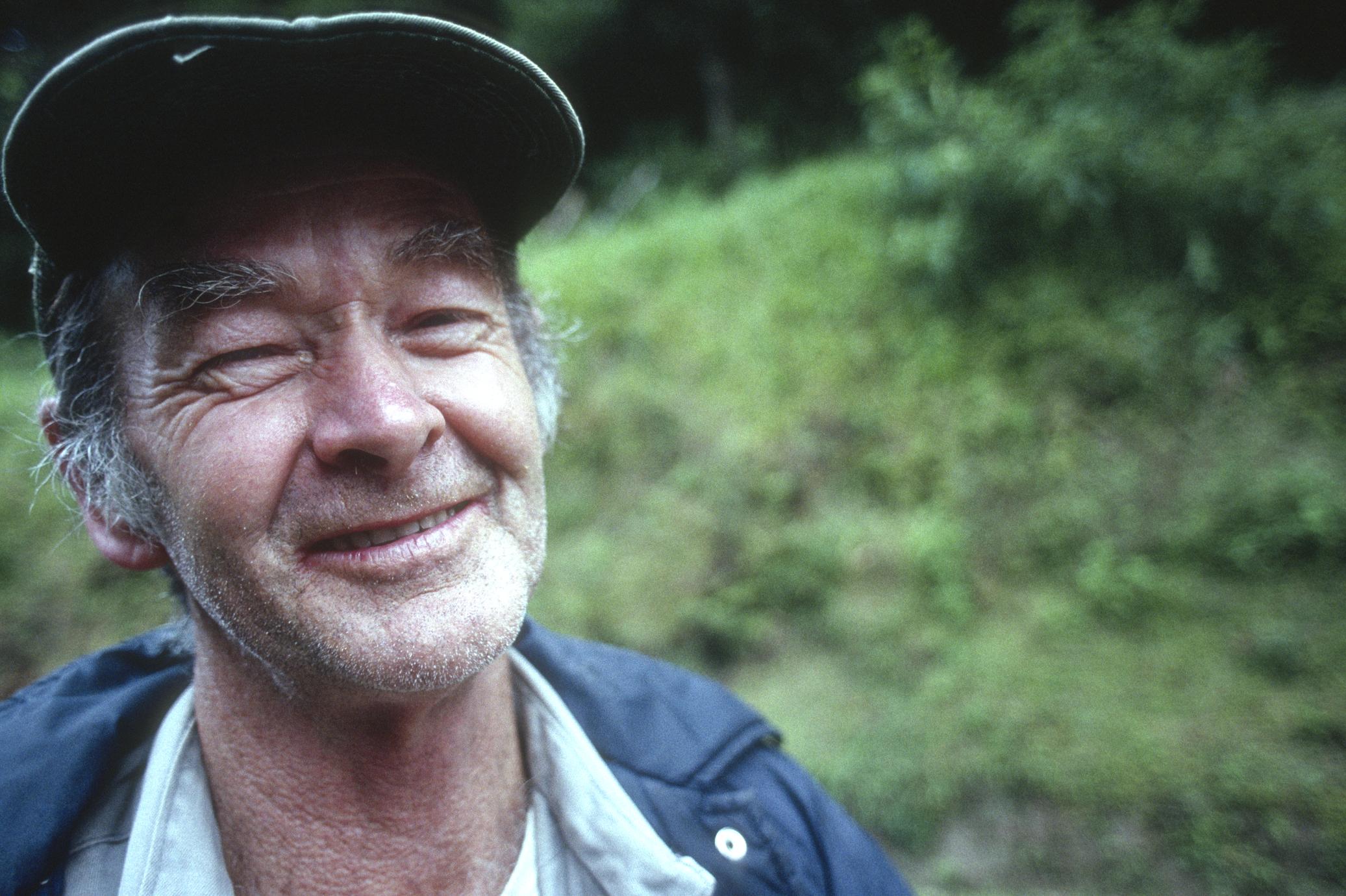
Wolf Guindon sold the first chainsaws in Costa Rica, then spent four decades patrolling the cloud forest he helped protect, unarmed, guided by the same Quaker conscience that got him arrested at eighteen.
In April 1970, two young biologists from UC Davis rented a cabin on a dairy farm in Monteverde, Costa Rica. George and Harriett Powell had come with Bill and Ruth Buskirk. George was studying mixed-species songbird flocks for his doctorate. Their landlord was the first chainsaw dealer in Costa Rica, a man who imported machines to help his neighbors clear forest faster for pasture. His name was Wilford "Wolf" Guindon.
"I didn't pay them much mind," Wolf later recalled, "and certainly didn't see that there was my destiny walking up the road."
The Refusal
Wilford Francis Guindon was born on August 17, 1930, in Barnesville, Ohio, to a family of German-Swiss Quakers. His brother Clifford graduated from Olney Friends School, the Quaker boarding school in Barnesville, and worked as its farm manager for thirty-one years. A dormitory at Olney still bears the Guindon name. The family belonged to Stillwater Monthly Meeting, one of the most conservative Quaker congregations in America. This was the culture Wolf came from: plain, stubborn, principled.
Wolf's mother, Bertha, was institutionalized for depression when he was five. She spent most of his childhood in the Ohio State Mental Institution. "As children, we wondered what she was being punished for, being sent away like that," Wolf said. "I didn't understand the situation." His father Albert raised the children on the farm, teaching by doing rather than talking. "Daddy was never one to dictate or preach to us. I somehow understood that when we were repairing a tractor, doing farm work or traveling together, we weren't to ask a lot of questions." Wolf absorbed Quaker philosophy "by osmosis," as he put it: "guiding and showing and understanding the value of being honest, honoring your body and health, and practicing nonviolence in all aspects of life."
How Wolf got from Ohio to Fairhope, Alabama, is undocumented. Fairhope itself was unusual: a single-tax colony founded in 1894 on the economic theories of Henry George, which attracted Quakers from across the country. The Fairhope Monthly Meeting was established in 1919 with fifty-two members, under the care of Ohio Yearly Meeting (Conservative, meaning the branch that kept the old ways: silent worship, no pastors, plain living). It was a community of people who took ideas seriously enough to move for them.
In 1948, the United States enacted the Selective Service Act, establishing peacetime conscription for the first time in the nation's history. Four young Quaker men from the Fairhope Meeting refused to register: Wilford Guindon, Howard Rockwell, Leonard Rockwell, and Marvin Rockwell. Marvin's statement to the court: "I cannot imagine Christ in a military uniform taking training in the art of murder."
They were arrested in December 1948. Ten months later, on October 26, 1949, they entered pleas of nolo contendere before U.S. District Judge John McDuffie in Mobile. The judge told them: "Those who oppose the laws of this country should get out of this country and stay out." He sentenced each to one year and one day, eligible for parole after four months. They were taken to Mobile County jail, then transferred to the Federal Correctional Institution in Tallahassee, Florida.
Wolf served four months and one day. He worked in the prison dairy and still knew his inmate number by heart decades later: 7310. Released on parole February 27, 1950, all four men refused again to sign the draft registration cards. The prison warden signed the cards for each of them so they would not be immediately rearrested.
Wolf's father Albert had been struck in the head by a pry lever while Wolf was in prison. He died a few months after Wolf's release, in the spring of 1950, from a blood clot caused by the accident. He was fifty-six. "It was very hard for me to go back to doing the chores and jobs that we had shared before Daddy's death," Wolf said. "When the group of us decided to go to Costa Rica it was very difficult for me to leave Fairhope, but one of the consolations I had was that I didn't have to leave my father."
The Country Without an Army
Costa Rica had abolished its army in 1948 after its civil war. President José Figueres welcomed foreign development. Wolf read about it in Reader's Digest: Figueres "invited people from developed countries to come and invest in Costa Rica. He requested help in making productive farmland out of the largely forested countryside." Wolf was interested. Forested land was cheap. "Of course," he added, "one of the big things in favor of Costa Rica was the new constitution that abolished the army. That was the bonus as well as the reason to come down here."
On October 14, 1950, Wolf married Emma Lucille "Lucky" Standing from Earlham, Iowa. He was twenty. She was eighteen. Lucky later recalled: "I didn't know anything about Costa Rica. Like everyone else I thought it was Puerto Rico. I wasn't particularly the adventurous sort, but if that was where he was going, that was where I was going."
On November 21, 1950, approximately forty-four Quakers in about eleven families flew Pan American Airlines from New Orleans to Guatemala City, then took a smaller plane to La Sabana Airport outside San José. Arthur Rockwell, one of the founding settlers, said: "We do not feel that our gesture in coming here was a striking blow against war." They were trying to live according to their convictions.
An advance party had found land near the village of Monteverde, at about 1,400 meters elevation on the Pacific slope of the Continental Divide. They purchased approximately 1,400 hectares from the Guacimal Land Company and local families for roughly $50,000. The land was divided into individual farms, with parcels reserved for a Friends School, a Meeting House, and a cheese plant. One-third of the total, about 554 hectares, was set aside as "The Watershed Property" to protect the headwaters of the Guacimal River, one of Costa Rica's first private conservation reserves. Costa Rican families, the Arguedas, Leitón, and Vargas among them, had settled the area between 1915 and 1920. The Quakers were newcomers. Fermín Arguedas, twelve years old when they arrived, remembered: "With them, peace came to our mountain."
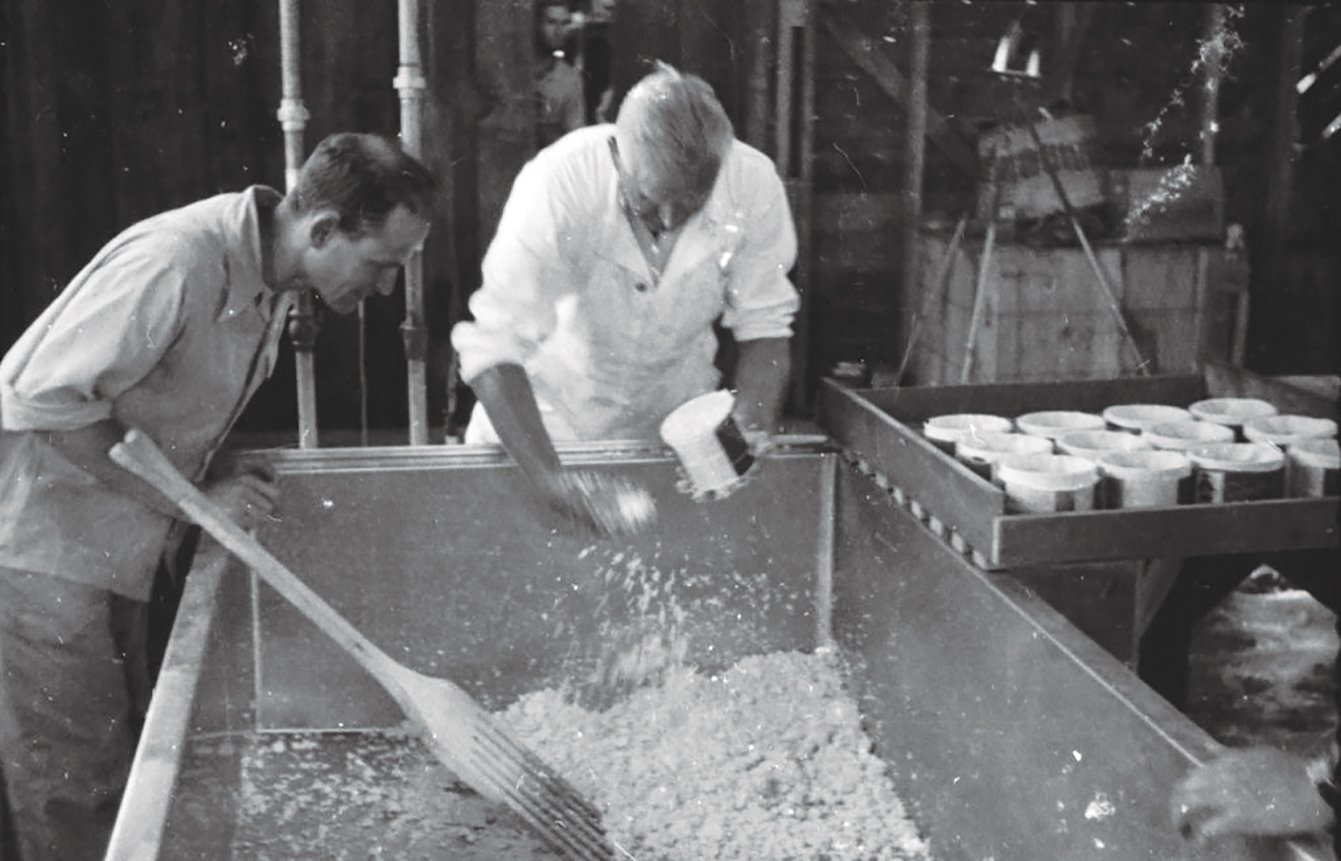
The road to Monteverde was traversable only by horse. Fresh milk could not be sold, so the community learned to make cheese. The Monteverde Cheese Factory, founded in 1953, initially produced about ten kilograms per day, the first pasteurized cheese in Costa Rica. After fifteen years managed mostly by Quaker families, the cooperative expanded to over three hundred associates, the majority local Costa Ricans, producing prize-winning cheeses, yogurts, and ice cream. Wolf helped establish the Coopesima credit union in 1953, the first in the Santa Elena area, to combat the five-percent-per-month interest rates that were devastating local families. The dairy plant, he said, "is one of the things I take a lot of pride in, knowing that the start was an act of faith."
Wolf became the first chainsaw dealer in Costa Rica. He imported the machines, taught people how to use them, and sold them across the region. He was clearing forest himself, developing pasture for an expanding dairy. He loved the work. "I loved to hear the trees come down," he said. "The Ticos would shout 'Al suelo!' 'Timber!' as my father would say." He became well known. "You were really somebody when you had a chainsaw."
He was aware of what he was doing. "When my neighbors and I were clearing land and cutting down trees, we thought about how many years it took for the big ones to grow. To look up at a tree that's over a hundred feet high and to start working away on it, I was very aware that the tree was produced well before me and wouldn't be replaced in my lifetime." And: "I believe that no one clears land without having an awareness of the responsibility they have in doing it."
The watershed set-aside and the chainsaw dealership coexisted for twenty years. "From the beginning Mildred Mendenhall said we should be saving the forest," Wolf recalled. "She always had a concern that we didn't cut down 'the last tree.' Even as we were cutting down trees for lumber for our homes she was emphatic that we didn't keep on clearing without considering the value of the forest." The conservation instinct was there from the start. It coexisted with aggressive land clearing. Wolf embodied both impulses simultaneously.
The Awakening
When the Powells discovered how fast the surrounding forest was vanishing, they began raising funds from friends and relatives in the United States to acquire primary forest before it could be cleared. Wolf was skeptical. "Then the sound of the chainsaws got to George," he recalled. "He started to talk seriously about what could be done to protect the forest. I didn't agree with him in the beginning. There was a need for working farms and pasture and crop production. As he was talking about the whole area being protected, I thought he was in the wrong country. I suggested that the idea might work in Brazil or Africa, but not here. A lot of people told him he should go away."
What changed was proximity and economics. "If it hadn't been that George and Harriett moved onto our land and I saw them often over a two-year period, I may not have been detoured into this lifetime project." And then the practical truth: "George needed someone to help with cutting trails, contacting landowners and establishing boundary lines. At the time I was paying my hired hand, Digno Arce, three colones an hour. George offered to pay me five colones an hour against the three." Wolf was honest about this for the rest of his life. "The real truth is that I took on the work because of my love of working in the forest, which I was doing for nothing anyway, and the offer of a cash income."

The golden toad helped justify the effort. A brilliant orange amphibian found nowhere else on Earth, it had been brought to scientific attention by Jerry James, son of Quaker settlers who arrived in 1958. Herpetologist Jay Savage, who had co-founded the Organization for Tropical Studies in 1963, formally described the species in 1966. Wolf helped collect specimens for Savage, chilling pairs and getting them to the airport. The toad's known breeding sites lay in the Brillante tract, a piece of high elfin woodland that Wolf and other settlers had planned to develop for pasture. "We'd had plans to develop pastures up there," Wolf said. "We stopped clearing and added that property to what was being bought up to protect the toads' habitat."
In 1972, George Powell acquired a donation of 328 hectares from the Guacimal Land Company, the Brillante tract, and the Tropical Science Center in San José agreed to manage it as the Monteverde Cloud Forest Reserve. The key organizers were the Powells, Costa Rican biologist Adelaida Chaverri, and CCT director Joseph Tosi, who had first visited Monteverde in 1968 with the ecologist Leslie Holdridge. Wolf's role was specific: he knew the land and the people. He identified desirable parcels, negotiated purchases with local landowners, cut boundary lines, and maintained trails. His son Ricardo described the shift: "It was a whole change in focus."
The Unarmed Guard
When the Powells returned to the United States, they left Wolf, his son Tomás, and a young man named Eladio Cruz to continue the work: finding properties, negotiating purchases, protecting plants and animals, maintaining boundary lines and trails.
Eladio Cruz Leitón grew up in San Luis, the farming community below Monteverde. As a teenager, he went to work on Wolf's dairy farm, where he met the Powells. Beginning in 1972, he assisted with trail development and became a lifelong conservationist. He was the first valley landowner to sell his property to the Monteverde Conservation League in the mid-1980s, hoping to set an example. Two species now bear his name: an ant (Procryptocerus eladio) and an orchid (Brachionidium cruzae). "I went back to Peñas Blancas," Eladio said, "and my mentality was different. I wanted to preserve." Wolf and Eladio spent decades together in the forest. "Neither of us panics if we get off track," Eladio said. "Instead, we sit down and drink a cup of coffee."
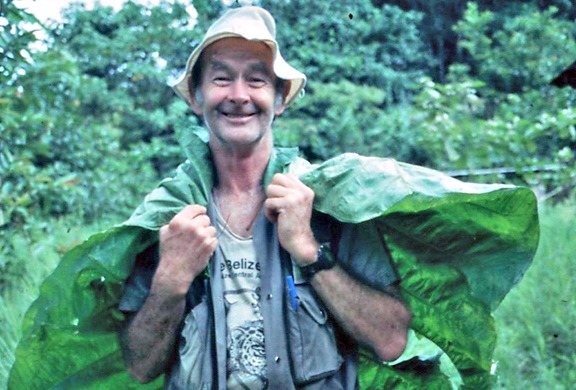
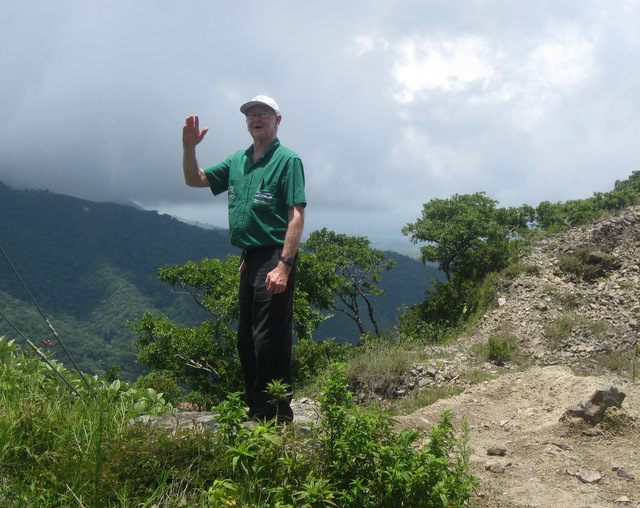
In August 1974, the Quaker community incorporated the Watershed Property as Bosqueterno S.A., "The Eternal Forest." The 554 hectares of mostly steep-sloped primary tropical cloud forest, with the Continental Divide running through it, were leased to the Tropical Science Center as part of the Reserve. On December 27, 1985, Wolf co-founded the Monteverde Conservation League with Bob Law, William Haber, Richard LaVal, Robert Timm, and John Campbell. Twenty-two charter members signed on. Wolf served as the League's first vice-president. Its mission: "preserve, conserve, and rehabilitate tropical ecosystems and their biodiversity."
In 1987, American biologist Sharon Kinsman gave a presentation at Eha Kern's elementary school in Fagervik, Sweden. The students raised enough money to buy six hectares of rainforest adjacent to League land. Kern and her husband Bernd formed Barnens Regnskog, the Children's Rainforest. Between 1988 and 1992, the campaign raised $2 million for land purchases, and spread to schools in forty-four countries. Separately, Sweden's international development agency SIDA funded reforestation, environmental education, and guard programs for the League. The Children's Eternal Rainforest (Bosque Eterno de los Niños) eventually grew to roughly 22,500 hectares, the largest private reserve in Costa Rica. Its name honored both the children's efforts and the Quakers' "Bosqueterno" from 1951. Eha Kern and Roland Tiensuu won the Goldman Environmental Prize.
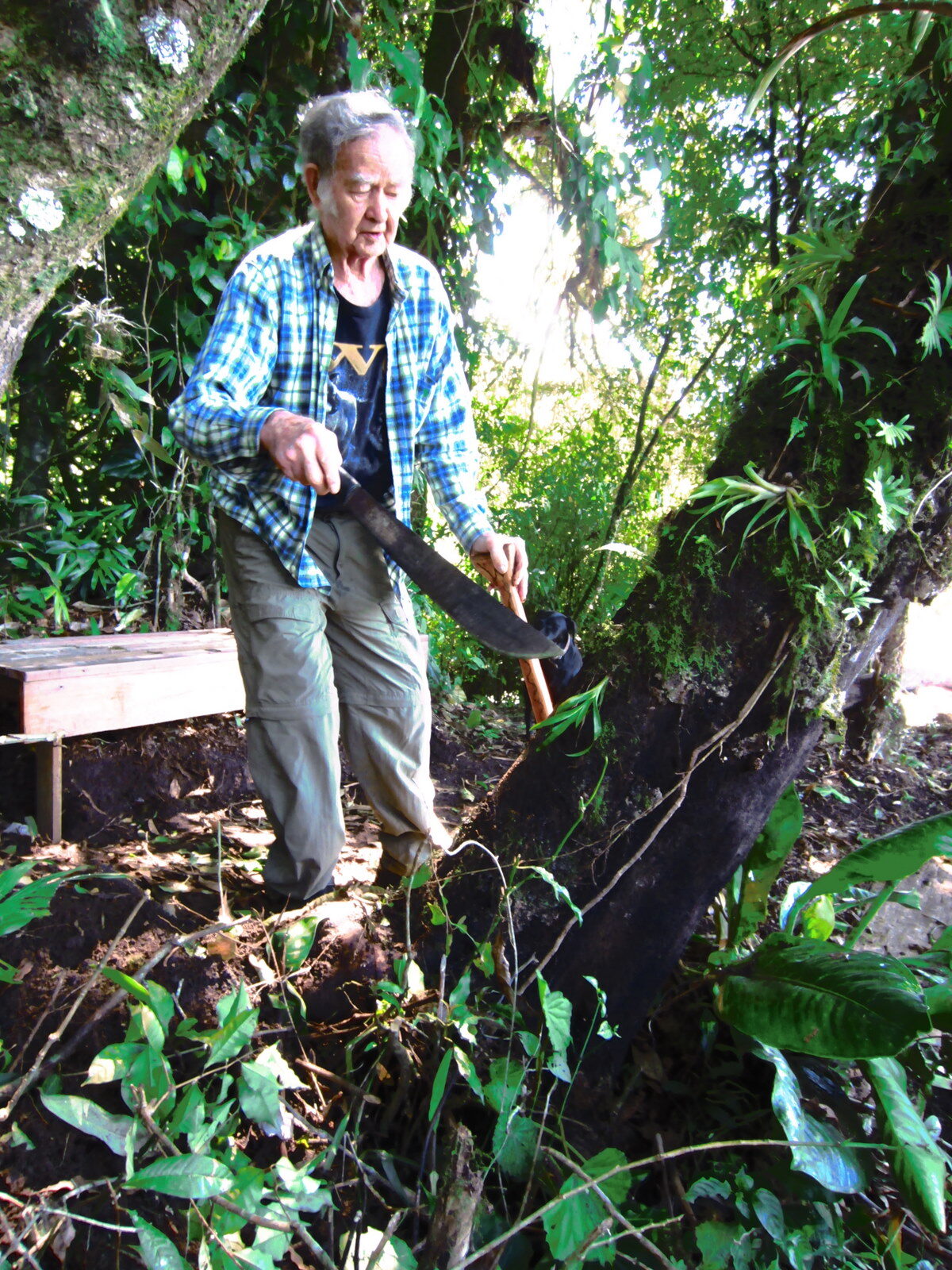
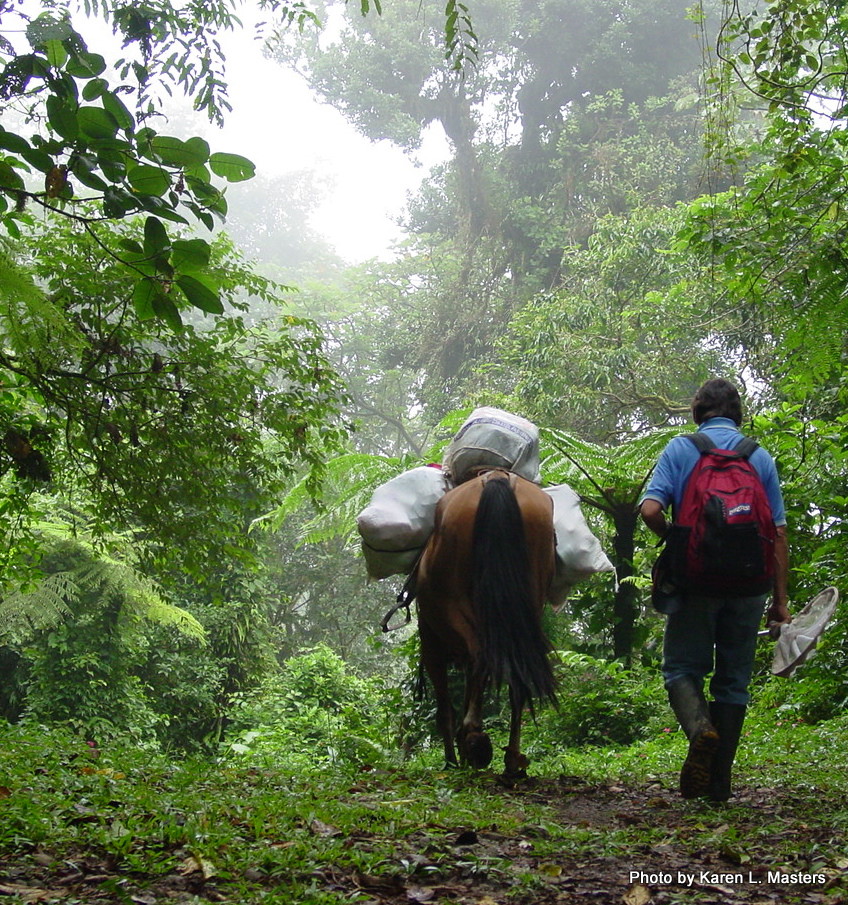
Wolf served as Head of Protection for both the Monteverde Cloud Forest Reserve and the Conservation League, holding the Reserve position for its first fifteen years. For nearly four decades, he patrolled thousands of hectares of remote terrain across ridges, streams, and valleys of the Peñas Blancas watershed. He was described as "one of the fastest walkers on the planet" in his prime. Bill Buskirk, the biologist who arrived with the Powells in 1970, recalled a group hike into the Peñas Blancas valley: "The rest of us were muscling our backpacks and plodding through the deep mud. Wolf was doing all that plus whacking and talking. We'd be topping one ridge between streams while Wolf was already at the top of the next one. There he'd be, cleared trail behind him, machete swinging and pointing, talking in rapid fire with no audience within earshot!"
He refused to carry a gun. "I always proceeded with the belief that God is in every person, and I approached everyone in a nonviolent manner," Wolf said. "I was always certain of how I should act even though I never knew how the other man might react." When he confronted armed poachers and illegal loggers, often alone in isolated areas, he used respect, humor, patience. "I want to get across to the person I'm confronting that I recognize him as a person who is equal to me, a person who wants to be fair. If I'd ever gone to war, I would have offered my hand in friendship to the enemy, not raised a gun."
The policy became institutional. "It was the Tropical Science Center's and the League's joint policy that the guards couldn't carry guns," Wolf explained. "It was important to minimize confrontations, not increase them. Our only weapon was the ability to file denuncias against illegal activities. Our little plastic identification card was all that stood between us and the characters we were confronting." He trained the young Costa Rican forest guards in this approach. Luis Ángel Obando, who succeeded Wolf as Head of Protection, described what he learned: "You first ask them to put down their guns or machetes. It lessens the tension. Then you can talk reasonably and work towards a peaceful solution together." To this day, the guards of the Reserve and the League do not carry guns.
Meanwhile, the golden toad disappeared. In 1987, researchers counted over 1,500 in the breeding pools. In 1988, an El Niño year, ten. In 1989, a single male in the main study area. Eladio Cruz and a fellow guard, patrolling a day's hike beyond Brillante, reported the last adults ever observed. In June 1990, Wolf and biologist Alan Pounds made one final search. "One more trip," Wolf wrote in his journal, "and it's dedicated to Dr. Alan Pounds and his hopping woodland subjects. It's been a long day because Alan and I sure looked for them golden toads. We shook out every pool. This will be the last official trip this year to see if we might find the toads." They found nothing. The IUCN classified the species as extinct. "Those beautiful, photogenic toads just appeared when we needed them to," Wolf said later. "Since we didn't have gorillas or elephants, we needed something to stir up people's interest in saving this cloud forest."
The Forest He Made
The Reserve grew from 328 hectares to over 10,500. The Monteverde Reserve Complex, comprising the Cloud Forest Reserve, the Children's Eternal Rainforest, and Bosqueterno, became the largest privately-owned protected area in Central America. Visitors rose from 2,700 in 1980 to over 200,000 annually by the 2020s. The Conservation League started tree nurseries and a "Forests on Farms" project, working with local farmers to plant native trees as windbreaks against the trade winds that battered the area during the dry season, with gusts reaching eighty kilometers per hour. By 1994, more than 500,000 trees had been planted in 320 windbreak projects. The League has since planted more than 1.6 million trees. The windbreak corridors eventually became part of the Bellbird Biological Corridor. Fermín Arguedas, the boy who watched the Quakers arrive, summed up the transformation: "You can sell that tree a thousand times as long as you don't cut it down."
Lucky, meanwhile, had been raising eight children largely on her own. "As far as I was concerned Wolf sacrificed his family for the Reserve," she said. "It became his sole obsession. He poured his energies into it and also our money. He bought supplies, equipment and tools for the Reserve. Not only were we losing a husband, caretaker and father, there wasn't enough money coming in to compensate for it." Their second child, Rebecca Jane, named after both their mothers, had died of jaundice on May 25, 1952. She was the first person buried in the Monteverde cemetery. Their daughter Helena recalled: "Those of us who are older had a dad who was present." The younger children did not.
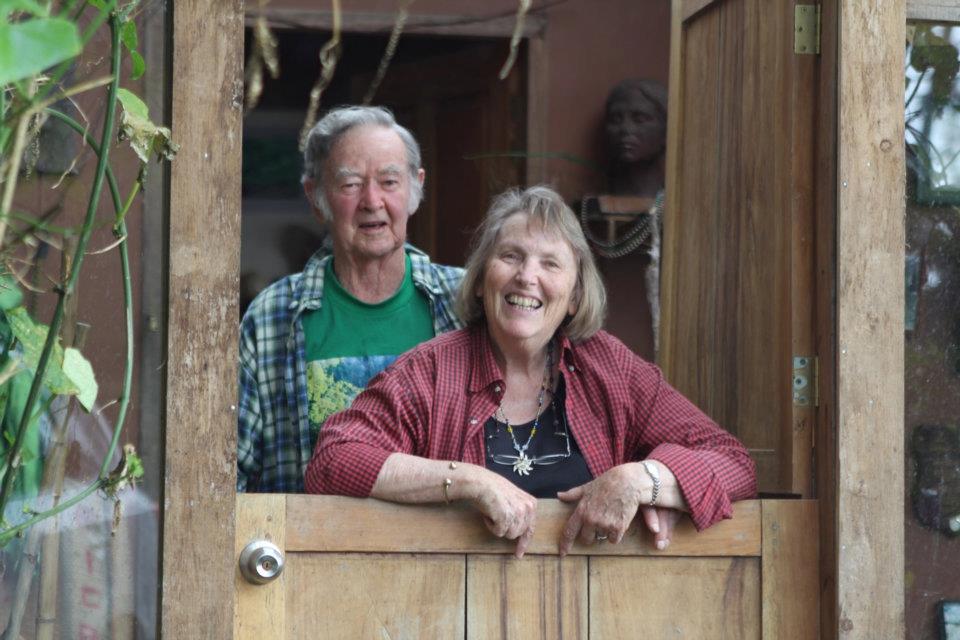
"It took me many years to realize that this jealousy I had of the Reserve wasn't a healthy thing," Lucky said. "It was ruining my life. I couldn't change him." In the 1970s, as Wolf disappeared deeper into the forest and the children grew up, Lucky began studying art with two visiting American artists. "I always thought of myself as a mother, that this was my role," she said. "But in the seventies, as Wolf got more involved with the Reserve and my kids were busy with their own lives, I started getting into art. That was the beginning of a new life for me." She became known for her finely detailed pen-and-ink drawings of the forest, held her first solo show in 1988, and her illustrations appear in the book Walking with Wolf. Wolf, who never finished their house, who left Lucky's sewing room unbuilt while he cut trails through the cloud forest, acknowledged: "This unfinished house is the only thing that I've ever seen her cry about, out of pure frustration."
Wolf was diagnosed with bipolar disorder in the early 1980s. "An incredible amount of energy accompanies bipolar disorder," the book Walking with Wolf observed. "Wolf likes to move and keep moving. He isn't good at finishing projects." Trail work was "perfect for him: constantly going forward, productive and worthwhile, with no end in sight." By 1982 he could no longer manage the Reserve. His children staged an intervention. A psychiatrist prescribed lithium, and by 1984 he was back in the forest. When asked later what helped him through difficult times, his answer was one word: "Lithium."
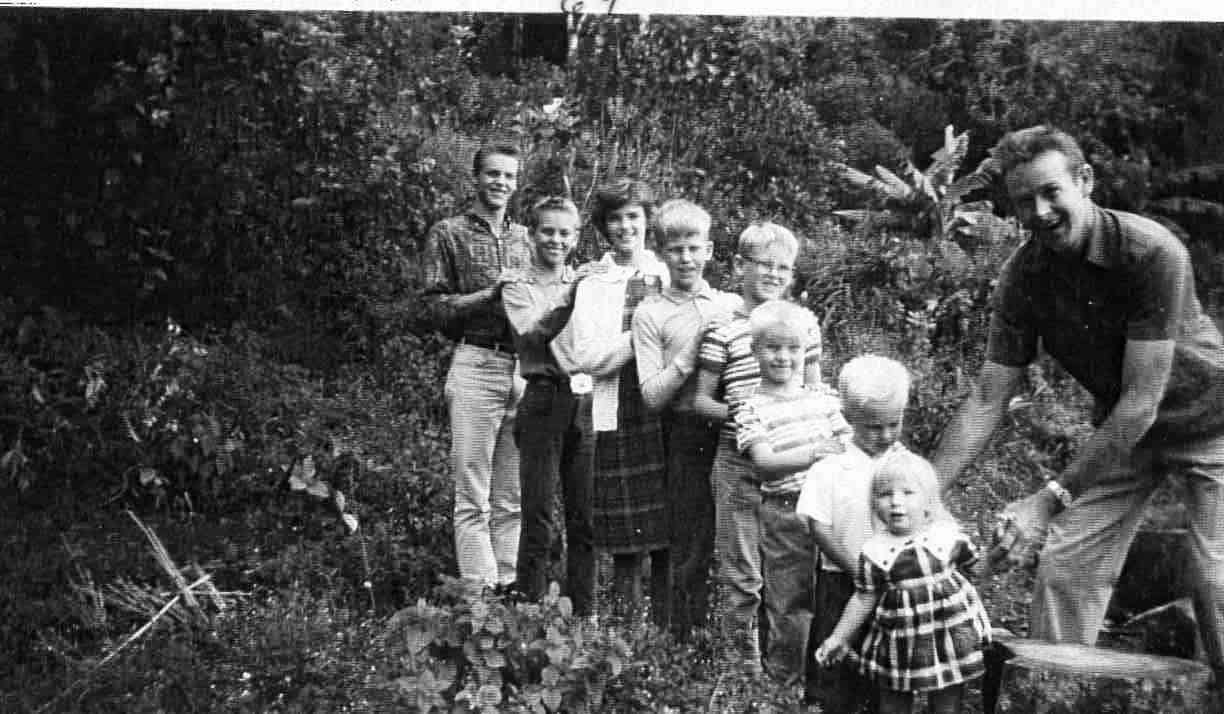
The Monteverde Friends School described Wolf as "a flawed character guided by love, respect, and kindness." He called square dances, performed in school skits, caught fly balls with his false teeth. His exuberant spirit and infectious laughter were as well known as his marathon hikes. He was emotional, "fighting those ever-ready Guindon tears" whenever he spoke about conservation. Eight children survived him: Alberto, a bronze sculptor; Tomás, who created guided night walks in the forest; Helena, a painter; Carlos, the first Monteverde Friends School graduate to earn a PhD (from Yale's School of Forestry), who translated his father's book into Spanish; Benito, who kept the dairy farm going; Ricardo, an ornithologist and nature guide; Antonio, a carpenter; and Melody, who has taught at the Friends School since 1983. The Guindons at one time made up a third of the school's student body.
A trail in the Reserve is named Sendero Wilford Guindon. A hanging bridge is named after him. He received a conservation award from the Ministry of the Environment in 1998 and the Conservation Action Prize from the International Center for Tropical Ecology in 2003. The prize money was taxed by the American government; part of Wolf's lifetime achievement award became, as the book noted, "a donation to the American war chest." In 2006, on National Parks Day, Wolf, Eladio Cruz, and three fellow Monteverde veterans received Honorary Parks Guard certificates. Carlos Hernández, the Reserve Director, said that Wolf would "always be their spiritual leader."
In April 2007, on what Wolf called his last hike on the Tapir Trail, Kay Chornook watched him lower himself onto a damp log at the campfire. "His thin poncho was stretched around his hunched shoulders and his hands cradled a warm cup of coffee." He told the group quietly: "This is a super group to be out with on my last hike on this trail." Then, not looking at anyone: "I think I've lost the spirit for this. I'm pretty sore. I'm not sure that I'll be able to come out and do this again." A month later, he hiked the trail again, with his son Benito, his daughter Melody, and six grandchildren.
Wolf Guindon died at eighty-five, on or around April 26, 2016, at home in Monteverde, surrounded by family and friends. He was buried on the family property, at the edge of the forest above where a landslide had once come down against the house. "I've always figured on that spot," he had said. "There I'd have a view."
In the acknowledgments of his book, Wolf had written: "I must acknowledge my fascination for this small but dynamic forest, which I have had the pleasure of sharing with so many people: its ambience of ever-changing degrees of sunlight, diffused by cloud cover and the blowing mist; that when you run out of sunlight, which happens at least once a day, a whole new world of sound and life emerges; the sharp silhouettes and varied patterns of its shadows; even the plant life with its own routines, some blooms coming alive at night while others are closing. Add to all of this the moon with its constantly changing phases, bringing its own rhythm that drives the pulse of the forest at night. So I give thanks to God's creation and for the blessing of having played a role in its protection."
Resources & Further Reading
Books and Film
The primary source for Wolf's life. Co-authored from recordings Chornook began making in 1990 after her first hike with Wolf. 298 pages, with color photographs, Lucky Guindon's ink drawings, maps, and index. Wandering Words Press. ISBN 9780980908503.
Spanish translation by Wolf's son Carlos, published by the University of Costa Rica Editorial Press (EUCR) and the Tropical Science Center (CCT). The book's Spanish publication became an emotional motivation for Wolf's recovery from a 2010 health crisis.
Directed by Robin Truesdale, produced by Bill Adler. Follows the Quaker families from Fairhope to Monteverde. Premiered at the Global Peace Film Festival 2020; aired on PBS/RMPBS.
Key Articles
Detailed account of the Fairhope Quakers, the draft refusal, imprisonment, and the founding of Monteverde.
The chainsaw-to-conservation arc and the unarmed guard tradition, including the institutional policy against carrying weapons.
The Tico Times obituary, with biographical details and the Guindon family portrait from 1969.
The broader story of conservation in the Monteverde region, including Eladio Cruz's trajectory from farmworker to conservationist.
Comprehensive overview of the Quaker settlement, land purchase, dairy cooperative, founding of the Reserve, and its growth to over 10,500 hectares.
Detailed account of the conservation movement, the Powells' arrival, Wolf's recruitment, the founding of the Reserve, and the growth of the Monteverde Reserve Complex.
Organizations
Website of the Quaker conservation corporation. History of the Watershed Property, early biologists and naturalists of Monteverde.
The organization Wolf co-founded in 1985. Manages the Children's Eternal Rainforest and ongoing reforestation programs.
The school's tribute to Wolf, including the description of him as "a flawed character guided by love, respect, and kindness."
The Goldman Prize page for the Swedish teachers whose Barnens Regnskog campaign raised $2 million for rainforest land purchases, helping create the Children's Eternal Rainforest managed by the Monteverde Conservation League that Wolf co-founded.
Related Profiles
Costa Rican biologist who helped organize the Monteverde Cloud Forest Reserve and served on its founding team alongside Wolf.
Director of the Tropical Science Center, which manages the Monteverde Reserve. First visited Monteverde in 1968 with Leslie Holdridge.
The ecologist who created the life zone classification system, providing the scientific framework for Costa Rica's conservation efforts.
Academic
Academic chapter in Biodiversity Islands (Springer) covering the Monteverde Reserve Complex, windbreak programs, and the Bellbird Biological Corridor.
Peer-reviewed account of Incilius periglenes: Jay Savage's 1966 description, the Brillante tract breeding sites, and the extinction timeline from 1,500 individuals in 1987 to zero by 1989.
Archival portrait by botanist Hugh Iltis, with primary-source caption describing Wolf as being of "German-Swiss descent" and noting he "spearheaded the purchase of key" Reserve parcels. CC BY-NC-ND 4.0.