What a Forest Is Worth
The Stanford ecologist Gretchen Daily turned a wrecked experiment in a Costa Rican coffee valley into a new science of how nature survives among people, and then into a global effort to make economies finally count what a forest is worth.
In 1995 a young Stanford scientist hung 100 hummingbird feeders across the hills of southern Costa Rica. Gretchen Daily meant to treat the remnant patches of rainforest in the Coto Brus valley as islands in a sea of farms, and to measure which birds were marooned on them. The sugar water had other admirers. A swarm of Africanized bees, the kind that can kill, descended on the feeders. The farmers whose land she was working on, friends of hers, were alarmed, and the feeders had to come down at once. The experiment was over before it had produced a result. As she put it later, "Then I had no project."
With nothing left to do, she walked out onto the farmland itself, the coffee and pasture and dooryard trees between the forest patches, and started counting whatever birds she found. There were far more than she expected. The birds ranged across the whole valley, feeding and nesting in the coffee, the hedgerows, and the scattered trees, well away from the forest islands. "The birds don't seem to see them as islands," she realized. "I realized that the farmland is habitat."
That sentence became a career. The accident in the Coto Brus valley gave Daily the idea she calls countryside biogeography, the study of how wild species persist in the working landscapes where people actually live. From it grew nearly everything she is now known for: the science of ecosystem services, the accounting framework of natural capital, and a global push to make governments and companies put a real number on what nature does for them. Costa Rica is where that argument started.
The Forests That Died
Daily was born in Washington, D.C., in 1964, and spent her early childhood in Marin County, north of San Francisco, with a half-wolf named Mishka that her father, an eye doctor, had taken in barter from a patient. She ran in the hills with the dog and grew up loving the open California country. When she was twelve the family moved to Frankfurt, in what was then West Germany, and the nature around her changed character: tended, walked, loved by people who had cared for the same forests for a thousand years.
Then those forests began to die. Acid rain was falling across central Europe in the late 1970s and 1980s, and the German word for what it did, Waldsterben, forest death, entered everyday speech. Daily was a teenager in Frankfurt when the protests filled the streets. The memory still moves her decades later.
What struck her was that people could see the cause, human activity, and were trying to change the society that produced it. She decided she would help, and that the way she could help most was to understand nature first and then work to change policy, finance, and the way decisions get made. At sixteen she wanted to study acid rain for a science competition; her chemistry teacher steered her to something tractable, the dissolved-oxygen content of a river near her home, which she measured from a small rubber boat in the snow. The project won her a trip back to the United States to present her results. The path was set early: science in the service of changing how people treat the living world.
Standing on the Shoulders of Giants
In 1985, at twenty-one, Daily walked into the Stanford office of the biologist Paul Ehrlich, the population theorist whose warnings about human numbers had made him famous and controversial. She would take all three of her degrees at Stanford, finishing her doctorate in 1992, with Ehrlich as her adviser and the plant ecologist Harold Mooney as a second mentor. Her early work sat squarely in Ehrlich's tradition of studying extinction. With Ehrlich and a fellow graduate student she helped produce, in 1997, one of the first rough estimates of how fast human activity was driving distinct populations of wildlife, the local building blocks of species, to disappear, a rate they put at roughly 1,800 populations an hour in tropical forests.
Counting losses was not enough for her. Conservation in those years was argued mostly on the ground that nature deserved to exist for its own sake, and the parks built on that argument were too few, too small, and too isolated to hold the losses back. Daily began to think the case had to be made in terms decision-makers could not ignore: what nature does for people, in money, health, and security. The turn brought her up against economics, a field that ecology was, in her words, "kind of at war" with. The bridge came when the economist Partha Dasgupta spent a year at Stanford and Ehrlich organized long, relaxed dinners to get the two disciplines talking. There she also met Kenneth Arrow, a Nobel laureate in economics, who had shown how nature could be treated as an asset that a society can invest in. Out of those conversations came the idea she would spend her life building.
Ehrlich, who became a lifelong friend, has never been modest about his former student. He likes to point out that the shy undergraduate who once worked in his lab is now, as an endowed Stanford professor who must approve his spending as an emeritus, his boss. "In my view," he has said, "she is the most important scholar working on environmental sustainability issues in the world today."
The Farmland Is Habitat
The valley where the bees ended one project and started another is a working countryside. Coto Brus, in the south of Costa Rica near the Panamanian border, was colonized in the early 1950s by a few dozen Italian immigrants, and the forest came down fast as the farms spread. By the time Daily arrived, tree cover across her study area had fallen to roughly a third of the land, the rest a patchwork of small farms, rarely more than a few hectares each, growing coffee and bananas and raising cattle, with trees surviving along the streams, the ridgelines, the roads, and the field edges. Set in the middle of it is the Las Cruces reserve, run by the Organization for Tropical Studies, about 250 hectares of premontane forest that Daily has called her most beloved spot in the world, and that her teams have used as a yardstick for what the land held before it was cleared.
Over the following decades Daily and a long line of students counted what lived in that mosaic, group by group: birds, moths, butterflies, bats, other mammals, and plants. The pattern held across taxa. A great deal of biodiversity persisted out in the farmland, more than the island picture predicted, so long as the countryside kept its scattered trees and forest scraps. The framework she built to explain it, countryside biogeography, was a deliberate alternative to the older theory that treated reserves as islands losing species to a hostile sea. The fate of most wild species, she argued, would be decided out in the farmed land around the parks, where most of the land actually lies.
Then she and her colleagues did something the older conservation argument rarely managed: they put a price on a forest fragment, and the price was high. In a study on a Costa Rican coffee farm published in 2004, they found that native bees living in two nearby forest patches, of 46 and 111 hectares, pollinated the coffee well enough to raise yields by 20 percent within about a kilometer of the trees and to cut the share of small misshapen "peaberries" by 27 percent. The pollination those two fragments delivered was worth roughly 60,000 dollars a year to that single farm, on par with what the land would have earned in competing uses, and far more than Costa Rica's conservation payments offered at the time to keep forest standing.
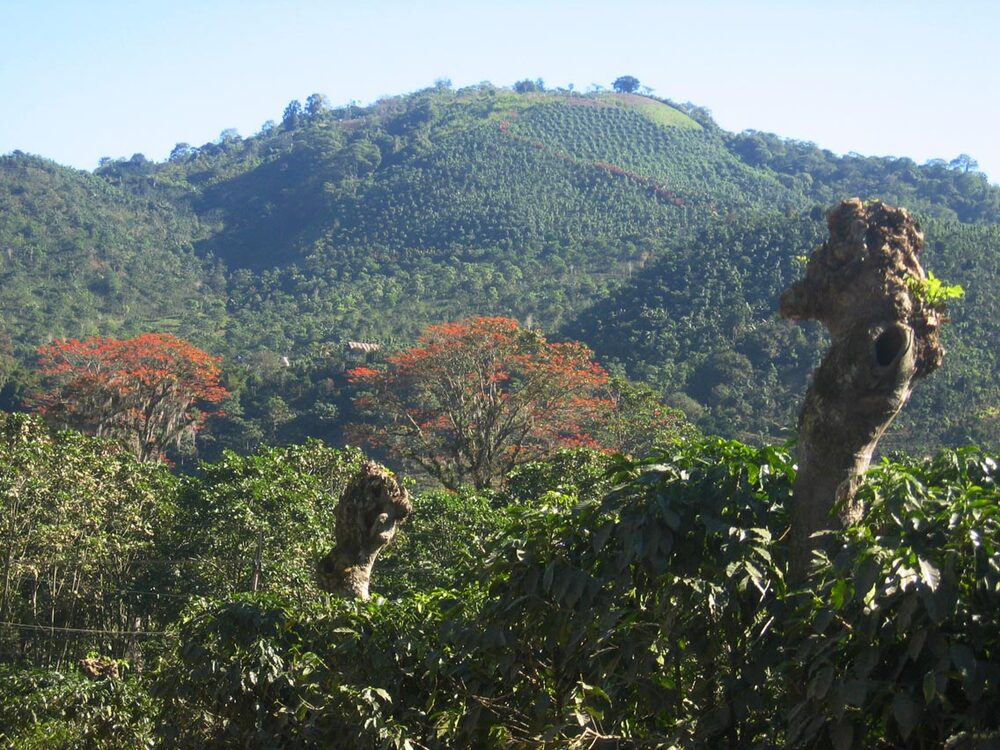
The forest paid a second way. The coffee berry borer, a tiny beetle that bores into the bean, is the crop's worst insect pest worldwide. In a study published in 2013, Daily's group showed that birds, drawn to farms with more forest cover, ate enough borers to roughly halve the infestation. Excluding the birds with netting let the damage double. The pest control the birds provided was worth between 75 and 310 dollars per hectare per year, and it was strongest where farms kept small forest fragments, some less than a hectare across. A forest patch on a coffee farm, it turned out, was paying its way in pollination and pest control, quietly, whether or not anyone wrote the number down.
The countryside findings carried a hopeful message, and Daily has been careful not to let it become a false one. The same valley produced a harder result. Over 11 field seasons between 1999 and 2010, her team mist-netted and released 57,255 birds of 265 species across coffee, riparian strips, secondary forest, and primary reserve. Of 112 bird populations they could track, 69 were declining, most of them the resident, insect-eating, forest-dependent specialists, and the decline showed up everywhere except the sites near the vast La Amistad International Park. Coffee farms can hold many birds, but the species that fill them are often spillovers from nearby forest or open-country generalists; the most sensitive forest birds are the ones that go missing. Las Cruces is about 250 hectares; La Amistad is about 400,000. The lesson Daily drew was that there is no substitute for large primary forest. "You really need at least 1,000 hectares," she has said.
Big intact forest is irreplaceable, and the farmed countryside in between is real habitat. Daily has kept both findings in view. A study her group published in 2023, after eighteen years of tracking birds across forest, diversified farms, and intensive monoculture, found the steepest declines inside the forests themselves, while on small diversified farms, the ones with varied crops threaded through with trees and forest patches, a meaningful set of forest birds actually increased. The countryside, managed well, can carry part of the load that the shrinking forests can no longer carry alone.
Zero or Infinity
The coffee farms gave Daily a concrete version of an argument she was making at the same time on a much larger scale. In 1997 she edited a book, Nature's Services, that gathered ecologists and economists to set out, service by service, how much human life depends on the work of natural ecosystems: the pollination, the water purification, the soil formation, the flood control, the climate regulation that no economy pays for and few even notice. Her own chapter asked the plain question, "What are ecosystem services?" The book is widely credited as one of the founding texts of the field, and a catalyst for the United Nations Millennium Ecosystem Assessment that followed.
The problem she kept running into was that nature entered almost every decision at one of two useless values. Either it was priceless, infinitely valuable and therefore impossible to weigh against anything, or it was free, worth zero, and so flattened the moment a road or a plantation promised a return. Neither number helps anyone choose. Her project was to replace both with a real figure, the kind that a farmer, a water utility, or a finance ministry could actually use.
The approach has critics, and Daily takes them seriously. Some conservationists argue that putting a price on nature is the first step toward selling it, that reducing a living system to a dollar figure cedes too much to the very logic that is consuming it. She shares the worry and answers it pragmatically. Most major decisions, she points out, are already made on a cost-benefit basis, and in those calculations nature is currently entered at zero. Demonstrating its value, she argues, is the way to get it counted at all. She has described the strategy in terms she still stands by: ecosystem services is "a strategy to buy time as well as getting buy-in." Asked years later whether she still believed it, she said she would stand by the quote. She has always been explicit that valuing nature for its benefits to people "does not in any way preclude" valuing it for its own sake as well.
Nature on the Balance Sheet
An idea on paper does not move money. In 2005 Daily co-founded the Natural Capital Project, a partnership that began with Stanford, The Nature Conservancy, and the World Wildlife Fund and later grew to include the University of Minnesota, the Chinese Academy of Sciences, and the Stockholm Resilience Centre. Its purpose was to take ecosystem-service science out of journals and into the rooms where land-use decisions are made. The tool it built is a free, open-source software suite called InVEST, which maps the services a landscape provides and shows, in either physical or dollar terms, how those services change under different decisions. It is now used in more than 185 countries.
The largest test came in China. After the Yangtze flooded catastrophically in 1998, a disaster widely blamed on upstream deforestation, the government launched some of the biggest conservation programs in history, paying farmers to return steep cropland to forest and grass. Daily and her colleagues helped build the country's first national ecosystem assessment. Of the seven natural services it tracked from 2000 to 2010, six improved, food production by 39 percent and carbon sequestration by 23 percent. The one that declined was the seventh: habitat for the country's most threatened species, down 3 percent. From that work came an accounting measure modeled on Gross Domestic Product and called Gross Ecosystem Product, an annual tally of what a region's ecosystems are worth, which China piloted at provincial and national scales and which fed into the ecosystem-accounting framework the United Nations adopted in 2021.
The country that first taught Daily the lesson has, in turn, become a place she models. With colleagues she used InVEST to study what full enforcement of Costa Rica's Forest Law would do if the forested strips the law requires along rivers were actually restored. The answer was large: reforesting those riverbanks would raise the retention of phosphorus by nearly 86 percent and of nitrogen by more than 81 percent, keeping fertilizer runoff out of the water that downstream communities drink. The same logic runs through Costa Rica's water funds and its long-running payments to landowners who keep forest standing, an early national experiment in exactly the idea Daily has spent her career generalizing.
Worried, and Optimistic
The honors gathered as the field she helped found became mainstream: the Midori Prize for Biodiversity in 2010, the Volvo Environment Prize in 2012, the Blue Planet Prize in 2017, the Tyler Prize for Environmental Achievement in 2020, election to the United States National Academy of Sciences, and more than 125,000 citations of her work. Colleagues describe a scientist who carries the weight of the subject lightly, "steely-eyed and realistic" about the danger while remaining, by temperament, hopeful. Her former adviser, less restrained, calls her "basically a genius" and faults her only for giving too much of her time to anyone who asks.
She is candid that she keeps at the policy work against her own preference. She would rather, she admits, just enjoy the biology; what holds her to the harder task is a sense that this is an unrepeatable moment, when humanity has gained enormous power over the planet and very little control of it, and when the choices made now will decide whether a great deal of suffering and destruction follows. Set against that is what she actually sees happening: people, governments, and companies beginning to recognize nature as an asset they cannot live without. She returns often to the image of a light switching on in someone's mind, and to nature's own capacity to recover.
Her dream, she says, is a world where every child can get out and play in nature, where people's basic needs are met and the bond between people and the living world is far stronger than it is now. It is the same conviction she formed as a teenager, watching crowds fill the streets of a German city over forests dying from the sky, refigured into a tool a finance minister can open on a laptop. The valley in southern Costa Rica taught her the lesson she has been generalizing ever since: a strip of forest among the coffee was doing real work, paying real returns, long before anyone thought to measure it. Her life's project has been to get the world to finally write the number down.
Resources & Further Reading
Books
The founding edited volume of the ecosystem-services field, including her chapter "What Are Ecosystem Services?"
Her case, with a journalist co-author, for conservation that pays for itself, drawing on examples including Costa Rica.
Natural-capital policy and finance mechanisms documented from cases around the world.
Key Articles & Interviews
A profile with biographical detail, including the half-wolf Mishka and Las Cruces as "her most beloved spot in the world."
Her own first-person account of the Waldsterben protests, the 1995 bee experiment, and the realization that "the farmland is habitat."
On Gross Ecosystem Product, the Natural Capital Project, and her "Great Degradation" framing.
Her work with the Chinese government and the "buy time as well as getting buy-in" defense of ecosystem services.
Coverage of the Karp et al. study on birds, the coffee berry borer, and the value of small forest fragments.
The long interview that is the source of her "all-you-can-eat buffet" and "if you give her a chance, she will come back" lines.
The primary source for the claim that Nature's Services was a catalyst for the U.N. Millennium Ecosystem Assessment.
An open-access summary of China's first national ecosystem assessment, with the per-service gains behind the paywalled Science (2016) paper.
A plain-language summary of the Langhans et al. (2022) study and its phosphorus and nitrogen retention gains from Costa Rica's Forest Law riverbanks.
Organizations
The organization Daily co-founded in 2005, home of the InVEST software now used in more than 185 countries.
The southern Costa Rican research station and forest reserve at the center of Daily's countryside-biogeography fieldwork.
Academic Papers
The coffee-pollination study: forest bees raised yields 20 percent and were worth about 60,000 dollars a year to one farm.
The pest-control study: birds drawn to forest cut coffee berry borer infestation by about half, worth 75 to 310 dollars per hectare a year.
The founding paper of countryside biogeography, from the Coto Brus bird surveys.
The 11-season dataset of 57,255 birds showing that most tracked populations were declining and that large reserves are irreplaceable.
China's first national ecosystem assessment, tracking service changes from 2000 to 2010.
InVEST modeling of Costa Rica's Forest Law riverbank rule and its large gains in water-quality protection.
A Costa Rican peer-reviewed history of the deforestation that shaped the valley Daily studies.
Her early extinction work, estimating that roughly 1,800 populations an hour are lost in tropical forests.
Related Profiles
The biologist who did more than anyone to popularize the value of biodiversity, the broader cause Daily's economics serves.
The tropical biologist whose forest-fragmentation experiment posed, in the Amazon, the island-versus-countryside question Daily reframed in Costa Rica.
The tropical ecologist whose decades of work in Costa Rica helped make the country a global laboratory for conservation science.