An Endangered Species
Five park rangers described their conditions to a newspaper. One patrols drug-trafficking waterways alone. One has no radio. One buys his own boots. Their union leader called the ranger "an endangered species." Between 2020 and 2024 the agency's budget fell 40 percent while its territory grew over 500 percent.
The outboard idles through water the color of ink. No moon. The channel is narrow, mangroves pressing in from both sides, and the only light is the dim glow of the instrument panel. The man at the tiller keeps it low. He listens. Tree frogs call from the mangrove roots, thousands of them, a wall of sound so constant it becomes silence. Water laps against the hull. Something splashes in the mangroves. A potoo whistles from the forested bank, one long descending note.
An engine ahead. He has been tracking the sound for several minutes, a deep pulse that carries across water on still nights. It could be a fishing panga returning late. It could be tourists who lost track of time on the river.
He turns toward it.
The other vessel is running dark. No navigation lights, no cabin glow. As he closes the distance, the engine note resolves into something heavy, too much power for anything that belongs on these waterways at this hour. The hull takes shape ahead of him, low and fast, built for open ocean.
He is close enough to call out when the first shot cracks across the water.
Then a second. He throws the tiller hard and opens the throttle. The bow swings. Behind him, the fast boat does not follow.
He runs without lights through channels he has memorized over a decade of nights like this one, navigating by the black outlines of mangroves against a sky only slightly less black.
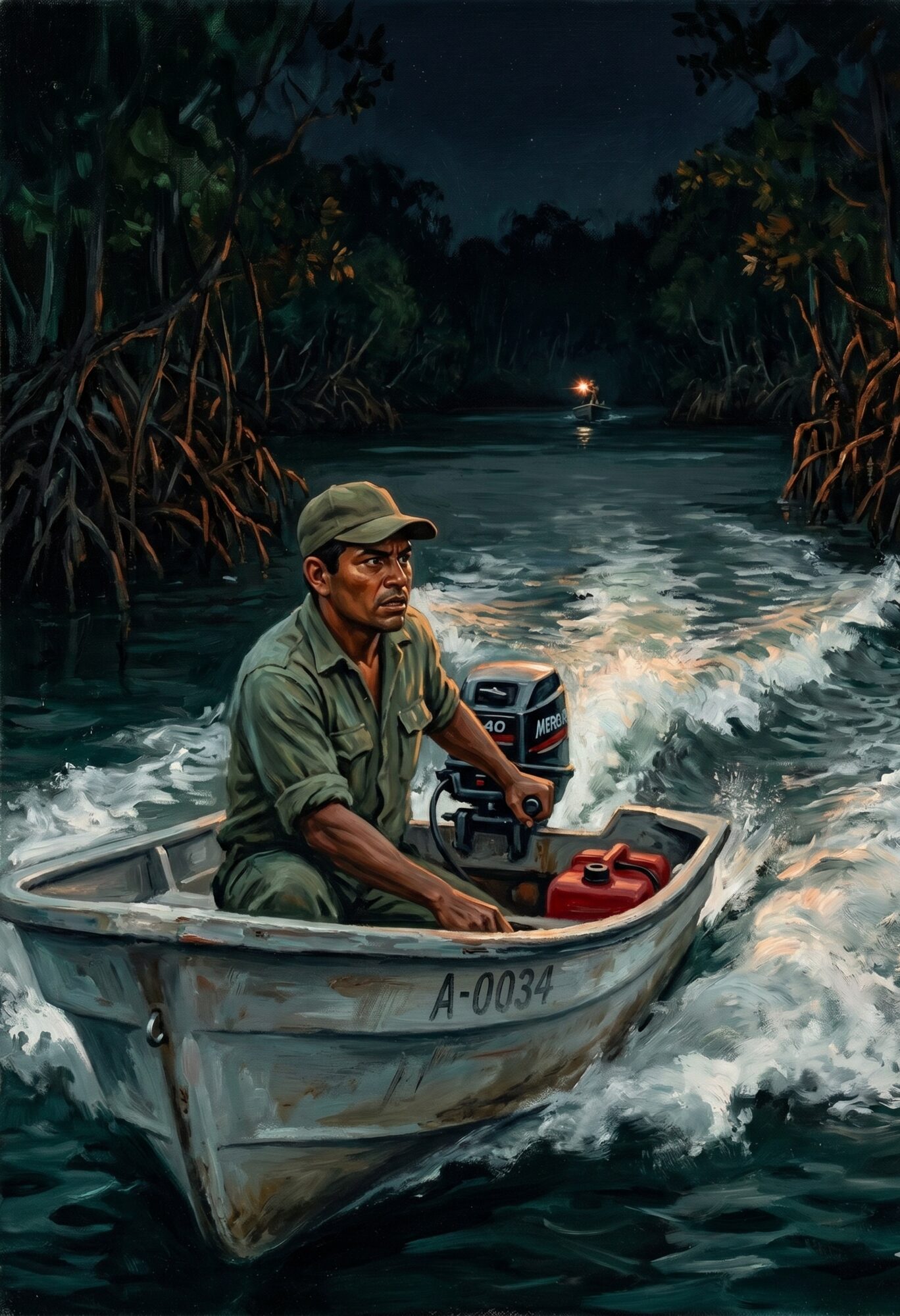
His name, or the name he agreed to use, is Mateo. He is a park ranger. He is employed by Costa Rica's Sistema Nacional de Áreas de Conservación, the agency tasked with managing the country's protected areas. He has patrolled the wetlands and mountainous terrain of the Osa Peninsula for more than ten years. The waterways where he works overlap with the Drake-Sierpe system, which a 2020 DEA intelligence report identified as a transit corridor for an estimated 500 tons of cocaine and 600 tons of marijuana per year.
He told this story to journalist Sofía Sánchez Ramírez for a feature published in La Nación on May 4, 2025. Four other rangers spoke too, from stations across the national park system. Oscar Beita gave his real name. The others, like Mateo, used pseudonyms. The problems they described were different at each station. The cause was the same.
Alberto works at a wildlife refuge near the Nicaraguan border. He patrols alone. He has no radio to contact his companions. When he encounters poachers or traffickers, there is no way to call for help.
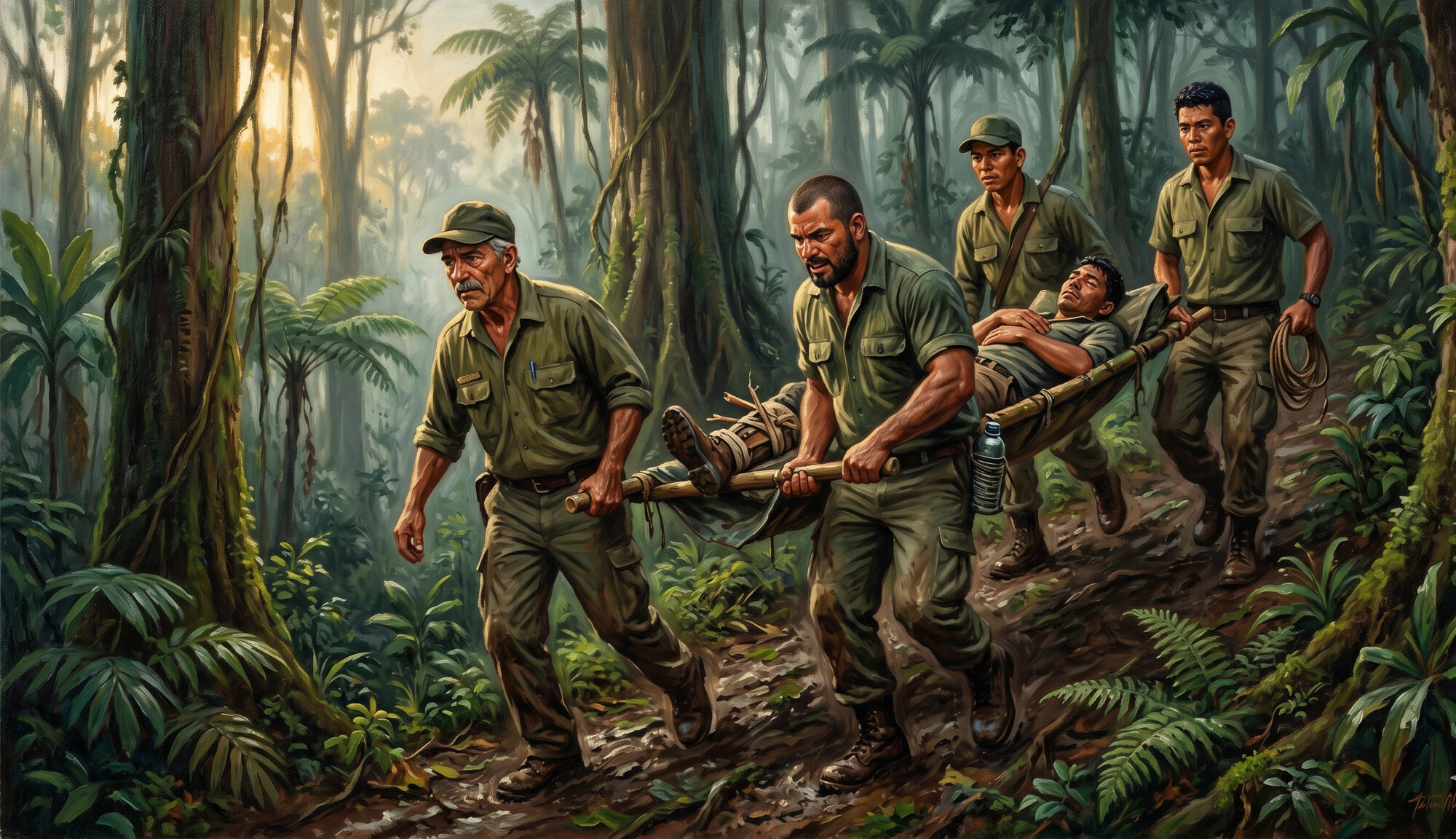
Oscar Beita has spent more than seven years at the Los Patos station in Corcovado National Park. He cannot drink the tap water at his station; he buys or filters his own. When a colleague suffered torn ligaments after the earth gave way during a patrol, four rangers spent fourteen hours evacuating him through jungle terrain. There was no 911 connection.
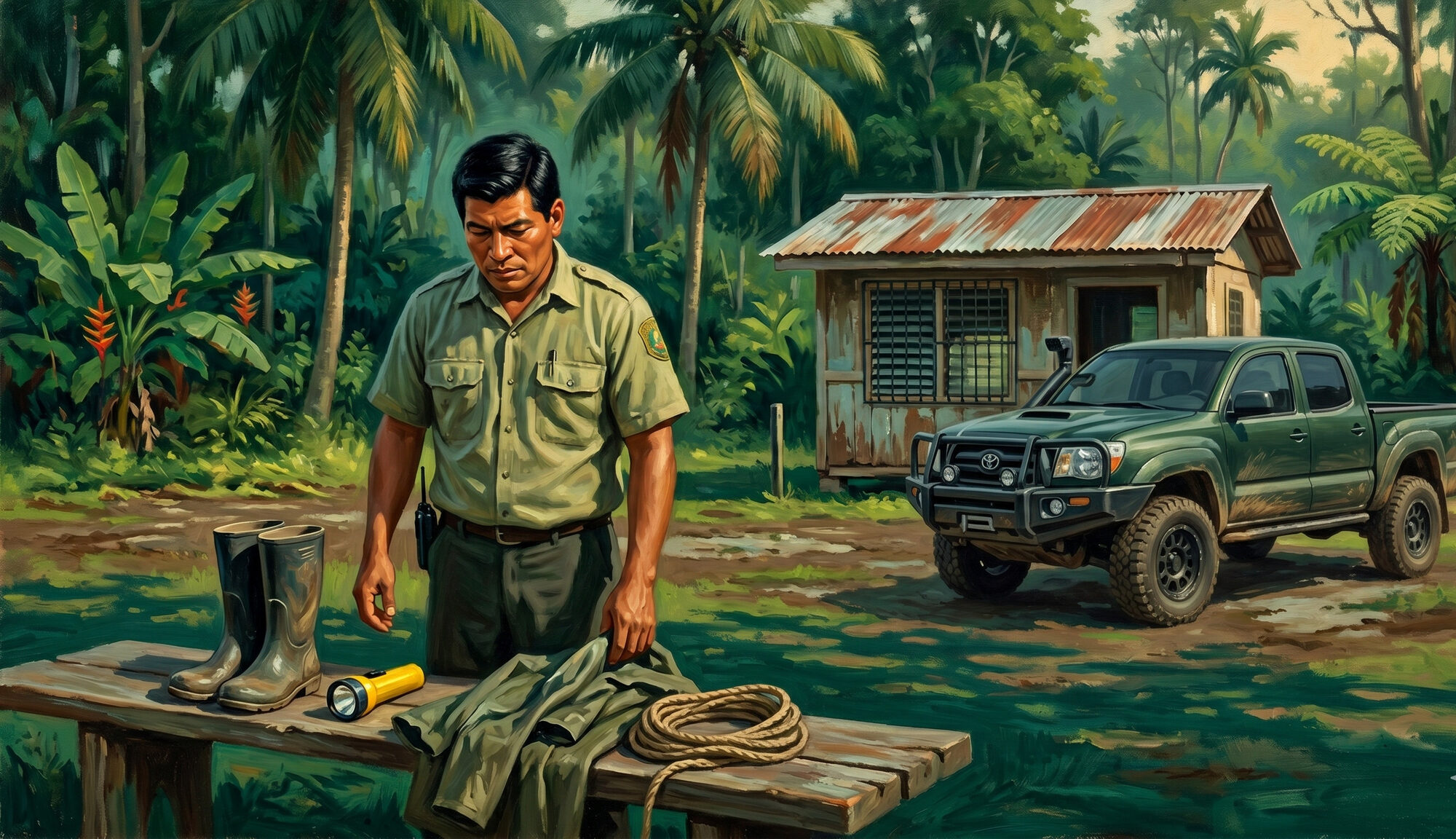
Julián once ascended an erupting volcano for a rescue mission. He buys his own uniforms, rain jackets, flashlights, and boots. "Cada funcionario hace su propio equipo," he said. Each official assembles his own gear.
Carlos has worked in a mountain location for fifteen years. He spends his days processing administrative paperwork instead of conducting field patrols. He has not seen new ranger hirings in years. "A nosotros nos exigen más papel que acción." They demand more paper from us than action.
These five rangers work for SINAC, an agency that manages 152 protected areas covering roughly a quarter of Costa Rica's national territory and nearly a third of its marine space. Six months before La Nación published their stories, the crisis they described had already been declared in public.
SINAC en Crisis
On October 10, 2024, a forum titled "SINAC en Crisis" convened at the Asamblea Legislativa. It was organized by Deputy Kattia Cambronero and the Centro Científico Tropical. The participants included Laura Pacheco, director of the Centro Científico Tropical; Miguel Madrigal, president of the retired park rangers association; Allan Valverde, dean of the Faculty of Environment and Development at the Universidad para la Cooperación Internacional; and Vice Minister Jorge Mario Rodríguez. The scientific community, the academy, the government, and the retired rangers were all represented.
The sharpest formulation came from the union itself. Cristian Brenes Jiménez, secretary general of Sitraminae, the rangers' union, gave it to La Nación.
Brenes said it under his own name. The rangers in the field had spoken under pseudonyms; the man who spoke for them did not. The crisis was now public, and what had caused it was in the budget.

The Budget
SINAC's budget fell from 44,029 million colones in 2020 to 26,420 million by 2024, a drop of 40 percent. The Área de Conservación Marina Cocos, which manages a third of Costa Rica's marine protected surface, lost 41.9 percent of its funding. Hours spent on control and surveillance across the system fell 62 percent between 2020 and 2024.
In 2024, SINAC's own regional directors publicly protested a further 2,350 million colon cut, calling it unsustainable. The 2025 allocation recovered slightly to 27,926 million colones, still 37 percent below the 2020 level. Each cut brings a protest and a partial recovery that never catches up.
The budget collapse did not begin with the pandemic. SINAC has been underfunded for as long as it has existed. According to the rangers' union, no new ranger positions were created after 1998. Creating permanent civil service positions requires authorization from the Ministry of Finance and the national planning authority, and no administration granted it. A 2014 Contraloría audit (DFOE-AE-IF-16-2014) found that 99 percent of the protected areas it evaluated lacked sufficient resources. MINAE and its agencies' environmental-protection spending averaged 0.56 percent of the national budget between 2019 and 2022, and was falling. The international financing initiative BIOFIN estimated a $90 million annual gap between what conservation required and what it received.
But the pandemic turned chronic underfunding into acute crisis. In 2020, Costa Rica's GDP contracted 4.1 percent, the worst since 1982. Tourism was the first casualty. The sector accounts for roughly 8 to 11 percent of GDP depending on how indirect contributions are measured, but it employs a disproportionate share of the workforce: 183,000 people directly and more than 549,000 when indirect jobs are included, nearly a quarter of the economically active population. When arrivals fell from 3.14 million to 1.01 million, revenue from foreign visitors dropped from $4.28 billion to $1.48 billion. Accommodation and food services contracted 43 percent. Guanacaste province hit 30 percent unemployment. At least 140 hotels closed.
National unemployment reached 24.4 percent by mid-year. The fiscal deficit hit a historic 8.34 percent of GDP and tax revenue fell nearly 11 percent. Central government debt jumped from 56 percent of GDP to 67 percent in a single year. Goods exports, driven by medical devices from the free trade zones, actually set a record at $11.68 billion, but the two-speed economy that resulted left the service sector and the informal workforce behind.
The debt spike triggered a mechanism that was already on the books. Ley 9635, the Fiscal Strengthening Law enacted in 2018, had introduced a fiscal rule tied to the central government debt-to-GDP ratio. When debt exceeds 50 percent of GDP, automatic spending caps restrict how fast government budgets can grow. The strictest tier of the rule took effect with the 2022 budget cycle, capping total spending growth well below inflation. In 2022, with inflation at 10.36 percent and the spending cap at 1.96 percent, agencies faced real cuts of roughly eight percent in a single year. And because the rule calculates growth ceilings from prior-year spending, the pandemic-depressed budgets of 2020 became the baseline. The cuts compounded from a floor that was already low.
The squeeze was government-wide. Education spending fell from 7.3 percent of GDP in 2020 to 4.9 percent in 2025, the lowest in 40 years. The Procuraduría General recommended declaring the 2023 education budget unconstitutional. Road investment fell 33 percent. Capital spending collapsed to 30-year lows. But the rule did not fall equally. The social security system was substantially exempted. The security budget, after initial cuts, received political corrections and extraordinary allocations. Debt service, consuming 46 percent of the national budget by 2024, was inherently outside the rule as a non-discretionary obligation. The agencies that bore the deepest cuts were those without political leverage to claw money back.
SINAC had no such leverage. Before Ley 9635, it retained the revenue it generated. Park entrance fees and concession payments stayed with the parks that earned them. After Ley 9635, that revenue was swept into the caja única, the single treasury account. SINAC generates income from the millions of tourists who visit its parks each year. That income now goes to the general treasury. The parks that earn the money cannot spend it. In 2021, SINAC transferred nearly 9 billion colones to the Ministry of Finance. It requested 7 billion back. It received 1.9 billion.
In September 2024, the Sala Constitucional heard a challenge to this arrangement. Resolution 25592-2024 did not strike down the law, but its dissenting opinions used language rarely seen in fiscal jurisprudence. One magistrate described the diversion of park fees as "regresión ambiental," environmental regression. Another wrote that the parks are in "franco deterioro," frank deterioration. Revenue "desviados a fines ajenos o redistribuidos a dedo": diverted to unrelated purposes or redistributed by fiat.
A partial legislative remedy did pass. Expediente 23.896, filed in 2023 and backed by an analysis from the United Nations Development Programme, became Ley 10898 on May 18, 2026. It lets SINAC pledge its future park-fee revenue to a trust and sell securities against it, with the proceeds held in banks outside the national treasury and exempt from the fiscal rule that swept the fees away in the first place. The money it raises is restricted to two uses: building infrastructure inside protected areas, and paying for private land the State expropriated to create them. It cannot buy a radio, a pair of boots, or a tank of fuel, and it cannot pay a ranger's salary. The mechanism that starves daily operations stays in place.
SINAC reported 517 staff members managing 152 protected areas in 2024, down from 545 in 2020. The decline accelerated between 2019 and 2020, when approximately 100 positions were eliminated under the Public Employment Law. The official ratio: one official per 347 square kilometers of protected territory.
Sitraminae disputes the official figure. A 2016 count put the number of park rangers at 471, and union representative Roberto Molina has long argued that only about 300 staff do real field control and protection work; the rest hold administrative positions.
The International Union for Conservation of Nature recommends one ranger per 500 hectares. Working from roughly 400 field rangers, La Nación put Costa Rica's coverage at one ranger per 3,257 hectares: 6.5 times the recommended level. On the union's count of approximately 300 field rangers, the ratio is roughly one per 5,600 hectares: more than 11 times the international standard. SINAC's own director has put the shortfall at more than 1,000 positions to reach an optimal level of operation.
The exact figure is in dispute; the scale of the gap is not. Whether the shortfall is 6.5 times the international standard or 11 times, the result is the same: rangers without radios, stations without clean water, patrols that encounter drug traffickers alone.
Protected on Paper
While the budget was cut 40 percent and staff declined, the territory SINAC was responsible for expanded more than 500 percent.
Costa Rica now manages 152 protected areas covering approximately 25 percent of its national territory and 30 percent of its marine space. A third of those areas lack management plans. In 2023, the protected areas that record visitation logged 2.73 million visits, 11.2 percent more than the year before.
Juan Posada, science manager at the MarViva Foundation, gave the phenomenon a name: "áreas protegidas de papel." Paper protected areas. "Some of them remain without a management plan being developed, or if one was developed, it is never implemented."
The constitutional court has documented the same crisis, in its own language. In December 2023, the Sala Constitucional ruled on conditions at the Playa Hermosa-Punta Mala wildlife refuge (Res. 31754-2023). The court found infrastructure in a "state of deterioration," "exposed to vandalism," and park rangers lacking "the minimum implements and equipment necessary to confront invaders." It ordered the Minister of Environment and the SINAC Executive Director to provide infrastructure and staffing within twelve months.
In November 2025, a second ruling (Res. 36585-2025) found that SINAC had failed to implement a presidential decree for the Isla del Coco marine conservation area, the same area that lost 41.9 percent of its budget. The court ordered "human, technical, and financial strengthening" within twelve months.
A third case has been running since 2016. Resolution 22417-2024 found that "many Protected Wildlife Areas have very great limitations for attending to the public, preventing gold miners from causing disasters in Corcovado, avoiding logging, or hunting, or fires." The ruling also cited reports that the government had gone two years without disbursing $7.16 million provided by the World Bank for environmental protection.
The cycle repeats: courts order fixes, deadlines pass, new cases are filed, and new orders follow. The rangers described at the beginning of this article work inside the gap between what the courts have ordered and what the institution has delivered.
The Other Half of the Job
The rangers in this story work inside the protected areas. The agency they work for does not stop at the park boundary. SINAC is also the Administración Forestal del Estado, the State Forest Administration, and the country's wildlife authority. Under the Ley Forestal and the Ley de Biodiversidad, the same institution that manages the 152 protected areas regulates the use of forests and wildlife across the whole country, including private land. The park ranger is the visible half of the job. The other half is administrative, and it runs on the same budget.
SINAC is not a single national office. The country is divided into eleven Áreas de Conservación, regional jurisdictions that each apply all of Costa Rica's natural-resource law within their boundaries, in the parks and on the farms alike. Their acronyms appear on every permit and every complaint file. Mateo patrols the Osa Peninsula, the Área de Conservación Osa, or ACOSA. The Isla del Coco marine area is the Área de Conservación Marina Cocos, ACMC. The central Pacific coast is ACOPAC; the Caribbean side of Talamanca is ACLAC. The work runs through 33 oficinas subregionales and 11 regional offices, and the same subregional desk where a landowner applies to cut trees is where a neighbor's report of illegal logging arrives for inspection.
As the Administración Forestal del Estado, SINAC controls who may cut a tree. Costa Rican law does not allow a forest to be cleared or its land use changed without authorization, and a forest may be harvested only under a management plan that SINAC approves and a licensed regente forestal executes. On farmland and other land without forest, the limits are specific: up to three trees per hectare each year through the regional council, more than ten trees on a property requires the forest administration's authorization, and more than twenty triggers a professional inventory filed with the oficina subregional. Timber from a plantation needs no cutting permit, but it cannot leave the farm without a certificate of origin and a transport guide. Each year SINAC's offices record on the order of three thousand forest-use authorizations and certificates, covering the harvest of roughly 400,000 to 500,000 cubic meters of timber, most of it from plantations. Every legal board in the country is meant to trace back to one of these documents.
SINAC's forest officials also enforce those rules. Under the Ley Forestal they carry the status of police authority, and the law lets them enter and inspect any rural or industrial property, with the exception of homes, to check whether cutting matches a permit. Complaints come in through SITADA, the environmental complaint system the environment ministry has run since 2013, by web form, by email, or by telephone. Between March 2023 and March 2024, SINAC processed 7,240 environmental complaints, led by illegal logging, and including 754 wildlife rescues and 278 hunting incidents inside protected areas. SINAC handles more of these complaints than any other agency, over 70 percent of everything filed through the system.
The agency is also the country's wildlife authority. A 2012 reform, the first Costa Rican law passed by citizen initiative after some 177,000 people signed for it, banned sport hunting nationwide, on private land as much as in the parks. It made Costa Rica the first country in Latin America to do so. SINAC issues the hunting and collection licenses the law still allows, runs the inspections, and makes the seizures, backed in the field by volunteer COVIRENAS committees.
When an inspection finds a violation, the finding can open three doors at once. SINAC can refuse or freeze permits on the property. It can take the case to the Tribunal Ambiental Administrativo, a separate environmental tribunal that can order a site shut down, restored, and the damage paid for. And it can file a criminal complaint with the Fiscalía Agrario Ambiental, the specialized environmental prosecutor, whose cases are investigated by the OIJ, the judicial investigation police, which created a dedicated environmental-crimes section in 2022. A fourth body, SETENA, sits earlier in the chain: it grants the environmental viability a project needs before it breaks ground, and it turns to SINAC for technical criteria when a project touches forest or wildlife. SINAC issues the permit, hears the complaint, inspects the ground, values the damage, and hands the file to the prosecutor and the tribunal.
All of this is the same institution this article has been describing, and the staffing numbers carry a caveat worth stating plainly. The 517 figure counts only the people assigned to the protected areas. SINAC's total workforce, by its director's own account, is about 1,154 people responsible for forests and wildlife across the whole country, against the roughly 2,250 the agency says it would need to do the job properly. The permits and the complaints move through the oficinas subregionales, which have lost staff along with the rest of the institution, and for which no separate headcount is published. Coalición Floresta files its denuncias with these offices, and we have found SINAC professional and responsive. The budget cuts this article describes reach past the parks. They fall on the same institution that regulates the cutting of the country's forests and that answers the complaints when the cutting is illegal.
Inflection Point
In November 2025, the XXXI Informe Estado de la Nación, the country's most authoritative annual institutional assessment, declared that Costa Rica had reached "a point of inflection in environmental matters" after more than thirty years of conservation leadership.
Laura Pacheco, director of the Centro Científico Tropical and one of the participants in the October 2024 forum, framed what a response would require: the country must "rethink SINAC: its financing model, management, governance, and legal framework."
As mentioned, Ley 10898 took effect on May 18, 2026, ten days after Costa Rica swore in a new president. The timing was a coincidence of the calendar. The outgoing Asamblea Legislativa had passed the bill in March, and the outgoing president sanctioned it on April 29, nine days before leaving office. It reached the official gazette only after the handover.
The new president, Laura Fernández, ran as the continuity candidate of the government she had served as minister, and she built a cabinet to match. Rodrigo Chaves, the president who left office on May 8, returned the same day as her Minister of the Presidency and Minister of Finance, the ministry that decides which agencies receive money. Her environment minister, Mónica Navarro del Valle, an attorney who has advised the real-estate and infrastructure sectors, replaced a predecessor whom conservation groups had spent four years criticizing.
Fernández's inauguration speech dwelt on organized crime, judicial reform, and infrastructure. It did not mention the environment, the parks, or the rangers. The closest it came was a pledge to end "the looting and the contamination at Crucitas," the site of an illegal gold rush, framed as a matter of security. Her government program had been more specific. It promised to "expand the corps of park rangers through a progressive increase in the budget." It said nothing about the fiscal rule or the caja única, the two channels that divert SINAC's money before it can be spent.
Central government debt slipped just below 60 percent of GDP at the end of 2024, which eased the spending cap for the 2026 budget. By the end of 2025 it had climbed back to 60.4 percent. Crossing that line reactivates the strictest tier of the fiscal rule for the 2027 budget, the tier whose caps produced the cuts described here. The official who will assemble that budget is Chaves, now at Finance.
Meanwhile the part of SINAC's budget that pays for daily operations is running out. In May 2025 the agency's director warned the vice minister that SINAC faced a possible "cierre técnico," a technical shutdown, by the middle of 2026. The operating line he was defending had been cut by 38 percent: 9,122 million colones requested, 5,660 million assigned. The shortfall would hit firebreak rounds, patrols, water and electricity at the stations, and a vehicle fleet already 70 percent past its useful life.
Other bills that would touch the crisis remain unfinished. The proposal to exempt SINAC and the police from fuel taxes was rejected. A bill to create a natural-resources police force run through SINAC cleared its first debate, and another to let the Cuerpo de Bomberos fight fires inside protected areas won a favorable committee vote. Both now wait in an Asamblea where a single party holds a majority for the first time since 1994. What that majority will do with them is not known.
Ley 10898 may eventually pay for a dock or a station house somewhere on the Osa Peninsula. It will not put a radio in Mateo's boat. He is out on the dark water tonight, deciding alone whether to turn toward an engine he cannot see.
Resources & Further Reading
Primary Reporting
The feature by Sofía Sánchez Ramírez containing the testimonies of Alberto, Oscar Beita, Mateo, Julián, and Carlos, as well as DEA trafficking data, the IUCN ratio, and the one-ranger-per-3,257-hectares figure.
SINAC director David Chavarría on the staffing shortfall: 2,250 staff needed for optimal operation, a deficit of 1,096 positions.
Coverage of the October 10, 2024 "SINAC en Crisis" forum at the Asamblea Legislativa, including participant list and budget and staffing figures from the forum presentation.
Coverage of the XXXI Informe Estado de la Nación, including the budget trajectory, control hour decline, "inflection point" language, and Karen Chacón Araya's assessment.
Reporting on the expansion paradox and Juan Posada's "paper protected areas" characterization.
Institutional Sources
The full report containing primary data on SINAC budget, staffing, control hours, and the "inflection point" assessment of Costa Rica's conservation system.
The United Nations Development Programme's analysis supporting the bill to restore SINAC's financial autonomy.
Reporting on SINAC's revenue crisis and the impact of Ley 9635 on park entrance fee retention.
Official SINAC statistics report: 2,728,582 visits to protected areas in 2023, 11.2 percent more than 2022.
Reporting on the 2014 CGR audit (DFOE-AE-IF-16-2014) finding 99 percent of the 128 protected areas it evaluated lacked sufficient resources.
The Forest and Wildlife Mandate
The law that makes SINAC the Administración Forestal del Estado: the prohibition on changing forest land use (art. 19), the management-plan and regente forestal requirement for harvesting (arts. 20-21), the tree-cutting limits on farmland (art. 27), and the police authority and seizure powers of forest officials (art. 54).
The law that created SINAC as a single deconcentrated body merging the forest, wildlife, and protected-area authorities, and organized the country into the 11 Áreas de Conservación that apply natural-resource law within their territories (arts. 22, 28).
The wildlife law and the 2012 citizen-initiative reform that banned sport hunting nationwide and names SINAC the wildlife authority for licensing, inspection, and seizure, backed by volunteer COVIRENAS committees (art. 15).
The law creating SETENA, which grants the environmental viability a project needs before it begins (art. 17), and the Tribunal Ambiental Administrativo, the administrative tribunal that hears environmental-damage complaints (arts. 103-111).
SINAC's annual statistics report, the source for the territorial structure (33 oficinas subregionales and 11 regional offices across 11 conservation areas) and the volume of authorized timber harvest, on the order of 400,000 to 500,000 cubic meters a year.
Reporting, with figures from the environment minister, that SINAC processed 7,240 environmental complaints between March 2023 and March 2024, led by illegal logging and including wildlife rescues and hunting cases.
Fiscal Context
Coverage of the X Informe Estado de la Educación. Education spending fell from 7.3% of GDP in 2020 to 4.9% in 2025, the lowest in 40 years.
Debt service consumed 46% of the 2024 national budget, growing 11.7% over 2023.
Academic analysis of the fiscal rule's unequal impact across government sectors, with proposals for inflation floors, capital investment exemptions, and own-revenue exclusions.
The first OECD environmental review of Costa Rica, finding that environmental spending is "not commensurate with Costa Rica's goals."
The Comptroller General's fiscal rule dashboard, including spending growth ceilings, debt-to-GDP trajectory, and compliance data by institution.
UNA master's study finding MINAE and its deconcentrated organs' environmental-protection spending averaged 0.56 percent of the national budget over 2019-2022, with a declining trend.
Legal Decisions
Ruling on infrastructure deterioration and ranger equipment deficiencies at the Playa Hermosa-Punta Mala wildlife refuge.
Ruling on SINAC's failure to implement Decreto 43368-MINAE, ordering human, technical, and financial strengthening of the marine conservation area.
The ongoing case since 2016 documenting systemic conservation area management failures, undisbursed World Bank funds, and Corcovado operational limitations.
Ruling on the constitutionality of diverting SINAC park entrance fees under the Fiscal Strengthening Law, with dissenting opinions describing "environmental regression."
The 2026 Transition
The enacted law (former Expediente 23.896) adding Articles 36 bis, 36 ter, and 36 quater to the Biodiversity Law. Authorizes SINAC to securitize future park-fee revenue through a trust, exempt from the fiscal rule and the single treasury account, for infrastructure and land expropriations only.
Coverage of the continuity cabinet, including Chaves holding both the Presidency and Finance portfolios and the appointment of Mónica Navarro del Valle to MINAE.
The divided response from conservation groups to Mónica Navarro's appointment, including FECON's reading of continuity and Apreflofas's hope for a reset of MINAE.
The SINAC director's warning of a possible mid-2026 "cierre técnico," documenting the 38 percent cut to the agency's operating line (9,122 million requested, 5,660 million assigned) and the aging vehicle fleet.
Debt reached 60.4% of GDP at end-2025, reactivating the strictest tier of the fiscal rule for the 2027 budget after a brief dip below 60% in 2024.
The bill to create a natural-resources protection police force attached to MINAE and operationalized through SINAC, approved in first debate (March 2026) and awaiting a final vote in the new Assembly.