Part I: How Costa Rica Invented Ecotourism (And Lost Control of the Word)
Costa Rica pioneered authentic ecotourism in the 1980s, creating a model the world has tried to copy. But the legal framework designed to protect small ecolodges has been captured by luxury developers, and state certifications now mask the very problems they were created to prevent.
In 1983, a biologist named Amos Bien macheted his way through cloud forest to a waterfall in the mountains northeast of San José. He looked around at thousands of hectares of virgin rainforest and asked himself a question that would change Costa Rica: could tourists pay enough to make cutting this down economically irrational?
At the time, a farmer in that region earned about $3 per day. Bien calculated that if international visitors would pay $25 per night to sleep in the rainforest and see wildlife, the land would be worth more standing than cleared. He opened Rara Avis Lodge that year—the world's first ecolodge—and proved the math worked. Within a decade, former ranchers across Costa Rica were discovering the same arithmetic: tourists willing to pay premium prices to see quetzals, monkeys, and jaguars generated far more revenue than cattle ever had.
This is the story Costa Rica tells about itself: a small tropical nation that reversed catastrophic deforestation, invented ecotourism, and proved that conservation could pay. Forest cover has increased from barely 21% in the mid-1980s to roughly 57-60% by 2025. Nearly all electricity comes from renewables. Over 28% of the country is formally protected. The "Pura Vida" brand positions the nation as a model for sustainable development.
The story is true. But it is incomplete.

What Ecotourism Actually Means
The concept of ecotourism is not a marketing label. It is a theoretical framework with specific, non-negotiable principles. While often misinterpreted as any form of tourism involving nature, its academic and organizational definitions are precise.
The International Ecotourism Society (TIES) defines ecotourism as "responsible travel to natural areas that conserves the environment, sustains the well-being of the local people, and involves interpretation and education." The Global Ecotourism Network emphasizes that it "creates knowledge and understanding through interpretation and education of all involved." The UN World Tourism Organization notes its educational features, appreciation of nature and traditional cultures, and minimization of negative impacts.
This framework contains a tension. The principles state that ecotourism should generate financial benefits for both local people and private industry. The framework, conceived in the 1980s, assumes these two interests are compatible. The core of Costa Rica's modern paradox is the failure of this assumption. The private industry model, in the form of foreign-owned all-inclusive resorts, has grown to a scale where its interests (mass-market volume, resource consolidation) are often opposed to the interests of local people (resource security, wage stability, cultural integrity).
How Costa Rica Invented Ecotourism
The ecotourism boom began in the late 1980s, not from policy design but from economic collapse. For decades, law had rewarded deforestation: farmers could only gain legal title to land by demonstrating they had "improved" it, legally defined as clearing forest for pasture or crops. The United States government had supercharged this with tens of millions in subsidized loans for cattle ranching during the 1960s and 1970s. Almost half of all agricultural credit went to livestock. The result was predictable: forest cover plummeted from over 75% in the 1940s to barely 21% by the mid-1980s.
Then the economics that drove deforestation collapsed. International beef prices crashed in the late 1980s, gutting ranch profitability. The 1989 collapse of the International Coffee Agreement devastated coffee farming, particularly in southern regions like Coto Brus, leaving fields fallow where forest could regenerate. Costa Rica reported 10,000 job losses and widespread farm abandonment.
Meanwhile, a handful of pioneers had been building something new. In 1951, American Quakers fleeing the Korean War draft established Monteverde for dairy farming. One of their neighbors was a logging truck driver named Wolf Guindon. For years, Guindon made his living hauling timber out of the cloud forest. Then something changed. He began guiding visiting scientists through the forest he had helped cut, and he started to see it differently—not as board-feet of lumber but as an ecosystem worth preserving. He helped found the Monteverde Cloud Forest Reserve in 1972, trading his chainsaw for a naturalist's notebook.
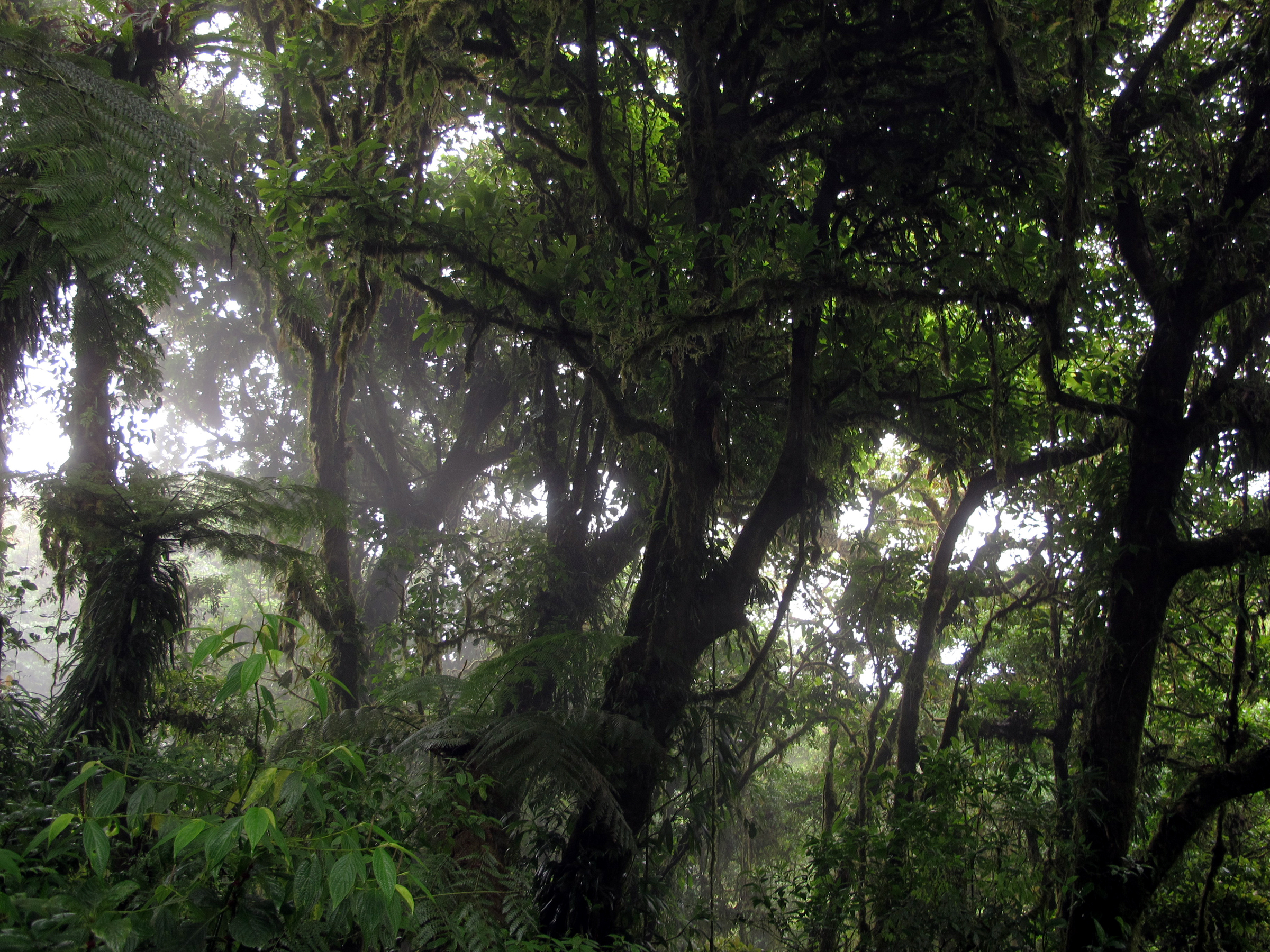
In 1965, Olof Wessberg and Karen Mogensen secured funding for Cabo Blanco, Costa Rica's first biological reserve. A 1978 BBC documentary on Monteverde launched it as an international destination. Visitors surged from 2,000 in 1978 to 7,000 in 1983. The market was proving that people would travel to see intact forest.
The 1980s saw the emergence of the private ecolodge. Amos Bien's Rara Avis, opened in 1983, proved the economic model. The Miranda family established Marenco Biological Station on the Osa Peninsula in 1985. That same year, John and Karen Lewis arrived in Costa Rica from the United States with an idea that would become a template: before they built Lapa Rios Lodge, they built a school. They understood that ecotourism's legitimacy depended on local benefit. The gamble paid off: children who attended that school now manage the property. Lapa Rios's 17 bungalows exist to finance preservation of a 1,000-acre private rainforest reserve that abuts Corcovado National Park.
Debt-for-nature swaps, pioneered by Conservation International in 1987, allowed Costa Rica to convert over $65 million in foreign debt into local-currency conservation funding. By the early 1990s, before any payment-for-conservation program even launched, forest cover was already recovering and ecotourism was exploding as an economic sector. The market had created the opportunity and the industry had built itself.
Ecotourism's Carveout in Conservation Law
The 1996 Forestry Law (Law 7575) was designed to freeze the agricultural frontier. It banned any further changes in land use for forested lands—effectively declaring that a forest must remain a forest forever. This made conservation the national default. To make this economically viable, the law also established the framework for the Payment for Environmental Services (PES) program, which paid landowners for four services their land provided: capturing carbon, protecting water sources, conserving biodiversity, and safeguarding scenic beauty. Crucially, PES funding is constitutionally durable: 3.5% of the national fuel tax plus 25% of the water use canon flow directly to forest protection—a financing mechanism that makes conservation economically rational rather than dependent on political will.
Article 19 of the Forestry Law explicitly permits limited development in forest for recreation or ecotourism, but only in a "proportional and reasonable" way. In practice, this means a very small fraction of a forest property can be cleared to build trails, small buildings, or basic infrastructure, commonly capped at 10% of the forest area. Even these exemptions must meet strict criteria: any ecotourism project must have minimal impact, protect wildlife and habitat, benefit local people, and be approved by the forest agency.
A 2023 amendment to forest regulations (Ley 10210) further expanded this carveout, allowing low-impact tourist facilities along rivers and watercourses that were previously off-limits. In theory, this harmonizes environmental protection with the advancement of sustainable tourism initiatives. In practice, Costa Rica is experimenting with adjusting strict conservation zones to permit ecotourism structures like observation decks, suspension bridges, and zip lines over riverbeds under permit.
How the Carveout Backfired
Article 19 was written for Wolf Guindon and the Lewis family—small operators who would clear a few hectares to build a lodge that financed thousands more in protection. The law assumed that anyone invoking "ecotourism" shared their values. It did not anticipate an industry where the word would be stripped of meaning.
The carveout has become a loophole. Projects claiming to be ecotourism operations, pitched as "sustainable" or "eco" to qualify for the 10% exemption, routinely exceed limits, build without proper approvals, or fail to deliver promised local benefits. The pattern is consistent: a developer acquires forested land, clears it under the ecotourism exemption, builds luxury infrastructure, and sells to foreign buyers. The law designed to protect small farmers has become a mechanism for land speculation. Prosecutors and environmental agencies have repeatedly halted developments that claimed permits and environmental sustainability, only to discover unauthorized logging, illegal forest clearing, and land-use violations. Rather than supporting conservation, the exemption has undermined the very framework the law was designed to protect.
The result is what researchers call a "fragmented national geography"—a structural outcome where islands of conservation (national parks) and islands of intensive development (coastal resorts, pineapple plantations) coexist, with the biological corridors between them left unprotected and vulnerable.
The "Degraded Pasture" Deception
Developers have found another workaround. The law makes no distinction between primary and secondary forests: a 20-year-old regenerated secondary forest receives the same Article 19 protection as a 300-year-old primary forest. All natural forests meeting Article 3 criteria are equally protected. But developers exploit a common misunderstanding, claiming that land on "former cattle pasture" or "secondary growth" is acceptable to clear. This framing is either ignorance or deliberate deception. If regenerated pasture now meets the legal definition of forest, it is protected forest.
Developers also target biological corridor lands. These narrow strips of forest connect national parks and allow wildlife to move between protected zones—jaguars tracking prey, tapirs seeking mates, birds following seasonal food sources. Corridors have the same legal protection as park forests, but they face an enforcement gap. Parks have permanent ranger stations and concentrated SINAC resources. Corridors span remote areas across multiple jurisdictions, making violations harder to detect.
This is where the enforcement gap becomes critical. Corridor forests have the same legal protection as park forests under Law 7575—clearing them is a crime with prison penalties. But parks have rangers, monitoring stations, and concentrated SINAC attention. Corridors, often remote and spanning multiple municipalities, rely on underfunded patrols and citizen reporting. Illegal clearing inside a national park triggers immediate investigation. The same violation in a corridor may go undetected for months. Developers know this. They target corridors not because development there is legal, but because violations take longer to catch.
The Certification Failure
With the "eco" label now the most valuable marketing tool in Costa Rican tourism, its co-option by greenwashing developers has become the central threat to brand integrity. This greenwashing operates on two levels.
The first level is straightforward misrepresentation. Some international resort chains have earned eco-star ratings and claim water and energy-saving programs, yet their construction wiped out forest, diverted creeks, and buried mangroves. Other resorts market themselves as pristine jungle luxury while sitting on cleared cattle pasture with water-intensive golf courses. As all-inclusive properties, they keep tourists on-site so spending goes back abroad, yielding little benefit to local communities.
The second level, eco-luxury, is more complex. The Papagayo Peninsula, a 1,400-acre private enclave in Guanacaste, exemplifies this model. It houses ultra-luxury brands like Four Seasons, Andaz, and Ritz-Carlton Reserve. Its sustainability reporting is sophisticated, citing compliance with Global Reporting Initiative standards, a 2050 Net Zero Roadmap, ISO 50001 energy management, and projects using AI to track food waste and restoring 10,000 coral fragments.
The critique is not that its data is false. The critique is that this model is an oxymoron. It is a resource-heavy enclave. The project's own 2023 impact report states that "Peninsula Papagayo relies heavily on groundwater sources" and that water consumption rose in 2023 due to construction work. This sophisticated greenwashing uses the language of sustainability and focuses on measurable internal metrics (carbon, waste) to justify and obscure its externalized impact on a scarce, shared public resource: water.
When State Certifications Fail
This co-option has been enabled by the failure of state certification systems to police the industry. The numbers are damning. The Certification for Sustainable Tourism (CST), created by the Costa Rican Tourism Board, has been adopted by only 3% of tourism businesses in Costa Rica. There are no penalties for non-compliance, no enforcement mechanism, no consequence for ignoring it entirely. Meanwhile, 98% of Costa Rican beaches qualify for the Ecological Blue Flag—a certification so ubiquitous it has lost all meaning as a differentiator. Perhaps most remarkably, the word "ecotourism" itself has no legal definition in Costa Rica. Any hotel, resort, or development can call itself an ecotourism operation without meeting any standard at all.
Academic analyses of the CST argue it fails to align with fundamental notions of sustainable tourism because it does not adequately address empowerment of civil society or social-environmental relationships. It functions as a technical checklist for business operations, not a holistic audit of a project's true social and environmental burden.
The state itself has acknowledged this crisis. In 2024, Costa Rica unveiled its first national Green Taxonomy—an attempt by financial regulators and the environment ministry to guide investors toward genuinely sustainable projects. The taxonomy is an implicit admission that existing certifications provide no credible guide. The booming real estate market, promoted as environmentally friendly, frequently practices greenwashing. High-volume tourism and luxury development for expats, particularly in coastal areas, fuels resource conflicts and environmental degradation.
A Word Without Meaning?
Costa Rica built something the world had never seen: a small tropical nation that reversed catastrophic deforestation, created the world's first ecolodges, and established a legal framework that made conservation the national default. The pioneers at Rara Avis, Monteverde, and the Osa Peninsula proved that intact rainforest could be economically viable. The 1996 Forestry Law codified their success into policy.
But the word "ecotourism" has been stripped of meaning. The legal carveout designed for 17-bungalow ecolodges financing private reserves is now invoked by 1,400-acre luxury enclaves draining aquifers. The certification systems meant to distinguish authentic operations from impostors now function as marketing tools that mask the very problems they were created to prevent. The "Pura Vida" brand, once a credible guide to sustainable travel, now requires a 200-page financial taxonomy to define what it should mean.
The original vision persists. In the Osa Peninsula, in community cooperatives, in Indigenous-led ventures, authentic ecotourism still operates as its founders intended: small-scale, locally owned, conservation-financing, and genuinely sustainable. The question is whether that authentic model can prevail against the forces that corrupted the word.
That question—what authentic ecotourism looks like in practice, and whether Costa Rica will choose it—is the subject of Part II of this series.
Key Sources & Resources
Ecotourism Theory & Practice
The authoritative definition: "responsible travel to natural areas that conserves the environment, sustains the well-being of the local people, and involves interpretation and education." Core principles include minimizing impacts, providing direct conservation benefits, generating local empowerment, and delivering interpretative experiences.
Academic analysis of Costa Rica's ecotourism model examining the tension between economic benefits for local communities and private industry, and documenting how the assumption of compatibility between these interests has failed at scale.
The definitive academic work on ecotourism, tracing its origins, principles, and corruption across multiple countries including Costa Rica. Honey documents how the term has been co-opted by mass tourism while authentic community-based models struggle to survive.
CREST conducts field research on tourism's impacts in Costa Rica, including the landmark studies on Osa Peninsula economic benefits and Guanacaste development patterns cited in this article.
Greenwashing & Certification Failures
Investigation documenting how the booming real estate market, promoted as environmentally friendly, frequently practices greenwashing, with specific examples including Hotel Riu Palace's superficial environmental practices and the eco-luxury contradiction of Peninsula Papagayo's resource-heavy operations masked by sophisticated sustainability reporting.
2021-2022 study analyzing water quality at Blue Flag-certified beaches finding: 82% of peak-season samples exceeded coral-toxic levels of oxybenzone (>50 ppt), 67% violated WHO recreational water standards for fecal coliforms, contamination strongly correlated with tourist arrivals (R²=0.71, p<0.001).
Academic critique arguing Costa Rica's CST program fails to align with fundamental notions of sustainable tourism because it inadequately addresses empowerment of civil society and social-environmental relationships, functioning as a technical checklist rather than holistic audit.
The resort's own impact report stating "Peninsula Papagayo relies heavily on groundwater sources" and that water consumption rose in 2023 due to construction, illustrating sophisticated greenwashing that uses sustainability language to justify externalized impacts.
Policy & Legal Framework
Full text of Costa Rica's landmark 1996 Forestry Law banning forest conversion, establishing Payment for Environmental Services program, and defining Article 19 ecotourism exemption permitting limited development (10% cap) in forest for recreation under strict minimal-impact criteria.
Comprehensive overview of Costa Rica's legal framework for conservation, including Forestry Law 7575, wildlife protection statutes, corridor legislation, and enforcement mechanisms.
Analysis of 2024 Green Taxonomy adoption by financial regulators and environment ministry to guide investors toward sustainable projects, representing implicit state admission that "Pura Vida" brand no longer provides credible market guidance.