Wildlife Corridors: Costa Rica's Lifelines for Biodiversity
How Legal Protection and Ecological Connectivity Are Saving Species
Imagine a jaguar prowling through the rainforest, its territory spanning dozens of kilometers. Now picture that same forest carved into isolated patches by roads, farms, and housing developments. The jaguar can no longer reach its hunting grounds, find mates, or escape threats. This is the reality of forest fragmentation, and it's happening across the tropics at an alarming rate.
Costa Rica has become a world leader in implementing biological corridors: vast landscape-scale zones that connect fragmented forests and allow wildlife to live, breed, and move freely. These corridors aren't just good ideas; they're backed by law, managed by communities, and proving crucial for species survival. But they're also under constant threat from development pressure, requiring vigilant enforcement to remain effective.
Quick Facts
- 1/3 of Costa Rica's land is now connected through 40+ biological corridors, massive landscape-scale zones where jaguars, tapirs, and migratory birds can roam freely
- 200,000+ acres in the Paso de la Danta Corridor (roughly the size of New York City), connecting the Osa Peninsula to the Talamanca Mountains in southern Costa Rica
- Sea level to 3,820m: The Talamanca-Caribe Corridor connects Caribbean beaches to cloud forest peaks, one of Earth's most dramatic elevation gradients in a single protected landscape
- Grassroots origins: Local communities pioneered Paso de la Danta in 2000, proving that bottom-up conservation can work at a national scale
- Legal teeth: Corridor destruction can result in prison time. These aren't just lines on a map; they're enforceable law backed by criminal penalties
- Required by law: Citizens must participate in corridor management, making this one of the world's most democratic conservation systems
Why Corridors Matter: The Biology of Connectivity
Costa Rica covers 0.03% of Earth's land area yet harbors roughly 5% of all known species, likely the highest species density of any country on the planet. But this remarkable richness is increasingly threatened by forest fragmentation: the breaking up of continuous forest into isolated patches. Understanding why fragmentation is so damaging requires looking at how wildlife actually uses landscapes.
The Devastating Reality of Forest Fragmentation
When development carves forests into fragments, the ecological consequences cascade through entire ecosystems:
Territory Loss and Population Decline
Large predators like jaguars and pumas require vast territories that vary dramatically with habitat quality and prey availability. Female jaguars in Costa Rica's high-quality forests may use territories as small as 10-25 square kilometers, while males typically need 25-80 square kilometers. However, in fragmented or degraded landscapes with scarce prey, male territories can expand to over 600 square kilometers, making habitat quality critical for survival. When forests are divided, these apex predators lose access to prey, mates, and den sites. A jaguar trapped in a 500-hectare forest fragment cannot sustain a viable population. Studies show that jaguar populations in fragmented landscapes decline rapidly, often disappearing entirely within a generation.
Even smaller species suffer. Monkeys, sloths, and forest-dependent birds cannot cross open agricultural land or roads safely. Populations become isolated in "forest islands," unable to reach new food sources or breeding sites.
Genetic Isolation and Inbreeding
When populations become isolated, genetic diversity plummets. Animals mate with close relatives, leading to inbreeding depression: reduced fertility, increased disease susceptibility, and genetic defects. Over time, isolated populations lose their ability to adapt to environmental changes and face higher extinction risk. This has been documented in species from tapirs to poison dart frogs across fragmented Central American forests.
Edge Effects and Habitat Degradation
Forest edges (where forest meets cleared land) experience dramatically different conditions than forest interiors. Wind penetrates deeper, temperatures spike, humidity drops, and invasive species colonize. Species adapted to cool, humid old-growth conditions (like many amphibians and understory birds) cannot survive near edges.
In small forest fragments, virtually the entire area becomes "edge," eliminating true forest interior habitat. A 100-hectare fragment might have less than 20 hectares of usable interior habitat once edge effects penetrate 100 meters inward from all sides.
Disrupted Ecological Processes
Forests function as interconnected systems where species depend on each other. Pollinating bats and insects carry pollen between flowering trees across kilometers. Frugivores (fruit-eating animals) like toucans and tapirs disperse seeds far from parent trees, regenerating the forest. When these mobile species disappear from fragments, plant reproduction fails and forest regeneration stops.
This creates a "extinction debt": the forest may still look green, but it's ecologically dead, no longer able to reproduce or sustain its biodiversity over time.
What Are Biological Corridors?
A biological corridor is a stretch of natural or semi-natural habitat that connects larger forest patches, protected areas, or ecosystems, functioning as living bridges between isolated habitats. Even relatively narrow strips of forest or vegetated land can serve as pathways for wildlife movement, but their value extends far beyond simple transit routes.
Biological corridors address fragmentation by restoring landscape connectivity. Species can move from healthy populations to recolonize depleted fragments, maintaining genetic diversity as individuals from different populations meet and breed. Large predators access multiple forest patches as a single functional territory rather than being trapped in isolated fragments. Species follow food availability and breeding sites across landscapes through seasonal migrations, and as climate changes, can shift their ranges along corridors to track suitable conditions. When development blocks animal routes, wildlife may venture into farms or villages, leading to dangerous encounters; corridors offer safe passages for animals to move without entering human settlements.
Corridors also provide critical ecosystem services that benefit human communities. They often encompass riverbanks and forested hillsides, protecting watersheds, water quality, and soil stability. The forests within corridors store carbon, regulate local climate, and support pollinating insects and seed-dispersing animals that sustain agricultural productivity in surrounding landscapes. This integration of conservation and community benefit distinguishes modern corridor approaches from traditional fortress conservation.
Research in the Talamanca-Caribe Biological Corridor (which connects lowland rainforests to montane cloud forests) shows that areas with functional corridors maintain higher species diversity and more stable populations than isolated fragments. Camera trap studies document jaguars, pumas, tapirs, and other wide-ranging species successfully using corridor pathways to move between protected areas.
Today, Costa Rica has officially recognized more than 40 biological corridors covering approximately 33% of the country's land area, a remarkable commitment showing how significant this strategy has become. These corridors range from mountain ridges to coastal strips, serving as "bridges of life" that connect national parks and wildlife refuges across the landscape.
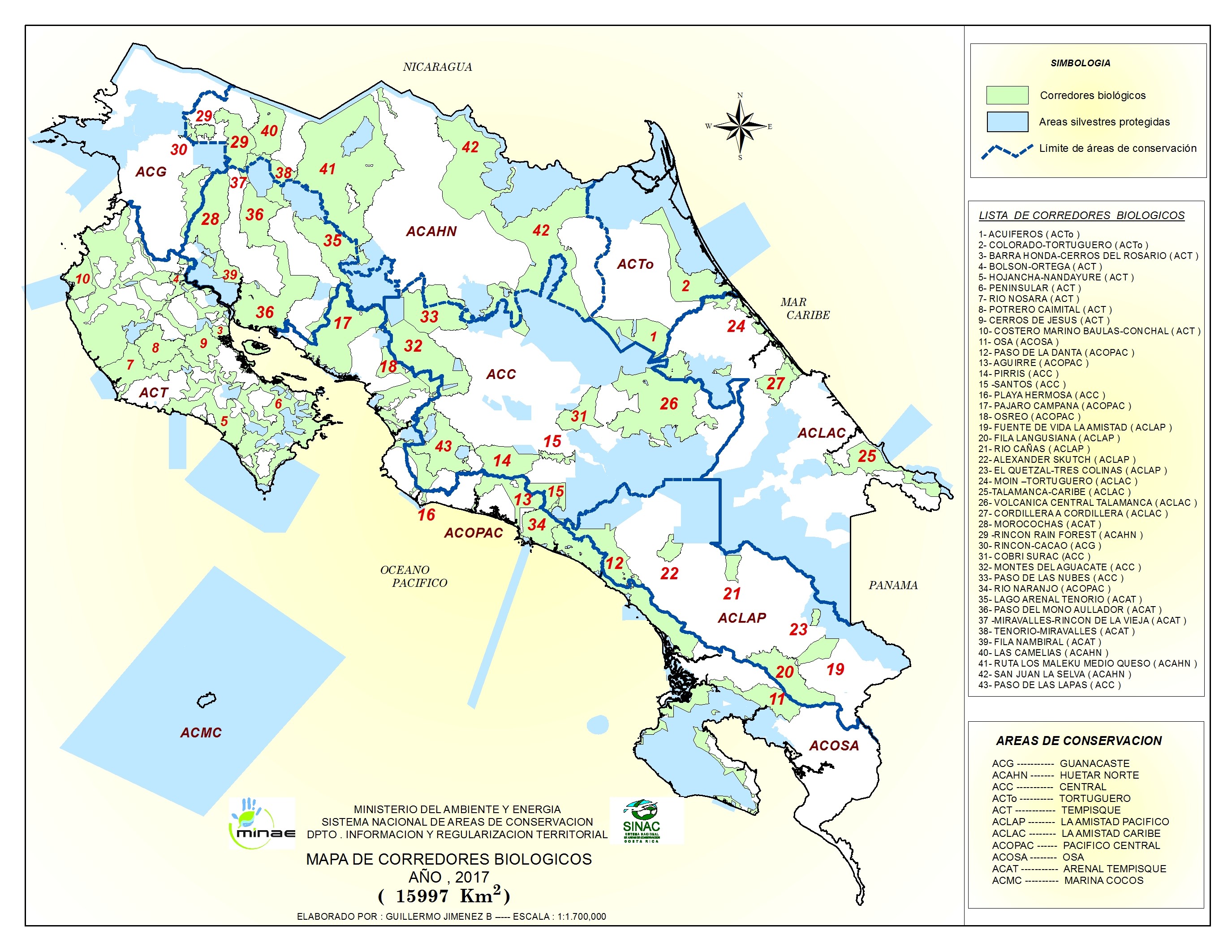
Official map of Costa Rica's biological corridors system (Source: SINAC). Click to view full resolution.
Costa Rica's Landscape-Scale Approach
Costa Rica has established more than 40 biological corridors covering approximately one-third of the country's territory. These differ fundamentally from traditional wildlife corridors. A typical wildlife corridor is a narrow linear feature: a riparian zone along a stream, a forested valley between mountains, a hedgerow connecting two woodlots. These serve as physical pathways allowing animals to move between habitat patches.
Costa Rica's biological corridors operate at landscape scale. A corridor like Paso de la Danta encompasses tens of thousands of hectares containing protected areas, private farms, Indigenous territories, towns, agricultural lands, secondary forests, and regenerating woodlands. Within these boundaries, wildlife populations can live, breed, and sustain themselves; not just pass through. The corridor itself functions as habitat, not merely as a bridge between habitats. This works because the scale is large enough and the land uses diverse enough to support complete ecological communities alongside human activities.
Scale matters. A 2019 study of northwest Costa Rica's protected areas found that isolated reserves could each support only 8-104 jaguars, populations too small for long-term viability. When connected by biological corridors spanning 8-25 kilometers, the combined area could support approximately 250 jaguars, a population size with far better survival odds. Larger corridors provide varied habitat types across elevation gradients, allow breeding populations rather than just transient movement, enable species to shift ranges with climate change, and integrate conservation with local livelihoods.
The Legal Framework: How Effective Is It?
Costa Rica's legal protection for biological corridors is built on multiple layers of legislation, creating one of the most comprehensive frameworks in the world. At the foundation is the Forestry Law No. 7575 (1996), which established the principle that forested land cannot be converted to other uses: the "once forest, always forest" rule that protects the building blocks of corridors.
Key Legal Protections
Decree No. 40043-MINAE (2016/2017)
Signed in August 2016 and implemented January 2017, this decree formally defines a biological corridor as "a continental, marine-coastal and insular territory delimited, whose primary purpose is to provide connectivity between wild protected areas" and between landscapes and ecosystems. The decree built upon earlier initiatives like the Mesoamerican Biological Corridor and declared the creation of biological corridors to be in the public interest. It establishes corridors as "citizen-protected areas" with official recognition and management structures. Article 9 creates Local Biological Corridor Committees (CLCB) that must include SINAC representatives, local government, non-governmental organizations, community grassroots groups, the productive sector, and private landowners. Article 10 requires each corridor to have a management plan, and SINAC must monitor corridor status annually.
Forestry Law No. 7575, Articles 5, 19, 37, 58, 61
Article 19 prohibits land-use change in forested areas. Once land meets the legal definition of forest (2+ hectares, 70%+ canopy cover, 60+ trees per hectare over 15cm diameter), it cannot be converted to pasture, agriculture, or development. Article 5 designates SINAC as the State Forestry Administration and allows citizens to file environmental complaints (denuncias) about illegal forestry activities. Article 37 envisions volunteer "forest brigades" for patrol and protection. Articles 58 and 61 establish criminal penalties including prison sentences for illegal land-use change.
Wildlife Conservation Law No. 7317
Protects wildlife habitat from destruction. Clearing forest in a corridor that harms wildlife populations violates this law, providing an additional enforcement mechanism.
Soil Management Law No. 7779
Requires sustainable land use to prevent erosion. Developers who clear corridor forests and cause soil degradation face fines and must repair damage.
FONAFIFO and Economic Incentives
The Forestry Law established the National Forest Financing Fund (FONAFIFO), which pays landowners for environmental services like preserving forests in corridors and provides tax exemptions for protected forest lands. This makes conservation economically viable for private landowners within corridors.
The legal effectiveness of these protections is significant but not absolute. The decree establishing corridors as "public interest" zones gives authorities clear grounds to deny development permits, and the criminal penalties under the Forestry Law; including prison sentences for illegal land-use change (Articles 58, 61); provide real deterrence. Article 57 even holds authorities and professionals (like forestry engineers) legally accountable if they knowingly allow violations through negligence or collusion.
However, enforcement challenges persist. The National System of Conservation Areas (SINAC), which manages corridor oversight, operates with limited budgets and personnel. Remote areas can see illegal clearing go undetected for weeks or months. This makes citizen participation crucial; and the law recognizes this by mandating community involvement in corridor management committees.
The Forestry Law's Article 37 even envisions "forest brigades" or surveillance committees involving civil society to patrol and protect forests. Combined with Environmental Law No. 7554, which guarantees citizens the right to be heard in environmental impact assessments and to access project information, the legal framework creates multiple avenues for public oversight. When communities report violations, file denuncias with SINAC, or participate in EIA comment periods, they activate the law's enforcement mechanisms.
Learn More About Costa Rica's Conservation Laws
Want to understand the complete legal framework protecting Costa Rica's forests; including Article 50's constitutional foundation, the Forestry Law's land-use ban, and criminal penalties for violations? Explore our comprehensive guide to conservation laws and how they work together to protect biological corridors.
Read: Costa Rica's Most Important Conservation LawsCitizens can also raise issues through Regional Environmental Councils and municipal environmental committees, or resort to legal action via constitutional appeals (recurso de amparo) if they believe the government is failing to protect their right to a healthy environment. Many communities have organized to patrol corridor areas, reporting illicit tree cutting to authorities and attending corridor committee meetings to raise concerns about new developments. Conservation groups often help by training communities on how to file environmental complaints and by following up with authorities; making citizen oversight a powerful force in protecting these vital habitats.
Landowners within corridors can adopt wildlife-friendly practices on their properties: keeping or planting native trees to create small stepping-stone habitats, installing simple wildlife crossings like rope bridges for monkeys over roads, or using insulated power lines to prevent electrocution. Even small actions, like maintaining existing forest patches instead of clearing them, contribute to a larger network of safe habitat. By becoming guardians of the corridor in their own backyards, residents help ensure these green corridors remain functional highways for life.
How to Get Involved
Citizen participation in corridor management is not just encouraged; it's legally mandated. Here's how to connect with the bodies overseeing your local corridor:
Regional Environmental Councils (CORAC)
Each of Costa Rica's 11 Conservation Areas has a CORAC where citizens can raise concerns about corridor violations and development threats.
Phone: +506 2522 6500
Email: [email protected]
Directory: sinac.go.cr/ES/transprncia/Paginas/consregcorac.aspx
Local Biological Corridor Committees
Participatory platforms with open convocation for landowners, community groups, NGOs, and local governments. These committees manage individual corridors and welcome citizen involvement.
National Program Contact:
Website: biocorredores.org
Address: Rohrmoser, San José (near Plaza Mayor)
Contact your regional SINAC office or the National Program to be connected to your local corridor committee.
Case Study: The Battle for Paso de la Danta
The Paso de la Danta Biological Corridor ("Tapir's Passage") in Costa Rica's southern Pacific region illustrates both the promise and challenges of corridor conservation. Established in 2000 through local initiative by the environmental group ASANA, this corridor spans approximately 79,000-82,000 hectares from the Osa Peninsula northeastward through Uvita, Dominical, and Quepos, continuing through the coastal mountains toward the Talamanca Cordillera, making it one of the largest corridors in the country.
Paso de la Danta was designed to connect the lowland rainforests of the Osa Peninsula (including parks like Corcovado and Marino Ballena) with the upland forests of the Talamanca Cordillera. The corridor links a chain of protected areas: Manuel Antonio National Park and Marino Ballena National Park on the coast connect through this corridor to several private wildlife refuges (like Hacienda Barú and Rancho La Merced) and onward to inland forest reserves including Los Santos Forest Reserve and the Chirripó area. This altitudinal connectivity, from sea level to mountain cloud forests, is critical for climate adaptation, allowing species to move as temperatures and conditions change.
Importantly, Paso de la Danta is not government-owned land but a mosaic of private farms, Indigenous lands, and small protected areas. Its conservation relies on the voluntary cooperation of landowners and the coordination of the Local Corridor Committee. The local committee was officially sworn in around 2013 and includes stakeholders from multiple sectors. SINAC staff from three Conservation Areas (Pacific Central, La Amistad-Pacífico, and Osa) participate, along with NGOs like ASANA and Reserva Playa Hermosa, representatives of the municipality of Pérez Zeledón, and managers of private reserves in the area.
Early on, ASANA convinced cattle ranchers to let trees grow back along streams running through their pastures, creating natural strips of forest that eventually reconnected larger forests. Community members have also created "living fences" and fruit tree patches that double as food for wildlife, practical innovations that demonstrate how working landscapes can support conservation. These efforts paid off, restoring continuous habitat where there had been gaps.
In May 2025, the corridor faced a critical test. A real estate developer began clearing forest within the corridor to build a residential project: "forest lots" marketed to buyers seeking nature views. Neighbors and environmentalists immediately raised alarms. Investigation revealed that the developers had presented a false certification stating the land was "not forest" and suitable for construction. In reality, a joint inspection by SINAC and the Environmental Prosecutor's Office confirmed the presence of real forest, meaning the permits should never have been granted under Law 7575. What followed demonstrated Costa Rica's legal framework in action.
The Environmental Prosecutor's office took the case to court swiftly, citing multiple violations: illegal change of forest land use (Forestry Law Articles 19 and 61), illegal logging without permits (Article 27), illegal use of water resources, destruction of protected riparian forests, and falsification of documents. A judge ordered the complete halt of construction and mandated the company to repair all environmental damage, including removing infrastructure built across streams and restoring affected riparian forests. The ruling sent a clear message: corridor protections have teeth.
This case illustrates a crucial point: laws are only as strong as their enforcement. The Paso de la Danta victory happened because vigilant community members reported the violation, environmental organizations documented the damage, prosecutors acted quickly, and judges upheld environmental law over development interests.
But it also reveals a troubling reality: even in conservation-leading Costa Rica, illegal corridor clearing continues. Without constant oversight, by SINAC rangers, local communities, and environmental NGOs; violations will keep occurring. The legal framework provides the tools, but civil society must wield them.
Regional Context: The Mesoamerican Biological Corridor
Costa Rica's national corridor system exists within a broader regional initiative: the Mesoamerican Biological Corridor (MBC), a transboundary conservation project spanning from southern Mexico through Central America to Panama. Established in 1997 and heralded as the world's largest and most ambitious conservation project, the MBC was designed to connect protected areas across eight countries, creating a continuous pathway for biodiversity across 7-10% of the world's known species.
Mixed Results: Ambition vs. Reality
The MBC attracted massive international investment, over $280 million within its first three years, eventually exceeding $500 million total. Nearly three decades after its establishment, assessments of the initiative remain mixed. While it successfully brought together environmental decision-makers from eight countries, reduced some international tensions, and remains part of Central America's regional environmental strategy, implementation has been highly uneven. A 2022 study of the Mexican component found management effectiveness rated as "good" in some states, yet Mexico closed the program in 2018 after 18 years. The broader challenge: translating ambitious regional planning into consistent local action across eight countries with vastly different governance capacities.
Critical Challenges
- Continued deforestation: Half of Central America's natural habitats have been converted to agriculture or urban areas. Central American countries continue losing approximately 400,000 hectares of forest annually. The situation worsened dramatically in 2024, when record fires, intensified by climate change and El Niño, burned five times more tropical primary forest than in 2023, with Latin America particularly hard hit. These losses directly undermine corridor connectivity across the region.
- Enforcement failures: Up to 40% of protected areas within the corridor go unenforced due to discontinuity of government and politics across national boundaries.
- Communication breakdown: One of the greatest shortcomings has been the lack of communication between locally-based projects and regional planning departments, resulting in fragmented efforts.
- Unclear mandate: During the planning process, stakeholders lacked a clear understanding of the MBC's exact functions, leading to anger and implementation delays.
Costa Rica's Exceptional Performance
Within this struggling regional initiative, Costa Rica stands out as the sole success story. While other MBC countries failed to implement effective corridor systems, Costa Rica took a fundamentally different approach: rather than relying solely on top-down regional planning, it worked with community organizations and environmental groups to create a chain of local biological corridors.
Costa Rica's strategy combined tax incentives, preservation easements, education, decentralized administration, partnerships with international organizations, and outright land purchases, creating a comprehensive system that addresses both conservation and socioeconomic realities. The first ecological corridor established in the 1990s was the Talamanca-Caribe corridor, which became the model for defining the broader Mesoamerican Corridor along the Caribbean coast.
Costa Rica's success within the struggling MBC reveals what makes effective corridor implementation possible. The country built a strong legal framework through Decree 40043-MINAE, declaring corridors zones of public interest with enforceable protections. FONAFIFO's Payment for Environmental Services program makes conservation economically viable for landowners, addressing the financial realities that doom conservation efforts elsewhere. Local corridor management committees with mandated citizen participation ensure communities have voice in decisions affecting their lands. SINAC provides centralized coordination while allowing decentralized implementation; balancing national oversight with local flexibility.
The contrast is clear: while the broader MBC struggles with fragmented protected areas and unenforced regulations, Costa Rica has established more than 40 biological corridors covering approximately one-third of its territory. This demonstrates that ambitious transboundary conservation requires more than international agreements; it demands robust national legal frameworks, adequate funding, community participation, and consistent political will. Regional vision must be matched with local implementation capacity.
Threats and What's Not Working
Enforcement Gaps and Legal Loopholes
While Costa Rica's corridor laws are strong on paper, enforcement remains challenging. With dozens of corridors and limited personnel, authorities struggle to monitor every hectare. Illegal logging or clearing can occur "under the radar," especially in remote areas; enforcement often relies on whistleblowers or chance discovery. One conservationist flying a gyrocopter over southern Costa Rica spotted illegal logging and alerted police. He noted the landowner received modest government payments for conservation but made far more by illegally cutting trees; proof that economic incentives can favor deforestation when enforcement is weak.
Article 19 of the Forestry Law's allowance for "ecotourism" or rural housing in forests can be interpreted loosely. Some developers hire consultants to certify that a forest is secondary growth (or not a forest at all) and then proceed with clearing under a project labeled "eco-lodge" or "sustainable villas." The law's wording allows constructions "for recreation, ecotourism and other similar improvements," which some developers have stretched to justify projects that fragment forests. Critically, the term "recreation" in the law was intended to mean a landowner's private enjoyment (like a single family cabin), not a massive commercial resort. Legal experts suggest that building a single small lodge with minimal tree removal fits ecotourism, but a 50-room hotel does not. Under Article 19, all forests meeting the Article 3 definition receive the same legal protection regardless of whether they are primary (old-growth) or secondary (regenerated) forest: the law makes no distinction based on forest age or successional stage. Yet if projects are rubber-stamped at local levels or not rigorously vetted by SINAC, forests in corridors can legally slip away.
Another issue is municipal zoning that conflicts with corridor goals. Municipalities control land use zoning and might zone parts of a corridor for tourism or residential expansion, sometimes using terms like "ecotourism zone." In practice, this could allow significant construction in a corridor as long as it meets the local plan, even if it fragments habitat. The national corridor program encourages municipalities to integrate corridor protection into their zoning, but it's not always binding; a policy gap where better alignment is needed.
Unlike a national park, a biological corridor does not automatically ban all development; it's often a voluntary conservation scheme. This means that if a landowner inside a corridor wants to sell their land for a housing project and can somehow satisfy legal requirements, there is no absolute protective status to stop it aside from normal environmental laws. Some corridor lands critical for connectivity might benefit from stronger designation, such as being declared protected areas or set aside under conservation easements.
Management Committees sometimes lack authority to enforce rules; they rely on persuasion and partnerships. If a powerful economic interest isn't cooperative, the committee alone cannot stop them without turning to government agencies or courts. Thus, gaps in coordination or political support can leave corridors vulnerable; particularly when local governments approve road expansions or infrastructure that slice through corridors without consulting the corridor committee in time.
Conservationists have called for closing these loopholes; such as clarifying the definition of ecotourism in Law 7575's regulations, strengthening SETENA's environmental impact assessment process for any project in a biological corridor, and perhaps even requiring a special "connectivity impact" assessment. Policymakers should also integrate corridor maps into municipal zoning plans (Planes Reguladores) so that local governments designate these areas for low-impact use or conservation, and give Local Corridor Committees a small budget and formal advisory role in development decisions.
Luxury Development and "Eco" Greenwashing
A particularly troubling trend threatens corridor integrity: luxury real estate marketed to foreign buyers under an "eco-friendly" label while destroying the very ecosystems it claims to protect. Costa Rica's real estate boom (in Guanacaste alone, transactions jumped from $104 million in 2021 to $156 million in 2022) has intensified development pressure on corridor lands, especially in coastal zones where biological corridors meet lucrative tourism markets.
The Costa Ballena Problem
The Southern Zone around Uvita and Ojochal (part of the Paso de la Danta biological corridor) illustrates the problem. Some developers have been reported using slash-and-burn agriculture techniques to clear forested land, then marketing the cleared parcels as "sustainable" or "eco-luxury" properties to foreign buyers seeking tropical paradise. These companies exploit lax enforcement and limited resources: rather than going through the traditional permitting process, they cut down trees and ask for "forgiveness" later, counting on overwhelmed authorities and slow legal responses.
The irony is bitter: foreign buyers attracted by Costa Rica's "green" reputation unwittingly fund the destruction of the ecosystems they came to experience. Marketing materials showcase "ocean view forest lots" and "sustainable luxury living," but the sustainability claim evaporates when mature forest is bulldozed for villa construction. This is greenwashing at its most cynical: using environmental rhetoric to sell environmental destruction.
Costa Rica has well-intentioned environmental laws, but limited resources to enforce them against bad actors who exploit this inadequacy. Some developers reportedly intimidate whistleblowers and use legal loopholes to fragment critical habitat. When removing trees, they may claim the land was "not forest" (as in the Paso de la Danta 2025 case) or that the project qualifies as "ecotourism" under Article 19 exceptions, even when the scale clearly violates the law's intent.
While Article 19 prohibits land use change on forested land, administrative regulations permit limited ecotourism infrastructure with a 10% total development footprint; including all roads, trails, buildings, and earthworks. Developers exploit this narrow exception, marketing luxury residential projects as "ecotourism" to circumvent the law. Even genuine ecotourism at the administrative 10% limit fragments critical corridor habitat. The challenge is not merely distinguishing responsible development from greenwashing; it's recognizing that the administrative exception itself, when applied to sensitive corridor zones, undermines connectivity that wildlife depends on. True forest protection requires transparency, genuine conservation commitment, adherence to environmental law, third-party verification, and enforcement mechanisms that catch violators before irreversible damage occurs.
As sustainable tourism advocates warn, the rise of mass tourism and luxury development is starting to bring environmental damage to a country once celebrated as a conservation leader. The integrity of biological corridors (and Costa Rica's green reputation) depends on closing enforcement gaps and holding developers accountable, regardless of how much money they invest or how many jobs they promise.
Lifelines for a Living Landscape
Biological corridors represent one of conservation biology's most powerful insights: nature doesn't exist in isolated fragments, and neither can its protection. Wildlife needs connected landscapes to survive and thrive, and Costa Rica's legal framework, from the Forestry Law to the Biological Corridors Decree, recognizes this fundamental truth.
The laws are strong (prohibiting deforestation, mandating community participation, and imposing serious penalties for violations). But laws alone cannot save jaguars or tapirs. That requires vigilant communities, responsive authorities, and a society committed to enforcing protection even when development interests push back.
The story of Paso de la Danta shows both the challenges ahead and the power of Costa Rica's conservation framework when citizens and institutions work together. These corridors are more than pathways through the forest; they're lifelines for biodiversity, insurance against climate change, and testament to a nation's commitment to preserving the natural world for future generations.
Resources & Further Reading
Legal Framework
-
Decree No. 40043-MINAE (2016, implemented 2017) - Biological Corridors
Establishes legal framework for biological corridors as "citizen-protected areas" with Local Corridor Committees and management requirements (signed August 31, 2016; implemented January 27, 2017)
-
Interlace Hub - Regulación del Programa Nacional de Corredores Biológicos
Detailed analysis of Decree 40043-MINAE covering 44 biological corridors (33% of territory), including 6 inter-urban corridors. Explains three corridor types, participatory governance model with Local Committees, and objectives including climate adaptation, ecosystem services, and connectivity strengthening
-
Forest Law No. 7575 (1996)
Foundation law prohibiting forest land-use change (Article 19) and establishing forest protection, with penalties for violations (Articles 58, 61) and provisions for citizen forest brigades (Article 37)
-
FAO LEX - Costa Rica Forestry Law No. 7575 (Full Text)
Complete text of the Forestry Law in PDF format
-
Wildlife Conservation Law No. 7317 (1992)
Protects wildlife habitat from destruction, complementing corridor protection
Government & Conservation Organizations
-
SINAC - National System of Conservation Areas
Manages biological corridors and protected areas nationwide
-
Programa Nacional de Corredores Biológicos (PNCB)
Official national biological corridors program with maps, corridor profiles, and management information
-
ASANA - Corredor Biológico Paso de la Danta
Local NGO that worked seven years before the corridor's official formation, pioneering riparian reforestation with farmers. Founding member of the Local Committee (sworn in 2013) and instrumental in expanding the corridor from 20,123 to 82,128 hectares in 2009
-
Jaguar Rescue Center - The Vital Role of Biological Corridors in Monkey Conservation
Explains how biological corridors help Costa Rica's four monkey species (capuchins, howler, spider, and squirrel) maintain genetic diversity, connect fragmented habitats, and reduce human-wildlife conflicts. Emphasizes corridors as "lifelines" for primates
-
Area de Conservacion Tortuguero - Biological Corridors General Information
Official information from SINAC stating that Costa Rica has over 40 biological corridors covering ~33% of territory. Defines corridors as "delimited territory providing connectivity between protected wilderness areas" and explains they include farms, coffee plantations, and rural zones to promote "harmonious coexistence between production and conservation"
Scientific Research on Corridor Effectiveness
-
A proposal for practical and effective biological corridors to connect protected areas in northwest Costa Rica
Nature Conservation (2019) - Study using jaguar (Panthera onca) as model species showing isolated protected areas support only 8-104 individuals each, while connected areas via biological corridors spanning 8-25 km could support ~250 jaguars with much higher survival probability. Demonstrates that large connected areas are far more viable than small isolated preserves.
-
Top predator ecology and conservation: Lessons from jaguars in southeastern Mexico
Conservation Science and Practice - Study documenting jaguar home range sizes in Central America: males averaged 296 km² (range: 48-633 km²) while females averaged 148 km² (range: 37-435 km²). Demonstrates how home range size varies dramatically with prey density, habitat quality, and human disturbance.
-
Density and habitat use of jaguars in the Brazilian Atlantic Forest
PLoS ONE - Research documenting jaguar density and habitat requirements, noting that female jaguars in high-quality Central American tropical forests can have home ranges as small as 10 km², while degraded or fragmented habitats require much larger territories. Emphasizes the critical importance of habitat quality for maintaining viable populations.
-
Ecological corridors in Costa Rica: An evaluation applying landscape structure, fragmentation-connectivity process, and climate adaptation (2021)
Conservation Science and Practice (2021) - Comprehensive assessment of Costa Rica's 44 ecological corridors covering 38% of territory. Found only 50% had improved connectivity, with highly variable composition in terms of area, natural habitat proportion, and fragmentation. Most corridors can maintain viable populations of peccaries and tapirs, but none could sustain jaguars or white-lipped peccaries, indicating effectiveness remains incomplete despite extensive network.
-
Mapping climate adaptation corridors for biodiversity in Central America (2024)
PLOS ONE (2024) - Regional-scale study identifying 2,375 potential corridors throughout Central America linking lowland protected areas with high-elevation intact forests. Emphasizes corridors' critical role for climate adaptation as species must shift ranges in response to warming temperatures. Provides roadmap for expanding connectivity networks across the region.
-
Permeability of a Biological Corridor for Medium and Large Mammals: A Case Study in Costa Rica (2025)
Tropical Conservation Science (2025) - Recent study assessing how effectively Costa Rican corridors allow medium and large mammal movement. Examines corridor permeability: the degree to which animals can actually traverse these landscapes, providing ground-level data on whether corridors function as intended for wildlife passage.
Recent Cases & News
-
Paso de la Danta Construction Halted (May 2025)
Environmental prosecutor successfully halts residential development using false forest certification, demonstrating enforcement of corridor protections
-
Threats to Costa Rica's Sustainable Tourism Model (El País, January 2025)
Analysis of how mass tourism threatens Costa Rica's environmental model, including 2,355 environmental complaints received by prosecutors in 2023 related to illegal forest loss and protected area damage
Regional Initiatives: Mesoamerican Biological Corridor
-
Mesoamerican Biological Corridor - Wikipedia
Overview of the MBC initiative spanning from southern Mexico to Panama. Established 1997 with $500M+ investment. Covers 8 countries, 7-10% of world's species. Mixed results: deforestation continues (400,000 ha/year), 40% of protected areas unenforced, but successfully brought countries together
-
Defining Common Ground for the Mesoamerican Biological Corridor (World Resources Institute)
Analysis of the MBC's challenges and opportunities, examining how to create effective transboundary conservation across diverse political and economic contexts
-
The Mesoamerican Biological Corridor in Panama and Costa Rica (ResearchGate)
Academic examination of how Costa Rica and Panama implemented the MBC framework, highlighting Costa Rica's unique success with community-based approaches versus top-down regional planning
-
The Mesoamerican Biological Corridor (Conservation Corridor, PDF)
Detailed report on the MBC's structure, implementation challenges, and lessons learned from transboundary conservation efforts
-
Mesoamerican Biological Corridor: Regional Initiative for Forest Conservation (FAO)
UN Food and Agriculture Organization perspective on the MBC as a regional forest conservation initiative, examining its role in sustainable development
-
Effectiveness of Management of the Mesoamerican Biological Corridor in Mexico (ScienceDirect, 2022)
2022 study evaluating the Mexican Mesoamerican Biological Corridor (2000-2018) in Chiapas and Tabasco. Found management effectiveness rated as "good" based on adequate design and multi-level stakeholder participation, though Mexico closed the program in 2018 after 18 years of implementation with little prior analysis of its effectiveness.
-
Mesoamerican Biological Corridor Project Performance Assessment (World Bank, PDF)
World Bank evaluation of the MBC project, examining investment outcomes and why the initiative failed to meet many of its conservation goals despite substantial funding
-
Tropical Forest Loss 2024: Record Fires in Latin America (World Resources Institute, 2025)
Analysis showing 2024 saw record tropical forest loss (6.7 million hectares globally), with fires burning five times more primary forest than 2023. Latin America was particularly hard hit, with hot, dry conditions from climate change and El Niño leading to larger, more widespread fires. Demonstrates ongoing threats to corridor connectivity in the Mesoamerican region despite decades of conservation investment.
Scientific Background
-
How Costa Rica Reversed Deforestation (Earth.org)
Overview of how Costa Rica reversed deforestation through the 1996 Forestry Law (making forest clearing illegal without approval) and Payment for Environmental Services program (paying farmers $64/hectare/year). Forest cover increased from ~25% in 1987 to close to 60% today through $500 million in incentives over 20 years
-
Ecological Corridors in Costa Rica: An Evaluation (Conservation Science and Practice)
Comprehensive evaluation of Costa Rica's biological corridors using landscape structure, fragmentation-connectivity processes, and climate adaptation metrics
-
Evaluating Effectiveness of Local vs Regional-Scale Wildlife Corridors (Biological Conservation)
Research comparing corridor effectiveness at different scales, finding that regional-scale corridors (7 of 9) performed better than local corridors (14 of 33) at capturing elevated connectivity levels
-
Path of the Tapir: Integrating Biological Corridors and Socioeconomic Development
Academic paper on integrating biological corridors, ecosystem management, and socioeconomic development in Costa Rica
-
Conservation Biology Research: Extensive research on corridor effectiveness shows that even relatively narrow strips of forest can maintain gene flow and allow species movement between protected areas, dramatically reducing local extinction rates. Camera trap studies in the Talamanca-Caribe corridor document jaguars, pumas, tapirs, and other wide-ranging species successfully using corridor pathways.
Development Challenges & Greenwashing
-
Exposing the Truth Behind "Eco-Friendly" Land Development in Costa Rica (Tico Times, 2024)
Investigative report on developers exploiting lax enforcement and using greenwashing to market land cleared through slash-and-burn, particularly in the Southern Zone around Uvita and Ojochal
-
In Costa Rica, Sustainable Tourism Is No Longer Enough (Mongabay, October 2024)
Sustainable tourism pioneers warn that mass tourism is "poisonous" and damaging ecosystems despite Costa Rica increasing forest cover from 40% (1987) to 57% (2024). Tourism accounts for 8.2% of GDP and 21.3% of workforce, but profits aren't being reinvested in conservation. Recommends shifting to "regenerative approach"
Previous Chapter:
Costa Rica's Biodiversity Law: Legal Shields for Endangered SpeciesNext Chapter:
Costa Rica's Conservation Programs