Once a Forest, Always a Forest Una Vez Bosque, Siempre Bosque
Article 19 of Costa Rica's Forestry Law permits construction on forested land. Criminal courts say that clearing forest cannot change its legal status. The Procuraduría resolved the contradiction in 2009. The answer is deceptively simple. El Artículo 19 de la Ley Forestal de Costa Rica permite la construcción en terrenos boscosos. Los tribunales penales dicen que la tala de bosque no puede cambiar su estatus legal. La Procuraduría resolvió la contradicción en 2009. La respuesta es engañosamente simple.

Article 19 of the 1996 Forestry Law (Ley 7575) opens with a blanket prohibition: "En terrenos cubiertos de bosque, no se permitirá cambiar el uso del suelo." On forested land, changing land use is not permitted. It then lists four exceptions where the State Forest Administration may grant permits: houses, offices, stables, nurseries, roads, bridges, and ecotourism facilities on private land; infrastructure deemed nationally important; tree removal for public safety; and firebreaks. The statutory text contemplates construction in forests. It provides a process for authorizing it. El Artículo 19 de la Ley Forestal de 1996 (Ley 7575) abre con una prohibición general: "En terrenos cubiertos de bosque, no se permitirá cambiar el uso del suelo." Luego lista cuatro excepciones donde la Administración Forestal del Estado puede otorgar permisos: casas, oficinas, establos, viveros, caminos, puentes e instalaciones de ecoturismo en terrenos privados; infraestructura de conveniencia nacional; tala por seguridad pública; y cortafuegos. El texto contempla la construcción en bosques. Proporciona un proceso para autorizarla.
In May 2003, the Tribunal de Casación Penal de San José issued a ruling that seemed to say something very different. In Voto 396-2003, the court declared: "el espacio ocupado por los bosques es irreductible." The space occupied by forests is irreducible. Anyone who damages forest through logging or fire with the purpose of changing the land's designation "debe comprender que no hay forma posible de cambiar el destino del suelo, y que el Estado hará cuanto sea para recuperar el bosque." Must understand that there is no possible way to change the land's designation, and that the State will do everything to recover the forest. En mayo de 2003, el Tribunal de Casación Penal de San José emitió un fallo que parecía decir algo muy diferente. En el Voto 396-2003, el tribunal declaró: "el espacio ocupado por los bosques es irreductible." Cualquiera que dañe el bosque mediante tala o incendio con el propósito de cambiar el destino del terreno "debe comprender que no hay forma posible de cambiar el destino del suelo, y que el Estado hará cuanto sea para recuperar el bosque."
One branch of government permits construction in forests. Another says forest land can never stop being forest. The tension is obvious. If forest land is legally irreducible, how can Article 19 authorize building on it? Una rama del gobierno permite la construcción en bosques. Otra dice que la tierra forestal nunca puede dejar de serlo. La tensión es obvia. Si la tierra forestal es legalmente irreductible, ¿cómo puede el Artículo 19 autorizar la construcción en ella?
In 2007, the Municipalidad de Aguirre asked exactly this question. The municipality wanted to know whether it could issue construction permits in forested areas, given what the criminal courts had been saying about irreducibility. The question went to the Procuraduría General de la República, Costa Rica's Attorney General's office, which issues binding legal opinions to government agencies. The answer, when it came in 2009, would reconcile the apparent contradiction and establish the principle's definitive scope. En 2007, la Municipalidad de Aguirre hizo exactamente esta pregunta. La municipalidad quería saber si podía emitir permisos de construcción en áreas boscosas, dado lo que los tribunales penales venían diciendo sobre la irreductibilidad. La consulta fue a la Procuraduría General de la República, que emite dictámenes vinculantes para las instituciones del gobierno. La respuesta, cuando llegó en 2009, reconciliaría la contradicción aparente y establecería el alcance definitivo del principio.
To understand that answer, the story must start at the beginning: three rulings in eighteen days, all from the same court, all in May 2003. Para entender esa respuesta, la historia debe comenzar desde el principio: tres fallos en dieciocho días, todos del mismo tribunal, todos en mayo de 2003.
Where the Principle Came From De Dónde Vino el Principio
May 2003. Three rulings in eighteen days. The Tribunal de Casación Penal de San José, Costa Rica's criminal cassation court, was hearing environmental crime prosecutions under Article 61(c) of the Forestry Law, which criminalizes unauthorized cambio de uso del suelo (land-use change) in forested areas. In each case, the defendant had cleared forest for agriculture or construction. Mayo de 2003. Tres fallos en dieciocho días. El Tribunal de Casación Penal de San José, el tribunal de casación penal de Costa Rica, estaba conociendo enjuiciamientos por delitos ambientales bajo el Artículo 61(c) de la Ley Forestal, que criminaliza el cambio de uso del suelo no autorizado en áreas boscosas. En cada caso, el acusado había talado bosque para agricultura o construcción.
On May 5, Voto 366-2003 (expediente 98-200262-0567-PE) ordered the removal of crops and structures that had replaced forest, plus mandatory reforestation of the destroyed areas. On May 8, Voto 396-2003 (expediente 99-200108-0567-PE) went further: it articulated the principle that would reshape Costa Rican environmental law. On May 22, Voto 450-2003 ordered full restoration of the affected area to its prior state, explicitly holding that the infractor must not derive benefit from illegality. El 5 de mayo, el Voto 366-2003 (expediente 98-200262-0567-PE) ordenó la remoción de cultivos y estructuras que habían reemplazado el bosque, más reforestación obligatoria de las áreas destruidas. El 8 de mayo, el Voto 396-2003 (expediente 99-200108-0567-PE) fue más lejos: articuló el principio que remodelaría el derecho ambiental costarricense. El 22 de mayo, el Voto 450-2003 ordenó la restitución total del área afectada a su estado anterior, sosteniendo explícitamente que el infractor no debe derivar beneficio de la ilegalidad.
The court did not merely punish the defendants. It ordered demolition of structures, removal of crops, and reforestation at the defendants' expense. The logic was clear: if destroying a forest ended its legal protection, the law would create a perverse incentive. Set fire to a forest, plant crops, and then claim the land is agricultural. The protection would evaporate the moment it was most needed. El tribunal no se limitó a castigar a los acusados. Ordenó la demolición de estructuras, la remoción de cultivos y la reforestación a costa de los acusados. La lógica era clara: si destruir un bosque terminara con su protección legal, la ley crearía un incentivo perverso. Incendia un bosque, planta cultivos, y luego reclama que la tierra es agrícola. La protección se evaporaría en el momento en que más se necesita.
The principle also covered natural disasters. The court held that "la protección del suelo de los bosques no termina o se suspende cuando por actos de seres humanos (incendios provocados, talas ilegales, etc.) o por hechos de la naturaleza (inundaciones, terremotos, incendios, etc.) el bosque viene a menos." Forest protection does not end or become suspended through human acts or natural events. Floods, earthquakes, landslides: none of these could reduce the protected status of forest land. El principio también cubría desastres naturales. El tribunal sostuvo que "la protección del suelo de los bosques no termina o se suspende cuando por actos de seres humanos (incendios provocados, talas ilegales, etc.) o por hechos de la naturaleza (inundaciones, terremotos, incendios, etc.) el bosque viene a menos." Inundaciones, terremotos, deslizamientos: ninguno de estos podía reducir el estatus protegido de la tierra forestal.
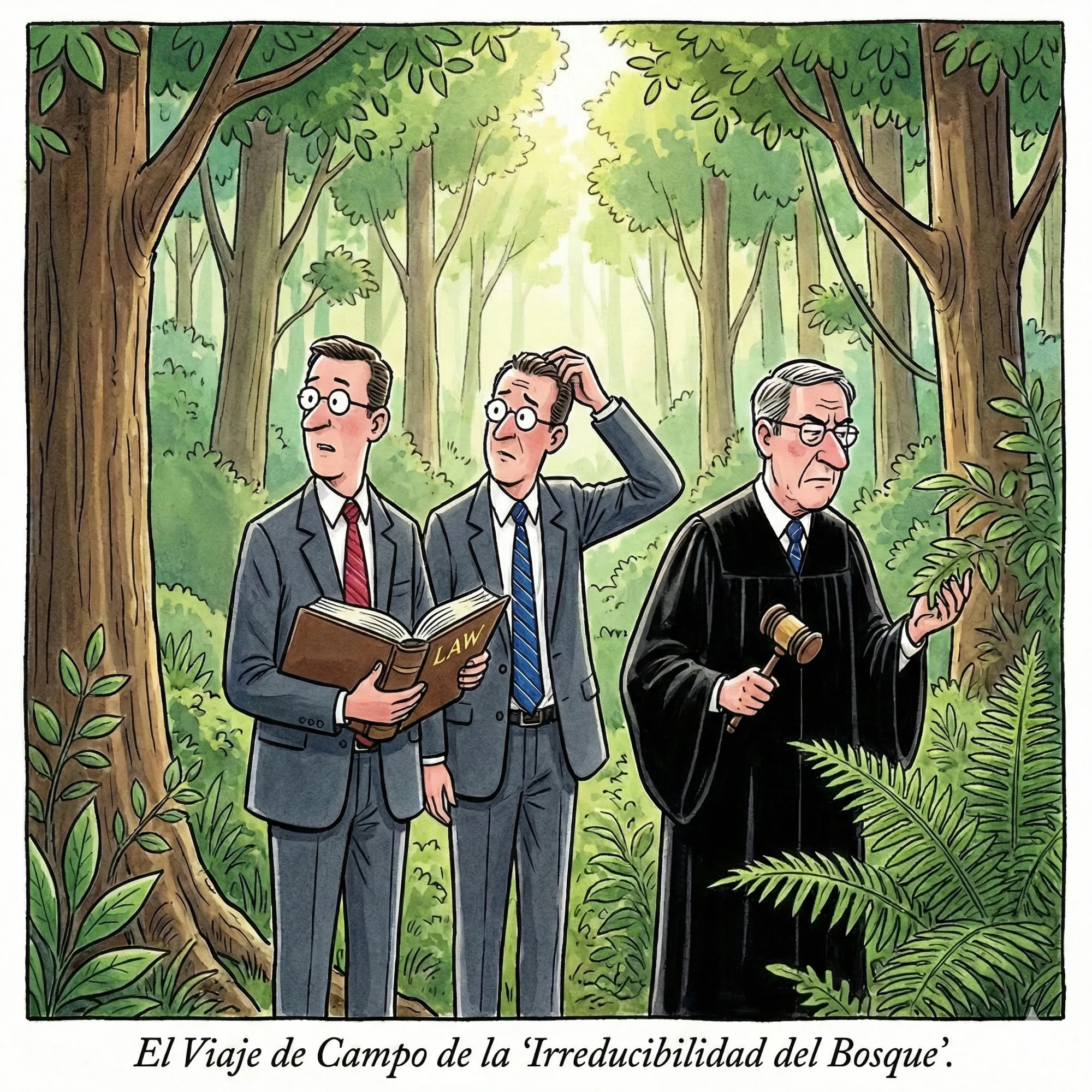
The PGR Picks It Up La PGR Lo Adopta
Within months, the Procuraduría General de la República noticed what the criminal court was doing. In August 2003, OJ-132-2003 observed that the Tribunal de Casación Penal had been "exigiendo una actitud más agresiva del Estado" in matters of forest irreducibility. The PGR was not yet adopting the principle as its own doctrine. It was noting that the judiciary was demanding a more aggressive State attitude toward enforcing forest protection. En cuestión de meses, la Procuraduría General de la República notó lo que el tribunal penal estaba haciendo. En agosto de 2003, OJ-132-2003 observó que el Tribunal de Casación Penal había estado "exigiendo una actitud más agresiva del Estado" en materia de irreductibilidad del bosque. La PGR aún no estaba adoptando el principio como doctrina propia. Estaba notando que el poder judicial exigía una actitud estatal más agresiva hacia la protección forestal.
That changed in October 2004. In C-297-2004, the PGR issued its first binding dictamen (legal opinion) applying the irreducibility principle. The context was a direct challenge to Decreto 31750-MINAE-TUR, a regulation that had authorized three-story hotel construction and 15-25% forest cutting for "ecotourism" in protected coastal forest zones. The PGR extensively quoted Votos 366-2003, 396-2003, and 450-2003, and used the irreducibility principle to invalidate the decree. If forest cannot be reduced through illegal acts, then a regulation that effectively authorized forest destruction for commercial tourism was fundamentally incompatible with the law. Eso cambió en octubre de 2004. En C-297-2004, la PGR emitió su primer dictamen vinculante aplicando el principio de irreductibilidad. El contexto fue un desafío directo al Decreto 31750-MINAE-TUR, un reglamento que había autorizado la construcción de hoteles de tres pisos y 15-25% de tala forestal para "ecoturismo" en zonas forestales protegidas costeras. La PGR citó extensamente los Votos 366-2003, 396-2003 y 450-2003, y usó el principio de irreductibilidad para invalidar el decreto. Si el bosque no puede reducirse mediante actos ilegales, un reglamento que efectivamente autorizaba la destrucción forestal para turismo comercial era fundamentalmente incompatible con la ley.
A month later, C-339-2004 followed, quoting the same foundational passage from the Tribunal de Casación Penal and reaffirming irreducibility as an operative principle. OJ-114-2006 continued the chain, citing sentencias 2003-0366, 2003-396, and 2003-0450. The PGR was building a doctrinal wall, opinion by opinion, each one quoting the same source passages, each one adding another layer of precedent. Un mes después, C-339-2004 siguió, citando el mismo pasaje fundacional del Tribunal de Casación Penal y reafirmando la irreductibilidad como principio operativo. OJ-114-2006 continuó la cadena, citando las sentencias 2003-0366, 2003-396 y 2003-0450. La PGR estaba construyendo un muro doctrinal, opinión por opinión, cada una citando las mismas fuentes, cada una agregando otra capa de precedente.
By 2007, the Tribunal de Casación Penal itself issued Voto 964-2007, which consolidated and reaffirmed the earlier rulings. The principle now had a paper trail running from the criminal courts through the Attorney General's office and back. It was cited in administrative opinions, in forest law enforcement guidance, and in challenges to executive decrees. The doctrine was no longer a criminal sentencing rationale. It was becoming a structural principle of environmental law. Para 2007, el propio Tribunal de Casación Penal emitió el Voto 964-2007, que consolidó y reafirmó los fallos anteriores. El principio ahora tenía un rastro documental que iba de los tribunales penales a la Procuraduría y de regreso. Se citaba en opiniones administrativas, en guías de aplicación de la ley forestal y en impugnaciones de decretos ejecutivos. La doctrina ya no era una justificación para sentencias penales. Se estaba convirtiendo en un principio estructural del derecho ambiental.
The Reconciliation La Reconciliación
C-200-2009, issued on July 21, 2009, is the landmark opinion. The Municipalidad de Aguirre had asked the question that the apparent contradiction demanded: can we issue construction permits in forested areas, given that criminal courts say forest land is irreducible? C-200-2009, emitido el 21 de julio de 2009, es el dictamen emblemático. La Municipalidad de Aguirre había formulado la pregunta que la contradicción aparente exigía: ¿podemos emitir permisos de construcción en áreas boscosas, dado que los tribunales penales dicen que la tierra forestal es irreductible?
The PGR's answer resolved the tension with a distinction so clean it seems obvious in retrospect. Article 19 allows legal construction with proper authorization. Irreducibility applies to illegal cambio de uso del suelo. The two are complementary. Article 19 is the legal framework for authorized intervention in private forests. The irreducibility principle ensures that unauthorized destruction cannot change a forest's legal status. The statute creates a door. The principle says you cannot burn down the wall to make your own. La respuesta de la PGR resolvió la tensión con una distinción tan limpia que parece obvia en retrospectiva. El Artículo 19 permite la construcción legal con autorización adecuada. La irreductibilidad se aplica al cambio de uso del suelo ilegal. Los dos son complementarios. El Artículo 19 es el marco legal para la intervención autorizada en bosques privados. El principio de irreductibilidad asegura que la destrucción no autorizada no puede cambiar el estatus legal de un bosque. El estatuto crea una puerta. El principio dice que no se puede quemar la pared para hacer una propia.
The dictamen traced the full citation chain, quoting Votos 366-2003, 396-2003, 450-2003, and 964-2007, alongside OJ-093-2004, C-297-2004, C-339-2004, and OJ-114-2006. It also referenced the implementing regulations: Decreto 25721-MINAE (the original Reglamento a la Ley Forestal) and Decreto 33957-MINAE (which reformed the methodology for determining land-use capacity). The following year, Decreto 35883-MINAET would further modify Article 36 and expressly codify the irreducibility principle in its considerandos. El dictamen trazó la cadena de citas completa, citando los Votos 366-2003, 396-2003, 450-2003 y 964-2007, junto con OJ-093-2004, C-297-2004, C-339-2004 y OJ-114-2006. También hizo referencia a los reglamentos: el Decreto 25721-MINAE (el Reglamento a la Ley Forestal original) y el Decreto 33957-MINAE (que reformó la metodología de determinación de capacidad de uso de tierras). Al año siguiente, el Decreto 35883-MINAET modificaría nuevamente el Artículo 36 y codificaría expresamente el principio de irreductibilidad en sus considerandos.
C-200-2009 also marked a critical expansion. The PGR told municipalities that they must deny construction permits in areas that had been illegally deforested, using historical forest coverage maps as evidence. The year-2000 map became the evidentiary baseline. If the map showed forest on a parcel in 2000 and the land is now bare, the municipality cannot simply issue a construction permit for what appears to be an empty lot. The land is still legally forest. The municipality must ask: was this forest removed legally, with proper AFE/SINAC authorization? If the answer is no, the permit must be denied. C-200-2009 también marcó una expansión crítica. La PGR indicó a las municipalidades que debían denegar permisos de construcción en áreas que habían sido ilegalmente deforestadas, usando mapas de cobertura forestal histórica como evidencia. El mapa del año 2000 se convirtió en la línea base probatoria. Si el mapa muestra bosque en una finca en 2000 y el terreno ahora está vacío, la municipalidad no puede simplemente emitir un permiso de construcción para lo que parece un lote baldío. La tierra sigue siendo legalmente bosque. La municipalidad debe preguntar: ¿fue este bosque eliminado legalmente, con autorización adecuada de AFE/SINAC? Si la respuesta es no, el permiso debe denegarse.
This was where the principle jumped from criminal sentencing to administrative law. For legal construction under Article 19, the requirements remained: AFE (SINAC) authorization, SETENA environmental evaluation, consistency with the municipal plan regulador, and compliance with INVU (alignment), AyA (water protection), Ministerio de Salud, and CNE requirements. For land that was illegally cleared, the answer was simpler: the forest status persists. No permits. The State must restore it. Aquí es donde el principio saltó de las sentencias penales al derecho administrativo. Para la construcción legal bajo el Artículo 19, los requisitos permanecían: autorización de AFE (SINAC), evaluación ambiental de SETENA, consistencia con el plan regulador municipal, y cumplimiento con INVU (alineamientos), AyA (protección de aguas), Ministerio de Salud y CNE. Para terrenos que fueron ilegalmente talados, la respuesta fue más simple: el estatus forestal persiste. Sin permisos. El Estado debe restaurarlo.
The Sala Constitucional Tests It La Sala Constitucional Lo Pone a Prueba
Two Constitutional Chamber rulings tested the principle's boundaries. In Voto 17126-2006, the Instituto Costarricense de Electricidad (ICE) challenged Article 19(b), arguing that irreducibility should yield to conveniencia nacional (national convenience) for infrastructure projects. The Sala IV's response was nuanced. It confirmed that Article 19 allows legal exceptions to the prohibition on forest land-use change, that proper authorization can permit construction in forested areas. But it also drew a line: Article 19 applies only to private forest land, not to the Patrimonio Natural del Estado (State Natural Heritage). Public forests receive absolute protection under Article 13 of the Forestry Law, with no exceptions for national convenience. Dos fallos de la Sala Constitucional pusieron a prueba los límites del principio. En el Voto 17126-2006, el Instituto Costarricense de Electricidad (ICE) impugnó el Artículo 19(b), argumentando que la irreductibilidad debía ceder ante la conveniencia nacional para proyectos de infraestructura. La respuesta de la Sala IV fue matizada. Confirmó que el Artículo 19 permite excepciones legales a la prohibición de cambio de uso en tierras forestales, que la autorización adecuada puede permitir la construcción en áreas boscosas. Pero también trazó una línea: el Artículo 19 se aplica solo a tierras forestales privadas, no al Patrimonio Natural del Estado. Los bosques públicos reciben protección absoluta bajo el Artículo 13 de la Ley Forestal, sin excepciones por conveniencia nacional.
Six years later, Voto 12716-2012 formalized this distinction into a standard constitutional formula. For forests within the Patrimonio Natural del Estado, the Sala IV declared, "no cabe la corta, el aprovechamiento forestal ni el cambio de uso del suelo" (logging, forest exploitation, and land-use change are all prohibited). This formula has become the standard constitutional citation for the PNE regime, quoted by the PGR through 2025 (PGR-OJ-174-2025). The practical result is a comprehensive prohibition across both public and private forest domains. For PNE forests, cambio de uso is prohibited outright, with no exceptions. For private forests, Article 19 allows legal cambio de uso with authorization, but the irreducibility principle ensures that unauthorized clearing cannot retroactively succeed: the forest classification persists regardless of what happens to the trees. The PGR routinely invokes both frameworks together. OJ-149-2014, for example, cites C-297-2004 and C-200-2009 (the core irreducibility opinions) alongside Voto 17126-2006 (the PNE prohibition) when reviewing legislation that would open protected areas to development. Seis años después, el Voto 12716-2012 formalizó esta distinción en una fórmula constitucional estándar. Para bosques dentro del Patrimonio Natural del Estado, la Sala IV declaró que "no cabe la corta, el aprovechamiento forestal ni el cambio de uso del suelo" (la tala, el aprovechamiento forestal y el cambio de uso del suelo están todos prohibidos). Esta fórmula se ha convertido en la cita constitucional estándar para el régimen del PNE, citada por la PGR hasta 2025 (PGR-OJ-174-2025). El resultado práctico es una prohibición integral que abarca tanto el dominio forestal público como el privado. Para bosques del PNE, el cambio de uso está prohibido de pleno derecho, sin excepciones. Para bosques privados, el Artículo 19 permite el cambio de uso legal con autorización, pero el principio de irreductibilidad asegura que el desmonte no autorizado no puede tener éxito retroactivamente: la clasificación forestal persiste independientemente de lo que ocurra con los árboles. La PGR invoca rutinariamente ambos marcos de forma conjunta. El OJ-149-2014, por ejemplo, cita el C-297-2004 y el C-200-2009 (los dictámenes centrales de irreductibilidad) junto con el Voto 17126-2006 (la prohibición del PNE) al revisar legislación que abriría áreas protegidas al desarrollo.
The 2019 nacientes (springs) case tested the opposite boundary. Environmental activists invoked the irreducibility principle to argue that spring protection zones should maintain their full protection radius even when a spring is reclassified from "permanent" to "intermittent." They wanted the principle to cover any environmental protection zone, not just forests. El caso de nacientes (manantiales) de 2019 probó el límite opuesto. Activistas ambientales invocaron el principio de irreductibilidad para argumentar que las zonas de protección de nacientes debían mantener su radio de protección completo incluso cuando una naciente se reclasifica de "permanente" a "intermitente." Querían que el principio cubriera cualquier zona de protección ambiental, no solo bosques.
The Sala IV refused. In Voto 9221-2019 (expediente 18-009400-0007-CO), the court drew a clear distinction. Forest irreducibility covers forests. It does not cover every environmental protection zone. The court held that the petitioners had confused áreas silvestres protegidas (protected wild areas) with áreas de protección de nacientes (spring protection zones). Spring protection zones may exist without forest cover; they are governed by technical hydrological criteria, not by the irreducibility doctrine. A spring whose flow diminishes can legitimately see its protection radius adjusted based on updated technical assessments. La Sala IV se negó. En la Voto 9221-2019 (expediente 18-009400-0007-CO), el tribunal trazó una distinción clara. La irreductibilidad del bosque cubre bosques. No cubre todas las zonas de protección ambiental. El tribunal sostuvo que los accionantes habían confundido áreas silvestres protegidas con áreas de protección de nacientes. Las zonas de protección de nacientes pueden existir sin cobertura forestal; se rigen por criterios hidrológicos técnicos, no por la doctrina de irreductibilidad. Una naciente cuyo caudal disminuye puede legítimamente ver su radio de protección ajustado según evaluaciones técnicas actualizadas.
These two rulings shaped the principle through limitation. The Sala IV acknowledged irreducibility's existence, strengthening it as settled law. At the same time, it refused to extend the principle beyond its scope. Forest irreducibility covers forests: land that meets the definition of bosque under Article 3(d) of the Forestry Law (a native or autochthonous ecosystem with predominance of trees, minimum 2 hectares). It does not automatically extend to every parcel that happens to fall within an environmental protection zone. Estos dos fallos moldearon el principio mediante limitación. La Sala IV reconoció la existencia de la irreductibilidad, fortaleciéndola como derecho establecido. Al mismo tiempo, se negó a extender el principio más allá de su alcance. La irreductibilidad del bosque cubre bosques: terrenos que cumplen la definición de bosque bajo el Artículo 3(d) de la Ley Forestal (un ecosistema nativo o autóctono con predominio de árboles, mínimo 2 hectáreas). No se extiende automáticamente a toda finca que se encuentre dentro de una zona de protección ambiental.
The Sala Constitucional also developed its own parallel concept: the irreductibilidad de las áreas protegidas. Through a series of votos beginning with Voto 1056-2009, then 13367-2012 and 10158-2013, the court established that protected area boundaries cannot be reduced in size except by law (the reserva de ley requirement) and with technical studies demonstrating the reduction will not harm natural resources, as required by Article 38 of the Ley Orgánica del Ambiente 7554. La Sala Constitucional también desarrolló su propio concepto paralelo: la irreductibilidad de las áreas protegidas. A través de una serie de votos comenzando con el Voto 1056-2009, luego 13367-2012 y 10158-2013, el tribunal estableció que los límites de las áreas protegidas no pueden reducirse en tamaño excepto por ley (el requisito de reserva de ley) y con estudios técnicos que demuestren que la reducción no perjudicará los recursos naturales, según requiere el Artículo 38 de la Ley Orgánica del Ambiente 7554.
The Principle Evolves El Principio Evoluciona
Two doctrinal branches now coexist. The first, irreductibilidad del bosque, emerged from criminal law in 2003: land that was forest remains legally forest regardless of what has been done to it. The second, irreductibilidad de las áreas protegidas, emerged from constitutional law beginning in 2009: protected area boundaries cannot be reduced except by legislative act supported by technical studies. Both share a common logic: environmental protection cannot be erased by the acts that make it most necessary. Ahora coexisten dos ramas doctrinales. La primera, irreductibilidad del bosque, surgió del derecho penal en 2003: la tierra que fue bosque sigue siendo legalmente bosque independientemente de lo que se le haya hecho. La segunda, irreductibilidad de las áreas protegidas, surgió del derecho constitucional a partir de 2009: los límites de las áreas protegidas no pueden reducirse excepto por acto legislativo respaldado por estudios técnicos. Ambas comparten una lógica común: la protección ambiental no puede ser borrada por los actos que la hacen más necesaria.
The concept continues to expand. In 2022, OJ-082-2022 applied non-regression reasoning to wetland protection, grounding it in Ramsar Convention obligations and the Ley de Conservación de Vida Silvestre. The reasoning parallels the forest doctrine: if destroying a wetland could extinguish its legal protection, the law would incentivize destruction. The same year, the Sala Tercera (Costa Rica's highest criminal court) endorsed the forest irreducibility principle in Resolución 691-2022 (expediente 12-200167-0591-PE), the highest criminal court confirmation the doctrine has received. El concepto continúa expandiéndose. En 2022, OJ-082-2022 aplicó el razonamiento de no regresión a la protección de humedales, fundamentándolo en las obligaciones de la Convención Ramsar y la Ley de Conservación de Vida Silvestre. El razonamiento es paralelo a la doctrina forestal: si destruir un humedal pudiera extinguir su protección legal, la ley incentivaría la destrucción. Ese mismo año, la Sala Tercera (el tribunal penal más alto de Costa Rica) refrendó el principio de irreductibilidad del bosque en la Resolución 691-2022 (expediente 12-200167-0591-PE), la confirmación más alta que la doctrina ha recibido de un tribunal penal.
By 2023, the Tribunal de Apelación de Sentencia Penal de San José was still applying the principle. Resolución 538-2023 (expediente 12-001958-0472-PE) confirmed the doctrine's unbroken application across two decades. In September 2024, the Tribunal de Apelación Penal de Cartago issued Voto 354-2024, the most recent confirmation in the judicial record. That ruling restated the principle in unqualified terms — "once a parcel is classified as forest, it cannot be converted to another use, whether agricultural or urban" — while explicitly reaffirming that no criminal conviction is required for a restoration order and that the international instruments behind the principle, the Rio Declaration and the Stockholm Declaration, continue to anchor it. Para 2023, el Tribunal de Apelación de Sentencia Penal de San José seguía aplicando el principio. La Resolución 538-2023 (expediente 12-001958-0472-PE) confirmó la aplicación ininterrumpida de la doctrina a lo largo de dos décadas. En septiembre de 2024, el Tribunal de Apelación Penal de Cartago emitió el Voto 354-2024, la confirmación más reciente en el registro judicial. Ese fallo reafirmó el principio en términos inequívocos: "una vez que un terreno se clasifica como bosque, no puede ser convertido a otro uso, como agrícola o urbanístico," y reiteró explícitamente que no se requiere condena penal para dictar una orden de restauración y que los instrumentos internacionales que sustentan el principio, la Declaración de Río y la Declaración de Estocolmo, siguen anclándolo.
The PGR citation record tells the same story of gradual expansion. From 2003 to 2006, opinions cited the criminal law doctrine of forest irreducibility. After C-200-2009, the principle entered administrative law. From 2017 onward (C-267-2017, OJ-011-2018), it appeared in challenges to executive decrees. By 2019, PGR opinions increasingly cited the Sala Constitucional's separate doctrine of protected area irreducibility alongside the original forest principle. In 2021 alone, five PGR opinions (OJ-076-2021, OJ-081-2021, OJ-088-2021, OJ-090-2021, C-253-2021) cited one or both variants, mostly in cases involving desafectación (removal) of protected area status. El registro de citas de la PGR cuenta la misma historia de expansión gradual. De 2003 a 2006, las opiniones citaban la doctrina penal de irreductibilidad del bosque. Después de C-200-2009, el principio entró al derecho administrativo. Desde 2017 (C-267-2017, OJ-011-2018), apareció en impugnaciones a decretos ejecutivos. Para 2019, las opiniones de la PGR citaban cada vez más la doctrina separada de la Sala Constitucional sobre irreductibilidad de las áreas protegidas junto con el principio forestal original. Solo en 2021, cinco opiniones de la PGR (OJ-076-2021, OJ-081-2021, OJ-088-2021, OJ-090-2021, C-253-2021) citaron una o ambas variantes, principalmente en casos de desafectación de estatus de área protegida.
What It Means in Practice Qué Significa en la Práctica
For landowners, municipalities, and developers, the principle creates concrete obligations. Courts have ordered desarraigo (removal of crops planted on illegally deforested land), demolición (demolition of structures built on illegally deforested land), and reforestación (mandatory reforestation to restore the area to forest). These are remedies, not punishments. The criminal penalty for unauthorized cambio de uso under Article 61(c) is 1 month to 3 years in prison. The restorative orders come on top of that. Para propietarios, municipalidades y desarrolladores, el principio crea obligaciones concretas. Los tribunales han ordenado desarraigo (remoción de cultivos plantados en tierra ilegalmente deforestada), demolición (demolición de estructuras construidas en tierra ilegalmente deforestada) y reforestación (reforestación obligatoria para restaurar el área a bosque). Estos son remedios, no castigos. La pena criminal por cambio de uso no autorizado bajo el Artículo 61(c) es de 1 mes a 3 años de prisión. Las órdenes de restitución se agregan encima de eso.
Historical coverage maps serve as the primary evidence. The year-2000 forest coverage map, referenced in C-200-2009 and the SINAC resolution R-SINAC-013-2006, establishes the baseline. Historical aerial photography can prove that a parcel was forested at a specific date. If a landowner buys a parcel that was illegally cleared before the sale, the forest status follows the land regardless of ownership changes. The buyer inherits the obligation to restore the forest, even if they had no involvement in the original clearing. Los mapas de cobertura histórica sirven como evidencia principal. El mapa de cobertura forestal del año 2000, referenciado en C-200-2009 y la resolución R-SINAC-013-2006, fija la línea base. La fotografía aérea histórica puede probar que una finca fue boscosa en una fecha específica. Si un propietario compra un terreno que fue ilegalmente talado antes de la venta, el estatus forestal sigue al terreno independientemente de los cambios de propiedad. El comprador hereda la obligación de restaurar el bosque, incluso si no tuvo participación en la tala original.
Municipalities bear direct responsibility. After C-200-2009, they must deny construction permits on illegally deforested land. SETENA environmental approval alone is insufficient. The municipal plan regulador must be consulted, and the municipality retains discretion to deny permits based on historical forest status. Decreto 35883-MINAET codified the principle in regulation, its considerandos explicitly citing the irreducibility doctrine and referencing the State's responsibility to recover illegally cleared forest. Las municipalidades tienen responsabilidad directa. Después de C-200-2009, deben denegar permisos de construcción en tierras ilegalmente deforestadas. La aprobación ambiental de SETENA por sí sola es insuficiente. El plan regulador municipal debe ser consultado, y la municipalidad conserva la discreción de denegar permisos basándose en el estatus forestal histórico. El Decreto 35883-MINAET codificó el principio en reglamento, sus considerandos citando explícitamente la doctrina de irreductibilidad y haciendo referencia a la responsabilidad del Estado de recuperar el bosque ilegalmente talado.
The irreducibility principle intersects with several other constitutional environmental doctrines. No regresión (non-regression) holds that environmental protection levels cannot decrease; irreducibility is a specific application. Objetivación de la tutela ambiental requires that environmental decisions be based on objective technical criteria, not administrative convenience. Reserva de ley mandates that protected area designations and forest classifications can only be altered by law, not by executive decree. Inderogabilidad singular prevents a general norm from being excepted by individual administrative act. C-267-2017 cited irreducibility alongside all of these doctrines in challenging Decreto 40675. C-253-2021 applied irreducibility together with non-regression and progressivity in a protected area desafectación case. The principle has become part of a doctrinal ecosystem, reinforcing and reinforced by the surrounding constitutional architecture. El principio de irreductibilidad se cruza con varias otras doctrinas ambientales constitucionales. No regresión sostiene que los niveles de protección ambiental no pueden disminuir; la irreductibilidad es una aplicación específica. Objetivación de la tutela ambiental requiere que las decisiones ambientales se basen en criterios técnicos objetivos, no en conveniencia administrativa. Reserva de ley establece que las designaciones de áreas protegidas y clasificaciones forestales solo pueden alterarse por ley, no por decreto ejecutivo. Inderogabilidad singular impide que una norma general sea excepcionada por acto administrativo individual. C-267-2017 citó la irreductibilidad junto con todas estas doctrinas al impugnar el Decreto 40675. C-253-2021 aplicó la irreductibilidad junto con no regresión y progresividad en un caso de desafectación de área protegida. El principio se ha convertido en parte de un ecosistema doctrinal, reforzando y reforzado por la arquitectura constitucional circundante.
The Record El Registro
The following tables catalog every PGR opinion and judicial ruling that has cited, applied, or tested the irreducibility principle. Each entry includes a brief description of the key holding. Las siguientes tablas catalogan cada opinión de la PGR y fallo judicial que ha citado, aplicado o puesto a prueba el principio de irreductibilidad. Cada entrada incluye una breve descripción del razonamiento clave.
Binding PGR Opinions (Dictámenes) Dictámenes Vinculantes de la PGR
| OpinionOpinión | DateFecha | SubjectTema | Key HoldingRazonamiento Clave |
|---|---|---|---|
| C-297-2004 | 19 Oct 200419 oct 2004 | Ecotourism in ZMT forests / Decreto 31750Ecoturismo en bosques ZMT / Decreto 31750 | First binding PGR opinion to adopt the principle; extensively quotes Votos 366, 396, 450-2003; applies it to invalidate ecotourism decreePrimer dictamen vinculante en adoptar el principio; cita extensamente Votos 366, 396, 450-2003; lo aplica para invalidar decreto de ecoturismo |
| C-339-2004 | 17 Nov 200417 nov 2004 | Forest law enforcementAplicación de ley forestal | Reaffirms irreducibility as operative principle; quotes same Tribunal de Casación Penal passageReafirma irreductibilidad como principio operativo; cita el mismo pasaje del Tribunal de Casación Penal |
| C-200-2009 | 21 Jul 200921 jul 2009 | Construction permits in forested areas (Mun. de Aguirre)Permisos de construcción en zonas boscosas (Mun. de Aguirre) | Landmark: reconciles irreducibility with Art. 19; Art. 19 allows legal construction, irreducibility applies to illegal cambio de usoEmblemático: reconcilia irreductibilidad con Art. 19; Art. 19 permite construcción legal, irreductibilidad aplica a cambio de uso ilegal |
| C-267-2017 | 14 Nov 201714 nov 2017 | Challenge to Decreto 40675Impugnación del Decreto 40675 | Cites irreducibility alongside inderogabilidad singular, reserva de ley, and objetivaciónCita irreductibilidad junto con inderogabilidad singular, reserva de ley y objetivación |
| C-253-2021 | 6 Sep 20216 sep 2021 | Desafectación of protected areaDesafectación de área protegida | Cites Sala IV variant (irreductibilidad de las áreas protegidas); requires law + technical studies + non-regressionCita variante de Sala IV (irreductibilidad de las áreas protegidas); requiere ley + estudios técnicos + no regresión |
Non-Binding PGR Opinions (Opiniones Jurídicas) Opiniones Jurídicas de la PGR (No Vinculantes)
| OpinionOpinión | DateFecha | SubjectTema | Key HoldingRazonamiento Clave |
|---|---|---|---|
| OJ-132-2003 | 4 Aug 20034 ago 2003 | Proposed criminal law reformsReformas penales propuestas | Earliest PGR reference; notes Tribunal demanding "more aggressive State attitude" on forest irreducibilityPrimera referencia de la PGR; nota que el Tribunal exige "actitud más agresiva del Estado" sobre irreductibilidad |
| OJ-093-2004 | 19 Jul 200419 jul 2004 | Forest law analysisAnálisis de ley forestal | Cites irreducibility alongside Tribunal de Casación Penal rulingsCita irreductibilidad junto con fallos del Tribunal de Casación Penal |
| OJ-114-2006 | 14 Aug 200614 ago 2006 | Forest law enforcementAplicación de ley forestal | Quotes foundational passage; cites sentencias 2003-0366, 2003-396, 2003-0450Cita el pasaje fundacional; cita sentencias 2003-0366, 2003-396, 2003-0450 |
| OJ-149-2014 | 4 Nov 20144 nov 2014 | ICE geothermal in protected areas (Exp. 19233)Geotermia del ICE en áreas protegidas (Exp. 19233) | Comprehensive PNE citation chain: cites C-297-2004, C-200-2009, and Sala IV 17126-2006 for cambio de uso prohibition in PNE landsCadena de citas comprensiva del PNE: cita C-297-2004, C-200-2009 y Sala IV 17126-2006 para prohibición de cambio de uso en tierras del PNE |
| OJ-011-2018 | 24 Jan 201824 ene 2018 | Decreto violating Ley 6126Decreto que viola Ley 6126 | Lists forest irreducibility among violated principles; PGR recused due to pending constitutional caseLista irreductibilidad entre principios violados; PGR se recusó por caso constitucional pendiente |
| OJ-101-2018 | 25 Oct 201825 oct 2018 | Parque Nacional Manuel Antonio propertyPropiedad del Parque Nacional Manuel Antonio | Applies irreducibility to show land had forest-use restrictions predating park creation (since Ley 4465, 1969)Aplica irreductibilidad para mostrar que el terreno tenía restricciones forestales previas a la creación del parque (desde Ley 4465, 1969) |
| OJ-087-2019 | 14 Aug 201914 ago 2019 | Protected area managementGestión de áreas protegidas | Cites Sala IV variant (irreductibilidad de las áreas silvestres protegidas); references Votos 1056-2009, 13367-2012, 10158-2013Cita variante de Sala IV (irreductibilidad de las áreas silvestres protegidas); referencia Votos 1056-2009, 13367-2012, 10158-2013 |
| OJ-070-2020 | 23 Apr 202023 abr 2020 | Land management in protected areasGestión de tierras en áreas protegidas | Cites protected area irreducibility; requires technical studies for any reductionCita irreductibilidad de áreas protegidas; requiere estudios técnicos para cualquier reducción |
| OJ-072-2020 | 11 May 202011 may 2020 | Forested land managementGestión de tierras boscosas | Cites Sala IV variant of protected area irreducibilityCita variante de Sala IV de irreductibilidad de áreas protegidas |
| OJ-076-2021 | 5 Apr 20215 abr 2021 | Desafectación of protected areaDesafectación de área protegida | Cites protected area irreducibility; requires law and technical justificationCita irreductibilidad de áreas protegidas; requiere ley y justificación técnica |
| OJ-081-2021 | 21 Apr 202121 abr 2021 | Protected area boundary issuesProblemas de límites de áreas protegidas | Cites Sala IV variant of protected area irreducibilityCita variante de Sala IV de irreductibilidad de áreas protegidas |
| OJ-088-2021 | 6 May 20216 may 2021 | Protected area managementGestión de áreas protegidas | Cites irreducibility; references Art. 38 Ley Orgánica del AmbienteCita irreductibilidad; referencia Art. 38 Ley Orgánica del Ambiente |
| OJ-090-2021 | 7 May 20217 may 2021 | Protected area boundaryLímites de área protegida | Cites protected area irreducibilityCita irreductibilidad de áreas protegidas |
| OJ-082-2022 | 20 Jun 202220 jun 2022 | Wetlands regulationRegulación de humedales | Applies non-regression reasoning to wetland protection under Ramsar Convention and LCVSAplica razonamiento de no regresión a protección de humedales bajo Convención Ramsar y LCVS |
| OJ-018-2023 | 28 Feb 202328 feb 2023 | Desafectación and donation of State propertyDesafectación y donación de propiedad estatal | Cites protected area irreducibility; references Sala IV Votos 1056-2009, 13367-2012, 10158-2013Cita irreductibilidad de áreas protegidas; referencia Votos de Sala IV 1056-2009, 13367-2012, 10158-2013 |
Criminal Court Rulings Fallos de Tribunales Penales
| RulingFallo | DateFecha | CourtTribunal | Key HoldingRazonamiento Clave |
|---|---|---|---|
| Voto 366-2003 | 5 May 20035 may 2003 | Tribunal de Casación Penal, San JoséTribunal de Casación Penal, San José | Orders removal of crops/structures; mandatory reforestation. Exp. 98-200262-0567-PEOrdena remoción de cultivos/estructuras; reforestación obligatoria. Exp. 98-200262-0567-PE |
| Voto 396-2003 | 8 May 20038 may 2003 | Tribunal de Casación Penal, San JoséTribunal de Casación Penal, San José | Foundational: articulates the irreducibility principle. "El espacio ocupado por los bosques es irreductible." Exp. 99-200108-0567-PEFundacional: articula el principio de irreductibilidad. "El espacio ocupado por los bosques es irreductible." Exp. 99-200108-0567-PE |
| Voto 450-2003 | 22 May 200322 may 2003 | Tribunal de Casación Penal, San JoséTribunal de Casación Penal, San José | Orders full restoration; infractor must not derive benefit from illegalityOrdena restitución total; infractor no debe derivar beneficio de la ilegalidad |
| Voto 964-2007 | 20072007 | Tribunal de Casación Penal, San JoséTribunal de Casación Penal, San José | Consolidation and reaffirmation of the 2003 rulingsConsolidación y reafirmación de los fallos de 2003 |
| Voto 32-2014 | 28 Jan 201428 ene 2014 | Tribunal de Apelación, CartagoTribunal de Apelación, Cartago | Application of irreducibility. Exp. 10-200773-0634-PEAplicación de irreductibilidad. Exp. 10-200773-0634-PE |
| Voto 339-2014 | 31 Jul 201431 jul 2014 | Tribunal de Apelación, CartagoTribunal de Apelación, Cartago | Application of irreducibility. Exp. 08-000429-0647-PEAplicación de irreductibilidad. Exp. 08-000429-0647-PE |
| Voto 686-2020 | 31 Jul 202031 jul 2020 | Tribunal de Apelación, Alajuela/San RamónTribunal de Apelación, Alajuela/San Ramón | Application of irreducibility. Exp. 15-200128-0591-PEAplicación de irreductibilidad. Exp. 15-200128-0591-PE |
| Voto 691-2022 | 24 Jun 202224 jun 2022 | Sala TerceraSala Tercera | Highest criminal court endorsement. Exp. 12-200167-0591-PEConfirmación del tribunal penal más alto. Exp. 12-200167-0591-PE |
| Voto 538-2023 | 24 Apr 202324 abr 2023 | Tribunal de Apelación, San JoséTribunal de Apelación, San José | Most recent application found. Exp. 12-001958-0472-PEAplicación más reciente encontrada. Exp. 12-001958-0472-PE |
Constitutional Court Cases Casos de la Sala Constitucional
| RulingFallo | SubjectTema | Key HoldingRazonamiento Clave |
|---|---|---|
| Voto 17126-2006 | ICE challenge to Art. 19(b)Impugnación de ICE al Art. 19(b) | Art. 19 allows legal exceptions; applies only to private forest, not PNEArt. 19 permite excepciones legales; aplica solo a bosque privado, no al PNE |
| Voto 1056-2009 | Protected area irreducibility (foundational)Irreductibilidad de áreas protegidas (fundacional) | Establishes that protected area boundaries cannot be reduced except by lawEstablece que los límites de áreas protegidas no pueden reducirse excepto por ley |
| Voto 12716-2012 | PNE regime and cambio de uso prohibitionRégimen del PNE y prohibición de cambio de uso | Standard constitutional formulation: PNE regime means "no cabe la corta, el aprovechamiento forestal ni el cambio de uso del suelo." Repeatedly cited by PGR through 2025.Formulación constitucional estándar: el régimen del PNE implica que "no cabe la corta, el aprovechamiento forestal ni el cambio de uso del suelo." Citado repetidamente por la PGR hasta 2025. |
| Voto 13367-2012 | Protected area boundariesLímites de áreas protegidas | Reaffirms protected area irreducibility; requires technical studies for any boundary changeReafirma irreductibilidad de áreas protegidas; requiere estudios técnicos para cualquier cambio de límites |
| Voto 10158-2013 | Protected area managementGestión de áreas protegidas | Continues protected area irreducibility doctrineContinúa doctrina de irreductibilidad de áreas protegidas |
| Voto 9221-2019 | Nacientes (springs) protectionProtección de nacientes | Forest irreducibility covers forests, not spring protection zones; petitioners confused áreas silvestres protegidas with áreas de protección de nacientesIrreductibilidad del bosque cubre bosques, no zonas de protección de nacientes; accionantes confundieron áreas silvestres protegidas con áreas de protección de nacientes |
Resources & Further Reading Recursos y Lecturas Adicionales
Primary Legislation Legislación Primaria
The foundation. Articles 1, 3(d), 13, 14, 19, 34, and 61(c) define the legal framework that the irreducibility principle protects. Art. 19 allows narrow exceptions for construction in private forests. Art. 61(c) criminalizes unauthorized land-use change. The principle bridges the two. La base. Los Artículos 1, 3(d), 13, 14, 19, 34 y 61(c) definen el marco legal que protege el principio de irreductibilidad. El Art. 19 permite excepciones limitadas para construcción en bosques privados. El Art. 61(c) criminaliza el cambio de uso no autorizado. El principio conecta ambos.
Article 38 requires that any reduction of a protected area be made by law and supported by technical studies. This provision grounds the Sala Constitucional's separate doctrine of protected area irreducibility. El Artículo 38 requiere que cualquier reducción de un área protegida sea hecha por ley y respaldada por estudios técnicos. Esta disposición fundamenta la doctrina separada de la Sala Constitucional sobre irreductibilidad de áreas protegidas.
Attorney General Opinions Opiniones de la Procuraduría
The landmark reconciliation. Resolves the apparent contradiction between Article 19 and the irreducibility principle. Art. 19 governs legal construction; irreducibility governs illegal deforestation. The two are complementary. Also establishes municipal duty to deny permits on illegally cleared land. La reconciliación emblemática. Resuelve la contradicción aparente entre el Artículo 19 y el principio de irreductibilidad. El Art. 19 regula la construcción legal; la irreductibilidad regula la deforestación ilegal. Los dos son complementarios. También establece el deber municipal de denegar permisos en terrenos ilegalmente talados.
First binding PGR opinion to apply the irreducibility principle. Extensively quotes the three foundational 2003 rulings. Used the principle to invalidate Decreto 31750-MINAE-TUR, which had authorized hotel construction and logging in coastal forest zones. Primer dictamen vinculante de la PGR en aplicar el principio de irreductibilidad. Cita extensamente los tres fallos fundacionales de 2003. Usó el principio para invalidar el Decreto 31750-MINAE-TUR, que había autorizado la construcción hotelera y tala en zonas forestales costeras.
Reaffirmed irreducibility as an operative legal principle one month after C-297-2004, quoting the same foundational passage from the Tribunal de Casación Penal. Reafirmó la irreductibilidad como principio legal operativo un mes después de C-297-2004, citando el mismo pasaje fundacional del Tribunal de Casación Penal.
Constitutional Court Rulings Fallos de la Sala Constitucional
The boundary case. Environmental activists tried to extend forest irreducibility to spring protection zones. The Sala IV refused, distinguishing between áreas silvestres protegidas and áreas de protección de nacientes. Clarifies what the principle does and does not cover. El caso de los límites. Activistas ambientales intentaron extender la irreductibilidad del bosque a zonas de protección de nacientes. La Sala IV rechazó, distinguiendo entre áreas silvestres protegidas y áreas de protección de nacientes. Clarifica qué cubre y qué no cubre el principio.
Established that Article 19 allows legal exceptions to forest protection but applies only to private forests. Public forests in the Patrimonio Natural del Estado receive absolute protection under Article 13, with no exceptions for national convenience. Estableció que el Artículo 19 permite excepciones legales a la protección forestal pero aplica solo a bosques privados. Los bosques públicos en el Patrimonio Natural del Estado reciben protección absoluta bajo el Artículo 13, sin excepciones por conveniencia nacional.
Criminal Court Doctrine Doctrina de Tribunales Penales
The foundational rulings. Three decisions in eighteen days, May 2003. Voto 396-2003 contains the principle's canonical formulation. All three order demolition, crop removal, and reforestation in environmental crime cases. Expedientes: 98-200262-0567-PE (366), 99-200108-0567-PE (396). Searchable via the Nexus portal of the Poder Judicial. Los fallos fundacionales. Tres decisiones en dieciocho días, mayo de 2003. El Voto 396-2003 contiene la formulación canónica del principio. Los tres ordenan demolición, remoción de cultivos y reforestación en casos de delitos ambientales. Expedientes: 98-200262-0567-PE (366), 99-200108-0567-PE (396). Consultables a través del portal Nexus del Poder Judicial.
Highest criminal court endorsement of forest irreducibility. The Sala Tercera is Costa Rica's supreme court for criminal matters. Expediente 12-200167-0591-PE. Confirmación del tribunal penal más alto sobre irreductibilidad del bosque. La Sala Tercera es la corte suprema de Costa Rica para asuntos penales. Expediente 12-200167-0591-PE.
Regulatory Implementation Implementación Reglamentaria
The only regulation that expressly codifies the irreducibility principle. Its considerandos cite the irreducibility doctrine and the State's obligation to recover illegally cleared forest. Modifies Article 36 of the Reglamento a la Ley Forestal. El único reglamento que codifica expresamente el principio de irreductibilidad. Sus considerandos citan la doctrina de irreductibilidad y la obligación del Estado de recuperar el bosque ilegalmente talado. Modifica el Artículo 36 del Reglamento a la Ley Forestal.
Establishes the technical methodology for verifying forest boundaries using historical coverage maps, the operational tools for enforcing irreducibility on the ground. Establece la metodología técnica para verificar límites forestales usando mapas de cobertura histórica, las herramientas operativas para aplicar la irreductibilidad en el terreno.