Walking Palm Palma Zancuda
Socratea exorrhiza — The palm that supposedly walks through the forest on stilt-like roots. The legend is false, but the science behind this remarkable tree is even more interesting than the myth. Socratea exorrhiza — La palma que supuestamente camina por el bosque sobre raíces como zancos. La leyenda es falsa, pero la ciencia detrás de este notable árbol es aún más interesante que el mito.
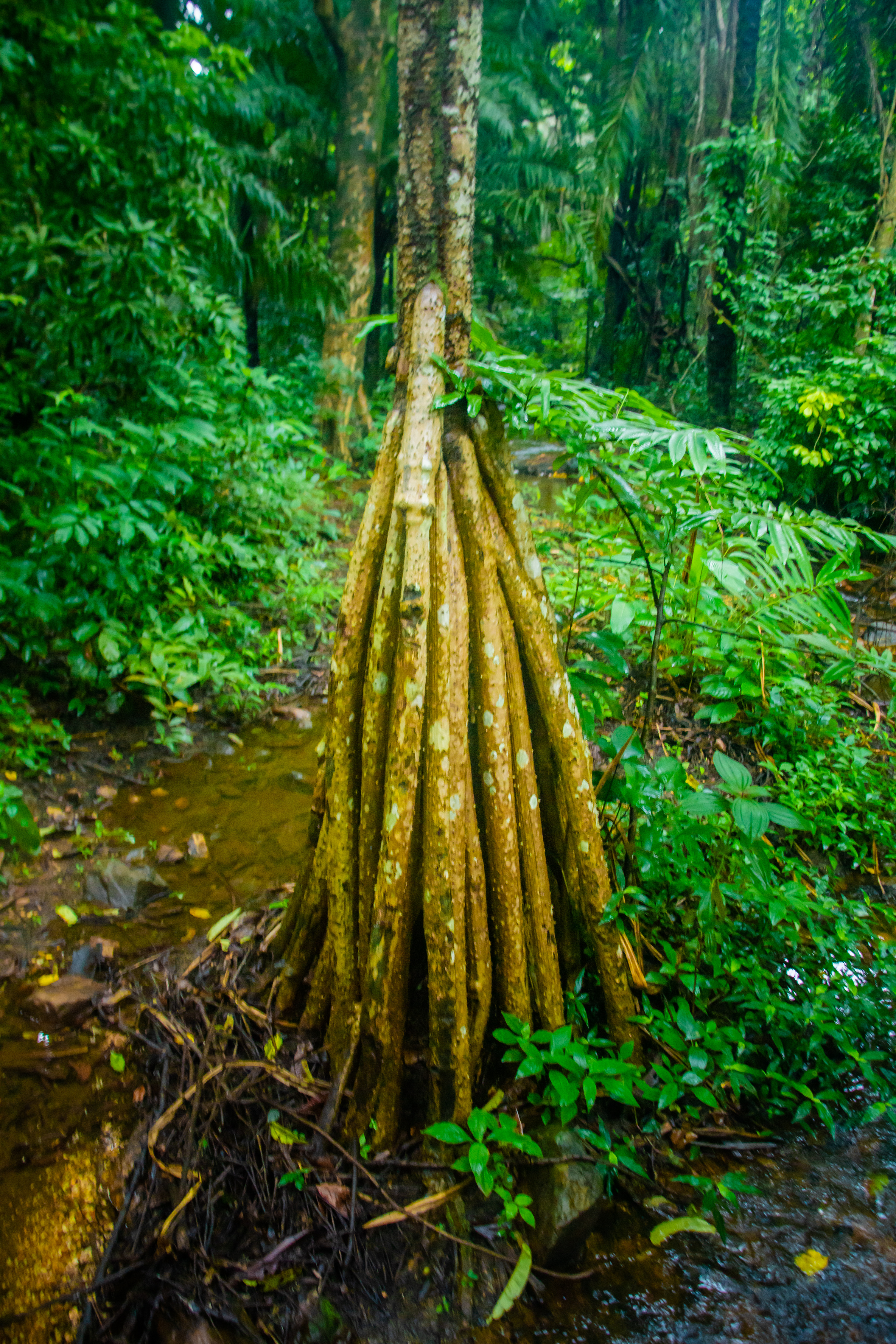
In the lowland rainforests of Corcovado National Park, visitors encounter one of the most distinctive trees in the Neotropics. The walking palm rises on a cone of spiny aerial roots that lift its trunk clear of the forest floor, looking for all the world like a plant caught mid-stride. Tour guides spin tales of trees that walk toward light, slowly migrating across the forest over years. It is a captivating story. It is also a myth. En las selvas tropicales de tierras bajas del Parque Nacional Corcovado, los visitantes encuentran uno de los árboles más distintivos del Neotrópico. La palma zancuda se eleva sobre un cono de raíces aéreas espinosas que levantan su tronco del suelo del bosque, pareciendo una planta atrapada a medio paso. Los guías turísticos cuentan historias de árboles que caminan hacia la luz, migrando lentamente por el bosque durante años. Es una historia cautivadora. También es un mito.
The walking palm's stilt roots are real and remarkable, but they do not enable locomotion. Costa Rican biologist Gerardo Avalos definitively debunked the walking myth in a 2005 study published in Biotropica. His research showed that while some roots may die off and new ones grow, the trunk itself remains rooted to the spot. No time-lapse photography has ever captured a walking palm in motion, because they do not move. Las raíces zancos de la palma zancuda son reales y notables, pero no permiten locomoción. El biólogo costarricense Gerardo Avalos refutó definitivamente el mito del caminar en un estudio de 2005 publicado en Biotropica. Su investigación mostró que aunque algunas raíces pueden morir y otras nuevas crecer, el tronco mismo permanece enraizado en su lugar. Ninguna fotografía de lapso de tiempo ha capturado jamás una palma zancuda en movimiento, porque no se mueven.
Identification Identificación
The Arecaceae, or palm family, comprises over 2,600 species worldwide, making it one of the most important plant families in tropical ecosystems. Socratea exorrhiza belongs to the Iriarteoid group, a lineage of stilt-rooted palms found exclusively in the Neotropics. Its closest relative in Costa Rica is Iriartea deltoidea, which has similar stilt roots but can be distinguished by its dark, spineless roots. Las Arecaceae, o familia de las palmas, comprende más de 2,600 especies en todo el mundo, convirtiéndola en una de las familias de plantas más importantes en ecosistemas tropicales. Socratea exorrhiza pertenece al grupo Iriarteoid, un linaje de palmas con raíces zancos encontrado exclusivamente en el Neotrópico. Su pariente más cercano en Costa Rica es Iriartea deltoidea, que tiene raíces zancos similares pero se puede distinguir por sus raíces oscuras y sin espinas.
Physical Characteristics Características Físicas
Stilt roots: The most distinctive feature. Light brown aerial roots emerge from the lower trunk and descend to the ground, forming a cone-shaped structure that can reach several meters in height. The roots are covered in short, sharp spines. New roots continuously form higher on the trunk while older roots at the base may die off, though this does not cause the tree to move. Raíces zancos: La característica más distintiva. Raíces aéreas de color marrón claro emergen del tronco inferior y descienden al suelo, formando una estructura en forma de cono que puede alcanzar varios metros de altura. Las raíces están cubiertas de espinas cortas y afiladas. Nuevas raíces se forman continuamente más arriba en el tronco mientras que las raíces más viejas en la base pueden morir, aunque esto no causa que el árbol se mueva.
Trunk: Slender and straight, typically 10-16 cm in diameter, reaching up to 25 meters in height. The relatively thin stem is possible because the stilt root system provides structural support that would otherwise require a thicker trunk. The trunk emerges from the apex of the root cone rather than from the ground. Tronco: Esbelto y recto, típicamente de 10-16 cm de diámetro, alcanzando hasta 25 metros de altura. El tallo relativamente delgado es posible porque el sistema de raíces zancos proporciona soporte estructural que de otro modo requeriría un tronco más grueso. El tronco emerge del ápice del cono de raíces en lugar del suelo.
Leaves: Large pinnate fronds typical of palms, forming a crown at the top of the trunk. The leaves can reach several meters in length with numerous leaflets arranged along a central rachis. Hojas: Grandes frondas pinnadas típicas de las palmas, formando una corona en la parte superior del tronco. Las hojas pueden alcanzar varios metros de longitud con numerosos folíolos dispuestos a lo largo de un raquis central.
Flowers and fruit: Flowers appear in October, attracting numerous insect pollinators. Fruits ripen at various times throughout the year, with peaks in March, July, September, and November. The fruits are consumed by bats, arboreal mammals, and birds, which disperse the seeds through the forest. Flores y frutos: Las flores aparecen en octubre, atrayendo numerosos insectos polinizadores. Los frutos maduran en varios momentos a lo largo del año, con picos en marzo, julio, septiembre y noviembre. Los frutos son consumidos por murciélagos, mamíferos arbóreos y aves, que dispersan las semillas por el bosque.
The Walking Myth El Mito del Caminar
The legend of the walking palm entered scientific literature in 1980 when anthropologist John H. Bodley proposed that the stilt roots allowed the tree to "walk" away from its germination point. He suggested that when a falling branch knocked over a seedling, the palm could right itself and gradually relocate toward better light by growing new roots in one direction while allowing old roots to die on the opposite side. La leyenda de la palma caminante entró en la literatura científica en 1980 cuando el antropólogo John H. Bodley propuso que las raíces zancos permitían al árbol "caminar" lejos de su punto de germinación. Sugirió que cuando una rama caída derribaba una plántula, la palma podía enderezarse y reubicarse gradualmente hacia mejor luz creciendo nuevas raíces en una dirección mientras permitía que las raíces viejas murieran en el lado opuesto.
The idea captured popular imagination and became a staple of rainforest tour narratives. But when Costa Rican biologist Gerardo Avalos, director of the Center for Sustainable Development Studies in Atenas, Costa Rica, conducted rigorous measurements of Socratea exorrhiza populations, he found no evidence of movement. "My paper proves that the belief of the walking palm is just a myth," he stated. As Benjamin Radford noted in Skeptical Inquirer: "As interesting as it would be to think that when no one is around trees walk the rainforest floor, it is a mere myth." La idea capturó la imaginación popular y se convirtió en un elemento básico de las narrativas de tours por la selva. Pero cuando el biólogo costarricense Gerardo Avalos, director del Centro de Estudios para el Desarrollo Sostenible en Atenas, Costa Rica, realizó mediciones rigurosas de poblaciones de Socratea exorrhiza, no encontró evidencia de movimiento. "Mi artículo prueba que la creencia de la palma caminante es solo un mito," declaró. Como señaló Benjamin Radford en Skeptical Inquirer: "Por interesante que sería pensar que cuando no hay nadie los árboles caminan por el suelo de la selva, es un mero mito."
What the Stilt Roots Actually Do Qué Hacen Realmente las Raíces Zancos
If not for walking, why did Socratea exorrhiza evolve such an elaborate root system? Research published in Revista de Biología Tropical provides an answer: the stilt roots enable a unique growth strategy that gives the palm a competitive advantage in the race for canopy light. Si no es para caminar, ¿por qué evolucionó Socratea exorrhiza un sistema de raíces tan elaborado? La investigación publicada en Revista de Biología Tropical proporciona una respuesta: las raíces zancos permiten una estrategia de crecimiento única que da a la palma una ventaja competitiva en la carrera por la luz del dosel.
Most trees must invest heavily in trunk diameter to support their height. A taller tree needs a thicker trunk, which requires significant biomass allocation. The walking palm sidesteps this constraint. By using stilt roots for structural support, it can grow a relatively thin trunk that shoots rapidly toward the canopy. Trees with greater height-to-diameter ratios consistently showed more developed stilt root systems, confirming this relationship. La mayoría de los árboles deben invertir mucho en diámetro de tronco para soportar su altura. Un árbol más alto necesita un tronco más grueso, lo que requiere una asignación significativa de biomasa. La palma zancuda evita esta restricción. Al usar raíces zancos para soporte estructural, puede crecer un tronco relativamente delgado que se dispara rápidamente hacia el dosel. Los árboles con mayores proporciones de altura a diámetro consistentemente mostraron sistemas de raíces zancos más desarrollados, confirmando esta relación.
This strategy makes Socratea exorrhiza an effective light-gap colonizer. When a large tree falls and opens a gap in the canopy, the walking palm can exploit the opportunity quickly, reaching toward the new light source faster than competitors that must invest in thicker trunks. The stilt roots also allow the palm to establish on uneven terrain, debris, or even on top of fallen logs. Esta estrategia hace de Socratea exorrhiza un colonizador efectivo de claros de luz. Cuando un árbol grande cae y abre un claro en el dosel, la palma zancuda puede explotar la oportunidad rápidamente, alcanzando hacia la nueva fuente de luz más rápido que los competidores que deben invertir en troncos más gruesos. Las raíces zancos también permiten que la palma se establezca en terreno irregular, escombros, o incluso encima de troncos caídos.
Habitat & Distribution Hábitat y Distribución
The walking palm ranges from Nicaragua through Central America to Peru, Venezuela, and Suriname. In Costa Rica, it is widely distributed across both the Atlantic and Pacific slopes in mature lowland rainforest. The Osa Peninsula and Corcovado National Park contain significant populations, with observations documented at locations including Drake Bay and San Pedrillo. La palma zancuda se distribuye desde Nicaragua a través de América Central hasta Perú, Venezuela y Surinam. En Costa Rica, está ampliamente distribuida en ambas vertientes Atlántica y Pacífica en selva tropical madura de tierras bajas. La Península de Osa y el Parque Nacional Corcovado contienen poblaciones significativas, con observaciones documentadas en ubicaciones incluyendo Bahía Drake y San Pedrillo.
Ecosystem: Mature lowland wet forest. The species grows best in primary forest with closed canopy, where light gaps provide opportunities for establishment and rapid vertical growth. Ecosistema: Bosque húmedo maduro de tierras bajas. La especie crece mejor en bosque primario con dosel cerrado, donde los claros de luz proporcionan oportunidades para establecimiento y crecimiento vertical rápido.
Succession stage: Mature forest species. While it exploits light gaps opportunistically, the walking palm is characteristic of old-growth rainforest rather than disturbed or secondary habitats. Etapa de sucesión: Especie de bosque maduro. Aunque explota claros de luz de manera oportunista, la palma zancuda es característica de selva primaria en lugar de hábitats perturbados o secundarios.
Ecological Importance Importancia Ecológica
The walking palm's flowers and fruits support a network of forest wildlife. Insect pollinators visit the flowers in October, while bats, monkeys, and birds feed on the fruits throughout the year. The stilt root structure itself creates microhabitat, with the spaces between roots providing shelter for small animals and accumulating leaf litter that supports invertebrate communities. Las flores y frutos de la palma zancuda sostienen una red de vida silvestre del bosque. Los insectos polinizadores visitan las flores en octubre, mientras que murciélagos, monos y aves se alimentan de los frutos durante todo el año. La propia estructura de raíces zancos crea microhábitat, con los espacios entre las raíces proporcionando refugio para animales pequeños y acumulando hojarasca que sostiene comunidades de invertebrados.
The wood of Socratea exorrhiza is notably hard and durable, which has led to its traditional use in construction by indigenous communities. However, in Costa Rica the species is protected on the "no cut" list, prohibiting harvest. La madera de Socratea exorrhiza es notablemente dura y durable, lo que ha llevado a su uso tradicional en construcción por comunidades indígenas. Sin embargo, en Costa Rica la especie está protegida en la lista de "no cortar", prohibiendo su cosecha.
Conservation Status Estado de Conservación
The walking palm has not been evaluated by the IUCN and is not listed under CITES. However, Costa Rica provides legal protection through inclusion on the national "no cut" list, which prohibits felling of protected tree species without special permits. This protection reflects both the species' ecological importance and its popularity with ecotourists, for whom the distinctive stilt-rooted palms are a highlight of forest walks in Corcovado and other protected areas. La palma zancuda no ha sido evaluada por la UICN y no está listada bajo CITES. Sin embargo, Costa Rica proporciona protección legal a través de la inclusión en la lista nacional de "no cortar", que prohíbe la tala de especies de árboles protegidas sin permisos especiales. Esta protección refleja tanto la importancia ecológica de la especie como su popularidad con los ecoturistas, para quienes las distintivas palmas con raíces zancos son un punto destacado de las caminatas por el bosque en Corcovado y otras áreas protegidas.
The species' dependence on mature forest makes it vulnerable to deforestation. While not immediately threatened in Costa Rica's well-protected Osa Peninsula, populations elsewhere in Central and South America face pressure from habitat conversion. Conservation of primary rainforest remains essential for the walking palm's long-term survival. La dependencia de la especie del bosque maduro la hace vulnerable a la deforestación. Aunque no está inmediatamente amenazada en la bien protegida Península de Osa de Costa Rica, las poblaciones en otras partes de América Central y del Sur enfrentan presión por conversión de hábitat. La conservación de la selva primaria sigue siendo esencial para la supervivencia a largo plazo de la palma zancuda.
Key Sources & Resources Fuentes y Recursos Clave
Species Information Información de la Especie
Local species information from the Osa Peninsula including phenology and photographs. Información local de la especie de la Península de Osa incluyendo fenología y fotografías.
Community observations and photographs from across Costa Rica. Observaciones y fotografías de la comunidad de todo Costa Rica.
Scientific Literature Literatura Científica
Key research on stilt root function and growth strategy at two Neotropical sites. Investigación clave sobre la función de las raíces zancos y estrategia de crecimiento en dos sitios neotropicales.
Popular science article discussing Gerardo Avalos's research debunking the walking myth. Artículo de ciencia popular discutiendo la investigación de Gerardo Avalos que desmiente el mito del caminar.
The Walking Myth El Mito del Caminar
History of the walking palm myth and scientific investigations that debunked it. Historia del mito de la palma caminante e investigaciones científicas que lo desmintieron.
Conservation organization perspective on the walking palm and its ecological significance. Perspectiva de organización de conservación sobre la palma caminante y su significado ecológico.
General Reference Referencia General
Overview of the species including distribution, ecology, and traditional uses. Resumen de la especie incluyendo distribución, ecología y usos tradicionales.
Comprehensive chapter covering morphology, population dynamics, and species interactions from Barro Colorado Island research. Capítulo completo cubriendo morfología, dinámica poblacional e interacciones de especies de investigación en Isla Barro Colorado.