Quizarrá Macho Quizarrá Macho
Ocotea atirrensis — A small understory tree with hollow stems that house entire ant colonies, raising questions about whether the relationship benefits the tree or exploits it. Ocotea atirrensis — Un pequeño árbol del sotobosque con tallos huecos que albergan colonias enteras de hormigas, planteando preguntas sobre si la relación beneficia al árbol o lo explota.
In 1979, ecologist Jean Stout examined 50 individuals of a small understory tree at the La Selva Biological Station in Costa Rica. Forty-nine of them had ants living inside their stems. This was not infestation or damage. The trees had hollow branches, and the ants had moved in. Stout had stumbled onto one of the more peculiar plant-insect relationships in the Neotropics: the association between Ocotea atirrensis and the ant Myrmelachista flavocotea. En 1979, la ecóloga Jean Stout examinó 50 individuos de un pequeño árbol del sotobosque en la Estación Biológica La Selva en Costa Rica. Cuarenta y nueve de ellos tenían hormigas viviendo dentro de sus tallos. Esto no era infestación ni daño. Los árboles tenían ramas huecas, y las hormigas se habían mudado. Stout había tropezado con una de las relaciones planta-insecto más peculiares del Neotrópico: la asociación entre Ocotea atirrensis y la hormiga Myrmelachista flavocotea.
The quizarrá macho, as it is known in Costa Rica, takes its scientific name from Atirro, a village near Turrialba where early specimens were collected. It is a shrub or small tree of the forest understory, rarely exceeding 10 meters in height. But what makes it remarkable is not its size. It is the architecture of its stems: hollow, angular twigs that serve as living quarters for an entire ant colony, from the ground to the tips of the highest branches. El quizarrá macho, como se le conoce en Costa Rica, toma su nombre científico de Atirro, un pueblo cerca de Turrialba donde se recolectaron los primeros especímenes. Es un arbusto o árbol pequeño del sotobosque, que raramente excede los 10 metros de altura. Pero lo que lo hace notable no es su tamaño. Es la arquitectura de sus tallos: ramitas huecas y angulares que sirven como vivienda para una colonia entera de hormigas, desde el suelo hasta las puntas de las ramas más altas.
Identification Identificación
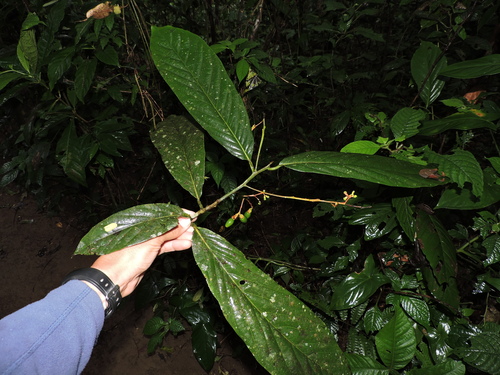
Bark and form: Gray bark, sometimes with small buttress roots at the base. The tree typically grows as a slender understory treelet in heavily shaded mature forest. Corteza y forma: Corteza gris, a veces con pequeñas raíces tabulares en la base. El árbol típicamente crece como un arbolito esbelto del sotobosque en bosque maduro muy sombreado.
Twigs: The diagnostic feature. Terminal twigs are hollow (fistulous) and slightly angular. In most individuals, these hollow stems are inhabited by ants. Ramitas: La característica diagnóstica. Las ramitas terminales son huecas (fistulosas) y ligeramente angulares. En la mayoría de los individuos, estos tallos huecos están habitados por hormigas.
Leaves: Simple, alternate, aromatic, elliptic to lanceolate, 10-45 cm long and 3-10 cm wide, with an acuminate apex. A useful field character: the leaves dry dark brown or black, unlike most other Ocotea species. Hojas: Simples, alternas, aromáticas, elípticas a lanceoladas, 10-45 cm de largo y 3-10 cm de ancho, con ápice acuminado. Un carácter útil de campo: las hojas se secan de color marrón oscuro o negro, a diferencia de la mayoría de las otras especies de Ocotea.
Flowers: Small, borne in paniculate inflorescences 12-27 cm long. Flowering occurs year-round with peak activity from December to June. Flores: Pequeñas, nacen en inflorescencias paniculadas de 12-27 cm de largo. La floración ocurre durante todo el año con mayor actividad de diciembre a junio.
Fruits: Oblong or ellipsoidal drupes, 1.5-3.5 cm long. The cupule at the base of the fruit is distinctively three-lobed (trilobate) and red, a useful character for distinguishing this species from similar Ocotea. Frutos: Drupas oblongas o elipsoidales, 1.5-3.5 cm de largo. La cúpula en la base del fruto es distintivamente trilobulada y roja, un carácter útil para distinguir esta especie de Ocotea similares.
The Ants Inside Las Hormigas Adentro
The relationship between Ocotea atirrensis and Myrmelachista flavocotea begins when the tree is still a seedling. Young plants produce specialized nodules on their main stem that serve as domatia: plant structures that house ants. Founding ant queens discover these seedlings and move in. Multiple queens may colonize the same plant, though eventually one queen typically comes to dominate the colony. La relación entre Ocotea atirrensis y Myrmelachista flavocotea comienza cuando el árbol todavía es una plántula. Las plantas jóvenes producen nódulos especializados en su tallo principal que sirven como domacios: estructuras vegetales que albergan hormigas. Las reinas fundadoras de hormigas descubren estas plántulas y se mudan. Múltiples reinas pueden colonizar la misma planta, aunque eventualmente una reina típicamente llega a dominar la colonia.
As the tree grows, so does the colony. The ants occupy all the hollow stem space, from ground level to the tips of every branch. A mature colony may contain hundreds to thousands of workers. Low densities of mealybugs (Pseudococcidae) are usually present inside the stems, tended by the ants as a food source. A medida que el árbol crece, también lo hace la colonia. Las hormigas ocupan todo el espacio de tallos huecos, desde el nivel del suelo hasta las puntas de cada rama. Una colonia madura puede contener cientos a miles de obreras. Usualmente hay bajas densidades de cochinillas (Pseudococcidae) presentes dentro de los tallos, atendidas por las hormigas como fuente de alimento.
Yet the relationship may be more complex than it first appears. Isotope studies have revealed that Myrmelachista flavocotea workers have nitrogen signatures consistent with a carnivorous or scavenging diet, not just mealybug honeydew. The ants appear to patrol the plant for prey, capturing small arthropods and concentrating nutrients in the hollow stems. When these ants die, those nutrients may become available to the plant. The ants may function less as bodyguards and more as a nutrient delivery system, though this hypothesis remains to be fully tested. Sin embargo, la relación puede ser más compleja de lo que parece a primera vista. Los estudios de isótopos han revelado que las obreras de Myrmelachista flavocotea tienen firmas de nitrógeno consistentes con una dieta carnívora o carroñera, no solo melaza de cochinillas. Las hormigas parecen patrullar la planta en busca de presas, capturando pequeños artrópodos y concentrando nutrientes en los tallos huecos. Cuando estas hormigas mueren, esos nutrientes pueden quedar disponibles para la planta. Las hormigas pueden funcionar menos como guardaespaldas y más como un sistema de entrega de nutrientes, aunque esta hipótesis aún debe ser probada completamente.
A Treelet, Not a Tree Un Arbolito, No un Árbol
One of the more puzzling aspects of Ocotea atirrensis is its small stature. Most Ocotea species are canopy trees reaching 20-35 meters. But O. atirrensis and its close relative O. dendrodaphne, both obligate ant hosts, are understory treelets that rarely exceed 4 meters in the forest interior. They flower and fruit in the deep shade where their larger relatives would still be waiting decades to reach the canopy. Uno de los aspectos más desconcertantes de Ocotea atirrensis es su pequeña estatura. La mayoría de las especies de Ocotea son árboles del dosel que alcanzan 20-35 metros. Pero O. atirrensis y su pariente cercano O. dendrodaphne, ambos hospederos obligados de hormigas, son arbolitos del sotobosque que raramente exceden 4 metros en el interior del bosque. Florecen y fructifican en la sombra profunda donde sus parientes más grandes todavía estarían esperando décadas para alcanzar el dosel.
Is the small size a consequence of the ant association? Founding ant queens have been collected from stump sprouts of other Lauraceae that grow into large canopy trees, but no large tree has ever been found hosting a Myrmelachista flavocotea colony. Perhaps something about becoming a large tree makes it unsuitable for the ants. Or perhaps the ants somehow keep their hosts small. The cause and effect remain unclear, but the correlation is striking: in this genus, ant-hosting and dwarfism go together. ¿Es el pequeño tamaño una consecuencia de la asociación con hormigas? Se han recolectado reinas fundadoras de hormigas de rebrotes de tocón de otras Lauraceae que crecen hasta ser grandes árboles del dosel, pero nunca se ha encontrado un árbol grande hospedando una colonia de Myrmelachista flavocotea. Quizás algo sobre convertirse en un árbol grande lo hace inadecuado para las hormigas. O quizás las hormigas de alguna manera mantienen pequeños a sus hospederos. La causa y efecto permanecen poco claros, pero la correlación es llamativa: en este género, hospedar hormigas y el enanismo van juntos.
Distribution and Habitat Distribución y Hábitat
Ocotea atirrensis ranges from Nicaragua to Panama, occurring at elevations from sea level to 1,800 meters. In Costa Rica, it grows on both the Atlantic and Pacific slopes, in humid, very humid, pluvial, and cloud forests. The species is common in mature wet forest understory at sites like La Selva, where Stout conducted her original observations, and in the cloud forests of Altos de Campana in Panama. Ocotea atirrensis se distribuye desde Nicaragua hasta Panamá, ocurriendo a elevaciones desde el nivel del mar hasta 1,800 metros. En Costa Rica, crece en ambas vertientes, Atlántica y Pacífica, en bosques húmedos, muy húmedos, pluviales y nubosos. La especie es común en el sotobosque de bosque húmedo maduro en sitios como La Selva, donde Stout condujo sus observaciones originales, y en los bosques nubosos de Altos de Campana en Panamá.
The wood is used locally in Panama for construction, fence posts, and firewood, though the small size of the trees limits commercial value. Like other Lauraceae, the fruits are presumably consumed by birds, though specific disperser observations for this species are lacking. La madera se usa localmente en Panamá para construcción, postes de cerca y leña, aunque el pequeño tamaño de los árboles limita el valor comercial. Como otras Lauraceae, los frutos son presumiblemente consumidos por aves, aunque faltan observaciones específicas de dispersores para esta especie.
Taxonomy Taxonomía
The species was described by Carl Mez and John Donnell Smith in 1901, based on specimens from the Atirro area near Turrialba, Costa Rica. The specific epithet atirrensis commemorates this type locality. Several names have been placed in synonymy with O. atirrensis, including O. nicaraguensis, O. paulii, O. pedalifolia, and O. wedeliana. The type specimen of O. nicaraguensis was destroyed during World War II, complicating the taxonomic history. La especie fue descrita por Carl Mez y John Donnell Smith en 1901, basándose en especímenes del área de Atirro cerca de Turrialba, Costa Rica. El epíteto específico atirrensis conmemora esta localidad tipo. Varios nombres han sido puestos en sinonimia con O. atirrensis, incluyendo O. nicaraguensis, O. paulii, O. pedalifolia, y O. wedeliana. El espécimen tipo de O. nicaraguensis fue destruido durante la Segunda Guerra Mundial, complicando la historia taxonómica.
Resources & Further Reading Recursos y Lecturas Adicionales
Species Information Información de la Especie
Authoritative taxonomic information including synonyms and distribution. Información taxonómica autorizada incluyendo sinónimos y distribución.
Detailed botanical description from the La Selva Biological Station flora. Descripción botánica detallada de la flora de la Estación Biológica La Selva.
Observations and photographs from Costa Rica and Panama. Observaciones y fotografías de Costa Rica y Panamá.
Ant-Plant Research Investigación Hormiga-Planta
Research on how ant queens colonize Ocotea seedlings. Investigación sobre cómo las reinas de hormigas colonizan plántulas de Ocotea.
Study using isotopes to understand the nutritional dynamics of the Myrmelachista-Ocotea relationship. Estudio usando isótopos para entender la dinámica nutricional de la relación Myrmelachista-Ocotea.
Species profile of the ant that lives inside Ocotea atirrensis stems. Perfil de la especie de hormiga que vive dentro de los tallos de Ocotea atirrensis.