Manil Manil
Symphonia globulifera — A swamp-dwelling tree with stilt roots and bright yellow latex that originated in Africa and floated across the Atlantic to colonize the Americas three separate times. Its scarlet flowers attract tanagers, and its resinous bark has been used to treat ailments from malaria to leishmaniasis. Symphonia globulifera — Un árbol de pantano con raíces zancudas y látex amarillo brillante que se originó en África y flotó a través del Atlántico para colonizar las Américas tres veces. Sus flores escarlata atraen tangaras, y su corteza resinosa se ha usado para tratar desde malaria hasta leishmaniasis.
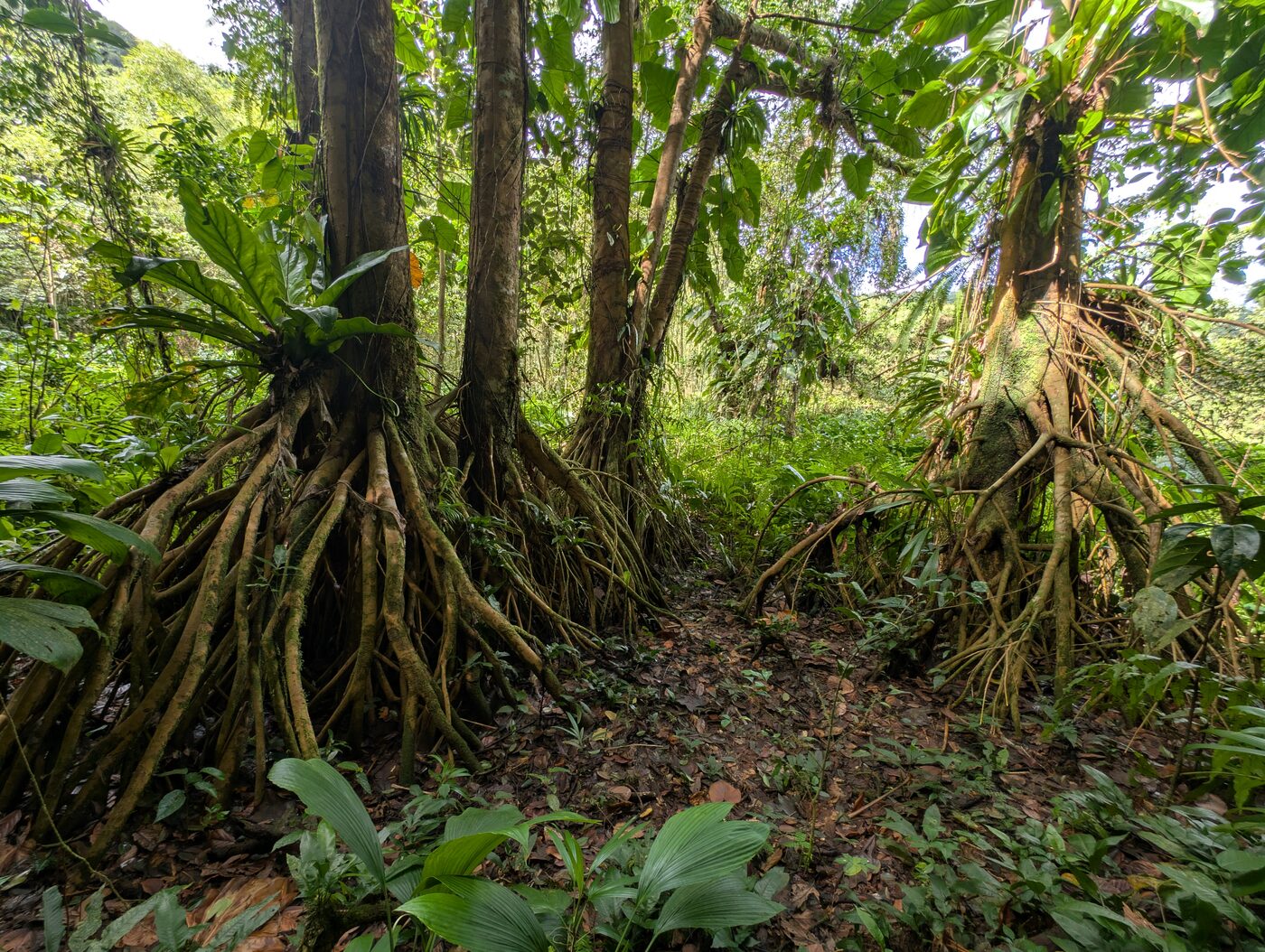
In the flooded forests of the Osa Peninsula, where streams spread across the lowlands and the soil stays waterlogged for months, a tree rises on stilts. Symphonia globulifera, known in Costa Rica as cerillo, leche amarilla, or by its trade name manil, lifts itself above the muck on a scaffold of aerial roots, surrounded by finger-like pneumatophores that poke up through the water to breathe. Slash the bark and a bright yellow latex oozes out, turning black and pitch-like as it dries in the air. En los bosques inundados de la Península de Osa, donde los arroyos se extienden sobre las tierras bajas y el suelo permanece anegado por meses, un árbol se eleva sobre zancos. Symphonia globulifera, conocido en Costa Rica como cerillo, leche amarilla, o por su nombre comercial manil, se levanta sobre el fango en un andamio de raíces aéreas, rodeado de neumatóforos como dedos que sobresalen del agua para respirar. Corte la corteza y un látex amarillo brillante rezuma, volviéndose negro y como brea mientras se seca al aire.
Indigenous peoples on two continents learned to use this resin to seal canoes and treat wounds, while the tree's scarlet globular flowers draw flocks of tanagers and honeycreepers through the swamp canopy. In parts of West Africa and Belize, people still chew its antibacterial twigs for dental hygiene, a practice validated by modern pharmacological research. Few trees have wound themselves so deeply into human cultures across such distant lands. Los pueblos indígenas de dos continentes aprendieron a usar esta resina para sellar canoas y tratar heridas, mientras las flores globulares escarlata del árbol atraen bandadas de tangaras y mieleros a través del dosel pantanoso. En partes de África Occidental y Belice, la gente todavía mastica sus ramitas antibacterianas para la higiene dental, una práctica validada por la investigación farmacológica moderna. Pocos árboles se han entrelazado tan profundamente en las culturas humanas a través de tierras tan distantes.
Identification Identificación
Physical Characteristics Características Físicas
Crown & Trunk: Symphonia globulifera is a medium to large evergreen tree, typically reaching 15 to 30 meters in height, with exceptional specimens exceeding 40 meters. The trunk is straight and cylindrical, with a rounded crown formed by horizontal branches that sometimes curve downward. In swampy habitats, the tree develops conspicuous stilt roots that elevate the trunk above the waterline, surrounded by finger-like pneumatophores that allow the roots to breathe in waterlogged soil. Copa y Tronco: Symphonia globulifera es un árbol perennifolio de mediano a grande, típicamente alcanzando 15 a 30 metros de altura, con especímenes excepcionales superando los 40 metros. El tronco es recto y cilíndrico, con una copa redondeada formada por ramas horizontales que a veces se curvan hacia abajo. En hábitats pantanosos, el árbol desarrolla conspicuas raíces zancudas que elevan el tronco sobre el nivel del agua, rodeadas de neumatóforos como dedos que permiten a las raíces respirar en suelo anegado.
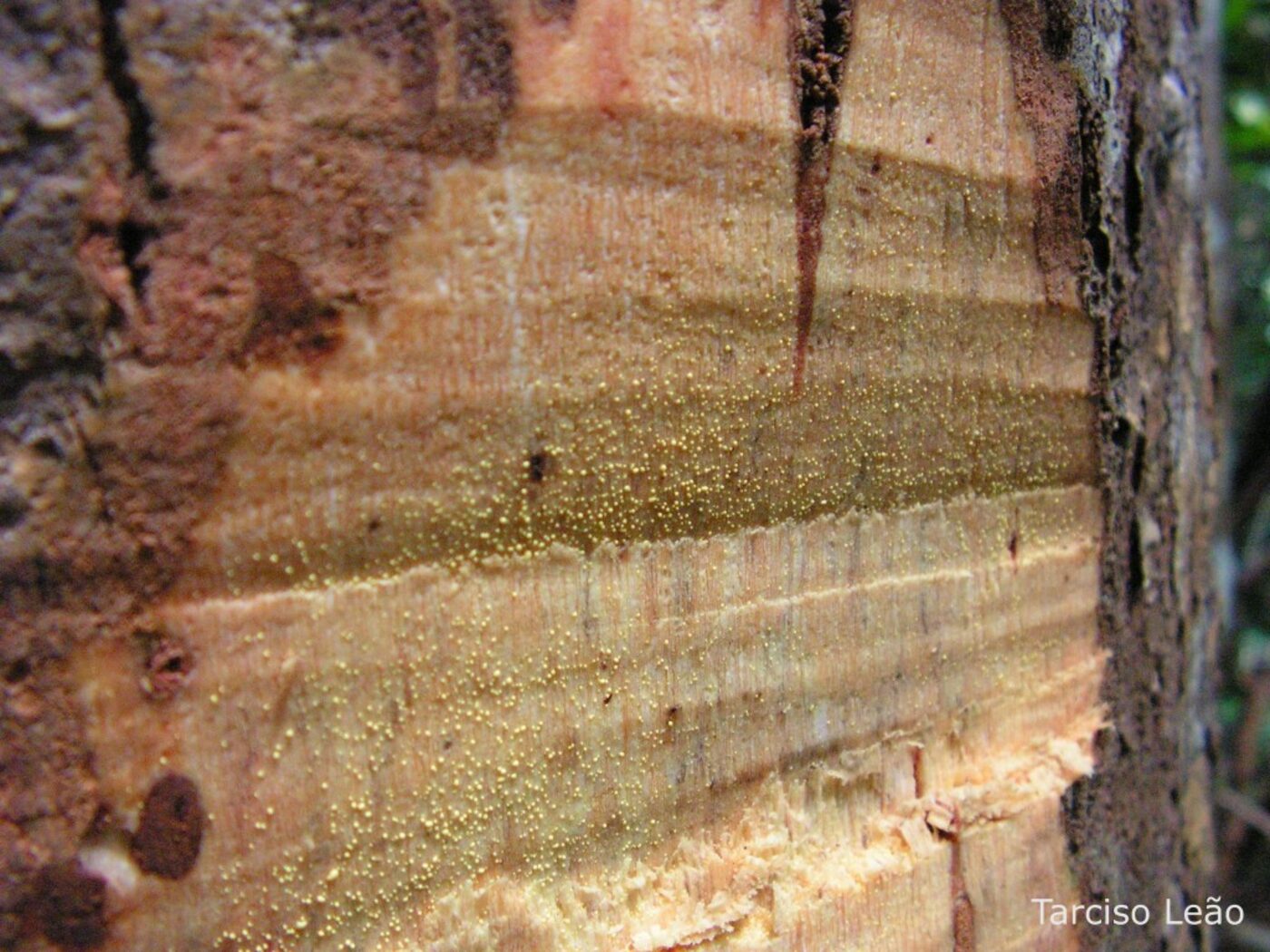
Bark & Latex: The bark is smooth or finely fissured, ranging from buff to greenish-yellow or grey-brown, with lenticels arranged in vertical rows. The tree's most distinctive feature is its bright yellow latex, which exudes from all parts when cut or wounded. This sticky resin oxidizes upon exposure to air, turning black and pitch-like within minutes. Indigenous peoples across its range have exploited this property for centuries, using the hardened resin as a waterproof sealant for canoes and tools. Corteza y Látex: La corteza es lisa o finamente fisurada, variando de ante a amarillo verdoso o marrón grisáceo, con lenticelas dispuestas en filas verticales. La característica más distintiva del árbol es su látex amarillo brillante, que exuda de todas las partes cuando se corta o hiere. Esta resina pegajosa se oxida al exponerse al aire, volviéndose negra y como brea en minutos. Los pueblos indígenas a través de su rango han explotado esta propiedad por siglos, usando la resina endurecida como sellador impermeable para canoas y herramientas.
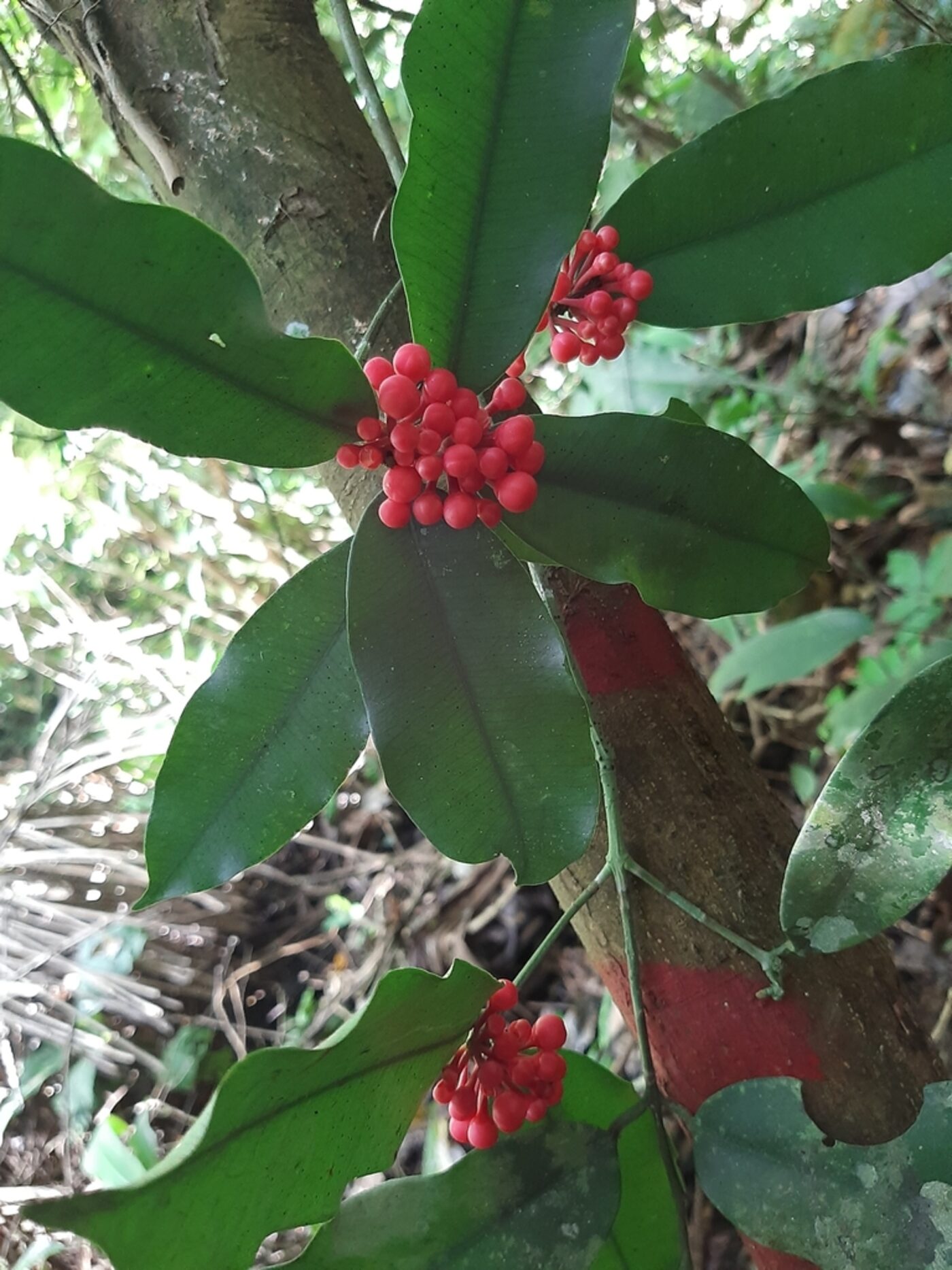
Leaves: The leaves are simple, opposite, and leathery, with elliptical to lanceolate blades measuring 5 to 12.5 cm long. They are dark green and glossy above, paler below, with a prominent midrib. The foliage forms a dense, dark crown that contrasts strikingly with the scarlet flowers. Hojas: Las hojas son simples, opuestas y coriáceas, con láminas elípticas a lanceoladas que miden de 5 a 12.5 cm de largo. Son verde oscuro y brillantes arriba, más pálidas abajo, con una nervadura central prominente. El follaje forma una copa densa y oscura que contrasta llamativamente con las flores escarlata.
Flowers: The flowers are striking: bright crimson or scarlet, globose, and arranged in umbel-like clusters. Each flower measures 10 to 12 mm in diameter, with thick, waxy petals that form a nectar chamber. The flowers are odorless but highly conspicuous against the dark foliage. They remain open for about 31 hours, typically opening around dusk and closing the following evening. Flores: Las flores son llamativas: carmesí brillante o escarlata, globosas, y dispuestas en racimos tipo umbela. Cada flor mide de 10 a 12 mm de diámetro, con pétalos gruesos y cerosos que forman una cámara de néctar. Las flores son inodoras pero altamente conspicuas contra el follaje oscuro. Permanecen abiertas aproximadamente 31 horas, típicamente abriéndose al atardecer y cerrándose la noche siguiente.
Fruits: The fruit is a broadly ellipsoid or globose berry, about the size of a pigeon's egg, containing 1 to 3 seeds embedded in a fleshy, acidulous pulp described as pleasantly tasting. The interior is filled with yellow resin. Bats and monkeys consume the fruits and disperse the seeds throughout the forest. Frutos: El fruto es una baya ampliamente elipsoide o globosa, aproximadamente del tamaño de un huevo de paloma, conteniendo 1 a 3 semillas incrustadas en una pulpa carnosa y acidulada descrita como de sabor agradable. El interior está lleno de resina amarilla. Murciélagos y monos consumen los frutos y dispersan las semillas por todo el bosque.
Distinguishing Features Características Distintivas
Symphonia globulifera is unmistakable in the field. The combination of opposite simple leaves, bright yellow latex that turns black, stilt roots in swampy locations, and scarlet globular flowers is unique. No other tree in Costa Rican swamp forests shares this suite of characteristics. When not in flower, the golden latex alone is diagnostic. Symphonia globulifera es inconfundible en el campo. La combinación de hojas simples opuestas, látex amarillo brillante que se vuelve negro, raíces zancudas en lugares pantanosos, y flores globulares escarlata es única. Ningún otro árbol en los bosques pantanosos de Costa Rica comparte este conjunto de características. Cuando no está en flor, el látex dorado solo es diagnóstico.
Habitat & Distribution Hábitat y Distribución
Symphonia globulifera has one of the most remarkable distributions of any tree: it occurs naturally across tropical America from Mexico to Brazil and Peru, throughout the Caribbean, and across tropical Africa from Guinea-Bissau to Tanzania, western Zambia, and Angola. This pantropical range is shared by only a handful of tree species, and most of those inherited their distribution from the breakup of Gondwana over 100 million years ago. Symphonia globulifera tiene una de las distribuciones más notables de cualquier árbol: ocurre naturalmente a través de América tropical desde México hasta Brasil y Perú, por todo el Caribe, y a través de África tropical desde Guinea-Bissau hasta Tanzania, Zambia occidental y Angola. Este rango pantropical es compartido por solo un puñado de especies arbóreas, y la mayoría de ellas heredaron su distribución de la ruptura de Gondwana hace más de 100 millones de años.
But the manil's story is different. The oldest fossil pollen of Symphonia (the fossil taxon Pachydermites diederexi) was found in Nigeria and dates to the mid-Eocene, approximately 45 million years ago, long after Africa and South America had separated. Genetic studies using plastid DNA and nuclear microsatellites have confirmed an African origin, with the species colonizing the New World independently three times. The most plausible explanation is marine dispersal: whole trunks, buoyant with resinous wood and capable of vegetative regeneration, floated across the Atlantic on ocean currents. Pero la historia del manil es diferente. El polen fósil más antiguo de Symphonia (el taxón fósil Pachydermites diederexi) se encontró en Nigeria y data del Eoceno medio, hace aproximadamente 45 millones de años, mucho después de que África y Sudamérica se separaran. Estudios genéticos usando ADN plastídico y microsatélites nucleares han confirmado un origen africano, con la especie colonizando el Nuevo Mundo independientemente tres veces. La explicación más plausible es dispersión marina: troncos enteros, flotantes con madera resinosa y capaces de regeneración vegetativa, flotaron a través del Atlántico en corrientes oceánicas.
This hypothesis is supported by the species' ecology: it is common along rivers and on the inner edges of mangroves, it tolerates occasional saltwater flooding, and it propagates vegetatively in open habitats. The genetic structure shows that Caribbean and Mesoamerican populations are highly differentiated, while the eastern foothills of the Andes show little genetic diversity, consistent with recent long-distance colonization. Esta hipótesis está respaldada por la ecología de la especie: es común a lo largo de ríos y en los bordes internos de manglares, tolera inundaciones ocasionales de agua salada, y se propaga vegetativamente en hábitats abiertos. La estructura genética muestra que las poblaciones caribeñas y mesoamericanas están altamente diferenciadas, mientras que las estribaciones orientales de los Andes muestran poca diversidad genética, consistente con una colonización reciente de larga distancia.
In Costa Rica, Symphonia globulifera grows on both the Atlantic and Pacific slopes from sea level to 1,700 meters elevation. It is most abundant in swamp forests and along stream banks, where it often forms the dominant canopy species alongside Calophyllum brasiliense. At La Selva Biological Station, an unusual ecotype occurs: small understory trees less than 15 meters tall, suggesting ongoing ecotype differentiation between swamp and terra firme populations. En Costa Rica, Symphonia globulifera crece en las laderas Atlántica y Pacífica desde el nivel del mar hasta 1,700 metros de elevación. Es más abundante en bosques pantanosos y a lo largo de orillas de arroyos, donde a menudo forma la especie dominante del dosel junto con Calophyllum brasiliense. En la Estación Biológica La Selva, ocurre un ecotipo inusual: pequeños árboles del sotobosque de menos de 15 metros de alto, sugiriendo una diferenciación de ecotipos en curso entre poblaciones de pantano y tierra firme.
Pollination & Ecology Polinización y Ecología
The scarlet flowers of Symphonia globulifera are pollinated not by hummingbirds, as one might expect from their color, but primarily by perching birds. Research in French Guiana documented five species of Thraupidae (tanagers and honeycreepers) as the main pollinators: black-faced dacnis, blue dacnis, green honeycreeper, purple honeycreeper, and red-legged honeycreeper. These are among the most colorful birds in the Neotropical forest, and they visit the flowers as members of mixed flocks, inserting their beaks into the nectar chamber formed by the thick petals. Occasional visitors include other tanagers such as the paradise tanager and silver-beaked tanager, plus the bananaquit and even the waved woodpecker. Las flores escarlata de Symphonia globulifera son polinizadas no por colibríes, como uno esperaría de su color, sino principalmente por aves perchadoras. Investigación en la Guayana Francesa documentó cinco especies de Thraupidae (tangaras y mieleros) como los polinizadores principales: dacnis carinegro, dacnis azul, mielero verde, mielero púrpura y mielero patirrojo. Estas son algunas de las aves más coloridas del bosque neotropical, y visitan las flores como miembros de bandadas mixtas, insertando sus picos en la cámara de néctar formada por los gruesos pétalos. Visitantes ocasionales incluyen otras tangaras como la tangara paraíso y tangara pico de plata, más el reinita bananaquit e incluso el carpintero ondulado.

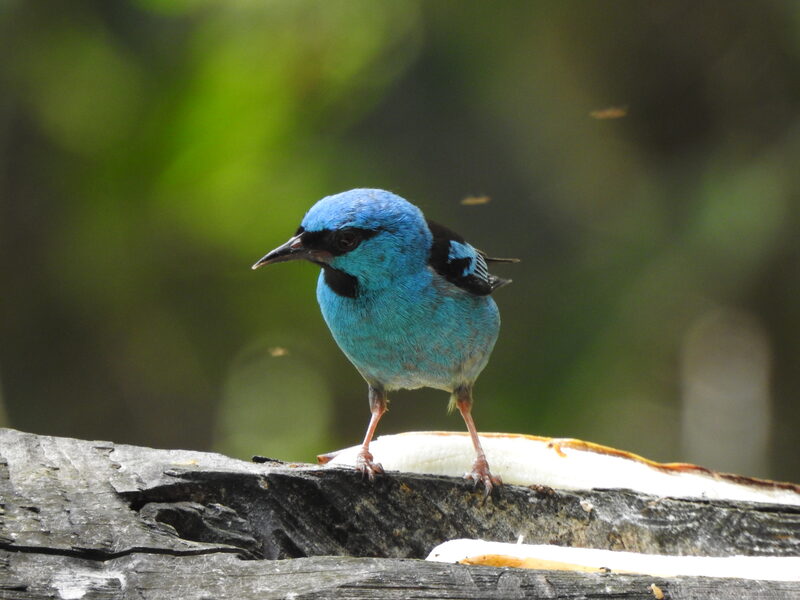


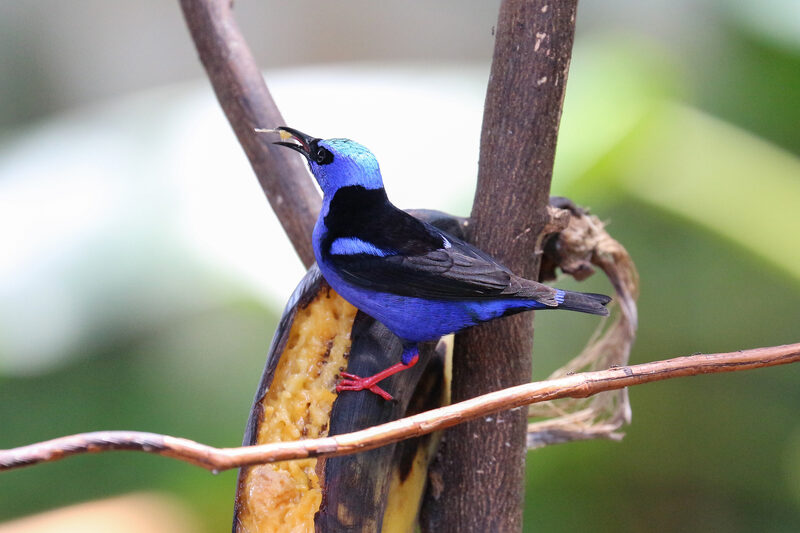
The five main bird pollinators of Symphonia globulifera in the Neotropics. Photos: Wikimedia Commons, CC BY-SA. Los cinco polinizadores principales de Symphonia globulifera en el Neotrópico. Fotos: Wikimedia Commons, CC BY-SA.
The floral anatomy is perfectly suited for perching birds: the flowers face upward and are easily reached from nearby branches; they are bright red, a color highly visible to birds; and the anthers and stigmas are positioned to contact bird beaks during nectar extraction. Most remarkably, the pollen is embedded in a sticky, glue-like substance that adheres readily to bird beaks, ensuring effective transfer between flowers. Nectar production is generous but highly variable, ranging from 3 to 130 microliters per flower, with sugar concentrations of 5 to 17 percent. The nectar is hexose-dominant, rich in glucose and fructose, which is typical of bird-pollinated flowers in the family Clusiaceae. La anatomía floral está perfectamente adaptada para aves perchadoras: las flores miran hacia arriba y son fácilmente alcanzadas desde ramas cercanas; son rojo brillante, un color altamente visible para las aves; y las anteras y estigmas están posicionados para contactar los picos de las aves durante la extracción de néctar. Lo más notable es que el polen está incrustado en una sustancia pegajosa similar a pegamento que se adhiere fácilmente a los picos de las aves, asegurando una transferencia efectiva entre flores. La producción de néctar es generosa pero altamente variable, variando de 3 a 130 microlitros por flor, con concentraciones de azúcar de 5 a 17 por ciento. El néctar es dominante en hexosas, rico en glucosa y fructosa, lo cual es típico de flores polinizadas por aves en la familia Clusiaceae.
Hummingbirds do visit the flowers, but research suggests they may be nectar robbers rather than effective pollinators. Their visits are so brief that observers have difficulty making confident determinations of their role. Bird-mediated pollen dispersal appears to be relatively local, with mean distances of only 27 to 53 meters in French Guiana, and over 1,000 meters in fragmented Costa Rican landscapes. This surprisingly limited gene flow makes the species' fragmented populations across the Osa Peninsula particularly important for conservation. In Africa, sunbirds and various insects take over the pollination role from the tanagers and honeycreepers that serve the species in the Americas. Los colibríes visitan las flores, pero la investigación sugiere que pueden ser ladrones de néctar en lugar de polinizadores efectivos. Sus visitas son tan breves que los observadores tienen dificultad para hacer determinaciones confiables de su rol. La dispersión de polen mediada por aves parece ser relativamente local, con distancias medias de solo 27 a 53 metros en la Guayana Francesa, y más de 1,000 metros en paisajes fragmentados de Costa Rica. Este flujo genético sorprendentemente limitado hace que las poblaciones fragmentadas de la especie a través de la Península de Osa sean particularmente importantes para la conservación. En África, suimangas y varios insectos asumen el rol de polinización de las tangaras y mieleros que sirven a la especie en las Américas.
Seed Dispersal: A Multi-Continental Network Dispersión de Semillas: Una Red Multicontinental
The seed dispersal network of Symphonia globulifera reflects its pantropical distribution. In the Neotropics, bats have been proposed as the main dispersers, consuming the fleshy, acidulous fruits and spreading the seeds across the forest. But the species has also enlisted an extraordinary cast of larger animals: tapirs, agoutis and other rodents, spider monkeys, howler monkeys, and even deer all consume the fruits and distribute the seeds. In Africa, an entirely different but ecologically similar guild takes over: hornbills, various primates, and duikers (small forest antelopes) perform the dispersal duties. La red de dispersión de semillas de Symphonia globulifera refleja su distribución pantropical. En el Neotrópico, los murciélagos han sido propuestos como los dispersores principales, consumiendo los frutos carnosos y acidulados y esparciendo las semillas por el bosque. Pero la especie también ha reclutado un extraordinario elenco de animales más grandes: tapires, agutíes y otros roedores, monos araña, monos aulladores e incluso venados consumen los frutos y distribuyen las semillas. En África, un gremio completamente diferente pero ecológicamente similar toma el relevo: cálaos, varios primates y duikers (pequeños antílopes de bosque) realizan las funciones de dispersión.
In Costa Rica, an unexpected consumer has been documented: Baird's tapir (Tapirus bairdii). Researchers in Corcovado National Park observed tapirs eating the bark from the exposed stilt roots of Symphonia globulifera, presumably for the medicinal compounds in the resinous bark. This behavior suggests that the tree's pharmacologically active compounds may serve ecological functions beyond deterring herbivores. These capable dispersers, able to move seeds across kilometers of forest, help explain why the species shows resilience to the genetic effects of forest fragmentation. En Costa Rica, un consumidor inesperado ha sido documentado: el tapir de Baird (Tapirus bairdii). Investigadores en el Parque Nacional Corcovado observaron tapires comiendo la corteza de las raíces zancudas expuestas de Symphonia globulifera, presumiblemente por los compuestos medicinales en la corteza resinosa. Este comportamiento sugiere que los compuestos farmacológicamente activos del árbol pueden servir funciones ecológicas más allá de disuadir herbívoros. Estos capaces dispersores, capaces de mover semillas a través de kilómetros de bosque, ayudan a explicar por qué la especie muestra resiliencia a los efectos genéticos de la fragmentación del bosque.
Traditional Medicine Medicina Tradicional
Across its vast range, Symphonia globulifera has been used in traditional medicine for more than 30 different health conditions, making it among the most ethnomedicinally important trees in tropical Africa and the Americas. In Belize and parts of West Africa, the tree is known as "chewstick" because its twigs have been used for centuries as a natural toothbrush and flossing tool. The antimicrobial compounds in the bark help maintain oral hygiene, and the practice persists today in rural communities. Research has confirmed that extracts show good antibacterial activity against Staphylococcus aureus, validating this traditional use. A través de su vasto rango, Symphonia globulifera ha sido usado en medicina tradicional para más de 30 condiciones de salud diferentes, haciéndolo uno de los árboles etnomedicinalmente más importantes en África tropical y las Américas. En Belice y partes de África Occidental, el árbol es conocido como "chewstick" porque sus ramitas se han usado por siglos como cepillo de dientes natural y herramienta de limpieza dental. Los compuestos antimicrobianos en la corteza ayudan a mantener la higiene oral, y la práctica persiste hoy en comunidades rurales. La investigación ha confirmado que los extractos muestran buena actividad antibacteriana contra Staphylococcus aureus, validando este uso tradicional.
In Colombia, traditional healers use a decoction of the bark to treat cutaneous leishmaniasis. In Nigeria, leaf decoctions are used for malaria, diabetes, and skin diseases. In Ghana, the bark tonic serves as an appetizer and stomachic, while bark extract is used to manage river blindness (onchocerciasis). In Uganda, it treats children's coughs; in Cameroon, pregnant women take it as a mild laxative and general tonic; in Gabon, the bark is used as an emetic for chest complaints, and boiled bark and roots create a wash for itching skin. En Colombia, los curanderos tradicionales usan una decocción de la corteza para tratar la leishmaniasis cutánea. En Nigeria, las decocciones de hojas se usan para malaria, diabetes y enfermedades de la piel. En Ghana, el tónico de corteza sirve como aperitivo y estomacal, mientras que el extracto de corteza se usa para manejar la ceguera de río (oncocercosis). En Uganda, trata la tos de los niños; en Camerún, las mujeres embarazadas lo toman como laxante suave y tónico general; en Gabón, la corteza se usa como emético para dolencias del pecho, y la corteza y raíces hervidas crean un lavado para la piel con picazón.
The yellow latex has its own pharmacopoeia. Applied externally as a wrap, it treats eczematous dermatoses, wounds, and skin infections. Burned to ashes and applied to recalcitrant ulcers of the abdomen and legs, it reportedly dries infections rapidly. In Panama, fresh latex is applied as a cataplasm against skin ailments and body pain. Taken internally, the resin is diuretic and has been used to treat gonorrhea. The sap from leaves can be sniffed to stop nosebleeds. Even the fruit is edible: the fleshy pericarp has been described as acidulous and pleasantly tasting, though it is rarely consumed today. El látex amarillo tiene su propia farmacopea. Aplicado externamente como envoltura, trata dermatosis eccematosas, heridas e infecciones de la piel. Quemado hasta cenizas y aplicado a úlceras recalcitrantes del abdomen y piernas, reportadamente seca las infecciones rápidamente. En Panamá, el látex fresco se aplica como cataplasma contra dolencias de la piel y dolor corporal. Tomado internamente, la resina es diurética y se ha usado para tratar gonorrea. La savia de las hojas puede ser aspirada para detener hemorragias nasales. Incluso el fruto es comestible: el pericarpio carnoso ha sido descrito como acidulado y de sabor agradable, aunque raramente se consume hoy.
Pharmacology: Validating Traditional Uses Farmacología: Validando los Usos Tradicionales
Modern phytochemical research has validated many of these traditional uses. Scientists have isolated over 40 compounds from Symphonia globulifera, including several polycyclic polyprenylated acylphloroglucinols (PPAPs) with remarkable biological activities. From the roots, researchers extracted poly-isoprenylated benzophenone derivatives known as guttiferones A through D, which showed HIV-inhibitory effects in laboratory studies. Prenylated xanthones from the plant demonstrated cytotoxic properties against cancer cells. La investigación fitoquímica moderna ha validado muchos de estos usos tradicionales. Los científicos han aislado más de 40 compuestos de Symphonia globulifera, incluyendo varios acilfloroglucinoles poliprenilados policíclicos (PPAPs) con notables actividades biológicas. De las raíces, investigadores extrajeron derivados de benzofenona poli-isoprenilados conocidos como gutiferones A a D, que mostraron efectos inhibitorios del VIH en estudios de laboratorio. Xantonas preniladas de la planta demostraron propiedades citotóxicas contra células cancerosas.
Extracts from the stem bark, root bark, seeds, and leaves have shown good antibacterial activity against Staphylococcus aureus, along with promising in vitro anti-leishmanial, antiplasmodial, and anti-trypanosomal activities. These findings confirm the traditional use of this plant for treating leishmaniasis, malaria, and skin infections, and point to the manil as a potential source of new pharmaceutical compounds. Extractos de la corteza del tallo, corteza de la raíz, semillas y hojas han mostrado buena actividad antibacteriana contra Staphylococcus aureus, junto con prometedoras actividades anti-leishmania, antiplasmodial y anti-tripanosoma in vitro. Estos hallazgos confirman el uso tradicional de esta planta para tratar leishmaniasis, malaria e infecciones de la piel, y señalan al manil como una fuente potencial de nuevos compuestos farmacéuticos.
Timber & Uses Madera y Usos
The wood of Symphonia globulifera, traded internationally as manil or boarwood, is a general-purpose timber used across the tropics. The heartwood is buff-brown with shades of yellow, rose, or orange, distinctly demarcated from the grey-yellow sapwood. The grain is generally straight, sometimes interlocked, with a medium to coarse texture and a characteristic mealy appearance. The wood has medium lustre, with conspicuous lines and arches on the radial surface. La madera de Symphonia globulifera, comercializada internacionalmente como manil o boarwood, es una madera de propósito general usada en todo el trópico. El duramen es marrón ante con tonos de amarillo, rosa o naranja, claramente demarcado del albura gris-amarillo. El grano es generalmente recto, a veces entrelazado, con una textura media a gruesa y una apariencia harinosa característica. La madera tiene lustre medio, con líneas y arcos conspicuos en la superficie radial.
The wood is moderately heavy, with a density of 530 to 750 kg per cubic meter at 12 percent moisture content. It falls between the weight and hardness of northern red oak and white oak and has been suggested as a substitute for those temperate species. The timber is easy to work with both hand and machine tools, though surfaces tend to roughen during planing and shaping, and pre-boring is recommended for nailing. Shrinkage rates are high, and the wood dries moderately rapidly with some risk of distortion and checking. La madera es moderadamente pesada, con una densidad de 530 a 750 kg por metro cúbico al 12 por ciento de contenido de humedad. Se ubica entre el peso y dureza del roble rojo del norte y el roble blanco y se ha sugerido como sustituto para esas especies templadas. La madera es fácil de trabajar con herramientas manuales y de máquina, aunque las superficies tienden a rugosarse durante el cepillado y moldeado, y se recomienda pre-perforar para clavar. Las tasas de contracción son altas, y la madera se seca moderadamente rápido con algo de riesgo de distorsión y agrietamiento.
The connection between this tree and watercraft runs deep. In southern Nigeria and Central Africa, straight trunks are cut and hollowed into small dugout canoes. In Guyana and across Amazonia, the same practice prevails. The Ijo people of the Niger Delta call it the "paddle tree" and carve the wood into oars and paddles. This nautical tradition reflects the tree's natural habitat in swamp forests and along rivers, where its buoyant, resinous wood was easily accessible to the canoe-makers of both continents. There is an irony in this: the same buoyancy that allowed the species to cross the Atlantic on floating trunks now sends it floating once more, this time carved by human hands. La conexión entre este árbol y las embarcaciones es profunda. En el sur de Nigeria y África Central, los troncos rectos se cortan y ahuecan para hacer pequeñas canoas. En Guyana y a través de la Amazonía, la misma práctica prevalece. El pueblo Ijo del Delta del Níger lo llama el "árbol de remos" y talla la madera en remos y palas. Esta tradición náutica refleja el hábitat natural del árbol en bosques pantanosos y a lo largo de ríos, donde su madera flotante y resinosa era fácilmente accesible para los constructores de canoas de ambos continentes. Hay una ironía en esto: la misma flotabilidad que permitió a la especie cruzar el Atlántico en troncos flotantes ahora la envía flotando una vez más, esta vez tallada por manos humanas.
Common uses include construction, flooring, carpentry, railway sleepers, boxes, crates, sports articles, furniture, cabinets, plywood, veneer, turning, tool handles, and truck bodies. The durability is moderate, and the wood is susceptible to termite damage, limiting its use in ground contact applications. One curiosity: freshly harvested logs in some regions are too dense to float, with densities of 800 to 950 kg per cubic meter, which means they cannot be transported by river until dried. Los usos comunes incluyen construcción, pisos, carpintería, durmientes de ferrocarril, cajas, cajones, artículos deportivos, muebles, gabinetes, madera contrachapada, chapas, torneado, mangos de herramientas y carrocerías de camiones. La durabilidad es moderada, y la madera es susceptible al daño por termitas, limitando su uso en aplicaciones de contacto con el suelo. Una curiosidad: los troncos recién cosechados en algunas regiones son demasiado densos para flotar, con densidades de 800 a 950 kg por metro cúbico, lo que significa que no pueden ser transportados por río hasta que se sequen.
Beyond timber, the bark gum known as hog gum, mani wax, or karamani wax has been used for centuries. This waterproof resin serves as glue for joining wood, fixing tool handles, and caulking boats and calabashes. Indigenous peoples across its range mixed the hardened resin with sand to seal the crevices of canoes and used it as a sealant for mooring arrowheads to their shafts. The resin also produces a khaki dye and can fuel candles and torches. Más allá de la madera, la goma de la corteza conocida como hog gum, cera maní o cera karamaní se ha usado por siglos. Esta resina impermeable sirve como pegamento para unir madera, fijar mangos de herramientas, y calafatear botes y calabazas. Los pueblos indígenas a través de su rango mezclaban la resina endurecida con arena para sellar las grietas de canoas y la usaban como sellador para amarrar puntas de flecha a sus astas. La resina también produce un tinte caqui y puede alimentar velas y antorchas.
Conservation Status Estado de Conservación
Symphonia globulifera is classified as Least Concern by the IUCN. The species has an enormous natural range spanning two continents, tolerates a variety of habitats from sea level to 2,600 meters, and regenerates readily from root suckers and fallen fragments. Its abundance in swamp forests and along rivers, habitats that are often difficult to develop, provides additional protection. While individual populations may face pressure from logging and habitat conversion, the species as a whole is under no immediate threat of extinction. Symphonia globulifera está clasificado como Preocupación Menor por la UICN. La especie tiene un rango natural enorme que abarca dos continentes, tolera una variedad de hábitats desde el nivel del mar hasta 2,600 metros, y se regenera fácilmente desde vástagos de raíz y fragmentos caídos. Su abundancia en bosques pantanosos y a lo largo de ríos, hábitats que a menudo son difíciles de desarrollar, proporciona protección adicional. Mientras poblaciones individuales pueden enfrentar presión por la tala y conversión de hábitat, la especie en su conjunto no está bajo amenaza inmediata de extinción.
In Costa Rica, Symphonia globulifera is protected within numerous reserves and national parks, including Corcovado National Park on the Osa Peninsula, where gene flow studies have documented its role as a key component of the swamp forest ecosystem. Its ability to vegetatively regenerate and its tolerance for disturbed wetlands make it likely to persist even as other, more sensitive species decline. En Costa Rica, Symphonia globulifera está protegido dentro de numerosas reservas y parques nacionales, incluyendo el Parque Nacional Corcovado en la Península de Osa, donde estudios de flujo genético han documentado su papel como componente clave del ecosistema del bosque pantanoso. Su capacidad de regenerarse vegetativamente y su tolerancia a humedales perturbados hacen probable que persista incluso mientras otras especies más sensibles declinan.
Resources & Further Reading Recursos y Lecturas Adicionales
Species Information Información de la Especie
Overview of the species including distribution, characteristics, and uses. Resumen de la especie incluyendo distribución, características y usos.
Costa Rican species account with common names and ecological information. Ficha de la especie de Costa Rica con nombres comunes e información ecológica.
Comprehensive information on uses, properties, and cultivation. Información completa sobre usos, propiedades y cultivo.
Detailed information on African populations, uses, and wood properties. Información detallada sobre poblaciones africanas, usos y propiedades de la madera.
Biogeography & Evolution Biogeografía y Evolución
Genetic study of African populations revealing Pleistocene population dynamics and refugia. Estudio genético de poblaciones africanas revelando dinámica poblacional del Pleistoceno y refugios.
Gene flow study in the Osa Peninsula examining dispersal by mobile pollinators and seed dispersers. Estudio de flujo genético en la Península de Osa examinando dispersión por polinizadores móviles y dispersores de semillas.
Pollination Biology Biología de la Polinización
Detailed study of flower morphology, nectar production, and pollination by perching birds. Estudio detallado de morfología floral, producción de néctar y polinización por aves perchadoras.
Research on Amazonian populations suggesting hummingbird pollination, later revised by French Guiana studies. Investigación sobre poblaciones amazónicas sugiriendo polinización por colibríes, posteriormente revisada por estudios en Guayana Francesa.
Seed Dispersal Dispersión de Semillas
Comparative dataset of dispersers and pollinators in Africa and the Neotropics. Conjunto de datos comparativo de dispersores y polinizadores en África y el Neotrópico.
Pharmacology & Medicinal Uses Farmacología y Usos Medicinales
Comprehensive review of over 40 compounds isolated from the species, including guttiferones with HIV-inhibitory effects. Revisión completa de más de 40 compuestos aislados de la especie, incluyendo gutiferones con efectos inhibidores del VIH.
Review of traditional medicinal uses and validation of antibacterial, anti-leishmanial, and antiplasmodial activities. Revisión de usos medicinales tradicionales y validación de actividades antibacterianas, anti-leishmania y antiplasmodiales.
Behavioral study validating traditional medicinal uses in Latin American and African medicine. Estudio conductual validando usos medicinales tradicionales en medicina latinoamericana y africana.
Wood Properties Propiedades de la Madera
Technical specifications and commercial information for boarwood timber. Especificaciones técnicas e información comercial para madera de boarwood.
Detailed wood anatomy and properties. Anatomía y propiedades detalladas de la madera.
Ethnobotany & Traditional Uses Etnobotánica y Usos Tradicionales
Seed source with information on the "chewstick" name and traditional dental hygiene uses. Fuente de semillas con información sobre el nombre "chewstick" y usos tradicionales de higiene dental.
Mesoamerican ethnobotanical research on traditional uses and ecology. Investigación etnobotánica mesoamericana sobre usos tradicionales y ecología.
Biodiversity Databases Bases de Datos de Biodiversidad
Global occurrence records and distribution maps. Registros de ocurrencia global y mapas de distribución.
Authoritative taxonomic information and native range data. Información taxonómica autorizada y datos de rango nativo.