Mangle Rojo Híbrido Mangle Rojo Híbrido
Rhizophora × harrisonii — A natural hybrid red mangrove whose arching prop roots create underwater labyrinths where juvenile hammerhead sharks find refuge. In Costa Rica's Golfo Dulce, this species bridges ocean and forest in one of the world's few tropical fjords. Rhizophora × harrisonii — Un mangle rojo híbrido natural cuyas raíces fúlcreas arqueadas crean laberintos submarinos donde los tiburones martillo juveniles encuentran refugio. En el Golfo Dulce de Costa Rica, esta especie conecta el océano y el bosque en uno de los pocos fiordos tropicales del mundo.
In the brackish waters of Golfo Dulce, where the Río Esquinas empties into one of the world's only tropical fjords, a forest rises from the sea. Here, mangrove roots arch into the water like flying buttresses, creating a maze of submerged passages. Among them swims a young scalloped hammerhead shark, one of thousands that use these protected shallows as a nursery. Above the waterline, the tangled roots support a tree with glossy, elliptical leaves and torpedo-shaped seedlings dangling from its branches. This is Rhizophora × harrisonii, the hybrid red mangrove, a species born from the ongoing interbreeding of two parent species that has stabilized into its own distinct form. En las aguas salobres del Golfo Dulce, donde el Río Esquinas desemboca en uno de los únicos fiordos tropicales del mundo, un bosque emerge del mar. Aquí, las raíces del manglar se arquean hacia el agua como arbotantes, creando un laberinto de pasajes sumergidos. Entre ellas nada un joven tiburón martillo festoneado, uno de los miles que usan estos bajíos protegidos como criadero. Sobre la línea del agua, las raíces entrelazadas sostienen un árbol con hojas elípticas brillantes y plántulas en forma de torpedo colgando de sus ramas. Este es Rhizophora × harrisonii, el mangle rojo híbrido, una especie nacida de la hibridación continua de dos especies parentales que se ha estabilizado en su propia forma distintiva.
Unlike most hybrids, which are often sterile or unstable, Rhizophora × harrisonii has become a recognizable and reproductively viable component of mangrove forests from West Africa to the Americas. Its characteristics blend those of its parents: the salt tolerance of Rhizophora mangle and the affinity for freshwater input of Rhizophora racemosa. In estuaries where large rivers meet the sea, where neither parent species dominates completely, the hybrid finds its niche. A diferencia de la mayoría de los híbridos, que a menudo son estériles o inestables, Rhizophora × harrisonii se ha convertido en un componente reconocible y reproductivamente viable de los bosques de manglar desde África Occidental hasta las Américas. Sus características mezclan las de sus padres: la tolerancia a la sal de Rhizophora mangle y la afinidad por la entrada de agua dulce de Rhizophora racemosa. En estuarios donde grandes ríos se encuentran con el mar, donde ninguna especie parental domina completamente, el híbrido encuentra su nicho.
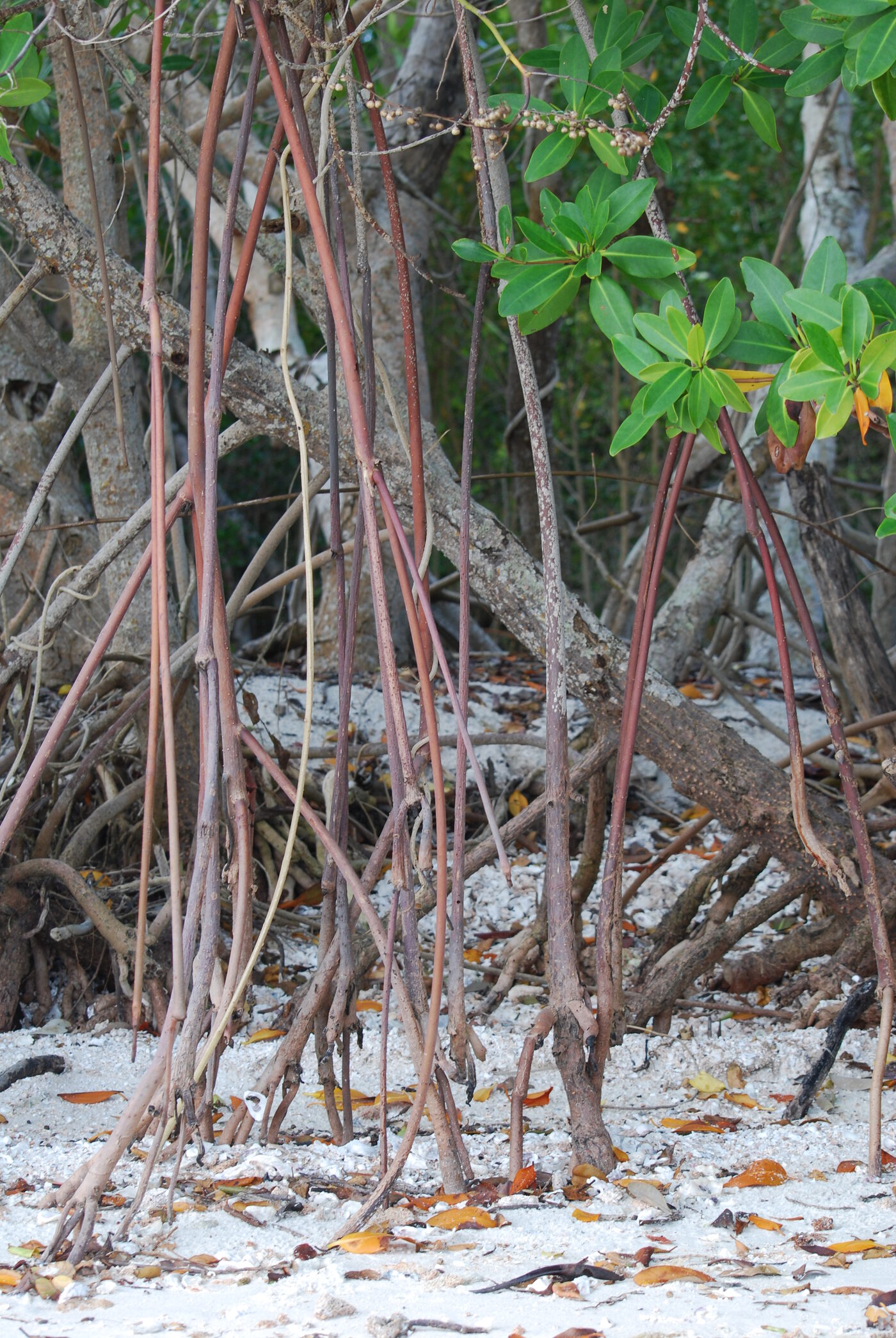
Identification Identificación
Taxonomy & Nomenclature Taxonomía y Nomenclatura
Rhizophora × harrisonii was first described in 1918 by Alleyne Leechman, a botanist working in British Guiana (now Guyana). The type specimen was collected near Georgetown, at the edge of the Atlantic where South America's great rivers discharge into the sea. Leechman named the species in honor of Sir John Burchmore Harrison, then Director of Science and Agriculture for British Guiana, recognizing his contributions to botanical research in the colony. Rhizophora × harrisonii fue descrito por primera vez en 1918 por Alleyne Leechman, un botánico que trabajaba en la Guayana Británica (ahora Guyana). El espécimen tipo fue recolectado cerca de Georgetown, en el borde del Atlántico donde los grandes ríos de Sudamérica desembocan en el mar. Leechman nombró la especie en honor a Sir John Burchmore Harrison, entonces Director de Ciencia y Agricultura de la Guayana Británica, reconociendo sus contribuciones a la investigación botánica en la colonia.
The genus name Rhizophora derives from Greek rhiza (root) and phoros (bearing), referring to the prop roots that characterize these mangroves. The multiplication sign (×) in the scientific name indicates hybrid origin. Modern genetic studies have confirmed what early botanists suspected: this species represents a stabilized hybrid between Rhizophora mangle and Rhizophora racemosa. Rather than being a sterile cross or an ephemeral hybrid swarm, it has become a self-perpetuating population with intermediate characteristics. El nombre del género Rhizophora deriva del griego rhiza (raíz) y phoros (portador), refiriéndose a las raíces fúlcreas que caracterizan estos mangles. El signo de multiplicación (×) en el nombre científico indica origen híbrido. Los estudios genéticos modernos han confirmado lo que sospechaban los primeros botánicos: esta especie representa un híbrido estabilizado entre Rhizophora mangle y Rhizophora racemosa. En lugar de ser un cruce estéril o un enjambre híbrido efímero, se ha convertido en una población autoperpetuante con características intermedias.
The Rhizophoraceae, or mangrove family, belongs to the order Malpighiales. This may seem surprising, as Malpighiales is a diverse order that includes everything from willows to passionflowers to rubber trees. But molecular phylogenetics has confirmed this placement, grouping the Rhizophoraceae with other families adapted to tropical forest life. Within the family, Rhizophora is the most species-rich genus, with representatives on tropical coastlines worldwide. Historical synonyms for R. × harrisonii include Rhizophora × brevistyla Salvoza (1936). Las Rhizophoraceae, o familia del mangle, pertenece al orden Malpighiales. Esto puede parecer sorprendente, ya que Malpighiales es un orden diverso que incluye desde sauces hasta pasionarias y árboles de caucho. Pero la filogenética molecular ha confirmado esta ubicación, agrupando a las Rhizophoraceae con otras familias adaptadas a la vida del bosque tropical. Dentro de la familia, Rhizophora es el género más rico en especies, con representantes en costas tropicales de todo el mundo. Los sinónimos históricos de R. × harrisonii incluyen Rhizophora × brevistyla Salvoza (1936).
Physical Characteristics Características Físicas
Leaves: The leaves are elliptical, 11-15 cm long and 4-7 cm wide, with an acute apex and cuneate (wedge-shaped) base. They are glabrous (hairless) and leathery, with black dots visible on the undersides. This dotting pattern helps distinguish the species from its parent R. mangle, whose leaves lack such punctation. The leaves are arranged oppositely on the branches. Hojas: Las hojas son elípticas, de 11-15 cm de largo y 4-7 cm de ancho, con ápice agudo y base cuneada (en forma de cuña). Son glabras (sin pelos) y coriáceas, con puntos negros visibles en el envés. Este patrón de puntos ayuda a distinguir la especie de su parental R. mangle, cuyas hojas carecen de tal punteado. Las hojas están dispuestas de forma opuesta en las ramas.
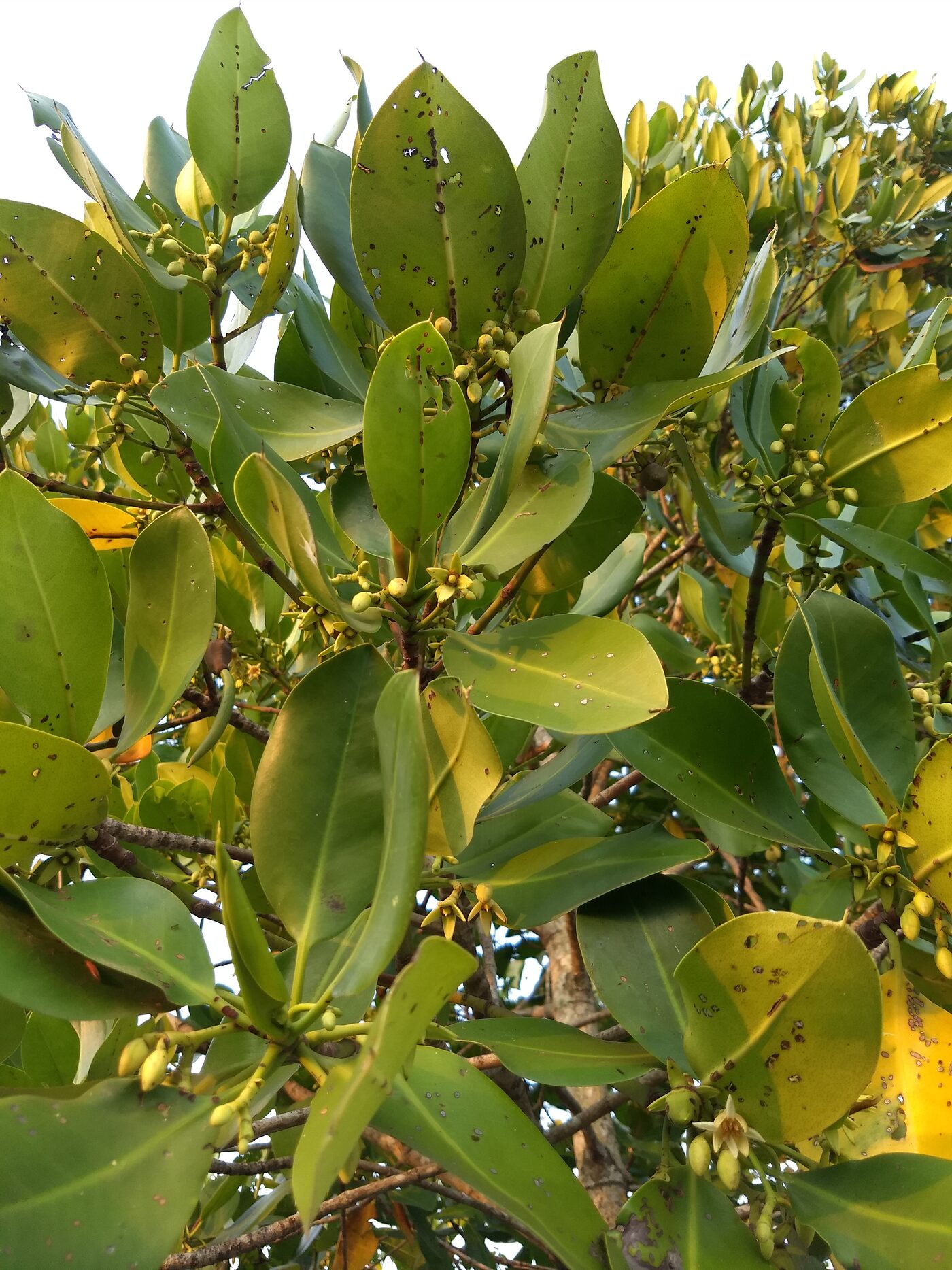
Flowers: The inflorescence is 5-12 cm long and branches 3-5 times, bearing many small flowers. Individual flowers are about 1 cm long, with oval to slightly elliptical buds and acute apexes. Each flower has 8 stamens and 2 stigmatic branches. The flowers are pollinated by wind and insects, including bees and flies that visit the mangrove forest. Flores: La inflorescencia mide 5-12 cm de largo y se ramifica 3-5 veces, portando muchas flores pequeñas. Las flores individuales miden aproximadamente 1 cm de largo, con botones ovales a ligeramente elípticos y ápices agudos. Cada flor tiene 8 estambres y 2 ramas estigmáticas. Las flores son polinizadas por el viento e insectos, incluyendo abejas y moscas que visitan el bosque de manglar.
Propagules: The fruit is oval-lanceolate, about 4 cm long and 1.5 cm wide. From it emerges the distinctive propagule, a torpedo-shaped structure 15-30 cm long. This length is intermediate between the shorter propagules of R. mangle and the longer ones of R. racemosa, reflecting the hybrid's intermediate nature. Propágulos: El fruto es oval-lanceolado, de aproximadamente 4 cm de largo y 1.5 cm de ancho. De él emerge el propágulo distintivo, una estructura en forma de torpedo de 15-30 cm de largo. Esta longitud es intermedia entre los propágulos más cortos de R. mangle y los más largos de R. racemosa, reflejando la naturaleza intermedia del híbrido.
Distinguishing the Hybrid from Its Parents Distinguiendo el Híbrido de Sus Parentales
In Costa Rica's mangroves, three Rhizophora species may occur together: the hybrid R. × harrisonii and its parent species R. mangle and R. racemosa. Distinguishing them requires attention to several key features, as the hybrid shows intermediate characteristics. En los manglares de Costa Rica, tres especies de Rhizophora pueden ocurrir juntas: el híbrido R. × harrisonii y sus especies parentales R. mangle y R. racemosa. Distinguirlas requiere atención a varias características clave, ya que el híbrido muestra características intermedias.
| CharacterCarácter | R. mangleR. mangle | R. × harrisoniiR. × harrisonii | R. racemosaR. racemosa |
|---|---|---|---|
| Leaf undersideEnvés de la hoja | No black dotsSin puntos negros | Black dots presentPuntos negros presentes | Black dots presentPuntos negros presentes |
| Propagule lengthLongitud del propágulo | 20-40 cm20-40 cm | 15-30 cm15-30 cm | 25-65 cm25-65 cm |
| InflorescenceInflorescencia | 2-4 flowers, 1-2 branches2-4 flores, 1-2 ramificaciones | Many flowers, 3-5 branchesMuchas flores, 3-5 ramificaciones | Many flowers, 5+ branchesMuchas flores, 5+ ramificaciones |
| Flower budsBotones florales | Rounded apexÁpice redondeado | Acute apexÁpice agudo | Acute apexÁpice agudo |
| Habitat preferencePreferencia de hábitat | Most salt-tolerant; seaward fringeMás tolerante a sal; borde hacia el mar | Intermediate; estuaries with freshwater inputIntermedio; estuarios con entrada de agua dulce | Requires freshwater; river-influenced zonesRequiere agua dulce; zonas influenciadas por ríos |
The easiest field identification begins with examining leaf undersides. If no black dots are present, the tree is likely R. mangle. If dots are present, look at propagule length and habitat: propagules over 30 cm suggest R. racemosa, while intermediate lengths (15-30 cm) in estuarine settings indicate the hybrid. The inflorescence structure, when flowers are present, provides additional confirmation: R. mangle produces simple inflorescences with few flowers, while both R. racemosa and the hybrid produce much-branched inflorescences with many flowers. La identificación de campo más fácil comienza examinando el envés de las hojas. Si no hay puntos negros presentes, el árbol es probablemente R. mangle. Si hay puntos presentes, observe la longitud del propágulo y el hábitat: propágulos de más de 30 cm sugieren R. racemosa, mientras que longitudes intermedias (15-30 cm) en ambientes estuarinos indican el híbrido. La estructura de la inflorescencia, cuando hay flores presentes, proporciona confirmación adicional: R. mangle produce inflorescencias simples con pocas flores, mientras que tanto R. racemosa como el híbrido producen inflorescencias muy ramificadas con muchas flores.
The Prop Roots Las Raíces Fúlcreas
Among mangrove genera, Rhizophora is best known for its prop root system. While black mangroves (Avicennia) produce pencil-like pneumatophores and white mangroves (Laguncularia) have cable roots, Rhizophora species develop arching prop roots called rhizophores. These structures emerge from the cambium of the main stem or branches and grow downward toward the substrate. Unlike true roots, which originate from the root system, rhizophores are modified branches with positive geotropism. They divide in a sympodial pattern as they grow, creating the characteristic arching architecture that gives mangrove forests their otherworldly appearance. All three Rhizophora species in Costa Rica, including both parent species and the hybrid, share this root type. Entre los géneros de manglar, Rhizophora es mejor conocido por su sistema de raíces fúlcreas. Mientras que los mangles negros (Avicennia) producen neumatóforos en forma de lápiz y los mangles blancos (Laguncularia) tienen raíces de cable, las especies de Rhizophora desarrollan raíces fúlcreas arqueadas llamadas rizóforos. Estas estructuras emergen del cámbium del tallo principal o las ramas y crecen hacia abajo hacia el sustrato. A diferencia de las raíces verdaderas, que se originan del sistema radicular, los rizóforos son ramas modificadas con geotropismo positivo. Se dividen en un patrón simpodial a medida que crecen, creando la arquitectura arqueada característica que da a los bosques de manglar su apariencia de otro mundo. Las tres especies de Rhizophora en Costa Rica, incluyendo ambas especies parentales y el híbrido, comparten este tipo de raíz.
These roots serve multiple functions. First, they provide stability in the soft, shifting sediments of the intertidal zone. Like flying buttresses on a cathedral, they distribute the tree's weight across a wide area, anchoring it against waves and currents. Second, they function as breathing organs. The waterlogged soils of mangrove forests are anaerobic, lacking the oxygen that roots need for respiration. The prop roots have lenticels on their surface, small pores that connect to air spaces within the root tissue. At low tide, these lenticels take up oxygen; at high tide, the air spaces supply oxygen to the submerged portions of the root system. Estas raíces cumplen múltiples funciones. Primero, proporcionan estabilidad en los sedimentos blandos y cambiantes de la zona intermareal. Como los arbotantes de una catedral, distribuyen el peso del árbol sobre un área amplia, anclándolo contra olas y corrientes. Segundo, funcionan como órganos respiratorios. Los suelos anegados de los bosques de manglar son anaeróbicos, careciendo del oxígeno que las raíces necesitan para la respiración. Las raíces fúlcreas tienen lenticelas en su superficie, pequeños poros que conectan con espacios de aire dentro del tejido radicular. Durante la marea baja, estas lenticelas absorben oxígeno; durante la marea alta, los espacios de aire suministran oxígeno a las porciones sumergidas del sistema radicular.
Third, the roots help exclude salt. Rhizophora species have highly suberized (waxy) root tissues that act as an ultrafiltration membrane. As water moves into the root, over 90% of the salt is excluded at the root surface. This allows the tree to thrive in seawater that would kill most plants, though it grows best in the brackish conditions where freshwater dilutes the ocean's salinity. Tercero, las raíces ayudan a excluir la sal. Las especies de Rhizophora tienen tejidos radiculares altamente suberizados (cerosos) que actúan como una membrana de ultrafiltración. A medida que el agua ingresa a la raíz, más del 90% de la sal se excluye en la superficie radicular. Esto permite que el árbol prospere en agua de mar que mataría a la mayoría de las plantas, aunque crece mejor en condiciones salobres donde el agua dulce diluye la salinidad del océano.

Viviparous Reproduction Reproducción Vivípara
Rhizophora species are famous for their viviparous reproduction, a strategy that gives their offspring a head start in the challenging mangrove environment. After fertilization, the seed does not enter dormancy like most plant seeds. Instead, it germinates immediately while still attached to the parent tree. The embryonic root, called the hypocotyl, pierces through the fruit and grows downward, eventually reaching 15-30 cm in length for R. × harrisonii. Las especies de Rhizophora son famosas por su reproducción vivípara, una estrategia que da a su descendencia una ventaja inicial en el desafiante ambiente del manglar. Después de la fertilización, la semilla no entra en dormancia como la mayoría de las semillas de plantas. En cambio, germina inmediatamente mientras aún está unida al árbol padre. La raíz embrionaria, llamada hipocótilo, atraviesa el fruto y crece hacia abajo, alcanzando eventualmente 15-30 cm de longitud para R. × harrisonii.
This pencil-shaped propagule hangs from the parent tree for months, photosynthesizing and accumulating reserves. When it finally detaches, it is not a seed but a seedling, already equipped with chlorophyll, stored nutrients, and a developing root system. If it falls at low tide onto suitable substrate, it can begin rooting immediately. If it falls into water, it floats horizontally, buoyed by air spaces in its tissue. Propagules can remain viable for over a year while floating, potentially traveling hundreds of kilometers on ocean currents. Este propágulo en forma de lápiz cuelga del árbol padre durante meses, fotosintetizando y acumulando reservas. Cuando finalmente se desprende, no es una semilla sino una plántula, ya equipada con clorofila, nutrientes almacenados y un sistema radicular en desarrollo. Si cae durante la marea baja sobre un sustrato adecuado, puede comenzar a enraizar inmediatamente. Si cae al agua, flota horizontalmente, sostenido por espacios de aire en su tejido. Los propágulos pueden permanecer viables durante más de un año mientras flotan, potencialmente viajando cientos de kilómetros en corrientes oceánicas.
Upon stranding, dehydration triggers the propagule to shift from horizontal floating to vertical orientation. The heavier root end sinks, the lighter shoot end rises, and root development accelerates. Research shows that propagules that strand vertically have establishment success rates around 50%, compared to only 10% for those stranding horizontally. Lower salinity accelerates root development, which may explain why R. × harrisonii often colonizes areas with significant freshwater input. Al varar, la deshidratación hace que el propágulo cambie de flotación horizontal a orientación vertical. El extremo de la raíz, más pesado, se hunde, el extremo del brote, más ligero, sube, y el desarrollo radicular se acelera. La investigación muestra que los propágulos que varan verticalmente tienen tasas de éxito de establecimiento de alrededor del 50%, comparado con solo el 10% para los que varan horizontalmente. La menor salinidad acelera el desarrollo radicular, lo que puede explicar por qué R. × harrisonii a menudo coloniza áreas con entrada significativa de agua dulce.
Habitat & Distribution Hábitat y Distribución
Rhizophora × harrisonii has an amphi-Atlantic distribution, occurring on both sides of the tropical Atlantic and extending into the eastern Pacific. In the Americas, its range stretches from Mexico's Gulf coast through Central America and the Caribbean to Brazil, and along the Pacific coast from Mexico to Peru. In Africa, it grows from Senegal to Angola. This wide distribution reflects the dispersal abilities of its floating propagules, which can cross oceans on currents. Rhizophora × harrisonii tiene una distribución anfi-atlántica, ocurriendo en ambos lados del Atlántico tropical y extendiéndose hacia el Pacífico oriental. En las Américas, su rango se extiende desde la costa del Golfo de México a través de Centroamérica y el Caribe hasta Brasil, y a lo largo de la costa del Pacífico desde México hasta Perú. En África, crece desde Senegal hasta Angola. Esta amplia distribución refleja las capacidades de dispersión de sus propágulos flotantes, que pueden cruzar océanos en las corrientes.
In Costa Rica, the hybrid mangrove occurs primarily along the Pacific coast, where the country's most extensive mangrove systems are found. The Térraba-Sierpe National Wetland, Central America's largest mangrove swamp covering over 30,000 hectares, harbors populations of R. × harrisonii alongside its parent species R. mangle and R. racemosa. Further south, the mangroves of Golfo Dulce, one of only four tropical fjords in the world, provide additional habitat. En Costa Rica, el mangle híbrido ocurre principalmente a lo largo de la costa del Pacífico, donde se encuentran los sistemas de manglar más extensos del país. El Humedal Nacional Térraba-Sierpe, el pantano de manglar más grande de Centroamérica cubriendo más de 32,000 hectáreas, alberga poblaciones de R. × harrisonii junto con sus especies parentales R. mangle y R. racemosa. Más al sur, los manglares del Golfo Dulce, uno de solo cuatro fiordos tropicales en el mundo, proporcionan hábitat adicional.
The ecological requirements of R. × harrisonii appear intermediate between its parent species. Rhizophora mangle is the most salt-tolerant species in the genus, able to colonize fully marine conditions. Rhizophora racemosa requires more freshwater, typically growing where large rivers dilute coastal salinity. The hybrid thrives in transitional zones where neither parent dominates, often in estuaries with substantial but variable freshwater input. Los requerimientos ecológicos de R. × harrisonii parecen intermedios entre sus especies parentales. Rhizophora mangle es la especie más tolerante a la sal del género, capaz de colonizar condiciones completamente marinas. Rhizophora racemosa requiere más agua dulce, típicamente creciendo donde los grandes ríos diluyen la salinidad costera. El híbrido prospera en zonas de transición donde ningún parental domina, a menudo en estuarios con entrada sustancial pero variable de agua dulce.
The Mangrove Zones Las Zonas del Manglar
In Costa Rica, eight species of mangrove trees from four different plant families form the coastal wetlands. These species arrange themselves in distinct zones based on their tolerance to flooding and salinity. Moving from ocean to land, Rhizophora species (including the hybrid) typically occupy the seaward fringe, growing in the deepest water. Their prop roots can tolerate permanent inundation and the highest salinity. Behind them, Avicennia (black mangroves) grow in the mid-intertidal zone, using vertical pneumatophores to breathe in waterlogged soils. Laguncularia racemosa (white mangrove) often colonizes areas with lower salinity, excreting salt through specialized leaf glands. Conocarpus erectus (buttonwood) occupies the landward edge, in areas rarely flooded by tides. En Costa Rica, ocho especies de árboles de mangle de cuatro familias de plantas diferentes forman los humedales costeros. Estas especies se organizan en zonas distintas según su tolerancia a la inundación y salinidad. Moviéndose del océano a la tierra, las especies de Rhizophora (incluyendo el híbrido) típicamente ocupan el borde hacia el mar, creciendo en el agua más profunda. Sus raíces fúlcreas pueden tolerar inundación permanente y la mayor salinidad. Detrás de ellas, Avicennia (mangles negros) crecen en la zona intermareal media, usando neumatóforos verticales para respirar en suelos anegados. Laguncularia racemosa (mangle blanco) a menudo coloniza áreas con menor salinidad, excretando sal a través de glándulas foliares especializadas. Conocarpus erectus (mangle botón) ocupa el borde hacia tierra, en áreas raramente inundadas por las mareas.
Co-occurring Species Especies Asociadas
Within Costa Rica's mangrove forests, R. × harrisonii grows alongside a characteristic community of trees and associated species. In the Rhizophoraceae, it may co-occur with both parent species as well as Pelliciera rhizophorae, the tea mangrove. Black mangroves are represented by Avicennia germinans, A. bicolor, and occasionally A. tonduzii. The understory may include the large mangrove fern Acrostichum aureum, which can dominate disturbed areas. Salt-tolerant herbs like Batis maritima and Sesuvium portulacastrum grow on exposed mudflats. Dentro de los bosques de manglar de Costa Rica, R. × harrisonii crece junto a una comunidad característica de árboles y especies asociadas. En las Rhizophoraceae, puede coexistir con ambas especies parentales así como con Pelliciera rhizophorae, el mangle piñuela. Los mangles negros están representados por Avicennia germinans, A. bicolor, y ocasionalmente A. tonduzii. El sotobosque puede incluir el gran helecho de manglar Acrostichum aureum, que puede dominar áreas perturbadas. Hierbas tolerantes a la sal como Batis maritima y Sesuvium portulacastrum crecen en los lodazales expuestos.
Ecological Importance Importancia Ecológica
Mangrove forests are among the most productive ecosystems on Earth, and Rhizophora × harrisonii contributes to this productivity alongside its co-occurring species. A single hectare of mangrove in Costa Rica generates an estimated $8,700 annually in ecosystem services, including coastal protection, carbon storage, water filtration, and support for fisheries. Los bosques de manglar están entre los ecosistemas más productivos de la Tierra, y Rhizophora × harrisonii contribuye a esta productividad junto con sus especies coexistentes. Una sola hectárea de manglar en Costa Rica genera un estimado de $8,700 anuales en servicios ecosistémicos, incluyendo protección costera, almacenamiento de carbono, filtración de agua y apoyo a las pesquerías.
Nursery Habitat Hábitat de Crianza
The tangled prop roots of Rhizophora create some of the most important nursery habitat in tropical coastal ecosystems. A global analysis estimated that mangrove forests support an annual abundance of over 700 billion juvenile fish and invertebrates. In Costa Rica's Golfo Dulce, research in the Zancudo mangrove documented 82 fish species from 30 families. More than half were estuarine transients, fish that use the mangrove as juveniles before migrating to deeper waters as adults. An estimated 71% of captured species had commercial value, demonstrating the mangroves' importance for regional fisheries. Las raíces fúlcreas entrelazadas de Rhizophora crean parte del hábitat de crianza más importante en los ecosistemas costeros tropicales. Un análisis global estimó que los bosques de manglar sustentan una abundancia anual de más de 700 mil millones de peces juveniles e invertebrados. En el Golfo Dulce de Costa Rica, la investigación en el manglar de Zancudo documentó 82 especies de peces de 30 familias. Más de la mitad eran transeúntes estuarinos, peces que usan el manglar como juveniles antes de migrar a aguas más profundas como adultos. Se estimó que el 71% de las especies capturadas tenían valor comercial, demostrando la importancia de los manglares para las pesquerías regionales.
Perhaps most dramatically, the mangroves of Golfo Dulce serve as a critical nursery for the scalloped hammerhead shark (Sphyrna lewini). Neonates and juveniles find food and protection from predators in the sheltered, nutrient-rich waters among the mangrove roots. Recognizing this importance, the Costa Rican government in May 2018 designated the wetlands in northern Golfo Dulce as a shark sanctuary, creating 4,000 hectares of "no-take" zone. This was Costa Rica's first shark sanctuary, established specifically to protect the mangrove nursery habitat. Quizás lo más dramático es que los manglares del Golfo Dulce sirven como un criadero crítico para el tiburón martillo festoneado (Sphyrna lewini). Los neonatos y juveniles encuentran alimento y protección contra depredadores en las aguas protegidas y ricas en nutrientes entre las raíces del manglar. Reconociendo esta importancia, el gobierno de Costa Rica en mayo de 2018 designó los humedales en el norte del Golfo Dulce como un santuario de tiburones, creando 4,000 hectáreas de zona de "no extracción". Este fue el primer santuario de tiburones de Costa Rica, establecido específicamente para proteger el hábitat de crianza del manglar.

Carbon Storage Almacenamiento de Carbono
Mangroves are remarkably efficient at sequestering carbon. Their waterlogged soils prevent decomposition of organic matter, locking carbon away for centuries or millennia. This "blue carbon" makes mangroves up to ten times more effective at carbon storage per hectare than upland tropical forests. As climate change accelerates, the carbon sequestration capacity of mangrove ecosystems becomes increasingly valuable. Los manglares son notablemente eficientes en el secuestro de carbono. Sus suelos anegados previenen la descomposición de materia orgánica, guardando el carbono durante siglos o milenios. Este "carbono azul" hace que los manglares sean hasta diez veces más efectivos en el almacenamiento de carbono por hectárea que los bosques tropicales de tierras altas. A medida que el cambio climático se acelera, la capacidad de secuestro de carbono de los ecosistemas de manglar se vuelve cada vez más valiosa.
Coastal Protection Protección Costera
The dense root systems of mangroves dissipate wave energy, buffer shorelines against storms, and trap sediments that would otherwise be lost to erosion. Communities behind healthy mangrove forests experience reduced flooding and storm damage. In an era of rising seas and intensifying storms, this natural infrastructure provides protection that would cost millions to replicate artificially. Los densos sistemas de raíces de los manglares disipan la energía de las olas, amortiguan las costas contra las tormentas, y atrapan sedimentos que de otro modo se perderían por erosión. Las comunidades detrás de bosques de manglar saludables experimentan menos inundaciones y daños por tormentas. En una era de mares crecientes y tormentas intensificándose, esta infraestructura natural proporciona protección que costaría millones replicar artificialmente.
Wildlife Relationships Relaciones con la Vida Silvestre
The mangrove ecosystem supports an extraordinary diversity of wildlife, from microscopic organisms in the sediment to large marine predators that use the forest as a nursery. El ecosistema del manglar sustenta una diversidad extraordinaria de vida silvestre, desde organismos microscópicos en el sedimento hasta grandes depredadores marinos que usan el bosque como criadero.
The Piangua La Piangua
For at least 1,200 years, indigenous communities have harvested the piangua clam (Anadara tuberculosa) from Costa Rica's mangroves. This bivalve buries itself in the mud among mangrove roots, filtering organic particles from the water. Today, piangua harvesting remains an important livelihood for coastal communities around Térraba-Sierpe, though overharvesting and habitat loss have reduced populations. Sustainable management of this traditional fishery depends on maintaining healthy mangrove forests. Durante al menos 1,200 años, las comunidades indígenas han cosechado la almeja piangua (Anadara tuberculosa) de los manglares de Costa Rica. Este bivalvo se entierra en el lodo entre las raíces del manglar, filtrando partículas orgánicas del agua. Hoy, la cosecha de piangua sigue siendo un medio de vida importante para las comunidades costeras alrededor de Térraba-Sierpe, aunque la sobreexplotación y la pérdida de hábitat han reducido las poblaciones. El manejo sostenible de esta pesquería tradicional depende de mantener bosques de manglar saludables.
Traditional Uses Usos Tradicionales
Like other Rhizophora species, R. × harrisonii has been used by coastal communities for generations. Kew's Plants of the World Online notes that the species "is used as a medicine," though specific applications are not detailed. More broadly, red mangrove bark is rich in tannins and has been used traditionally for treating fevers, dysentery, and skin conditions across the species' range. The wood is dense, durable, and resistant to decay in wet conditions, making it valuable for construction of fish traps, boats, and dock pilings. Como otras especies de Rhizophora, R. × harrisonii ha sido utilizado por las comunidades costeras durante generaciones. Plants of the World Online de Kew señala que la especie "se usa como medicina," aunque las aplicaciones específicas no están detalladas. Más ampliamente, la corteza del mangle rojo es rica en taninos y se ha usado tradicionalmente para tratar fiebres, disentería y afecciones de la piel en todo el rango de la especie. La madera es densa, durable y resistente a la descomposición en condiciones húmedas, haciéndola valiosa para la construcción de trampas para peces, botes y pilotes de muelles.
Conservation Conservación
Rhizophora × harrisonii has not been formally assessed by the IUCN, likely because its hybrid status complicates classification. However, like all mangrove species, it faces significant threats from human activities and climate change. Rhizophora × harrisonii no ha sido evaluada formalmente por la UICN, probablemente porque su estatus híbrido complica la clasificación. Sin embargo, como todas las especies de manglar, enfrenta amenazas significativas de las actividades humanas y el cambio climático.
Costa Rica has taken significant steps to protect its mangroves. The Térraba-Sierpe National Wetland was designated a Forest Reserve in 1977 and recognized as a RAMSAR Wetland of International Importance in 1995. Under Costa Rican law, mangrove cutting is prohibited except under special permits. The 2018 establishment of the Golfo Dulce shark sanctuary demonstrates continued commitment to protecting these ecosystems. Costa Rica ha tomado pasos significativos para proteger sus manglares. El Humedal Nacional Térraba-Sierpe fue designado Reserva Forestal en 1977 y reconocido como Humedal RAMSAR de Importancia Internacional en 1995. Bajo la ley costarricense, la tala de manglar está prohibida excepto bajo permisos especiales. El establecimiento del santuario de tiburones del Golfo Dulce en 2018 demuestra el compromiso continuo de proteger estos ecosistemas.
Restoration efforts are underway in degraded areas. Organizations including Misión Tiburón are working to restore 20 hectares of mangrove habitat in Golfo Dulce, using propagules of Rhizophora and other mangrove species to revegetate damaged sites. These efforts recognize that protecting juvenile shark habitat requires maintaining the mangrove forests on which they depend. Los esfuerzos de restauración están en marcha en áreas degradadas. Organizaciones incluyendo Misión Tiburón están trabajando para restaurar 20 hectáreas de hábitat de manglar en el Golfo Dulce, usando propágulos de Rhizophora y otras especies de manglar para revegetar sitios dañados. Estos esfuerzos reconocen que proteger el hábitat de tiburones juveniles requiere mantener los bosques de manglar de los cuales dependen.
For visitors to Costa Rica's Pacific coast, a boat trip through the mangroves offers a window into one of the world's most productive and important ecosystems. Watch for the arching prop roots of Rhizophora, the torpedo-shaped propagules dangling from branches, and the remarkable wildlife that depends on this forest between land and sea. In these coastal wetlands, where rivers meet the ocean and fresh water mixes with salt, the hybrid red mangrove has found its place, bridging not only two parent species but two worlds. Para los visitantes de la costa del Pacífico de Costa Rica, un viaje en bote a través de los manglares ofrece una ventana a uno de los ecosistemas más productivos e importantes del mundo. Busca las raíces fúlcreas arqueadas de Rhizophora, los propágulos en forma de torpedo colgando de las ramas, y la notable vida silvestre que depende de este bosque entre la tierra y el mar. En estos humedales costeros, donde los ríos se encuentran con el océano y el agua dulce se mezcla con la sal, el mangle rojo híbrido ha encontrado su lugar, conectando no solo dos especies parentales sino dos mundos.
Key Sources & Resources Fuentes y Recursos Clave
Species Information Información de la Especie
General overview of the species with information on distribution, taxonomy, and hybrid status. Resumen general de la especie con información sobre distribución, taxonomía y estatus híbrido.
Authoritative taxonomic information, hybrid formula, and distribution from the Royal Botanic Gardens, Kew. Información taxonómica autorizada, fórmula híbrida y distribución del Real Jardín Botánico de Kew.
Detailed information on red mangrove ecology, prop roots, and vivipary applicable to the genus. Información detallada sobre la ecología del mangle rojo, raíces fúlcreas y viviparia aplicable al género.
Costa Rica Mangroves Manglares de Costa Rica
Overview of Central America's largest mangrove wetland and its biodiversity. Resumen del humedal de manglar más grande de Centroamérica y su biodiversidad.
Information about the Golfo Dulce Hope Spot and shark nursery conservation efforts. Información sobre el Hope Spot del Golfo Dulce y los esfuerzos de conservación del criadero de tiburones.
Details on Costa Rica's first shark sanctuary and mangrove restoration projects. Detalles sobre el primer santuario de tiburones de Costa Rica y los proyectos de restauración de manglares.
Official RAMSAR wetland designation record including area (30,654 hectares) and conservation status. Registro oficial de designación de humedal RAMSAR incluyendo área (30,654 hectáreas) y estado de conservación.
Scientific Research Investigación Científica
Research documenting 82 fish species and the importance of the mangrove as a nursery. Investigación que documenta 82 especies de peces y la importancia del manglar como criadero.
Taxonomic revision confirming hybrid status between R. mangle and R. racemosa. Revisión taxonómica confirmando el estatus híbrido entre R. mangle y R. racemosa.
Global analysis estimating the contribution of mangroves to fish and invertebrate populations worldwide. Análisis global estimando la contribución de los manglares a las poblaciones de peces e invertebrados en todo el mundo.
Mangrove Ecology Ecología del Manglar
Scientific study on the anatomy, morphology, and ecology of Rhizophora prop roots. Estudio científico sobre la anatomía, morfología y ecología de las raíces fúlcreas de Rhizophora.
Information on mangrove conservation challenges and restoration in Costa Rica. Información sobre los desafíos de conservación y restauración de manglares en Costa Rica.
Comprehensive overview of mangrove ecology, salt exclusion mechanisms, and propagule dispersal. Resumen completo de la ecología del manglar, mecanismos de exclusión de sal y dispersión de propágulos.