Hicatee Fig Higuerón de Río
Ficus maxima — A free-standing fig of riverbanks and disturbed forests, this species supports more insect diversity on a single tree than almost any other in the Neotropics. Unlike its strangling cousins, it grows from the ground up, but it feeds the same howler monkeys and bats. Ficus maxima — Un higo independiente de riberas y bosques perturbados, esta especie sustenta más diversidad de insectos en un solo árbol que casi cualquier otro en el Neotrópico. A diferencia de sus primos estranguladores, crece desde el suelo, pero alimenta a los mismos monos aulladores y murciélagos.
In a 1997 study of insect diversity in Panamanian dry forest, Norwegian biologist Frode Ødegaard climbed 24 different tree species and catalogued every plant-eating insect he could find. One species stood out: Ficus maxima supported 78 species of phytophagous insects on a single tree, including the second-largest wood-feeding insect fauna and the fourth-most specialized herbivore community in the study. En un estudio de 1997 sobre diversidad de insectos en el bosque seco panameño, el biólogo noruego Frode Ødegaard trepó 24 especies de árboles diferentes y catalogó cada insecto herbívoro que pudo encontrar. Una especie destacó: Ficus maxima albergaba 78 especies de insectos fitófagos en un solo árbol, incluyendo la segunda fauna más grande de insectos xilófagos y la cuarta comunidad de herbívoros más especializada del estudio.
Unlike the strangler figs that begin life in the canopy and descend to strangle their hosts, Ficus maxima is a free-standing tree. It germinates in the soil and grows upward like any conventional tree. It belongs to the fig subgenus Pharmacosycea, which includes most of the Neotropical free-standing figs. But it shares the family trait that makes all figs ecological keystones: asynchronous fruiting, where different trees in a population fruit at different times, ensuring that figs are available somewhere in the forest even when other fruit is scarce. A diferencia de los matapalos que comienzan su vida en el dosel y descienden para estrangular a sus hospederos, Ficus maxima es un árbol independiente. Germina en el suelo y crece hacia arriba como cualquier árbol convencional. Pertenece al subgénero de higos Pharmacosycea, que incluye la mayoría de los higos independientes neotropicales. Pero comparte el rasgo familiar que hace de todos los higos claves ecológicas: fructificación asincrónica, donde diferentes árboles en una población fructifican en diferentes momentos, asegurando que los higos estén disponibles en algún lugar del bosque incluso cuando otras frutas escasean.
Identification Identificación
Ficus maxima is one of approximately 60 fig species found in Costa Rica. The species name maxima means "largest," referring to the large leaves of young seedlings, which can reach 30 cm long and 19 cm wide. Scottish botanist Philip Miller first described the species in 1768, citing earlier illustrations from Jamaica. Ficus maxima es una de aproximadamente 60 especies de higo encontradas en Costa Rica. El nombre de la especie maxima significa "la más grande," refiriéndose a las hojas grandes de las plántulas jóvenes, que pueden alcanzar 30 cm de largo y 19 cm de ancho. El botánico escocés Philip Miller describió la especie por primera vez en 1768, citando ilustraciones anteriores de Jamaica.
Physical Characteristics Características Físicas
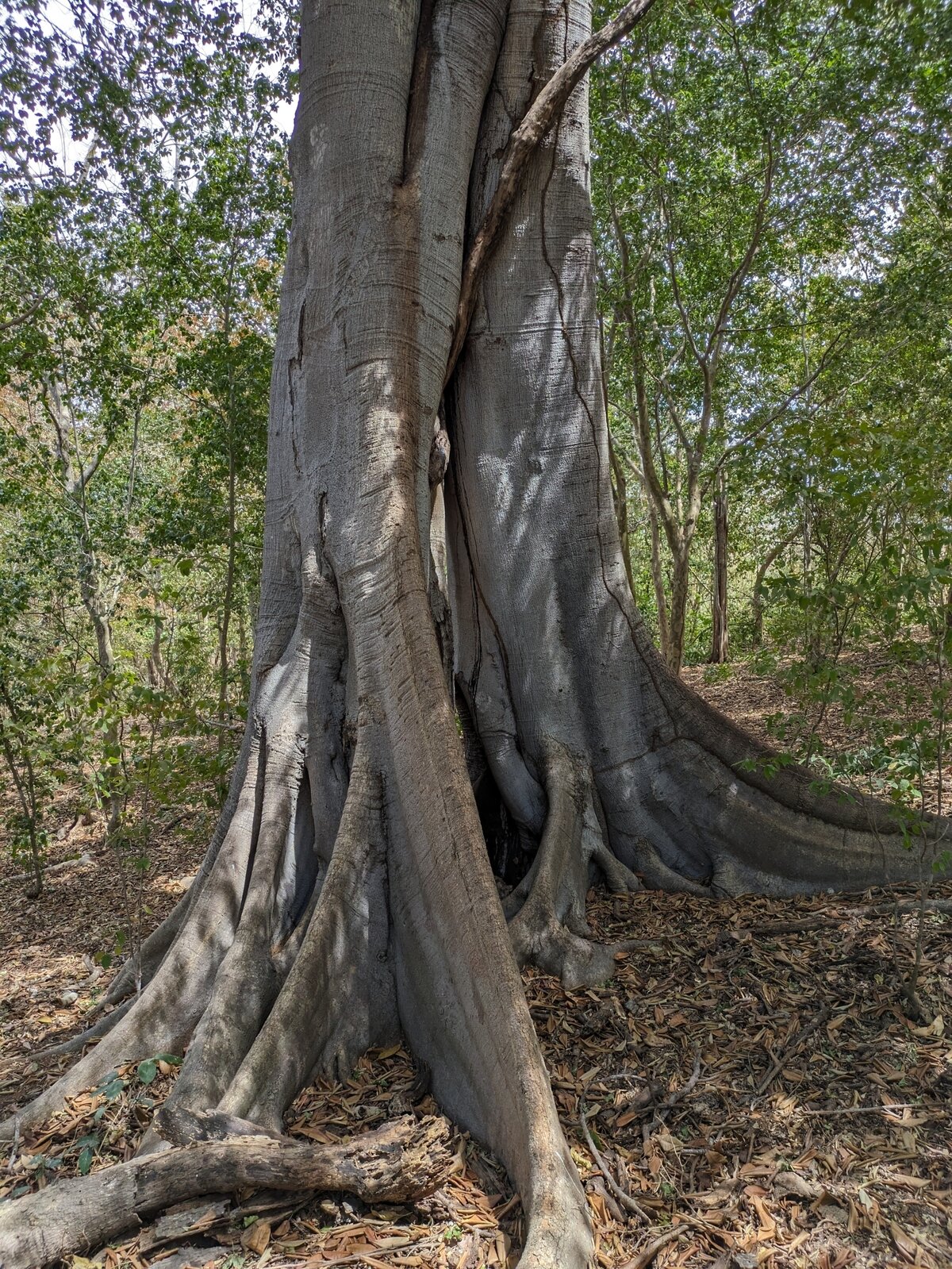
Trunk: Unlike strangler figs, F. maxima has a conventional solid trunk. The bark is smooth and grayish-brown. Like all figs, it exudes copious white latex when cut. Tronco: A diferencia de los matapalos, F. maxima tiene un tronco sólido convencional. La corteza es lisa y gris-marrón. Como todos los higos, exuda abundante látex blanco cuando se corta.
Leaves: Large, thick, and leathery with a pronounced central vein. Adult leaves are typically 10-20 cm long, but seedling leaves can be much larger. The leaf shape is elliptical to oblong with a rounded or slightly pointed tip. Hojas: Grandes, gruesas y coriáceas con una vena central pronunciada. Las hojas adultas miden típicamente 10-20 cm de largo, pero las hojas de las plántulas pueden ser mucho más grandes. La forma de la hoja es elíptica a oblonga con una punta redondeada o ligeramente puntiaguda.
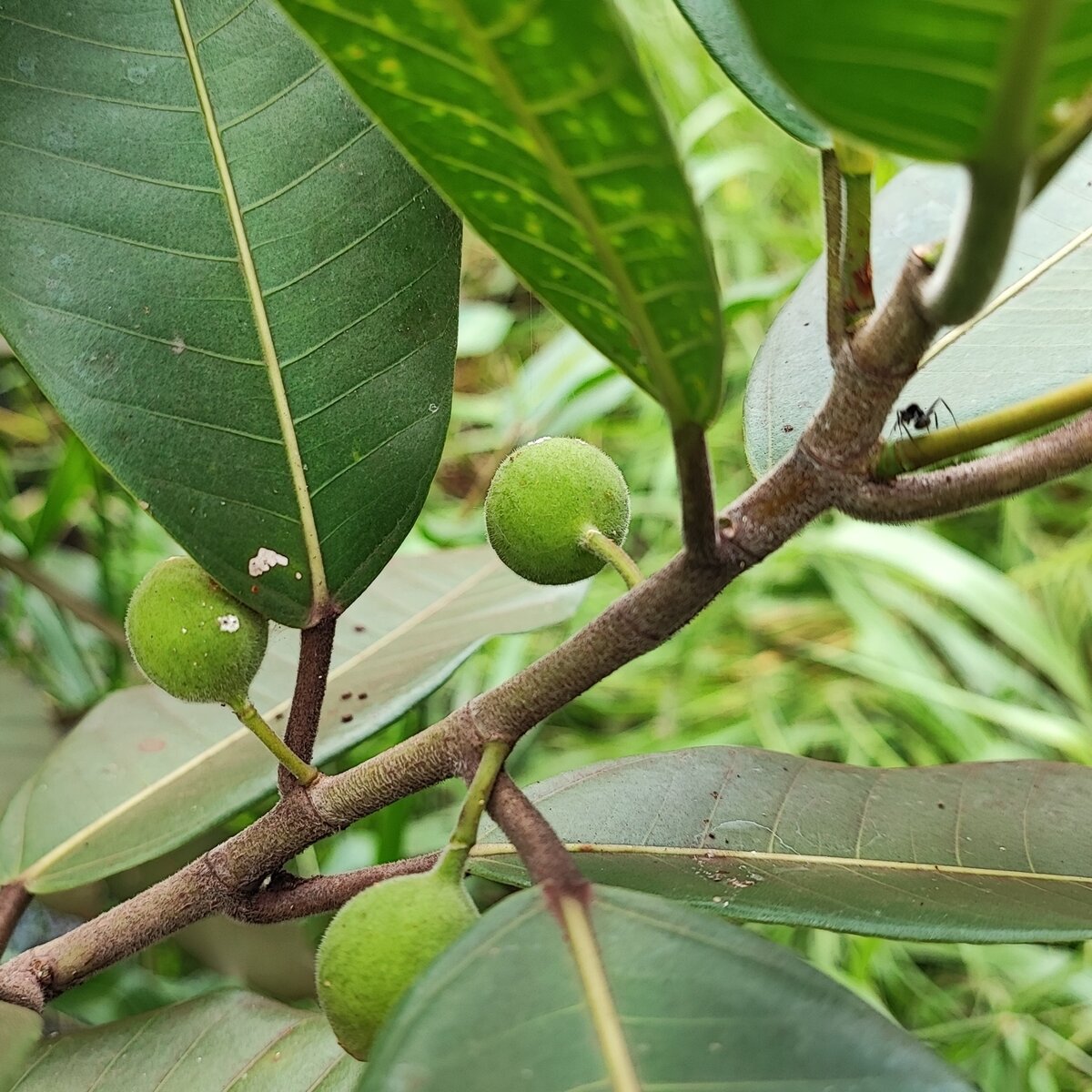
Figs (Syconia): Spherical, 1-2.5 cm in diameter, borne singly in the leaf axils. This solitary fig arrangement is characteristic of subgenus Pharmacosycea and distinguishes F. maxima from strangler figs like F. obtusifolia, which bear figs in pairs. The figs ripen from green to yellowish or reddish. Higos (Siconos): Esféricos, de 1-2.5 cm de diámetro, naciendo solitarios en las axilas de las hojas. Este arreglo de higos solitarios es característico del subgénero Pharmacosycea y distingue a F. maxima de los matapalos como F. obtusifolia, que producen higos en pares. Los higos maduran de verde a amarillento o rojizo.
Free-Standing vs. Strangler Figs Higos Independientes vs. Matapalos
The genus Ficus contains approximately 850 species worldwide, roughly split between hemiepiphytic (strangling) species and free-standing species. In Costa Rica, you encounter both types among about 60 native figs. The strangler figs, such as Ficus obtusifolia (higuerón), belong to subgenus Urostigma. They germinate in the canopy, send roots down, and eventually kill their host trees. The free-standing figs, such as Ficus maxima and Ficus insipida (chilamate), belong to subgenus Pharmacosycea. They germinate in the soil and grow upward like conventional trees. El género Ficus contiene aproximadamente 850 especies en todo el mundo, divididas aproximadamente entre especies hemiepífitas (estranguladoras) y especies independientes. En Costa Rica, encuentras ambos tipos entre los aproximadamente 60 higos nativos. Los matapalos, como Ficus obtusifolia (higuerón), pertenecen al subgénero Urostigma. Germinan en el dosel, envían raíces hacia abajo y eventualmente matan a sus árboles hospederos. Los higos independientes, como Ficus maxima y Ficus insipida (chilamate), pertenecen al subgénero Pharmacosycea. Germinan en el suelo y crecen hacia arriba como árboles convencionales.
The Pollinator Wasp La Avispa Polinizadora
Every fig species has its own pollinator wasp, and for Ficus maxima, that partner is Tetrapus americanus. Recent genetic work suggests that T. americanus is actually a cryptic species complex of at least two species that are not even closely related to each other, suggesting that the fig-wasp relationship is more complicated than it appears. Cada especie de higo tiene su propia avispa polinizadora, y para Ficus maxima, ese socio es Tetrapus americanus. Trabajo genético reciente sugiere que T. americanus es en realidad un complejo de especies crípticas de al menos dos especies que ni siquiera están estrechamente relacionadas entre sí, sugiriendo que la relación higo-avispa es más complicada de lo que parece.
Ficus maxima is passively pollinated, meaning the female wasp does not actively collect and deposit pollen. Instead, pollen simply adheres to her body and rubs off inside the next fig she enters. About one-third of all fig species use passive pollination. This contrasts with actively pollinated figs, where the wasp has specialized pollen pockets and deliberately packs pollen into them. Ficus maxima es polinizado pasivamente, lo que significa que la avispa hembra no recolecta ni deposita activamente el polen. En cambio, el polen simplemente se adhiere a su cuerpo y se transfiere dentro del próximo higo al que entra. Aproximadamente un tercio de todas las especies de higo usan polinización pasiva. Esto contrasta con los higos polinizados activamente, donde la avispa tiene bolsillos de polen especializados y deliberadamente empaca polen en ellos.
The wasp lifecycle follows the same pattern as in all figs. The female enters through the ostiole, lays eggs in some flowers, pollinates others, and dies inside. Her offspring develop within the fig. Males emerge first, mate with females, and chew exit holes. Females emerge laden with pollen and fly off to find another receptive fig. The timing is critical: a fig population must be large enough that some trees are always in the receptive stage, or the wasps will have nowhere to go and the cycle breaks. El ciclo de vida de la avispa sigue el mismo patrón que en todos los higos. La hembra entra a través del ostiolo, pone huevos en algunas flores, poliniza otras, y muere adentro. Su descendencia se desarrolla dentro del higo. Los machos emergen primero, se aparean con las hembras, y mastican agujeros de salida. Las hembras emergen cargadas de polen y vuelan para encontrar otro higo receptivo. El tiempo es crítico: una población de higos debe ser lo suficientemente grande para que algunos árboles estén siempre en la etapa receptiva, o las avispas no tendrán a dónde ir y el ciclo se rompe.
Habitat & Distribution Hábitat y Distribución
Ficus maxima has one of the widest ranges of any Neotropical fig, extending from Mexico through Central America and the Caribbean to Paraguay and Bolivia in South America. In Costa Rica, it occurs on both Pacific and Caribbean slopes from sea level to about 1,000 meters. Ficus maxima tiene uno de los rangos más amplios de cualquier higo neotropical, extendiéndose desde México a través de Centroamérica y el Caribe hasta Paraguay y Bolivia en Sudamérica. En Costa Rica, ocurre en las vertientes del Pacífico y Caribe desde el nivel del mar hasta aproximadamente 1,000 metros.
Unlike many forest trees, F. maxima tolerates disturbance well. It is frequently found along streams and riverbanks, in pastures, along roadsides, and at forest edges. It is more common in seasonally dry areas than in the wettest forests. This tolerance of open, disturbed habitats means you often see it standing alone in cleared landscapes where other forest trees have been cut. A diferencia de muchos árboles del bosque, F. maxima tolera bien la perturbación. Se encuentra frecuentemente a lo largo de arroyos y riberas, en pastizales, a lo largo de caminos, y en los bordes del bosque. Es más común en áreas estacionalmente secas que en los bosques más húmedos. Esta tolerancia a hábitats abiertos y perturbados significa que a menudo lo ves parado solo en paisajes despejados donde otros árboles del bosque han sido cortados.
Wildlife Relationships Relaciones con la Vida Silvestre
Like all figs, Ficus maxima is a keystone species. Because different trees in a population fruit at different times, figs are available somewhere in the forest even when other fruit is scarce. F. maxima figs have been found to have relatively high protein content and low water-soluble carbohydrates compared to other fig species, making them particularly nutritious for frugivores. Como todos los higos, Ficus maxima es una especie clave. Debido a que diferentes árboles en una población fructifican en diferentes momentos, los higos están disponibles en algún lugar del bosque incluso cuando otras frutas escasean. Se ha encontrado que los higos de F. maxima tienen un contenido de proteína relativamente alto y bajos carbohidratos solubles en agua comparados con otras especies de higos, haciéndolos particularmente nutritivos para los frugívoros.
The remarkable insect diversity on F. maxima deserves emphasis. In Ødegaard's Panamanian study, this species supported the fourth-most specialized phytophagous insect community and the second-largest wood-feeding insect fauna among 24 tree species sampled. The smooth bark, abundant latex, and year-round leaf production create microhabitats for beetles, caterpillars, and countless other arthropods. La notable diversidad de insectos en F. maxima merece énfasis. En el estudio panameño de Ødegaard, esta especie albergó la cuarta comunidad de insectos fitófagos más especializada y la segunda fauna más grande de insectos xilófagos entre 24 especies de árboles muestreadas. La corteza lisa, el abundante látex, y la producción de hojas durante todo el año crean microhábitats para escarabajos, orugas e incontables otros artrópodos.
Traditional Uses Usos Tradicionales
Throughout its range, Ficus maxima has been used for medicine and materials. The white latex, like that of other figs, contains proteolytic enzymes with anti-parasitic properties. A lo largo de su rango, Ficus maxima ha sido usado para medicina y materiales. El látex blanco, como el de otros higos, contiene enzimas proteolíticas con propiedades antiparasitarias.
The Survivor El Sobreviviente
Ficus maxima is not the most dramatic of figs. It does not strangle hosts or form hollow cathedrals of fused roots. It simply grows, fruits, and persists. It survives in cleared pastures, along dusty roadsides, at the edges of forests that have retreated. In these marginal spaces, it continues to feed howler monkeys and bats, to support specialized insect communities, to maintain the fig-wasp mutualism that has persisted for 75 million years. Ficus maxima no es el más dramático de los higos. No estrangula hospederos ni forma catedrales huecas de raíces fusionadas. Simplemente crece, fructifica y persiste. Sobrevive en pastizales despejados, a lo largo de caminos polvorientos, en los bordes de bosques que se han retirado. En estos espacios marginales, continúa alimentando monos aulladores y murciélagos, sustentando comunidades especializadas de insectos, manteniendo el mutualismo higo-avispa que ha persistido por 75 millones de años.
In a landscape of fragments, the trees that tolerate edges and disturbance become the bridges. F. maxima standing alone in a pasture is a wildlife refuge, a seed source for forest regeneration, a node in the network that connects what remains. It may lack the strangler's architectural drama, but it shares the strangler's essential role: feeding the forest, year after year, through every season. En un paisaje de fragmentos, los árboles que toleran bordes y perturbación se convierten en puentes. F. maxima parado solo en un pastizal es un refugio de vida silvestre, una fuente de semillas para la regeneración del bosque, un nodo en la red que conecta lo que queda. Puede carecer del drama arquitectónico del matapalo, pero comparte el rol esencial del matapalo: alimentar al bosque, año tras año, a través de cada temporada.
Key Sources & Resources Fuentes y Recursos Clave
Species Information Información de la Especie
Overview of the species with information on taxonomy, distribution, and pollinator wasp. Resumen de la especie con información sobre taxonomía, distribución y avispa polinizadora.
Comprehensive information on uses, cultivation, and ecology of the species. Información completa sobre usos, cultivo y ecología de la especie.
Fig Ecology & Evolution Ecología y Evolución del Higo
Detailed explanation of the fig-wasp mutualism and passive vs. active pollination. Explicación detallada del mutualismo higo-avispa y la polinización pasiva vs. activa.
Research revealing the cryptic species complexity within fig wasp populations, including Tetrapus americanus. Investigación revelando la complejidad de especies crípticas dentro de poblaciones de avispas de higo, incluyendo Tetrapus americanus.
Scientific review of strangler vs. free-standing fig ecology and the evolution of hemiepiphytism. Revisión científica de la ecología de matapalos vs. higos independientes y la evolución del hemiepifitismo.
Insect Diversity Research Investigación sobre Diversidad de Insectos
Study documenting 78 phytophagous insect species on a single F. maxima tree in Panamanian dry forest. Estudio documentando 78 especies de insectos fitófagos en un solo árbol de F. maxima en el bosque seco panameño.