The Stumps of Pike County Los Tocones del Condado de Pike
Gifford Pinchot's family fortune came from clear-cutting forests. His life's work was making sure no one could do it again. He built the U.S. Forest Service, invented the American meaning of "conservation," and spent his last decades arguing that forests were beautiful, that ecology mattered, and that world peace depended on how nations shared their natural resources. La fortuna de la familia Pinchot provino de la tala rasa de bosques. El trabajo de su vida fue asegurarse de que nadie pudiera hacerlo de nuevo. Construyó el Servicio Forestal de EE.UU., inventó el significado estadounidense de "conservación," y pasó sus últimas décadas argumentando que los bosques eran hermosos, que la ecología importaba, y que la paz mundial dependía de cómo las naciones compartían sus recursos naturales.
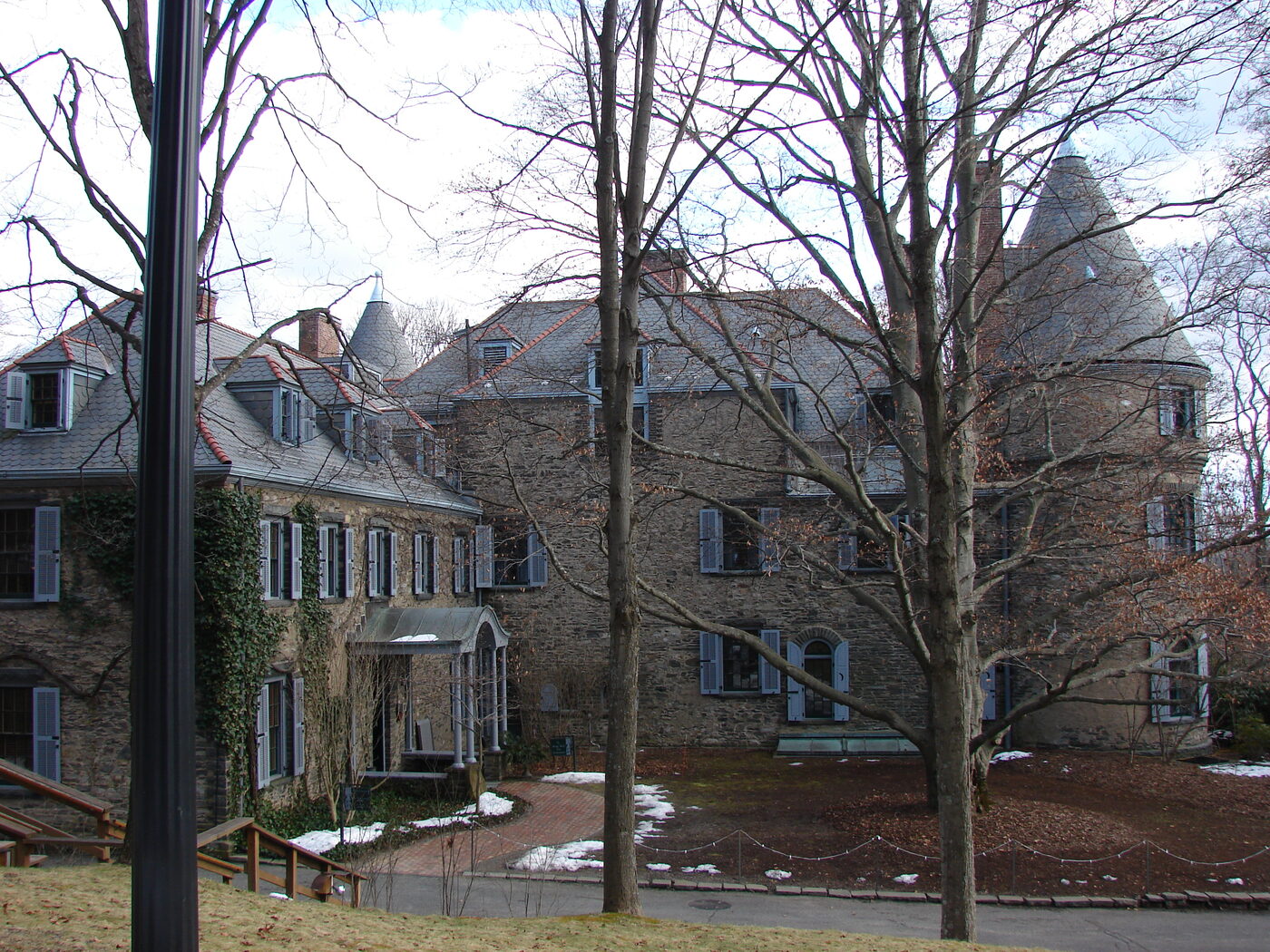
In 1886, a French-American family built a chateau on a hilltop in Milford, Pennsylvania. The architect was Richard Morris Hunt, who was also designing the base of the Statue of Liberty and George Vanderbilt's Biltmore mansion. The house was called Grey Towers. It commanded views across the Delaware Valley in every direction. En 1886, una familia franco-estadounidense construyó un castillo en lo alto de una colina en Milford, Pensilvania. El arquitecto fue Richard Morris Hunt, quien también estaba diseñando la base de la Estatua de la Libertad y la mansión Biltmore de George Vanderbilt. La casa se llamaba Grey Towers. Dominaba vistas a través del Valle del Delaware en todas las direcciones.
What those views showed was stumps. The family's patriarch, Cyrille Constantin Pinchot, had emigrated from France in 1816 as a Bonapartist fleeing the Bourbon Restoration. He became Milford's largest taxpayer through sawmills and lumber rafts. By the end of the 1860s the county, once lushly covered with dense forest, was cut clean. Grey Towers rose from a landscape the family had stripped. Lo que mostraban esas vistas eran tocones. El patriarca de la familia, Cyrille Constantin Pinchot, había emigrado de Francia en 1816 como bonapartista huyendo de la Restauración borbónica. Se convirtió en el mayor contribuyente de Milford a través de aserraderos y balsas de madera. Para finales de la década de 1860, el condado, alguna vez cubierto exuberantemente de bosque denso, estaba talado por completo. Grey Towers se levantó sobre un paisaje que la familia había despojado.
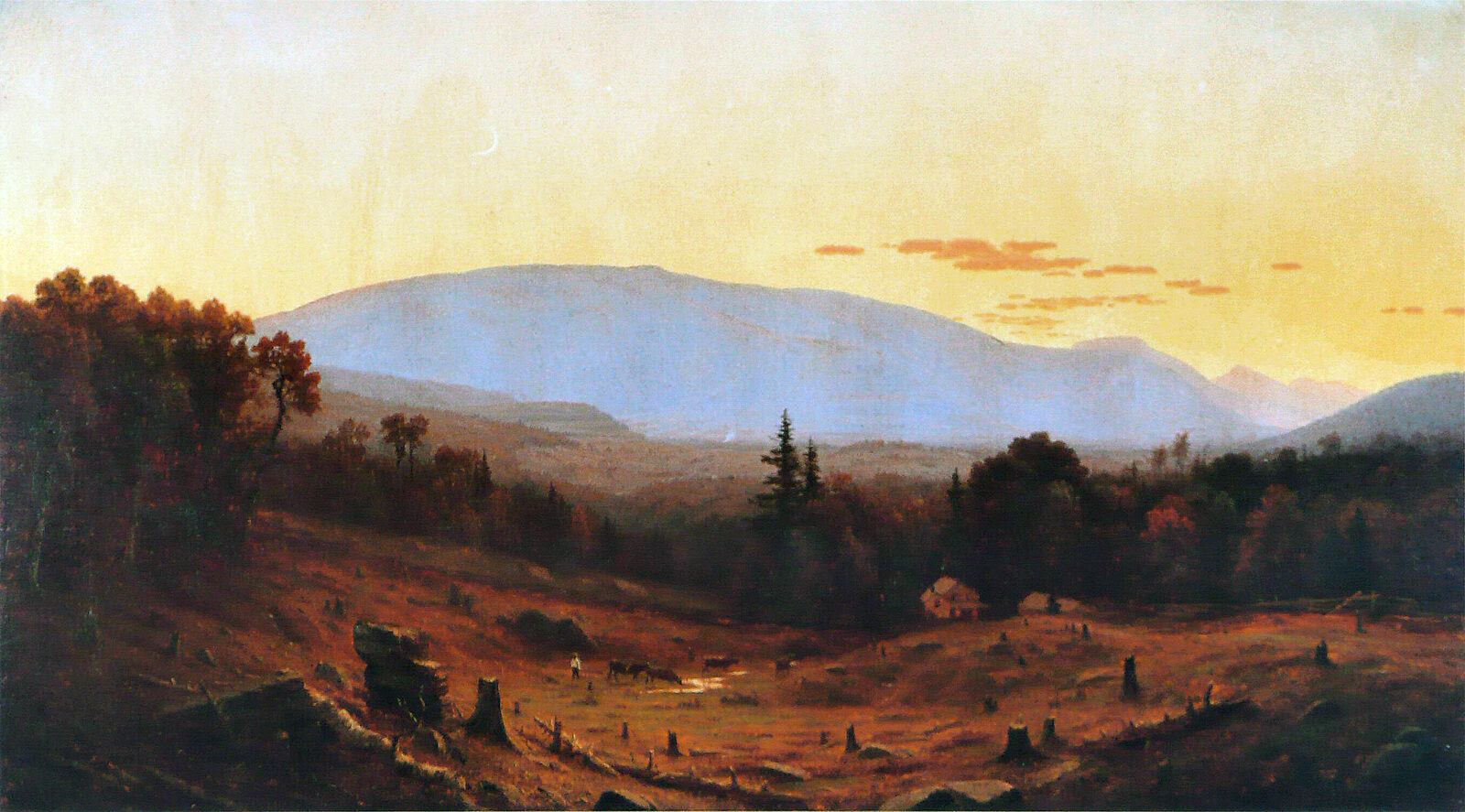
Now the Pinchots were planting trees on the bare hillsides, and inside the house, a painting hung in a prominent place. It was Sanford Gifford's Hunter Mountain, Twilight, completed in 1866: a logged-over slope with stumps in the foreground, a somber mountain under a sickle moon and evening star. The artist had been the godfather and namesake of the family's eldest son, young Gifford Pinchot. The artist's grandfather had worked in the tanning industry that stripped the hemlock forests of the Catskills. James Pinchot, young Gifford's father, "knew all about stumps, too, for his family had also prospered through the wholesale destruction of a once-sylvan land." The painting followed the family to every house they inhabited. Ahora los Pinchot estaban plantando árboles en las laderas peladas, y dentro de la casa, una pintura colgaba en un lugar prominente. Era Hunter Mountain, Twilight de Sanford Gifford, completada en 1866: una ladera talada con tocones en primer plano, una montaña sombría bajo una luna creciente y estrella vespertina. El artista había sido el padrino y homónimo del hijo mayor de la familia, el joven Gifford Pinchot. El abuelo del artista había trabajado en la industria curtidora que despojó los bosques de cicuta de los Catskills. James Pinchot, padre del joven Gifford, "sabía todo sobre tocones también, porque su familia también había prosperado a través de la destrucción masiva de una tierra alguna vez selvática." La pintura siguió a la familia a cada casa que habitaron.
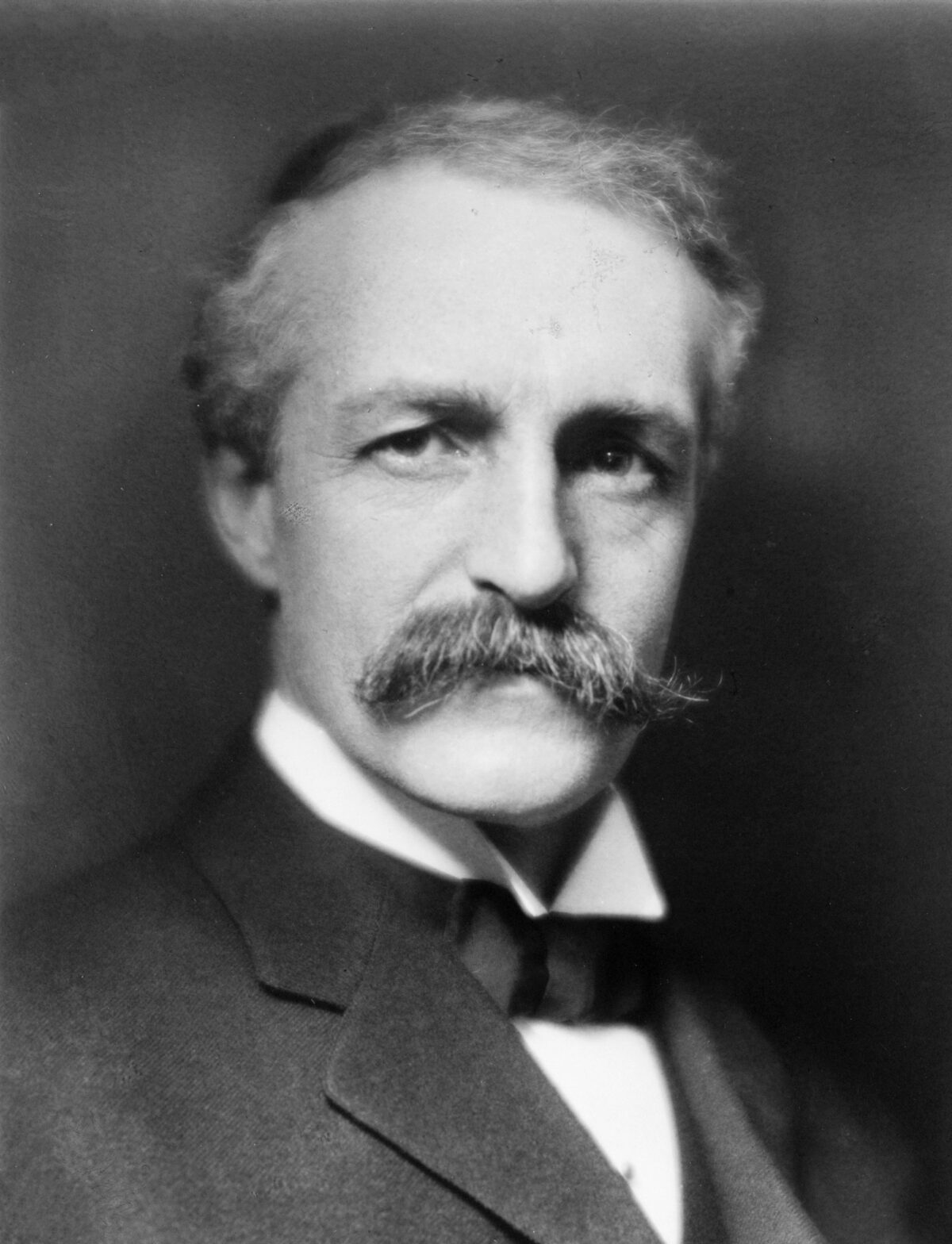
James also made money in wallpaper manufacturing and dry goods importing in New York City. He was an avid collector of Hudson River School landscapes. He married Mary Jane Eno, whose father Amos was a major New York real estate investor. The family had money, political connections, and a conscience about what had paid for both. At a Yale commencement dinner, James asked his son: would you like to become a forester? No American forestry schools existed. The question was an act of atonement. James también ganó dinero con la manufactura de papel tapiz y la importación de mercancías en Nueva York. Era un ávido coleccionista de paisajes de la Escuela del Río Hudson. Se casó con Mary Jane Eno, cuyo padre Amos era un importante inversor inmobiliario de Nueva York. La familia tenía dinero, conexiones políticas, y una conciencia sobre lo que había pagado por ambos. En una cena de graduación de Yale, James le preguntó a su hijo: ¿te gustaría convertirte en silvicultor? No existían escuelas de silvicultura en Estados Unidos. La pregunta fue un acto de expiación.
Gifford said yes. Gifford dijo que sí.
An American in Nancy Un Estadounidense en Nancy
In October 1889, Gifford Pinchot sailed from New York on the SS Elbe. He was twenty-four years old, freshly graduated from Yale, and knew almost nothing about his chosen profession. "I must admit that I felt rather lonely at parting and on my solitary way down the bay," he wrote. The harbor pilot promptly ran the ship aground on a mud bank in the Narrows. En octubre de 1889, Gifford Pinchot zarpó de Nueva York en el SS Elbe. Tenía veinticuatro años, recién graduado de Yale, y no sabía casi nada sobre su profesión elegida. "Debo admitir que me sentí bastante solo al partir y en mi camino solitario bahía abajo," escribió. El práctico del puerto encalló el barco en un banco de barro en los Narrows.
In London he talked his way into the India Office on "good gall" and secured letters of introduction. He toured the managed parkland of Windsor Castle: "I have never seen a more beautiful drive." Then he traveled to Bonn to meet the man who would shape him. Dietrich Brandis had built British India's colonial forest service from nothing, creating the first professional state forestry in the tropics. He would mentor Pinchot until his death in 1907. After extended conversations, Pinchot emerged with "a clearer idea of forestry than I ever came near to having before." En Londres logró entrar en la Oficina de la India con "buena audacia" y obtuvo cartas de presentación. Recorrió los parques gestionados del Castillo de Windsor: "Nunca he visto un camino más hermoso." Luego viajó a Bonn para conocer al hombre que lo moldearía. Dietrich Brandis había construido el servicio forestal colonial de la India británica desde cero, creando la primera silvicultura estatal profesional en los trópicos. Sería mentor de Pinchot hasta su muerte en 1907. Después de conversaciones extensas, Pinchot emergió con "una idea más clara de la silvicultura de la que jamás estuve cerca de tener."
Brandis steered him to the French National School of Forestry at Nancy, one of France's grandes écoles devoted to training a technologically elite corps to both extract and conserve national resources. Pinchot chafed under the school's rigidity, calling the student-teacher relationship "this miserable baby system of shutting the students up." He dismissed fellow students who called forestry "fumisterie"—claptrap. But he admired professor Lucien Boppe, who had learned "in the woods what he taught in the lecture room." Brandis lo dirigió a la Escuela Nacional de Silvicultura en Nancy, una de las grandes escuelas de Francia dedicada a formar un cuerpo de élite tecnológica para extraer y conservar los recursos nacionales. Pinchot se irritó bajo la rigidez de la escuela, llamando a la relación estudiante-profesor "este miserable sistema infantil de encerrar a los estudiantes." Desdeñó a los compañeros que llamaban a la silvicultura "fumisterie," palabrería. Pero admiraba al profesor Lucien Boppe, quien había aprendido "en el bosque lo que enseñaba en el aula."
The key insight came early. He recognized that the French autocratic model, which treated forests as legible grids for the state, could never be transplanted to republican America. He advised his mother: "With us, the painstaking minuteness that prevails here is impossible." His friend James Reynolds joked: "Go on, brave heart...I expect that some day you will have reduced our forests to such a degree of subjection that not a half will rustle without the express permission of the autocratic G.P." La perspicacia clave llegó temprano. Reconoció que el modelo autocrático francés, que trataba los bosques como cuadrículas legibles para el estado, nunca podría trasplantarse a la América republicana. Aconsejó a su madre: "Con nosotros, la minuciosidad meticulosa que prevalece aquí es imposible." Su amigo James Reynolds bromeó: "Adelante, corazón valiente...Espero que algún día hayas reducido nuestros bosques a tal grado de sumisión que ni una hoja se agitará sin el permiso expreso del autocrático G.P."
From Nancy he went to the Sihlwald, a municipal forest near Zurich that had been under continuous management "since before Columbus discovered America." Here he learned the principle of sustained yield: cut each year no more timber than the total annual growth over the whole area. The Sihlwald "yielded to the city a net revenue of more than eight dollars an acre." Forestry as a paying proposition. This was the proof that American landowners would need. De Nancy fue al Sihlwald, un bosque municipal cerca de Zúrich que había estado bajo manejo continuo "desde antes de que Colón descubriera América." Aquí aprendió el principio de rendimiento sostenido: cortar cada año no más madera que el crecimiento anual total sobre toda el área. El Sihlwald "rendía a la ciudad un ingreso neto de más de ocho dólares por acre." La silvicultura como una propuesta rentable. Esta era la prueba que los propietarios estadounidenses necesitarían.
One evening in Paris, he and Reynolds visited the Folies Bergère. The ballet Les Baigneuses was "the most carefully arranged bit of indecency that I ever saw." When propositioned by one of the Folies' "tough looking maidens," Pinchot "kept my face closed." He was six-foot-two, had been voted handsomest in his Yale class, and was already one of the most tightly wound young men in American public life. Una noche en París, él y Reynolds visitaron el Folies Bergère. El ballet Les Baigneuses fue "el trozo de indecencia más cuidadosamente organizado que jamás vi." Cuando fue abordado por una de las "doncellas de aspecto rudo" del Folies, Pinchot "mantuvo la cara cerrada." Medía un metro ochenta y ocho, había sido votado como el más apuesto de su clase de Yale, y ya era uno de los jóvenes más contenidos de la vida pública estadounidense.
The Damaged Fabric El Tejido Dañado
He returned to a country that had no forestry profession, no forest management, and no one to teach either. Frederick Law Olmsted, who was designing the grounds for George Vanderbilt's Biltmore Estate in North Carolina, recognized that the 125,000-acre property needed a trained forester. Olmsted and the architect Richard Morris Hunt were old friends of the Eno and Pinchot families, and Pinchot was the only American with European forestry credentials. Olmsted recommended him. Olmsted's vision for Biltmore went beyond practical reforestation. The goal was philosophical: to blur the distinction between wildness and cultivation, so that when Vanderbilt's guests rode in carriages up the proposed three-mile drive, "they would have the sensation of passing through the remote depths of a natural forest." All landscapes, Olmsted argued, are constructed. Regresó a un país que no tenía profesión forestal, no tenía manejo de bosques, y no tenía a nadie para enseñar ninguna de las dos cosas. Frederick Law Olmsted, quien estaba diseñando los terrenos de la finca Biltmore de George Vanderbilt en Carolina del Norte, reconoció que la propiedad de 125,000 acres necesitaba un silvicultor formado. Olmsted y el arquitecto Richard Morris Hunt eran viejos amigos de las familias Eno y Pinchot, y Pinchot era el único estadounidense con credenciales forestales europeas. Olmsted lo recomendó. La visión de Olmsted para Biltmore iba más allá de la reforestación práctica. El objetivo era filosófico: difuminar la distinción entre lo silvestre y lo cultivado, de modo que cuando los huéspedes de Vanderbilt cabalgaran en carruajes por el camino propuesto de tres millas, "tendrían la sensación de pasar a través de las profundidades remotas de un bosque natural." Todos los paisajes, argumentaba Olmsted, son construidos.
Pinchot served as chief forester at Biltmore from 1892 to 1895, the first systematic forestry practiced in America. He established three goals: promote profitable timber production, establish a constant annual yield, and improve the general condition of the forest. The historian Char Miller argues that Pinchot was suited to the work because his forestry had aesthetic roots that are systematically overlooked. Growing up surrounded by his father's Hudson River School paintings, Pinchot had built "his later studies in forestry's scientific language upon an already established aesthetic vocabulary; in his hands, the forester's tools could become a paintbrush." Art dealer Samuel Avery wrote James Pinchot that Gifford's forestry reports did honor to the young man's "combined names," meaning the namesake artist Sanford Gifford. Pinchot sirvió como silvicultor jefe en Biltmore de 1892 a 1895, la primera silvicultura sistemática practicada en América. Estableció tres objetivos: promover la producción maderera rentable, establecer un rendimiento anual constante, y mejorar la condición general del bosque. El historiador Char Miller argumenta que Pinchot era apto para el trabajo porque su silvicultura tenía raíces estéticas que son sistemáticamente pasadas por alto. Criado rodeado de las pinturas de la Escuela del Río Hudson de su padre, Pinchot había construido "sus estudios posteriores en el lenguaje científico de la silvicultura sobre un vocabulario estético ya establecido; en sus manos, las herramientas del silvicultor podían convertirse en un pincel." El marchante de arte Samuel Avery escribió a James Pinchot que los informes forestales de Gifford hacían honor a los "nombres combinados" del joven, refiriéndose al artista homónimo Sanford Gifford.
Before Biltmore, Pinchot made his first trip west. He visited the Grand Canyon before the dams, before the tourists, before the park designation. He spent four days struggling to comprehend the scale. "A vast hole full of air and mountains," he wrote. Standing by the undammed Colorado River: "vast dark river...tremendous and appalling in the gloom of a gathering storm." He found religious meaning in the landscape. The canyon's power lay in its "serenity...absolute peace." He sang the doxology alone on the rim. His mule, less moved, escaped back to Flagstaff. Antes de Biltmore, Pinchot hizo su primer viaje al oeste. Visitó el Gran Cañón antes de las represas, antes de los turistas, antes de la designación como parque. Pasó cuatro días tratando de comprender la escala. "Un vasto agujero lleno de aire y montañas," escribió. De pie junto al río Colorado sin represas: "vasto río oscuro...tremendo y espantoso en la penumbra de una tormenta que se acercaba." Encontró significado religioso en el paisaje. El poder del cañón residía en su "serenidad...paz absoluta." Cantó la doxología solo en el borde. Su mula, menos conmovida, escapó de regreso a Flagstaff.
He also took consulting work in Arizona for Phelps Dodge & Company, an afforestation project in the Sulphur Spring Valley. Miller reveals that some of the company's board members "were his maternal cousins in the Phelps family," a connection Pinchot never mentioned in his diary or in Breaking New Ground. The project failed. The desert could not sustain the trees they wanted to plant. It was one of the first moments Pinchot confronted "the possibility that there were limitations to what foresters and forestry could accomplish." También aceptó trabajo de consultoría en Arizona para Phelps Dodge & Company, un proyecto de forestación en el Valle de Sulphur Spring. Miller revela que algunos miembros de la junta directiva de la empresa "eran sus primos maternos de la familia Phelps," una conexión que Pinchot nunca mencionó en su diario ni en Breaking New Ground. El proyecto fracasó. El desierto no podía sostener los árboles que querían plantar. Fue uno de los primeros momentos en que Pinchot confrontó "la posibilidad de que hubiera limitaciones a lo que los silvicultores y la silvicultura podían lograr."
The Machine La Máquina
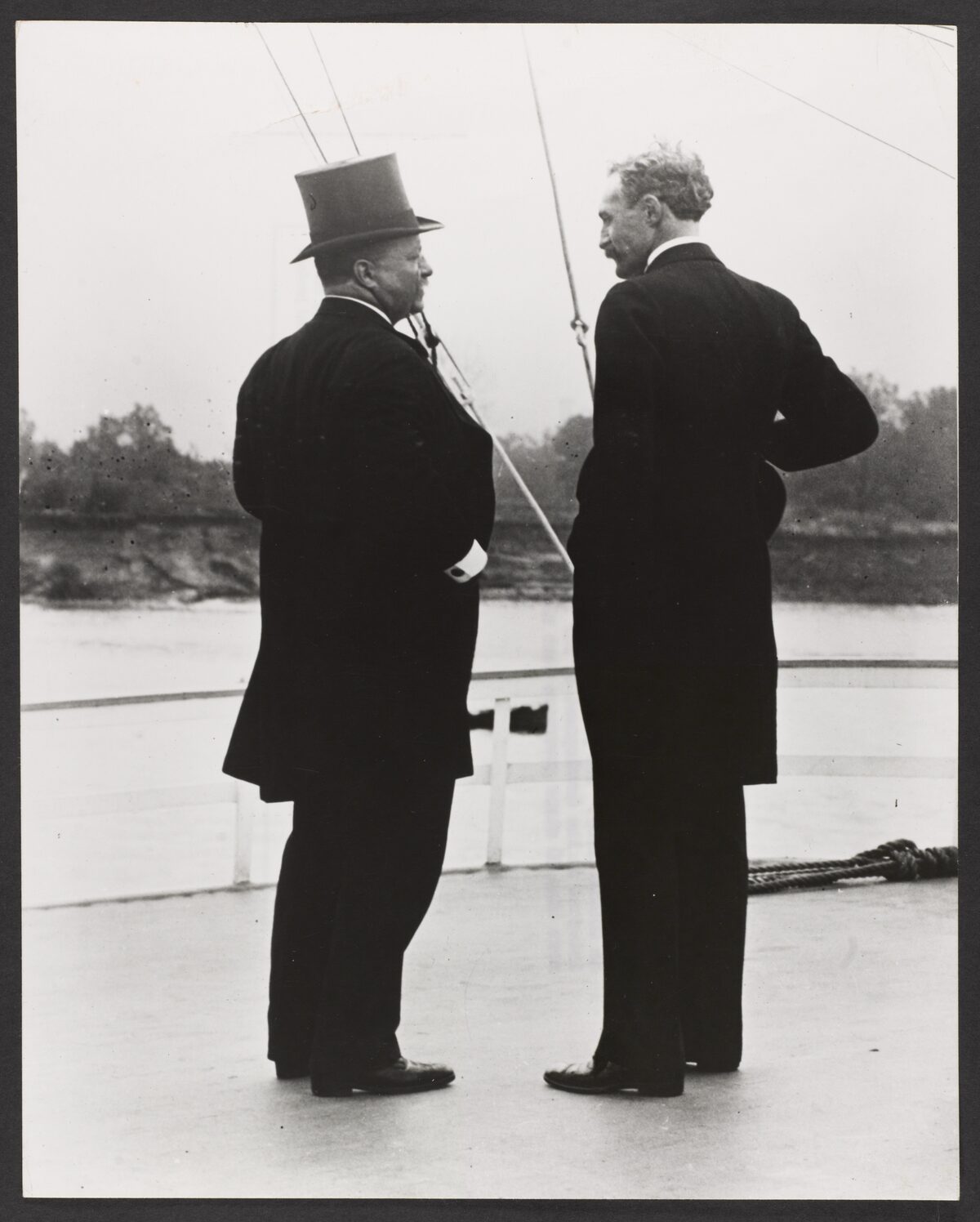
In February 1899, Pinchot and Grant LaFarge traveled to the Adirondacks to examine a forested tract for the Division of Forestry. They stopped in Albany to visit the new governor. The mansion was "under ferocious attack from a band of invisible Indians." Roosevelt was lowering children out of a window on a rope. That night: boxing. Pinchot, with his long reach, knocked Roosevelt "off his very solid pins." Then wrestling. The more powerful Roosevelt overwhelmed him. They became friends immediately. En febrero de 1899, Pinchot y Grant LaFarge viajaron a los Adirondacks para examinar un terreno boscoso para la División de Silvicultura. Se detuvieron en Albany para visitar al nuevo gobernador. La mansión estaba "bajo feroz ataque de una banda de indios invisibles." Roosevelt estaba bajando niños por una ventana con una cuerda. Esa noche: boxeo. Pinchot, con su largo alcance, derribó a Roosevelt "de sus muy sólidas piernas." Luego lucha libre. El más fornido Roosevelt lo dominó. Se hicieron amigos inmediatamente.
The friendship was built on shared physicality. They climbed Mount Marcy in winter, in temperatures twenty-five to forty below zero; Pinchot wore summer clothes plus a sweater and crawled on hands and knees through a blizzard on the summit, stopping "every minute or two to rub my face against freezing." Their guide was laid up for over a year with frostbite. As part of Roosevelt's informal "Tennis Cabinet," they chopped wood for exercise, tramped through Rock Creek Park, rode horses, and swam the Potomac in late fall. Roosevelt reportedly called Pinchot "the keeper of his conscience" on conservation questions. James Pinchot, Gifford's father, called Roosevelt a "vampire," seeing how the relationship consumed his son. La amistad se construyó sobre la fisicalidad compartida. Escalaron el Monte Marcy en invierno, con temperaturas de veinticinco a cuarenta grados bajo cero; Pinchot llevaba ropa de verano más un suéter y se arrastró de rodillas y manos a través de una ventisca en la cumbre, deteniéndose "cada minuto o dos para frotar mi cara contra la congelación." Su guía estuvo postrado más de un año por congelamiento. Como parte del "Gabinete de Tenis" informal de Roosevelt, cortaban leña para hacer ejercicio, caminaban por Rock Creek Park, montaban a caballo, y nadaban en el Potomac a finales de otoño. Según se dice, Roosevelt llamaba a Pinchot "el guardián de su conciencia" en cuestiones de conservación. James Pinchot, el padre de Gifford, llamó a Roosevelt un "vampiro," viendo cómo la relación consumía a su hijo.
The real work beneath the adventure stories was institutional. In 1898, Pinchot was appointed head of the Division of Forestry in the Department of Agriculture. In 1905, the Transfer Act moved the forest reserves from the Department of the Interior to Agriculture, creating the U.S. Forest Service with Pinchot as its first chief. Under his leadership, the system grew from 60 forest reserves covering 56 million acres to 150 national forests covering 145 million acres. He built a professional civil service, wrote the Use Book (a pocket-sized manual explaining how national forests could be used), instituted a 36-hour correspondence rule (every letter answered within a day and a half), and reportedly had desk drawers nailed shut to prevent paperwork from accumulating. Stewart Udall called him a "magnificent bureaucrat" whose vision made the Forest Service "the most exciting organization in Washington." El trabajo real bajo las historias de aventura era institucional. En 1898, Pinchot fue nombrado jefe de la División de Silvicultura en el Departamento de Agricultura. En 1905, la Ley de Transferencia movió las reservas forestales del Departamento del Interior a Agricultura, creando el Servicio Forestal de EE.UU. con Pinchot como su primer jefe. Bajo su liderazgo, el sistema creció de 60 reservas forestales cubriendo 56 millones de acres a 150 bosques nacionales cubriendo 145 millones de acres. Construyó un servicio civil profesional, escribió el Libro de Uso (un manual de bolsillo explicando cómo podían usarse los bosques nacionales), instituyó una regla de correspondencia de 36 horas (cada carta respondida en un día y medio), y según se dice mandó clavar los cajones de los escritorios para evitar que se acumulara el papeleo. Stewart Udall lo llamó un "magnífico burócrata" cuya visión hizo del Servicio Forestal "la organización más emocionante de Washington."
In March 1907, Congress moved to strip the president's authority to create new forest reserves in six western states. Roosevelt and Pinchot spent two days designating 16 million acres of new national forests before the bill took effect. The "midnight forests," as opponents called them, were Roosevelt's final conservation act as a free hand. En marzo de 1907, el Congreso actuó para eliminar la autoridad del presidente de crear nuevas reservas forestales en seis estados del oeste. Roosevelt y Pinchot pasaron dos días designando 16 millones de acres de nuevos bosques nacionales antes de que el proyecto de ley entrara en vigor. Los "bosques de medianoche," como los llamaron los opositores, fueron el último acto de conservación de Roosevelt con mano libre.
The conceptual work mattered as much as the administrative. One evening in February 1907, riding his horse Jim through Rock Creek Park to clear his head, Pinchot had what he later described as an epiphany. "Suddenly it flashed through my head that there was a unity in this complication." Forests, water, soil, minerals, wildlife: they were all part of a single problem. He gave that problem a name. Drawing on the utilitarian philosopher Jeremy Bentham and the ethnologist William John McGee, he coined a definition: "the greatest good, for the greatest number, for the longest time." The addition of "for the longest time" committed the concept to intergenerational sustainability. The word was "conservation." El trabajo conceptual importaba tanto como lo administrativo. Una tarde de febrero de 1907, montando su caballo Jim por Rock Creek Park para despejar su mente, Pinchot tuvo lo que luego describió como una epifanía. "De repente me vino a la mente que había una unidad en esta complicación." Bosques, agua, suelo, minerales, vida silvestre: todos eran parte de un solo problema. Le dio un nombre a ese problema. Basándose en el filósofo utilitarista Jeremy Bentham y el etnólogo William John McGee, acuñó una definición: "el mayor bien, para el mayor número, por el mayor tiempo." La adición de "por el mayor tiempo" comprometió el concepto con la sostenibilidad intergeneracional. La palabra fue "conservación."
The Washington Post observed in 1905: "He preaches and excites as devotedly as Peter the Hermit heralding a crusade." In 1900 he founded the Society of American Foresters, which became the profession's largest organization. That same year, using an endowment from his parents, he and Henry S. Graves established the Yale School of Forestry, the first in the United States. During its first four decades, the school graduated the first four chiefs of the U.S. Forest Service. El Washington Post observó en 1905: "Predica y excita con tanta devoción como Pedro el Ermitaño anunciando una cruzada." En 1900 fundó la Sociedad de Silvicultores Americanos, que se convirtió en la organización más grande de la profesión. Ese mismo año, usando una dotación de sus padres, él y Henry S. Graves establecieron la Escuela de Silvicultura de Yale, la primera en Estados Unidos. Durante sus primeras cuatro décadas, la escuela graduó a los primeros cuatro jefes del Servicio Forestal de EE.UU.
The Rift La Ruptura
Pinchot had first met John Muir in October 1892 in the Adirondacks, introduced by a mutual friend while Pinchot was evaluating a forest tract. In 1896, they traveled together on the National Forest Commission's four-month tour of the American West. They fished together at Lake McDonald, which would become part of Glacier National Park. One night they camped on the south rim of the Grand Canyon. Pinchot recalled feeling like "guilty schoolboys" the next morning after staying up past midnight around the campfire. "It was such an evening as I have never had before or since." Pinchot había conocido a John Muir por primera vez en octubre de 1892 en los Adirondacks, presentados por un amigo en común mientras Pinchot evaluaba un terreno forestal. En 1896, viajaron juntos en la gira de cuatro meses de la Comisión Nacional de Bosques por el oeste estadounidense. Pescaron juntos en Lake McDonald, que se convertiría en parte del Parque Nacional Glacier. Una noche acamparon en el borde sur del Gran Cañón. Pinchot recordó sentirse como "colegiales culpables" a la mañana siguiente después de haberse quedado despiertos hasta pasada la medianoche alrededor de la fogata. "Fue una noche como nunca he tenido antes ni después."
Their alliance was strategic and mutually beneficial. Muir needed political advocates to advance the cause of forests in Congress; Pinchot needed Muir's eloquent magazine writing to generate public interest. "Without that interest, as Pinchot knew better than most, there would be no legislation." Together, Pinchot's political lobbying and Muir's essays in the Atlantic and Harper's Weekly helped produce the landmark 1897 Organic Act, which established the legal foundation for what would become the U.S. Forest Service. In 1895, Muir himself had praised forestry and supported use alongside preservation: "It is impossible in the nature of things to stop at preservation." Forests "may be made to yield a sure harvest of timber, while at the same time all their far-reaching uses may be maintained unimpaired." Su alianza era estratégica y mutuamente beneficiosa. Muir necesitaba defensores políticos para avanzar la causa de los bosques en el Congreso; Pinchot necesitaba la elocuente escritura de Muir en revistas para generar interés público. "Sin ese interés, como Pinchot sabía mejor que la mayoría, no habría legislación." Juntos, el cabildeo político de Pinchot y los ensayos de Muir en el Atlantic y Harper's Weekly ayudaron a producir la histórica Ley Orgánica de 1897, que estableció la base legal para lo que se convertiría en el Servicio Forestal de EE.UU. En 1895, Muir mismo había elogiado la silvicultura y apoyado el uso junto con la preservación: "Es imposible en la naturaleza de las cosas detenerse en la preservación." Los bosques "pueden hacerse rendir una cosecha segura de madera, mientras que al mismo tiempo todos sus usos de largo alcance pueden mantenerse intactos."
The break came gradually. The Forest Commission had split into two camps: Sargent, Muir, and Agassiz wanted reserves closed and patrolled by the Army; Pinchot and Hague wanted regulated use with a professional forest service. Sargent wrote Muir that he had been "obliged to talk rather disagreeably with them." After Pinchot's appointment as head of the Division of Forestry in 1898, he began rupturing relationships with older mentors in rapid succession: Bernhard Fernow, Charles Sargent, Muir. Miller sees an oedipal pattern. Each had mentored Pinchot; each was surpassed and then alienated. The 1908 Conservation Conference invitation list deliberately excluded all three, "an act of omission that was as psychologically charged as it was politically motivated." La ruptura vino gradualmente. La Comisión de Bosques se había dividido en dos bandos: Sargent, Muir y Agassiz querían reservas cerradas y patrulladas por el ejército; Pinchot y Hague querían uso regulado con un servicio forestal profesional. Sargent le escribió a Muir que se había visto "obligado a hablar de manera bastante desagradable con ellos." Después del nombramiento de Pinchot como jefe de la División de Silvicultura en 1898, comenzó a romper relaciones con mentores mayores en rápida sucesión: Bernhard Fernow, Charles Sargent, Muir. Miller ve un patrón edípico. Cada uno había sido mentor de Pinchot; cada uno fue superado y luego alienado. La lista de invitaciones de la Conferencia de Conservación de 1908 excluyó deliberadamente a los tres, "un acto de omisión tan cargado psicológicamente como políticamente motivado."
Hetch Hetchy crystallized the division. In 1908, Roosevelt's Department of the Interior granted San Francisco authority to dam the Tuolumne River inside Yosemite National Park. Pinchot supported the dam as an obvious utilitarian choice: "The intermittent aesthetic enjoyment of less than one per cent is being balanced against the daily comfort and welfare of 99 per cent." Roosevelt had sent Pinchot to visit Muir in 1907; Pinchot admitted he had never actually seen the valley. Muir was incandescent: "You might as well deface the world's great cathedrals...for no holier temple has ever been consecrated by the heart of man." He added: "I cannot believe Pinchot, if he really knows the valley, has made any such statements." On December 19, 1913, President Wilson signed the Raker Act authorizing the dam. Muir's last letter to Pinchot had been sent in May 1905. Hetch Hetchy cristalizó la división. En 1908, el Departamento del Interior de Roosevelt otorgó a San Francisco autoridad para represar el río Tuolumne dentro del Parque Nacional Yosemite. Pinchot apoyó la represa como una elección utilitaria obvia: "El disfrute estético intermitente de menos del uno por ciento se está balanceando contra la comodidad y el bienestar diario del 99 por ciento." Roosevelt había enviado a Pinchot a visitar a Muir en 1907; Pinchot admitió que nunca había visto realmente el valle. Muir estaba incandescente: "Bien podrían desfigurar las grandes catedrales del mundo...porque ningún templo más sagrado ha sido consagrado por el corazón del hombre." Añadió: "No puedo creer que Pinchot, si realmente conoce el valle, haya hecho tales declaraciones." El 19 de diciembre de 1913, el presidente Wilson firmó la Ley Raker autorizando la represa. La última carta de Muir a Pinchot había sido enviada en mayo de 1905.
Muir died in 1914, the year after the Raker Act. Pinchot's own fall from government had come four years earlier. In 1909, President Taft replaced Roosevelt's Secretary of the Interior with Richard Ballinger. When Louis Glavis, a federal land-office investigator, became convinced Ballinger had a financial interest in blocking an investigation of coal claims in Alaska, Glavis brought his evidence to Pinchot. Taft exonerated Ballinger and fired Glavis. Pinchot then sent an open letter to Congress praising Glavis as a "patriot," openly rebuked Taft, and asked for hearings. He was promptly fired. After returning from an African safari, Roosevelt concluded that Taft had so badly betrayed conservation ethics that he had to be ousted, leading to the 1912 Bull Moose challenge that split the Republican Party and handed the White House to Wilson. Muir murió en 1914, el año después de la Ley Raker. La propia caída de Pinchot del gobierno había ocurrido cuatro años antes. En 1909, el presidente Taft reemplazó al Secretario del Interior de Roosevelt con Richard Ballinger. Cuando Louis Glavis, un investigador federal de la oficina de tierras, se convenció de que Ballinger tenía un interés financiero en bloquear una investigación de reclamos de carbón en Alaska, Glavis llevó sus pruebas a Pinchot. Taft exoneró a Ballinger y despidió a Glavis. Pinchot entonces envió una carta abierta al Congreso elogiando a Glavis como un "patriota," reprendió abiertamente a Taft, y pidió audiencias. Fue despedido de inmediato. Tras regresar de un safari en África, Roosevelt concluyó que Taft había traicionado tan gravemente la ética de la conservación que tenía que ser destituido, lo que llevó al desafío del Partido Alce de 1912 que dividió al Partido Republicano y entregó la Casa Blanca a Wilson.
Miller argues that the Pinchot-Muir conflict, for all its bitterness, was generative. "Out of this tradition of brawling, the national forest and park systems were born." Radicals made moderates look reasonable; moderates adopted radical positions to maintain standing. The political conflict was "a subtle composition, as opposing factions, like partners in a dance, seek to take (or grab) the lead." The two systems that resulted, national forests and national parks, embodied the tension between use and preservation that neither man could resolve alone. Miller argumenta que el conflicto Pinchot-Muir, con toda su amargura, fue generativo. "De esta tradición de peleas, nacieron los sistemas de bosques nacionales y parques nacionales." Los radicales hacían que los moderados parecieran razonables; los moderados adoptaban posiciones radicales para mantener su posición. El conflicto político era "una composición sutil, donde facciones opuestas, como compañeros en un baile, buscan tomar (o arrebatar) la delantera." Los dos sistemas que resultaron, bosques nacionales y parques nacionales, encarnaron la tensión entre uso y preservación que ninguno de los dos hombres podía resolver solo.
Family Affairs Asuntos de Familia
While building the Forest Service, Pinchot was quietly living a private life that would astonish the colleagues who knew him only as a policy machine. At Biltmore in 1892, he had met Laura Houghteling, a smart, assertive woman who loved poetry and was deeply spiritual. She was convalescing from tuberculosis at Strawberry Hill. They fell in love. A nurse named Julia Sullivan caught them embracing in the parlor. At Yale, Pinchot's friends knew Laura as his "C.B.," Skull and Bones slang for "Connubial Bliss." Mientras construía el Servicio Forestal, Pinchot vivía en silencio una vida privada que habría asombrado a los colegas que lo conocían solo como una máquina de políticas. En Biltmore en 1892, conoció a Laura Houghteling, una mujer inteligente y segura que amaba la poesía y era profundamente espiritual. Estaba convaleciente de tuberculosis en Strawberry Hill. Se enamoraron. Una enfermera llamada Julia Sullivan los sorprendió abrazándose en el salón. En Yale, los amigos de Pinchot conocían a Laura como su "C.B.," argot de Skull and Bones para "Dicha Conyugal."
Laura died on February 7, 1894, before they could marry. Pinchot wore black for at least two years. Thirty-eight days after her death, he wrote in his diary: "My lady is very near." For twenty years, he wrote about her as if she were a living presence. He developed a coded system: "a bright day" or "a clear day" meant he felt her near; "not a clear day" meant difficulty reaching her. On April 22, 1896, during a late-night spiritual communion, he wrote: "In God's sight my Lady and I are husband and wife." He consulted her spirit on major political decisions. He dedicated The Fight for Conservation to "LH." Laura murió el 7 de febrero de 1894, antes de que pudieran casarse. Pinchot vistió de negro por al menos dos años. Treinta y ocho días después de su muerte, escribió en su diario: "Mi dama está muy cerca." Durante veinte años, escribió sobre ella como si fuera una presencia viva. Desarrolló un sistema codificado: "un día brillante" o "un día claro" significaba que la sentía cerca; "un día no claro" significaba dificultad para alcanzarla. El 22 de abril de 1896, durante una comunión espiritual nocturna, escribió: "Ante los ojos de Dios, mi Dama y yo somos marido y mujer." Consultaba su espíritu sobre decisiones políticas importantes. Dedicó The Fight for Conservation a "LH."
He did not marry until his father had died and his mother was on her deathbed. Cornelia Bryce, sixteen years his junior, came from a political dynasty of her own: her great-grandfather Peter Cooper had founded Cooper Union and run for president; her father Lloyd Bryce edited the North American Review and served as U.S. minister to the Netherlands. Gifford and Cornelia met during the 1912 Bull Moose campaign. They married on August 15, 1914, at her parents' home in Roslyn, New York, with Roosevelt as a witness. Pinchot was forty-nine. Cornelia knew about Laura. No se casó hasta que su padre murió y su madre estaba en su lecho de muerte. Cornelia Bryce, dieciséis años menor que él, venía de su propia dinastía política: su bisabuelo Peter Cooper había fundado Cooper Union y se había postulado para presidente; su padre Lloyd Bryce editaba la North American Review y había servido como ministro de EE.UU. en los Países Bajos. Gifford y Cornelia se conocieron durante la campaña del Alce de 1912. Se casaron el 15 de agosto de 1914, en la casa de los padres de ella en Roslyn, Nueva York, con Roosevelt como testigo. Pinchot tenía cuarenta y nueve años. Cornelia sabía sobre Laura.
Cornelia Bryce Pinchot was nationally known for her feminism. Pinchot became vice-president of a Men for Suffrage organization. Their only child, Gifford Bryce Pinchot, was born on December 22, 1915. The marriage was a genuine partnership between two progressives. Cornelia Bryce Pinchot era conocida a nivel nacional por su feminismo. Pinchot se convirtió en vicepresidente de una organización de Hombres por el Sufragio. Su único hijo, Gifford Bryce Pinchot, nació el 22 de diciembre de 1915. El matrimonio fue una verdadera asociación entre dos progresistas.
The Governor and the Forester El Gobernador y el Silvicultor
Pinchot served two non-consecutive terms as governor of Pennsylvania (1923-1927 and 1931-1935). He reorganized state government, streamlining 139 agencies into 15 departments. He settled a coal strike by arbitration, investigated abusive police conduct during the strikes, paved rural roads to help struggling farmers, established the Giant Power Survey Board to regulate electric utilities, and created what was arguably the first state anti-pollution agency in the Sanitary Water Board. His second term coincided with the Great Depression: he enacted banking reform, halted unfair labor injunctions, reduced utility rates, and welcomed 113 Civilian Conservation Corps camps, second only to California. He was the first governor to have two women on his cabinet. Pinchot sirvió dos mandatos no consecutivos como gobernador de Pensilvania (1923-1927 y 1931-1935). Reorganizó el gobierno estatal, reduciendo 139 agencias a 15 departamentos. Resolvió una huelga minera por arbitraje, investigó la conducta policial abusiva durante las huelgas, pavimentó caminos rurales para ayudar a los agricultores en dificultades, estableció la Junta de Estudio de Energía para regular las empresas eléctricas, y creó lo que fue posiblemente la primera agencia estatal contra la contaminación en la Junta de Agua Sanitaria. Su segundo mandato coincidió con la Gran Depresión: promulgó reforma bancaria, detuvo las injunciones laborales abusivas, redujo las tarifas de servicios públicos, y acogió 113 campamentos del Cuerpo Civil de Conservación, segundo solo después de California. Fue el primer gobernador en tener dos mujeres en su gabinete.
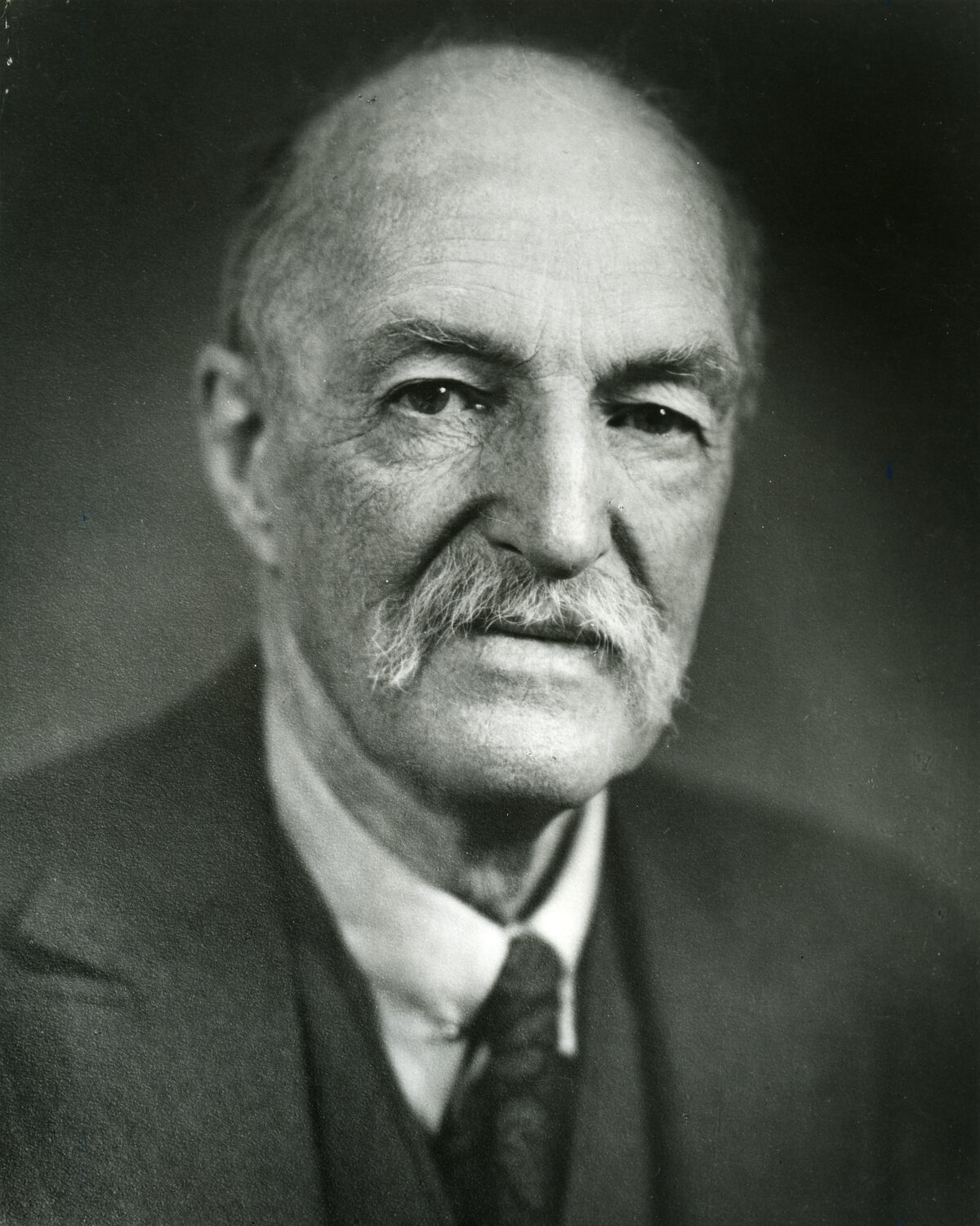
But what matters more than the policy record is the intellectual evolution that happened alongside it. It can be tracked through the four editions of The Training of a Forester, published in 1914, 1917, 1933, and 1937. The first editions were pure utilitarian textbooks: silvics, forest economics, lumbering. The 1937 edition was a different book. Pinchot had embraced "forest ecology," wildlife management, and aesthetic appreciation. His new language was startling: Pero lo que importa más que el historial de políticas es la evolución intelectual que ocurrió paralelamente. Puede rastrearse a través de las cuatro ediciones de The Training of a Forester, publicadas en 1914, 1917, 1933 y 1937. Las primeras ediciones eran libros de texto puramente utilitarios: silvicultura, economía forestal, explotación maderera. La edición de 1937 era un libro diferente. Pinchot había adoptado la "ecología forestal," el manejo de vida silvestre, y la apreciación estética. Su nuevo lenguaje era sorprendente:
And further: "Woodlands are beautiful. This 'good' which the forest offers so freely to all men cannot be measured in board feet and cords, in dollars and cents. It is immeasurable because it reaches and uplifts our inner selves." This was the man who had once defined forestry as "Tree Farming" and argued that "all of the resources of the forest reserves are for use." The utilitarian framework had cracked open. Miller writes that "utilitarian forestry had been undercut" by its own founder. An American Forests reviewer noted that practicing foresters would "find it a means of re-orienting themselves in their chosen profession." Y además: "Los bosques son hermosos. Este 'bien' que el bosque ofrece tan libremente a todos los hombres no puede medirse en pies tablares ni en dólares y centavos. Es inconmensurable porque alcanza y eleva nuestro ser interior." Este era el hombre que alguna vez había definido la silvicultura como "Cultivo de Árboles" y argumentado que "todos los recursos de las reservas forestales son para uso." El marco utilitario se había resquebrajado. Miller escribe que "la silvicultura utilitaria había sido socavada" por su propio fundador. Un reseñador de American Forests notó que los silvicultores en ejercicio "encontrarían en él un medio para reorientarse en su profesión elegida."
The political evolution was equally dramatic. By the 1930s and 1940s, Pinchot advocated nationalizing private timberlands through lease, purchase, or eminent domain. He opposed wartime clear-cuts in Pennsylvania state forests, calling them "tree butchery," and when the timber industry wrapped itself in the flag, Pinchot suggested their motto should be "Profita omnia excusat": profit excuses all. His 1945 speech to the Society of American Foresters, his last major public address, attacked "Economic Royalists" and "Concentrated Wealth," and called for moving "from a social order in which unregulated profit is the driving force" to one "in which equality of opportunity will cease to be a dream." Many in the audience "wished he had answered no" to his father's question about forestry. The profession had moved away from him. La evolución política fue igualmente dramática. Para las décadas de 1930 y 1940, Pinchot abogaba por nacionalizar las tierras madereras privadas mediante arrendamiento, compra o expropiación. Se opuso a las talas rasas de guerra en los bosques estatales de Pensilvania, llamándolas "carnicería de árboles," y cuando la industria maderera se envolvió en la bandera, Pinchot sugirió que su lema debería ser "Profita omnia excusat": el lucro todo lo excusa. Su discurso de 1945 ante la Sociedad de Silvicultores Americanos, su última dirección pública importante, atacó a los "Realistas Económicos" y la "Riqueza Concentrada," y llamó a moverse "de un orden social en el que el lucro sin regular es la fuerza motriz" a uno "en el que la igualdad de oportunidades dejará de ser un sueño." Muchos en la audiencia "deseaban que hubiera respondido no" a la pregunta de su padre sobre la silvicultura. La profesión se había alejado de él.
"I have been a governor now and then," he said on the Forest Service's fortieth anniversary, "but I am a forester all the time. Have been, and shall be, all my working life." "He sido gobernador de vez en cuando," dijo en el cuadragésimo aniversario del Servicio Forestal, "pero soy silvicultor todo el tiempo. Lo he sido, y lo seré, toda mi vida laboral."
Pinchot was a delegate to the First and Second International Eugenics Congresses (1912 and 1921) and a member of the advisory council of the American Eugenics Society from 1925 to 1935. He solicited contributions from scientists and social activists advocating eugenics for the National Conservation Commission's three-volume report to Roosevelt in 1909. The connections between early conservation and eugenics ran through many of the movement's leading figures, and Pinchot was among them. Pinchot fue delegado al Primer y Segundo Congreso Internacional de Eugenesia (1912 y 1921) y miembro del consejo asesor de la Sociedad Americana de Eugenesia de 1925 a 1935. Solicitó contribuciones de científicos y activistas sociales que abogaban por la eugenesia para el informe de tres volúmenes de la Comisión Nacional de Conservación a Roosevelt en 1909. Las conexiones entre la conservación temprana y la eugenesia atravesaron a muchas de las figuras principales del movimiento, y Pinchot estaba entre ellas.
The World Conference La Conferencia Mundial
On February 18, 1909, delegates from the United States, Canada, Newfoundland, and Mexico gathered in Washington for the North American Conservation Conference, the first international meeting on conservation policy. Among the delegates was Miguel de Quevedo, known as "the father of Mexican conservation." Pinchot was the catalyst. Roosevelt committed the country to a world conference in the Netherlands for September 1909 and sent invitations to thirty nations. All accepted. Then Taft took office and canceled it. El 18 de febrero de 1909, delegados de Estados Unidos, Canadá, Terranova y México se reunieron en Washington para la Conferencia Norteamericana de Conservación, la primera reunión internacional sobre política de conservación. Entre los delegados estaba Miguel de Quevedo, conocido como "el padre de la conservación mexicana." Pinchot fue el catalizador. Roosevelt comprometió al país a una conferencia mundial en los Países Bajos para septiembre de 1909 y envió invitaciones a treinta naciones. Todas aceptaron. Luego Taft asumió el cargo y la canceló.
For thirty years after that cancellation, Pinchot promoted the world conservation conference idea to successive presidents. None took it up. When war erupted in Europe in 1939, he reframed the concept: conservation was essential to achieving permanent peace. "International cooperation in conserving, utilizing, and distributing natural resources to the mutual advantage of all nations," he wrote, "might well remove one of the most dangerous of all obstacles to a just and permanent world peace." The argument was that resource competition was the root cause of territorial aggression. "The demand for new territory, made by one nation against another, is a demand for additional natural resources." Durante treinta años después de esa cancelación, Pinchot promovió la idea de la conferencia mundial de conservación ante presidentes sucesivos. Ninguno la adoptó. Cuando la guerra estalló en Europa en 1939, reformuló el concepto: la conservación era esencial para lograr la paz permanente. "La cooperación internacional en conservar, utilizar y distribuir los recursos naturales para la ventaja mutua de todas las naciones," escribió, "bien podría eliminar uno de los obstáculos más peligrosos para una paz mundial justa y permanente." El argumento era que la competencia por recursos era la causa raíz de la agresión territorial. "La demanda de nuevo territorio, hecha por una nación contra otra, es una demanda de recursos naturales adicionales."
In 1924, he published "A Forest Devastation Warning" in a government volume on Pan American forestry cooperation, warning that tropical forests across the Americas would "soon be obliterated if not brought under careful regulation." It was Pinchot addressing the hemisphere that included Costa Rica, naming the problem that Costa Rica's Ley Forestal would eventually address. Miller notes that the warning was confirmed seventy years later by the 1995 Santiago Declaration on sustainable forest management. En 1924, publicó "Una Advertencia sobre la Devastación Forestal" en un volumen gubernamental sobre cooperación panamericana en silvicultura, advirtiendo que los bosques tropicales de las Américas "pronto serían obliterados si no se sometían a regulación cuidadosa." Era Pinchot dirigiéndose al hemisferio que incluía a Costa Rica, nombrando el problema que la Ley Forestal de Costa Rica eventualmente abordaría. Miller señala que la advertencia fue confirmada setenta años después por la Declaración de Santiago de 1995 sobre el manejo forestal sostenible.
In 1929, Pinchot's schooner the Mary Pinchot sailed through the Caribbean, crossed the Panama Canal, and passed Isla del Coco, Costa Rican territory far off the Pacific coast. "Off the Cocos, the sea was simply jammed with fish." He continued to the Galápagos, where he spent a month and called for the islands to be set aside as wildlife refuges. "Somehow it ought to be done." Ecuador created the sanctuary five years later, in 1934. During earlier fishing trips in the Florida Keys, Pinchot had harpooned porpoises until close observation of their behavior shamed him. A porpoise would "examine us with one eye, then turn and examine us with the other, obviously disapprove of us, and then make off." He forswore the chase: "Since I got to know about them...I've gone no more a'hunting." Any porpoise could parade "across the bow of my canoe in perfect safety. He's free of the seas for all of me." Miller saw evidence of "a deeply complex relationship with the natural world." En 1929, la goleta de Pinchot, la Mary Pinchot, navegó por el Caribe, cruzó el Canal de Panamá, y pasó por la Isla del Coco, territorio costarricense lejano frente a la costa del Pacífico. "Frente a los Cocos, el mar estaba simplemente atestado de peces." Continuó a las Galápagos, donde pasó un mes y pidió que las islas fueran apartadas como refugios de vida silvestre. "De alguna manera debería hacerse." Ecuador creó el santuario cinco años después, en 1934. Durante viajes de pesca anteriores en los Cayos de Florida, Pinchot había arponeado marsopas hasta que la observación cercana de su comportamiento lo avergonzó. Una marsopa "nos examinaba con un ojo, luego se volteaba y nos examinaba con el otro, obviamente nos desaprobaba, y luego se marchaba." Renunció a la caza: "Desde que llegué a conocerlas...no he ido más a cazar." Cualquier marsopa podía desfilar "frente a la proa de mi canoa con perfecta seguridad. Es libre de los mares por lo que a mí respecta." Miller vio evidencia de "una relación profundamente compleja con el mundo natural."
In 1944, at Franklin Roosevelt's request, Pinchot drafted a letter to Allied governments proposing a conservation conference "as a necessary requirement for permanent peace." Roosevelt promised to brief Churchill and Stalin on the plan. Then Roosevelt died on April 12, 1945. Pinchot lobbied Truman, who agreed it "was a good thing," partly, in the words of Secretary of the Interior Harold Ickes, to "keep G.P. out of his hair." After the atomic bombings, Pinchot expanded his framework to include atomic energy as a natural resource requiring international management. En 1944, a petición de Franklin Roosevelt, Pinchot redactó una carta a los gobiernos aliados proponiendo una conferencia de conservación "como un requisito necesario para la paz permanente." Roosevelt prometió informar a Churchill y Stalin sobre el plan. Luego Roosevelt murió el 12 de abril de 1945. Pinchot cabildeo a Truman, quien aceptó que "era algo bueno," en parte, en palabras del Secretario del Interior Harold Ickes, para "quitarse a G.P. de encima." Después de los bombardeos atómicos, Pinchot expandió su marco para incluir la energía atómica como un recurso natural que requería gestión internacional.
The personal toll of his final years was heavy. His brother Amos, an old progressive who had become an America First isolationist, descended into alcoholism after his daughter Rosamond's suicide in 1938. Amos slit his veins with a safety razor in a relative's bathroom in August 1942. He was discovered and revived but never recovered, dying in February 1944. With his sister Antoinette also dead, Gifford was "for his last an only child." El costo personal de sus últimos años fue pesado. Su hermano Amos, un viejo progresista que se había convertido en aislacionista de América Primero, cayó en el alcoholismo después del suicidio de su hija Rosamond en 1938. Amos se cortó las venas con una navaja de afeitar en el baño de un pariente en agosto de 1942. Fue descubierto y reanimado pero nunca se recuperó, muriendo en febrero de 1944. Con su hermana Antoinette también fallecida, Gifford era "en sus últimos días un hijo único."
Gifford Pinchot died of leukemia on October 4, 1946, at eighty-one. Breaking New Ground, his autobiography, was published posthumously in 1947. He called it his "thrice accursed" book and "this wretched autobiographical screed of mine." It devoted more than a hundred pages to attacking Taft and opened with: "This is my personal history of how Forestry and Conservation came to America. As the only living witness to much of this history, you will have to take it or leave it on my say-so." It was a political tract to the end. Gifford Pinchot murió de leucemia el 4 de octubre de 1946, a los ochenta y un años. Breaking New Ground, su autobiografía, fue publicada póstumamente en 1947. La llamó su "tres veces maldito" libro y "este miserable escrito autobiográfico mío." Dedicó más de cien páginas a atacar a Taft y abrió con: "Esta es mi historia personal de cómo la Silvicultura y la Conservación llegaron a América. Como el único testigo vivo de gran parte de esta historia, tendrán que aceptarla o dejarla bajo mi palabra." Fue un tratado político hasta el final.
Three years after his death, the conference he had spent thirty years trying to convene finally took place. The 1949 United Nations Scientific Conference on the Conservation and Utilization of Resources met at Lake Success, New York. It was global in scope, exactly as Pinchot had envisioned. It was also, in the judgment of those who knew his vision, "gutted of much of its original visionary quality and practical idealism." The conference was highly technical and had no policy-making authority. The UN would not seriously address the environment until the 1972 Stockholm Conference. Tres años después de su muerte, la conferencia que había pasado treinta años tratando de convocar finalmente se realizó. La Conferencia Científica de las Naciones Unidas sobre la Conservación y Utilización de Recursos se reunió en Lake Success, Nueva York, en 1949. Fue global en alcance, exactamente como Pinchot había imaginado. También fue, a juicio de quienes conocían su visión, "despojada de gran parte de su calidad visionaria original e idealismo práctico." La conferencia fue altamente técnica y no tenía autoridad para hacer política. La ONU no abordaría seriamente el medio ambiente hasta la Conferencia de Estocolmo de 1972.
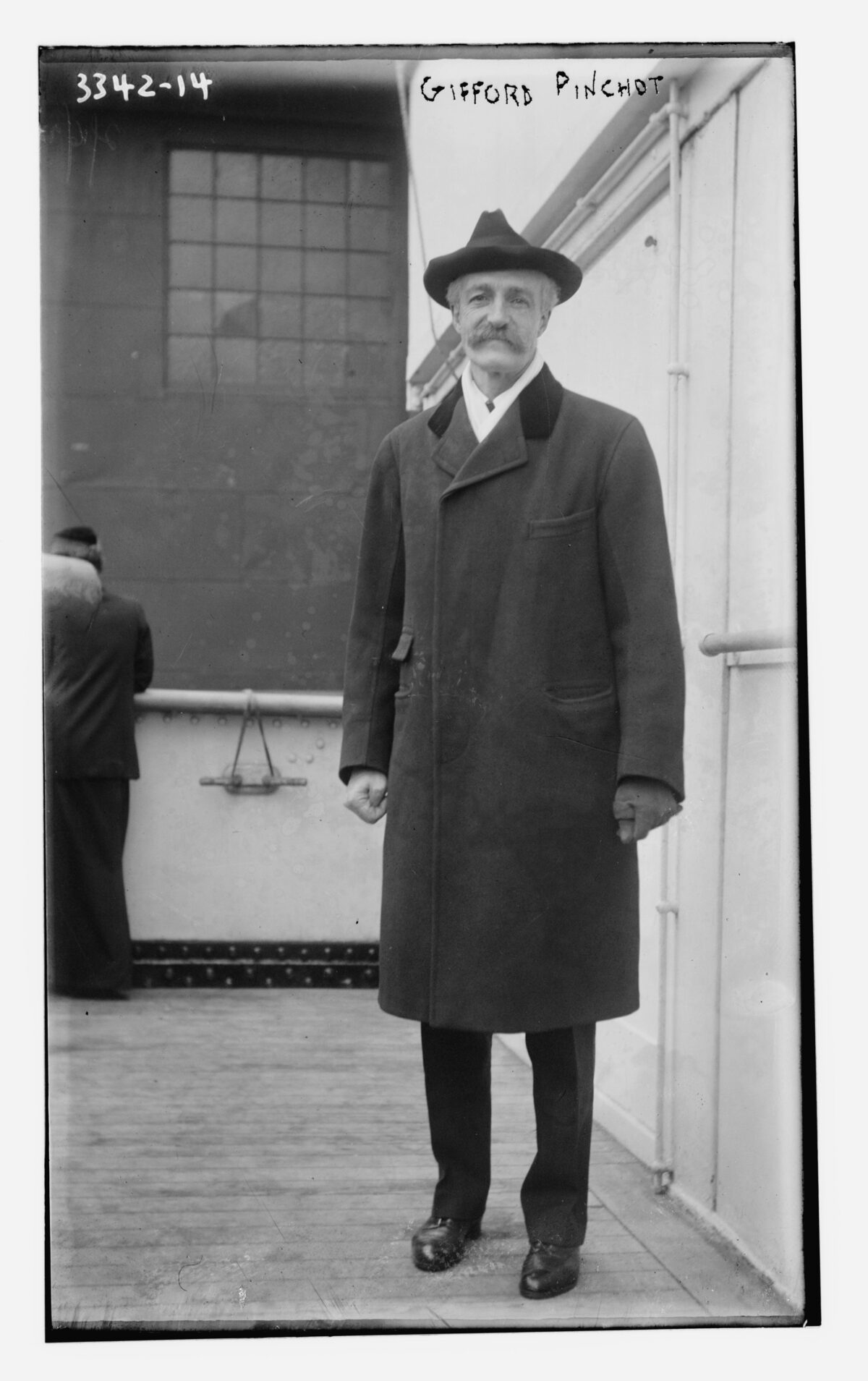
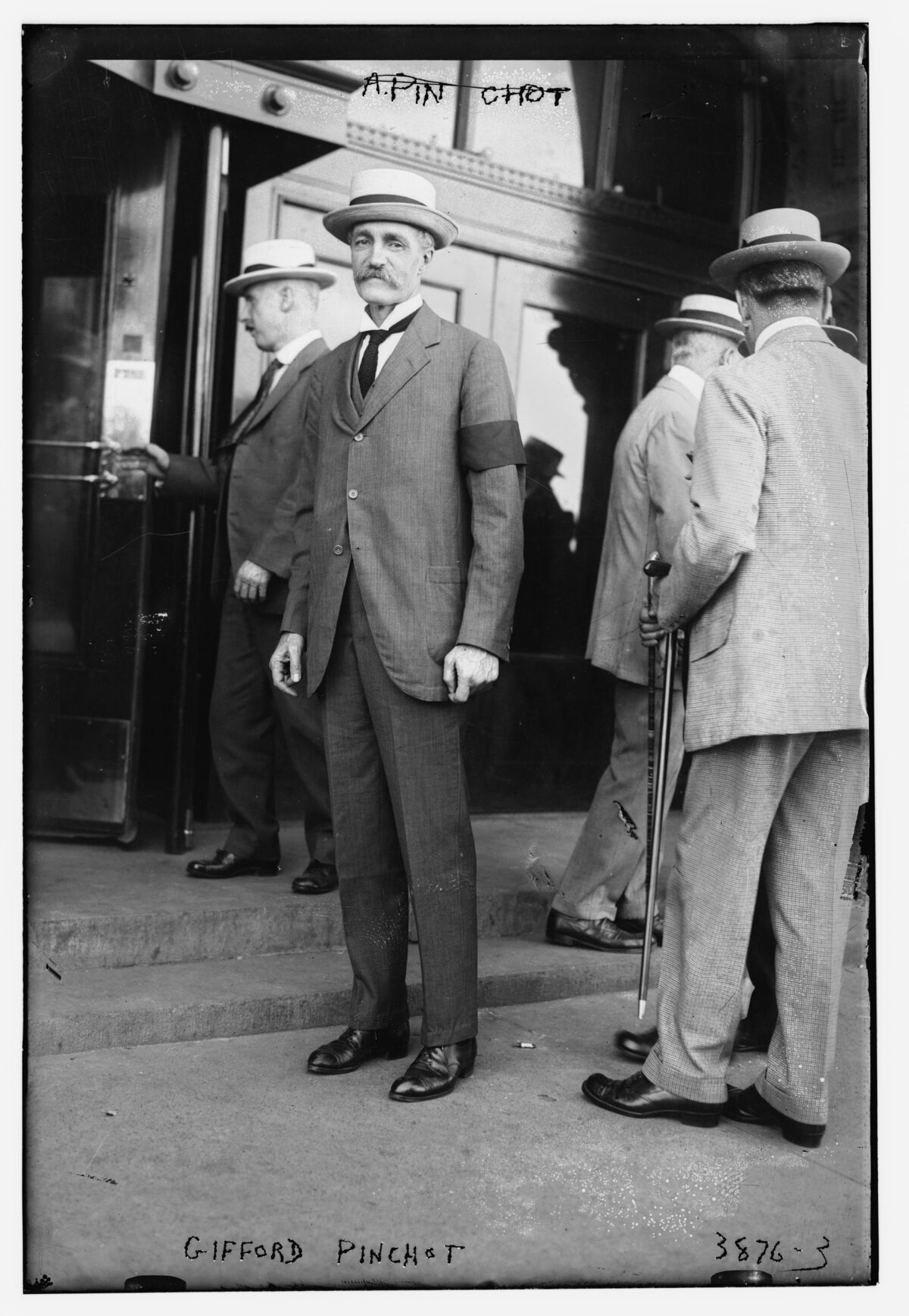
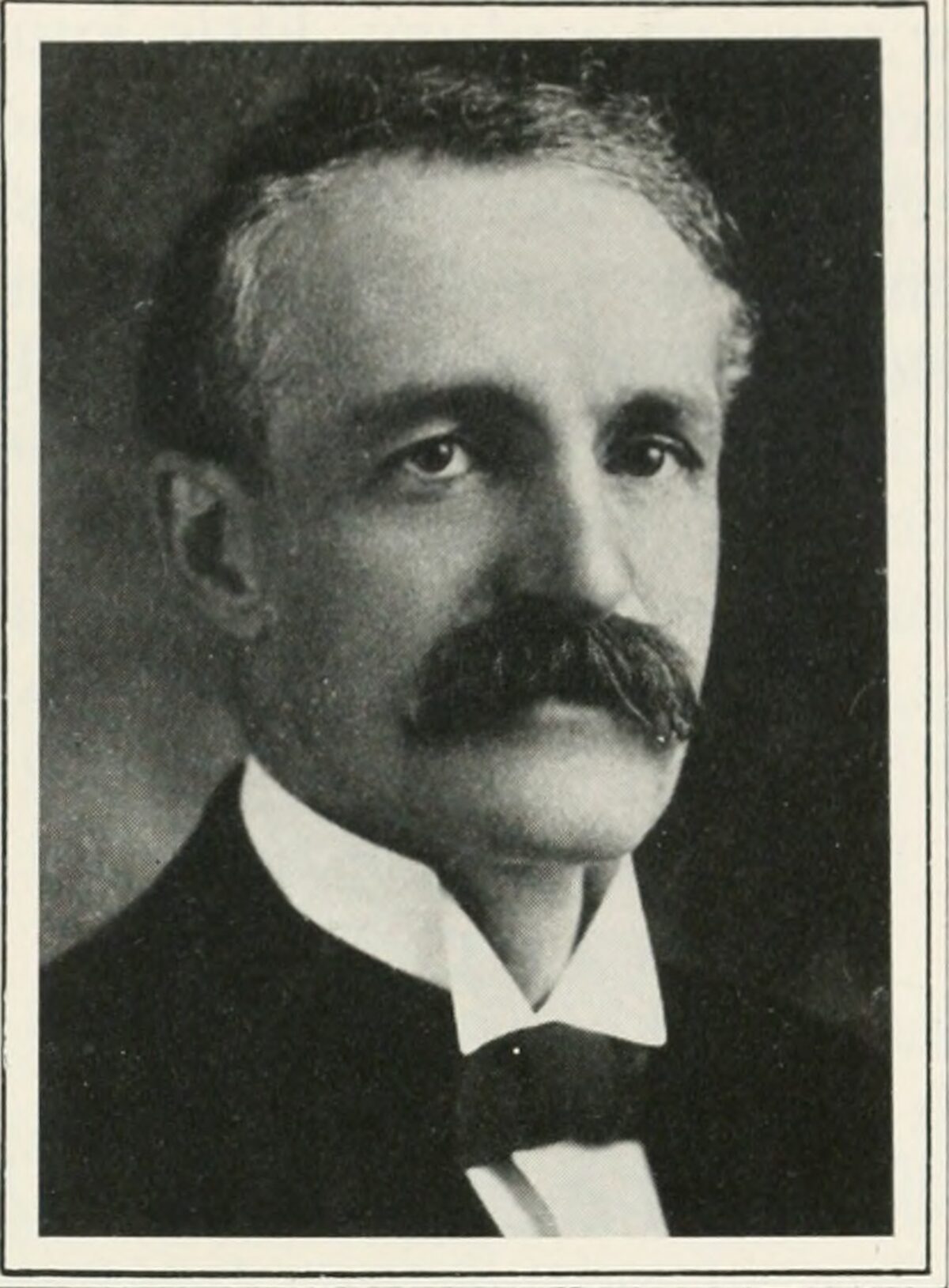
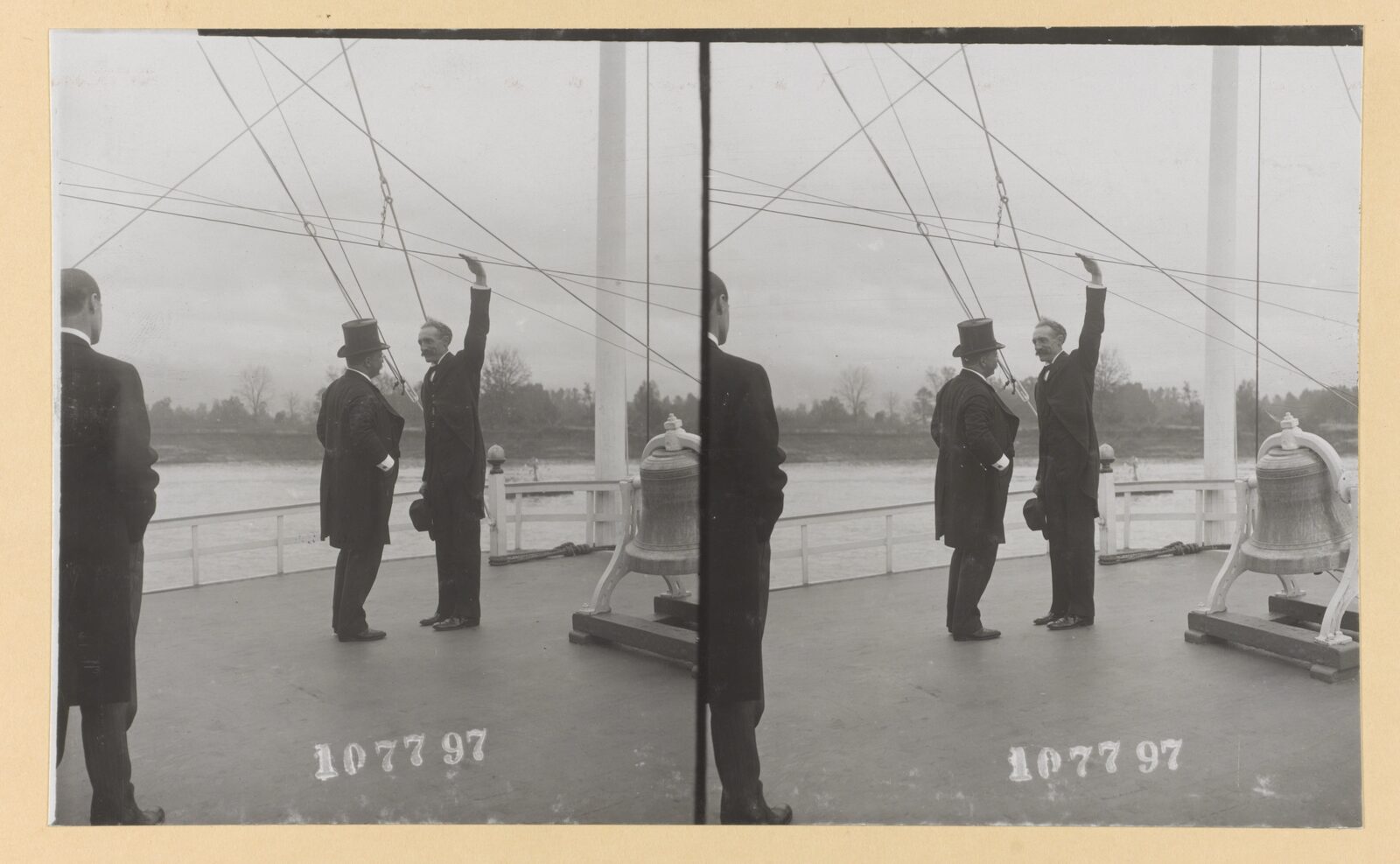
The School and the Student La Escuela y el Estudiante
In 1900, Gifford Pinchot used his parents' money to found the Yale School of Forestry. During its first four decades, the school graduated the first four chiefs of the U.S. Forest Service. In 1961, a Venezuelan citizen named Gerardo Budowski completed his doctorate at that same school. His dissertation, on how tropical forests recover after disturbance, became foundational work in the field. Budowski went on to direct CATIE's Natural Resources Department in Turrialba, Costa Rica, serve as IUCN Director General, coin the Spanish term "agroforestería," and publish the tourism-conservation framework that Costa Rica would make famous. At the 1972 Stockholm Conference, the international environmental gathering that Pinchot had spent thirty years trying to convene, Budowski represented the global conservation movement. En 1900, Gifford Pinchot usó el dinero de sus padres para fundar la Escuela de Silvicultura de Yale. Durante sus primeras cuatro décadas, la escuela graduó a los primeros cuatro jefes del Servicio Forestal de EE.UU. En 1961, un ciudadano venezolano llamado Gerardo Budowski completó su doctorado en esa misma escuela. Su disertación, sobre cómo los bosques tropicales se recuperan después de perturbaciones, se convirtió en trabajo fundacional en el campo. Budowski pasó a dirigir el Departamento de Recursos Naturales del CATIE en Turrialba, Costa Rica, servir como Director General de la UICN, acuñar el término en español "agroforestería," y publicar el marco de turismo y conservación que Costa Rica haría famoso. En la Conferencia de Estocolmo de 1972, la reunión ambiental internacional que Pinchot había pasado treinta años intentando convocar, Budowski representó al movimiento de conservación global.
Pinchot never visited Costa Rica. He never corresponded with a Costa Rican official. The closest he came was sailing past Isla del Coco in 1929, marveling at the fish. His connection to this country runs through institutions, not biography: the school he built trained the man who shaped Costa Rica's conservation thinking; his 1924 Pan American warning named the deforestation problem that Costa Rica's Ley Forestal would address; his institutional template of professional foresters, state-managed forests, and legal authority to prevent destruction is the template Costa Rica adapted and then surpassed. Pinchot nunca visitó Costa Rica. Nunca se correspondió con un funcionario costarricense. Lo más cerca que estuvo fue navegar frente a la Isla del Coco en 1929, maravillándose con los peces. Su conexión con este país corre a través de instituciones, no de biografía: la escuela que construyó formó al hombre que moldeó el pensamiento de conservación de Costa Rica; su advertencia panamericana de 1924 nombró el problema de deforestación que la Ley Forestal de Costa Rica abordaría; su plantilla institucional de silvicultores profesionales, bosques gestionados por el estado, y autoridad legal para prevenir la destrucción es la plantilla que Costa Rica adaptó y luego superó.
The modern environmental reassessment has shifted heroic status from Pinchot to Muir. As ecology-minded environmentalism grew, "those who saw nature in a broader light, who valued it for its spiritual and natural amenities and sought to preserve it in its wild state, enjoy the best legacy." The irony is that Pinchot, by the end of his life, was arguing much the same thing: that forests are complex communities, that foresters must maintain the balance of nature, that woodlands are beautiful and their value immeasurable. He did not arrive there first. But he arrived. La reevaluación ambiental moderna ha trasladado el estatus heroico de Pinchot a Muir. A medida que el ambientalismo orientado a la ecología creció, "aquellos que vieron la naturaleza bajo una luz más amplia, que la valoraron por sus amenidades espirituales y naturales y buscaron preservarla en su estado silvestre, disfrutan del mejor legado." La ironía es que Pinchot, al final de su vida, estaba argumentando prácticamente lo mismo: que los bosques son comunidades complejas, que los silvicultores deben mantener el equilibrio de la naturaleza, que los bosques son hermosos y su valor inmensurable. No llegó allí primero. Pero llegó.
Cornelia Pinchot, at the 1949 dedication of the Gifford Pinchot National Forest: he "insisted that conservation must be reinvigorated, revived, remanned, revitalized by each successive generation, its implications, its urgencies, its logistics translated in terms of the present of each of them." Cornelia Pinchot, en la dedicación de 1949 del Bosque Nacional Gifford Pinchot: él "insistía en que la conservación debe ser revigorizada, revivida, renovada, revitalizada por cada generación sucesiva, sus implicaciones, sus urgencias, su logística traducida en términos del presente de cada una de ellas."
Costa Rica translated it. In a language Pinchot never spoke, on soil he never walked, with tools he could not have imagined. Costa Rica la tradujo. En un idioma que Pinchot nunca habló, en suelo que nunca pisó, con herramientas que no habría podido imaginar.
Resources & Further Reading Recursos y Lecturas Adicionales
Primary Sources and Biographies Fuentes Primarias y Biografías
Biographical overview of Pinchot's career as first Chief of the U.S. Forest Service. Resumen biográfico de la carrera de Pinchot como primer Jefe del Servicio Forestal de EE.UU.
Detailed biographical portrait covering Pinchot's European training, Biltmore work, and Forest Service career. Retrato biográfico detallado cubriendo la formación europea de Pinchot, su trabajo en Biltmore y su carrera en el Servicio Forestal.
Miller's essay on the Pinchot family's roots in Milford, Pennsylvania, including the lumber fortune. Ensayo de Miller sobre las raíces de la familia Pinchot en Milford, Pensilvania, incluyendo la fortuna maderera.
Academic review of Miller's biography, which argues Pinchot evolved beyond the utilitarian caricature. Reseña académica de la biografía de Miller, que argumenta que Pinchot evolucionó más allá de la caricatura utilitaria.
Pinchot's own statement of his conservation philosophy, dedicated to "LH" (Laura Houghteling). La propia declaración de Pinchot de su filosofía de conservación, dedicada a "LH" (Laura Houghteling).
The Muir-Pinchot Relationship La Relación Muir-Pinchot
National Endowment for the Humanities account of the alliance and rupture between Muir and Pinchot. Relato del National Endowment for the Humanities sobre la alianza y ruptura entre Muir y Pinchot.
Academic analysis of the conservation vs. preservation philosophies embodied by Muir and Pinchot. Análisis académico de las filosofías de conservación vs. preservación encarnadas por Muir y Pinchot.
Review of Clayton's argument that Muir and Pinchot's rival approaches jointly yielded America's public lands system. Reseña del argumento de Clayton de que los enfoques rivales de Muir y Pinchot produjeron conjuntamente el sistema de tierras públicas de América.
International Conservation Vision Visión Internacional de Conservación
Account of the first international conservation conference, organized by Pinchot and Roosevelt. Relato de la primera conferencia internacional de conservación, organizada por Pinchot y Roosevelt.
Pinchot's thirty-year campaign to link conservation with international peace, from the 1909 conference to the 1949 UN gathering. La campaña de treinta años de Pinchot para vincular la conservación con la paz internacional, desde la conferencia de 1909 hasta la reunión de la ONU en 1949.
Conservation Philosophy and Criticism Filosofía de Conservación y Crítica
Academic critique framing Pinchot's efficiency obsession through Jacques Ellul's technological society framework. Crítica académica que enmarca la obsesión por la eficiencia de Pinchot a través del marco de la sociedad tecnológica de Jacques Ellul.
Pinchot's pocket-sized manual for Forest Service rangers explaining how national forests could be used. El manual de bolsillo de Pinchot para los guardabosques del Servicio Forestal explicando cómo podían usarse los bosques nacionales.
Pinchot's core maxim: "The greatest good to the greatest number for the longest time." La máxima central de Pinchot: "El mayor bien para el mayor número por el mayor tiempo."
Scholarly examination of the connections between the early conservation movement and eugenics, including Pinchot's involvement. Examen académico de las conexiones entre el movimiento de conservación temprano y la eugenesia, incluyendo la participación de Pinchot.
Personal Life Vida Personal
Scholarly account of Pinchot's spiritual relationship with Laura Houghteling after her death. Relato académico de la relación espiritual de Pinchot con Laura Houghteling después de su muerte.
Profile of Cornelia Bryce Pinchot's feminism and political activism. Perfil del feminismo y activismo político de Cornelia Bryce Pinchot.
Institutional Legacy Legado Institucional
History of the Yale School of Forestry, founded by Pinchot in 1900, which trained the first four U.S. Forest Service chiefs and Gerardo Budowski. Historia de la Escuela de Silvicultura de Yale, fundada por Pinchot en 1900, que formó a los primeros cuatro jefes del Servicio Forestal de EE.UU. y a Gerardo Budowski.
The Pinchot family estate in Milford, Pennsylvania, now administered by the U.S. Forest Service. La finca de la familia Pinchot en Milford, Pensilvania, ahora administrada por el Servicio Forestal de EE.UU.
Official account of Pinchot's two terms as Governor of Pennsylvania (1923-1927, 1931-1935). Relato oficial de los dos mandatos de Pinchot como Gobernador de Pensilvania (1923-1927, 1931-1935).