Yema de Huevo
Chimarrhis latifolia Standl. — A riparian giant of Costa Rica's Pacific lowlands, its cream-colored bark and egg-yolk yellow wood make it unmistakable along the forested streams of the Osa Peninsula.
In the wet lowland forests where streams carve through volcanic soils, a distinctive canopy tree rises on thin, blade-like buttresses. Chimarrhis latifolia, known locally as yema de huevo (egg yolk), takes its name from the remarkable color transformation of its freshly cut wood, which oxidizes from pale cream to an intense yellow-orange that recalls the center of a freshly cracked egg. But even before the axe reveals this hidden color, the tree announces itself through its striking bark: smooth and cream-yellow, marked with fine vertical striations that create an intertwining pattern of light and shadow visible from considerable distance through the forest understory.
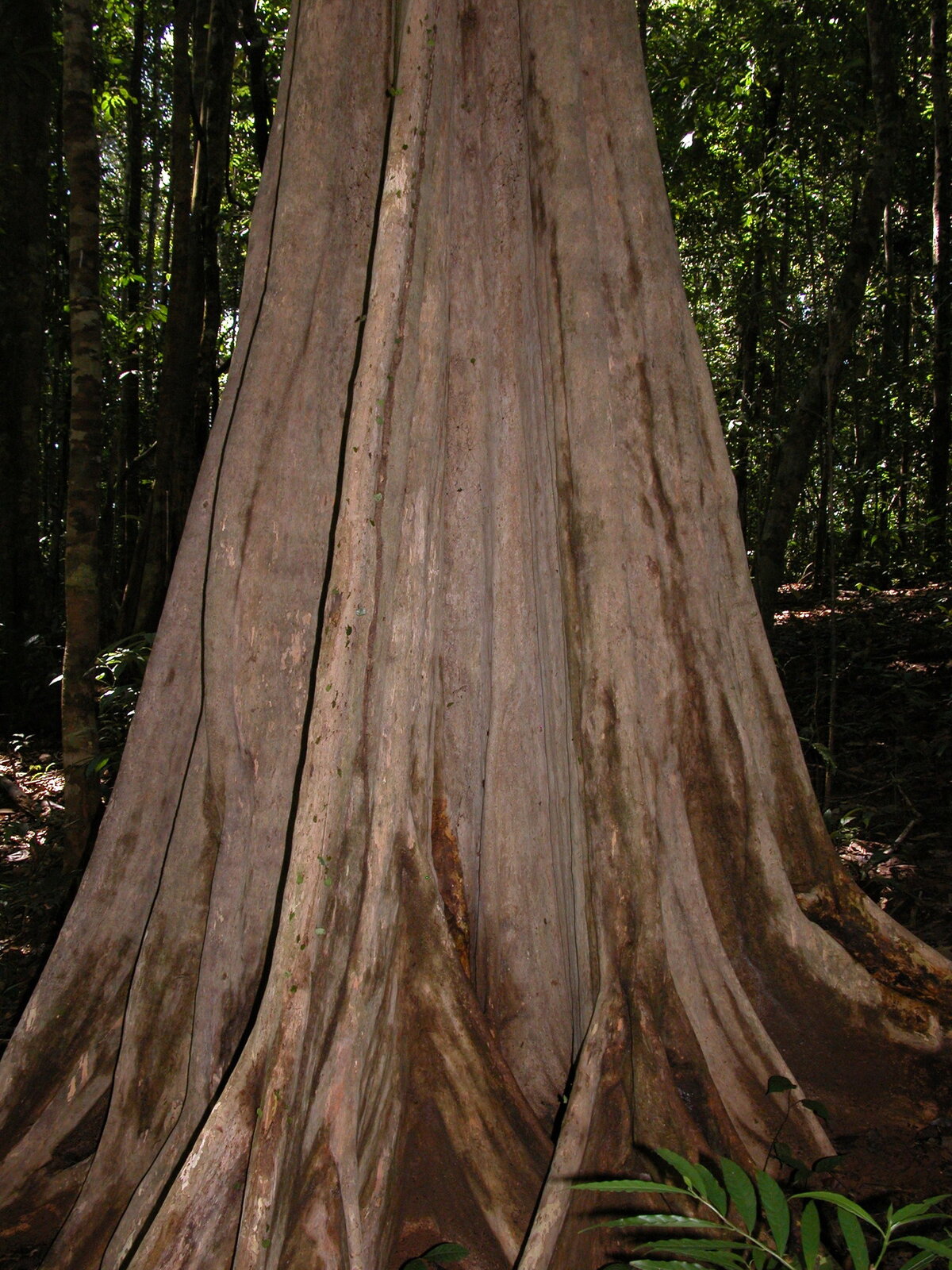
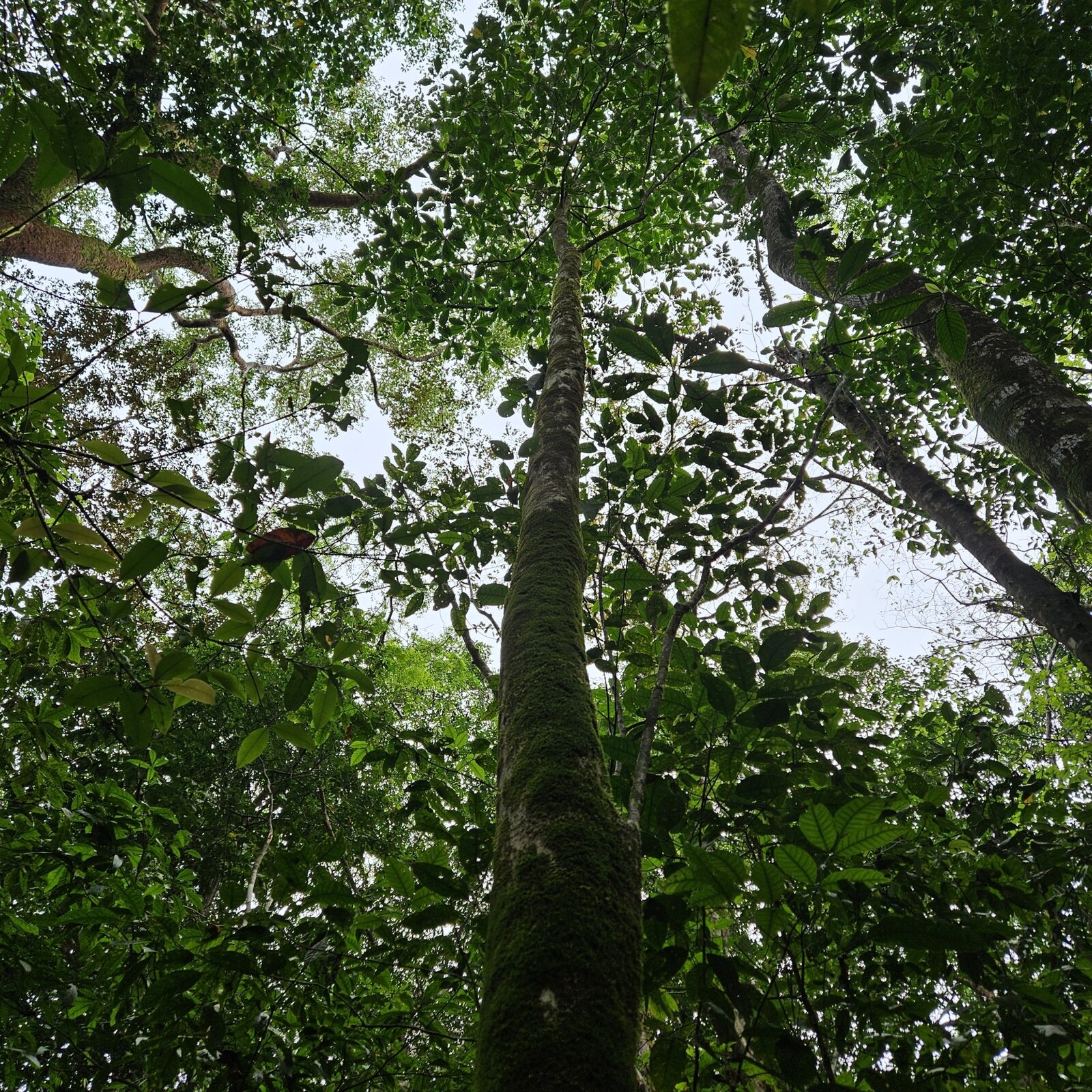
This is a tree of running water. The genus name Chimarrhis derives from the Greek cheimarros, meaning "winter torrent" or "flowing in winter," a reference to the seasonal streams along which these trees grow in their Caribbean and Central American range. In Costa Rica's Osa Peninsula and surrounding Brunca region, C. latifolia inhabits the poorly drained valleys and stream banks of the humid Pacific lowlands, where year-round rainfall keeps the soil perpetually moist. Here, among the most biodiverse forests on Earth, this member of the coffee family (Rubiaceae) reaches heights of 25 to 30 meters, emerging into the canopy on columnar trunks that often exceed one meter in diameter.
Identification
Trunk and Bark
The bark is the most diagnostic feature for field identification. It is tan to cream-yellow with fine vertical striations that create an intertwining pattern of lighter and darker shades. This distinctive coloration is visible from a distance and sets the species apart from other canopy trees in its habitat. The trunk is columnar but frequently irregular and angular in cross-section. Distinctive long, thin, straight buttresses extend up to 2 meters high and 1 meter outward from the base of larger individuals, resembling thin blades or fins radiating from the trunk.
Leaves
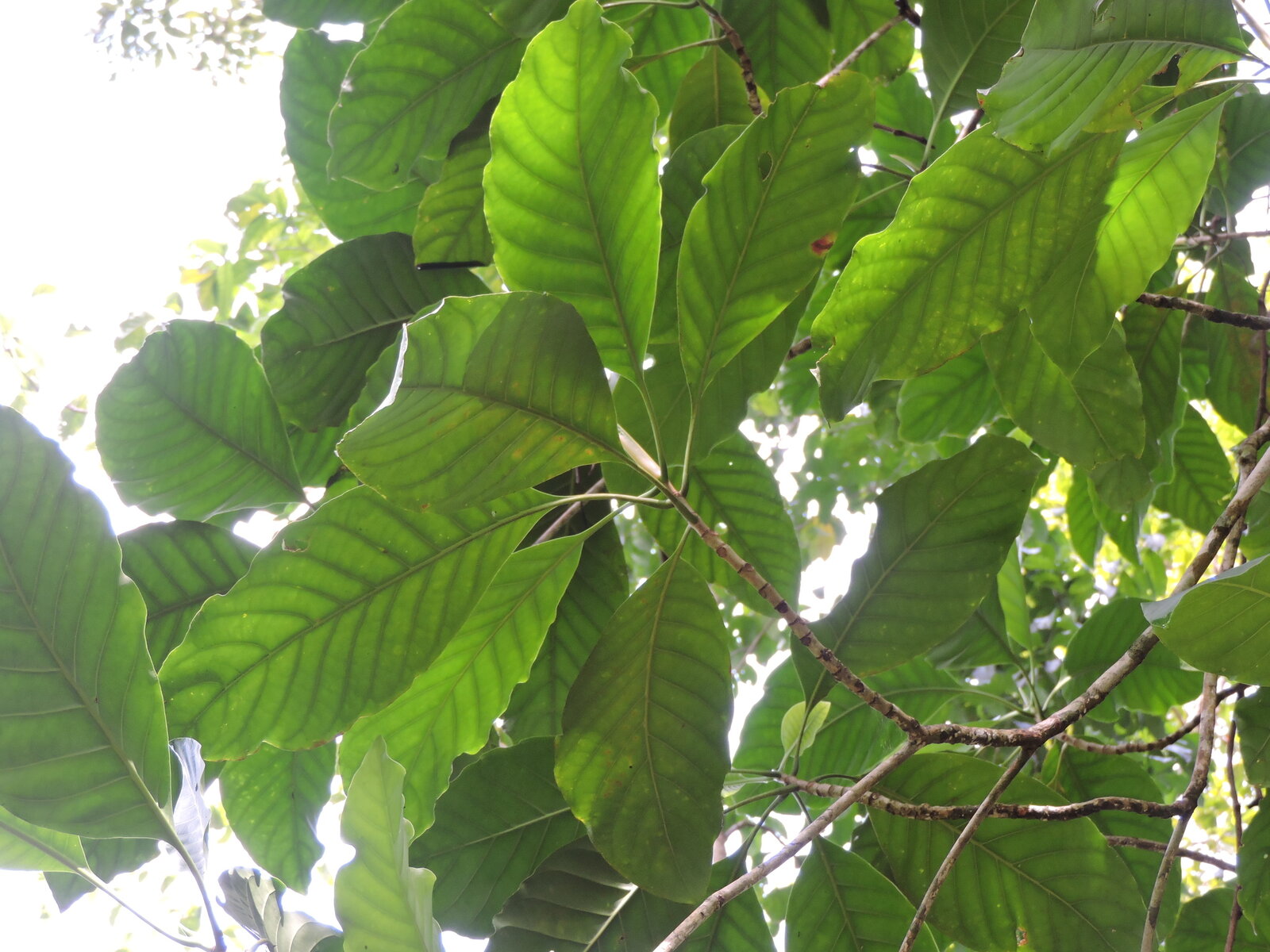
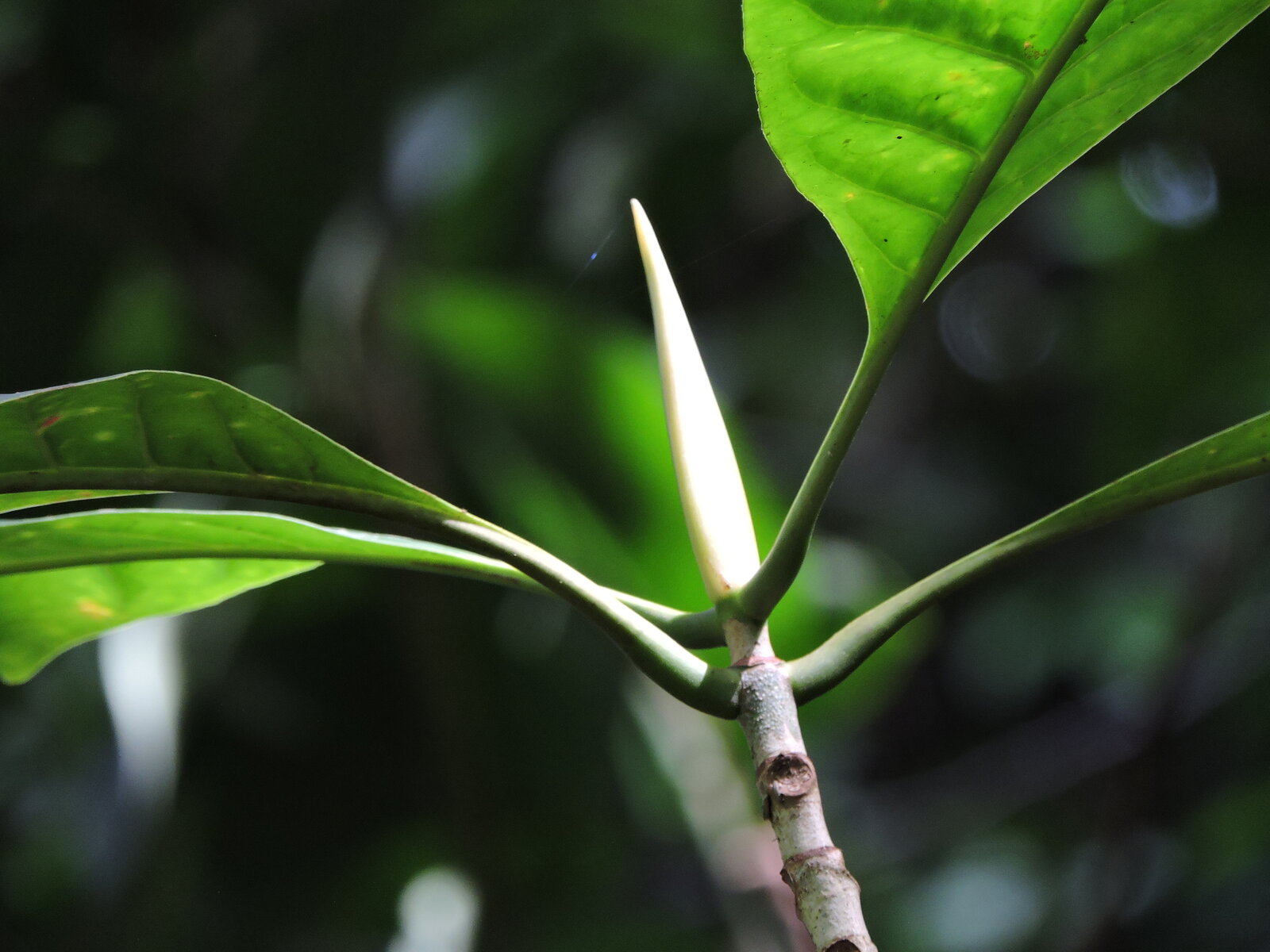
The leaves are simple and opposite, arranged in pairs along the branches as is typical of the Rubiaceae family. Each leaf is broadly elliptical, approximately 14 cm long by 6 cm wide, with a notably long petiole. The glossy blades display a bright yellow-green color with conspicuous white or pale venation. The species epithet latifolia, meaning "broad-leaved" in Latin, refers to this characteristic. Between each pair of leaves, a prominent interpetiolar stipule (a small leaf-like structure typical of Rubiaceae) projects from the node, providing another useful identification character.
Flowers
The flowers appear in large, dense terminal panicles during late October through November. Individual flowers are small (approximately 8 mm), pale white, with a narrow white corolla tube and a sweet fragrance. This timing places the flowering peak during the heart of Costa Rica's wet season, when pollinators are abundant. The fragrant white flowers attract bees and other insects as pollinators.
Fruits
The fruits are tiny capsules approximately 2 mm in diameter that ripen from January through April. When dry, the capsules open to release minute seeds that are dispersed by wind (anemochory). Related species in the genus have documented winged seeds, suggesting similar morphology in C. latifolia. This wind-dispersal strategy is well suited to riparian habitats, where seeds may travel along stream corridors to colonize suitable sites downstream.
Wood
The wood is heavy and hard, yellowish when fresh but rapidly oxidizing to an intense yellow-orange color upon exposure to air. This dramatic color change, reminiscent of an egg yolk, gives the tree its common name. The wood has been used locally for flooring, framing, and general construction where its hardness and durability are valued. Related Caribbean species (Chimarrhis cymosa) have similar timber properties including moderate hardness, fair elasticity, and resistance to termites.
Distribution
Chimarrhis latifolia has a restricted distribution endemic to the humid Pacific lowlands from southwestern Costa Rica to western Panama. In Costa Rica, it occurs primarily in the Osa Peninsula, Manuel Antonio National Park, Carara National Park, and the broader Zona Sur region. The species is recorded from sea level to approximately 200 meters elevation, with one outlier record at 946 meters in Perez Zeledon suggesting occasional occurrence at higher elevations.
GBIF records document 157 occurrences of this species, with 145 from Costa Rica and the remainder from Panama. A small number of records from Colombia (Caldas department) may represent a significant range extension if confirmed, or possibly misidentifications requiring verification. Within Costa Rica's Brunca region, the species is an occasional but distinctive component of lowland wet forest, most easily found along stream corridors where its preferred riparian habitat occurs.
Ecology
This species is strictly associated with riparian habitats, growing along stream banks and in poorly drained valley bottoms. It avoids the drier hillside forests and coastal habitats that characterize much of its geographic range. This habitat specificity explains both its local abundance along suitable watercourses and its relative rarity across the broader landscape. In the Osa Peninsula, where annual rainfall exceeds 5,000 mm in some areas, C. latifolia finds optimal conditions in the waterlogged soils of forest streams.
The fragrant white flowers attract bees and other insects as pollinators during the wet season flowering period from September through November. Wind dispersal of the tiny seeds allows the species to colonize new sites along stream corridors. As a canopy tree reaching 25-30 meters, C. latifolia provides habitat structure for epiphytes and nesting sites for birds, while its flowers and fruits contribute to the food web of the diverse riparian forest community.
Taxonomic History
Chimarrhis latifolia was described by Paul Carpenter Standley and published in Publications of the Field Museum of Natural History, Botanical Series on October 24, 1929. The holotype specimen (Cooper & Slater 260, collected in fruit during July-August 1927) is deposited at the Field Museum in Chicago, with duplicate specimens (isotypes) at the US National Herbarium and the University of Wisconsin. The type locality is Progreso in Chiriqui Province, Panama.
Standley (1884-1963) was an American botanist who specialized in neotropical plants, working at the US National Museum and later the Field Museum of Natural History. He authored major floristic works including the Flora of Costa Rica (1937) and Flora of Guatemala. Three genera have been named in his honor. The genus Chimarrhis was established by Nikolaus Joseph von Jacquin in 1763 and contains approximately 15 accepted species distributed across Central America, South America, and the West Indies. Modern molecular studies place Chimarrhis in tribe Condamineae within the subfamily Ixoroideae of Rubiaceae.
Conservation Outlook
Chimarrhis latifolia was assessed as Least Concern by the IUCN Red List in 2018. Despite its restricted geographic range, the species appears to maintain stable populations within its riparian habitat. In Costa Rica, significant portions of its range fall within protected areas including Corcovado National Park, Piedras Blancas National Park, and the Golfo Dulce Forest Reserve on the Osa Peninsula, as well as Manuel Antonio and Carara National Parks further north along the Pacific coast.
The species' association with riparian habitats provides some natural protection, as stream corridors are often maintained as forest buffers even in otherwise agricultural landscapes. However, ongoing deforestation in unprotected areas of southwestern Costa Rica and western Panama continues to reduce available habitat. The species' limited elevation range (primarily below 200 m) and habitat specificity make it potentially vulnerable to climate change impacts on lowland stream ecosystems.
Resources & Further Reading
Species Information
Detailed species account with identification features for Costa Rica's Pacific slope.
Species profile from the Osa Peninsula's botanical collection.
Global distribution records and specimen data from herbarium collections.
Taxonomy & Nomenclature
Type specimen information and nomenclatural details from Missouri Botanical Garden.
Genus-level taxonomy and accepted species list from Kew Science.
Conservation
Taxonomic classification and IUCN Red List status reference.