Welfia regia (Palmito)
Welfia regia — The amargo palm dominates the wet forests of Costa Rica's Golfo Dulce region, its dramatic red new leaves unfurling like flames against the green canopy. Though its heart of palm was once prized, harvesting it kills the tree.
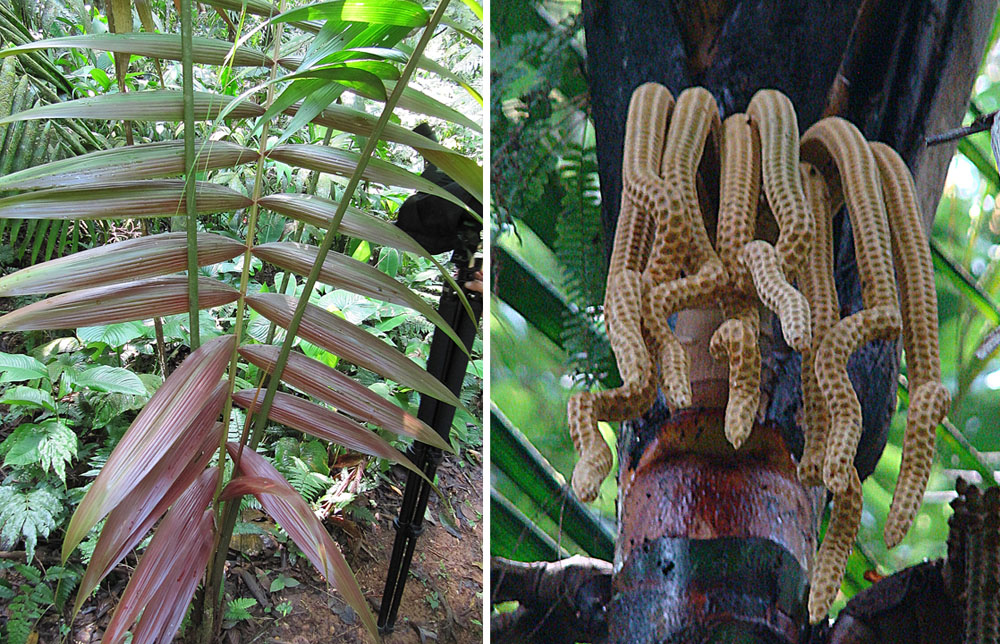
In the lowland rainforests of the Osa Peninsula, one palm stands out for the striking color of its emerging leaves. Where most palms unfurl pale green or yellow fronds, Welfia regia produces new leaves in shades of deep red and burgundy, earning it the nickname "Rastafarian Palm" for the way its developing leaf segments hang like dreadlocks from the crown. This dramatic display is not merely ornamental. It represents the tree's strategy for surviving in the dim understory while racing toward canopy light.
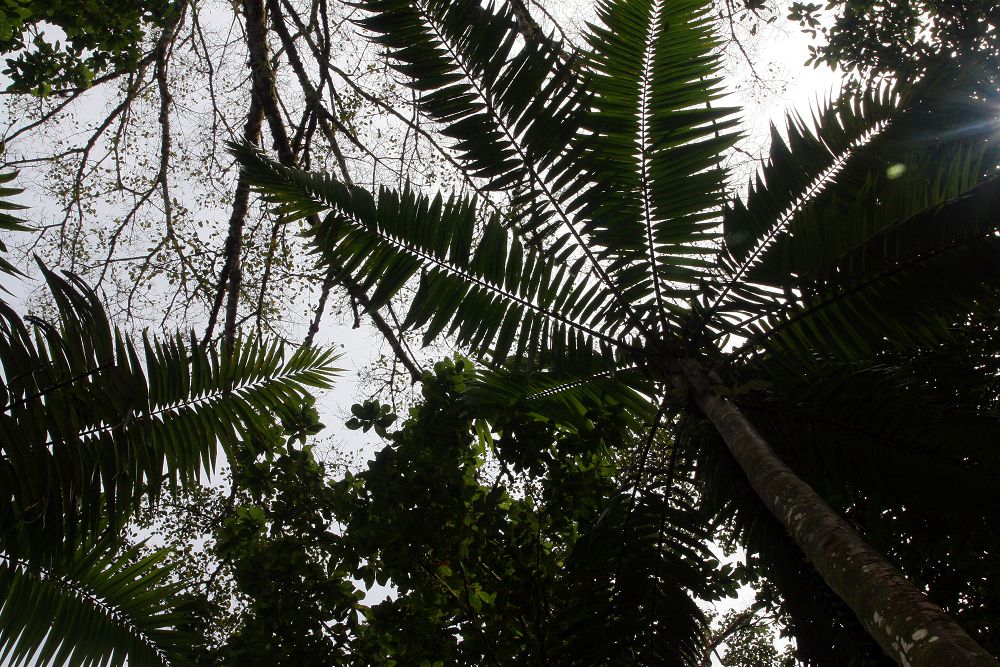
Welfia regia is the sole species in its genus found outside Peru, making it botanically distinctive as well as visually striking. In the wet forests of the Brunca region, it can reach densities of over 50 adult trees per hectare, forming a significant component of the forest structure. The species is particularly abundant in the Golfo Dulce lowlands and Corcovado National Park, where its tall, slender trunks rise 12 to 25 meters into the canopy.
Identification
The genus Welfia belongs to the palm family Arecaceae and contains only two recognized species: Welfia regia, which ranges from Honduras to Ecuador, and Welfia alfredii, restricted to a small area of central Peru. This makes Welfia a nearly monotypic genus in Central America, with W. regia as the sole representative throughout its extensive range.
Physical Characteristics
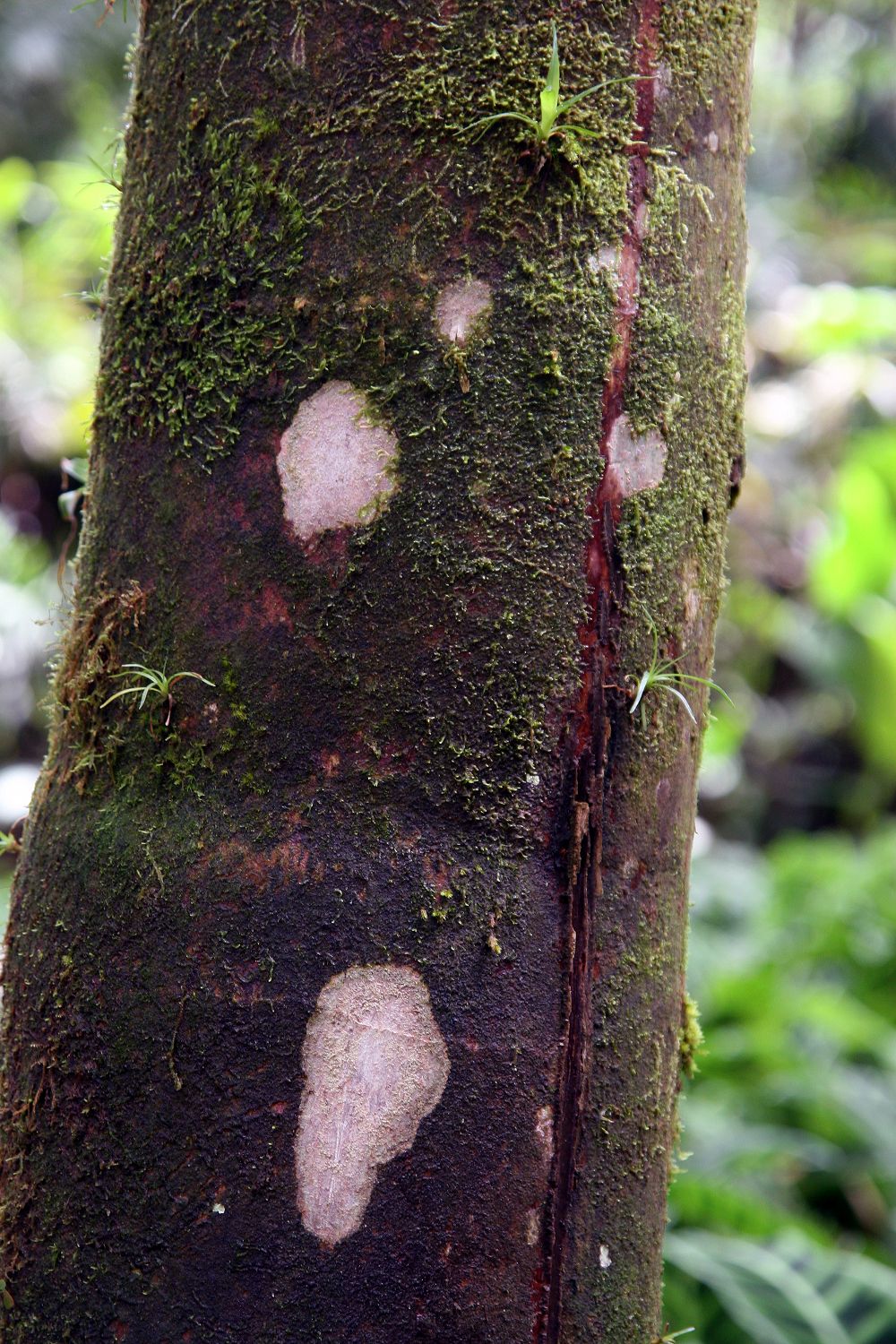
Trunk: Single-stemmed, unbranched, reaching 12-25 meters in height with a diameter of 10-15 cm. The trunk displays a distinctive reddish-brown color and is marked by numerous ring-like leaf scars where old fronds have fallen. Research on stem mechanics shows that Welfia regia achieves height through a growth strategy different from stilt-rooted palms. Rather than using aerial roots for support like the walking palm, it develops denser stem tissue toward the base and periphery, increasing strength as the tree grows taller.
Leaves: The crown bears 10-30 massive pinnate fronds, each reaching 3-6 meters in length. The most distinctive feature is the color of emerging leaves, which unfurl in shades of deep red, burgundy, and pink before gradually maturing to green. As the new leaves develop, their pinnae hang loosely in a manner that has earned the tree its nickname "Rastafarian Palm." Mature fronds form a shuttlecock-like crown at the top of the trunk.
Flowers and fruit: The branched inflorescence emerges below the crown, bearing yellowish-white flowers that are pollinated by both beetles and bees. The oval fruits ripen to a reddish-brown color and are consumed by birds and mammals, which disperse the seeds through the forest.
Habitat & Distribution
Welfia regia ranges from Honduras through Central America to Colombia and Ecuador, inhabiting wet lowland and montane rainforests at elevations from sea level to 1,500 meters. In Costa Rica, the species occurs on both the Caribbean slope and the Pacific lowlands of the south, with two distinct populations. The northern population extends from southeastern Nicaragua through the Caribbean lowlands to the central mountain ranges. The southern population centers on the Golfo Dulce region and Osa Peninsula, occurring at elevations of 100-350 meters.
The palm typically grows as a sub-canopy tree on slopes and ridges in areas of high rainfall. At La Selva Biological Station in northeastern Costa Rica, researchers documented densities of 54 adult trees per hectare, making it one of the more abundant palm species in mature wet forest. In the Brunca region, it is a characteristic element of the lowland rainforest that once covered the Golfo Dulce coastline and still dominates Corcovado National Park.
Ecology
Welfia regia plays multiple ecological roles in the wet forest ecosystem. Its flowers attract beetles and bees as pollinators, continuing a relationship between palms and beetles that dates back millions of years. Studies of palm pollination systems show that approximately 52% of palm species are beetle-pollinated, with palms representing one of the plant families where this ancient pollination strategy remains dominant.
The reddish-brown fruits provide food for forest birds and mammals, which serve as seed dispersers. The tall trunks also provide habitat for epiphytes. Research at La Selva Biological Station found that the epiphytic fern Trichomanes godmanii occurs more frequently and abundantly on Welfia trunks than on dicotyledonous trees, representing one of the few documented cases of host-specific preference among epiphytic ferns.
The Palmito: Heart of Palm
The name "palmito" refers to the edible apical bud, or heart of palm, that lies at the growing tip of the trunk. In Welfia regia, this heart has been described as sweet and edible, making the species a traditional source of this delicacy throughout its range. However, harvesting the palmito comes at a fatal cost: unlike some palms that can regenerate from lateral shoots, Welfia regia has only a single growing point. Cutting out the heart kills the tree.
This unsustainable dynamic led to overharvesting pressure on wild Welfia populations throughout Central America. The solution has come from a different palm entirely: the peach palm (Bactris gasipaes), which produces up to 40 stems per plant through vegetative reproduction. By harvesting stems from the edges of the clump while leaving the center to regenerate, peach palm plantations can produce heart of palm sustainably without killing the plant. This shift toward cultivated sources has reduced pressure on wild populations of Welfia and other single-stemmed palms.
Traditional Uses
Beyond the palmito, Welfia regia has provided materials for traditional construction throughout its range. The large leaves serve as excellent thatching material, creating roofs that can last several years before requiring replacement. The trunk, once harvested, has been used as structural pillars in traditional houses. In coastal areas, the wood's resistance to saltwater rot made it particularly valuable for construction near the sea.
Conservation Status
Welfia regia has not been formally evaluated by the IUCN, but the species remains locally common within protected areas of Costa Rica. Corcovado National Park, which protects the largest remaining tract of Pacific lowland wet forest in Mesoamerica, harbors significant populations. The shift away from wild harvest of palmito toward cultivated peach palm has also reduced one major threat to the species.
The primary conservation concern for Welfia regia is habitat loss. As a species of mature wet forest, it depends on the continued protection of lowland rainforest habitat. Outside protected areas, deforestation for agriculture and development has eliminated much of the palm's former range in Costa Rica. Within the Brunca region, the conservation of Corcovado and the Golfo Dulce Forest Reserve ensures that substantial populations will persist, but maintaining connectivity between protected areas remains important for the long-term viability of forest-dependent species like this palm.
Key Sources & Resources
Species Information
Overview of the genus including distribution, taxonomy, and basic characteristics.
Community observations and photographs from across Costa Rica.
Comprehensive information on uses, habitat, and cultivation.
Scientific Literature
Taxonomic revision of the genus recognizing two species.
Research on stem mechanics and growth strategy comparing Welfia to stilt-rooted palms.
Study documenting host-specific epiphyte preference for Welfia trunks.
Palm Ecology
Comprehensive review of palm pollination including beetle pollination prevalence.
Heart of Palm
Overview of heart of palm harvest and sustainability concerns.