Mountain Poinsettia
A scarlet-bracted tree whose crimson inflorescences drape through the wet forests of the Neotropics. The national flower of Trinidad and Tobago, named for a Polish exile who collected orchids across Central America.
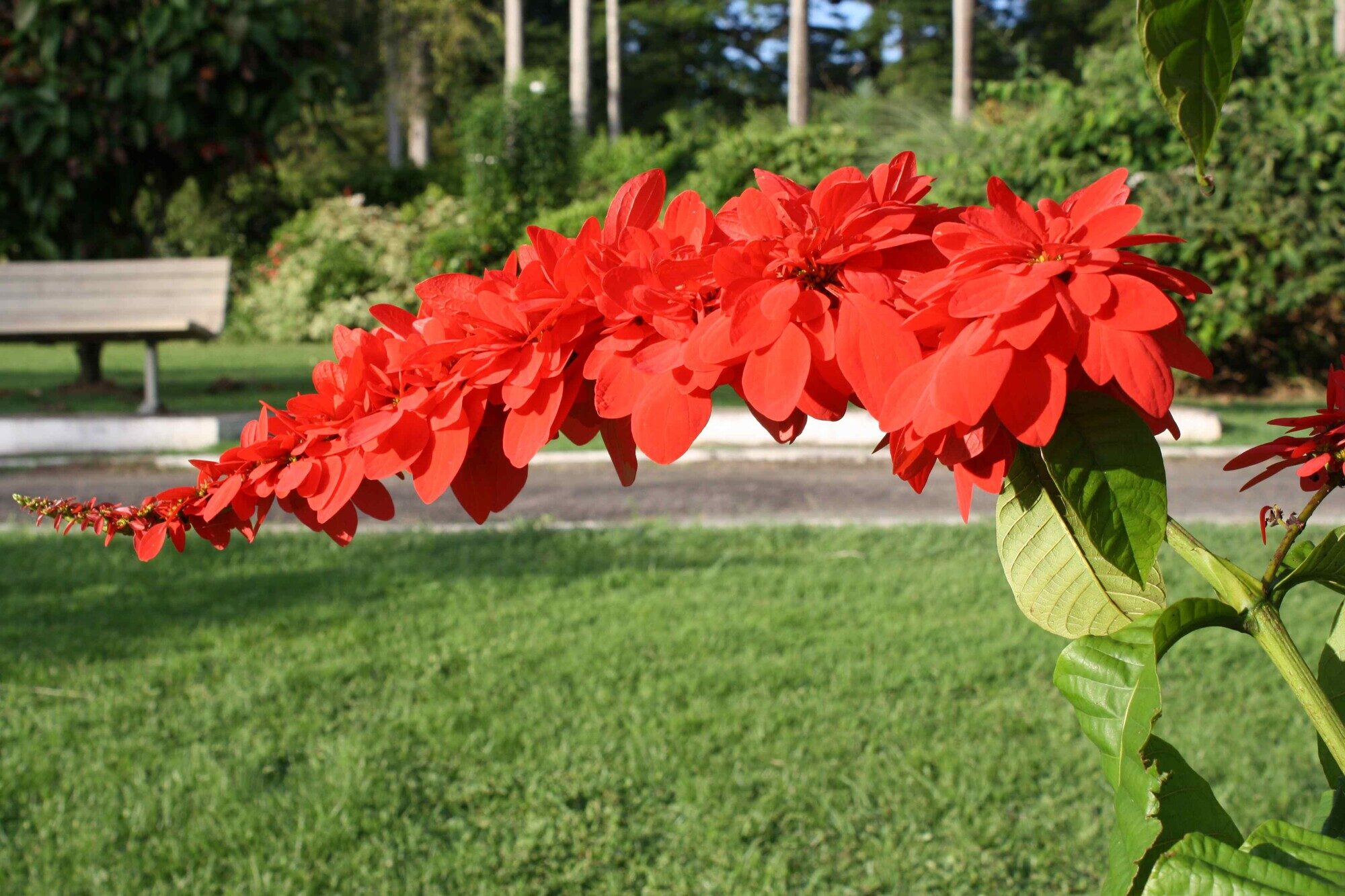
In 1957, a naturalist named David Auyong scrambled down a near-vertical cliff along the Blanchisseuse road in Trinidad's Northern Range to reach something he had spotted from above: a single specimen of Warszewiczia coccinea bearing an abnormal inflorescence, a double row of brilliant crimson bracts instead of the usual single row. With the help of Grace Mulloon, who had first noticed the plant, Auyong took cuttings and brought them to Roy Nichols, a plant physiologist at the Imperial College of Tropical Agriculture. Of the three plants they rooted in sand medium, only one survived to maturity. Every double chaconia in the world today descends from that individual. The original wild plant was destroyed shortly afterward when the road was widened.
In Trinidad and Tobago, W. coccinea is the national flower, chosen because it blooms around August 31, the nation's Independence Day. They call it "chaconia," after Don Jose Maria Chacon, the last Spanish Governor of Trinidad, who served from 1783 to 1797 and is credited with significant improvements to the island's capital, Port of Spain. In Costa Rica, the same tree goes by "pastora de montana," mountain poinsettia, and "bandera," flag. It grows as a shrub or small tree in the understory of wet lowland forests from Nicaragua to Bolivia, where its racemiform inflorescences, each bearing a single brilliant crimson calyx lobe per flower cluster, make it one of the most immediately recognizable plants in the Neotropical flora. "This is one of Costa Rica's most showy trees," wrote William Burger and Charlotte Taylor in the Flora Costaricensis treatment of Rubiaceae, "but it is not common."
Identification
Habit
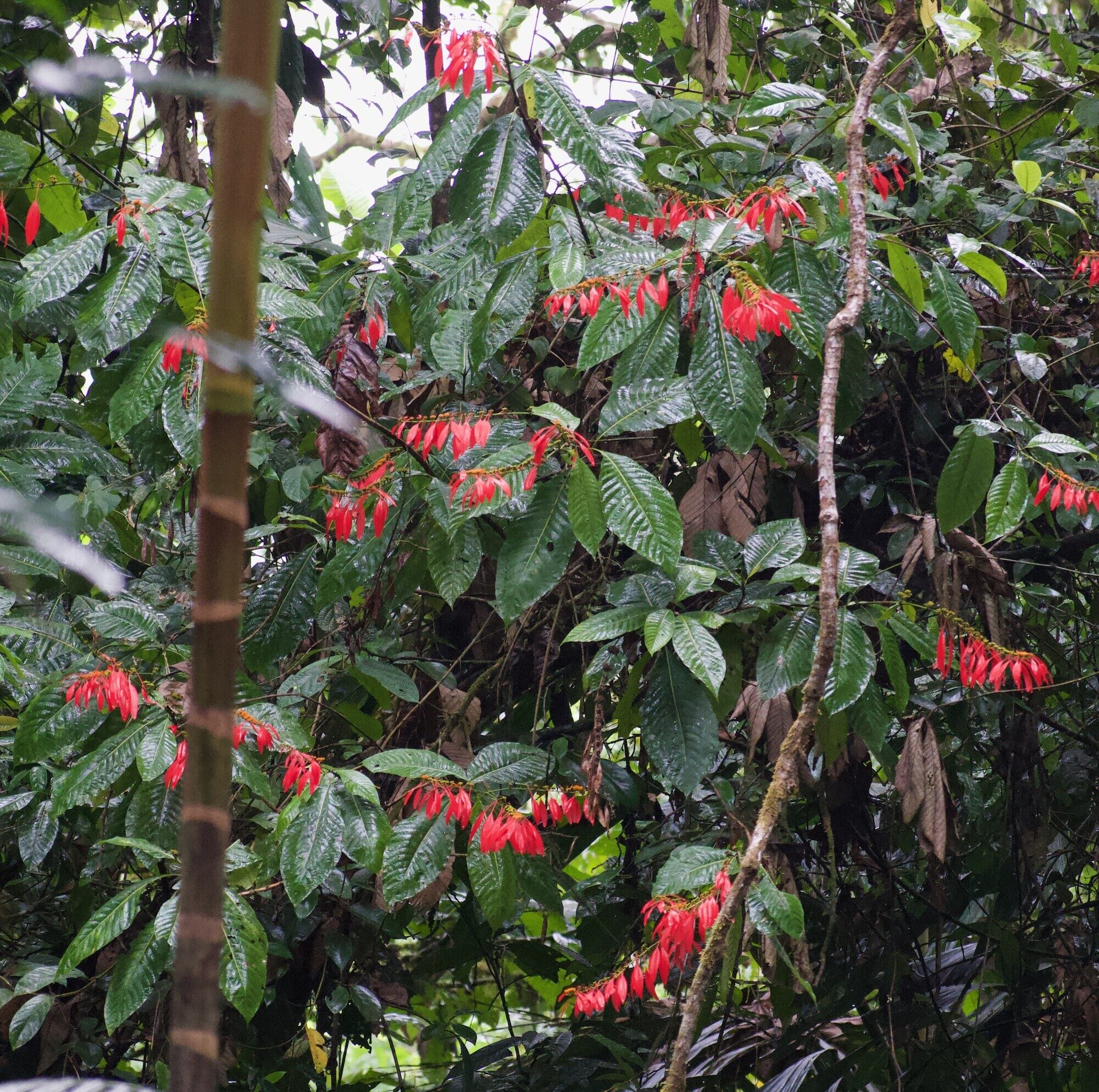
Warszewiczia coccinea grows as a shrub or small tree, typically reaching 2 to 10 meters in height and occasionally extending to 15 meters. The crown is irregular and sparse, carried on a crooked trunk with a diameter of 15 to 25 cm. Leafy branches are 3.5 to 12 mm thick, flattened when young and becoming cylindrical (terete) with age, covered in minute appressed hairs that wear away over time. The bark is irregular, blotched light brown and white. The species is a light-demanding gap colonizer, growing in forest light gaps, along forest edges, and in secondary growth. In mature forest it occupies the understory to midstory, but it thrives where canopy openings allow light to reach the lower strata.
Leaves
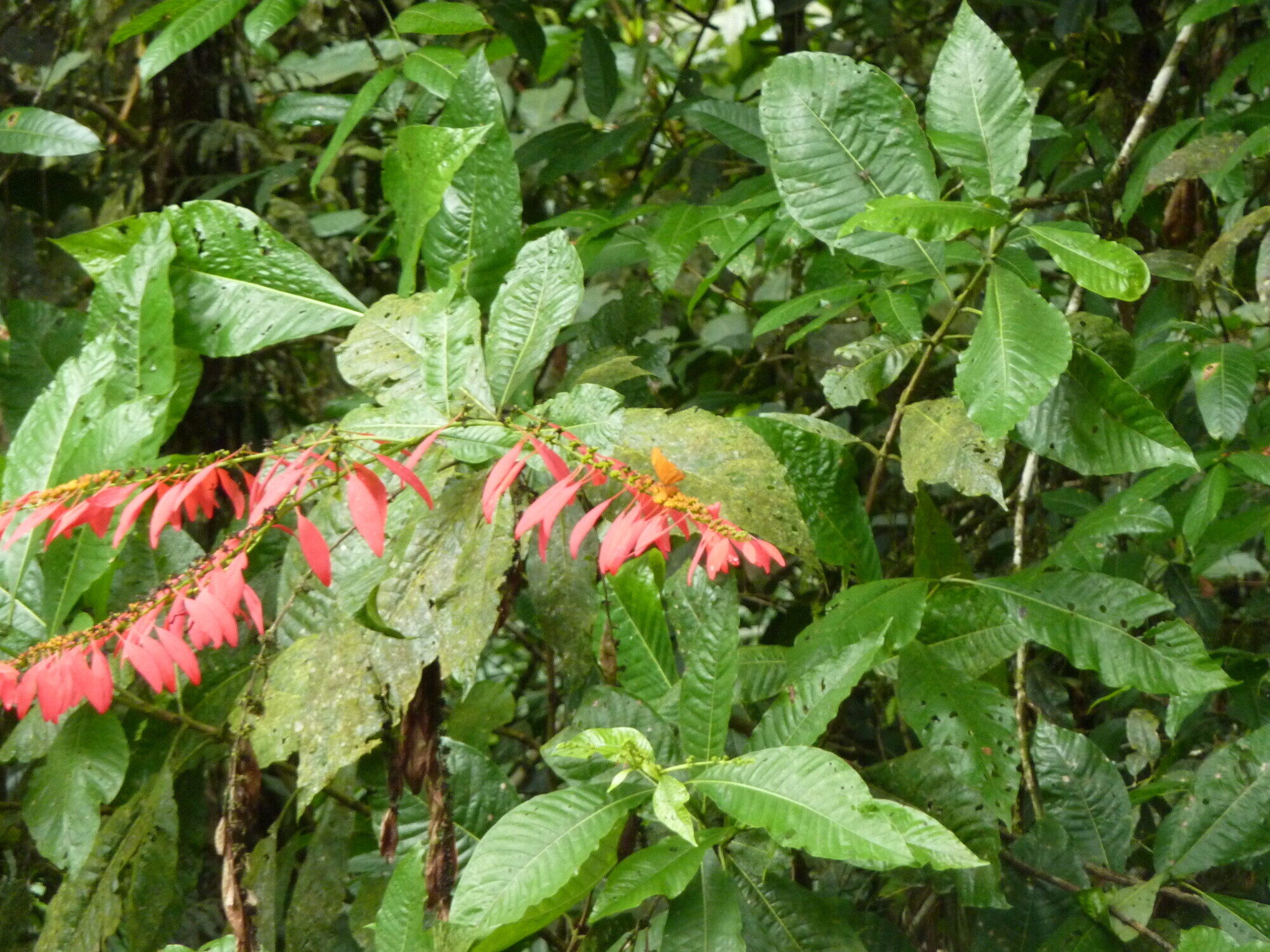
The leaves are among the largest in the Costa Rican Rubiaceae: blades measure (15-)20-36(-60) cm long and 7-15(-23) cm broad, elliptic to elliptic-oblong or elliptic-obovate, with the apex obtuse to acuminate and the base gradually narrowed, slightly decurrent (running down) onto the petiole. They are arranged opposite and decussate (in alternating pairs at right angles), or sometimes in whorls of three. The petioles are (5-)12-25(-50) mm long, covered in minute appressed hairs. The upper leaf surface is glabrous (hairless) and slightly lustrous, while the lower surface bears short (0.3 mm) thin appressed hairs, with golden hairs visible on the veins beneath. Secondary veins number 13-20 per side, arching toward the margin. Between the petioles, large interpetiolar stipules 1-4 cm long, narrowly triangular, bear glandular colleters (small secretory structures) at their base.
Flowers and Inflorescence
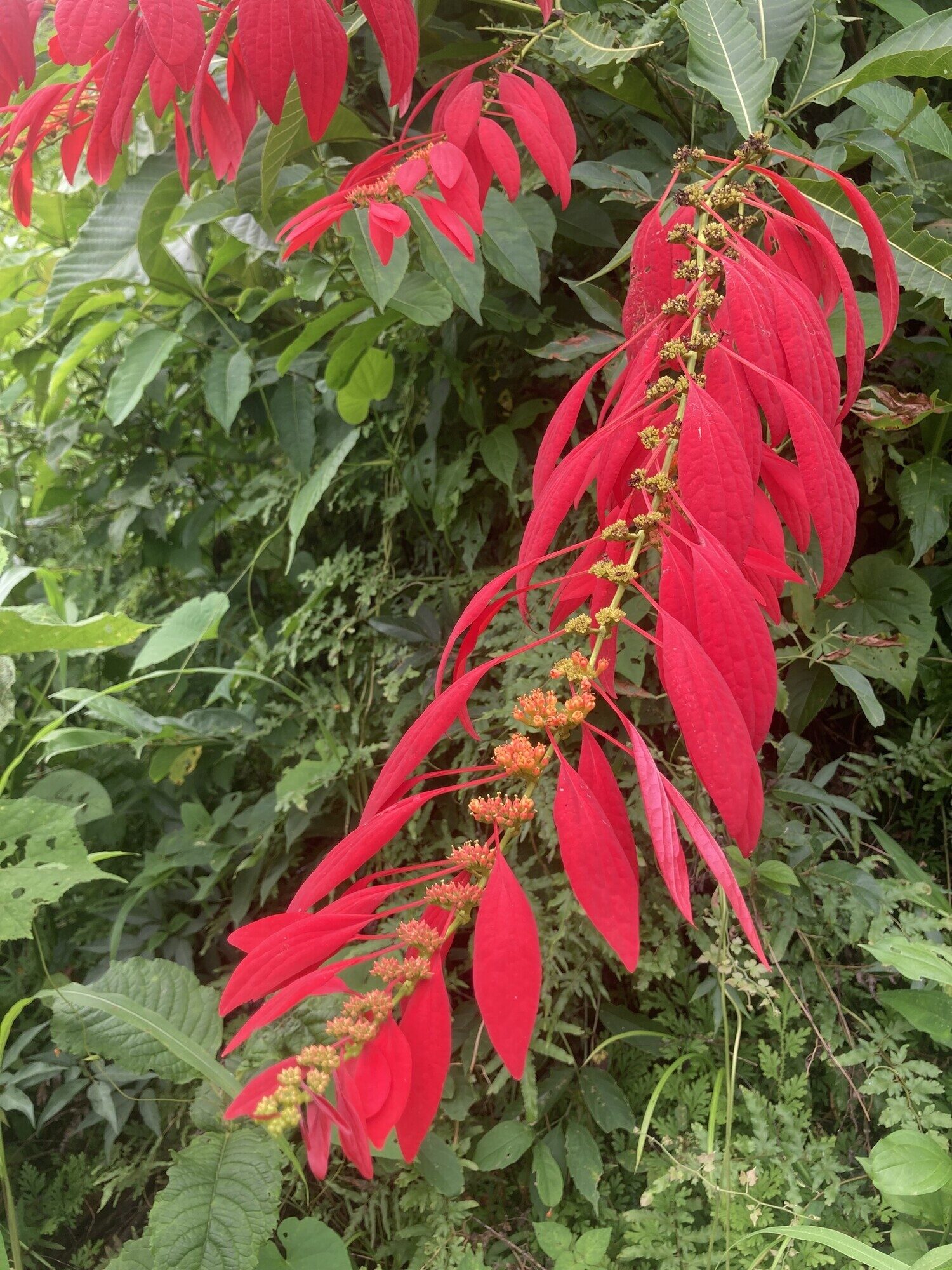
The inflorescence is the species' most arresting feature. Terminal or axillary, it takes the form of an elongate raceme 20 to 80 cm long, with a primary peduncle to 10 cm long and about 4 mm thick. Along the central rachis, broad cymose flower clusters are spaced 1 to 5 cm apart, opposite or nearly so, each cluster holding 5 to 30 small flowers. The diagnostic feature is the calycophyll: one calyx lobe per cluster is enlarged into a brilliant crimson leaf-like blade, 3-10 cm long and 1-4 cm broad, borne on a slender petiole-like stipe 12-38 mm long. The effect is a loosely organized pseudanthium, where the coordinated display of one colored bract per cluster mimics a larger single flower, functioning as the attraction unit for pollinators. Distal branches often bear three inflorescences: one terminal and two laterals.
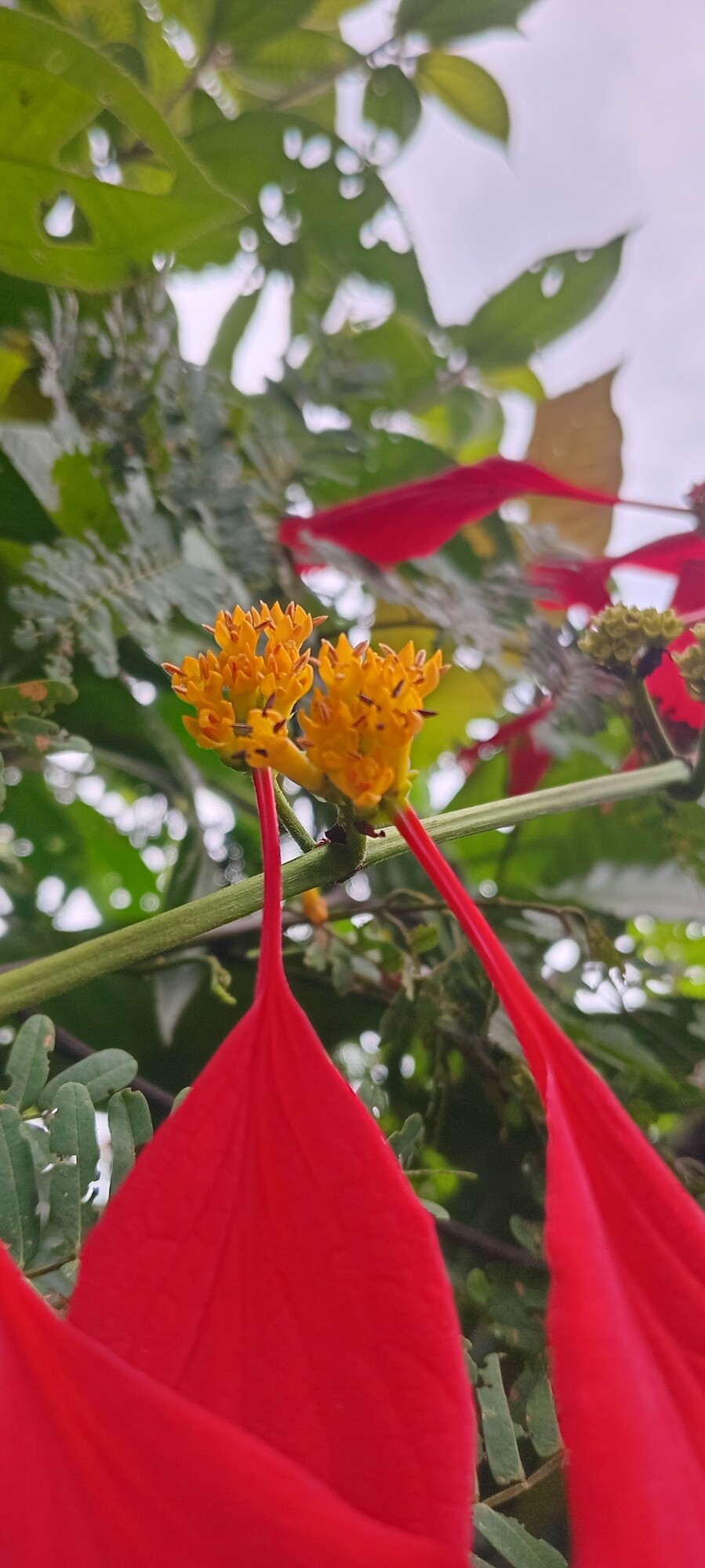
The individual flowers are small and easily overlooked against the spectacle of the calycophylls. Each has a hypanthium (fused floral base) 1-2 mm long, obconic and densely sericeous (silky-hairy) with ascending yellowish hairs. The corolla is yellow-orange to orange-red, with a tube 3-5 mm long and five acute lobes 2-4 mm long. Five stamens are borne in the throat of the corolla tube, their anthers dorsifixed and versatile, sagittate (arrow-shaped) at the base. The ovary is two-chambered, with many horizontal ovules. Flowering occurs throughout the year, with the principal peak from April to September. The species is self-incompatible, as confirmed by Kamaljit Bawa and James Beach in their 1983 study of breeding systems at La Selva Biological Station in Costa Rica.
Fruits
The fruits are woody capsules, 3-5 mm long and 3-4 mm in diameter, obconic (inversely conical) to nearly spherical, covered in fine appressed hairs. They open by septicidal and basipetal dehiscence (splitting along the septa from the top downward), with two valves that are entire or slightly cleft at the tip. The seeds are numerous, tiny (0.2-0.5 mm long), and horizontal, each bearing a narrow marginal wing that facilitates wind dispersal. Germination is slow, occurring within 30 to 40 days. The extended flowering season means that fruiting also occurs over much of the year.
Distribution
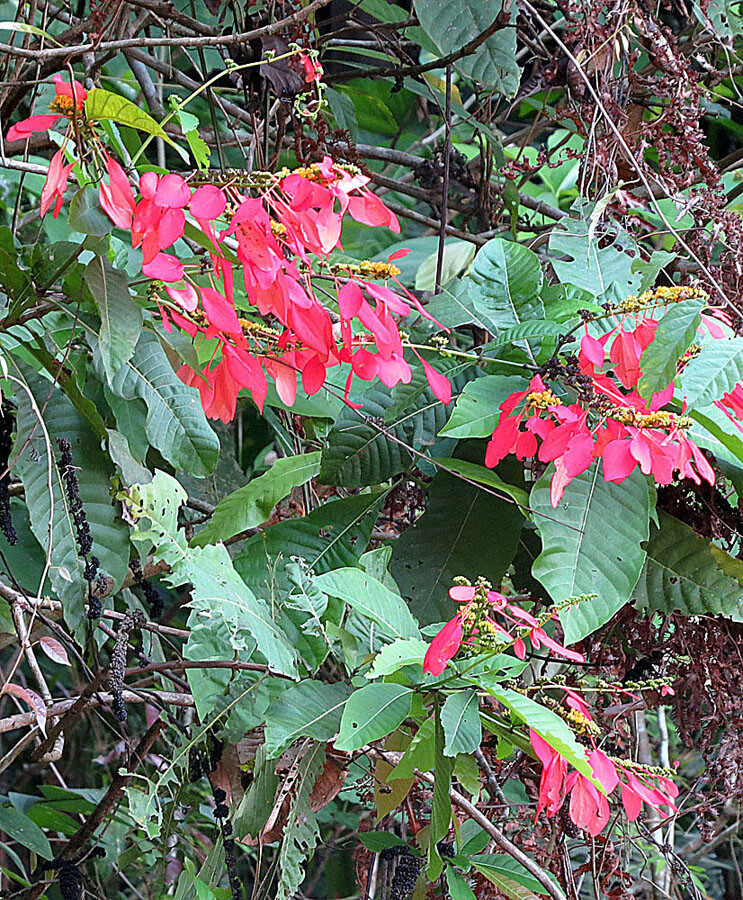
Warszewiczia coccinea ranges from southern Nicaragua through Costa Rica and Panama into South America, where it extends across Colombia, Venezuela, Ecuador, Peru, Bolivia, Brazil, and the Caribbean islands of Trinidad and Tobago. With over 7,100 GBIF occurrence records, Colombia holds nearly half the documented population (3,532 records), followed by Brazil (918), Ecuador (862), Peru (509), and Costa Rica (426). The species is essentially continuous across the Neotropical lowland wet forest belt. The abundance of heterotypic synonyms, from Warszewiczia pulcherrima to W. schomburgkiana to W. splendens, reflects the fact that different populations across this vast range were described as separate species by multiple 19th-century botanists working independently.
In Costa Rica, the species occurs across both the Atlantic and Pacific lowlands but is notably absent from the dry forests of Guanacaste. The majority of collections come from the Atlantic slope, particularly the Sarapiqui region in Heredia Province, where it has been recorded at La Selva Biological Station, Braulio Carrillo National Park, Chilamate, and Tirimbina at elevations of 50-350 m. On the Caribbean coast, it occurs in Limon Province at Hitoy Cerere Biological Reserve, Valle de la Estrella, Barra del Colorado, and along the Lari River at 15-340 m. Pacific lowland populations occur inland at Carara and La Cangreja, and across the southern Pacific in the Brunca region. The typical elevation range is 10-300 m, though an outlier record from the junction of the Canas and Cabagra rivers in the Cordillera de Talamanca reaches 1,580 m.
In the Brunca region, numerous localities are documented. These include Dos Brazos de Rio Tigre and Quebrada Pizote on the Osa Peninsula (200 m), Rancho Quemado near Guerra (250 m), Rey Curre on the margins of the Rio Terraba (100 m), La Gamba and Parque Nacional Esquinas, Alto San Juan along the Fila Sabalo near Sierpe, and Las Pilas east of Perez Zeledon. The species favors moist, fertile clayey soils in valley bottoms and near rivers, growing in evergreen lowland rain forest formations.
Ecology
The crimson calycophylls serve as visual attractants for the species' pollinators, which include butterflies and hummingbirds. A 2003 study by Stefan Andersson and Heidi Dobson examined the floral scent chemistry of W. coccinea in relation to Heliconius melpomene, the postman butterfly. Using gas chromatography coupled with electroantennographic detection (GC-EAD), they found that the butterfly's antennae responded to specific volatile compounds in the floral scent, particularly linalool, linalool oxides, and phenylacetaldehyde. Female butterflies showed stronger antennal responses than males, suggesting that the floral scent may function partly as a female-targeted signal, perhaps related to egg-laying site selection near nectar sources.
Seeds are dispersed by wind. The tiny seeds (0.2-0.5 mm), each fitted with a narrow marginal wing, are released when the woody capsules split open along their septa. This wind-dispersal strategy, combined with the species' affinity for light gaps and disturbed areas, allows it to colonize new openings as they form in the forest canopy. Despite being self-incompatible, the species flowers nearly year-round, with an extended peak from February through November. In Trinidad, where the plant is particularly abundant in moist semi-shaded flatlands and lower wooded hillsides, E.J. Duncan reported in 2007 that it flowers "at intervals throughout the year, particularly in the wet months."
Taxonomic History
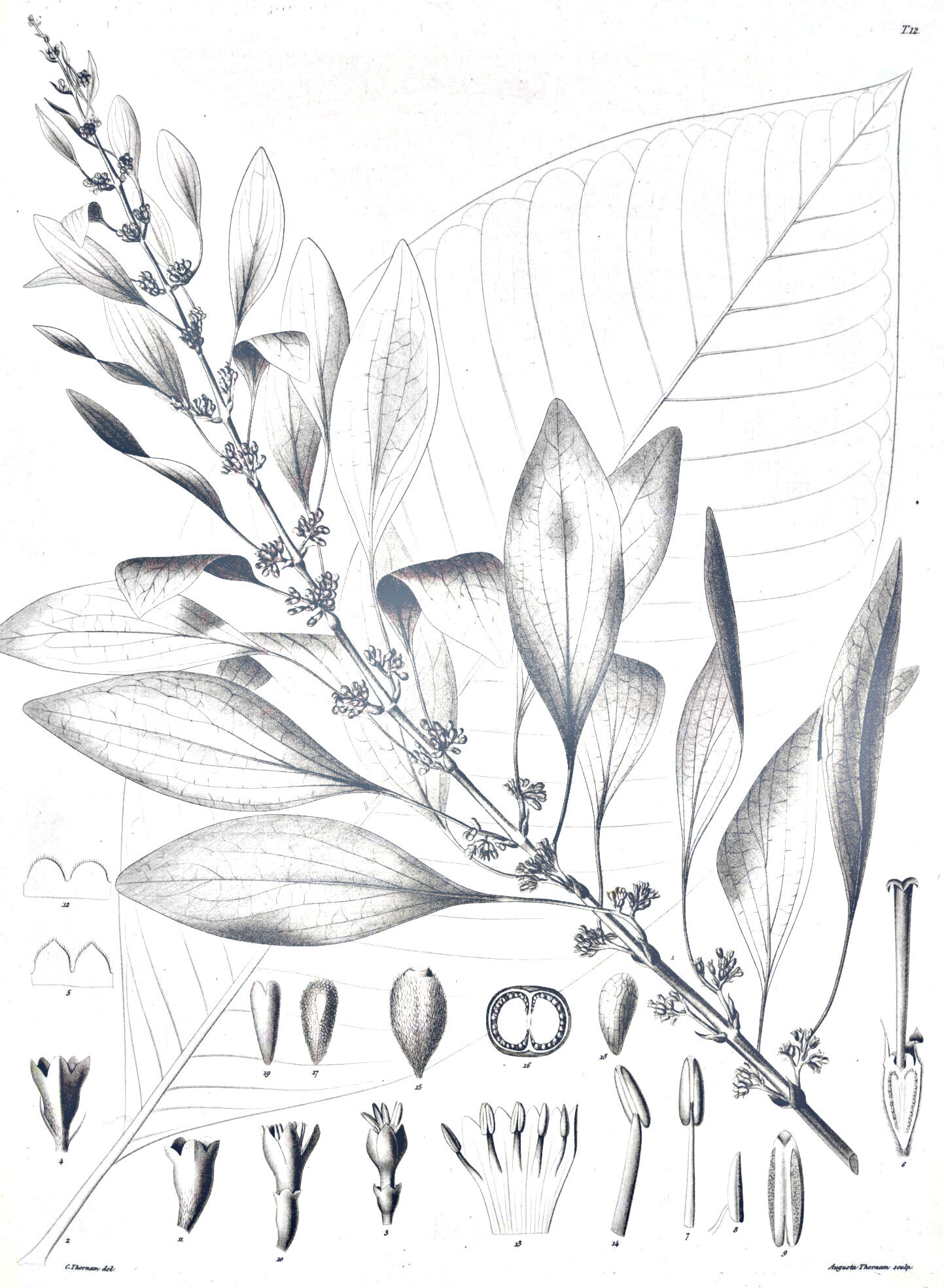
The species was first described as Macrocnemum coccineum by the Danish-Norwegian botanist Martin Vahl in 1791, published in Symbolae Botanicae (2: 38). The species epithet coccinea, from Latin coccineus meaning "scarlet" or "dyed scarlet," refers to the brilliant crimson calycophylls. The species was subsequently transferred to Mussaenda by Poiret in 1797, then to Calycophyllum by Augustin Pyramus de Candolle in 1838. Both reassignments reflect genuine morphological convergence: Mussaenda, an Old World genus of Africa and tropical Asia, also produces enlarged colorful calyx lobes to attract pollinators, though its calycophylls are typically white, pink, or red rather than the deep crimson of Warszewiczia. Calycophyllum, whose name literally translates as "calyx-leaf," shares the same enlarged sepal character, though Costa Rica's native Calycophyllum candidissimum (the madroño) has white rather than red bracts, making field confusion unlikely.
The genus Warszewiczia was established in 1853 by Johann Friedrich Klotzsch, a German botanist at the Berlin Herbarium, in a paper titled "Einige neue Gattungen der Rubiaceen" published in the proceedings of the Royal Prussian Academy of Sciences. In the same publication, Klotzsch created the new combination Warszewiczia coccinea (Vahl) Klotzsch and simultaneously described W. pulcherrima from specimens collected by the man he intended to honor: Jozef Warszewicz.
Jozef Warszewicz Ritter von Rawicz (c. 1812-1866) was born in Vilnius, then part of the Russian Empire, to an impoverished Polish noble family. He found work as an assistant gardener at the Berlin Botanical Garden in 1840, and in 1844, upon the recommendation of Alexander von Humboldt, was sent by Louis Benoit Van Houtte, a horticulturist in Ghent, to join a Belgian colony in Guatemala. Warszewicz soon became an independent collector and wholesale supplier of plants, primarily orchids, to European botanical gardens. Over two expeditions spanning 1844-1850 and 1850-1853, he traversed Guatemala, Honduras, Nicaragua, Costa Rica, Panama, Ecuador, Peru, Bolivia, and Brazil, shipping thousands of previously unknown plants to Europe. Yellow fever forced his return in 1853, and he took up the position of inspector (supervisor) at the Jagiellonian University Botanical Garden in Krakow, where he died on 29 December 1866 at the age of 54. His herbarium sheets were bequeathed to the Berlin Botanic Garden. Over 100 taxa bear variants of his name, and two genera honor him: Warczewiczella (Orchidaceae) and Warszewiczia (Rubiaceae). Of the 650 herbarium sheets preserved at the Jagiellonian University's KRA herbarium, the lectotype of W. pulcherrima (later synonymized with W. coccinea) is among them. A large portion of the Berlin duplicates was destroyed on the night of 1-2 March 1943, when Allied bombing destroyed the herbarium.
The Danish botanist Anders Sandoe Oersted, who explored Nicaragua and Costa Rica between 1846 and 1848, encountered the species in the Sarapiqui lowlands and recorded it as Warszewiczia pulcherrima among the understory Rubiaceae. In the Primitiae florae costaricensis (1891-1901), the vegetation description of the descent to the Rio de la Paz (approximately 1,000 m) mentions "Rubiacees (Warszewiczia pulcherrima), des Scitaminees, des Piperacees et des Aroidees" growing among tree ferns, palms, and lianas. This is among the earliest documented observations of the species in Costa Rica.
Molecular phylogenetic analysis places Warszewiczia in tribe Condamineeae within subfamily Ixoroideae (Rubiaceae), in a clade with Bathysa, Chimarrhis, and Dolichodelphys. The genus contains approximately eight accepted species, of which W. coccinea is by far the most widespread. Other species include W. uxpanapensis (the northernmost, extending into southern Mexico), W. schwackei (studied for phytochemistry in the Brazilian Amazon), and W. cordata, W. elata, W. longistaminea, and W. peltata. Only W. coccinea occurs in Costa Rica.
Chemistry and Uses
Bioguided fractionation of W. coccinea stem extract has yielded two triterpenes with acetylcholinesterase inhibitory activity: 3-beta,6-beta,19-alpha-trihydroxy-urs-12-en-28-oic acid and sumaresinolic acid. Acetylcholinesterase inhibitors are of pharmaceutical interest because they slow the breakdown of acetylcholine, a neurotransmitter involved in memory and cognition, making them candidates for Alzheimer's disease research. A separate study isolated scopoletin, a coumarin compound, from the leaves, and found antimicrobial activity against Escherichia coli, Pseudomonas aeruginosa, Staphylococcus aureus, and Candida albicans. The hexane extract of branches showed antiangiogenic activity. Among the Yanesha people of Peru, the species is used in traditional medicine; a 2009 study by Valadeau and colleagues evaluated extracts from Yanesha medicinal plants for leishmanicidal and antimalarial activity, though the specific results for W. coccinea were not detailed in the published abstract. In folk medicine, the anise-scented roots are attributed aphrodisiac properties.
The wood is medium-textured and of moderate weight with poor durability, used locally for light cabinet making, tool handles, fuel, and charcoal. Commercial timber value is limited by the small trunk diameter, typically 15-25 cm. The species is far more widely valued as an ornamental. Cultivated forms, especially the double chaconia ('David Auyong'), are planted in tropical gardens across the Caribbean, and the species appears in botanical garden collections in Singapore, Hawaii, and Australia. A Hawaii/Pacific Weed Risk Assessment (2020) scored it at -7 (low risk), noting that the species is self-incompatible, has no vegetative spread, and has not been reported as invasive or naturalized outside its native range.
Conservation Outlook
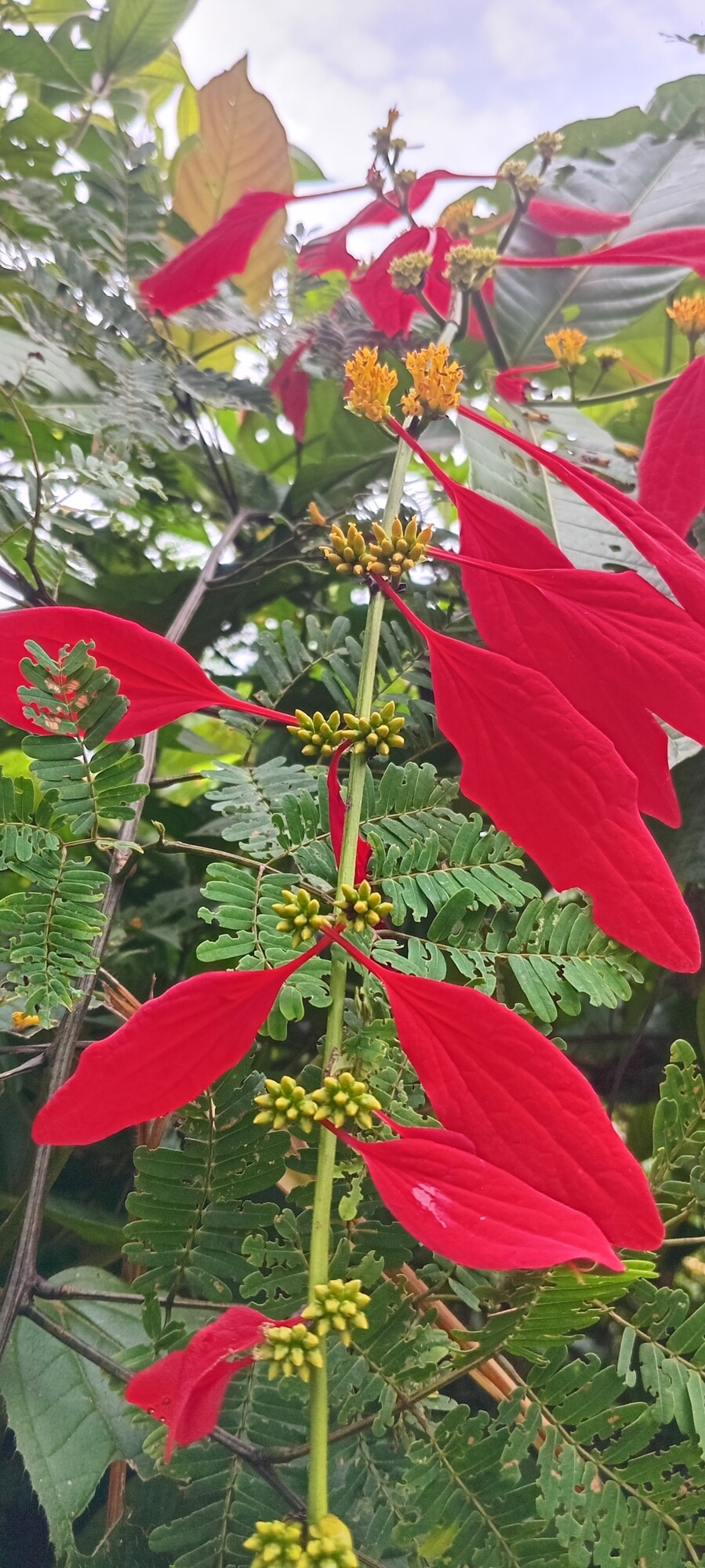
Warszewiczia coccinea has not been assessed by the IUCN Red List. Its enormous geographic range, spanning 10 countries from Central America to Bolivia and the Caribbean, and over 7,100 documented occurrence records suggest that the species is not globally threatened. In Trinidad, Duncan (2007) reports that it "grows in abundance in moist, semi-shaded, flat lands and the lower wooded hillsides." In Costa Rica, however, the picture is different: the Flora Costaricensis describes it as "not common," and the 426 GBIF records across the country, compared to 3,532 in Colombia, place Costa Rica at the northern margin of the species' core range.
The species occurs within several protected areas in Costa Rica, including Braulio Carrillo National Park, La Selva Biological Station, Carara National Park, Corcovado National Park, Piedras Blancas National Park (Esquinas), La Cangreja National Park, Hitoy Cerere Biological Reserve, and Barra del Colorado National Wildlife Refuge. As a light-gap specialist, it may benefit from moderate levels of natural disturbance and even selective logging, since these create the canopy openings it favors. Conversion of wet lowland forest to agriculture, particularly oil palm and pineapple plantations in the Caribbean lowlands and cattle ranching in the Pacific lowlands, represents the primary threat to local populations. Its dependence on cross-pollination (self-incompatibility) means that isolated individuals or small populations may fail to set seed.
Resources & Further Reading
Species Information
Plants of the World Online entry with accepted name, distribution map, and full synonymy.
Global occurrence records with over 7,100 entries across 10 countries.
Native plant database entry with Costa Rican common names, habitat, and phenology data.
Economic botany summary including wood properties, medicinal uses, and cultivation notes.
Detailed morphological description from cultivated specimens in Singapore's botanical gardens.
Taxonomy & Nomenclature
Nomenclatural data and specimen records from Missouri Botanical Garden.
Phytotaxa paper designating the lectotype from Warszewicz's collections at KRA herbarium.
PhytoKeys paper typifying five plant names described from Warszewicz's Central and South American specimens.
American Journal of Botany phylogenetic analysis placing Warszewiczia in tribe Condamineeae with Bathysa, Chimarrhis, and Dolichodelphys.
Ecology & Chemistry
Journal of Chemical Ecology study identifying linalool and phenylacetaldehyde as key floral scent compounds attracting postman butterflies.
Natural Product Communications paper reporting two bioactive triterpenes from stem extracts of W. coccinea collected in Panama.
Journal of Ethnopharmacology evaluation of leishmanicidal and antimalarial activity in medicinal plants used by the Yanesha people of Peru.
Risk assessment scoring W. coccinea at -7 (low risk), with notes on self-incompatibility and dispersal ecology.
Related Reading
Official government page on the chaconia as national flower, including origin of the name and Independence Day connection.
Account of the 1957 discovery of the double chaconia by David Auyong and Grace Mulloon on the Blanchisseuse road.
Living World (Trinidad and Tobago Field Naturalists' Club) review covering morphology, ecology, and cultural significance of the chaconia.
Biography of the Polish botanist and orchid collector for whom the genus is named, including his Central American expeditions.
Historical study of Warszewicz's plant collections preserved at the Jagiellonian University herbarium in Krakow.