Walking Palm
Socratea exorrhiza — The palm that supposedly walks through the forest on stilt-like roots. The legend is false, but the science behind this remarkable tree is even more interesting than the myth.
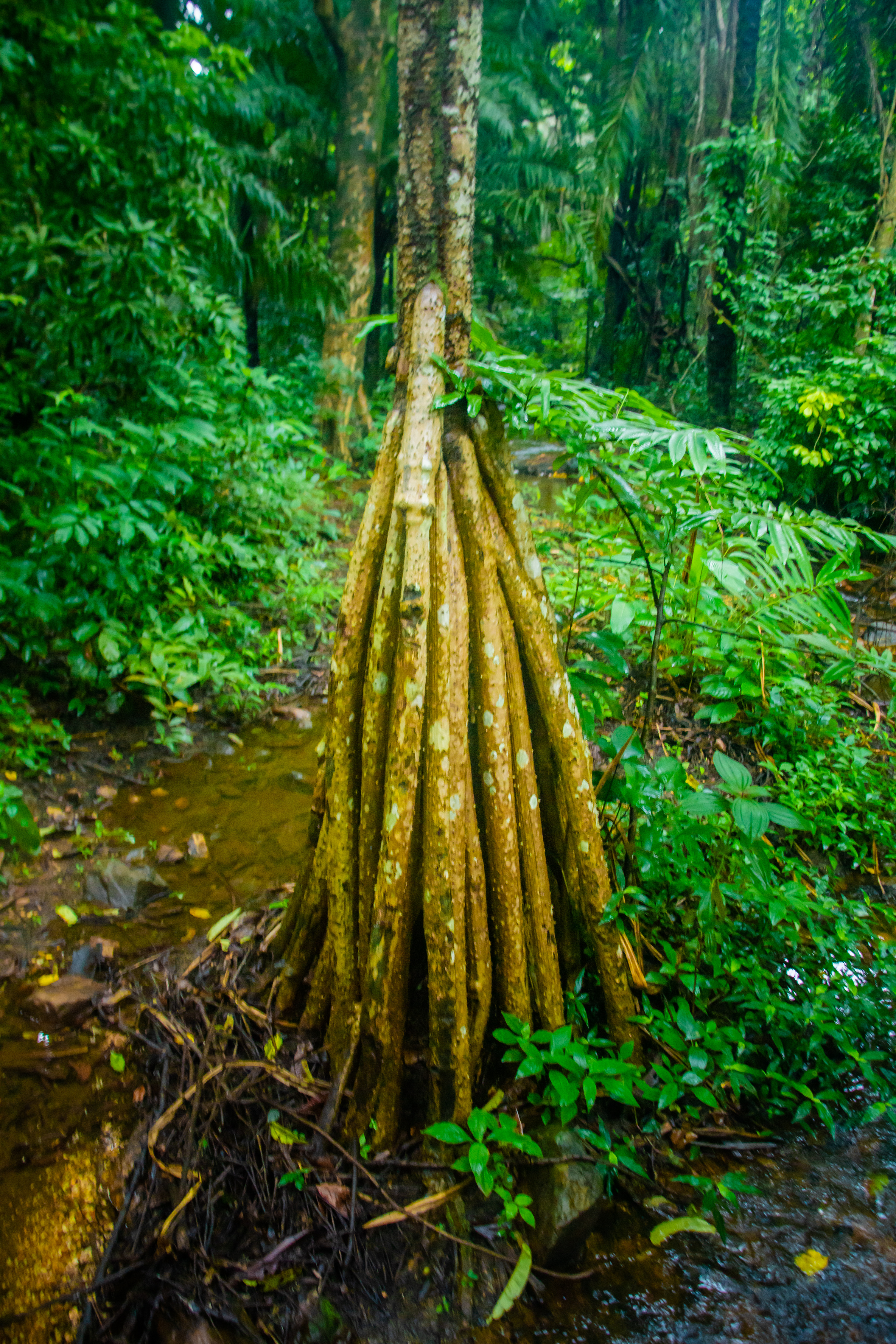
In the lowland rainforests of Corcovado National Park, visitors encounter one of the most distinctive trees in the Neotropics. The walking palm rises on a cone of spiny aerial roots that lift its trunk clear of the forest floor, looking for all the world like a plant caught mid-stride. Tour guides spin tales of trees that walk toward light, slowly migrating across the forest over years. It is a captivating story. It is also a myth.
The walking palm's stilt roots are real and remarkable, but they do not enable locomotion. Costa Rican biologist Gerardo Avalos definitively debunked the walking myth in a 2005 study published in Biotropica. His research showed that while some roots may die off and new ones grow, the trunk itself remains rooted to the spot. No time-lapse photography has ever captured a walking palm in motion, because they do not move.
Identification
The Arecaceae, or palm family, comprises over 2,600 species worldwide, making it one of the most important plant families in tropical ecosystems. Socratea exorrhiza belongs to the Iriarteoid group, a lineage of stilt-rooted palms found exclusively in the Neotropics. Its closest relative in Costa Rica is Iriartea deltoidea, which has similar stilt roots but can be distinguished by its dark, spineless roots.
Physical Characteristics
Stilt roots: The most distinctive feature. Light brown aerial roots emerge from the lower trunk and descend to the ground, forming a cone-shaped structure that can reach several meters in height. The roots are covered in short, sharp spines. New roots continuously form higher on the trunk while older roots at the base may die off, though this does not cause the tree to move.
Trunk: Slender and straight, typically 10-16 cm in diameter, reaching up to 25 meters in height. The relatively thin stem is possible because the stilt root system provides structural support that would otherwise require a thicker trunk. The trunk emerges from the apex of the root cone rather than from the ground.
Leaves: Large pinnate fronds typical of palms, forming a crown at the top of the trunk. The leaves can reach several meters in length with numerous leaflets arranged along a central rachis.
Flowers and fruit: Flowers appear in October, attracting numerous insect pollinators. Fruits ripen at various times throughout the year, with peaks in March, July, September, and November. The fruits are consumed by bats, arboreal mammals, and birds, which disperse the seeds through the forest.
The Walking Myth
The legend of the walking palm entered scientific literature in 1980 when anthropologist John H. Bodley proposed that the stilt roots allowed the tree to "walk" away from its germination point. He suggested that when a falling branch knocked over a seedling, the palm could right itself and gradually relocate toward better light by growing new roots in one direction while allowing old roots to die on the opposite side.
The idea captured popular imagination and became a staple of rainforest tour narratives. But when Costa Rican biologist Gerardo Avalos, director of the Center for Sustainable Development Studies in Atenas, Costa Rica, conducted rigorous measurements of Socratea exorrhiza populations, he found no evidence of movement. "My paper proves that the belief of the walking palm is just a myth," he stated. As Benjamin Radford noted in Skeptical Inquirer: "As interesting as it would be to think that when no one is around trees walk the rainforest floor, it is a mere myth."
What the Stilt Roots Actually Do
If not for walking, why did Socratea exorrhiza evolve such an elaborate root system? Research published in Revista de Biología Tropical provides an answer: the stilt roots enable a unique growth strategy that gives the palm a competitive advantage in the race for canopy light.
Most trees must invest heavily in trunk diameter to support their height. A taller tree needs a thicker trunk, which requires significant biomass allocation. The walking palm sidesteps this constraint. By using stilt roots for structural support, it can grow a relatively thin trunk that shoots rapidly toward the canopy. Trees with greater height-to-diameter ratios consistently showed more developed stilt root systems, confirming this relationship.
This strategy makes Socratea exorrhiza an effective light-gap colonizer. When a large tree falls and opens a gap in the canopy, the walking palm can exploit the opportunity quickly, reaching toward the new light source faster than competitors that must invest in thicker trunks. The stilt roots also allow the palm to establish on uneven terrain, debris, or even on top of fallen logs.
Habitat & Distribution
The walking palm ranges from Nicaragua through Central America to Peru, Venezuela, and Suriname. In Costa Rica, it is widely distributed across both the Atlantic and Pacific slopes in mature lowland rainforest. The Osa Peninsula and Corcovado National Park contain significant populations, with observations documented at locations including Drake Bay and San Pedrillo.
Ecosystem: Mature lowland wet forest. The species grows best in primary forest with closed canopy, where light gaps provide opportunities for establishment and rapid vertical growth.
Succession stage: Mature forest species. While it exploits light gaps opportunistically, the walking palm is characteristic of old-growth rainforest rather than disturbed or secondary habitats.
Ecological Importance
The walking palm's flowers and fruits support a network of forest wildlife. Insect pollinators visit the flowers in October, while bats, monkeys, and birds feed on the fruits throughout the year. The stilt root structure itself creates microhabitat, with the spaces between roots providing shelter for small animals and accumulating leaf litter that supports invertebrate communities.
The wood of Socratea exorrhiza is notably hard and durable, which has led to its traditional use in construction by indigenous communities. However, in Costa Rica the species is protected on the "no cut" list, prohibiting harvest.
Conservation Status
The walking palm has not been evaluated by the IUCN and is not listed under CITES. However, Costa Rica provides legal protection through inclusion on the national "no cut" list, which prohibits felling of protected tree species without special permits. This protection reflects both the species' ecological importance and its popularity with ecotourists, for whom the distinctive stilt-rooted palms are a highlight of forest walks in Corcovado and other protected areas.
The species' dependence on mature forest makes it vulnerable to deforestation. While not immediately threatened in Costa Rica's well-protected Osa Peninsula, populations elsewhere in Central and South America face pressure from habitat conversion. Conservation of primary rainforest remains essential for the walking palm's long-term survival.
Key Sources & Resources
Species Information
Local species information from the Osa Peninsula including phenology and photographs.
Community observations and photographs from across Costa Rica.
Scientific Literature
Key research on stilt root function and growth strategy at two Neotropical sites.
Popular science article discussing Gerardo Avalos's research debunking the walking myth.
The Walking Myth
History of the walking palm myth and scientific investigations that debunked it.
Conservation organization perspective on the walking palm and its ecological significance.
General Reference
Overview of the species including distribution, ecology, and traditional uses.
Comprehensive chapter covering morphology, population dynamics, and species interactions from Barro Colorado Island research.