Lechero
The Brunca milkwood whose paired pods, milky latex, and dusk-opening flowers anchor living fences from Corcovado to Cahuita while feeding hawkmoths, cuckoos, and hedgerow biodiversity.
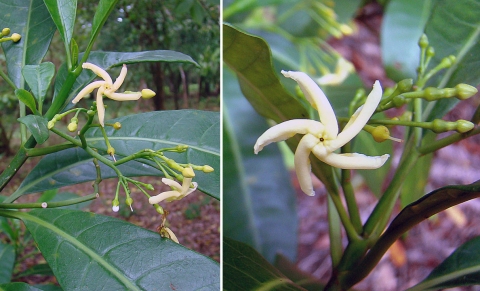
Locals across the Pacific and Caribbean slopes call this tree cojón de gato, lechero, lecherillo, and Uts'um péek'—names logged by Mexico's Enciclovida platform alongside hundreds of herbarium and community-science records. Botanically it is a milkwood, a name given to trees whose stems bleed white latex when cut. Philip Miller described the species in 1768, native from Veracruz and Cuba through all of Central America into Chocó and the Colombian piedmont, thriving in river levees, evergreen swamp borders, and humid lowland forest up to roughly 600 meters.
Flora of Guatemala notes that fruits exude copious white latex that coagulates into a chicle-like gum chewed locally or blended to stretch Manilkara harvests, while the pale, fine-grained wood still frames walls and palenques in poorer lowland dwellings. Those uses persist along the Térraba-Sierpe plains, where fresh cuts also drip nectar-like sap that stingless bees harvest as waterproofing resin for their hives.
Identification
Habit
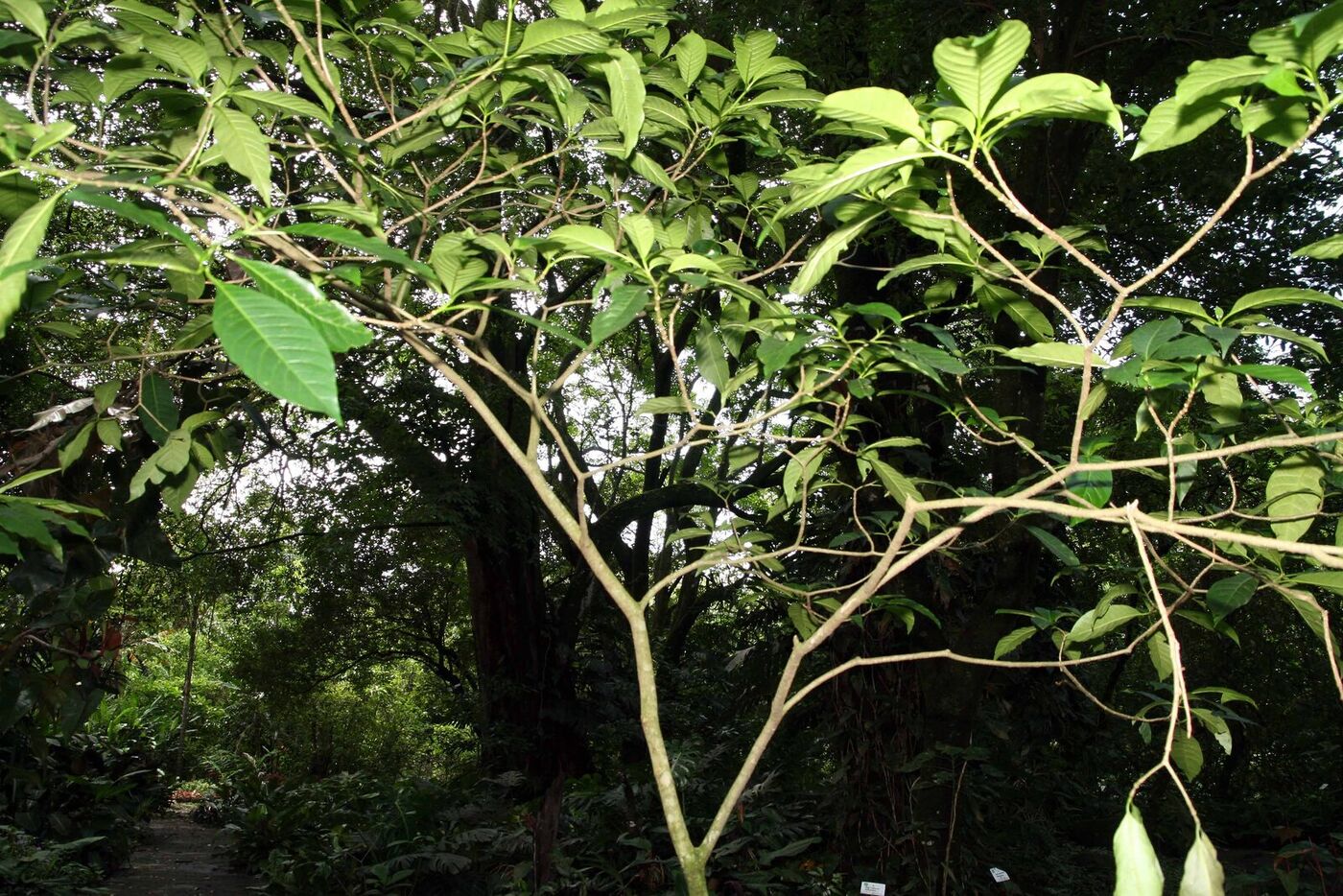
Tabernaemontana alba grows as a large shrub or small tree reaching up to 15 meters in height, with a dense, spreading crown that distinguishes it from the scraggly hedgerow profile of many Apocynaceae. The trunk measures up to 45 cm in diameter, though it is usually smaller, and may be round or somewhat fluted at the base. Like all members of its genus, the stems branch dichotomously (forking repeatedly in pairs), creating a layered architecture well-suited to the shaded forest understory. When any part of the plant is cut, it exudes abundant milky latex that coagulates readily when rubbed between the hands.
Leaves
The leaves are arranged in opposite pairs along the stems, a characteristic shared by all Tabernaemontana species. Each blade measures 3–25 cm long, elliptical in shape with a glossy upper surface and prominent venation. When torn, the leaves release the same milky sap found throughout the plant. The evergreen foliage stays glossy even during the dry season, making the species easy to spot in deciduous hedgerows where neighboring shrubs may have dropped their leaves.
Flowers
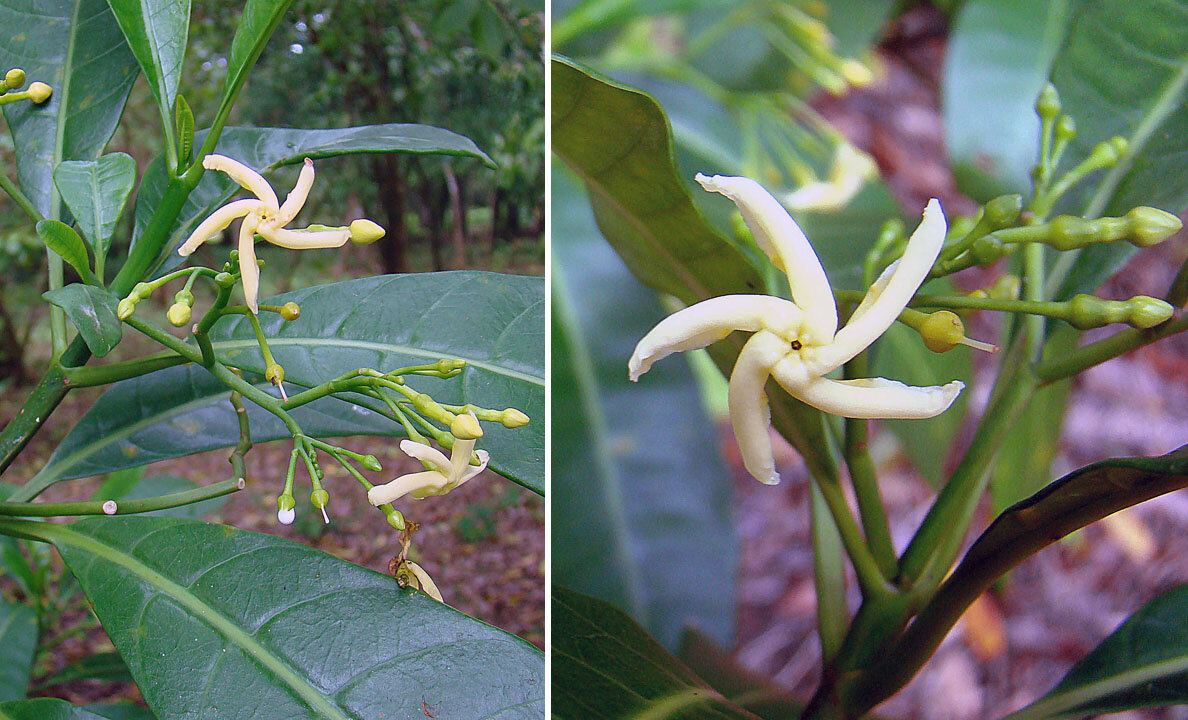
The flowers are fragrant, white, and 1–5 cm in diameter, with a salverform corolla (tubular base flaring into a flat, pinwheel-like face). The five corolla lobes overlap sharply to the left, a diagnostic feature of the genus. Flowers open primarily at dusk and remain fragrant through the night, attracting hawkmoths such as Manduca sexta that probe the narrow corolla tube for nectar. Corymbose or umbellate cymes emerge at the branch forks, bearing many flowers in succession over the wet season.
Fruits
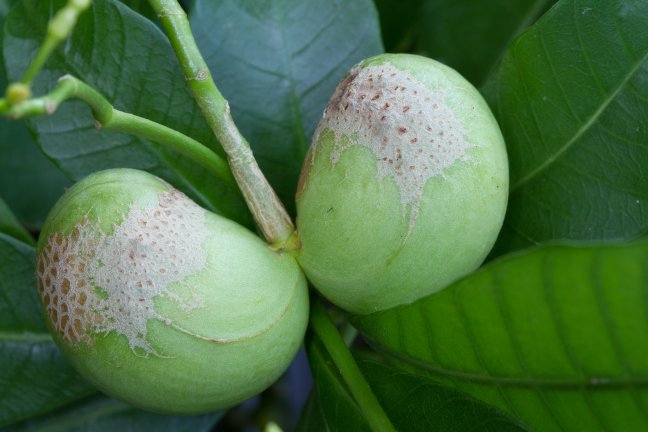
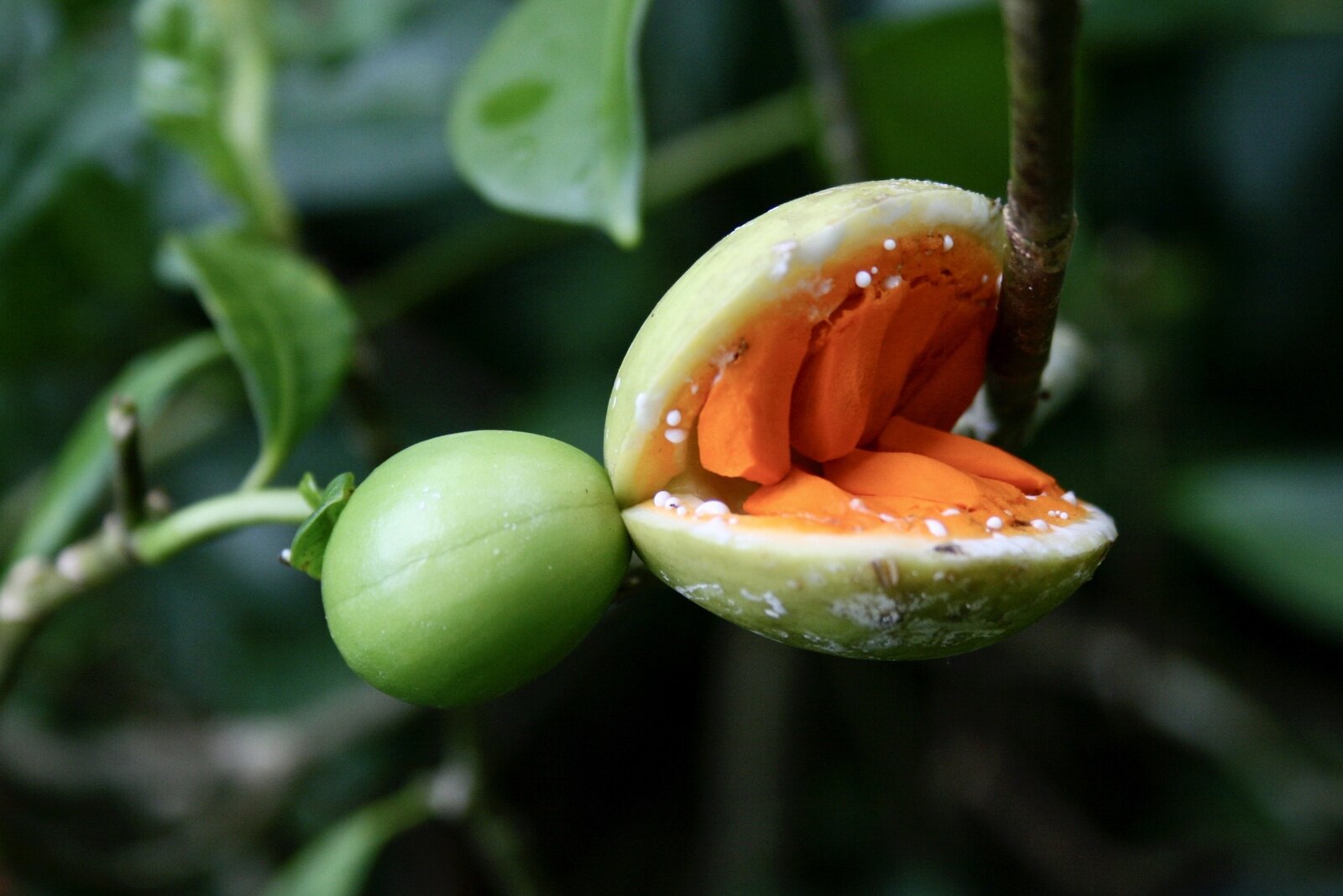
The fruit consists of two free follicles (pod-like structures) that spread apart at maturity, giving the species its vernacular name "cojón de gato" (cat's testicles). Each follicle is thick-walled and exudes copious white latex when cut, which coagulates into a chicle-like gum that locals have historically chewed or used to adulterate commercial chicle harvests. The follicles eventually dehisce (split open) to release seeds embedded in a fleshy, orange-red aril that attracts birds and other frugivores.
Distribution
Tabernaemontana alba ranges from southern Mexico through Central America to Colombia, and across the Caribbean to Cuba. It has also naturalized in southern Florida, where it escapes from ornamental plantings. Throughout this range it favors wet lowland forests, swamp edges, and the sunlit margins of rivers and clearings, from sea level to about 1,200 meters elevation.
In Costa Rica the species is locally common in the Atlantic lowlands and along the Pacific slope from Guanacaste to the Osa Peninsula. It thrives in the hedgerows that crisscross cattle pastures, where ranchers tolerate it because it roots easily from stakes and fills gaps quickly. In the Brunca region it appears along the Golfito foothills, the trails of Corcovado, and the living fences that connect forest fragments across the southern Pacific lowlands.
Ecology
Because the species coppices readily and roots from fresh stakes, it is one of the first shrubs ranchers tolerate when they renovate hedgerows. Studies of Veracruz living fences found that T. alba ranked second in importance value among hedgerow saplings, and landowners routinely spare the species when they weed beneath barbed wire to keep spiny corridors dense.
When the hedges flush with new growth, striped tetrio sphinx caterpillars (Pseudosphinx tetrio) mow through the latex-rich leaves—one larva can skeletonize an entire branch in a day—yet the toxins they sequester rarely deter mangrove cuckoos, which have been filmed plucking caterpillars straight from living fences. Fresh cuts also lure stingless bees such as Melipona beecheii, which harvest the latex to seal their nests, turning each fence post into a micro pollinator oasis.
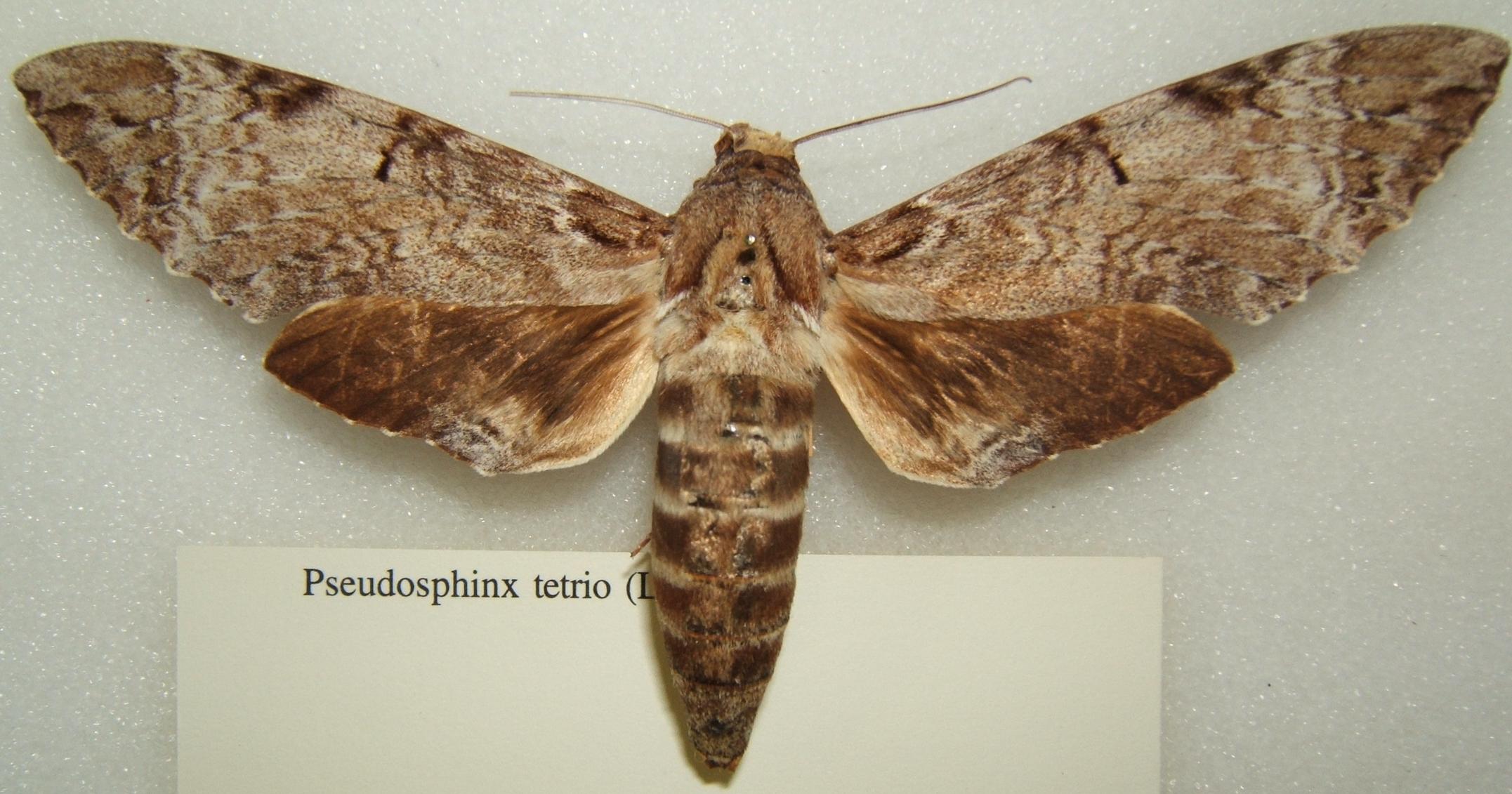
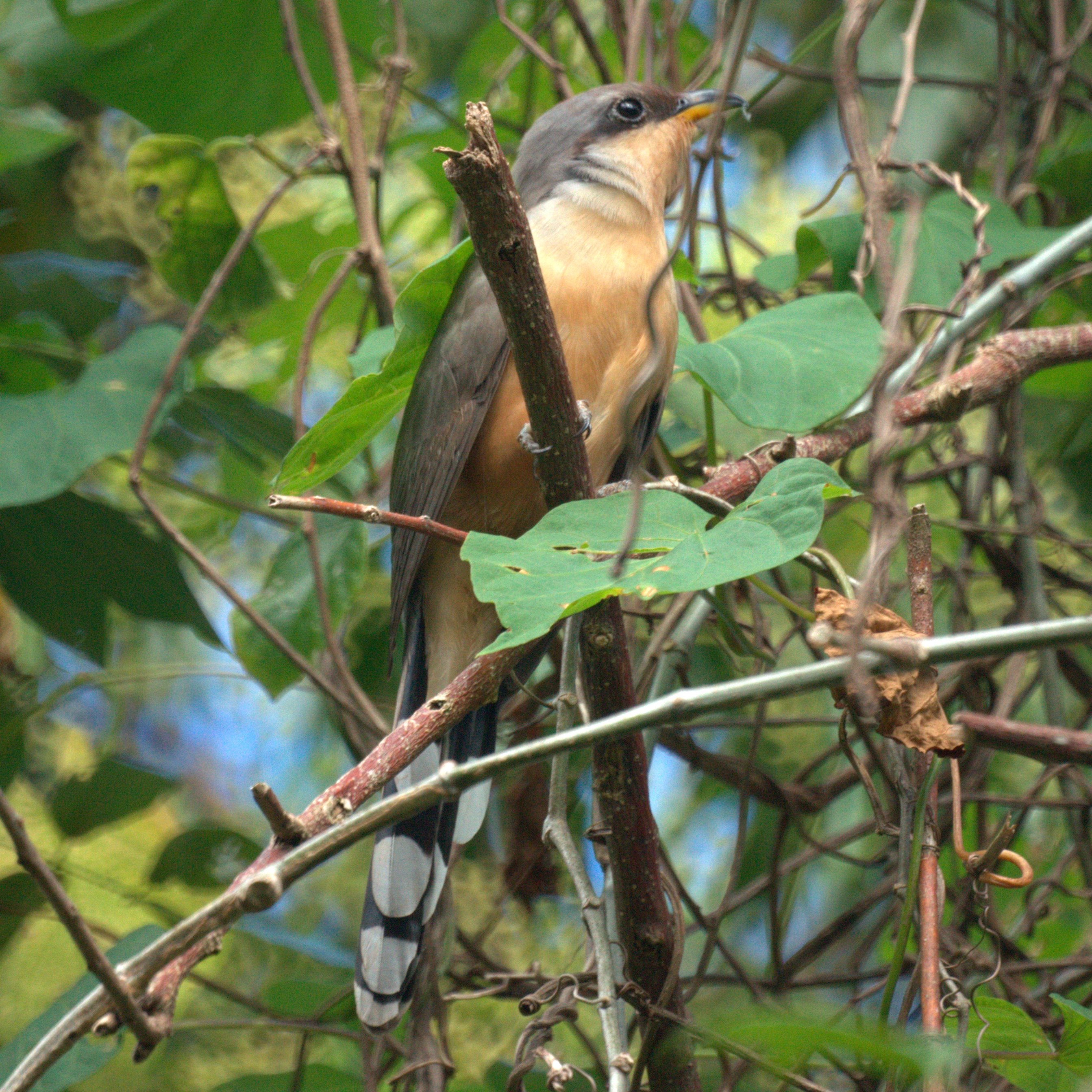
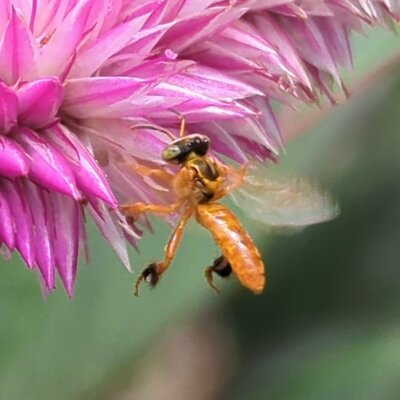
Photos: Pseudosphinx tetrio adult moth (S. James Hetrick, CC BY-SA 2.5), mangrove cuckoo (Mike's Birds, CC BY-SA 2.0), Tetragona ziegleri stingless bee (mettcollsuss via iNaturalist, CC BY).
Taxonomic History
The genus name honors Jakob Theodor (c. 1522–1590), a German physician who styled himself "Tabernaemontanus" after his hometown of Berg-Zabern in the Palatinate—literally "mountain tavern" in Latin. Beginning as an apprentice apothecary, he rose to serve Philip II, Count of Nassau-Saarbrücken, and later the bishop of Speyer, treating nobles while quietly botanizing the Rhineland. His mentors were the pioneers of illustrated herbalism: Otto Brunfels, who published the first botanically accurate plant woodcuts, and Hieronymus Bock, whose vernacular German descriptions gave peasants a medical vocabulary. Tabernaemontanus absorbed both traditions and spent 36 years compiling them into a monument of early modern botany.
The Neuw Kreuterbuch appeared in Frankfurt in 1588, featuring more than 2,300 woodcut illustrations of plants with their medicinal properties. Part two followed in 1591, and the work proved so authoritative that John Gerard's celebrated Herball (1597) quietly borrowed many of its images and descriptions without acknowledgment. Tabernaemontanus died the year after publication, but his herbal was reprinted throughout the 17th century and remains one of the foundational texts of European pharmacognosy. When Charles Plumier named the milkwood genus in 1703, he chose to honor not a patron or king but this provincial doctor who had spent a lifetime documenting the healing power of plants.
The species epithet "alba" appears in the eighth edition of Philip Miller's Gardeners Dictionary, published 16 April 1768—the edition in which the longtime head gardener of the Chelsea Physic Garden finally adopted Linnaeus's binomial nomenclature. Miller (1691–1771) had resisted the new system for decades, preferring Joseph Pitton de Tournefort's polynomial names, but by 1768 the tide of botanical practice had shifted. The eighth edition ran to over 1,300 pages and weighed some eight kilograms; in it Miller described several hundred species unknown to Linnaeus himself, drawing on living specimens cultivated at Chelsea from seeds and cuttings shipped from the Americas, Africa, and Asia.
For nearly fifty years Miller presided over one of the world's richest botanical gardens, exchanging seeds with Linnaeus, cultivating the first coffee plants in the Western Hemisphere, and training gardeners who went on to direct collections across Europe. His herbarium—nearly 10,000 specimens—was purchased after his death by Joseph Banks and now resides in the Natural History Museum, London. In naming the white milkwood T. alba, Miller documented a New World shrub that would later prove to harbor some of the same alkaloid chemistry as the African iboga—an irony he could not have anticipated.
Chemistry
The Central African shrub Tabernanthe iboga has long been known for ibogaine, an alkaloid used in Bwiti spiritual ceremonies and more recently studied as a single-dose treatment for opioid addiction. What researchers discovered in the 2010s is that Mexican Tabernaemontana species—including T. alba—contain the same family of monoterpene indole alkaloids: coronaridine, voacangine, ibogamine, and ibogaine itself. A 2019 study by Krengel and colleagues at UNAM extracted these compounds from root bark of T. alba and T. arborea collected in Veracruz and Chiapas, finding that methanol was the most effective solvent. More remarkably, they showed that a single chemical step—demethoxycarbonylation—could convert coronaridine and voacangine directly into ibogamine and ibogaine, bypassing the need for intermediate purification.
The practical implications are significant. Harvesting Tabernanthe iboga in Gabon threatens wild populations and raises complex issues of indigenous intellectual property. But if T. alba—a weedy hedgerow species that coppices readily and grows throughout Mesoamerica—can supply precursor alkaloids, it could relieve pressure on the African source while enabling clinical research into addiction treatment. The humble lechero of Costa Rican fence lines may yet prove to be a pharmacy waiting for science to unlock it.
Conservation Outlook
The IUCN Global Tree Specialist Group assessed Tabernaemontana alba as Least Concern in 2019, noting that no major threats to the species are currently documented. Unlike many tropical trees that depend on intact primary forest, this milkwood thrives in the disturbed habitats that humans create: hedgerows, forest edges, riparian margins, and even open pine savannas. Its ability to coppice readily and root from fresh stakes means that every living fence post is a potential propagation source.
This weedy resilience carries conservation implications beyond the species itself. As ranchers increasingly maintain living fences to comply with Costa Rica's reforestation incentives, T. alba often appears spontaneously in these corridors, contributing to the hedgerow biodiversity that links forest fragments across pastureland. The species' role as a food source for hawkmoths, stingless bees, and frugivorous birds means that each lechero shrub functions as a stepping stone for pollinators and seed dispersers moving between protected areas. Conservation of this species is less about preventing decline than about recognizing the ecological services it already provides in human-dominated landscapes.
Resources & Further Reading
Floristic & Ecological References
Lists national names, indigenous vernaculars, use categories (medicinal, wood, charcoal), and 1,466 SNIB occurrence records.
Provides accepted taxonomy, synonymy, and native range from Mexico to Colombia and Cuba.
Documents the Least Concern assessment and lack of major threats.
Quantifies T. alba importance value in hedgerow saplings and explains why ranchers retain the species.
Summarizes habit, habitat, latex use for chicle, and timber applications cited from Flora of Guatemala.
Details how Pseudosphinx tetrio feeds on Apocynaceae (including Tabernaemontana hedges) and notes mangrove cuckoos preying on the larvae.
Explains how stingless bees harvest Apocynaceae latex to seal nests, an interaction frequently observed on T. alba hedges.
Used for global, Costa Rican, and Brunca counts plus monthly phenology statistics cited above.
Provides recent verifiable observation totals that ground the field-note counts.
Historical Botany & Nomenclature
Biography of the German herbalist whose Neuw Kreuterbuch (2,300 woodcuts) earned him the honor of having the genus named in his memory.
Illustrated essay on Tabernaemontanus's 36-year herbal project and his teachers Otto Brunfels and Hieronymus Bock.
Profile of the Chelsea Physic Garden's chief gardener, who described T. alba in the 1768 eighth edition of the Gardeners Dictionary.
Overview of Miller's eight editions (1731–1768), explaining why the eighth edition remains authoritative for binomial nomenclature.
Alkaloid Chemistry & Addiction Research
Documents coronaridine, voacangine, ibogamine, and ibogaine in T. alba root bark and demonstrates one-step demethoxycarbonylation to produce ibogaine.
Earlier study quantifying ibogaine and voacangine in wild and cultivated T. alba plants, including in vitro callus cultures.
Background on the African iboga shrub, Bwiti ceremonies, and the alkaloid's emerging role in opioid addiction treatment research.