Surá
Terminalia oblonga — A towering rainforest emergent with silky, pale-orange bark that peels in paper-thin sheets, prized for its heavy "dragonwood" timber with intricate grain patterns.
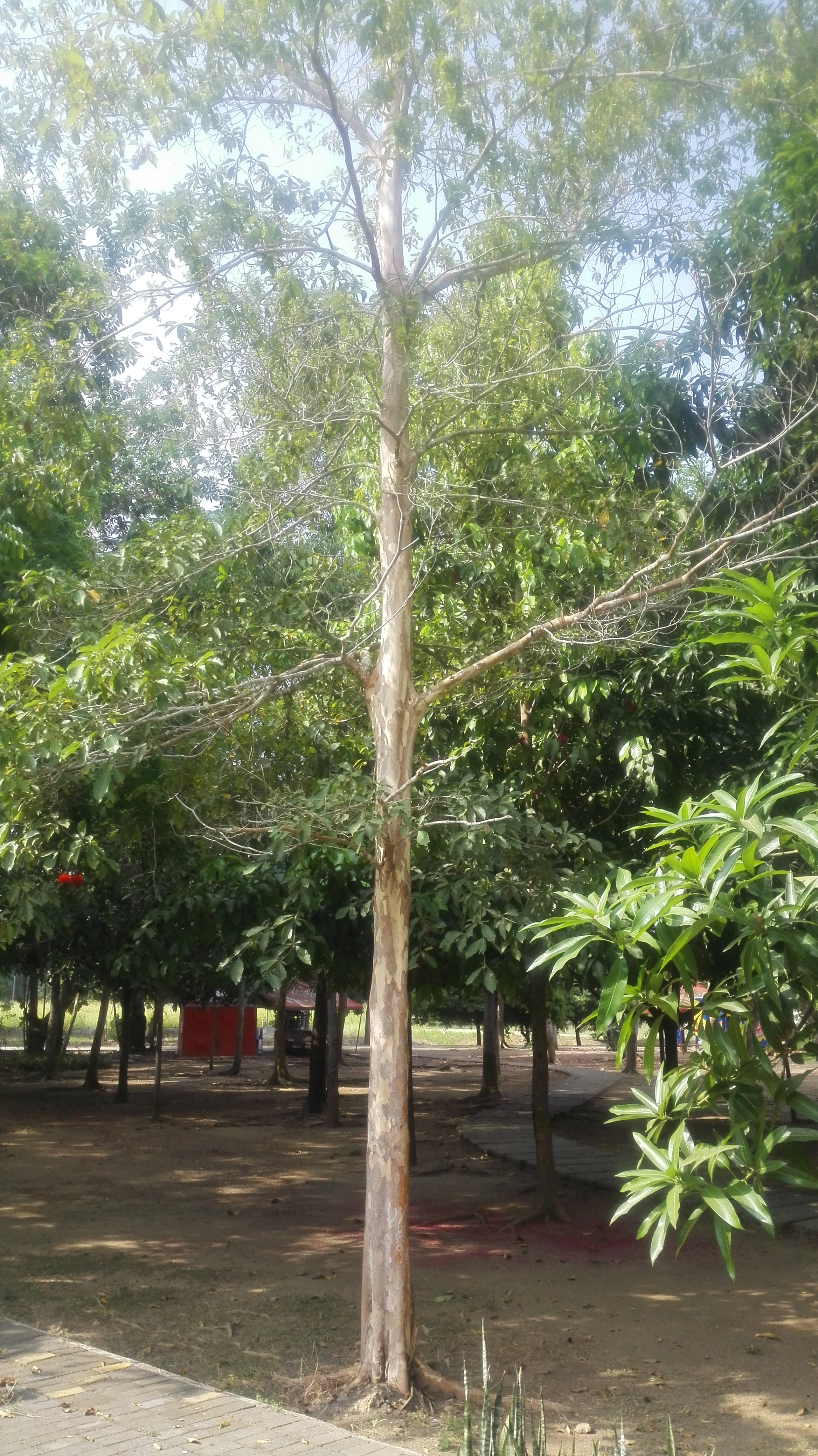
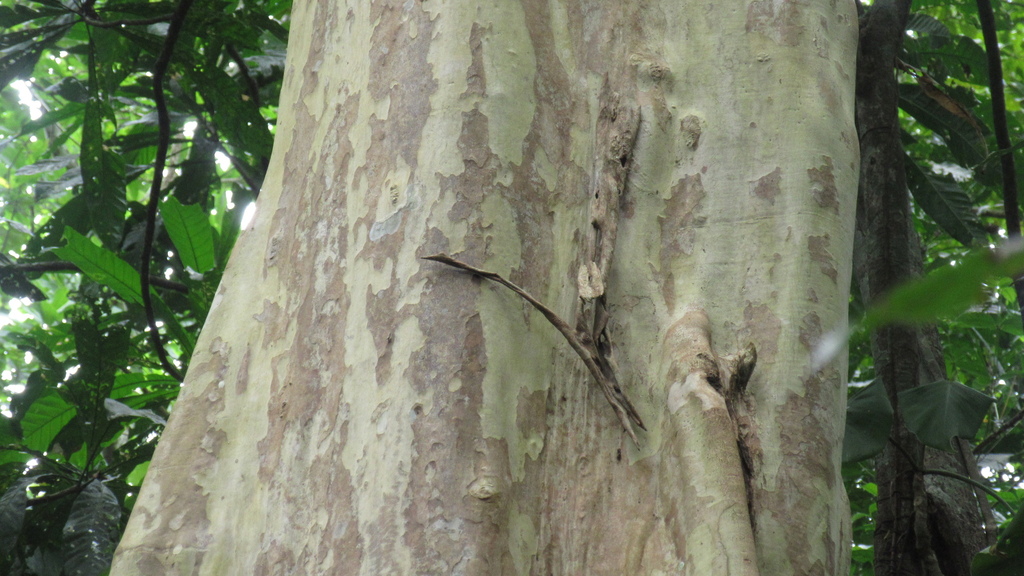
Along the streamsides and poorly drained valleys of Costa Rica's lowland forests, Terminalia oblonga rises above the canopy as one of the most distinctive trees in the Neotropics. Known locally as surá or guayabón, this emergent giant catches the eye immediately: its trunk is clad in extraordinarily smooth, pale-orange or tan bark that gleams in the dappled forest light, often peeling away in large, paper-thin sheets like parchment. Though mostly straight, the trunk bears subtle lumps and shallow dents along its length, irregularities accentuated by the silky-smooth bark that catches light from every angle.
The species ranges from southern Mexico through Central America and into Amazonian South America, inhabiting humid lowland forests from sea level to about 900 meters elevation. In Costa Rica, surá grows on both Atlantic and Pacific slopes, favoring riparian zones and areas with seasonally waterlogged soils. It is one of several Terminalia species in the region, sharing its genus with the widespread beach almond (T. catappa) and the towering amarillón (T. amazonia).
Identification
Physical Characteristics
Size and Form: Terminalia oblonga grows as a large canopy to emergent tree, commonly reaching 30 to 35 meters in height, with exceptional specimens attaining 45 meters. The trunk is mostly straight and cylindrical, reaching 80 to 150 centimeters in diameter, though the cross-section is often mildly irregular. The crown is dense and globose. Large, thin, planar buttress roots are always present, typically merging with the bole at a height of about one meter. The tree can remain free of branches for approximately half its height.
Bark: The bark is the most distinctive feature for field identification. It is extremely smooth and thin, pale orange to tan in color, with a silky sheen that catches the eye even from a distance. The bark often exfoliates in large, randomly shaped, paper-thin sheets. This unusual texture and the tree's resemblance to guava (Psidium) bark has earned it the local name "guayabón" (big guava).
Leaves: The leaves are simple and alternate, measuring approximately 14 by 9 centimeters, with an oblanceolate shape (widest toward the tip, tapering toward the base). They are smooth, light green, and somewhat leathery, clustering in whorl-like arrangements at the tips of twigs. Each leaf has a short, poorly developed drip-tip. The species is evergreen to briefly deciduous, typically dropping and replacing foliage in November and December.
Flowers: The flowers appear in axillary racemes approximately 15 centimeters long, each raceme bearing roughly 55 minute flowers. Individual flowers are just 3 millimeters in diameter, greenish, and lack petals. A cup-shaped calyx supports ten stamens surrounding a central pistil. Flowering typically occurs from November to January, with peak production in December. The flowers are pollinated by bees and other insects, with some evidence suggesting wind may also play a role.
Fruits: The fruits are distinctive double-winged samaras, flat and papery, turning brown when mature. Each samara contains a single elliptical seed and measures approximately 3 centimeters long by 1.5 centimeters wide. The two lateral wings facilitate wind dispersal during the dry season. Fruit maturation occurs primarily from March to April, with germination following the onset of the May-June rains. Seed viability is generally poor, with many fruits lacking viable seeds.
Taxonomy
Discovery and the Ruiz-Pavón Expedition
The species was first described as Gimbernatia oblonga by Spanish botanists Hipólito Ruiz López and José Antonio Pavón Jiménez in their 1798 work Systema Vegetabilium Florae Peruvianae et Chilensis. The type specimen was collected by Pavón in Peru and deposited at the Royal Botanical Garden of Madrid (MA). The Ruiz-Pavón expedition (1777-1816) was one of the most important botanical explorations of the Spanish Empire, documenting approximately 3,000 plant specimens from Peru and Chile. Sponsored by King Carlos III, the expedition spent 38 years documenting the flora of Spain's South American colonies, producing over 2,200 botanical illustrations.
The German botanist Ernst Gottlieb von Steudel transferred the species to the genus Terminalia in 1841, published in his Nomenclator Botanicus. This combination remains the accepted name today. The genus name Terminalia derives from the Latin terminus (end), referring to the characteristic clustering of leaves at the tips of branches. The specific epithet oblonga describes the oblong shape of the leaves.
Classification and Synonymy
Terminalia oblonga belongs to section Oblongae Engl. & Diels within the genus Terminalia. The genus Terminalia contains approximately 250-280 species worldwide, making it the second largest genus in the family Combretaceae. Species are distributed across tropical regions of Asia, Africa, Madagascar, Australia, and the Americas. In the Brazilian Amazon alone, eleven native Terminalia species have been recorded, including T. amazonia, T. oblonga, and T. dichotoma.
Combretaceae is often called the "White Mangrove family" because Laguncularia racemosa, the white mangrove, is one of its better-known members in the Americas. However, this common name is misleading: the family contains about 500 species across 14 genera, and most are not mangroves at all. While a few species like white mangrove and Conocarpus erectus (buttonwood) are coastal mangrove associates, the vast majority of Combretaceae species are upland forest trees like surá. The family includes some of the most important tropical timber species, including the Terminalia genus with its many commercial hardwoods.
Due to the species' broad geographic range and morphological variation, it has accumulated numerous synonyms over time. Homotypic synonyms (based on the same type specimen) include Gimbernatia oblonga Ruiz & Pav. and Myrobalanus oblonga (Ruiz & Pav.) Kuntze. Heterotypic synonyms (based on different specimens later determined to be the same species) include Terminalia chiriquensis Pittier (described from Panama in 1917), Terminalia tarapotensis Van Heurck & Müll.Arg. (from Peru), Terminalia obidensis Ducke (from Brazil), Chuncoa oblonga Pers., and Chuncoa diptera F.Dietr.
Ecology
Terminalia oblonga thrives in humid tropical lowland forests, particularly in areas with periodic flooding or poorly drained soils. It grows along streamsides, in valley bottoms, and on floodplains throughout its range. The species tolerates a wide range of rainfall regimes, from areas with distinct dry seasons to regions receiving 1,500 to 3,500 millimeters of precipitation annually. It is adapted to warm temperatures, typically between 24 and 35 degrees Celsius.
As an emergent tree, surá's crown rises above the main forest canopy, positioning it to catch the wind that carries its winged seeds across the landscape. The timing of fruit maturation in the dry season (March-April) coincides with stronger trade winds and reduced vegetation, maximizing dispersal distance. However, seed viability is generally poor, and successful germination depends on suitable conditions following the onset of the rainy season.
Regeneration and Seedling Ecology
Research from the BOLFOR sustainable forestry project in Bolivia's La Chonta forest has revealed key requirements for surá regeneration. Studies found that seedlings and saplings of T. oblonga occur almost exclusively on disturbed soil with thin litter layers. They are commonly found along logging roads, skid trails, and in areas where canopy openings allow light penetration to the forest floor. This pattern identifies surá as a light-demanding pioneer species that benefits from the moderate disturbance created by selective logging.
The La Chonta research site, located in Bolivia's Department of Santa Cruz, represents a subtropical humid forest with approximately 367 trees per hectare, 59 species per hectare, and an average canopy height of 25 meters. In this forest, surá grows alongside other emergent species including Hura crepitans (sandbox tree), Schizolobium parahyba (pacara earpod tree), Cariniana ianeirensis (jequitibá), and Sweetia fruticosa. This association with fast-growing, light-demanding species confirms surá's ecological strategy as a gap colonizer rather than a shade-tolerant climax species.
Tree Ring Chronology and Climate Response
A 2025 dendrochronological study from the Peruvian Amazon constructed a 94-year tree ring chronology for Terminalia oblonga spanning 1929 to 2022, representing one of the longest such records for a tropical tree species. The research revealed that surá's growth patterns show a negative correlation with precipitation and a positive correlation with temperature. This counterintuitive finding suggests that in the consistently humid Amazonian environment, warmer temperatures may enhance photosynthesis and growth rates more than additional moisture benefits the species. The tree rings also showed sensitivity to climate variability, making surá potentially valuable for reconstructing historical climate patterns in regions lacking instrumental weather records.
Wildlife Interactions
The small, greenish flowers of T. oblonga are pollinated primarily by bees and other insects attracted to nectar. Flowering occurs during the transition from wet to dry season (November-January), providing resources for pollinators at a time when many other forest trees are not in bloom. The wind-dispersed samaras are not consumed by animals, but the broad crown and stable branch structure provide nesting and perching sites for forest birds. The buttress roots create sheltered microhabitats at ground level that may be used by small mammals, reptiles, and amphibians.
Uses
Timber
Surá produces one of the most distinctive and valuable timbers in Central America. The heartwood ranges from grayish-brown to olive-green with darker bands and veins, while the sapwood is yellowish-gray. When dried, the heartwood intensifies to a rich brown with striking patterns that have earned it the trade name "dragonwood." These dragon-like patterns within the grain make each piece unique and highly prized for decorative applications.
The wood is very heavy and hard, with a Janka hardness of approximately 1,800 lbf (8,000 N) and high natural luster. It is moderately durable and shows resistance to dry wood borers and fungi. These properties make it excellent for flooring, furniture, cabinetry, structural beams, tool handles, and decorative veneers. In traditional use, it has been employed for railroad ties, fence posts, and ship construction.
Agroforestry
In Central America, T. oblonga is sometimes cultivated as a shade tree in coffee plantations, providing both microclimate benefits for the coffee and a future timber harvest. The dense, globose crown casts excellent shade, while the tree's preference for moist soils makes it suitable for lower-elevation coffee zones. Propagation is typically from seed, which requires 50 to 60 days for germination when sown in partially shaded nursery beds. Seedlings reach planting size within 8 to 12 months.
Resources & Further Reading
Species Information
Authoritative taxonomic information including synonyms, native range, and nomenclatural details.
Detailed field guide account with identification features, phenology, and ecology.
Species profile with distribution, uses, and phenology from the Osa Peninsula.
Comprehensive information on uses, propagation, and cultivation requirements.
Wood Properties
Technical specifications including hardness, density, and workability.
Scientific Literature
BOLFOR project research on regeneration ecology of T. oblonga and other timber species in La Chonta forest, Bolivia.
94-year dendrochronological study (1929-2022) documenting climate-growth relationships in the Peruvian Amazon.
Taxonomic synopsis documenting eleven native Terminalia species in the Brazilian Amazon, including T. oblonga.
Observations
Community observations and photographs from across the species' range.