Strangler Figs of the Brunca Region
Six species of strangler figs inhabit Costa Rica's Brunca region, including two endemics found nowhere else on Earth. All share the same ancient strategy: germinate in the canopy, embrace the host, outlive it by centuries.
For centuries, we have called them killers. Matapalo, tree-killer. The strangler fig wraps its host in a lattice of roots, competes with it for light and water, and eventually stands alone over the rotting remains. The story seems straightforward: parasite conquers host. But recent research has complicated this narrative. In 2013, Cyclone Oswald tore through Australia's Lamington National Park. When researchers surveyed the aftermath, they found something unexpected: trees with strangler figs attached were far more likely to have survived than trees without them. The stranglers, it seemed, had protected their hosts.
The strangler fig's relationship with its host is more complex than simple parasitism. Yes, it will eventually kill the tree it grows on. But for decades before that happens, the fig's aerial roots may act as guy-wires, anchoring the host to surrounding trees and the ground. Its canopy closes gaps in the forest roof, shielding the host from wind. Its root lattice reinforces the trunk like scaffolding. The strangler is both executioner and bodyguard, depending on when you ask.
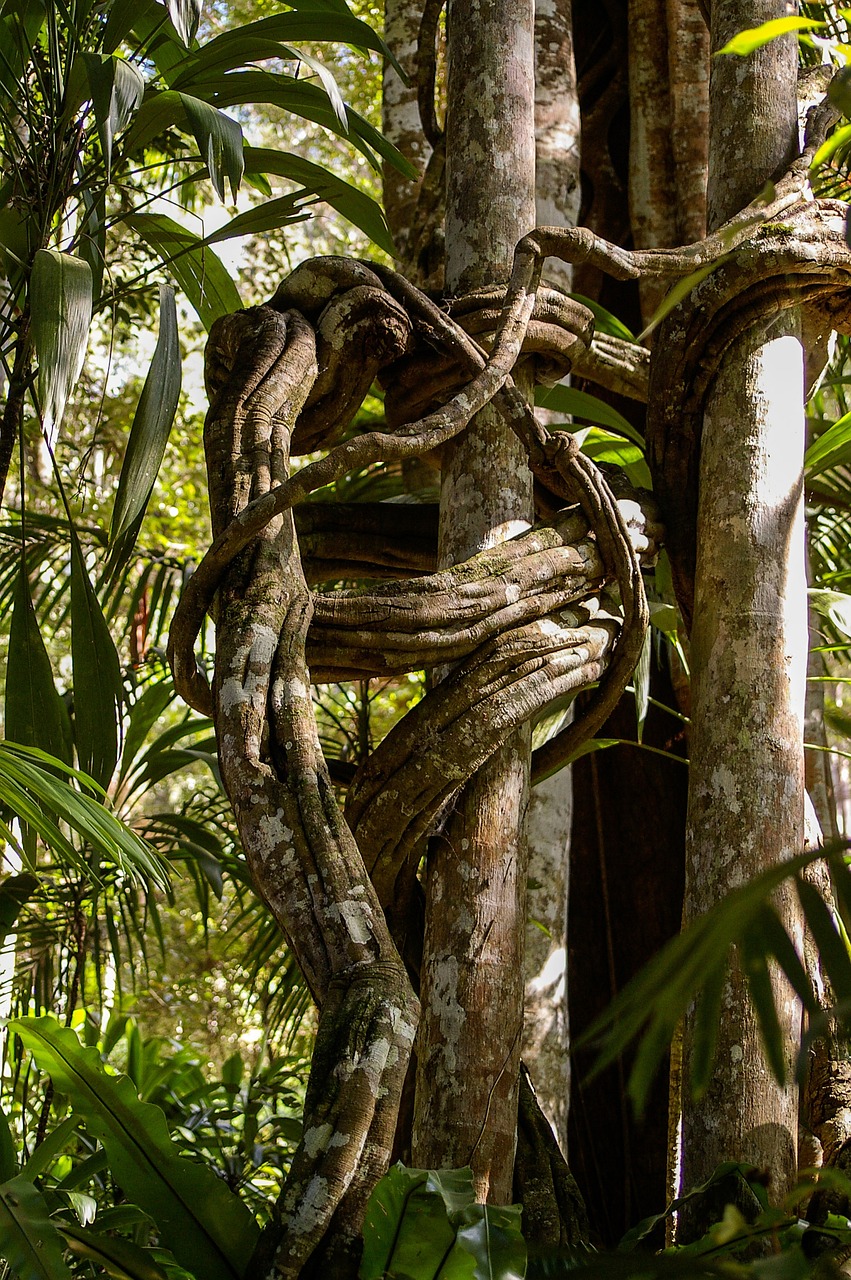
The Strangler's Lifecycle
A bird deposits a seed in a crack of bark high in the canopy. The seed germinates and the fig begins life as an epiphyte, surviving on rainwater and decomposing debris. Many seedlings die at this stage. Those that survive send roots toward the ground, becoming hemiepiphytes once they make soil contact. Growth accelerates. More roots descend, wrapping and fusing around the host trunk. The process takes 50-70 years to reach maturity.
Eventually, the host tree dies, outcompeted for light above and nutrients below. How long this takes varies enormously: a weak tree might succumb in a few years; a healthy giant could persist for a century or more. As the host rots away, the strangler becomes a free-standing tree with a hollow trunk, a cylinder of fused roots enclosing empty air. These hollow giants can live for centuries more.
Recognizing Strangler Figs
The genus Ficus contains approximately 850 species worldwide, with about 60 found in Costa Rica. Six strangler fig species occur in the Brunca region. All share the hemiepiphytic lifestyle, but each has distinguishing features. The universal traits are: copious white latex when cut, figs (syconia) borne in pairs at leaf axils, and the distinctive latticed trunk formed by fused aerial roots.
Physical Characteristics
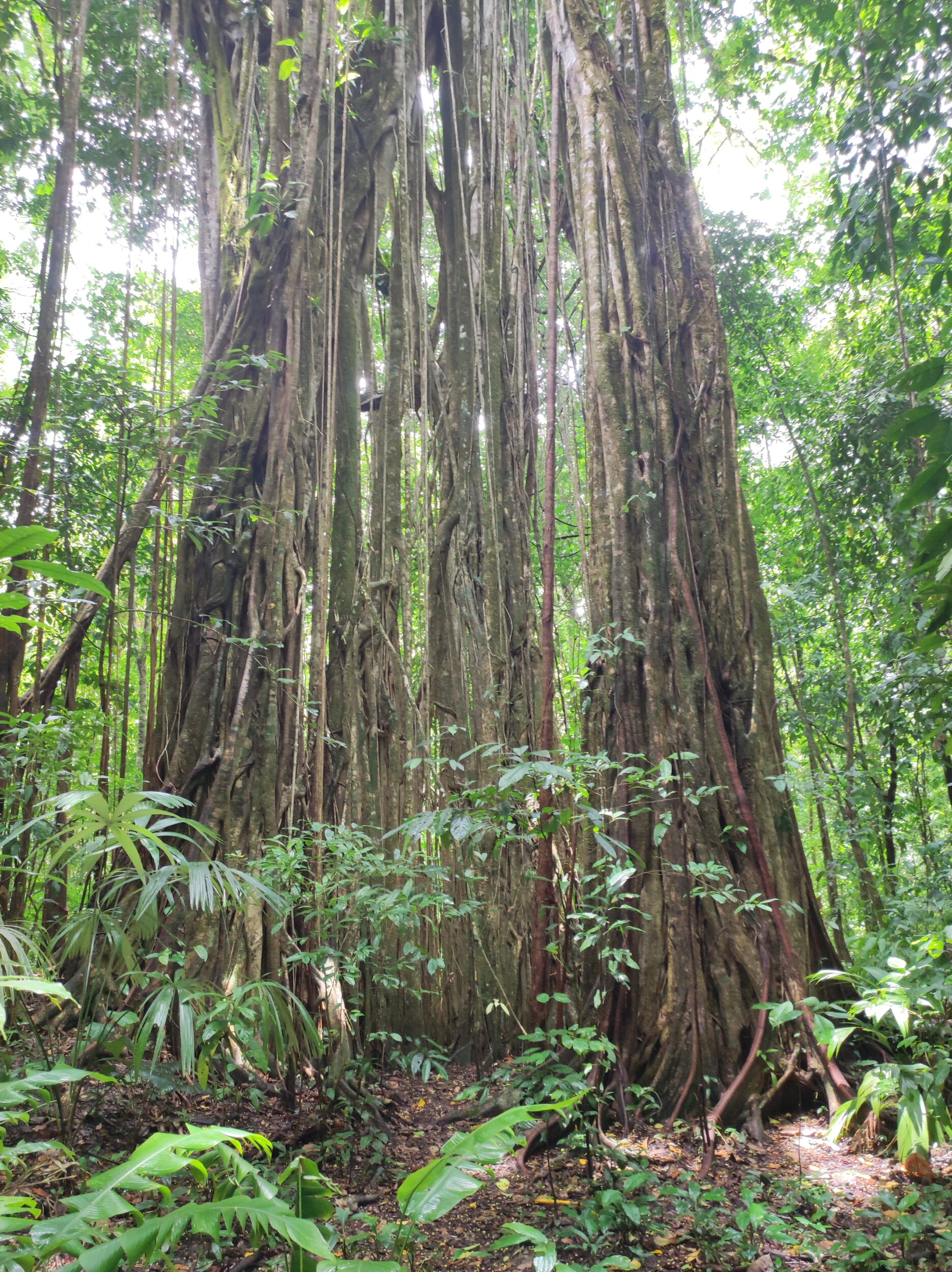
Trunk: In mature specimens, the trunk is not a single column but a fusion of descending aerial roots that have grown together over decades. The resulting structure is often hollow, with gaps and windows between the latticed roots. Bark is smooth and pale gray. Like all figs, it contains copious white latex.
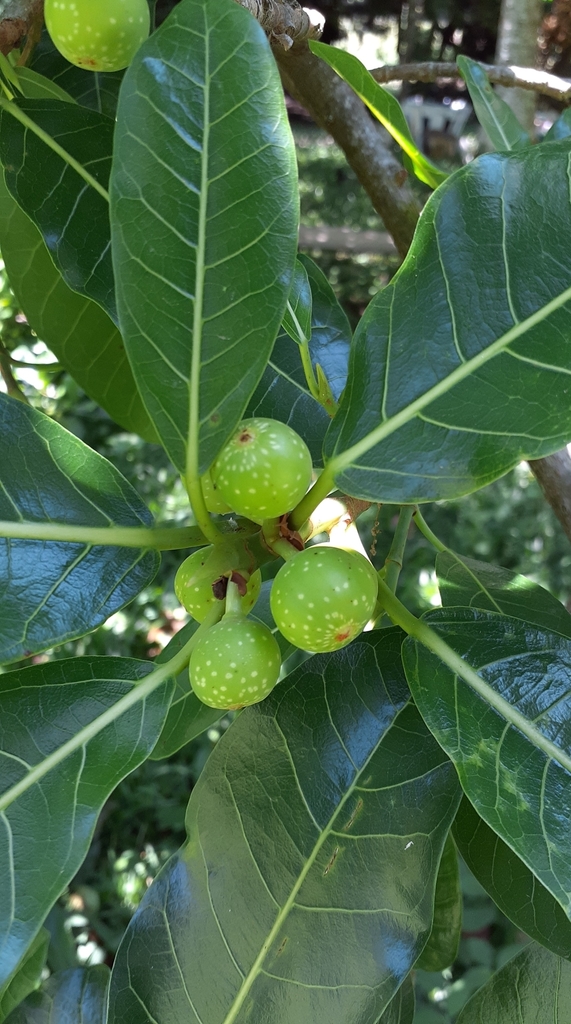
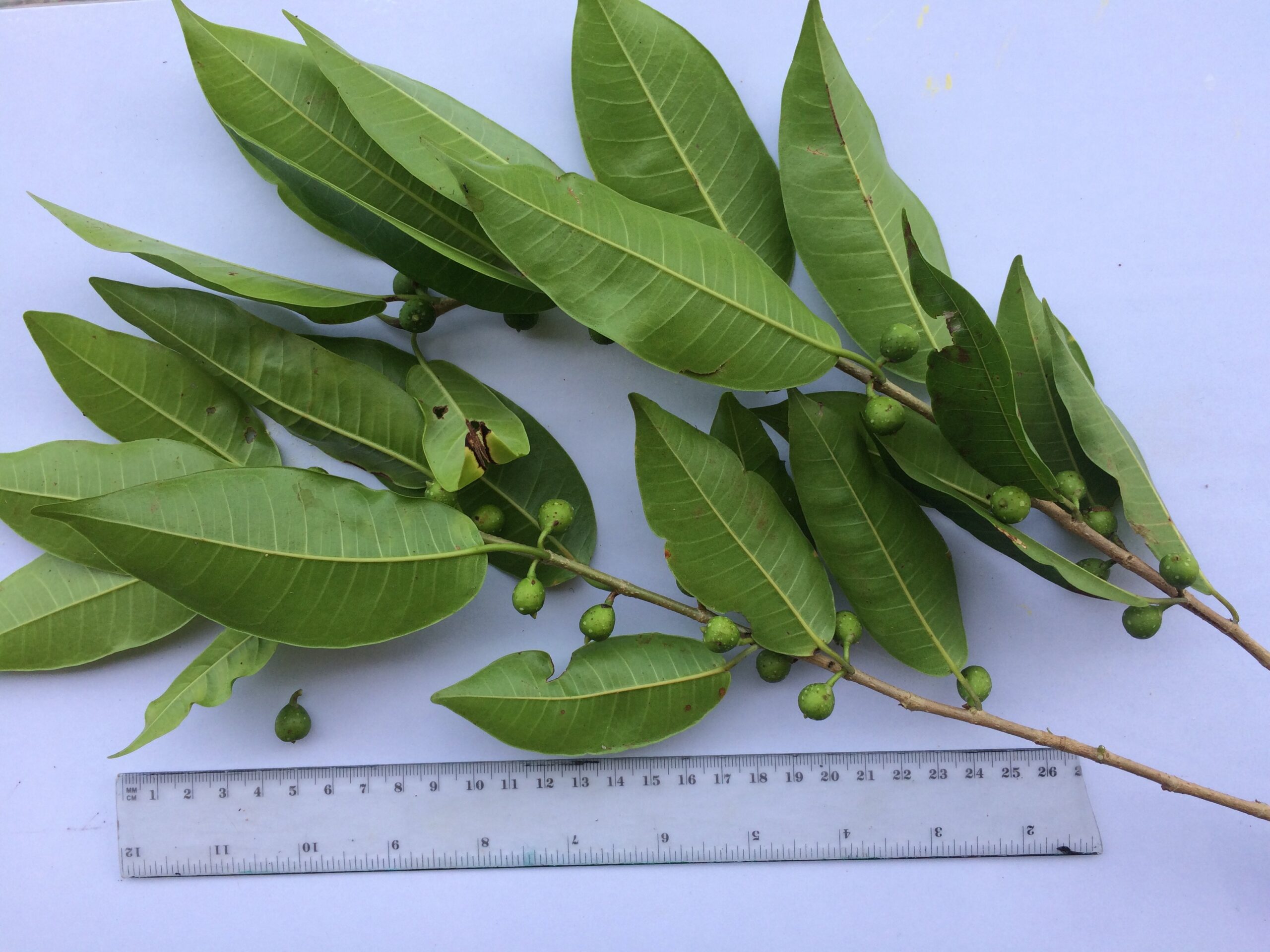
Leaves: Simple and alternate in all species, but size and shape vary considerably. F. obtusifolia has large spatulate leaves (8-20 cm) with blunt tips; F. nymphaeifolia has even larger rounded leaves (9-30 cm); F. pertusa and F. osensis have notably small, narrow leaves. Leaves are generally leathery and dark green. Young leaves are enclosed in prominent stipules, often pink.
Figs (Syconia): Spherical figs borne in pairs at leaf axils, though size varies by species: most are 1-2 cm in diameter, but F. nymphaeifolia produces larger figs (1.5-2.5 cm). Color progression from green to yellowish, reddish, or purple-spotted when ripe. Each fig contains hundreds of tiny flowers on its inner surface, pollinated by a species-specific wasp.
The Pollinator Wasp
Every fig species has its own pollinator wasp. Each of the six strangler species in Brunca depends on a different Pegoscapus wasp, and no other. This relationship is obligate: the wasp cannot reproduce without the fig, and the fig cannot produce fertile seeds without the wasp. The partnership is at least 75 million years old.
A female wasp, less than 2 mm long, locates a receptive fig by scent. She squeezes through the ostiole, a tiny pore at the fig's apex, losing her wings and antennae in the process. She will never leave. Inside, she deposits pollen collected from her birth fig, simultaneously laying eggs in some of the fig's flowers. The long-styled flowers receive only pollen and develop into seeds. The short-styled gall flowers receive eggs and develop into the next generation of wasps.
Male wasps emerge first, blind and wingless. They mate with still-enclosed females, then chew exit tunnels through the fig wall before dying. Females, now carrying pollen and fertilized eggs, crawl out and fly off to find another fig, continuing the cycle that has persisted since dinosaurs roamed the Earth.
Strangler vs. Free-Standing Figs
Not all figs strangle. Ficus insipida, the chilamate profiled elsewhere on this site, germinates in the soil and grows as a conventional tree from the start. Ficus obtusifolia takes the epiphytic route. Why the difference?
Strangler figs have solved the central problem of rainforest trees: reaching the light. In a closed-canopy forest, a seed germinating on the dark forest floor may wait decades for a gap before it can grow tall enough to photosynthesize effectively. Most seedlings die in this lightless purgatory. Strangler figs bypass the problem entirely. By germinating in the canopy, they start life in full sun, with only the challenge of eventually reaching soil water. The host tree provides the scaffold; the strangler provides the patience.
The strategy comes with costs. Strangler figs invest heavily in aerial roots before they ever reach the ground. Many epiphytic seedlings die before establishing soil contact. But those that succeed gain a massive competitive advantage: they occupy canopy space without having to compete for it from below.
The Six Stranglers of Brunca
The Brunca region hosts at least six strangler fig species, all locally called higuerón or matapalo. Two are endemics with extremely restricted ranges. The table below summarizes their distinguishing features.
| Species | Distinguishing Feature | Distribution | Fruiting |
|---|---|---|---|
| Ficus obtusifolia | Large, blunt-tipped (spatulate) leaves | Mexico to Brazil; Pacific slope | Jan-Feb, Jun-Jul, Oct-Dec |
| Ficus zarzalensis | Dramatic aerial root "curtains" | Costa Rica to Colombia; Pacific slope | Jan-Jun |
| Ficus osensis | Small leaves; ENDEMIC | Golfo Dulce + E Panama only | Aug, Oct |
| Ficus bullenei | Brown hairs throughout the plant | Costa Rica to Peru; Golfo Dulce | Jan, Aug |
| Ficus pertusa | Small, narrow leaves | Mexico to Paraguay; abundant | Year-round |
| Ficus nymphaeifolia | Large, rounded (water-lily) leaves | Mexico to Brazil; below 700 m | Variable |
Ficus obtusifolia — The Blunt-leaved Strangler
The most commonly encountered strangler in the Brunca region, and the one most visitors will see when hiking in Corcovado or along the Golfo Dulce. Recognized by its large, spatulate leaves (8-20 cm) with distinctively blunt tips, which give the species its name (obtusifolia = blunt-leaved). Distributed from Mexico to Brazil, concentrated on the Pacific slope in Costa Rica. Fruits in pulses: January-February, June-July, and October-December. Pollinator: Pegoscapus hoffmeyeri.

Ficus zarzalensis — The Root-Curtain Strangler
Distinguished by its numerous aerial roots that originate high in the canopy and descend in dramatic curtain-like formations. This visual effect is more pronounced than in other local stranglers. Found on the Pacific slope from Costa Rica to Colombia, with a more restricted range than F. obtusifolia. Fruits from January through June, making it an important early dry-season food source for wildlife. Pollinator: Pegoscapus sp. (undescribed).
Ficus osensis — The Osa Strangler
One of two endemic strangler figs in the region, known only from the Golfo Dulce lowlands and a small area of eastern Panama. Identified by its notably small leaves compared to other local stranglers. Fruits only in August and October, a narrow window that may make it vulnerable to climate shifts. Never formally assessed by the IUCN, but its extremely restricted range makes it a conservation priority. This is the strangler you are least likely to encounter, and most likely to overlook if you do. Pollinator: Pegoscapus sp. (undescribed).
Ficus bullenei — The Hairy Strangler
Unmistakable once you know what to look for: abundant brown hairs cover the entire plant, including leaves, stems, and figs. No other local strangler has this fuzzy texture. In Costa Rica, concentrated in the Golfo Dulce region, though its overall range extends south to Peru. Fruits in January and August. The hairy covering may reduce water loss or deter herbivores, though neither function has been confirmed experimentally. Pollinator: Pegoscapus gemellus.
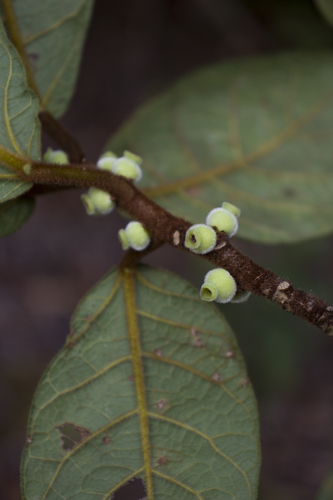
Ficus pertusa — The Narrow-leaved Strangler
The most widespread strangler in the Neotropics, ranging from Mexico to Paraguay and abundant throughout Costa Rica. Recognized by its small, narrow leaves, distinctly smaller than the spatulate leaves of F. obtusifolia. Unlike all other local stranglers, F. pertusa flowers and fruits year-round, making it arguably the single most important fig species for maintaining wildlife populations through seasonal food gaps. This continuous reproduction may explain its success across such a vast range. Pollinator: Pegoscapus silvestrii.
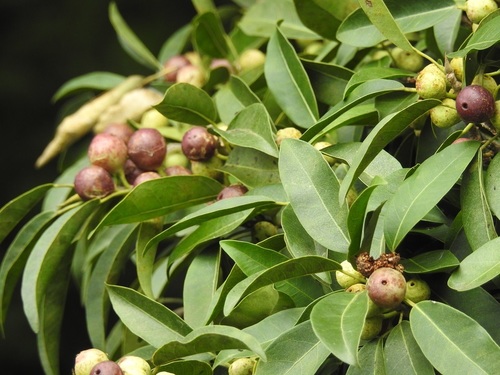
Ficus nymphaeifolia — The Water-Lily Strangler
Named for leaves that resemble water lilies (Nymphaea): large (9-30 cm), rounded to heart-shaped with a cordate base. These distinctive leaves make identification straightforward. One of the larger stranglers, reaching 35 meters. Its figs are also large (15-25 mm diameter), greenish with purple spots when ripe. Found from Mexico to Brazil, but restricted to elevations below 700 meters in Costa Rica. Research suggests its figs are particularly important for bats, which may be its primary seed dispersers. Pollinator: Pegoscapus sp. (undescribed).
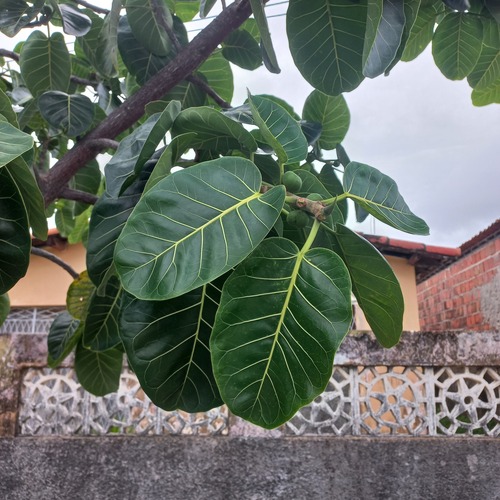
Strangler Figs vs. Lianas: Field Identification
At first glance, strangler figs and lianas can look similar: both are woody plants draped over host trees, both reach the canopy without building their own trunks from the ground up. But they represent fundamentally different life strategies, and learning to distinguish them reveals much about how tropical forests work.
The Fundamental Difference: Direction of Growth
The key distinction is where the plant began its life and which direction it grew. Strangler figs are primary hemiepiphytes: they germinate high in the canopy (from seeds deposited by birds or bats) and grow downward, sending aerial roots toward the soil. They share this strategy with Clusia species (some of which also strangle their hosts) and a few other tropical plants, but figs are by far the most common and conspicuous examples. Lianas, by contrast, germinate on the forest floor and climb upward, using the host tree as scaffolding to reach the light. One descends; the other ascends.
This difference in origin determines everything else. A liana remains rooted in the ground its entire life; it never loses soil contact. A strangler fig spends its early years as a true epiphyte, surviving on rainwater and decomposing debris in the canopy, only later establishing ground connection through its descending roots.
Visual Clues in the Field
The Lattice vs. The Rope
Perhaps the most reliable visual cue is the structure of what wraps the tree. Strangler fig roots descend as multiple separate strands that gradually fuse where they touch, creating a lattice or cage around the host trunk. Over decades, this lattice thickens into what resembles a melted candle poured over the tree. Lianas, by contrast, are single stems (or a few stems) that spiral upward like ropes. They grip the bark but do not envelop it.
Look also at where the woody material is thickest. On a strangler fig, the roots are thickest near the ground, where they have been growing longest and have fused most completely. On a liana, the stem is often thickest near the ground as well, but it remains a single coherent stem rather than a fusion of multiple roots.
End States: Independence vs. Dependence
The ultimate fate of each plant type reveals the difference most starkly. A mature strangler fig can stand alone. When its host dies and rots away, the strangler remains as a free-standing tree, its hollow trunk a cylinder of fused roots. It no longer needs the host; it has become structurally independent. A liana can never achieve this. It remains dependent on its host for structural support throughout its life. Kill the host tree and the liana collapses with it.
Wildlife Relationships
Strangler figs are keystone species, and collectively the six Brunca species provide fruit across most months of the year. But stranglers provide something beyond fruit: structure. The latticed trunks, the hollow centers, the complex architecture of fused roots create habitat found nowhere else in the forest.
The hollow interiors of mature strangler figs are particularly valuable. In tropical forests where standing dead trees quickly rot and collapse, the durable hollow trunks of strangler figs provide rare denning and nesting sites. The hollow may stretch from the base of the tree, where small mammals hide, to the very top where bats roost by day. Some hollow figs become multi-generational roosts used by bat colonies for decades. A single mature strangler can produce hundreds of thousands of figs per year, feeding wildlife through seasons when little else fruits.
People have recognized this architecture's value too. In Vanuatu, islanders have sheltered inside giant strangler figs during cyclones for thousands of years. According to UNICEF researchers, entire villages would wriggle down into the extensive root systems, tucking children into cavities and waiting out the storm. The interlaced roots form protective chambers with thick woody walls capable of shielding people from wind and flying debris. When Cyclone Pam struck Vanuatu in 2015, this traditional practice contributed to a remarkably low death toll.
Traditional Uses
Throughout its range, Ficus obtusifolia has been used by indigenous peoples for medicine and materials. The white latex, like that of other figs, contains proteolytic enzymes with documented anti-parasitic properties.
Unlike many timber trees, strangler figs are rarely logged. The hollow, irregular trunks yield little usable lumber. This has inadvertently protected them; mature strangler figs often survive in otherwise deforested landscapes, standing as solitary reminders of the original forest.
Climbing Strangler Figs in Costa Rica
The latticed roots and hollow interiors that make strangler figs ecological treasures also make them irresistible to climbers. In Costa Rica, a small tree climbing community has developed around these remarkable trees, offering visitors a chance to ascend into the canopy by routes that would be impossible on a conventional tree.
The technique requires no previous experience. Climbers wear harnesses and are belayed from below, with a guide controlling the rope and taking up slack as the climber ascends. What makes strangler figs special is the option to climb inside the hollow trunk. You enter through gaps in the root lattice at ground level and emerge high above, as if climbing up through a living chimney. Some mature figs offer routes of 30-40 meters.
Where to Climb
Monteverde: The cloud forest region is the center of Costa Rica's tree climbing culture. Several operators offer strangler fig climbs, and a massive fig along the road to the Monteverde Cloud Forest Reserve is freely accessible for self-guided climbing (bring your own gear). The Original Canopy Tour includes a 45-meter rappel followed by a climb up through the interior of a hollow strangler fig. Finca Modelo Ecológica offers climbs on a 40-meter strangler with three route options.
Osa Peninsula: Bosque del Cabo, a lodge on the southern Osa Peninsula, offers guided strangler fig climbs. The experience costs around $45 per person and lasts about 1.5 hours. Climbers ascend both inside and outside the tree, reaching the canopy where they can view the surrounding rainforest and Pacific Ocean.
Climbing Barefoot
Experienced tree climbers in Costa Rica often climb barefoot. This is not merely tradition. Rubber-soled shoes can damage the delicate bark and living tissues of the tree. Bare feet grip better on wet tropical bark and distribute weight more gently. Some climbing guides require it; others strongly recommend it. The practice reflects a broader ethic in the tree climbing community: the climb should leave no trace, and the tree's health takes precedence over the climber's comfort.
Organizations like Palo Vivo in the Monteverde area teach tree climbing to local children, combining recreation with environmental education. The goal is not to create thrill-seekers but to foster a generation that understands the forest from the inside, literally ascending into the canopy to see what most people never will: the strangler fig's crown, where fig wasps arrive, birds feed, and the hollow trunk opens to the sky.
Killer and Protector
The strangler fig defies simple categories. It is a parasite that may protect its host. It is a killer whose hollow corpse becomes a home. It is a tree that begins life as an air plant and ends it as the largest organism in the forest. For 50 years it may shelter its host from storms; for the next 50 it slowly starves it to death; for centuries after, it houses bat colonies and feeds the forest.
Perhaps this is why host trees have never evolved defenses against stranglers. The relationship may be too complex for simple resistance. A strangler fig kills eventually, but it also anchors, shelters, and reinforces. It takes decades, but it gives centuries. In the calculus of the rainforest, where storms flatten unprotected trees and droughts starve the unconnected, the strangler's embrace may be a bargain worth making.
Key Sources & Resources
Species Information
General overview of the species with information on distribution and characteristics.
Comprehensive information on uses, cultivation, and ecology of the species.
Database of Costa Rican trees including multiple Ficus species.
Osa Arboretum Species Pages
Detailed profile of the blunt-leaved strangler, the most common species in the region.
The root-curtain strangler, distinguished by its dramatic descending aerial roots.
Endemic to the Golfo Dulce region; characterized by small leaves.
The hairy strangler, distinguished by brown hairs covering the entire plant.
The narrow-leaved strangler, the most widespread Neotropical species.
The water-lily strangler, named for its distinctive rounded leaves.
Fig-Wasp Mutualism
Detailed explanation of the intricate reproductive relationship between figs and their pollinator wasps.
Overview of fig wasp biology, life cycle, and coevolutionary relationship with figs.
Strangler Fig Ecology
Popular article on the ecological importance of strangler figs in Costa Rican ecosystems.
Research comparing population genetics between strangler and free-standing fig species.
Overview of research suggesting strangler figs may protect their hosts from storm damage.
Original research from Cyclone Oswald (2013) in Queensland, Australia, showing trees with attached strangler figs were more likely to survive.
Tree Climbing
Details on guided strangler fig climbing experiences at this Osa Peninsula ecolodge.
Profile of the tree climbing culture in Monteverde, including the barefoot climbing ethic and Palo Vivo educational program.
Hemiepiphytes & Lianas
Scientific review clarifying the botanical terminology distinguishing hemiepiphytes from lianas and other climbing plants.
Comprehensive chapter on the ecology and growth forms of structurally dependent plants in tropical forests.
Accessible overview of liana ecology and their role in tropical forest ecosystems.