Ira Rosa
An emergent giant of the Osa rainforest whose tiny capsules bristle with purple spines and split to reveal a single orange-cloaked seed, so sweet that spider monkeys break off branches to reach it.
Sometime in the early 1950s, on forested hills behind a banana plantation near Palmar, in the Golfo Dulce country of southern Costa Rica, the botanist Paul Allen gathered fruiting branches of a tree he could not otherwise reach. The crown stood far overhead, well past the height of any ladder. The branches came to him because a roving band of spider monkeys, feeding in the canopy on the tree's sweet orange-arilled seeds, snapped off short fruiting twigs and let them fall to the forest floor. Allen collected what the monkeys discarded. The fruits in his hand were small woody capsules barely an inch long, densely armed with dark-purple, needle-like spines, and they belonged to a tree that local people at Sierpe called Zopilote, the vulture.
That relationship is written into the tree's names. Its epithet, picapica, is Costa Rican Spanish for cowitch or stinging hairs, a reference to the spiny capsule that itches like the climbing legume of the same nickname. When Paul Standley and Julian Steyermark first studied the species they reached for a different name altogether and called it, in unpublished manuscript, Sloanea simiarum, "Sloanea of the monkeys." Both names describe the same small, fiercely spined, monkey-harvested fruit produced, improbably, by one of the tallest trees in the Pacific lowland forest.
Identification
Habit
The Ira Rosa is a forest giant. The Manual de Plantas de Costa Rica records mature trees at 25 to 57 meters, and Allen measured one near Palmar at roughly 38 meters with a trunk over a meter across. It reaches the emergent layer, its crown standing above the general canopy and visible as a dense, vividly green dome of fine texture, with branches confined mostly to the upper third of the bole. The trunk itself is stout and often twisted, splaying at the base into thick, wall-like buttresses that rise as much as three meters and radiate outward in every direction. Buttresses of that scale anchor a heavy tree on the shallow, waterlogged soils it favors, and they make a fallen specimen unmistakable even when no leaves or fruit can be found. The bark is light brown to gray and scaly, the youngest twigs brown, marked with pale lenticels and a short dense felt of hairs that soon wears away.
Leaves
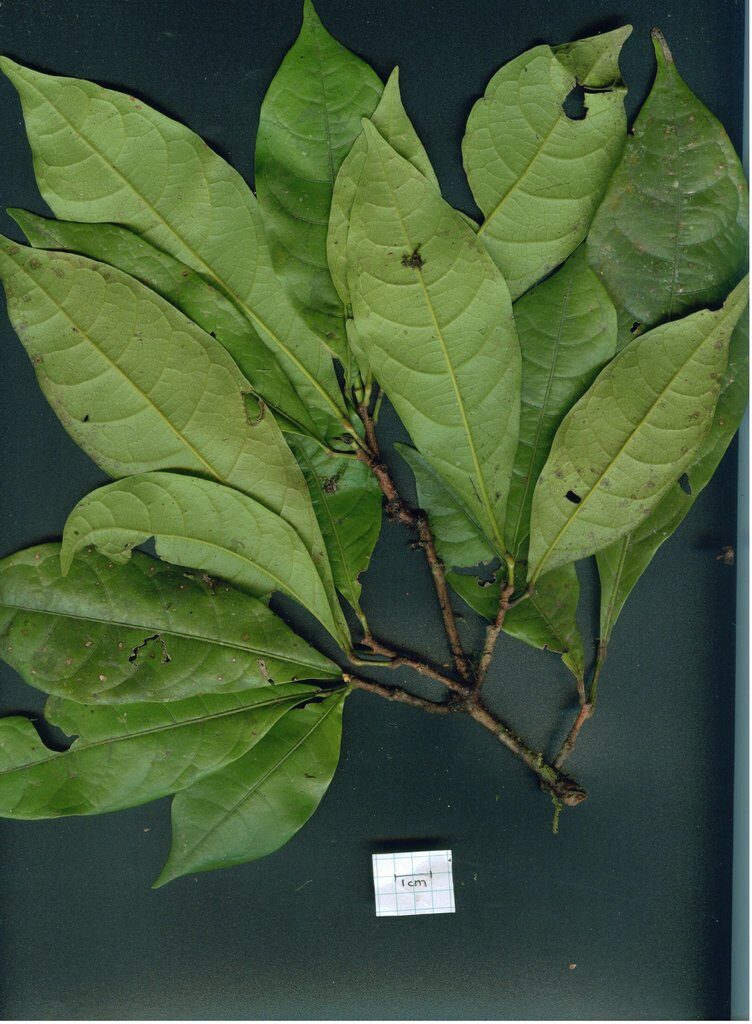
For so large a tree the leaves are surprisingly small. They are simple and alternate, the blade measuring roughly 3 to 9 centimeters long and 1.5 to 4.8 wide, elliptic in outline and drawn out at the tip into a long, narrow point that botanists call caudate. The margin is entire and the surface smooth, the shape variable and often slightly asymmetric from one side of the midrib to the other. A distinctive trait of the genus appears at the leaf base, where the petiole is doubly pulvinate, swollen at both ends like a tiny double hinge that lets the blade pivot toward light. The secondary veins arc upward and bend toward the vein above them, a small character that the Manual uses to key the species out. Slender, sickle-shaped stipules sit at the base of each young leaf but drop early, so they are seldom seen. The tree is evergreen, exchanging old leaves for new during a flush in May and June.
Flowers
The flowers are easy to miss and unpleasant to smell. Borne in small subumbellate or cymose clusters on stubby axillary shoots, each flower is only about 4 millimeters across and carries no petals at all, a feature shared across the genus. What it offers instead is a tight, brush-like tuft of stamens surrounding a green pistil, framed by four small yellowish sepals little more than a millimeter long. The filaments are roughly twice the length of the anthers and conspicuously hairy, tipped by a minute sterile point. The whole flower gives off a faintly disagreeable odor, the kind of smell that suggests pollination by small generalist insects drawn to a brushy mass of pollen rather than by the bright color or nectar a bee or hummingbird would seek. Flowering runs through the second half of the year, recorded in August, October, and December and extending toward January.
Fruits
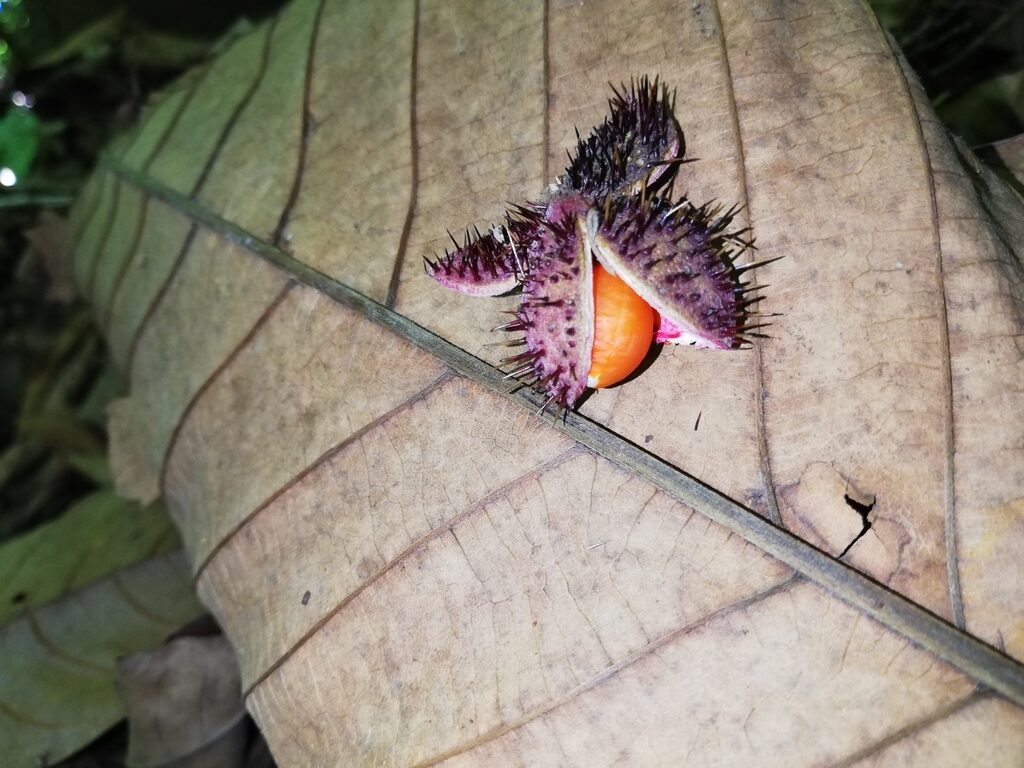
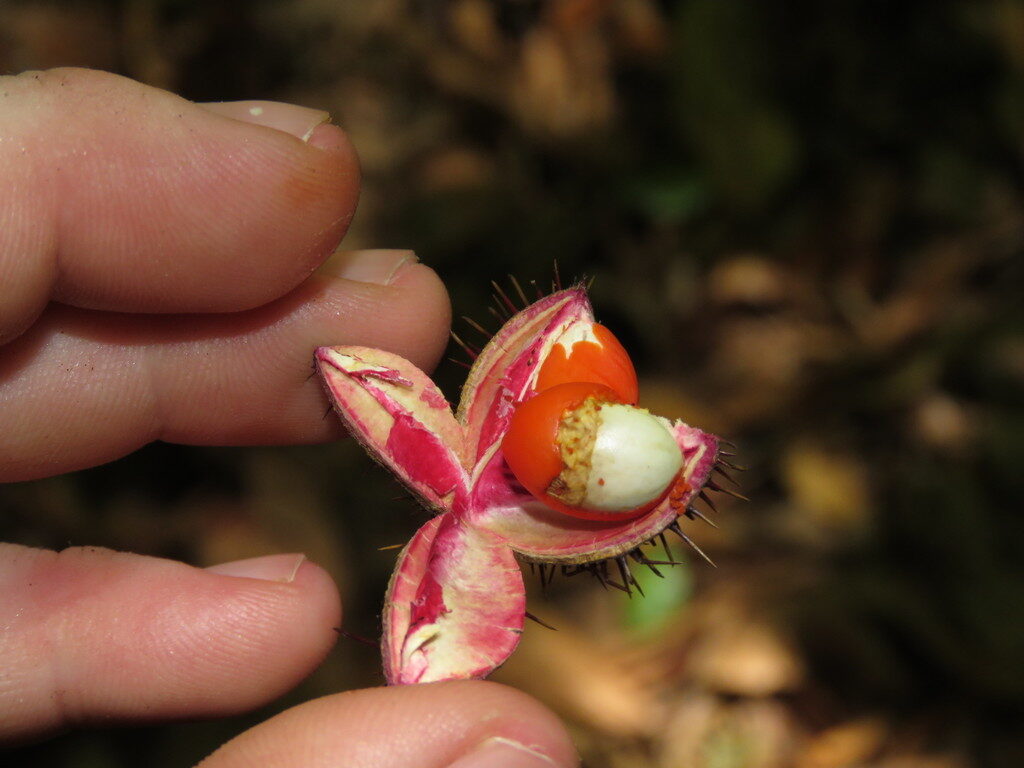
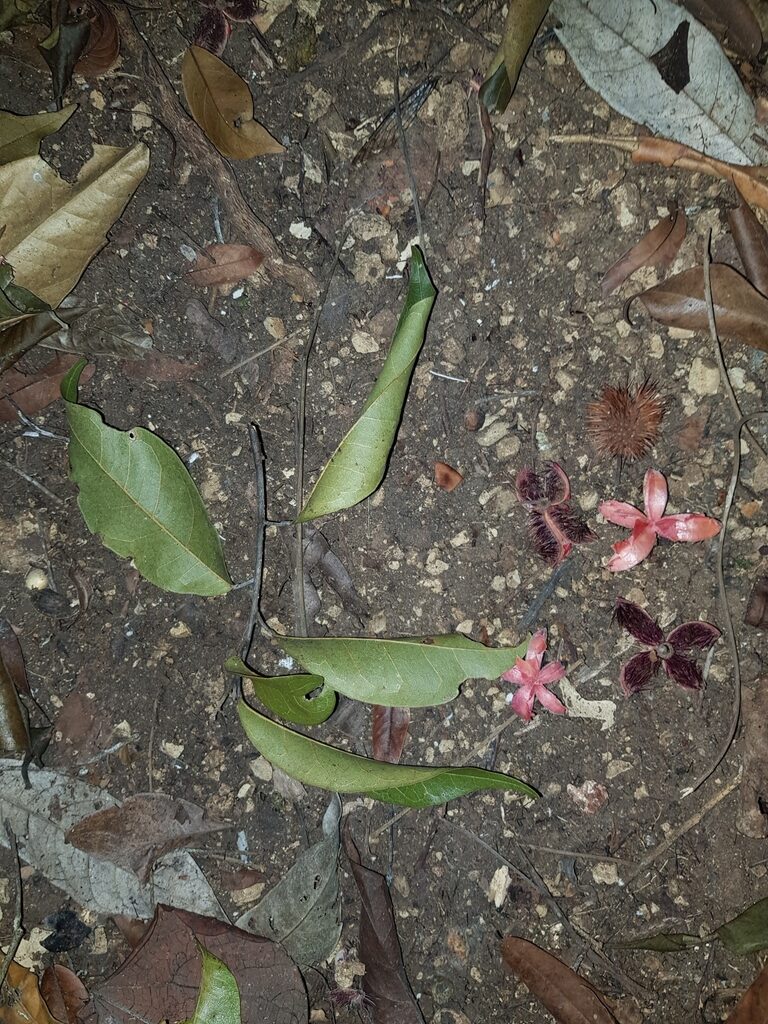
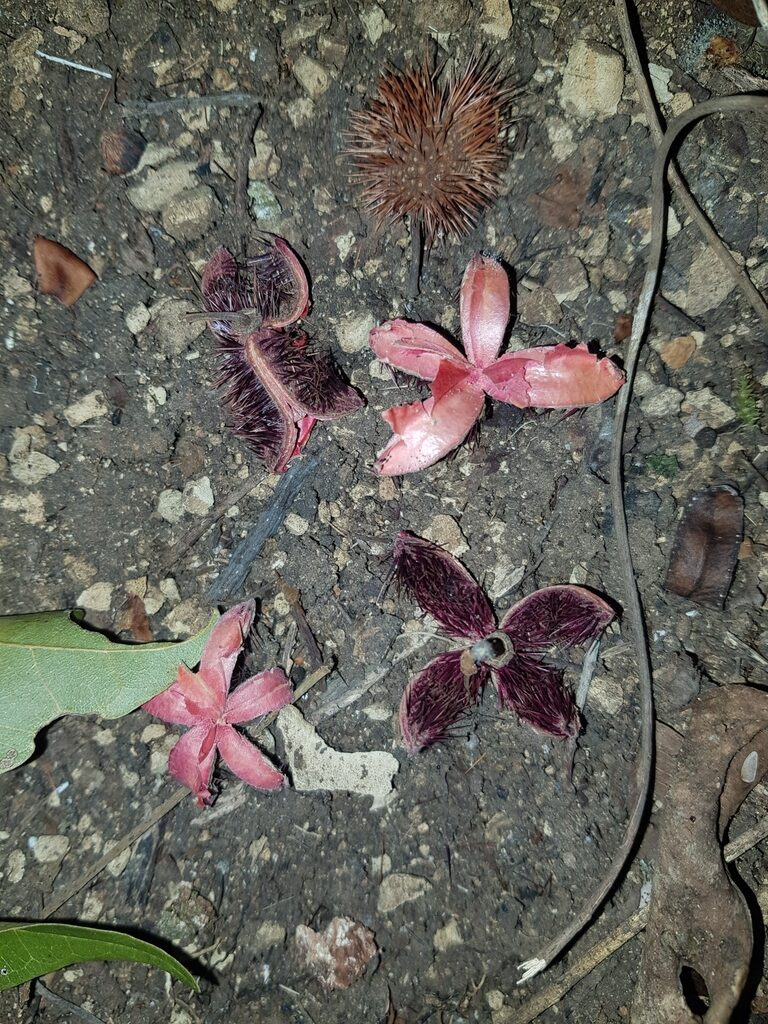
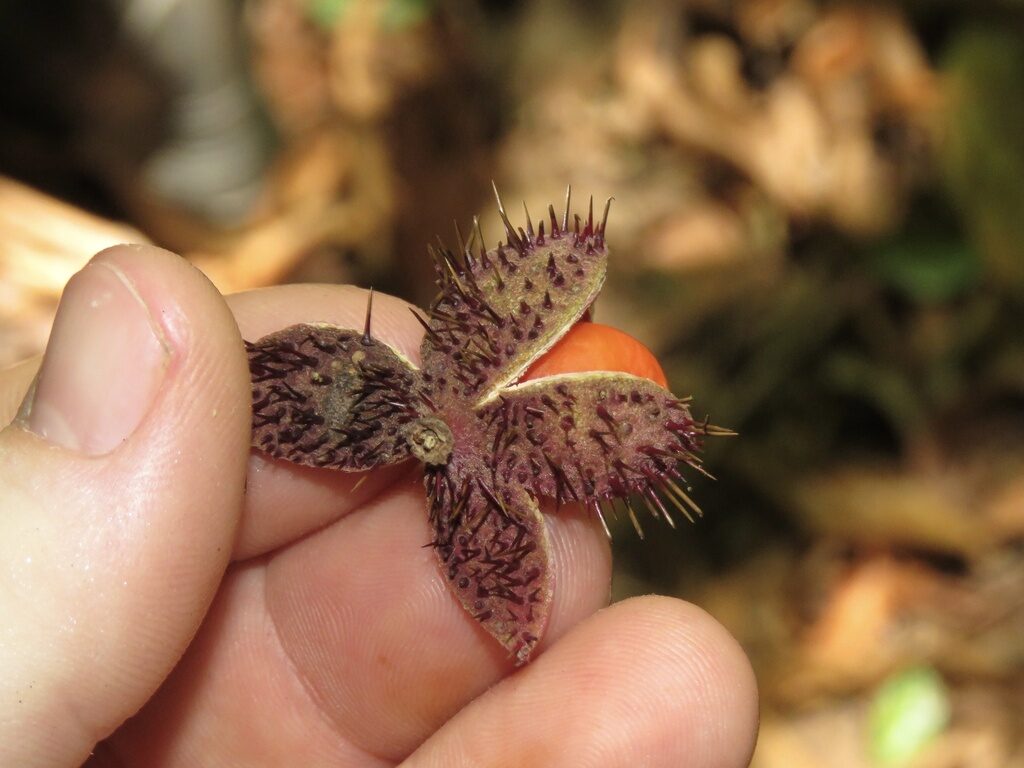
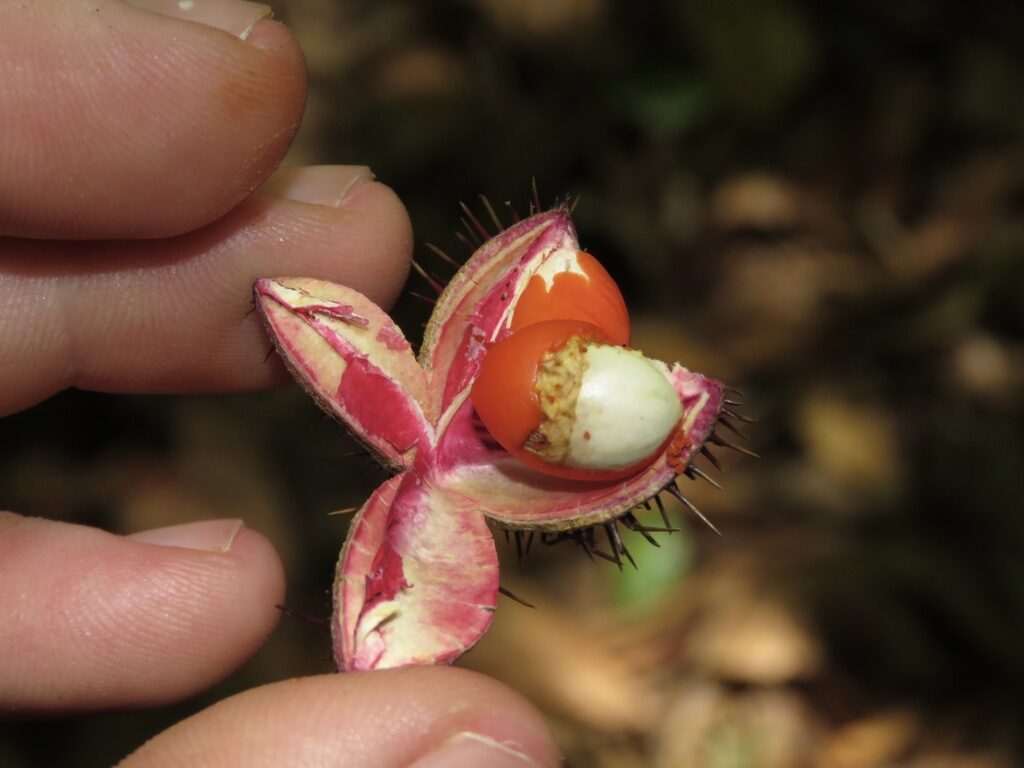
The fruit is the tree's signature. It is a woody, loculicidal capsule between 1.4 and 1.8 centimeters long, green at first and ripening through reddish to a striking violet-maroon. The whole rind is set with straight, sharp, brittle spines up to about six to nine millimeters long, monomorphic in form, which snap off readily and give the capsule its itch-provoking character and the tree its name. As it dries, the capsule splits into four or five irregular, petal-like valves that curl back from the center, and it is these rose-colored, splayed valves scattered across the litter that earned the name Ira Rosa. Each capsule usually holds a single seed. Allen recorded fruiting in late March; modern observations place the harvest from February into April. Once fallen, the seeds germinate almost immediately on reaching the damp forest floor.
Distribution
The Ira Rosa ranges along the wet Neotropical lowlands from Honduras and Nicaragua south through Costa Rica into Colombia, Ecuador, Peru, Bolivia, Venezuela, and Guyana. Of the roughly two hundred occurrence records compiled by GBIF, more than eighty come from Costa Rica, where the species sits at the northern heart of its distribution. In Costa Rica it is overwhelmingly a tree of the Pacific south. The great majority of its records cluster in Puntarenas on and around the Osa Peninsula, with scattered occurrences on the Caribbean slope at places like Caño Negro and the Bananito valley near Limón.
The Brunca region holds the densest concentration of all, with more than forty documented localities. Collectors have found it again and again along the trails of the Sirena station in Corcovado National Park, on the Jack, Ollas, Anacardium, and Pavo trails and the banks of the Río Claro, and through the Reserva Forestal Golfo Dulce at Río Nuevo and the Trocha de La Tarde south of Rincón. It grows along the Río Sierpe between the town of Sierpe and Boca Chocuaco within the Térraba-Sierpe wetlands, in the forested hills near Palmar Sur where Allen first collected it, around the Esquinas station in the Coto Colorado valley, and as far north as Manuel Antonio and the Carara reserve on the central Pacific. The species reaches from sea level to nearly 500 meters, but in Costa Rica it is a creature of the lowlands, most at home below 300.
Within those forests the Ira Rosa keeps to wet and very wet lowland forest and shows a clear preference for poorly drained, water-saturated ground. It turns up again and again near or beside small streams, the kind of low, soggy terrain where its broad buttresses pay off. It is an uncommon tree wherever it grows, scattered as single individuals rather than forming stands, a pattern typical of the genus throughout the wet Neotropics.
Ecology
The unpleasant, petalless flowers point to generalist insect pollination, though no specific pollinator has been documented for the species. The interesting story lies on the other side of the life cycle, in how the seeds get away from the parent tree. Inside the spiny armor of each capsule sits a single white seed wrapped in a thin, bright orange aril, and that aril is sweet. Paul Allen reported the seeds as edible and pleasantly flavored, and the animals of the forest agree. In Manuel Antonio, squirrel monkeys and white-faced capuchins take them; elsewhere it is the spider monkeys, joined by fruit-eating birds, that strip the arils. The spiny husk seems designed to make the animals work for the reward, dropping or discarding the empty capsule once the soft aril is gone.
The tree does not feed its dispersers every year. Field observers report that large fruit harvests appear roughly every other year, and that the individuals of the species seem to ripen in synchrony, all fruiting heavily in the same season and then resting. This supra-annual masting, common among long-lived tropical canopy trees, can satiate seed predators and concentrate the attention of dispersers in the years of plenty. The spider monkeys that feed in the crown become, in effect, the tree's branch pruners and seed couriers at once, and it was exactly that behavior, monkeys snapping off fruiting twigs high overhead, that delivered the first scientific specimens into a botanist's hands.
Taxonomic History
The species was named in 1940 by Paul Carpenter Standley, the prolific American botanist of the Field Museum of Natural History in Chicago, in the museum's Botanical Series. Standley (1884-1963) was one of the great cataloguers of Central American plants, author of the floras of Guatemala and Costa Rica and of Trees and Shrubs of Mexico. He often skipped making duplicate collections, which means many of his specimens are unique, and after retiring he settled at the Escuela Agrícola Panamericana in Honduras, dying in Tegucigalpa in 1963. The type specimen of Sloanea picapica, Christine von Hagen 1390, sits in the Field Museum herbarium with a duplicate at the New York Botanical Garden. It was gathered in Costa Rica by Christine von Hagen, who traveled the country in 1940 with her husband, the explorer and popular historian Victor Wolfgang von Hagen, during his expedition through Panama and Costa Rica; Standley described the species the same year.
The genus name honors Sir Hans Sloane (1660-1753), the Anglo-Irish physician and collector whose vast cabinet of 71,000 specimens and curiosities became the founding collection of the British Museum, the Natural History Museum, and the British Library. Linnaeus, who had visited Sloane and drawn on his published illustrations for Species Plantarum, named the genus for him. The epithet picapica comes from the Costa Rican name for cowitch or stinging hairs, applied here to the irritating spines of the capsule. The unpublished manuscript name that Standley and Steyermark first considered, Sloanea simiarum, the Sloanea of monkeys, never reached valid publication but survives in the literature as a record of how immediately the tree's natural history struck its first students. Two later names, Sloanea potsniroki from Peru and Sloanea ptariana from Venezuela, were eventually folded into S. picapica as synonyms in the comprehensive 2017 monograph of the American species of the genus by Terence Pennington and Robert Wise.
Similar Species
Costa Rica is home to a dozen or more species of Sloanea, and telling them apart can be demanding. The Ira Rosa is set apart by the combination of small, alternate, long-pointed leaves and small fruits sparsely armed with straight, sharp, brittle spines. In Allen's original Golfo Dulce field key the simplest contrast was with Sloanea laurifolia, whose leaves run larger than ten centimeters and whose woody capsules carry no spines at all. Among the spiny-fruited species, S. medusula, the Peine de Mico, is unmistakable on its own enormous leaves and far longer fruit spines, up to two centimeters, and its styles divided nearly to the base. Sloanea petenensis shares the hairy stamen filaments of the Ira Rosa but its styles are divided only toward the tip. Two more lowland congeners, S. rugosa with its opposite, felted leaves and S. terniflora, the Terciopelo, with broad obovate leaves and large purple sepals, separate readily on foliage.
Conservation Outlook
The Ira Rosa has not been assessed by the IUCN and carries no formal conservation status. Its broad geographic range, from Honduras to Bolivia, and its presence in a network of major protected areas suggest the species as a whole is not in immediate danger. In Costa Rica it occurs inside Corcovado National Park, Manuel Antonio National Park, the Reserva Forestal Golfo Dulce, the Carara reserve, the Térraba-Sierpe National Wetland, and the Caño Negro wildlife refuge, an unusually strong spread of protection for a single lowland tree.
That security depends on the lowland wet forest it requires. The tree is uncommon, scattered, and slow to establish a presence, and its strong attachment to poorly drained, stream-side ground ties it to exactly the low, wet terrain most exposed to drainage, agricultural conversion, and development along the Pacific coast. Its wood is hard, dark brown, and notably durable, reported to resist rot even in contact with soil or water, which has long made it useful for construction despite the twisted form of the bole. Where the forest stands, the Ira Rosa holds its place as one of the quiet giants of the canopy, recognized less often by its crown than by the rose-colored, spiny capsules the monkeys leave scattered on the ground below.
Resources & Further Reading
Species Information
Plants of the World Online entry with distribution and synonymy.
Global occurrence records and specimen data, including the Costa Rican collections.
Detailed field account with dispersers, masting, and fruit description.
Osa Peninsula species profile with phenology and common names.
Summary of morphology, habitat, edibility, and timber properties.
Citizen-science observations and field photographs from across the range.
Taxonomy & Nomenclature
Nomenclatural data, type specimens, and synonymy from Missouri Botanical Garden.
Comprehensive modern monograph that synonymized S. potsniroki and S. ptariana under S. picapica.
The original publication describing Sloanea picapica, via the Biodiversity Heritage Library.
Biography of the Field Museum botanist who named the species.
The collector whose cabinet founded the British Museum and lent his name to the genus.
The explorer whose 1940 Costa Rica expedition produced the type collection by Christine von Hagen.
Related Reading
Paul Allen's classic account of the Golfo Dulce flora, with the original Sloanea picapica field description and the spider-monkey collecting story (pp. 325-326).
Authoritative modern flora; the Elaeocarpaceae treatment provides the technical description and Costa Rican distribution.
Genus-level reference for the more than 100 American species of Sloanea.
Overview of the family and its placement in the order Oxalidales.