Sebo
Virola sebifera — The original Virola, this slender understory tree of the nutmeg family was the first species described in a genus that would later become central to Amazonian shamanism. Its fat-rich seeds once lit indigenous homes as natural candles, and its blood-red sap hints at the potent alkaloids coursing through its kin.
In 1775, the French botanist Jean Baptiste Christophore Fusée Aublet published his monumental Histoire des plantes de la Guiane françoise, a four-volume catalog of the flora he had encountered in French Guiana. Among the trees he described was a slender species with blood-red sap and fatty seeds that local people burned as torches. He named it Virola sebifera, from the Latin "sebum" meaning tallow or fat, establishing the type specimen for what would become a genus of over 60 species spanning the American tropics.
Today the Sebo remains one of the most widespread Virola species, growing from Honduras through Costa Rica and Panama into South America, where it reaches Bolivia and Brazil. Unlike its larger cousin Virola koschnyi, which ascends into the rainforest canopy, the Sebo is primarily an understory tree, thriving in the diminished light of the forest floor. Its narrow, pyramidal silhouette and distinctively reddish-brown branchlets make it recognizable even in the dense vegetation of primary tropical forest.

Identification
Physical Characteristics
Crown: The Sebo displays the narrow, pyramidal crown characteristic of the genus Virola. Very long, thin horizontal branches emerge at right angles from the upper third of the trunk. These highly flexible, whip-like limbs droop under the weight of foliage, creating a distinctive tall, narrow silhouette. The tree typically branches only in its upper portion, with an unbranched bole below that rises through the forest understory.
Trunk: The trunk is straight and cylindrical, rarely exceeding 20 cm in diameter in typical understory individuals, though specimens in optimal conditions can reach 30-40 cm. Young trees display smooth, dark bark streaked with fine vertical lenticels. As the tree matures, the bark becomes lighter and rougher, showing moderate exfoliation in larger individuals. Elevated scars mark former limb positions along the unbranched bole. Buttresses are absent. When cut, the bark bleeds a watery sap that rapidly oxidizes to blood-red.
Leaves: Simple and alternate, the leaves measure approximately 6 by 2 cm, maintaining consistent width along most of their length before abruptly narrowing to a drip tip. Rust-colored hairs densely cover the leaf undersurfaces, particularly along the petioles and the thin, zigzagging twigs. This pubescence, combined with the distinctively reddish-brown color of the young branchlets, provides a reliable field identification character.
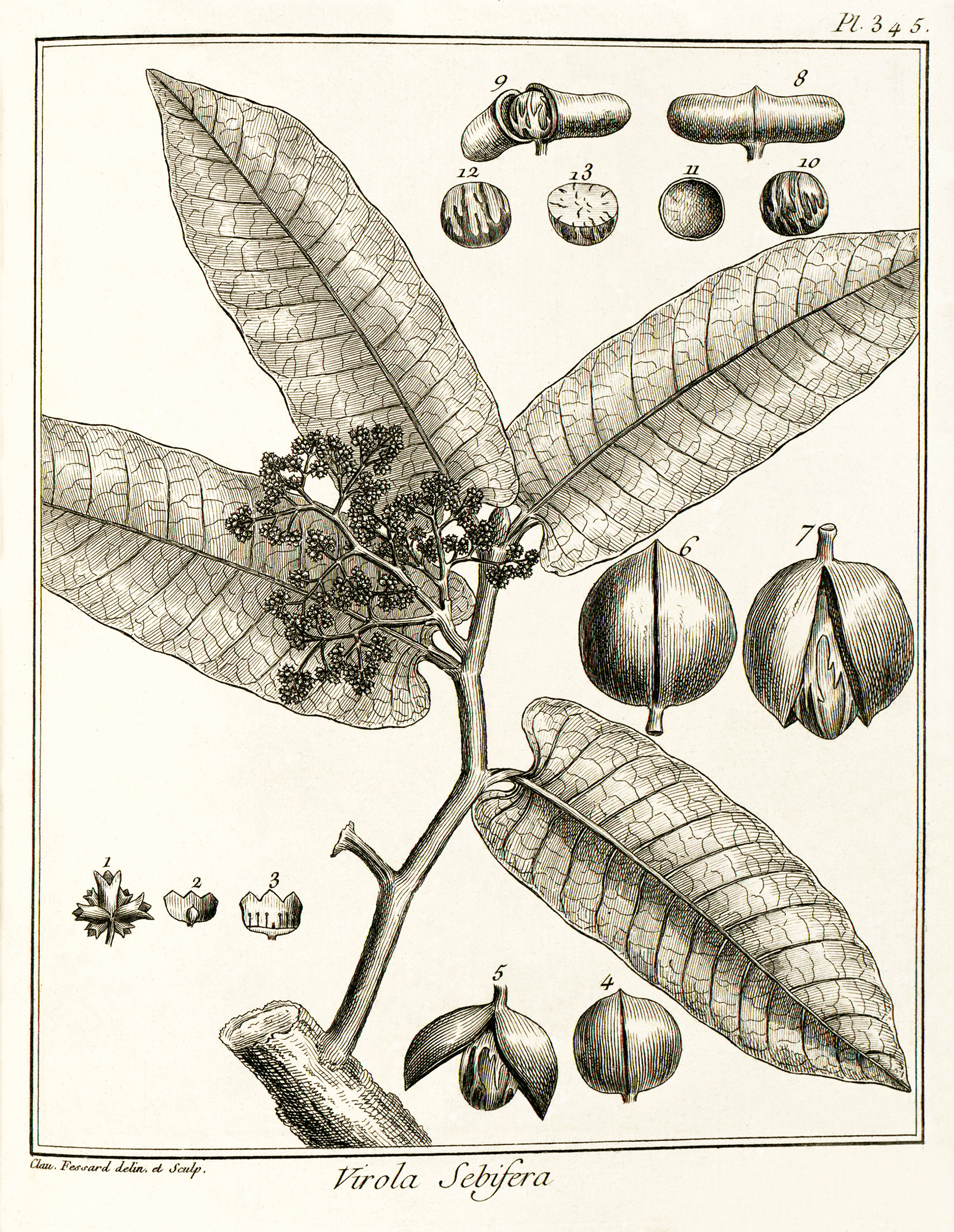
Flowers: The species is dioecious, with individual trees bearing either male or female flowers. The plain, petalless blossoms are tiny, measuring only 2 mm in diameter, with four brown sepals covered in fine hairs. They are produced in dense, rust-colored axillary panicles and emit a faint citrus-like aroma that attracts pollinating insects. Flower buds emerge in December, with the flowering period annual, well-synchronized, and very regular: the first blossoms open in February and the last in June.
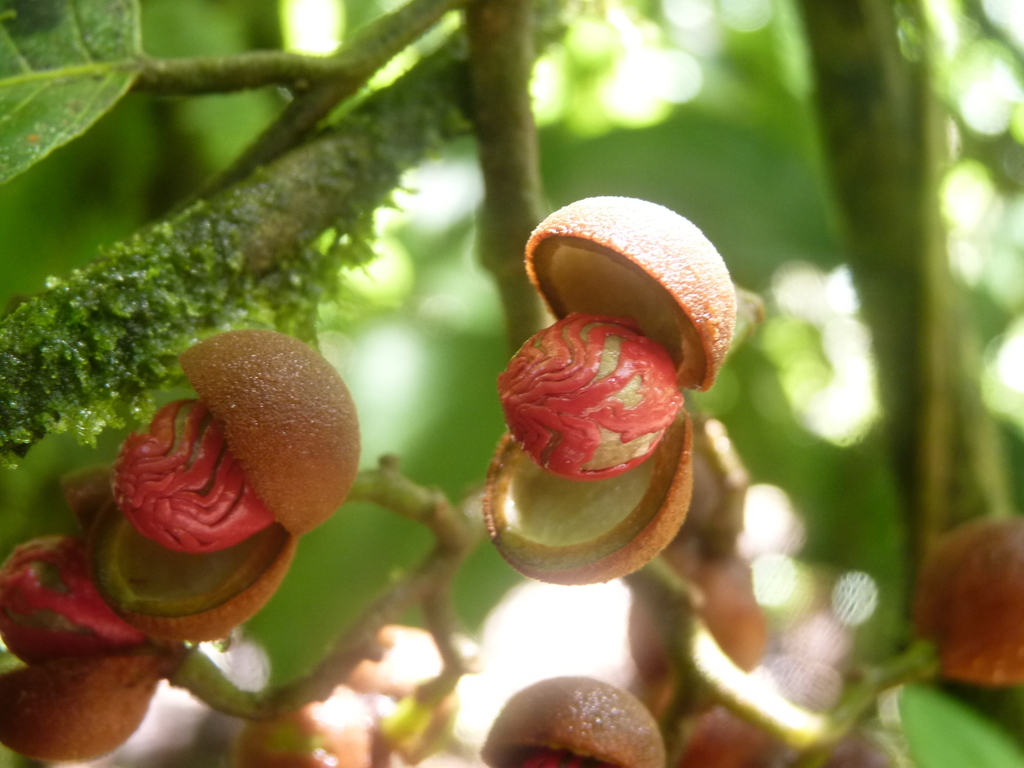
Fruit: Immature fruits appear as early as April and develop into velvety, rust-colored, nearly spherical dehiscent capsules arranged in clusters. Each capsule splits longitudinally into two equal valves to reveal a single, round, grooved seed covered with a stringy, scarlet-red aril. This net-like aril is rich in lipids and attracts the birds and mammals that disperse the seeds. Unlike Virola koschnyi, which produces golden-yellow capsules, the Sebo's fruits remain rust-colored throughout development. Fruiting occurs annually in October and November, with harvests varying from year to year.
Distinguishing from Similar Species
Five or six Virola species occur in Costa Rica, and field identification requires attention to detail. The Sebo is most reliably distinguished by its reddish-brown branchlets and its position as an understory tree. The closely related Virola koschnyi is significantly larger (reaching the canopy at 25-35 m) and produces bright golden-yellow fruit capsules rather than rust-colored ones. Lacmellea panamensis has similarly shaped leaves but displays opposite leaf arrangement and conspicuous trunk thorns. The characteristic blood-red sap that flows when bark is cut is shared by all Virola species and confirms membership in the genus.
Ecology
Habitat and Distribution
The Sebo thrives in the diminished light regimes characteristic of the lower levels of primary rainforest. It is a common evergreen understory to occasional subcanopy tree, distributed from Honduras through Central America to South America, where it ranges to Brazil and Bolivia. In Costa Rica, it occurs on both the Atlantic and Pacific slopes at elevations from sea level to 1,000 meters, occasionally reaching 1,500 m. Some sources note that it is more common in semideciduous forests and secondary growth on well-drained soils than in dense primary forest.
A Keystone Resource
The Sebo fruits during annual periods of fruit scarcity in the tropical forest. This timing makes it a keystone plant resource, sustaining populations of fruit-eating birds and mammals that are critical for dispersing seeds of many other tree species throughout the year. Research on Barro Colorado Island in Panama has revealed just how valuable this food source is: the scarlet aril surrounding each seed contains 54% lipid, 7% protein, and 8% usable carbohydrate, making it one of the most nutritious fruit structures documented for any bird-dispersed plant.
The Birds That Plant Forests
Pioneering research by ecologist Henry F. Howe on Barro Colorado Island documented the remarkable efficiency of the Sebo's seed dispersal system. Each tree produces 1 to 96 ripe arillate seeds daily (averaging 24), and an astonishing 40-89% of these are taken by birds within just a few hours of dawn. The seeds are swallowed whole, and the birds regurgitate them intact within 10-30 minutes, depositing them far from the parent tree.
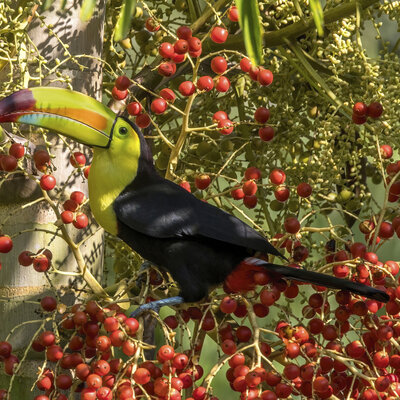
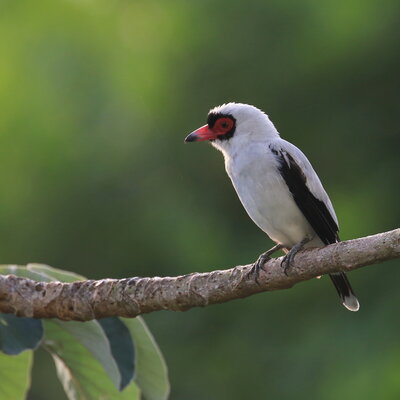
Three bird species serve as "regulars" visiting most or all trees in a population: the Chestnut-mandibled Toucan (Ramphastos swainsonii), which alone accounts for 43% of seeds removed; the Keel-billed Toucan (R. sulfuratus); and the Masked Tityra (Tityra semifasciata). Three additional species, the Slaty-tailed Trogon, Rufous Motmot, and Collared Aracari, visit less consistently but still contribute to dispersal. Among mammals, white-faced capuchins, howler monkeys, and spider monkeys also feed on the lipid-rich arils.
 Chestnut-mandibled Toucan
 Keel-billed Toucan
 Masked Tityra
 Slaty-tailed Trogon
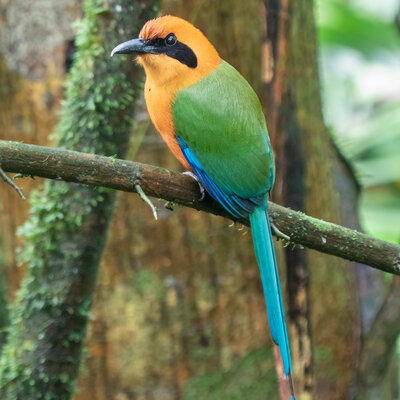 Rufous Motmot
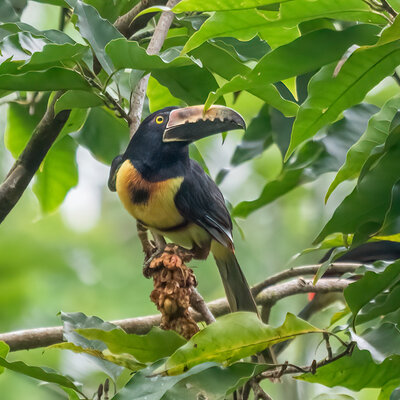 Collared Aracari
Pollination is carried out by insects, particularly bees and other small visitors attracted by the faint citrus scent of the tiny flowers. The phenological cycle is highly regular, with flowering synchronized across individual trees, ensuring effective cross-pollination during the February to June flowering window.
Traditional Uses
Seeds as Candles
The Sebo's most distinctive use gave it both its scientific and common names. The seeds contain a yellow, aromatic fat that smells like nutmeg, reflecting the tree's membership in the same family as the famous spice. Indigenous peoples of the Talamanca mountains in Costa Rica and native Panamanians developed an ingenious application: they skewered the oily seeds on splinters of wood and burned them as natural candles. These seed torches produce intense light and little smoke, and emit a pleasant fragrance as they burn.
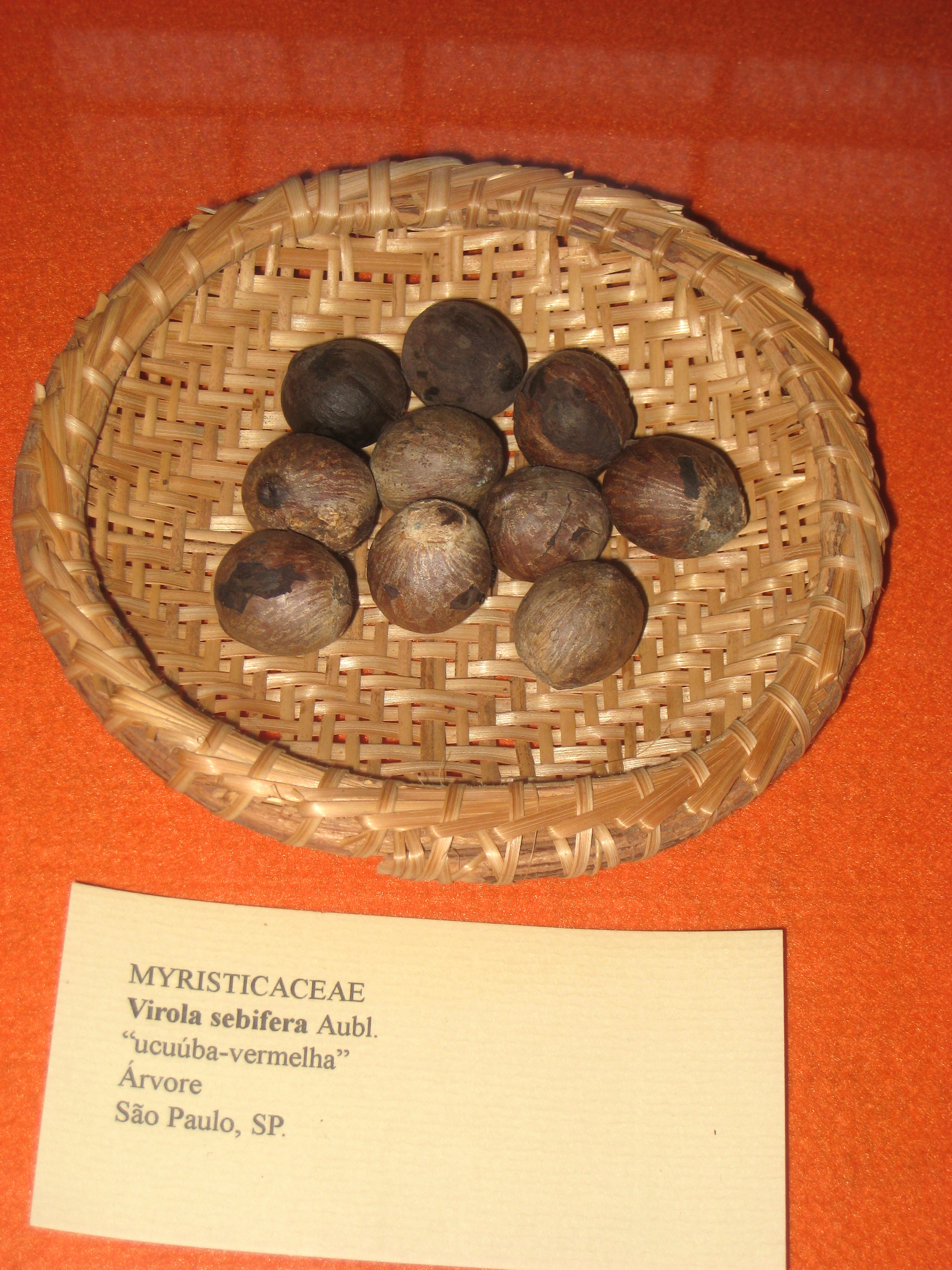
Seed Oil and Industrial Uses
The fat extracted from Sebo seeds has properties similar to cocoa butter and shea butter. Historically it was processed for candle-making, soap production, and as a lubricant for machinery. The oil becomes rancid quickly, limiting some applications, but it remains valued in traditional contexts. The fat has also been used as a base for medicinal preparations.
Medicinal Uses
Various parts of the Sebo have been used in traditional medicine throughout its range. The bark serves as an astringent, emetic, and stimulant preparation. Decoctions of the bark treat dyspepsia, intestinal colic, and erysipelas. The resinous red sap is applied directly to toothaches and mouth sores, as well as skin ulcers and eruptions. In Venezuela, shamans smoke the dried inner bark at ritual dances to treat fever conditions, calling it "wircawei-yek" or "erika-bai-yek." The smoke is also employed to drive out evil spirits.
In modern homeopathy, the tree is known as "Myristica sebifera" and preparations from the red resin are used for treating suppurative conditions such as abscesses, boils, and fistulas. The remedy was proved and introduced by the homeopath Mure, who noted that it caused "pain in the finger-nails with swelling of the phalanges," leading to its use in treating whitlow (a painful infection of the fingertip).
Alkaloids and the Shamanic Connection
Chemical analysis of Sebo bark has revealed a complex cocktail of psychoactive compounds. The bark contains 0.065-0.25% alkaloids, primarily N,N-dimethyltryptamine (DMT) and 5-methoxy-DMT, the same compounds that make ayahuasca and other Virola species so potent. Researchers have also identified N-methyl-N-formyltryptamine, N-methyl-N-acetyltryptamine, and β-carboline compounds including 2-methyl-1,2,3,4-tetrahydro-β-carboline. The β-carbolines function as monoamine oxidase inhibitors (MAOIs), preventing the breakdown of DMT and enabling it to be active when taken orally.
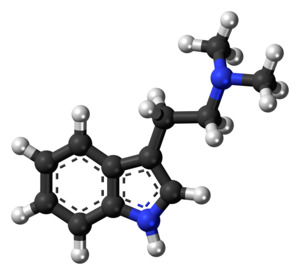 N,N-DMT
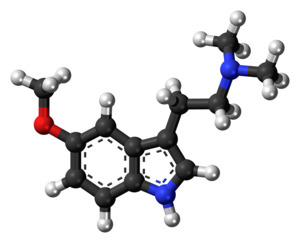 5-MeO-DMT
The resin or "gum" of the bark contains the highest alkaloid concentrations, reaching up to 8%. This explains why indigenous peoples carefully scrape and process the inner bark rather than simply using the outer layers. The use of various Virola species as ritual snuffs was first documented by American ethnobotanist Richard Evans Schultes in the 1950s, who was astonished that such significant practices had gone unrecorded by Western science for so long.
Wood
The Sebo produces a moderately light wood with a density of approximately 0.48-0.54 g/cm³, placing it in the same range as Spanish cedar and mahogany. As the wood dries, the heartwood develops a pinkish golden-brown to deep reddish-brown color, with lighter cream-colored sapwood that is not sharply demarcated. The grain is straight with a coarse texture and low to medium luster. With a low silica content (around 0.11%), the wood works easily with both hand and machine tools, producing an excellent finish. It glues well, is easy to hammer, and cuts cleanly into veneers. Its workability is often compared to Spanish cedar and mahogany.
Traditional uses include interior construction, paneling, furniture, cabinetry, matchsticks, toothpicks, toys, cigar boxes, and as pulp for paper. The wood is also valued for plywood and veneer production. However, its low natural durability and high susceptibility to termites make it unsuitable for exterior applications or ground contact. The wood has good dimensional stability once properly dried, making it reliable for interior work where it will not be exposed to moisture.
Propagation and Growth
The Sebo presents challenges for cultivation. As a dioecious species, both male and female trees are required for seed production. Germination rates are generally low, typically less than 30%, with seeds sprouting within 30-50 days when sown fresh. Seeds remain viable only for a limited period and require the damp, shady conditions of old-growth forest understory to germinate successfully. Seedlings grow slowly at first, rarely exceeding 2 meters in height during the second year. These characteristics help explain why the Sebo thrives in stable primary forest but is less common in highly disturbed areas.
The Type Species
Among the approximately 60 species in the genus Virola, V. sebifera holds special taxonomic significance as the type species. When Aublet described it in 1775, he established the genus itself, making the Sebo the reference point against which all other Virola species are compared. The genus would later gain notoriety for species like V. elongata, V. calophylla, and V. theiodora, which contain high concentrations of tryptamine alkaloids and are central to indigenous Amazonian shamanism.
Virola represents the largest American genus in the Myristicaceae and the fourth largest in the family worldwide. The family itself, which includes the nutmeg tree Myristica fragrans, ranks among the most ecologically important tree families in lowland tropical forests globally. The lipid-rich arils that characterize Virola fruits make these trees crucial food sources for the frugivorous birds and primates that maintain forest diversity.
Key Sources & Resources
Species Information
Overview of the species including taxonomy, description, distribution, and uses.
Detailed species account with identification features, ecology, and natural history for Costa Rica's Pacific lowlands.
Species profile from the Osa Peninsula arboretum with local ecological context.
Kew's authoritative taxonomic database with accepted name, synonyms, and distribution data.
Comprehensive database entry covering uses, cultivation, and botanical description.
Taxonomy and Systematics
Comprehensive taxonomic treatment of all Mesoamerican Virola species, including six newly described species.
The original 1775 publication where Aublet described Virola sebifera and established the genus Virola.
Ecological Research
Henry F. Howe's foundational research on seed dispersal at Barro Colorado Island, documenting fruit nutrition, bird visitors, and the 44-fold survival advantage for dispersed seeds.
Research identifying Virola sebifera as a keystone resource that sustains frugivore populations during periods of fruit scarcity.
Research extending Howe's findings to montane forest ecosystems in Bolivia.
Phytochemistry and Ethnobotany
Chemical analysis identifying DMT, 5-MeO-DMT, and β-carboline compounds in Virola sebifera bark used for hallucinogenic snuffs in Venezuela.
Comprehensive review of traditional uses, phytochemistry, and biological activity across the Virola genus.
Information on the ethnobotanical use of Virola species as shamanic snuffs by Amazonian peoples.
Biography of the "father of ethnobotany" who documented Virola use by indigenous Amazonian peoples in the 1950s.
Overview of the genus covering ecology, ethnobotany, and phytochemistry.
Wood Properties
Detailed wood properties including density, workability, and commercial applications.
Cultivation requirements, propagation notes, and medicinal uses.
Family Context
Overview of the nutmeg family's global diversity and ecological importance.