Sandbox Tree
Hura crepitans — The "dynamite tree" shoots its seeds like bullets, bleeds toxic sap used for poison arrows, and bristles with spines that earn it another name: monkey-no-climb.
A Tree That Shoots Back
In 1977, botanists M.D. Swaine and T. Beer set up recording equipment beneath a sandbox tree in Ghana and waited. When the pumpkin-shaped fruit finally exploded, it did so with a sound like a gunshot. High-speed analysis revealed seeds leaving the capsule at 70 meters per second, roughly 250 kilometers per hour. The seeds traveled up to 45 meters from the parent tree, spinning with backspin that reduced drag and extended their flight.
This explosive dispersal gives Hura crepitans one of its common names: the dynamite tree. But the sandbox tree has earned many names, each reflecting a different aspect of its formidable nature. In Costa Rica it is called javillo or jabillo. In the Caribbean, where the Caribs extracted its sap for poison arrows, it is known as the possumwood. In the Amazon, the Tupi name is assacu. The conical spines that armor its trunk have inspired monkey-no-climb, while the explosive fruit has generated monkey's dinner bell (the sound announces that seeds are falling) and monkey's pistol.
Quick Facts
The Explosive Fruit
The fruit of the sandbox tree is a flattened, pumpkin-shaped capsule about 5-8 centimeters in diameter, divided into 16 radially arranged segments like the sections of a tangerine. Each segment contains a single coin-shaped seed. As the fruit matures and dries, tension builds in the woody walls of each segment. When the stress becomes too great, the fruit explodes, flinging its seeds in all directions.
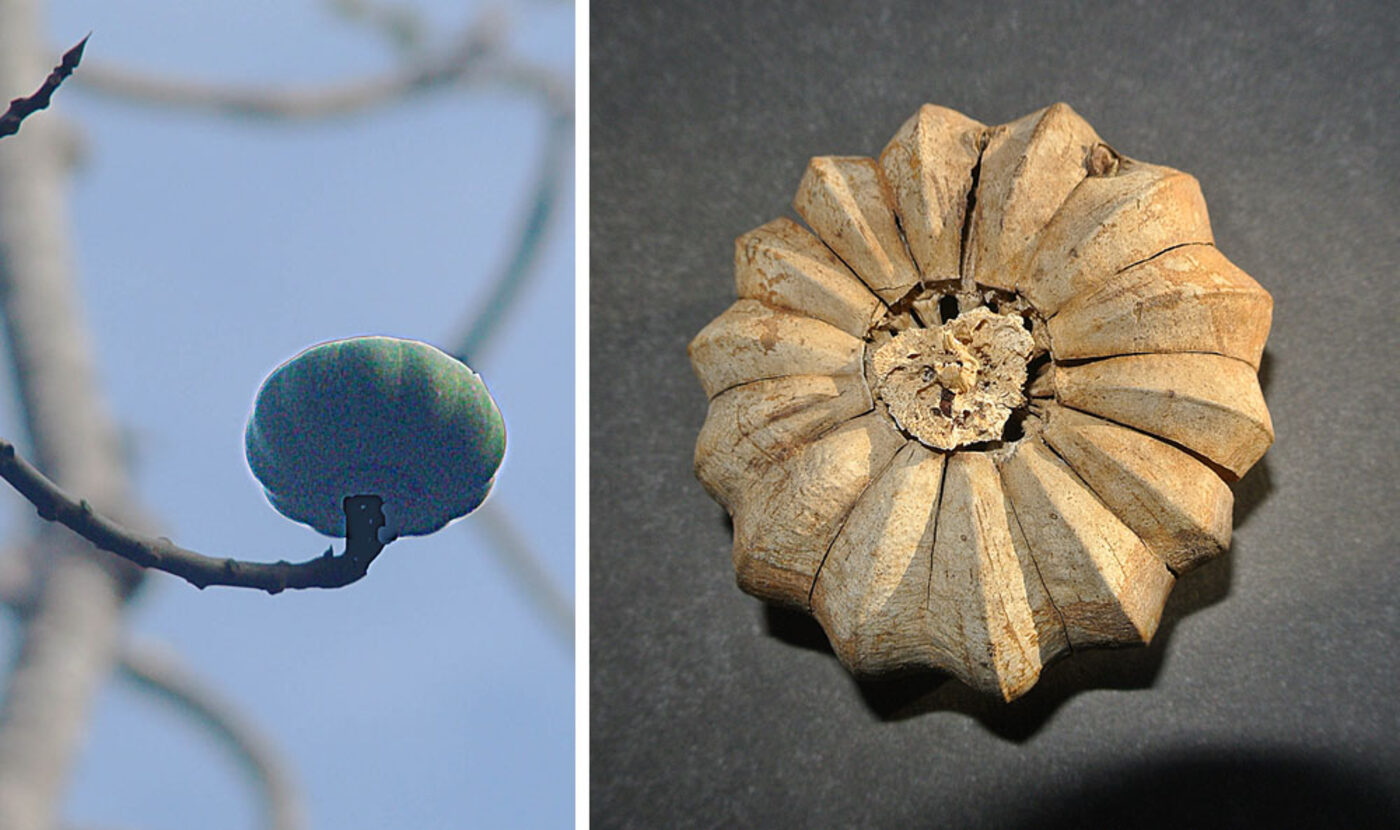
The explosion is loud enough to startle anyone nearby. In the dry season, when most dispersal occurs, the sound echoes through the forest. Standing beneath a ripe sandbox tree is inadvisable: the seeds are hard and fast enough to cause injury. The trees are sometimes avoided for this reason, and their use as street trees is limited despite their attractive form.
The English name "sandbox tree" comes from a more peaceful use of the fruit. In the colonial British West Indies, before the era of blotting paper, writers sprinkled fine sand over wet ink to dry it. The sandbox tree's fruit capsules, with their elegant radial segments, made attractive containers for this sand. Craftsmen would harvest unripe capsules before they could explode, then either wire the segments together or pour molten lead into the center to hold them in place. These "pounce pots" became fashionable desk accessories, decorated and polished to sit beside quills and inkwells. The practice has long disappeared, but the name remains.
Toxic Sap and Poison Arrows
The sandbox tree bleeds a thick, white latex when cut. This sap contains huratoxin, a diterpene compound, along with phorbol esters and other irritants. Contact with the skin causes severe inflammation. Contact with the eyes can cause temporary or permanent blindness. Ingestion is dangerous: the seeds, if eaten, act as a violent purgative and emetic.
The Caribs of the Caribbean recognized this toxicity and turned it to their advantage. They extracted the latex and applied it to the tips of their arrows, creating a poison that could incapacitate prey and enemies alike. The same compounds that make the sap dangerous to humans are also toxic to fish: fishermen in some regions still use sandbox latex to stun fish in streams and pools, a practice that predates European contact.
The Spiny Trunk
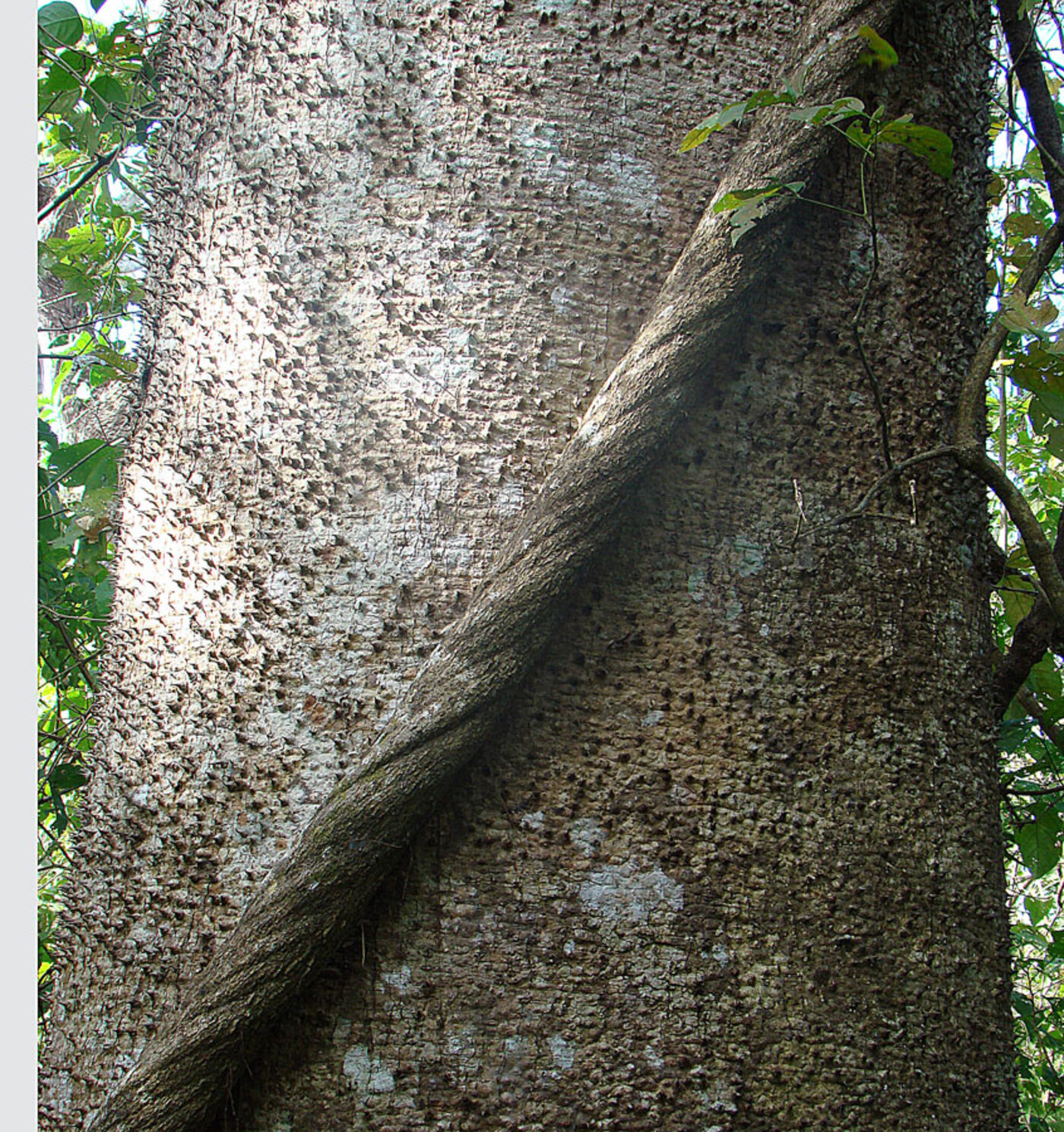
The trunk of the sandbox tree is unmistakable. Pale gray bark is studded with hundreds of dark, conical spines, each curved slightly upward like a horn. These spines persist throughout the tree's life, covering the trunk from base to canopy. The effect is formidable: nothing climbs a sandbox tree casually. Hence the name monkey-no-climb, used throughout the Americas.
The spines likely evolved as a defense against herbivores, though their effectiveness today is incidental. What matters ecologically is that the sandbox tree has survived long enough to become a canopy giant. Mature trees reach 35-50 meters in height, with straight, columnar trunks that can exceed two meters in diameter. The bole often rises 20-30 meters before the first branch, making the tree valuable for timber despite the hazards of harvesting it. The leaves are large and heart-shaped, up to 60 centimeters long, with a thin, papery texture and a pattern of prominent veins.
Flowers and Pollination
The sandbox tree is monoecious, bearing separate male and female flowers on the same tree. The male flowers are striking: dark red, cone-shaped catkins about 5 centimeters long, densely packed with stamens but lacking petals. The female flowers are smaller and solitary, each with a maroon, daisy-shaped structure and a conspicuous swelling at the base that will become the fruit. Both flower types bloom primarily from late dry season through the wet season, though in consistently wet areas flowering may occur year-round.

Pollination in the sandbox tree is unusual for the spurge family: it is primarily bat-pollinated. The flowers emit a fermenting odor at night that attracts fruit bats, particularly species in the genus Artibeus. The flower structure facilitates this relationship: the exposed stamens produce copious pollen, and the large stigmatic surfaces of the female flowers readily receive it from bat fur. Secondary pollination occurs via nocturnal sweat bees (Megalopta), and wind may play a minor role given the exposed stamens, but bats are the primary vectors.
Habitat and Distribution
The sandbox tree ranges from Nicaragua through Central America to Peru, Bolivia, and Brazil, and throughout the Caribbean islands. In Costa Rica, it occurs along rivers and streams throughout the Pacific slope, from the dry forests of Guanacaste in the north to the wet forests of the Osa Peninsula in the south. It thrives in gallery forests from sea level to about 1,000 meters elevation. The tree is found in Corcovado National Park, where it grows alongside other canopy giants like Ceiba pentandra, Dipteryx panamensis, and Carapa guianensis. Populations also occur in Santa Rosa and Palo Verde national parks in Guanacaste.
The sandbox tree's key requirement is access to water. Whether in the seasonal forests of Guanacaste or the year-round wet forests of the Golfo Dulce region, it favors riverbanks, stream margins, and areas with high water tables. This preference for riparian habitat allows it to thrive across a range of rainfall regimes, from areas receiving 1,500 mm annually to those receiving over 5,000 mm.
Wood and Timber
The sandbox tree produces one of the lightest commercial timbers in the Neotropics. With an air-dry density of just 240-450 kg/m³, it is significantly lighter than balsa in some specimens. The wood is pale, soft, and easy to work, though the presence of tension wood can cause fuzzy surfaces when machining green lumber. It shrinks relatively little when drying (about 7% volumetrically) and is rated as having medium movement in service.
Indigenous peoples throughout the Amazon and Caribbean have long valued the sandbox tree for dugout canoes: the large, straight boles carve easily, and the resulting vessels are light enough for portaging. The wood is also used for plywood, interior paneling, crates, boxes, and furniture components. Its main weakness is susceptibility to termites and decay, limiting its use to interior applications or treated lumber. Woodworkers must take care to avoid the toxic sap, which can cause severe skin reactions.
Traditional Medicine and Other Uses
Despite the tree's toxicity, indigenous communities have developed careful protocols for medicinal use. Leaf preparations have been applied topically to treat eczema and skin conditions. Bark decoctions, highly diluted, have served as emetics and purgatives. Extracts have been used for rheumatism and intestinal worms. The seed oil is a powerful purgative. All such applications require expert knowledge and carry significant risk; they are not recommended without traditional guidance.
The latex mixed with sand has been used to stupefy fish in streams, a practice that predates European contact and continues in some regions today. The chemicals in sandbox latex proved potent enough that researchers in the United States once studied them for tear gas development. More benignly, the seeds contain oil that can be processed into biodiesel and soap; the residual starch, after cooking to neutralize toxins, has been used as animal feed.
Ecological Role
The sandbox tree's primary value today is ecological. As a canopy emergent in gallery forests, it provides nesting sites for birds and mammals while helping to stabilize riverbanks with its extensive root system. Its rapid growth allows it to colonize disturbed areas and forest gaps quickly, making it an early player in forest succession. The explosive seed dispersal promotes genetic diversity by spreading offspring far from the parent tree, reducing competition and allowing colonization of new sites.
A related species, Hura polyandra, occurs from Mexico to Costa Rica. It differs in having white rather than red stamens in its male flowers and is sometimes confused with H. crepitans. Both species share the explosive fruit and toxic sap. The sandbox tree has also been introduced outside its native range: it is grown as a boulevard tree in south Florida despite its hazards, and populations in Tanzania are now considered invasive.
Resources & Further Reading
Species Information
Overview of the species with information on distribution, toxicity, and uses.
Detailed species account with Costa Rica-specific distribution and habitat information.
Comprehensive information on uses, cultivation, and ecology.
Scientific Studies
The classic study documenting seed velocities and dispersal distances.
High-speed video analysis revealing that seeds fly with backspin, not topspin as previously assumed.
Study of the unusual bat pollination system and multicarpellate flower structure.
Additional Resources
General overview including historical use as colonial desk accessories.
Illustrated history of the tree's many names, dangers, and uses.