Quina Falsa
Pink flowers with a yellow-bearded throat, first cultivated in a Belgian nursery from Guatemalan seed. For 175 years, botanists have argued over whether this cloud forest shrub deserves its own genus.
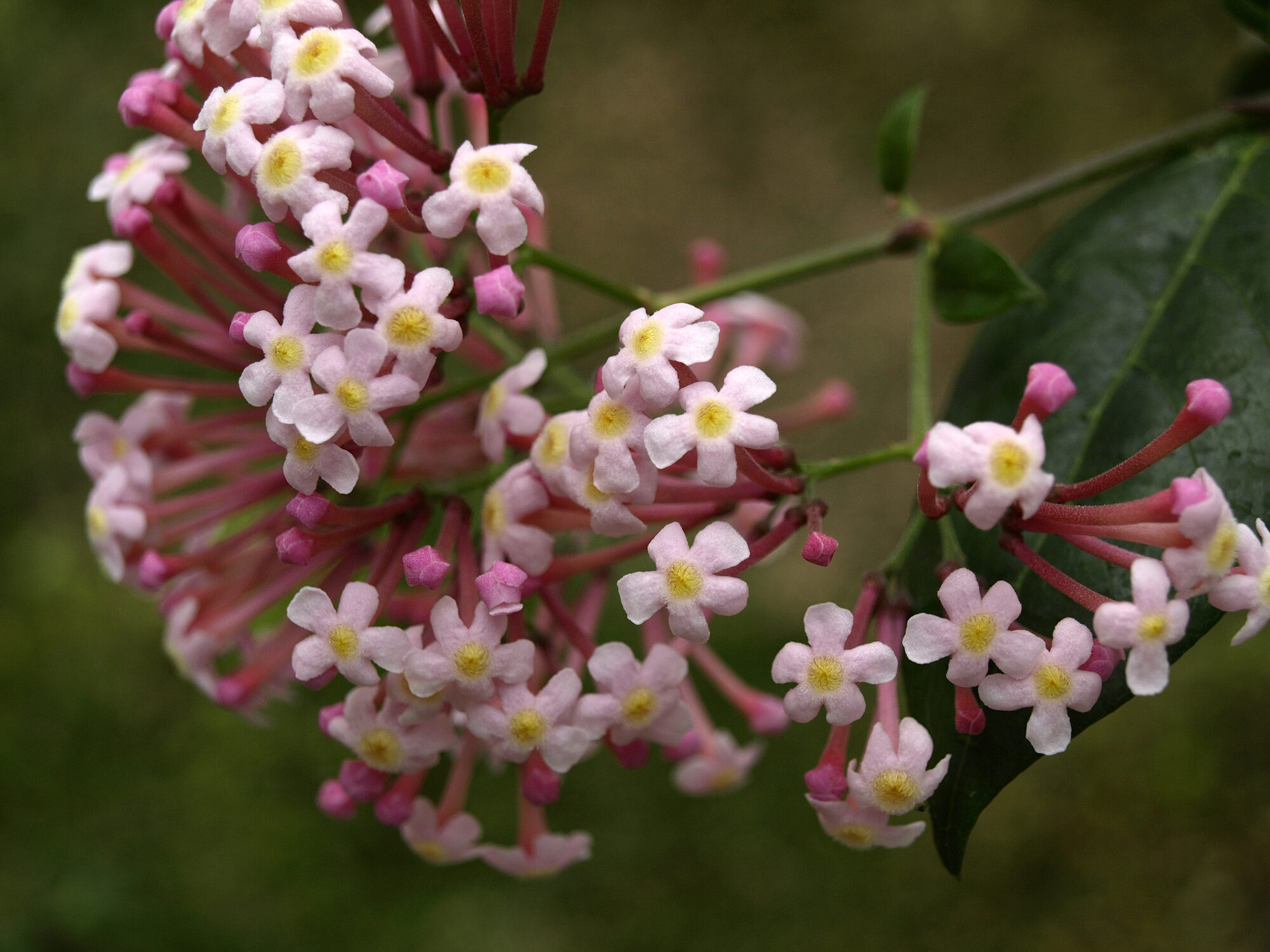
In 1838, a shipment of seed from Guatemala arrived at the most successful nursery in Europe. Louis van Houtte, whose operation at Gentbrugge near Ghent supplied exotic plants to gardens across the continent, grew the seedlings to flowering size and handed them to Jules Emile Planchon for description. Planchon recognized something unusual: the pink, sweetly perfumed flowers with their yellow-fringed throats looked nothing like any Rondeletia he knew. He erected a new genus, Rogiera, and named the species amoena, Latin for "beautiful." The year was 1849. It would take until 2021 for molecular evidence to prove Planchon right.
In Costa Rica, the species is known as quina falsa (false quinine) and teresa. The first name reflects its membership in the Rubiaceae, the same family as the true quinine tree (Cinchona), and hints at historical folk confusion between the two. The species ranges from southern Mexico to western Colombia, following the highland corridor of Mesoamerica through evergreen montane forests from 1,000 to 2,500 meters elevation. In the Brunca region, it grows along the flanks of the Cordillera de Talamanca, where it has been collected in 27 documented localities within the Parque Internacional La Amistad and surrounding highlands.
Identification
Habit
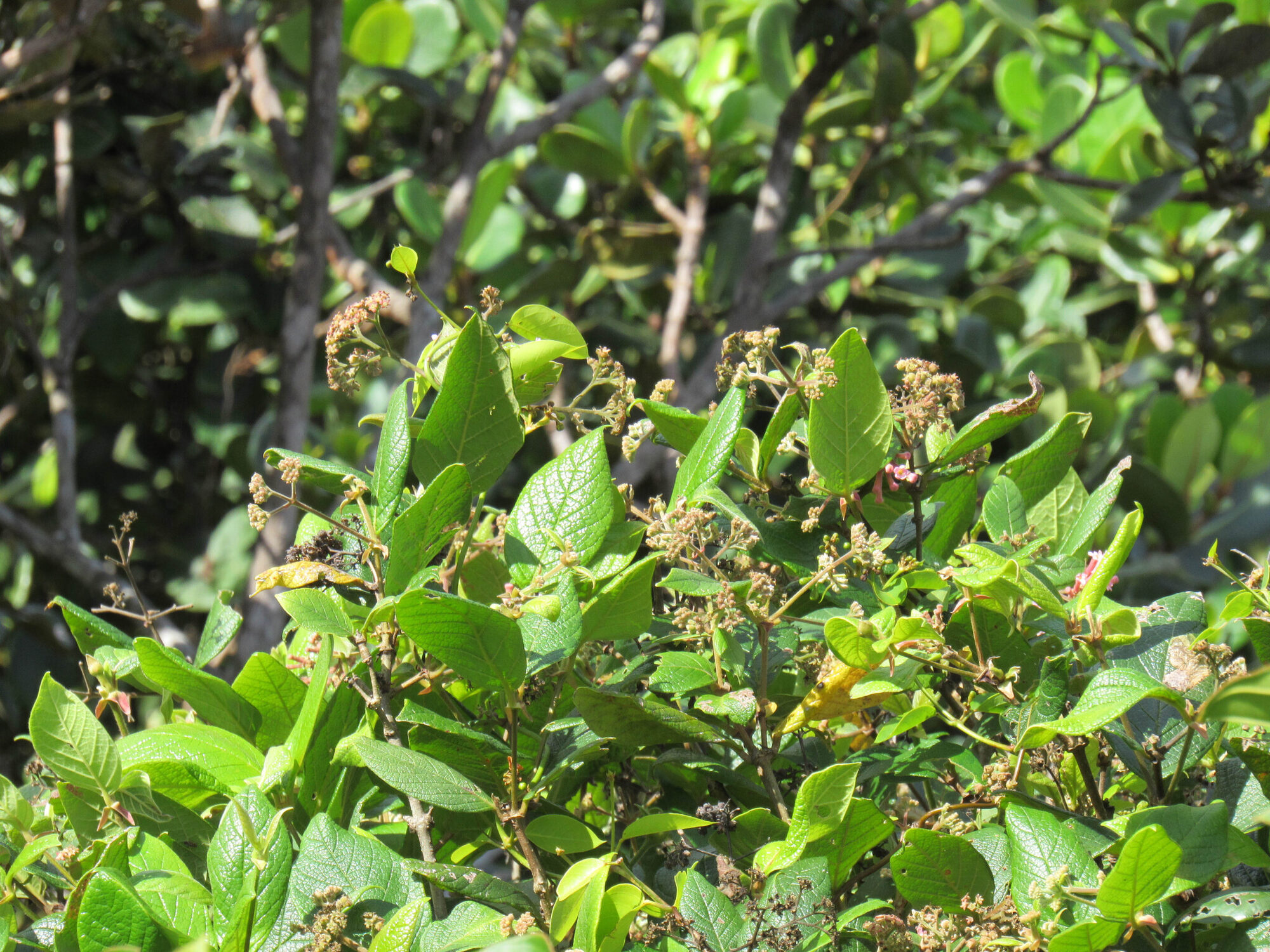
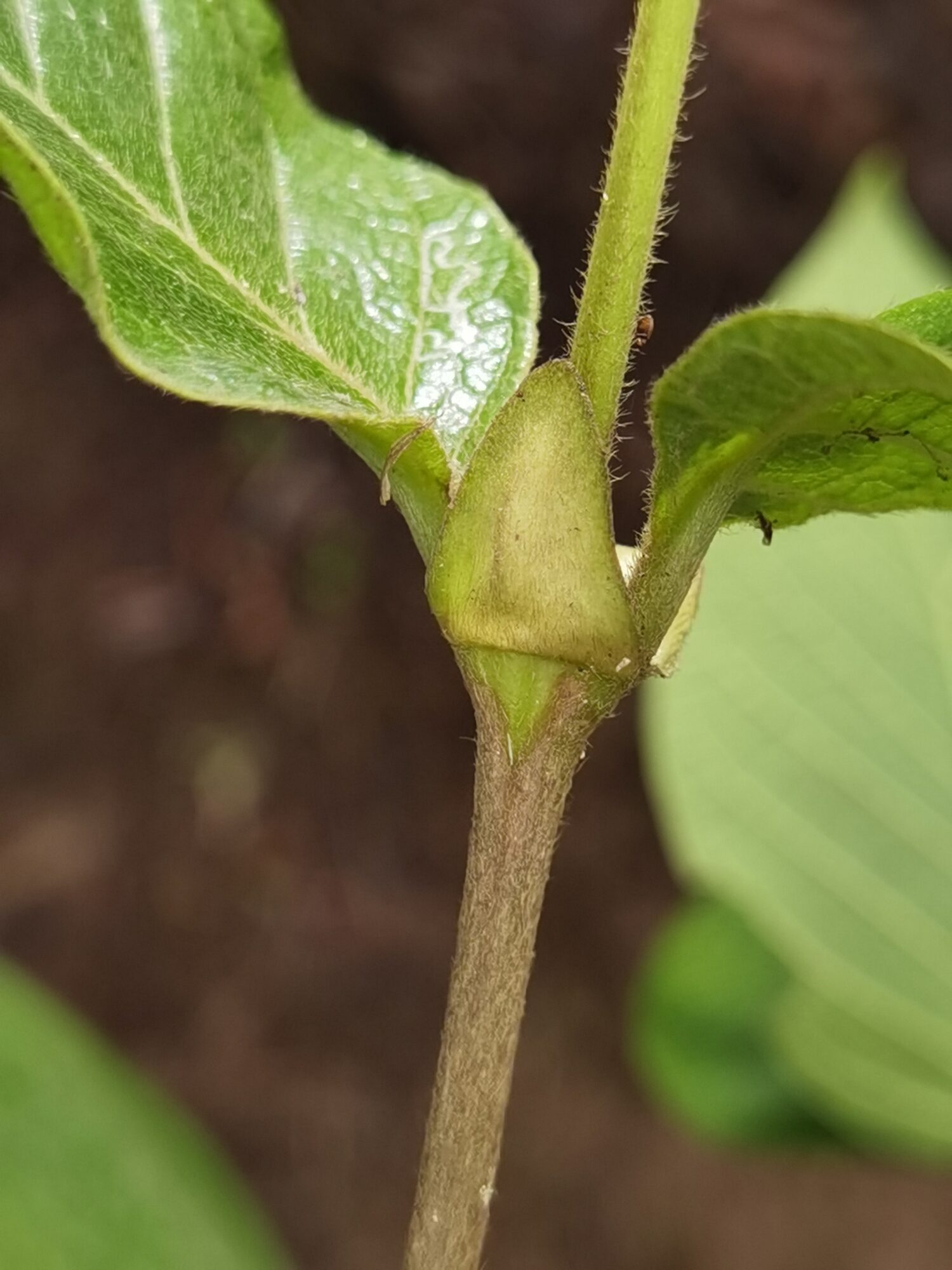
Rogiera amoena grows as an evergreen shrub or small tree, typically reaching 2 to 7 meters tall, occasionally attaining 10 meters in favorable conditions. The leafy branchlets are 2 to 6 mm thick and covered with soft, ascending yellowish hairs that darken to brown with age. One of the most distinctive vegetative features visible from a distance is the stipules: triangular, 4 to 13 mm long and 3 to 10 mm broad, silky-haired on the outer surface, they become conspicuously reflexed (bent backward) as they mature. These persistent, backward-curving stipules help distinguish the species in the field even without flowers or fruit.
Leaves
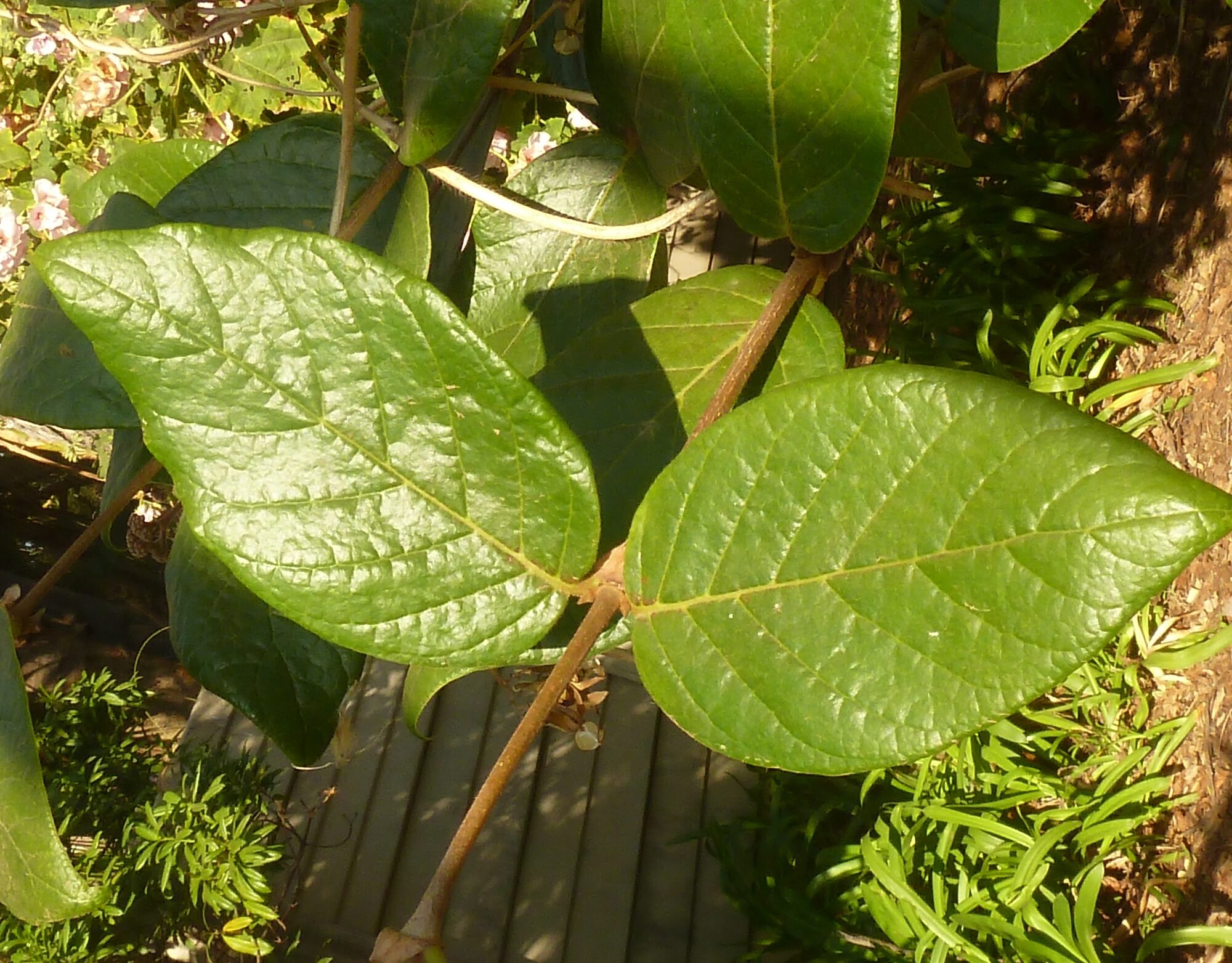
The leaves are opposite, borne on densely yellowish-puberulent petioles 3 to 12 mm long. Blades measure 6 to 16 cm long (reaching 22 cm in vigorous shoots) and 4 to 9 cm broad, broadly ovate to ovate-elliptic, with an acuminate apex and a broadly obtuse to rounded base. The texture is subcoriaceous (somewhat leathery), with thin strigose hairs on both surfaces, denser along the midvein above and with erect yellowish hairs beneath. Five to eight secondary veins per side arch upward, with the tertiary veins prominent beneath. As the leaf ages, the veins become impressed on the upper surface, producing a distinctly bullate (puckered) texture that is one of the species' most recognizable features. The Flora Costaricensis describes these as "thick broadly ovate leaves often becoming bullate in age."
Flowers
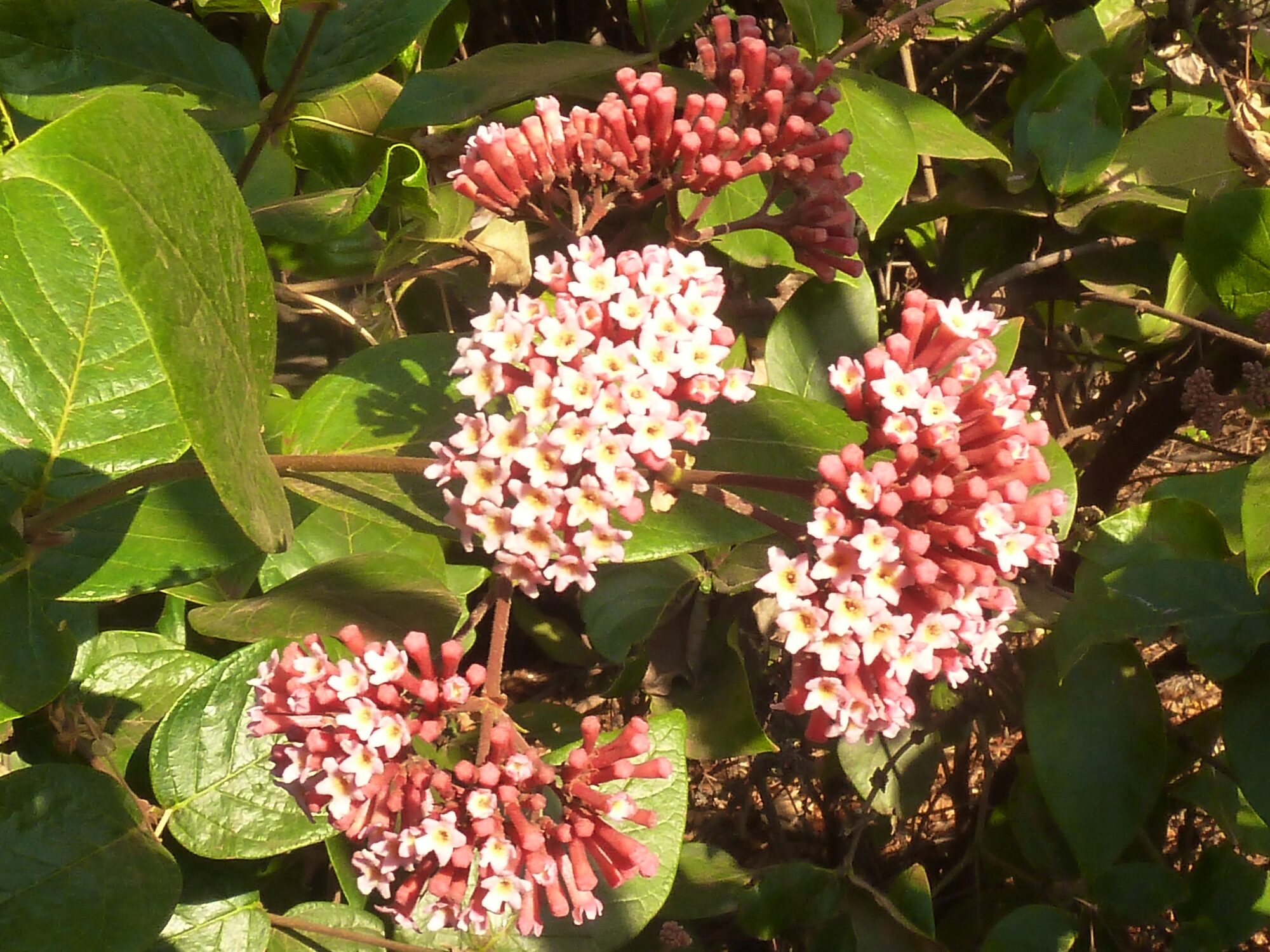
The inflorescence is terminal, 5 to 18 cm long and nearly as broad, forming open, rounded panicles with two or three pairs of opposite branches. The first pair of lateral branches is much larger than those above, giving the inflorescence a characteristic tripartite (three-branched) shape. Dense yellowish sericeous-velutinous hairs cover the inflorescence axes. Individual flowers have an urceolate hypanthium about 1.5 mm long, and 4 to 6 calyx lobes that are slightly unequal, oblong, and glabrous within.
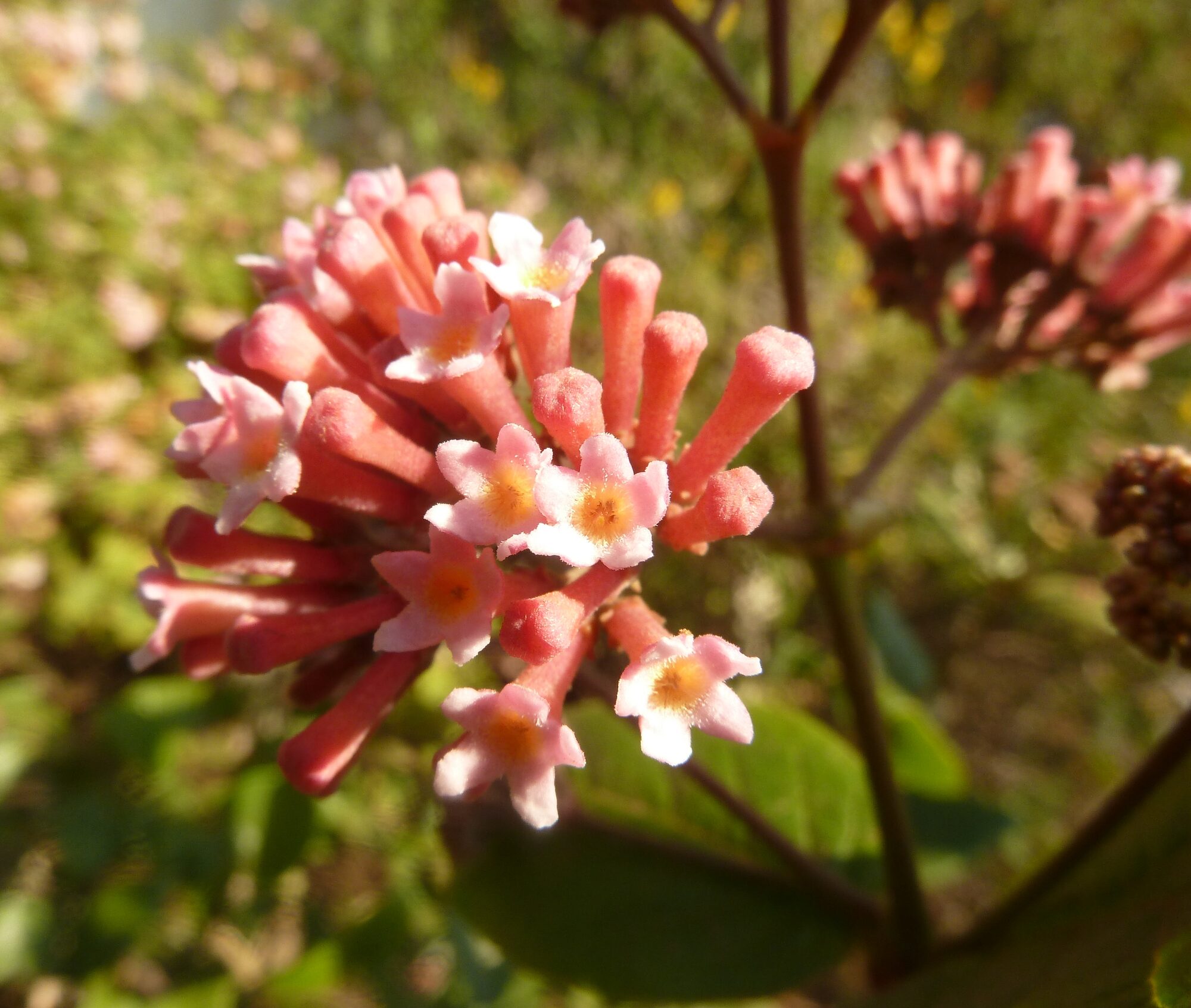
The corolla is white to pink (salmon-pink in cultivation), minutely puberulent externally, with a tube 9 to 14 mm long and about 2 mm in diameter at the top. At the mouth of the tube, dense erect yellowish hairs about 0.5 mm long form the characteristic "bearded throat" visible in the open flower. The 5 to 6 corolla lobes are 1.5 to 3 mm long, rounded at the tips. The flowers are sweetly perfumed and distylous: they occur as pin morphs (with long styles and short stamens) and thrum morphs (with short styles and long stamens), a breeding system common in Rubiaceae that promotes outcrossing between different individuals. In Costa Rica, flowering occurs primarily from November through February, coinciding with the onset of the dry season.
Fruits
The fruit is a loculicidal capsule, 3 to 5 mm long and 3 to 6 mm broad, oblate-subglobose with two longitudinal sulci (grooves) on opposite sides. The capsule wall is woody, and the calyx lobes reflex or fall off as the fruit matures, leaving it glabrescent. When ripe, the capsule splits open along the midline of each locule, releasing fusiform seeds with bipolar wings adapted for wind dispersal. Fruiting occurs throughout the year in Costa Rica, though capsules are most abundant between May and November.
Distribution
Rogiera amoena ranges from southern Mexico through Central America to western Colombia, following the Mesoamerican highland corridor. Among the 1,199 records in GBIF, Mexico accounts for 31.8% and Costa Rica for 30.8%, making these two countries the core of its documented range. Panama (10.6%), Nicaragua (7.4%), Guatemala (4.3%), and Honduras (3.7%) hold most of the remaining records. The species has also been introduced as an ornamental in Australia, New Zealand, and southern European gardens, where it was cultivated as early as 1838 at Van Houtte's nursery in Belgium and recorded at the Monserrate gardens in Sintra, Portugal, by 1885.
In Costa Rica, 369 GBIF records span every major mountain system: the Cordillera de Tilaran (including Monteverde), the Central and Talamanca volcanic ranges, the margins of the Meseta Central (Central Valley), and the northern reaches of the Cordillera de Talamanca into the Brunca region. Collection localities range from about 600 m on the lower flanks to 2,640 m near the summits, though most records fall between 1,000 and 2,000 m. In the Brunca region, the species has been documented at 27 localities concentrated in the Parque Internacional La Amistad corridor: Tres Colinas (2,050 m), Valle del Silencio, Las Tablas, Potrero Grande, and the Sabanas Helechales. Collections span from 1996 to 2022, with the most recent from Coto Brus district.
The species inhabits evergreen montane forest formations, occupying the premontane wet forest and lower montane wet forest life zones. The Flora Costaricensis describes it as a "common species" within these habitats. Its stature of 2 to 7 meters places it in the understory to midstory, where it tolerates partial shade but flowers most prolifically where canopy gaps allow direct light.
Ecology
The long tubular corolla (9 to 14 mm) and yellow-bearded throat suggest adaptation for long-tongued pollinators. Horticultural sources report visits by bees, butterflies, and occasionally birds, though no species-specific pollinator studies have been published. The distylous breeding system, with its pin and thrum morphs, ensures that effective pollination requires transfer between genetically distinct individuals, favoring animal pollinators over self-pollination.
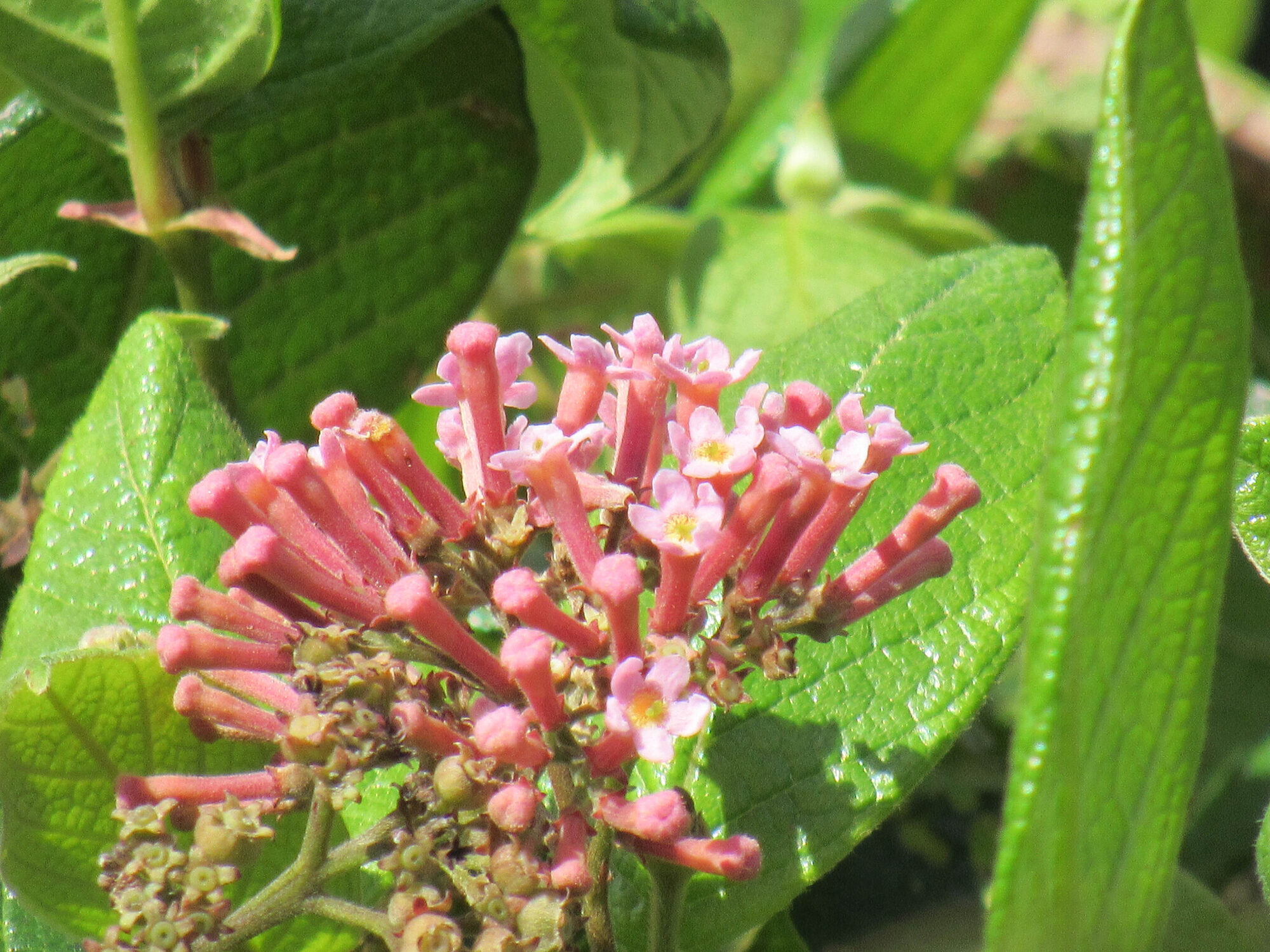
Seeds are wind-dispersed. The fusiform, dorsoventrally compressed seeds bear bipolar wings that catch air currents when the loculicidal capsule splits open. This anemochorous strategy is well suited to the montane forest environment, where wind patterns along ridges and through canopy gaps can carry lightweight seeds across the steep terrain. The species is evergreen, retaining its foliage year-round in the cloud forests and premontane formations it inhabits.
Taxonomic History
The taxonomic saga of this species spans 175 years and three genera. Planchon first described it as Rogiera amoena in 1849, published in Louis van Houtte's lavish botanical journal Flore des Serres et des Jardins de l'Europe. The description was based on cultivated plants at Van Houtte's nursery in Gentbrugge near Ghent, grown from material introduced from Guatemala in 1838. Planchon recognized that the species' combination of open, multiflowered panicles, heterostylous flowers, a hairy ring at the corolla mouth, and capsular fruits warranted a separate genus from Rondeletia, and he named it Rogiera in honor of Charles Latour Rogier, the Belgian Prime Minister and patron of horticulture. A hand-colored lithograph by L. Stroobant accompanied the original description.
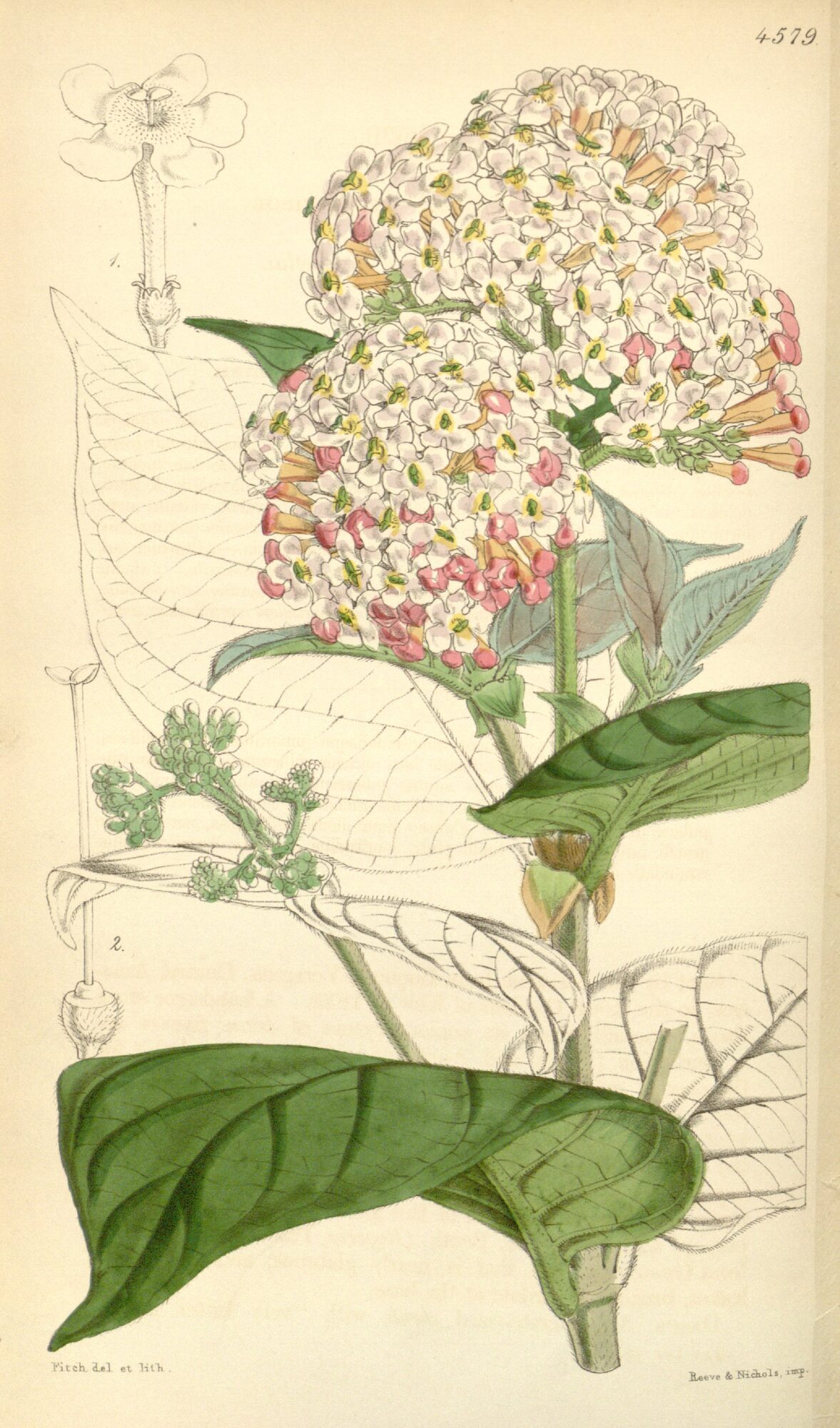
The species was independently described multiple times in the years that followed. In 1851, it appeared in Curtis's Botanical Magazine (volume 77, plate 4579) as Rondeletia versicolor, the "changeable-flowered Rondeletia," with a hand-colored plate by W.H. Fitch. Then in 1853, the Danish botanist Anders Sandoe Oersted published it as Rondeletia latifolia, based on collections he made during his landmark 1846 to 1848 expedition through Costa Rica and Nicaragua. Oersted assembled one of the most significant early botanical collections from Costa Rica. He collected this species around Cartago, the country's oldest city, where it still grows today.
In 1879, the English botanist William Botting Hemsley merged Rogiera into Rondeletia, publishing the combination Rondeletia amoena while working on the botanical content for Biologia Centrali-Americana, a monumental encyclopedia of Central American natural history. For over a century, this treatment held. The Flora Costaricensis (Burger and Taylor, 1993) used the name Rondeletia amoena, but noted that the species is "quite different in appearance from our other species of Rondeletia" and that this distinctiveness "explains Planchon's using this species as the basis for his genus Rogiera."
The molecular era vindicated Planchon. Studies by Rova and colleagues (2009), using ITS, rps16, and trnL-F DNA sequences, showed that Rondeletia as traditionally circumscribed was polyphyletic, and that Rogiera belonged in tribe Guettardeae rather than Rondeletieae. Manns and colleagues (2020) confirmed that the Rondeletieae is mainly an Antillean clade, separate from Rogiera. Finally, Torres-Montufar, Flores-Olvera, and Ochoterena published a comprehensive taxonomic treatment of Rogiera in Systematic Botany in 2021, recognizing ten species based on molecular and morphological evidence. The accepted name is once again Rogiera amoena Planch., the name Planchon gave it in 1849. The species carries 17 synonyms from its long taxonomic journey, including R. versicolor, R. latifolia, R. rugosa, R. pittieri, and R. schumanniana.
Etymology
The species epithet amoena comes from the Latin amoenus, meaning "beautiful, showy, pleasing," referring to the ornamental attractiveness of the flowers. The genus name Rogiera honors Charles Latour Rogier (1800-1885), who served twice as Prime Minister of Belgium (1847-1852, 1857-1868) and was a patron of horticulture. The naming reflects the deep connections between Belgian politics and the botanical enterprise in the mid-nineteenth century, when Van Houtte's nursery at Ghent was the preeminent source of exotic plants for European gardens. The older genus name Rondeletia, assigned by Linnaeus in 1753, commemorates Guillaume Rondelet (1507-1566), a French physician and naturalist who served as Regius Professor of Medicine at the University of Montpellier. Both a genus of deep-sea fish (Rondeletia, the redmouth whalefish) and this plant genus bear his name.
Similar Species
In Costa Rica, the most likely confusion is with Rondeletia aspera Standl., the only other Rondeletia-group species that co-occurs on the Pacific slope. The two are readily distinguished. Rogiera amoena has thick, broadly ovate leaves that become bullate (puckered) with age, open tripartite panicles, and grows in evergreen montane forest at 1,000 to 2,500 m. R. aspera has smaller, lanceolate leaves with dense white arachnoid tomentum beneath, compact subcapitate (head-like) inflorescences, and is restricted to partly deciduous forest between 600 and 1,200 m, from Monteverde to Ciudad Colon. As the Flora Costaricensis noted, Rogiera amoena is "quite different in appearance from our other species of Rondeletia." Mexico is the center of diversity for Rogiera, harboring nine of the ten recognized species, four of which are Mexican endemics.
Conservation Outlook
Rogiera amoena was assessed as Least Concern by the IUCN in 2021, with a stable population trend. The species is described as "common" in the Flora Costaricensis, and its broad distribution across nine countries, from Mexico to Colombia, provides resilience against localized threats. In Costa Rica alone, 369 GBIF records document its presence from Guanacaste in the northwest to the Cordillera de Talamanca in the southeast, spanning nearly every protected area with suitable montane forest habitat.
The species occurs within Monteverde Cloud Forest Reserve, Braulio Carrillo National Park, the protected areas of the Central Volcanic Range, and the Parque Internacional La Amistad in the Brunca region. Its dependence on evergreen montane forest at 1,000 to 2,500 m elevation makes it potentially vulnerable to upward range shifts driven by climate change, as suitable habitat area decreases with altitude. The invasiveness risk is considered low; a Pacific region weed risk assessment scored it at -2, and it is classified in Queensland as an exotic with nil pest status.
Resources & Further Reading
Species Information
Accepted name entry with distribution, synonymy, and taxonomic references.
1,199 occurrence records with collection localities, dates, and specimen images.
Community observations with field photographs from across the species' range.
Nomenclatural data, type information, and publication details from Missouri Botanical Garden.
Taxonomy & Nomenclature
Comprehensive revision recognizing ten Rogiera species based on molecular and morphological evidence. Systematic Botany 46(1): 186-210.
Molecular phylogenetic analysis using ITS, rps16, and trnL-F that confirmed Rogiera as distinct from Rondeletia. Annals of the Missouri Botanical Garden 96(1).
Confirmed Rondeletieae as mainly an Antillean clade, separate from Rogiera. Plant Systematics and Evolution.
Burger & Taylor (1993). Fieldiana: Botany n.s. 33. Field Museum. Includes the detailed treatment of Rondeletia amoena with morphological description and key.
Original description of Rogiera amoena in Van Houtte's botanical journal, with the first illustration.
Volume 77 (1851) contains plate 4579, the hand-colored illustration of the species as Rondeletia versicolor.
Related Reading
Biographical profile of the botanist who described Rogiera amoena and saved European viticulture from Phylloxera.
Biography of the 16th-century French physician and naturalist for whom the genus Rondeletia was named.
The Belgian horticulturist whose Ghent nursery first cultivated Rogiera amoena in Europe.
Van Houtte's lavish botanical journal (1845-1888) where Rogiera amoena was first described and illustrated.
Belgian statesman and patron of horticulture for whom the genus Rogiera was named.
Botanical collections from the Danish explorer who first documented the species in Costa Rica (1846-1848).
Species identification tool with photographs and IUCN conservation status.
The 1879 publication where Hemsley transferred the species to Rondeletia.