Roble de Trelease
Quercus gulielmi-treleasei — A towering evergreen oak of Costa Rica and Panama's wet montane forests, named for the pioneering American botanist William Trelease. Rising to 50 meters with trunk diameters of 2 meters, this red oak inhabits elevations between 1,300 and 3,000 meters and faces an uncertain future as climate change reshapes its mountain habitat.
In the wet montane forests of the Cordillera de Talamanca, where clouds drift through moss-draped canopies, Quercus gulielmi-treleasei reaches toward the sky. This massive evergreen oak, one of the largest trees in Central American highlands, belongs to a distinctive group of red oaks that evolved in the mountains connecting North and South America. Its range stretches from Costa Rica into western Panama, with scattered populations reported from Guatemala, Honduras, and Mexico, though the full extent of its distribution remains uncertain.
The species occupies a broad elevational band from 1,300 to 3,000 meters, lower than its relative Q. costaricensis but overlapping with it in the upper montane zone. In these forests, the roble de Trelease grows alongside other oaks and mingles with Podocarpus, Magnolia, and tree ferns in an ecosystem that captures moisture from passing clouds. The consistent humidity, cool temperatures, and deep organic soils create ideal conditions for these slow-growing giants.
Taxonomic History
The American botanist Cornelius Herman Muller described Quercus gulielmi-treleasei in his 1942 monograph The Central American Species of Quercus, published by the U.S. Department of Agriculture. The specific epithet honors William Trelease (1857-1945), the first director of the Missouri Botanical Garden and a pioneering oak taxonomist. Trelease had established the modern tripartite classification of American oaks into sections Quercus, Lobatae, and Protobalanus, and his 1924 work The American Oaks remained a standard reference for decades.
The latinized name "gulielmi-treleasei" translates to "of William Trelease," with "gulielmi" being the genitive form of Gulielmus (William in Latin). The species has several synonyms: Quercus seemannii subsp. gulielmi-treleasei, Q. seemannii var. gulielmi-treleasei, and Q. chiriquina Trel. It belongs to the Q. seemannii complex, a distinctive group of red oaks distributed across Central America and into Colombia. This complex also includes Q. rapurahuensis, Q. costaricensis, Q. eugeniifolia, and the Colombian Q. humboldtii.
What makes the Q. seemannii complex unusual among red oaks is their annual acorn maturation. Most red oaks (section Lobatae) require two growing seasons to produce mature acorns: flowers pollinated in spring remain as tiny, dormant embryos through winter, resuming growth only the following year. In contrast, white oaks (section Quercus) mature their acorns within a single season. The Q. seemannii complex represents an exception: despite being true red oaks with the bristle-tipped leaves and other characteristics of section Lobatae, they complete acorn development in just one year, like white oaks. This annual cycle may be an adaptation to the consistent moisture and mild temperatures of Central American cloud forests, where the selective pressure to delay germination through a harsh winter does not exist.
Identification
Physical Characteristics
Size and Form: Quercus gulielmi-treleasei ranks among the largest oaks in Central America. Mature trees commonly reach 30 meters and can exceed 50 meters in height, with trunk diameters approaching 2 meters. The trunk is straight and cylindrical, supporting a dense, rounded crown that can dominate the forest canopy. Young branches are initially covered with fine hairs (tomentose) but become smooth as they mature.
Bark: The bark is dark brownish-black (pardo negruzca), not particularly thick but becoming deeply fissured with age. This dark coloration contributes to the "black oak" appearance shared by members of section Lobatae.
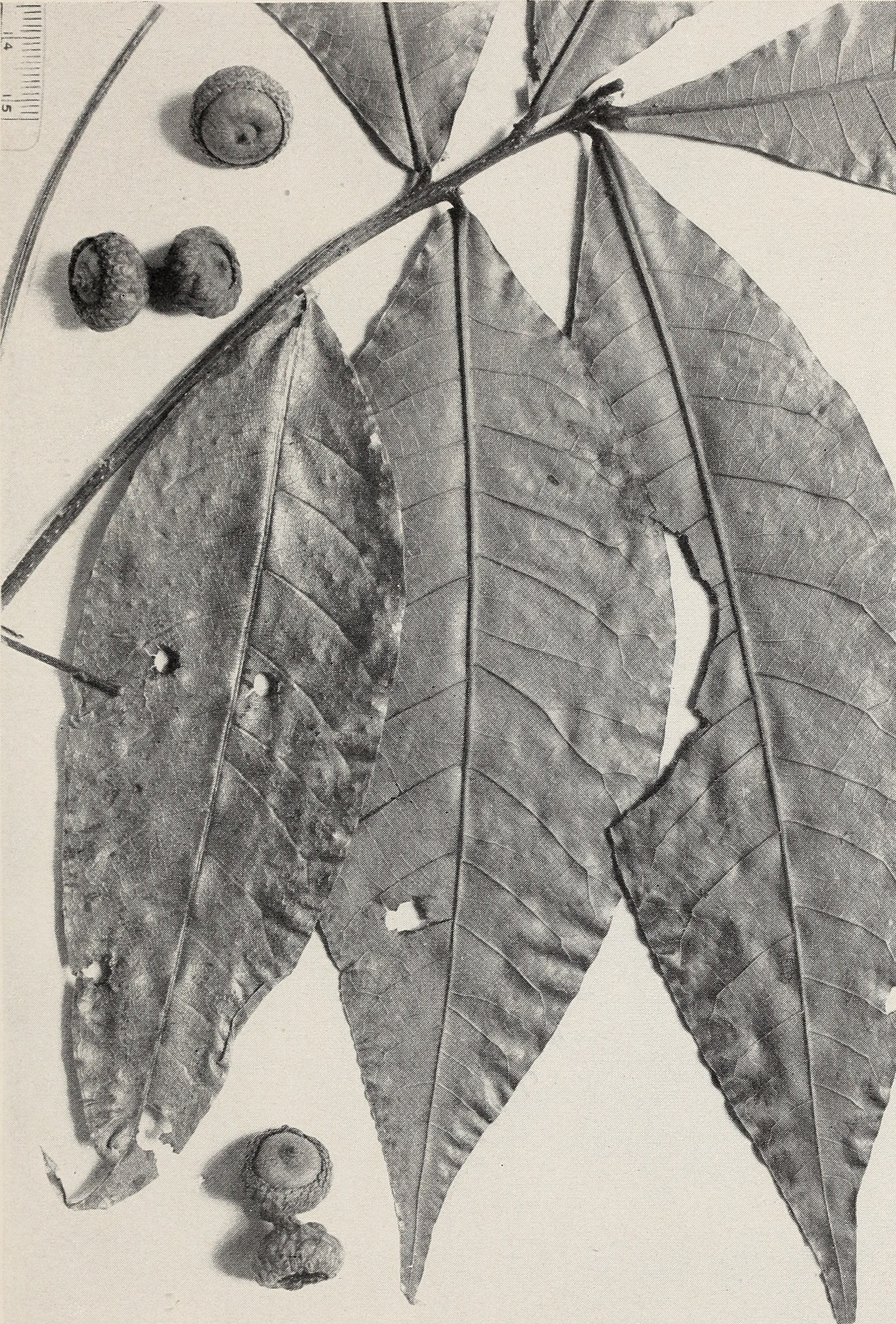
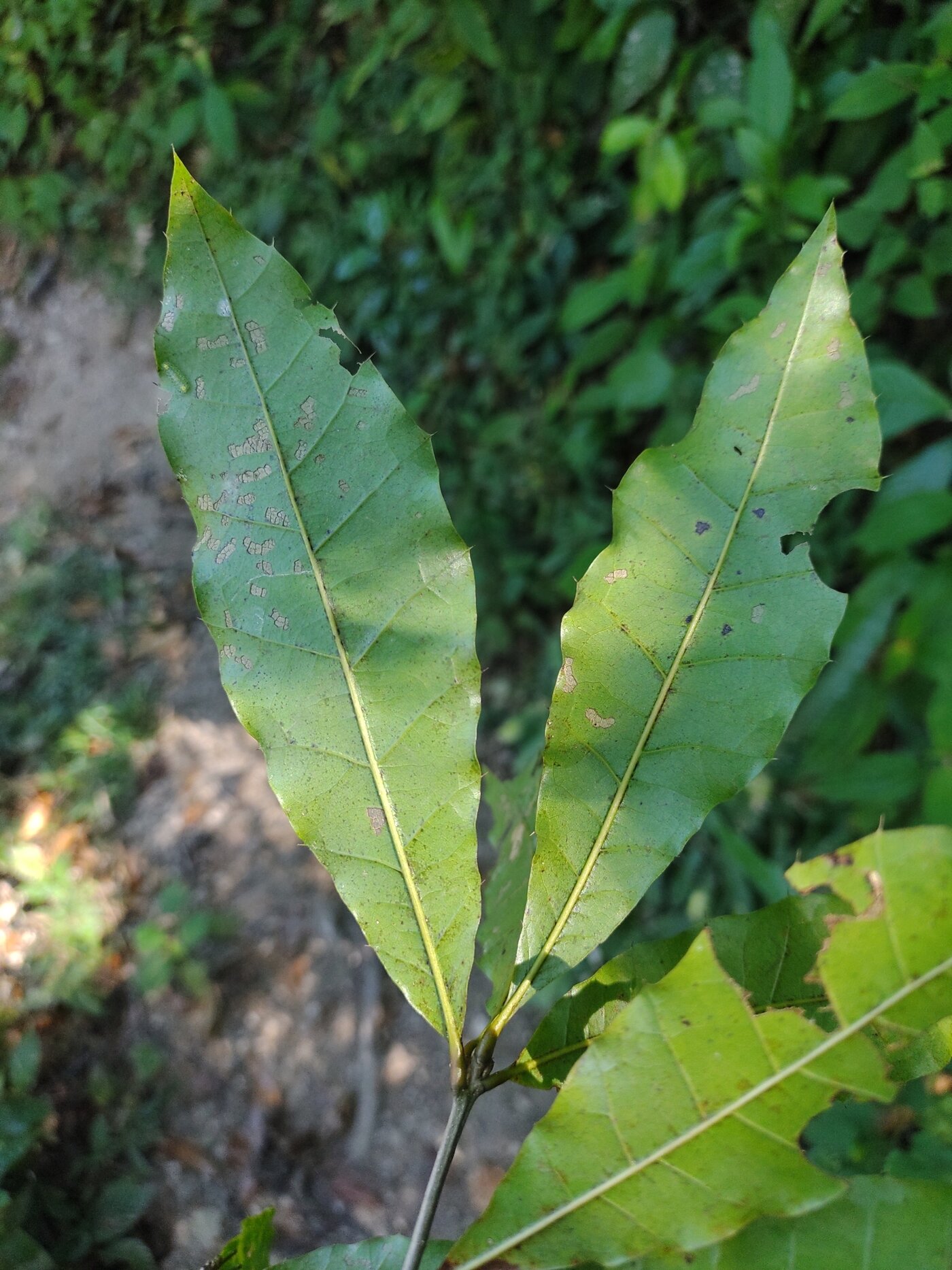
Leaves: The leaves are thin but firm and leathery (coriaceous), measuring 10-25 cm long by 5-7 cm wide. The blade is narrowly to broadly lanceolate or oblanceolate in shape, with a narrowly acute to very acuminate apex and a cuneate to very narrowly rounded base. Like other members of section Lobatae, the leaf tips may bear fine bristles. The margins are entire (without teeth) and slightly crisped or wavy. The upper surface is glabrous and silky, while the lower surface is glabrous or sparsely pubescent along the midrib. The petioles are short, only 2-4 mm long.
Acorns: The acorns mature in a single year (annually), unusual for section Lobatae where most species require two years. They appear solitary or in pairs and are hemispherical to ovoid in shape, measuring 7-15 mm long by 11-15 mm wide. The cup (cupule) is 13-18 mm in diameter. This annual ripening allows the species to reproduce more rapidly when conditions permit.
Conservation and Threats
The IUCN has classified Quercus gulielmi-treleasei as Vulnerable, citing its restricted geographic range and continuing decline in habitat quality. The species faces multiple threats: habitat fragmentation from agricultural expansion, illegal logging, and increasingly, the effects of climate change on its montane habitat.
Climate modeling for Costa Rica projects that the warm temperate moist forest zone where this species thrives will decrease in area by an average of 31 percent by the years 2061-2080, as warming temperatures shift vegetation zones upslope. Species already living at high elevations face the prospect of suitable habitat simply disappearing from mountaintops. For Q. gulielmi-treleasei, which spans a broader elevational range than some highland oaks, the lower populations may be most at risk.
Resources & Further Reading
Species Information
Authoritative taxonomic information including synonyms, distribution, and nomenclatural details.
Species profile from the Flora de Costa Rica database with habitat and distribution information.
Biography of the American botanist for whom this species is named, including his pioneering work on oak taxonomy.
Conservation
Assessment of conservation status, climate change threats, and ex situ collection gaps for this species.
Comprehensive scientific treatment of Central American montane oak forests edited by Maarten Kappelle.
Taxonomic References
Complete monograph with 124 botanical plates illustrating Central American oaks. USDA Miscellaneous Publication No. 477.