Roble Seemann
Quercus seemannii — A red oak of the Central American cloud forests, ranging from southern Mexico to Panama. Named for the German botanist Berthold Seemann, this evergreen tree displays striking bronzy-red new growth that matures to glossy green, and unusually for a red oak, its acorns mature in a single season.
In the cloud forests of the Cordillera de Talamanca and beyond, Quercus seemannii grows alongside its more celebrated relatives. While the endemic black oaks receive more attention, this widespread species bridges the oak forests from Chiapas in southern Mexico through Guatemala, Honduras, El Salvador, Nicaragua, Costa Rica, and into Panama. It is one of the "red oaks" (section Lobatae), distinguished from the white oaks by their pointed leaf lobes, bitter acorns, and annual acorn maturation cycle.
The species commemorates Berthold Seemann (1825-1871), a German botanist who trained at Kew Gardens under John Smith before being appointed naturalist to HMS Herald in 1846. Seemann joined the ship in Panama in January 1847 and explored the isthmus extensively, discovering many new plant species. He collected the type specimen of this oak in Panama, and Frederik Liebmann formally described and named the species in 1854. Seemann later published Botany of the Voyage of HMS Herald (1852-1857), covering floras from the Arctic to the tropics. He died of malaria in Nicaragua in 1871 while managing a gold mine.
Identification
Physical Characteristics
Crown and Form: Q. seemannii typically develops a dense, rounded crown on a straight trunk. Under optimal conditions in protected valleys, trees can reach 20-30 meters in height with trunk diameters approaching 75 cm. The species is evergreen, maintaining its foliage year-round in the constant moisture of the cloud forest environment.
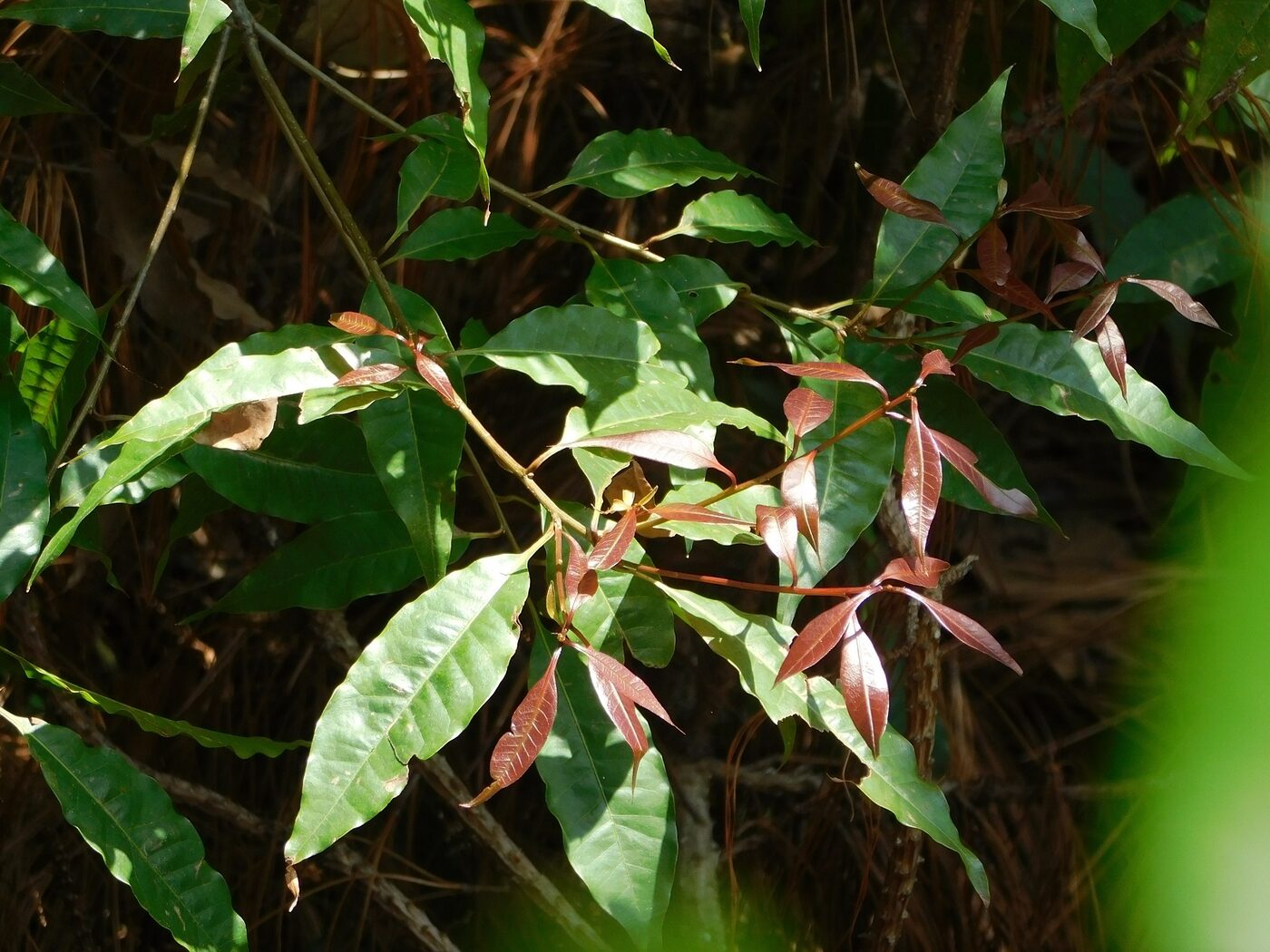
Leaves: The leaves are simple and alternate, lanceolate to elliptic in shape with entire (smooth) margins. Young leaves emerge in striking bronzy-red to coppery tones, gradually maturing to glossy dark green on the upper surface with a lighter, duller underside. This flush of colorful new growth is particularly visible in the photos from cloud forest populations. The leaves are leathery in texture, an adaptation to the cool, moist conditions of the montane forest.
Bark: The bark is grayish-brown, becoming fissured with age. In the perpetually humid cloud forest, trunks are typically covered with mosses, lichens, and small epiphytes that obscure the bark surface.
Flowers and Acorns: Like all oaks, Q. seemannii is monoecious. Male flowers are borne in pendant catkins, while the smaller female flowers appear at leaf axils. Unusually for a red oak, the acorns require only one growing season to mature. Most red oaks take two years, but Q. seemannii belongs to a distinctive Central American clade (including Q. costaricensis and Q. rapurahuensis) that shares this annual maturation pattern with white oaks. The acorns are small to medium-sized and sit in cup-shaped cupules.
Phenology
A 1991 phenology study by Roberto Céspedes Porras at Loma Larga de Cartago (1,700 m elevation) tracked ten trees in natural oak forest over multiple seasons. All phenological characteristics showed annual periodic behavior. Leaf fall occurs year-round but is more pronounced during dry season months. Vegetative shoot growth is constant throughout the year but proceeds at a much higher rate during the rainy season. The study found a positive correlation between shoot growth and soil moisture, and a negative correlation between soil moisture and the timing of leaf emergence and development.
Ecology and Distribution
Quercus seemannii has a broad distribution across Central America, occurring from the highlands of Chiapas in southeastern Mexico southward through Guatemala, Honduras, El Salvador, Nicaragua, and Costa Rica to Panama. This makes it one of the more widespread Central American oak species, though it remains restricted to montane cloud forest habitats throughout its range.
The species occurs at elevations between 1,500 and 2,400 meters, in wet tropical montane forests characterized by persistent cloud cover and high annual rainfall. In the cloud forests of Costa Rica's Cordillera de Talamanca, it grows alongside other oak species including Q. copeyensis and Q. costaricensis, as well as characteristic cloud forest trees like Drimys granadensis (Winter's bark), Billia hippocastanum, and Oreopanax species.
Oak forests in this region are among the tallest in Central America. At sites like Savegre in the Cordillera de Talamanca, old-growth forests reach 45 meters in height, with Q. seemannii among the dominant canopy species alongside Q. costaricensis, Q. copeyensis, and Q. oocarpa.
Documented localities in Costa Rica include Braulio Carrillo National Park (Sector Barva, where it grows near the entrance alongside Q. copeyensis), the Savegre forestlands at 1,900-2,100 m elevation, the Villa Mills area at 2,600-2,800 m in the Talamancan Cordillera, and Loma Larga de Cartago at 1,700 m where the species' phenology has been studied.
Mycorrhizal Associations
Like all oaks, Q. seemannii forms obligate ectomycorrhizal associations with soil fungi. Studies of Central American oak forests have documented a diverse fungal community including Amanita, Laccaria, Russula, Cortinarius, Lactarius, Boletus, and Cantharellus species. These fungi form symbiotic relationships with oak roots, exchanging soil nutrients for photosynthetic sugars. Research suggests these ectomycorrhizal fungi co-migrated from North America with their oak hosts as the genus expanded southward into Central America over millions of years.
Taxonomy and Synonyms
The taxonomic boundaries of Q. seemannii have expanded considerably as regional variants have been synonymized. Originally described from Panama, the species now includes populations formerly described as separate species, including Q. boquetensis (from Boquete, Panama), Q. borucasana (from Costa Rica's Boruca region), Q. citrifolia, Q. eugeniifolia, Q. flagellifera, Q. granulata, Q. petiolata, and Q. pittieri.
Some taxonomists have considered Q. tonduzii, a rare oak restricted to the vicinity of Volcán Poás in Costa Rica, to be a subspecies or variety of Q. seemannii. However, morphological differences support maintaining them as distinct species. Q. seemannii belongs to a distinctive clade of red oaks with annual maturation common in Central America and extending to Colombia, which includes the related Q. rapurahuensis and Q. gulielmi-treleasei, as well as Q. costaricensis and the Colombian Q. humboldtii.
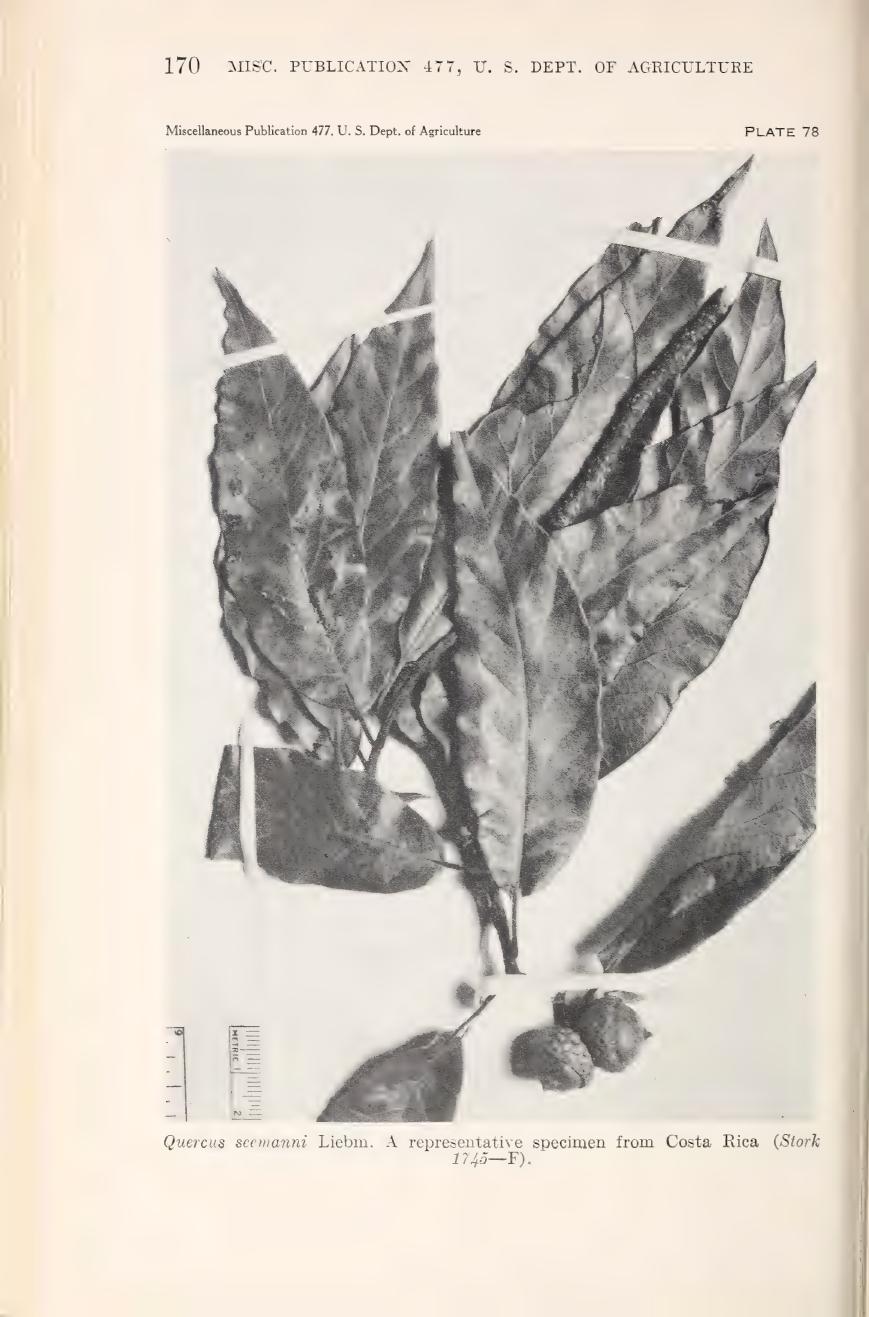
The definitive taxonomic treatment of Central American oaks remains Cornelius Muller's 1942 monograph The Central American Species of Quercus, published as USDA Miscellaneous Publication No. 477. This work, along with William Trelease's earlier The American Oaks (1924), established the framework for understanding oak diversity in the region. Modern molecular phylogenetic studies have largely confirmed these morphology-based classifications while revealing the deep evolutionary history of the group.
Uses and Conservation
The wood of Q. seemannii, like that of other Central American oaks, is hard, heavy, and durable. Oak wood in the region has traditionally been used for flooring, construction, railroad ties, furniture, and charcoal production. The wood is difficult to dry properly, being prone to checking (surface cracks from uneven drying) and warping, but its density and durability make it valuable where available.
Due to its broad distribution across multiple countries and relatively large populations within protected cloud forest areas, Q. seemannii is currently assessed as Least Concern by the IUCN. Much of its habitat falls within protected areas, including Costa Rica's national parks and reserves in the Cordillera de Talamanca. However, like all cloud forest species, it faces long-term threats from climate change as montane forest zones shift upward in elevation.
Resources & Further Reading
Species Information
Official taxonomic information, distribution data, and synonyms from the Royal Botanic Gardens, Kew.
Community observations with photos and distribution maps from citizen scientists across Central America.
Global occurrence records and distribution data from the Global Biodiversity Information Facility.
Oak Forest Ecology
Comprehensive review of oak distribution and diversity in the Americas, including Central American montane species.
Profile of the related Q. tonduzii with discussion of its taxonomic relationship to Q. seemannii.
Overview of oak forest biodiversity in the Savegre Valley of Costa Rica's Cordillera de Talamanca.
The primary phenological study of this species, tracking seasonal patterns in leaf fall, shoot growth, and reproduction at 1,700 m elevation.
Taxonomic References
The definitive taxonomic monograph on Central American oaks, published as USDA Miscellaneous Publication No. 477. Available via Biodiversity Heritage Library.
Complete monograph with 124 botanical plates illustrating Central American oaks. USDA Miscellaneous Publication No. 477.