Roble de Cortés
Quercus cortesii — A large evergreen oak ranging from Mexico to Panama, reaching 40 meters in height. Part of the Acutifoliae series, this slow-growing species inhabits montane cloud forests between 700 and 2,400 meters and reproduces in mast cycles of five to ten years.
In the cloud forests that drape the mountains from southern Mexico to Panama, Quercus cortesii forms part of a distinctive oak community. This large evergreen tree ranges across an impressive geographic span, from the Trans-Mexican Volcanic Belt through Belize, Honduras, Nicaragua, and Costa Rica, reaching its southern limit in the Cordillera de Talamanca and Chiriquí Province of Panama. Wherever it grows, it favors the mist-shrouded slopes of montane wet forests, contributing to the dense canopy that defines these ecosystems.
Unlike higher-elevation specialists like Q. costaricensis, the roble de Cortés occupies a broader elevational range, from 700 meters up to 2,400 meters. This flexibility allows it to grow in both lower montane and upper montane forests, though it is most common in the mid-elevation cloud forest zone where moisture is abundant year-round.
Mast Seeding: A Survival Strategy
Walk through a forest of Q. cortesii in most years and you will find no acorns. The trees stand silent, investing their energy in leaves, wood, and roots. Then, every five to ten years, the forest erupts. Acorns carpet the ground in such abundance that even the hungriest rodents, birds, and tapirs cannot consume them all. This dramatic "feast or famine" cycle is called mast seeding, and it represents one of the most sophisticated survival strategies in the plant kingdom.
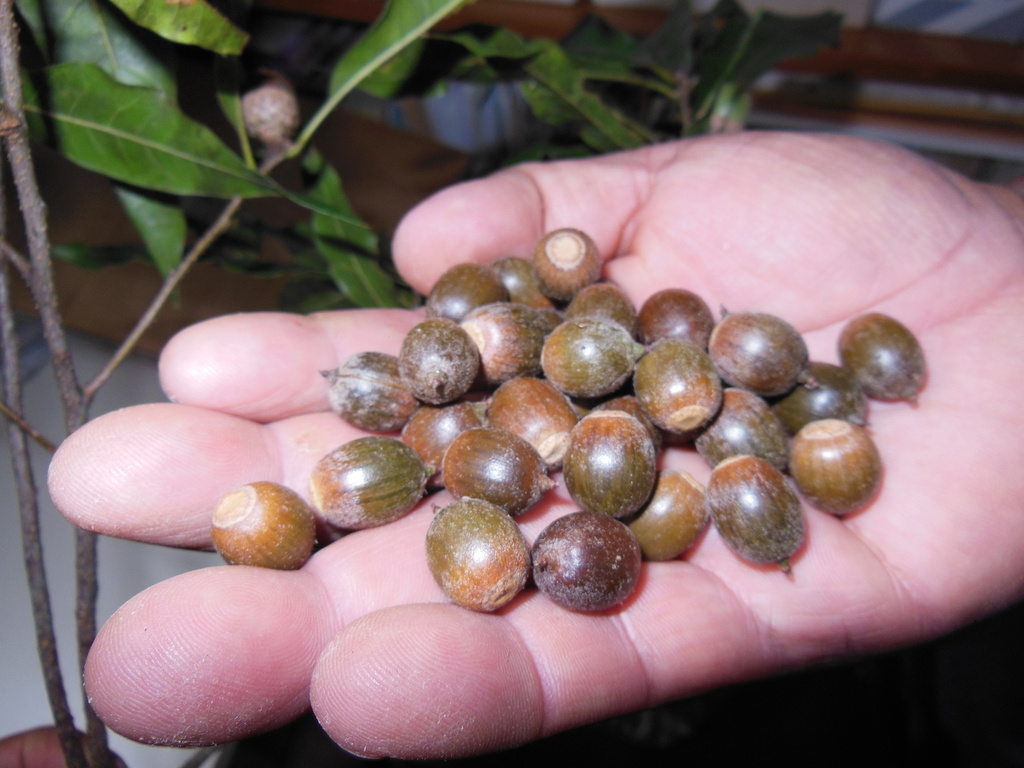
The logic of mast seeding centers on overwhelming seed predators through the principle of predator satiation. In the lean years between mast events, the scarcity of acorns keeps populations of squirrels, agoutis, peccaries, and seed-boring weevils in check. With limited food, these animals cannot build the numbers needed to threaten a massive seed crop. When a mast year finally arrives, the sheer volume of acorns overwhelms the predators. They gorge themselves, yet the flood of seeds ensures that thousands escape consumption and germinate. Had the tree produced a moderate crop every year, seed predators would maintain populations large enough to consume nearly every acorn.
How do trees separated by kilometers coordinate their reproductive timing? Research points to two complementary mechanisms. First, specific weather patterns—particular sequences of temperature and rainfall—serve as synchronized triggers across wide areas, cueing all trees to reproduce in the same year. Second, producing large seeds like acorns requires enormous energy reserves. During non-mast years, oaks accumulate carbohydrates in their wood and roots, building the reserves necessary for a massive reproductive investment. Only when these reserves reach a threshold can the tree afford to fruit. Since all trees in a region face similar weather and similar resource constraints, they tend to cross this threshold together.
The ecological cascades that follow a mast year ripple through the entire food web. When Q. cortesii and neighboring oaks flood the forest floor with acorns, populations of rodents and ground-feeding birds explode. This abundance of prey then supports population booms in predators: snakes, owls, and forest cats. In the following lean years, when the oaks go quiet again, these elevated predator populations crash along with their prey. Ecologists have documented that in temperate oak forests, mast years even affect human health through links to Lyme disease: more acorns lead to more mice, which support more ticks, which spread more disease. While such human health connections remain unstudied in Central American cloud forests, the broader principle holds—mast seeding sends waves through ecosystems that persist for years after the acorns have germinated or decayed.
For a slow-growing tree like Q. cortesii, which may live for centuries, the five-to-ten-year wait between mast events is a small investment in a strategy that has allowed oaks to dominate forests across the Northern Hemisphere for millions of years. The infrequent reproduction also explains why mature trees bearing acorns are rarely encountered in the field—you must be fortunate to visit during one of the brief windows when the forest is in full mast.
Taxonomic History
Frederik Michael Liebmann described Quercus cortesii in 1854 based on specimens collected in Veracruz, Mexico. The type specimens came from Hacienda de Jovo to Huitamalco, and the syntypes are deposited at the Copenhagen herbarium. As with many of Liebmann's oak descriptions, the work was completed before his early death in 1856 at age 43, with his colleague Anders Sandøe Ørsted later editing the oak monograph for posthumous publication.
The species belongs to section Lobatae (the red oaks) and is placed within the series Acutifoliae, a group of ten closely related species that share certain leaf characteristics. Other members of this series include Q. acutifolia, Q. brenesii, Q. skinneri, and Q. xalapensis. The Acutifoliae are distributed from the southeastern United States to Costa Rica, with five species endemic to Mexico.
Identification
Physical Characteristics
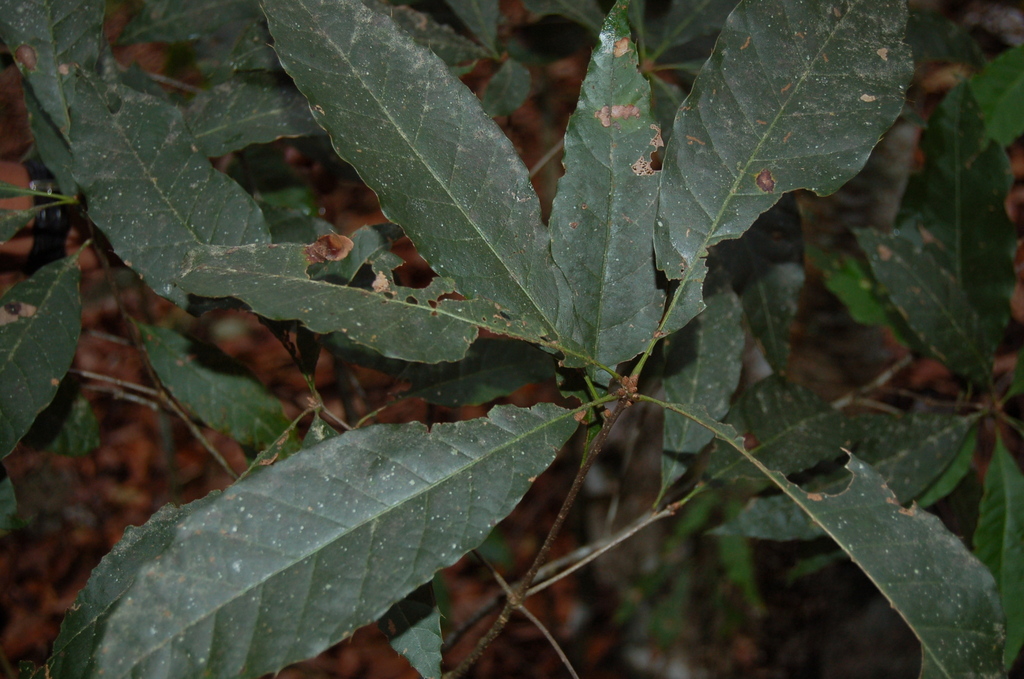
Leaves: The leaves of Q. cortesii are thin and narrowly elliptic to narrowly lanceolate in shape, distinguishing this species from oaks with broader foliage. Each leaf bears 4 to 6 pairs of aristate (bristle-tipped) teeth distributed in the upper half of the blade. The secondary veins are generally straight and parallel as they extend toward the leaf margin, a key characteristic that separates this species from the closely related Q. brenesii, whose secondary veins often curve into an S-shape near the teeth.
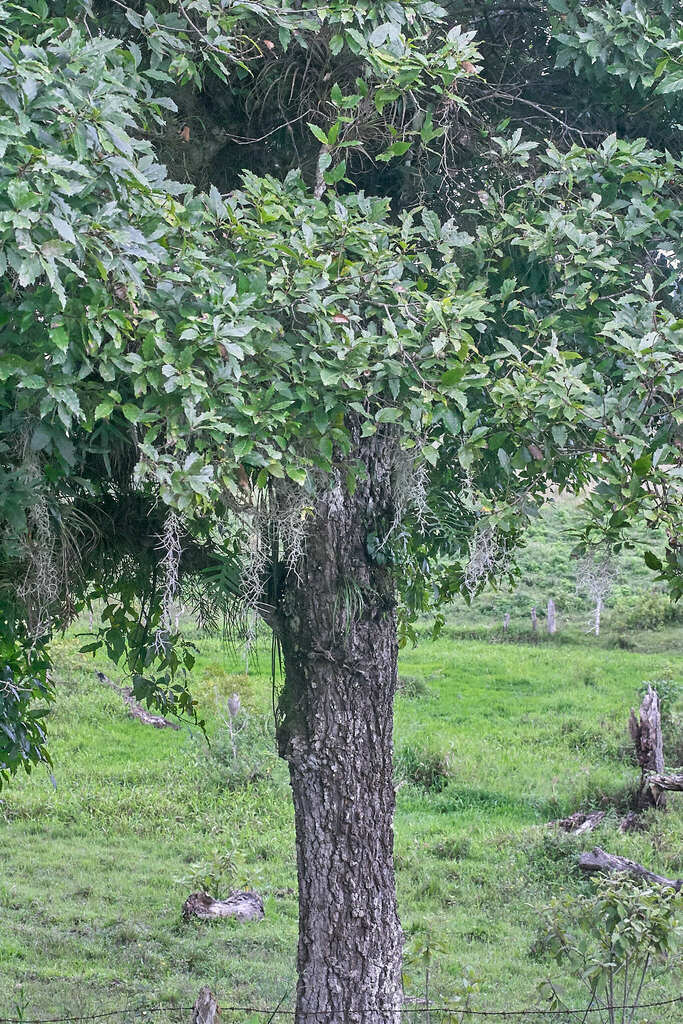
Size and Form: Quercus cortesii grows as a large evergreen tree reaching up to 40 meters in height. It is slow-growing with a very long life cycle, typical of cloud forest oaks that invest heavily in structural wood rather than rapid growth. The trunk develops the characteristic fissured bark common to mature red oaks.
Reproduction: As described above, Q. cortesii is a mast-seeding species with reproductive cycles of five to ten years. The acorns are typical of section Lobatae (red oaks), with a cup that encloses about one-third of the nut and a woolly inner shell surface. Like most red oaks, the acorns require two years to mature after pollination—the flowers that open in one mast year will not produce ripe acorns until the following year's mast event, a remarkable synchronization that spans multiple reproductive cycles.

Conservation
The IUCN classifies Quercus cortesii as Near Threatened. The species has an extensive geographic range, with an extent of occurrence estimated at 500,000 square kilometers, but the actual area of occupancy is much smaller, estimated at just 416 square kilometers, likely an underestimate due to limited sampling. Throughout its range, the species faces habitat loss from logging of montane forests and forest clearance for agriculture and cattle pasture.
In Costa Rica, the southern populations of Q. cortesii occur within the Cordillera de Talamanca, where significant areas are protected within La Amistad International Park and other reserves. However, forest fragmentation outside protected areas continues to reduce connectivity between populations. The species' slow growth rate and infrequent reproduction cycles make recovery from disturbance a prolonged process.
Resources & Further Reading
Species Information
Authoritative taxonomic information including distribution, synonyms, and nomenclatural details.
Overview of distribution, habitat, and conservation status across its range from Mexico to Panama.
Community observations with photos and distribution records from citizen scientists.
Taxonomy
Detailed taxonomic study of the series Acutifoliae, including morphological descriptions and species delimitation.
Comprehensive scientific treatment of Central American montane oak forests edited by Maarten Kappelle.