Bentham's Oak
Quercus benthamii — A towering red oak of Central America's highest cloud forests, reaching up to 40 meters with entire-margined leaves that turn bronze before falling.
In the misty cloud forests of the Talamanca range, where the air is permanently damp and orchids drape from every branch, Quercus benthamii rises to dominate the canopy. This red oak belongs to section Lobatae, a group distinguished by acorn characteristics (woolly inner shells, high tannin content, typically two-year maturation) rather than leaf shape. It is one of the tallest oaks in Central America, reaching heights that place it among the emergent trees breaking through the cloud forest canopy.
The species was described by Alphonse de Candolle in 1864 and named in honor of George Bentham, the prominent English botanist. For many years, Costa Rican botanists knew this tree under a different name: Quercus rapurahuensis, the "Talamanca oak," described from specimens collected at Copey in the Dota highlands at 1,800 meters elevation. Modern taxonomic work has shown that Q. rapurahuensis and several other names are synonyms of the widespread Q. benthamii.
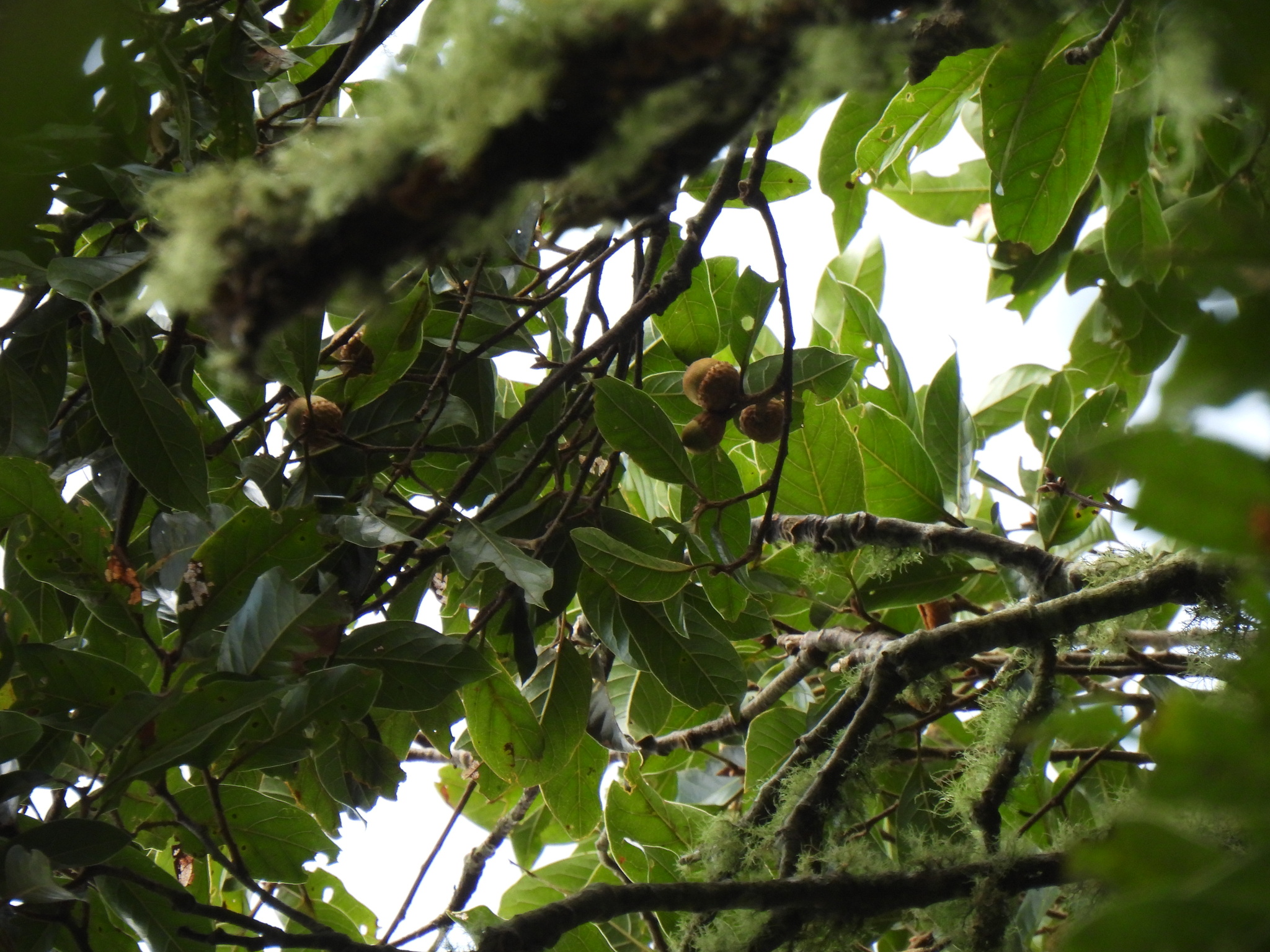
Identification
Physical Characteristics
Form: Quercus benthamii is a large tree that commonly reaches 25 to 35 meters, with exceptional individuals attaining 40 meters. The trunk is straight and robust, with a well-developed crown in open conditions. In forest settings, the crown may be more narrow as the tree competes for light in the canopy.
Bark: The bark is dark gray to nearly black on mature trees, developing deep vertical furrows with age. Young branches are covered with dense tawny or golden-brown hairs (tomentose), which is a useful field character for distinguishing this species from other sympatric oaks.
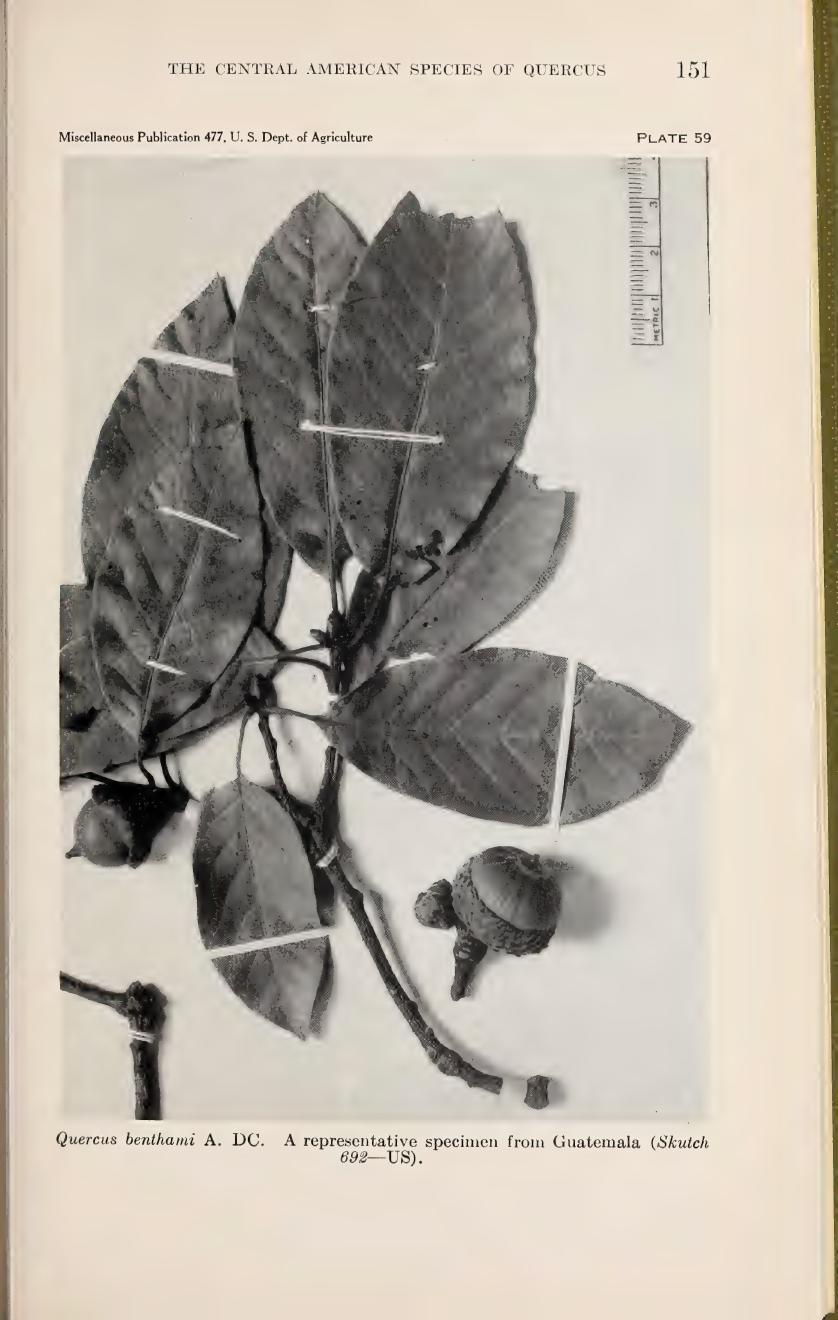
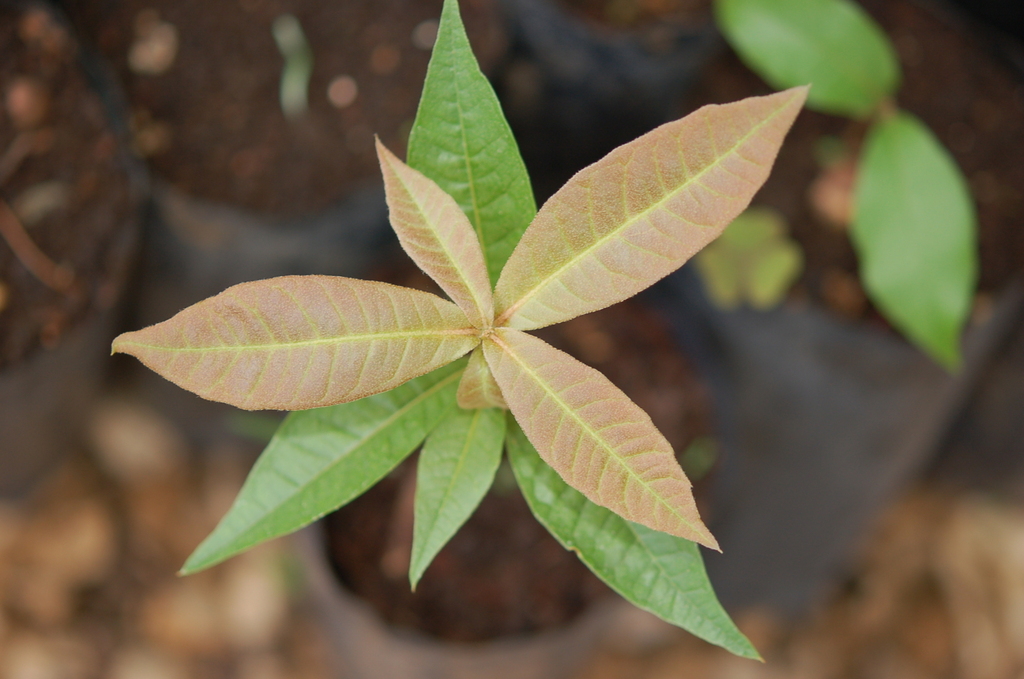
Leaves: Unlike most temperate red oaks, Q. benthamii has entire-margined leaves without lobes. The blades are elliptical to narrowly obovate, measuring 9.5 to 19 centimeters long and 4 to 7 centimeters wide, with a wedge-shaped (cuneate) base and an acuminate to long-pointed (caudate) apex. The margins are entire and slightly revolute (rolled under). The upper surface is dark green and somewhat glossy, becoming glabrous with age; the lower surface is paler with persistent hairs along the midrib. Before falling, the leaves turn a distinctive bronze or copper color, adding seasonal interest to the forest. Some Nicaraguan populations may show slightly toothed (dentate) margins.
Acorns: Unlike most red oaks, which require two years for their acorns to mature, Q. benthamii produces acorns that mature in a single year. This annual maturation pattern is shared with other members of the Quercus seemannii complex, a distinctive clade of Central American cloud forest oaks that also includes Q. seemannii, Q. costaricensis, and Q. gulielmi-treleasei. The acorns are relatively large, with a deep cup that encloses about one-third to one-half of the nut. The inner surface of the acorn shell is woolly, a characteristic of red oaks that distinguishes them from white oaks. The acorns have higher tannin content than white oak acorns, making them less palatable to some wildlife but still an important food source for quetzals, toucans, and other montane forest birds.
Ecology and Distribution
Quercus benthamii ranges from southern Mexico (Chiapas) through Guatemala, Honduras, El Salvador, Nicaragua, and Costa Rica to the highlands of western Panama. Throughout this range, it is a characteristic tree of upper montane cloud forests between 1,500 and 3,000 meters elevation. In Costa Rica, it is most commonly found between 1,800 and 2,400 meters, in the Talamanca range and the highlands around Dota and Copey.
The species typically occurs in oak-dominated forests alongside other oaks such as Quercus copeyensis and Quercus costaricensis. These high-elevation oak forests are characterized by persistent cloud cover, high rainfall (2,500 to 4,000 mm annually), and cool temperatures averaging 10 to 16°C. The trees support rich communities of epiphytes, including mosses, ferns, bromeliads, and orchids, contributing to the high biodiversity of these ecosystems.
As an emergent tree that breaks through the forest canopy, Q. benthamii plays an important structural role in the ecosystem. The species' semi-deciduous habit, with leaves turning bronze before falling, creates seasonal patterns in the forest and contributes to nutrient cycling.
Wildlife Interactions
The acorns of Q. benthamii support an important food web in the cloud forest. Camera trap studies in Mexico's El Triunfo Biosphere Reserve have documented the endangered Baird's tapir (Tapirus bairdii), the largest native mammal in the Neotropics, actively consuming acorns from Q. benthamii trees. Despite ten mammal species being recorded near oak trees, only Baird's tapir and Deppe's squirrel (Sciurus deppei) were documented feeding on the acorns, suggesting these may be key dispersers and consumers.
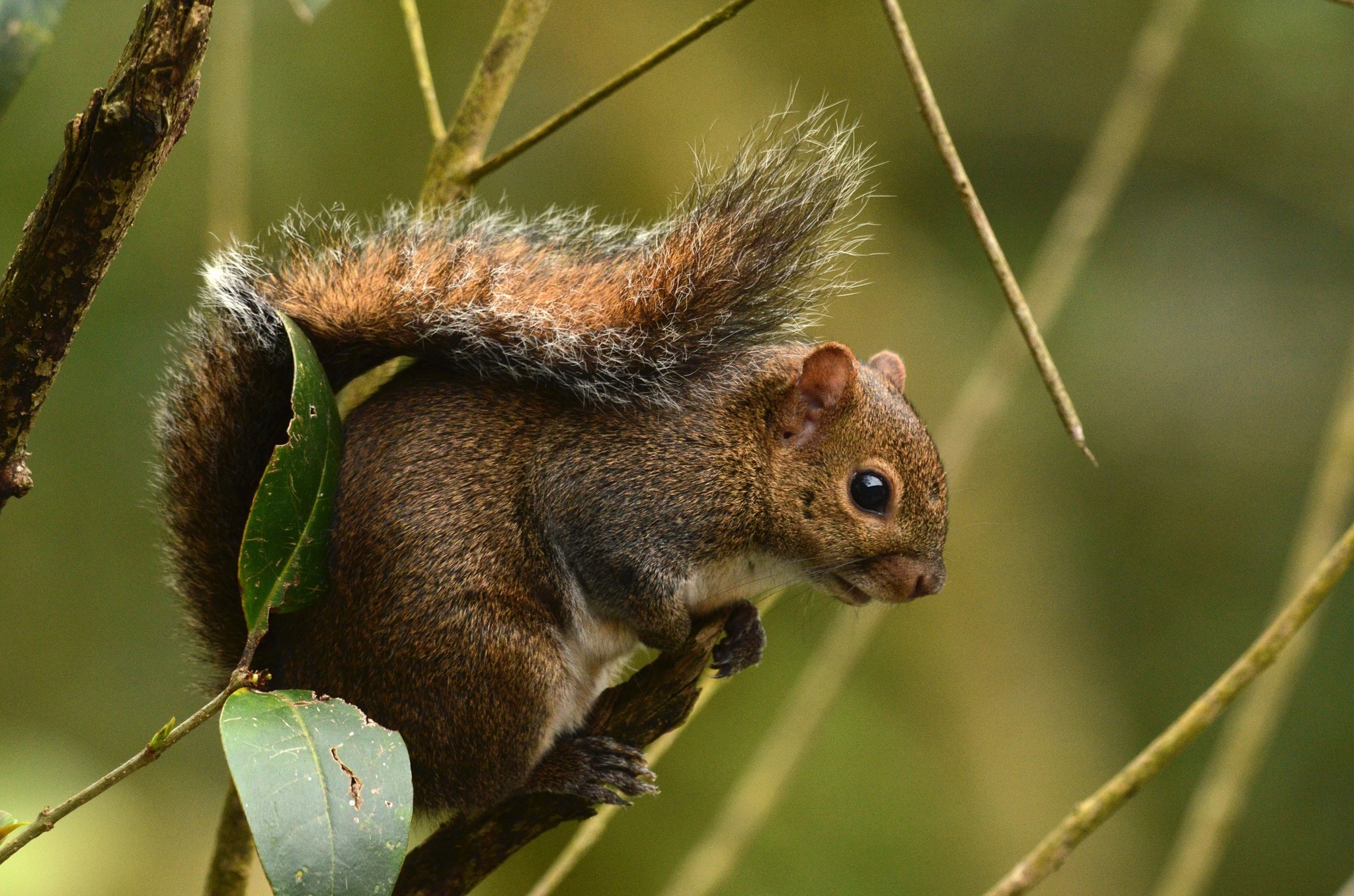
Jays, woodpeckers, and squirrels harvest more acorns than they can eat during times of abundance, hiding many in random locations for later consumption. Some stored acorns are found and eaten, but many are forgotten—a behavior called scatter-hoarding that has planted oak forests across the landscape for millennia. The cloud forests of Mesoamerica may owe their oak-dominated character in part to this ancient partnership between trees and the animals that unintentionally plant them.
While the Resplendent Quetzal (Pharomachrus mocinno) inhabits the same cloud forests as Q. benthamii, research shows that quetzals are specialized frugivores that depend primarily on fruits of the laurel family (Lauraceae), particularly wild avocado relatives called aguacatillos. Oaks contribute to quetzal habitat by providing forest structure and supporting the diverse insect community that quetzals feed to their young during the breeding season.
Conservation Status
Quercus benthamii is listed as Near Threatened by the IUCN (assessed 2018), with an estimated area of occupancy of just 584 km²—a figure that may underestimate its true range given how difficult cloud forest oaks are to survey. The 2020 Red List of Oaks, compiled by Botanic Gardens Conservation International, The Morton Arboretum, and the IUCN Global Tree Specialist Group, found that 31% of the world's oak species are threatened with extinction. Deforestation for agriculture and urbanization are the primary drivers of oak decline in Mexico and Central America.
Throughout its range, Q. benthamii faces multiple threats: over-extraction of timber and firewood, cattle grazing in forest understory, human-caused fires, and conversion of cloud forest to pasture and coffee plantations. The cloud forest enclaves that harbor this species have been reduced to small fragments in many areas. Climate change adds an additional threat, as rising temperatures may force cloud forest species upward on mountain slopes, reducing available habitat on peaks.
In Costa Rica, significant populations are protected within national parks and reserves in the Talamanca range, including Chirripó National Park and the surrounding biosphere reserve. The species also occurs in the protected forests around Cerro de la Muerte and the highlands of the Dota region, where cloud forest conservation has been strengthened in part to protect quetzal habitat.
Taxonomy and Synonyms
Quercus benthamii was described by Alphonse de Candolle in 1864 in his monumental work Prodromus Systematis Naturalis Regni Vegetabilis. The species has accumulated numerous synonyms over the years as different populations were described as distinct species before modern understanding of the species' variability:
- Quercus rapurahuensis Pittier ex Trel. (1924) — the "Talamanca oak," type from Copey, Costa Rica at 1,800 m
- Quercus baruensis C.H.Mull. (1963) — described from Volcán Barú, Panama
- Quercus gemmata Trel. (1924) — described from Guatemala
- Quercus lowilliamsii C.H.Mull. (1963) — described from Honduras
The consolidation of these names under Q. benthamii reflects modern understanding that this widespread species shows considerable variation across its range, but this variation falls within the normal limits of a single species. The name Q. rapurahuensis may still appear in older Costa Rican literature and herbarium collections.
Resources & Further Reading
Species Information
Authoritative taxonomic information including synonyms and native range.
Conservation assessment showing Near Threatened status and population trends.
Scientific Literature
The definitive 34-chapter synthesis on neotropical oak forests, covering paleo-ecology, biogeography, composition, population dynamics, and conservation. Multiple chapters discuss Q. benthamii and the seemannii complex.
Analysis of 75 red oak species identifying centers of richness and endemism. Found that only 41% of red oak species are protected and recommends expanding 12 reserves plus creating 26 new ones.
Comprehensive assessment of all 430 oak species worldwide. Documents that 31% are threatened with extinction, with deforestation the main driver in Mexico and Central America.
Camera trap study documenting Baird's tapir and Deppe's squirrel consuming Q. benthamii acorns at El Triunfo Biosphere Reserve in Chiapas.
Overview of the Morton Arboretum's cloud forest oak conservation program, including work with the Global Conservation Consortium for Oak.
Observations and Images
Community observations and photographs of this species throughout its range, from Mexico to Panama.
Complete monograph with 124 botanical plates illustrating Central American oaks. USDA Miscellaneous Publication No. 477.