Monte Hiltún Cafecillo
Psychotria marginata Sw. strings airy, pale-yellow panicles and red-rimmed leaves from La Selva's successional plots to Monte Hiltún's limestone valleys, carrying the Q'eqchi' name "Ookan cimarrón".
The Monte Hiltún cafecillo is the understory shrub that botanist Cyrus Lundell recorded as "Ookan cimarrón" in 1937 when he mapped the limestone valleys of Petén, noting how its thickets stabilized the montane ravines that were already being scorched by ranching fires. In Costa Rica the same species pops up along the Sendero Tres Ríos at La Selva, on the piedmont of Piedras Blancas, and throughout the Brunca foothills, linking research plots, private refuges, and indigenous agroforestry clearings with a single familiar cafecillo.
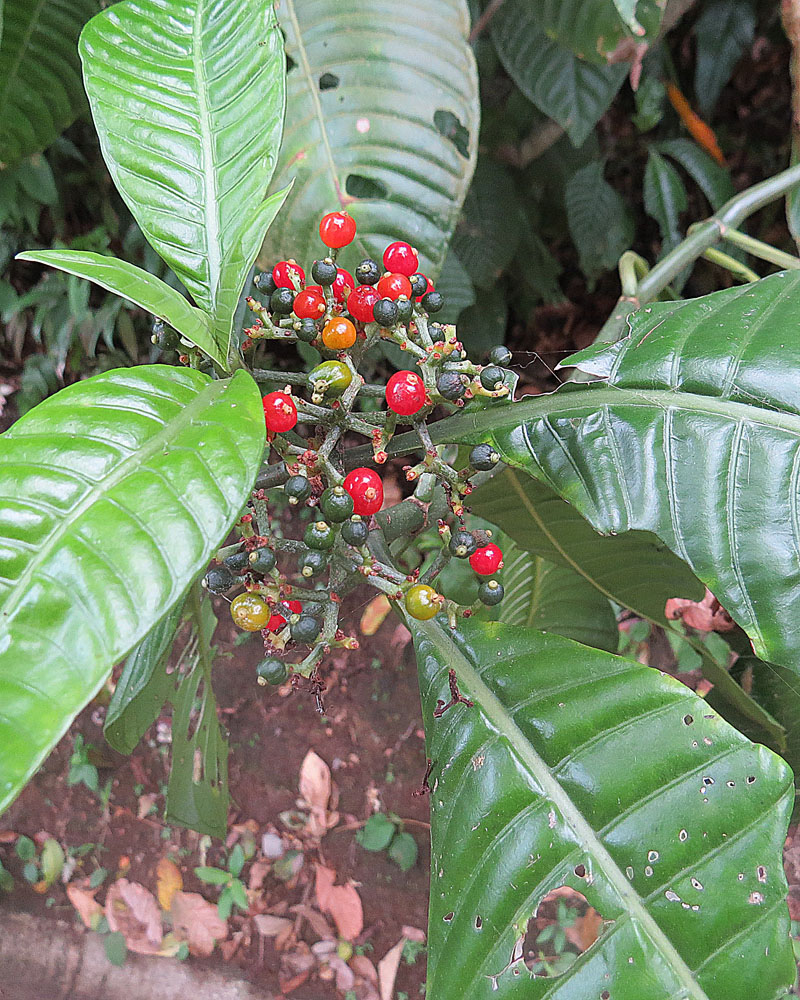
Its signature look combines oblanceolate leaves lined with tiny cilia, conspicuous domatia where the secondary veins meet the midrib, and huge, right-angled panicles that split into five or six ranks of threadlike axes bearing distylous, pale-yellow flowers. Fruits ripen into marble-sized, glossy red drupes that darken to black on herbarium sheets, which is why collectors habitually pressed both leafy shoots and fruiting cymes on the same voucher.
Identification
Habit and Bark
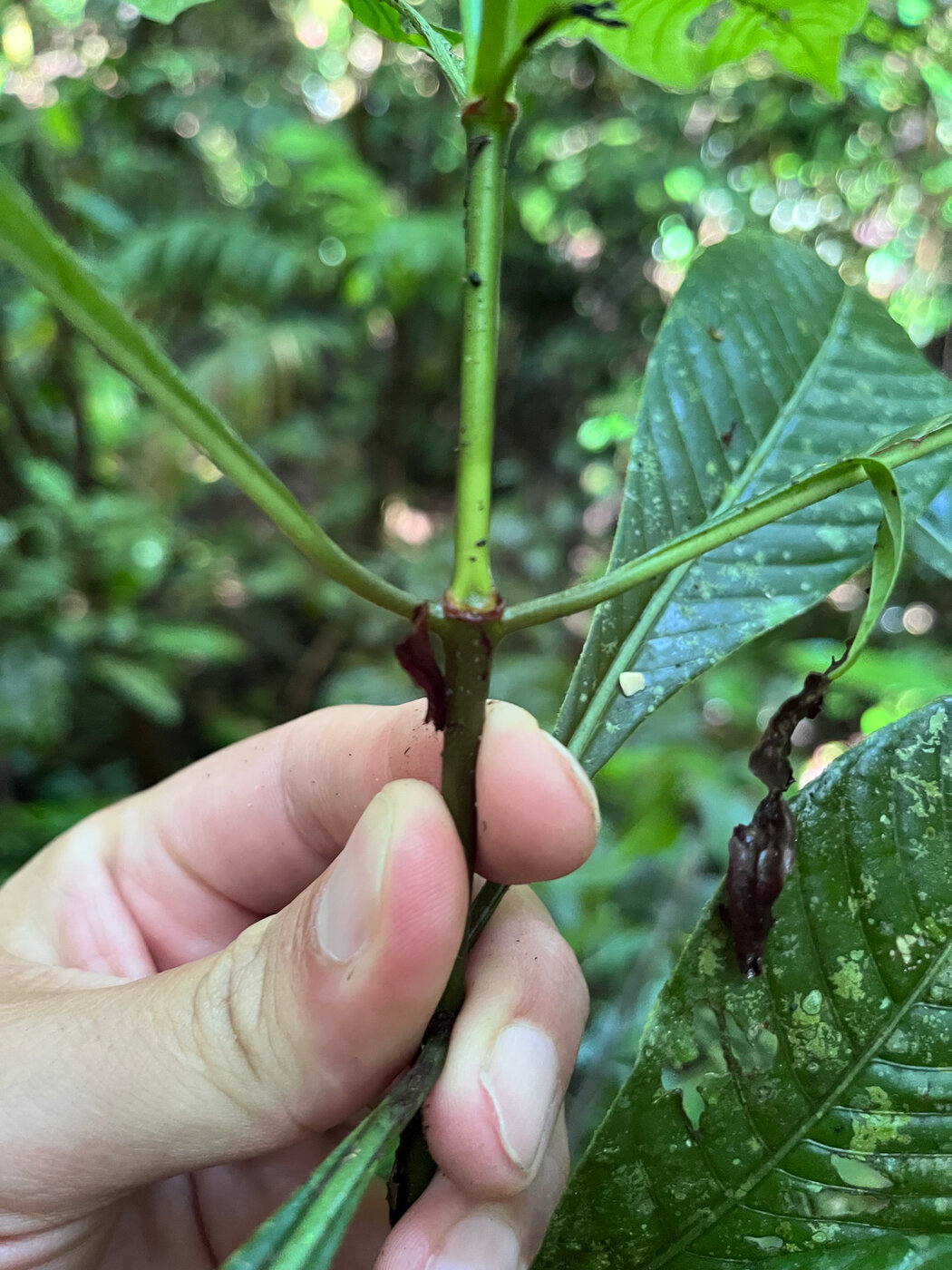
P. marginata grows as a multi-stemmed shrub 1–4 m tall with smooth, hairless young stems. Leaf-like stipules about 1 cm long clasp each node before falling, leaving a pale ridge with a distinctive red-brown fringe. The clumps branch from near the base and send straight shoots toward patches of light, which is why La Selva researchers frequently note individuals along the edges of successional plots and forest roads.
Leaves
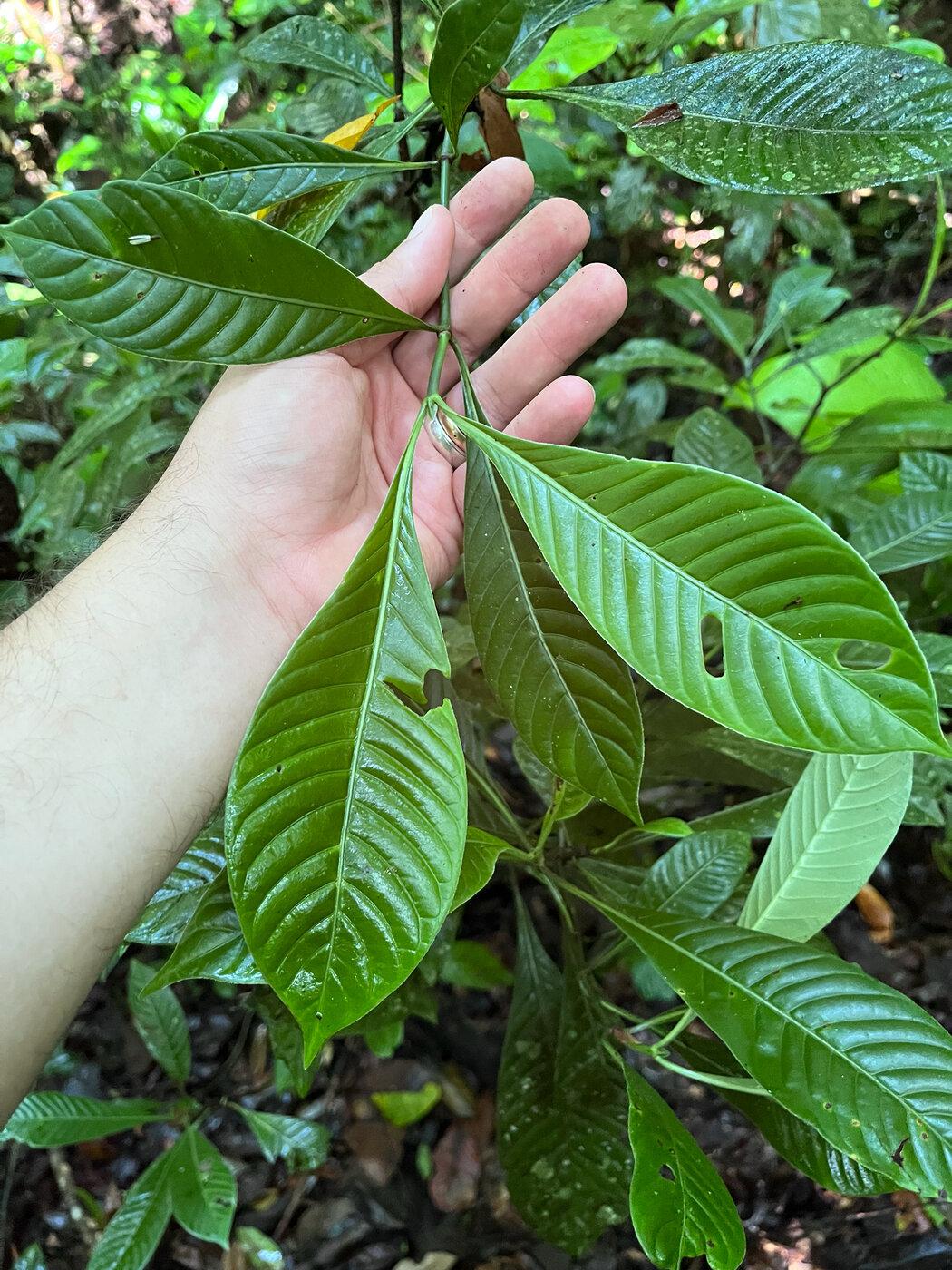
Leaves are thin and papery, spoon-shaped (oblanceolate) to elliptic, 10–20 cm long by 3–6 cm wide, narrowing gradually toward the stalk. The surfaces are hairless except for tiny hairs along the margins that you can feel by running a finger along the edge. When dried, the blades take on a distinctive red-gray hue. Each leaf carries 12–14 pairs of secondary veins that arch gently toward the tip. The opposite leaves sit in a flat plane, creating the layered "book page" effect you notice along humid trails.
Along the midvein beneath, where secondary veins branch off, small pockets called domatia provide shelter for predatory and fungivorous mites. This is no accident: the Rubiaceae, with 819 documented species bearing these structures, account for a third of all domatia-bearing plants on Earth. The arrangement represents a classic bodyguard mutualism that fossil evidence traces back 75–76 million years to the Late Cretaceous. The plant provides refuge; in return, mites consume fungal spores and tiny herbivores that would otherwise damage the leaf surface. Studies on the related Psychotria horizontalis across Panama confirm that domatia occupancy correlates with reduced herbivory and fewer fungal lesions. For P. marginata, the conspicuous pits visible on pressed specimens are not merely taxonomic curiosities but functional infrastructure inherited from deep time.
Flowers
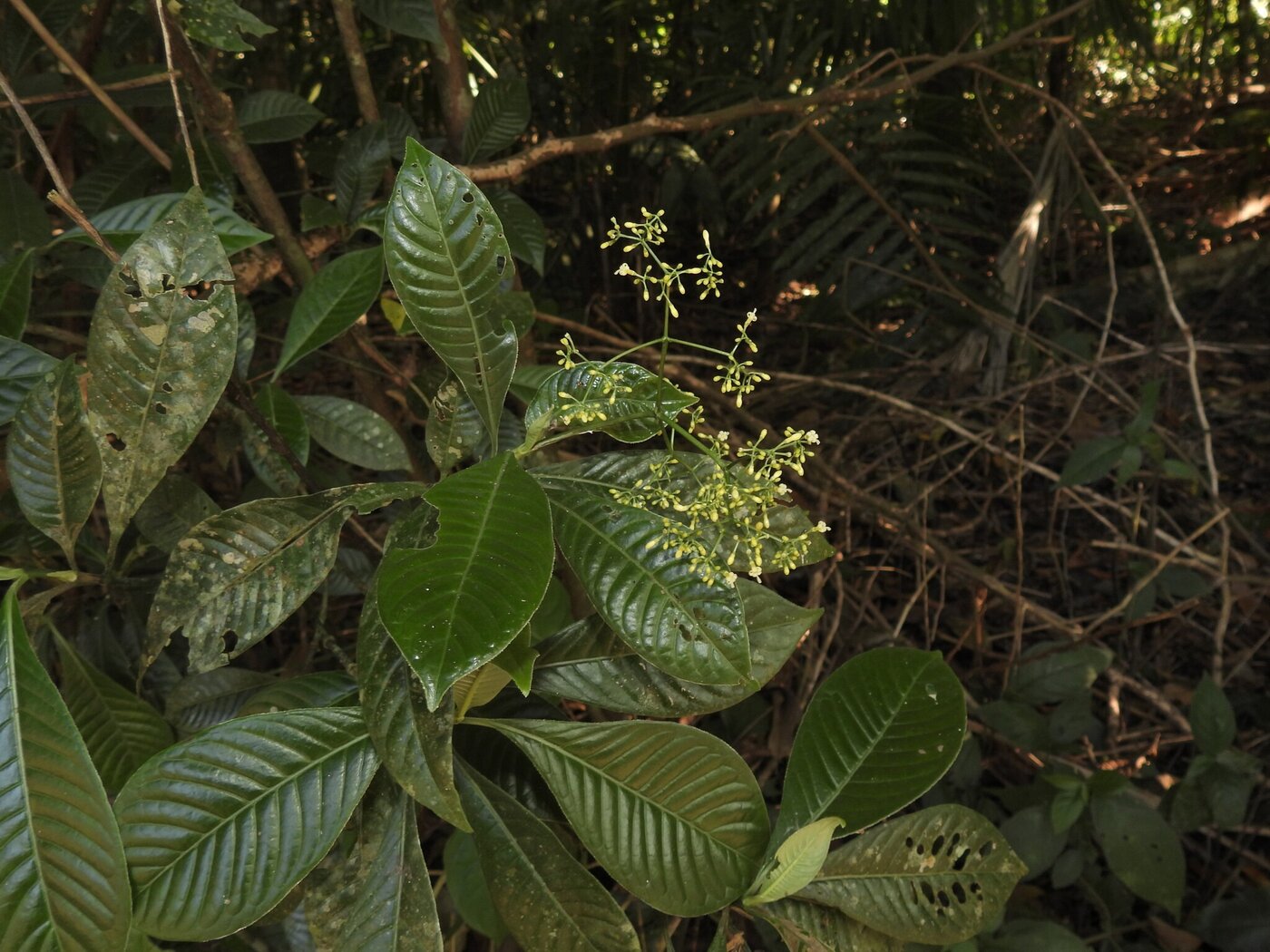
Flowers appear in airy, open-branched clusters (panicles) 10–15 cm long at the branch tips. The secondary branches split off at right angles, giving the inflorescence a distinctive zigzag architecture. Each pale-yellow flower is tiny, with a 2–3 mm tube and small triangular lobes. Like many coffee-family species, this plant is distylous: some individuals produce "pin" flowers with tall styles and low stamens, while others produce "thrum" flowers with the arrangement reversed. Pollinators carrying pollen from one form to the other ensure cross-fertilization. La Selva field notes mention these delicate flower clusters hovering 1–2 meters above the ground along trail edges.
Fruits
Fruits are small, round drupes only 3–4 mm across that ripen from yellow-orange to bright scarlet before drying black on herbarium sheets. Each seed has distinctive deep furrows running lengthwise. La Selva documents these juicy drupes persisting on the plant through February and March, remaining visible even as the leaves darken during the dry season.
Distribution
Plants of the World Online and Taylor's monograph treat P. marginata as a single, widespread species ranging from southern Mexico (Chiapas, Oaxaca, Veracruz) through Guatemala, Belize, Honduras, Nicaragua, Costa Rica, and Panama, and reappearing in Cuba, Jamaica, Colombia, Venezuela, Ecuador, Peru, and Bolivia, mostly below 1,000 meters in moist to premontane rainforest. Lundell's 1937 survey added the Monte Hiltún limestone valley of Petén to that map, emphasizing its abundance in karst basins.
Current occurrence data show the species thriving across Costa Rica. GBIF lists 569 georeferenced collections and observations for the country, with 269 of those falling within the Brunca region. Pacific-slope clusters appear near Piedras Blancas, Río Claro, and the Coto Brus foothills. On the Caribbean slope, La Selva Biological Station hosts well-documented populations on research plots dating to 1974, in private reserves like Nogal and Alto Botella, and along the Sendero Oriental.
Ecology
The shrub is a reliable indicator of humid, lightly disturbed understory: La Selva's species profile simply states "esta especie es común en bosques secundarios maduros, particularmente cerca de las Parcelas de Sucesión y al final del Sendero Tres Ríos," underscoring how it colonizes canopy gaps yet persists beneath closed forest. Its distylous flowers produce nectar deep inside a 2–3 mm tube with a hairy throat, a configuration that favors small bees and syrphid flies while enforcing cross-pollination between pin and thrum morphs (Taylor 1989). Flowering collections exist for every month of the year, with peaks between September and April, and fruiting vouchers are likewise recorded year-round, although La Selva's phenology list highlights flowers from July to November and fruit clusters from February to March.
Seasonal Leaf Strategy
A 1992 study published in the Proceedings of the National Academy of Sciences revealed that P. marginata produces two physiologically distinct leaf types each year. Researchers from the University of Missouri-St. Louis documented bimodal leaf flushes: a major peak at the start of the wet season and a secondary peak at its end, together accounting for 75–87% of annual leaf production. Dry-season leaves showed higher specific mass, reduced stomatal conductance, and greater water-use efficiency than their wet-season counterparts.
The most striking finding was that this dimorphism is not triggered by drought itself. Plants maintained under irrigation throughout consecutive dry seasons still produced leaves with identical dry-season traits. The researchers concluded that the adaptation is "strongly canalized by some factor other than water availability," suggesting an internal calendar rather than a response to current conditions. This pre-programmed strategy allows the shrub to prepare for seasonal drought before it arrives, a physiological hedge that helps explain why the species persists so reliably across both research forests and fire-prone limestone valleys.
Seed Dispersal
Fruiting shrubs place marble-sized drupes at 1–2 m height along the same secondary strips that people and wildlife use as corridors; the clusters persist for weeks, leaving bright red signals tucked just beneath the canopy. Studies of Psychotria species in Panama found that manakins and migratory thrushes account for 97% of all fruit removal, with Psychotria representing 27% of fleshy fruits recovered from bird samples in the forest understory. While no species-specific disperser observations have been published for P. marginata, the exposed panicles and long-lived drupes ensure that seeds are available whenever frugivores patrol those gaps.
In limestone valleys such as Monte Hiltún, Lundell observed the species as "a common large shrub" embedded within remnants of primary forest while nearby savannas were repeatedly burned, highlighting its dependence on shaded, moisture-retentive microsites even as it tolerates some disturbance.
Taxonomic History
Olof Swartz published the name Psychotria marginata in his 1788 "Prodromus," based on material he collected during an extraordinary Caribbean expedition. Born in 1760 to a wealthy Swedish family, Swartz trained under Carl Linnaeus the Younger in Uppsala before departing for the West Indies at age 23. He arrived at Montego Bay, Jamaica on January 5, 1784 and spent the next two and a half years exploring Jamaica, Hispaniola, Puerto Rico, and Cuba, amassing some 6,000 specimens despite repeated bouts of tropical fever. He returned to Sweden in 1787 and spent decades publishing his findings, beginning with the 1788 Prodromus that established P. marginata and culminating in the three-volume Flora Indiae Occidentalis (1797–1806), which described roughly 900 new species. Swartz's Jamaican holotype remains the nomenclatural anchor for the species, tying every Central American voucher to his 18th-century collections.
Later authors shuffled the species through Uragoga marginata (Kuntze) and Myrstiphyllum marginatum (Hitchcock), and described Central American segregates such as Psychotria nicaraguensis Benth. (Bentham in Ørsted 1853). Taylor's 1989 revision compared hundreds of vouchers from the Greater Antilles to Bolivia and concluded that the oblanceolate leaves with ciliate margins, domatia, and delicate multi-ranked panicles remain strikingly uniform across the range, justifying a single species concept that Plants of the World Online now follows.
Conservation Outlook
No global Red List assessment exists for P. marginata, but thousands of herbarium sheets and hundreds of recent GBIF-mediated observations show the species thriving inside protected landscapes such as La Selva Biological Station, Piedras Blancas National Park, La Amistad, and community reserves like Nogal. The shrub's ability to persist in mature secondary forest means it benefits from restoration projects that maintain shaded corridors between riparian buffers and cacao or banana agroforestry plots.
Threats arise when those narrow corridors are removed: Lundell already warned that repeated savanna fires in central Petén left limestone mounds "denuded or only partially wooded," and the same pattern now appears along the Pacific piedmont where cattle pastures or sun-grown coffee erase understory structure. Prioritizing fuel-break management and supporting shade-grown agriculture across the Brunca foothills will keep Monte Hiltún's cafecillo a fixture in both research forests and community lands.
Resources & Further Reading
Floras & Monographs
Detailed morphology, distribution maps, and specimen citations for every Central American collection.
Bilingual species account with habitat notes, phenology, and a gallery of field photographs from Sarapiquí.
Historical Accounts
Classic Carnegie Institution volume documenting "Ookan cimarrón" in Monte Hiltún's limestone valleys and surrounding savannas.
Research
PNAS study documenting bimodal leaf production and pre-programmed seasonal dimorphism in P. marginata at Barro Colorado Island.
Biology Letters study tracing domatia-mite mutualisms to 75–76 million years ago using Late Cretaceous leaf fossils.
PNAS survey identifying Rubiaceae (819 species) as the dominant domatia-bearing family, representing 33% of all known occurrences.
Data Portals
Accepted taxonomy, synonymy, and global range pulled from WCVP and IPNI records.
Downloadable specimen and observation records documenting the species across Mesoamerica and northern South America.