Slender Wild Coffee
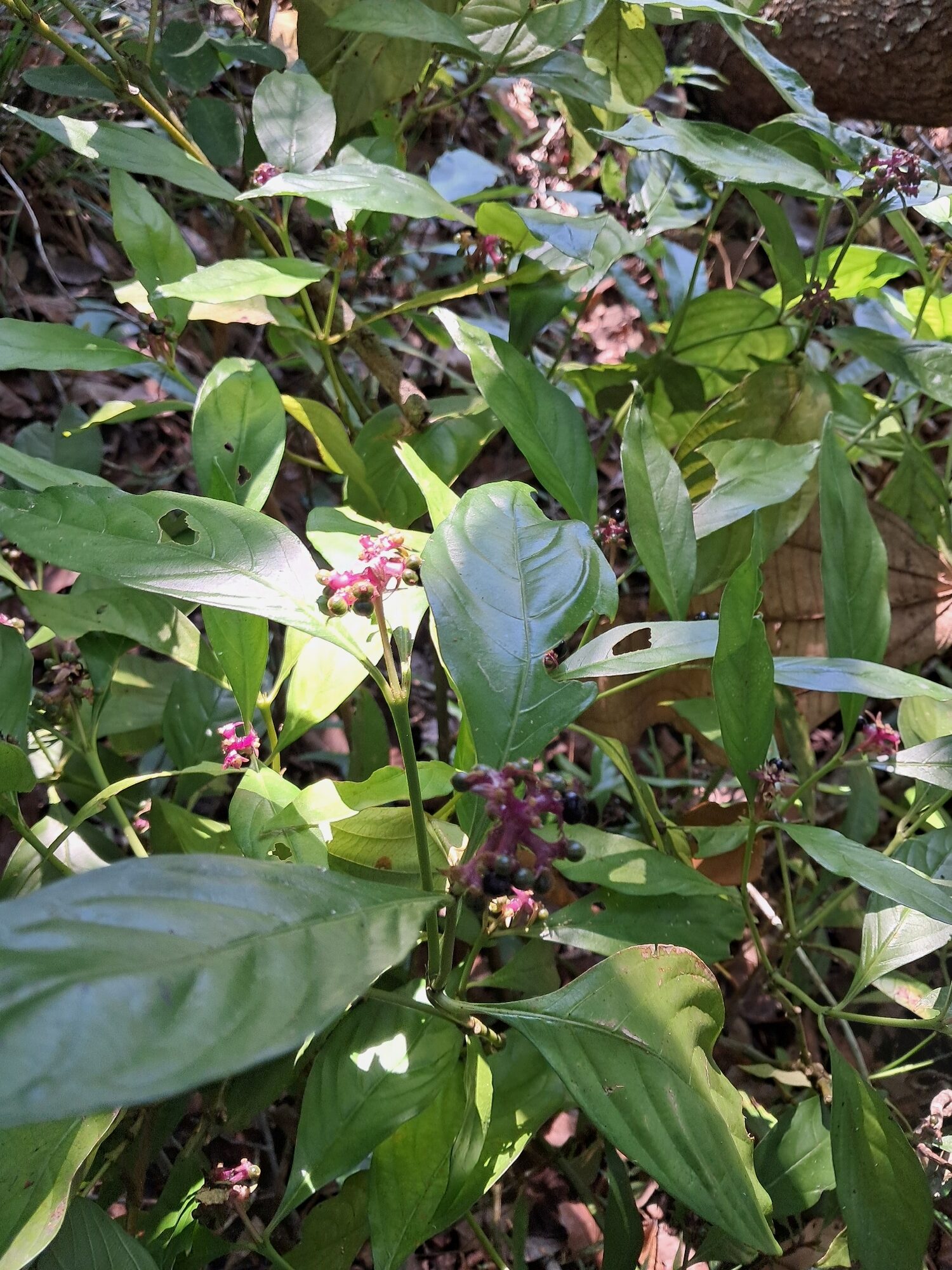
Ribbed, blue-black berries hang from hot-pink stalks in the rainforest understory. DNA evidence recently carried this slender shrub out of one of the largest plant genera on Earth.
In the deep shade of Costa Rica's wettest lowland forests, on soggy ground where water lingers after rain, grows a slender shrub seldom taller than a person. Its small white flowers sit cupped in a collar of leafy bracts, and its berries ripen from green to a deep blue-black, each one scored with lengthwise ribs and strung along inflorescence branches that flush a vivid magenta-pink. For so modest a plant, it has caused botanists more than its share of trouble. A herbarium sheet bearing its pressed leaves might be filed under any of half a dozen names.
Most of that trouble comes down to a single question that molecular biology only settled in the last decade: which genus does it belong to? For more than a century the species rested in Psychotria, among the largest genera of flowering plants on Earth, with well over 1,500 species. Then DNA sequencing took the old, sprawling genus apart and showed that this shrub and its relatives belonged with a different lineage altogether. Today its accepted name is Palicourea gracilenta, though the plant in the forest has not changed in the slightest.
Identification
Habit
This is a shrub or subshrub, usually 1 to 2 meters tall and occasionally reaching 3, with thin, hairless branchlets only a few millimeters thick. It is a creature of the forest floor rather than the canopy, growing in the dim, humid air beneath taller trees, and it keeps its leaves year-round. Nothing about its stature draws the eye. The plant announces itself instead through its flowering and fruiting branches, which rise from the tips of the stems and, in fruit, glow magenta against the surrounding green.
Leaves
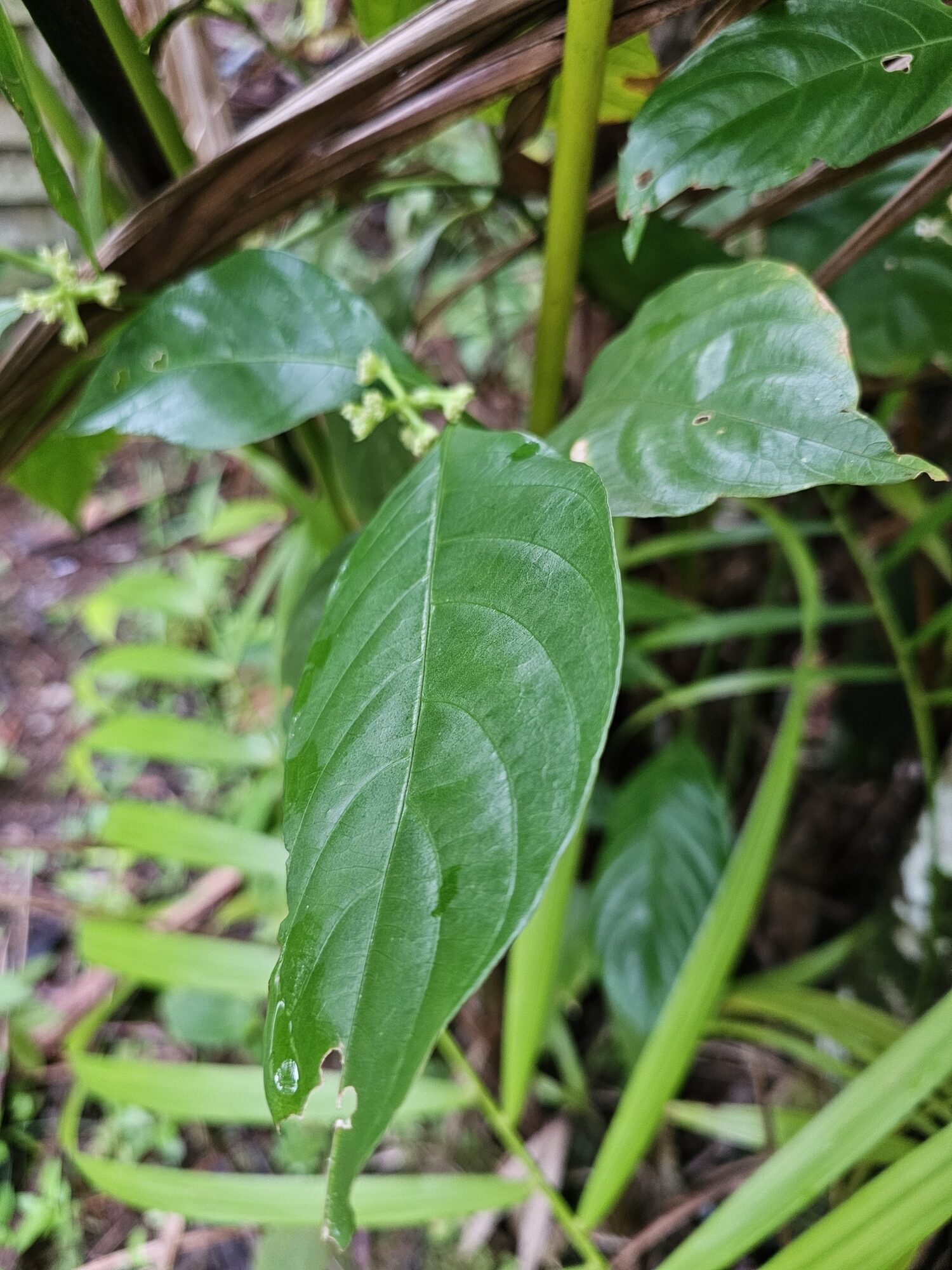
The leaves are arranged in opposite pairs, as in coffee and the rest of the Rubiaceae. Each blade runs 9 to 16 cm long, occasionally to 18, and 3 to 7 cm wide, shaped like a narrow oval that tapers to a short drawn-out point (acuminate) at the tip and narrows gradually to the base. They are glabrous (hairless) on both surfaces and dry to a thin, papery texture with a greenish cast, a small but useful field mark. On either side of the midrib, four to eight secondary veins curve upward in a gentle arc, and the finer veins between them run roughly parallel toward the margin.
Twigs & Stipules
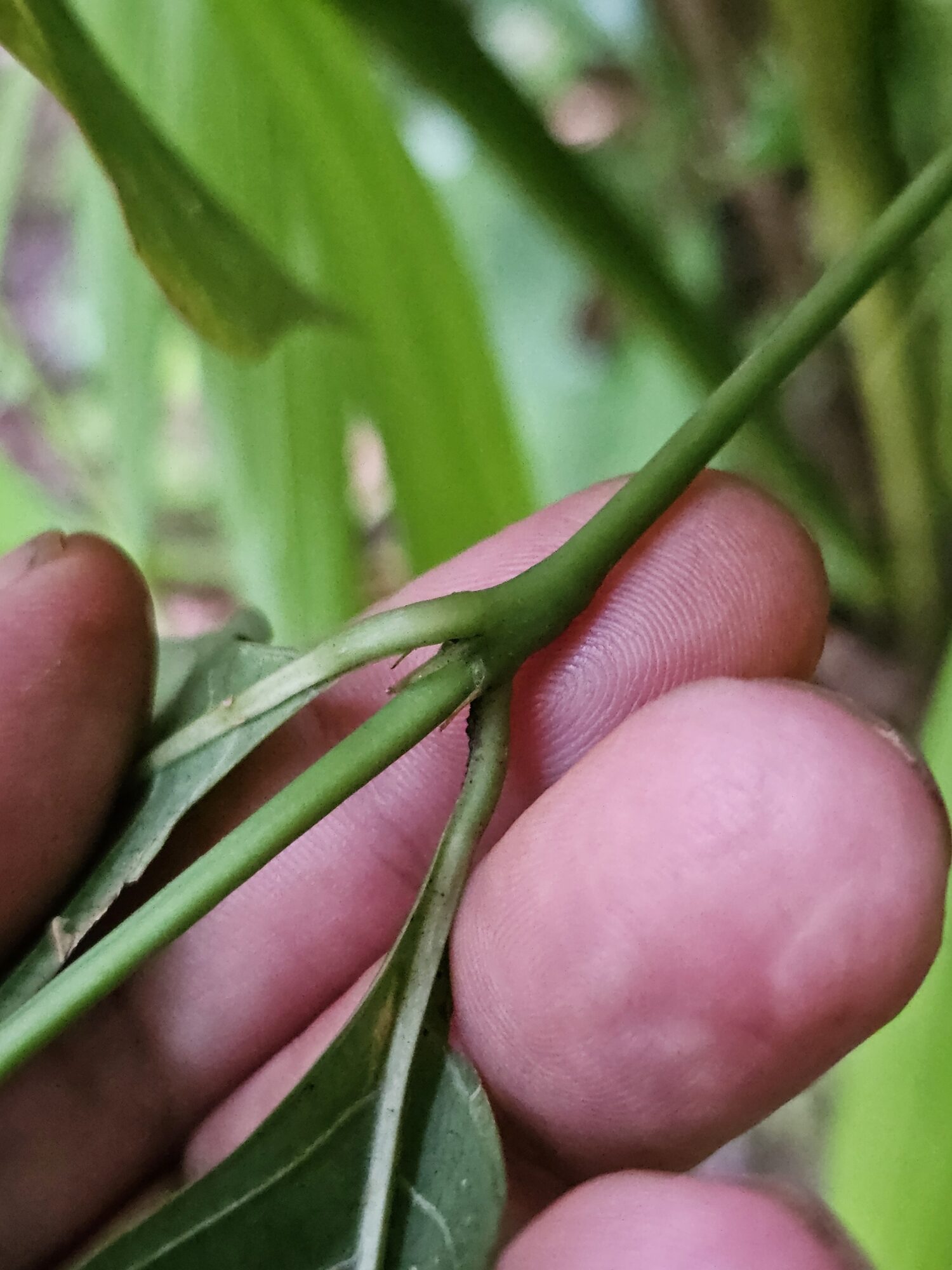
Where each pair of leaves meets the stem sits a stipule, a small appendage that in this family bridges the gap between the two leaf stalks (interpetiolar). In the slender wild coffee the stipules are distinctive: each bears two narrow, linear-to-triangular lobes per side, 2 to 7 mm long, separated by a shallow U-shaped notch, and they persist on the twig rather than dropping early. Together with the hairless, green-drying leaves, these well-separated stipule lobes are among the surest ways to recognize the species when it is not in fruit.
Flowers
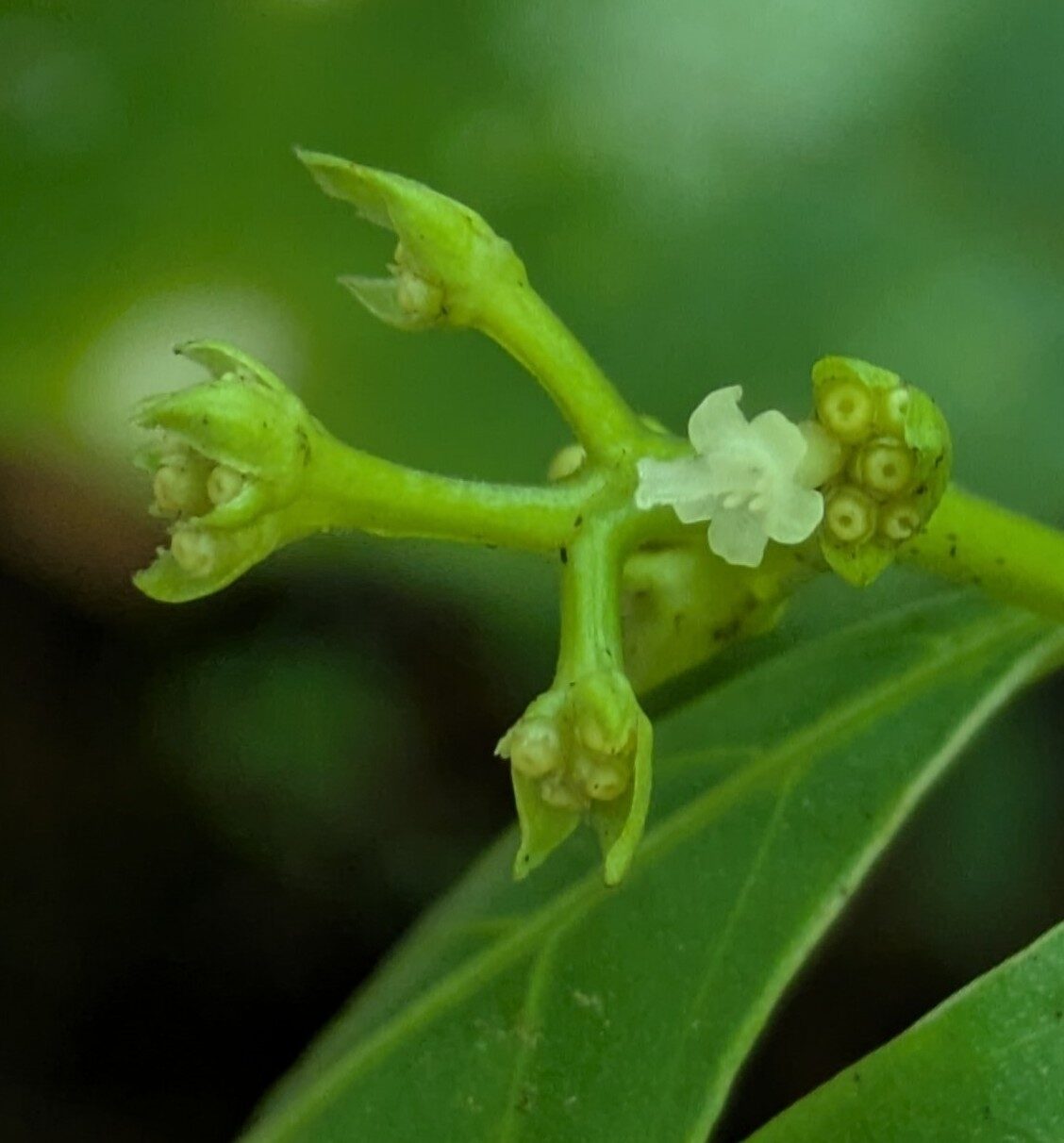
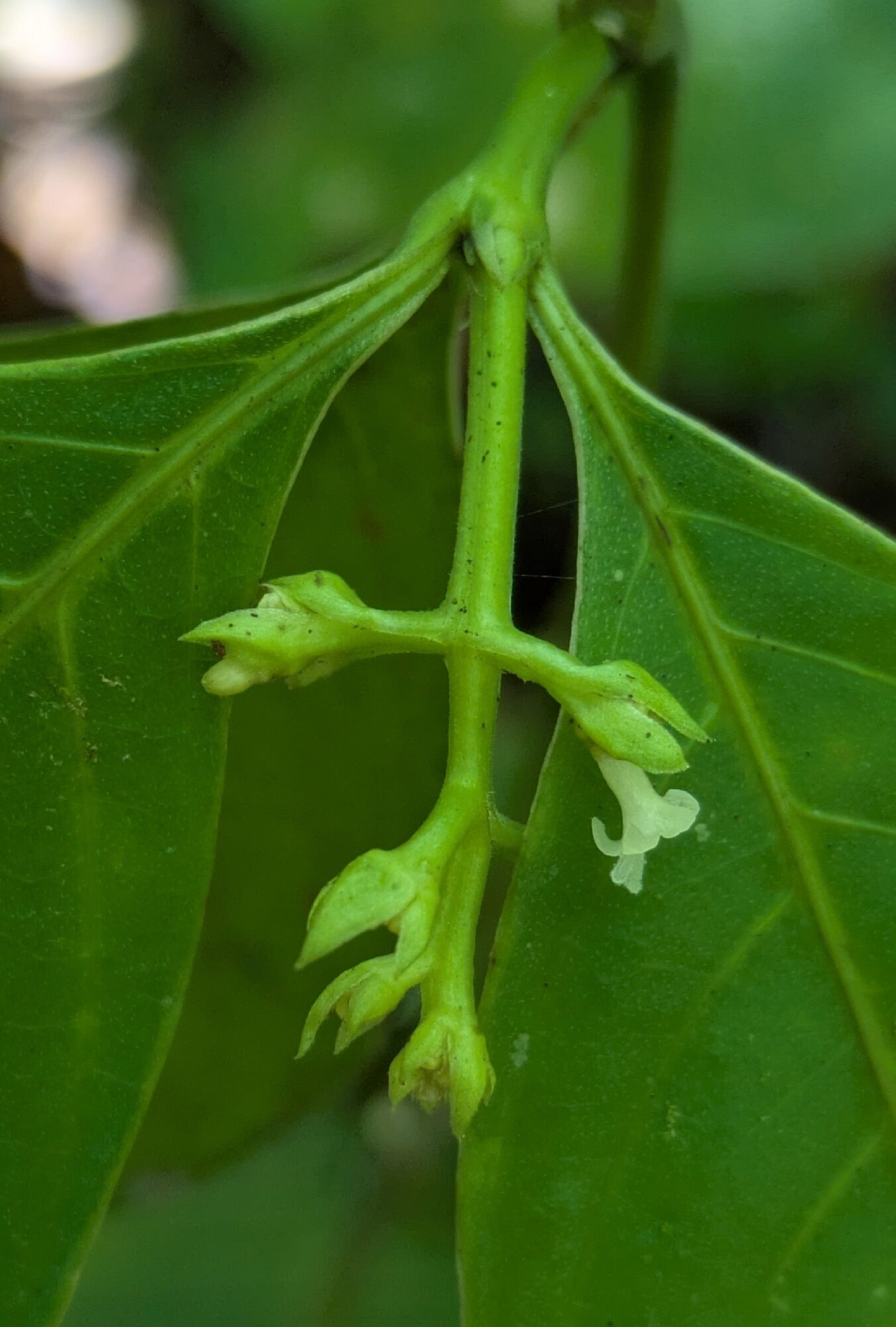
The flowers are tiny and white, with a corolla shaped like a salver: a slender tube only 1.5 to 4 mm long that flares into five short lobes. They are borne in a small terminal cluster, 1.2 to 3 cm long, that is narrowly branched or sometimes drawn into a tight head, and the flowers themselves sit without stalks (sessile). A distinctive touch is the involucre, a collar of three leafy bracts fused at the base that cups the flower cluster. In Costa Rica the species flowers mainly in July and August.
Like nearly all of its relatives, the slender wild coffee is distylous, a form of heterostyly in which a population contains two kinds of plant. "Pin" flowers hold a long style with the stigma at the mouth of the tube and the anthers tucked below; "thrum" flowers reverse the arrangement, with short style and high anthers. A flower can normally only be fertilized by pollen from the opposite form, an arrangement that forces cross-pollination between different individuals.
Fruits
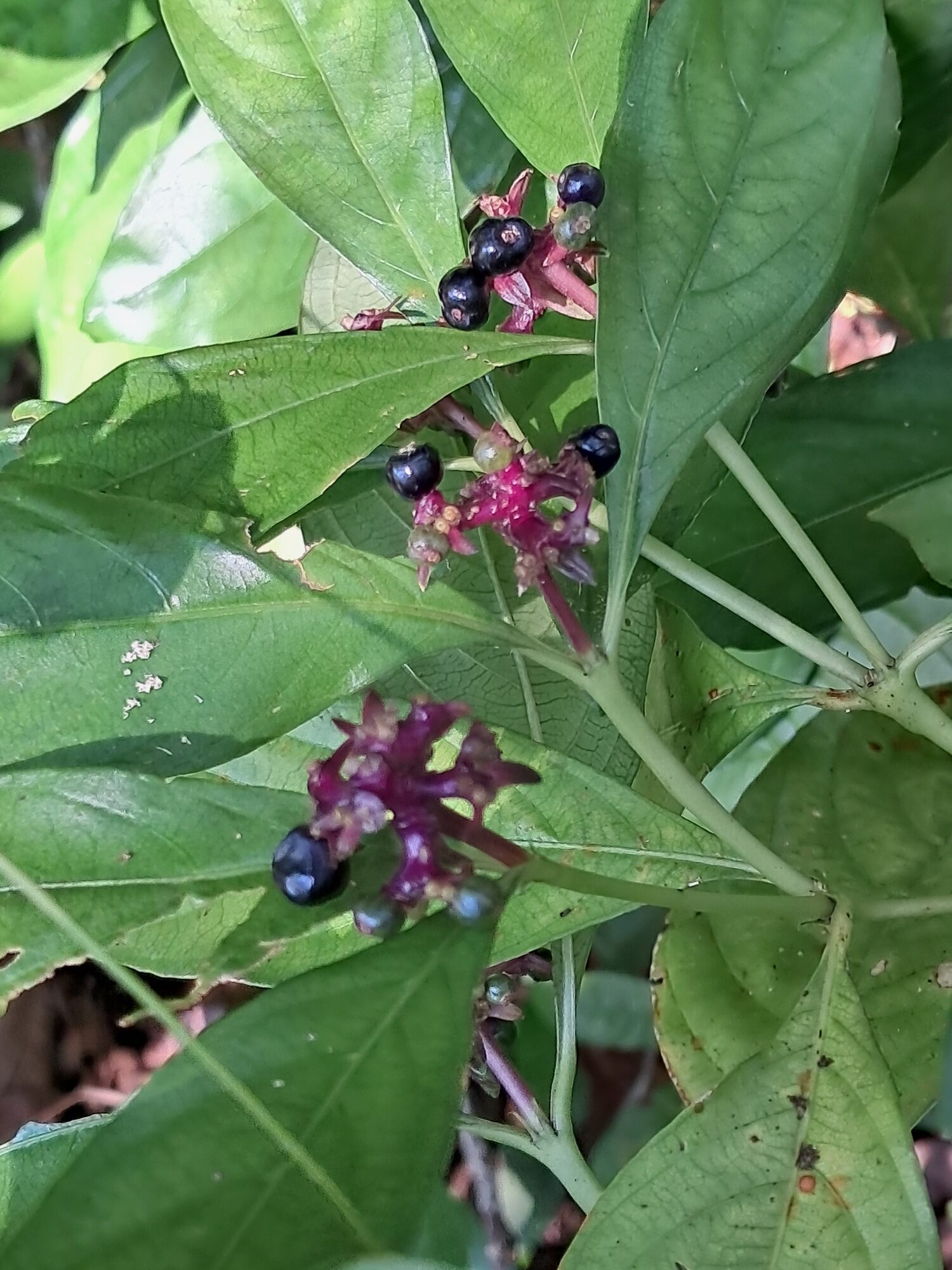
The fruit is a small drupe (a fleshy fruit with a hard stony center), roughly 4 mm in each direction, globe-shaped to slightly oblong, and marked by prominent lengthwise ribs that give it the look of a miniature melon. It ripens from green to a deep purple-black, almost blue-black when fully ripe, and the two or three stones inside (pyrenes) each carry four or five ridges. As the fruit matures, the inflorescence axes that hold it deepen to magenta-pink, so the dark berries sit against a bright backdrop, the kind of color contrast that advertises ripe fruit to birds. In Costa Rica fruiting runs from August into October, with a second pulse in December.
Distribution
Few understory shrubs range as widely. The slender wild coffee grows from Nicaragua south through Costa Rica and Panama into Colombia, Ecuador, Peru and Bolivia, across the Amazon basin and the Guianas, and on into the Atlantic forest of eastern Brazil, where the type specimen was collected at Bahia. Across that span botanists have logged some 2,300 occurrences, the most from Brazil and Colombia. Costa Rica accounts for 166 of them, a high tally for a forest-floor shrub, recorded from sea level up to about 1,035 m.
In Costa Rica it is well represented in the Caribbean lowlands, with many collections from La Selva Biological Station in Sarapiquí, the San Carlos plains, and the Río San Juan borderlands of the Corredor Fronterizo refuge. In the Brunca region of the southern Pacific it turns up across the Osa Peninsula and the Golfo Dulce: in Corcovado National Park near the San Pedrillo station, in the Golfo Dulce Forest Reserve around Los Mogos and Pargos, and through the Térraba-Sierpe National Wetland at Piedras Blancas and Isla Violín. The species also reaches the General Valley near Pérez Zeledón, where it has been collected at the Alexander Skutch Bird Refuge at Los Cusingos, and climbs to its highest Costa Rican record, around 1,035 m, on the Fila Retinto ridge above Palmar.
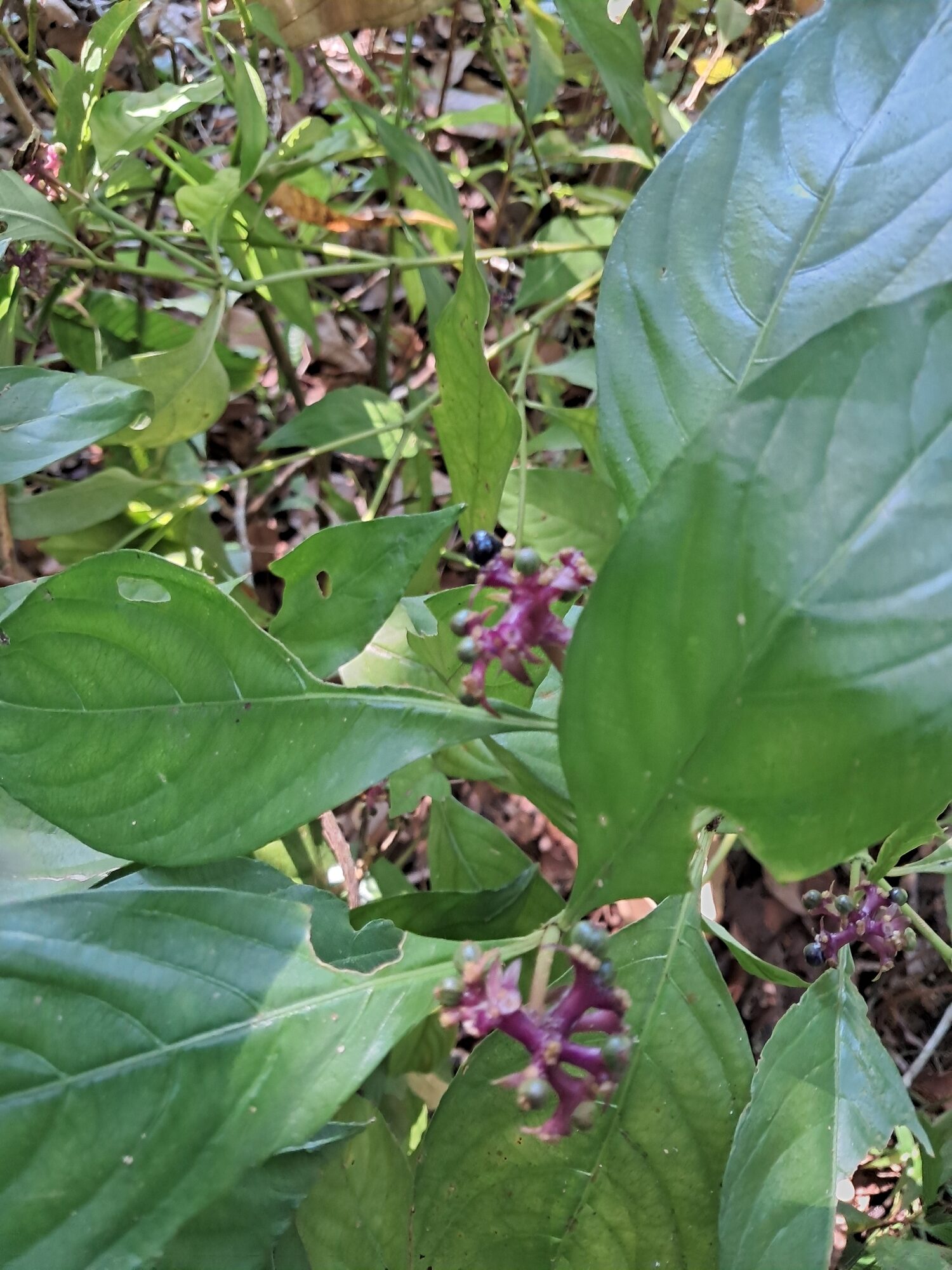
Throughout its range it favors the same conditions: the understory of lowland and premontane wet forest, on both the Caribbean and Pacific slopes, in shaded sites where the ground stays wet and poorly drained. It is a plant of closed, humid forest rather than open or dry country, and its broad geographic reach reflects how widespread that lowland rainforest habitat once was across the American tropics.
Ecology
No one has published a pollination study of this exact species, so its visitors must be inferred from its flowers and from its many studied relatives. The small, white, short-tubed corolla fits the pattern that botanists associate with bee pollination, the syndrome typical of the group it belongs to. The genus Palicourea also contains the showy, long-tubed, brightly colored flowers built for hummingbirds, but the slender wild coffee sits firmly on the small-and-white side of that divide, the kind of flower that small bees and other short-tongued insects work. Its distyly, the two reciprocal flower forms, means a successful visit must move pollen between different plants.
The fleshy, blue-black drupes follow the classic recipe for bird dispersal, and the bright magenta stalks that hold them act as a visual flag. Here too the specific evidence is general rather than species-level: across the understory Rubiaceae of Neotropical forests, fruits of this kind are taken by manakins, tanagers, thrushes and other small frugivorous birds, which carry the seeds away from the parent plant. For a low shrub rooted in deep shade, that animal traffic is the main way new ground gets colonized.
A Psychoactive Namesake
The coffee family is a chemical workshop, and the lineage that includes the slender wild coffee is known for indole alkaloids built on the tryptamine skeleton. In 2016 chemists working on Brazilian plants identified as Psychotria brachybotrya, a name now folded into P. gracilenta, isolated a new compound from the aerial parts and named it brachybotryne after the plant. Alongside it they found bufotenine (5-hydroxy-N,N-dimethyltryptamine), a psychoactive tryptamine better known from the skin secretions of certain toads and from hallucinogenic snuffs. The find should be read with one caution: the name "brachybotrya" was applied loosely across the Amazon for many years, so the alkaloids are best described as coming from material identified under that name rather than confirmed for Costa Rican plants.
That chemistry places the species in notable company. The same broad group gave the world the DMT-bearing Psychotria viridis used in ayahuasca and the emetine of ipecac, long drawn from a relative once called Psychotria ipecacuanha. Tryptamine-derived alkaloids are so consistent across Palicourea that chemists have offered them as supporting evidence for the genus boundaries that DNA redrew. A darker thread runs through the genus as well: several Brazilian Palicourea accumulate sodium monofluoroacetate and poison livestock, though the slender wild coffee is not among the species implicated.
Taxonomic History
The species was named in 1876 by Johannes Müller Argoviensis, a Swiss botanist from the canton of Aargau who signed his work "Argoviensis," after his home canton, to set himself apart from the other naturalists named Müller. A specialist in lichens and a monographer of several plant families, he held the chair of botany at Geneva and described the plant in the journal Flora. The specimen he worked from had come across the Atlantic from Bahia, in eastern Brazil, collected by Jacques Samuel Blanchet (1807–1875), another Swiss, a merchant and consul based at Bahia who collected plants prolifically. So the name-bearing specimen of a shrub now familiar in Costa Rican forests was gathered by a Swiss consul in Brazil and described by a Swiss professor in Geneva, where the type is still held; a duplicate rests at the Natural History Museum in London.
Its wide range made for a tangle of names. Müller himself later described the same plant a second time, as Psychotria brachybotrya, in Martius's Flora Brasiliensis in 1881; Paul Standley named Peruvian material Psychotria iquitosensis from Iquitos in 1930; and Otto Kuntze shuffled it into his rejected genus Uragoga. As recently as 1993, when William Burger and Charlotte Taylor wrote the Rubiaceae volume of the Flora Costaricensis, they still treated P. brachybotrya as a species in its own right. The pooling of all these names under gracilenta came afterward.
The larger change came from DNA. In 2014 a team led by Sylvain Razafimandimbison sequenced hundreds of samples and found that the old, broad Psychotria was not a natural group at all. The subgroup of small, white-flowered species long called Heteropsychotria, which includes the slender wild coffee, fell in with Palicourea, the genus famous for its hummingbird flowers, rather than with true Psychotria. To make both genera natural, that whole subgroup had to be moved into Palicourea. The new combination Palicourea gracilenta was published by Piero Delprete and Joseph Kirkbride in 2016 and again, independently, by Attila Borhidi in 2017; the earlier of the two is the accepted name.
What makes the episode instructive is the trait that misled earlier botanists. The genera had long been told apart by flower form, the colored, long-tubed corollas of hummingbird flowers against the small, pale, short-tubed corollas of bee flowers. The DNA showed that bird pollination had evolved over and over from bee-pollinated ancestors, so the very feature once used to sort the species into genera turned out to be a poor guide to their relationships. As for the names themselves, the epithet gracilenta is Latin for "slender," after the plant's habit. Psychotria, coined by Linnaeus from Patrick Browne's earlier Psychotrophum, comes from Greek roots meaning "life-sustaining," a nod to the medicinal reputation of the first species described. Palicourea, named by the French botanist Aublet in 1775, is generally taken to honor the Palikur people of French Guiana and the neighboring Brazilian Amapá.
Similar Species
In Costa Rica the slender wild coffee is most easily confused with a handful of its understory cousins, among them Palicourea officinalis, P. hoffmannseggiana and P. platypoda. The clearest marks of this species are the involucre of three basally fused bracts that cups each flower cluster, the well-separated stipule lobes, the hairless leaves that dry green, and the ribbed, purple-black fruit. It is usually a larger plant than P. officinalis, which differs further in having a lengthwise groove down its stone. On Cocos Island, far off the Pacific coast, the species takes a distinctive form with smaller leaves, just 6 to 9 cm long, and blue-black fruit, one of many populations that set that isolated island apart. The slender wild coffee shares its species group with Palicourea winkleri, another member of this group profiled in our tree collection.
Conservation Outlook
The slender wild coffee has not been assessed for the IUCN Red List, so its formal status is Not Evaluated. By the ordinary measures, though, it is among the more secure plants in this collection. Its range covers ten countries and some 2,300 recorded occurrences, it is common where it grows, and in Costa Rica alone it has been documented from a long list of protected areas, including Corcovado National Park, the Golfo Dulce Forest Reserve, the Térraba-Sierpe National Wetland, Isla del Coco National Park, La Selva Biological Station, the Alexander Skutch Bird Refuge and the Guanacaste Conservation Area.
No specific threat has been recorded for the species. Like every plant of the lowland understory, it depends on intact, shaded, wet forest, and the steady clearance of lowland rainforest across the American tropics is the broad pressure that bears on it. Where that forest stands, in the reserves and national parks of the Brunca region and beyond, the slender wild coffee remains a quiet, common presence on the forest floor.
Resources & Further Reading
Species Information
Plants of the World Online genus page; Palicourea gracilenta is the accepted name, with 706 species in the expanded genus.
Global occurrence records and specimen data across the species' range.
Synonymy, regional floras and distribution for the species.
Field observations and photographs contributed by naturalists across the Neotropics.
Taxonomy & Nomenclature
Nomenclatural data, type specimens and the full synonymy from the Missouri Botanical Garden.
PhytoKeys 80: 53–63. New combinations and the pollination-syndrome argument; places P. gracilenta and P. winkleri in the same species group.
American Journal of Botany 101: 1102–1126. The phylogeny that split the broad Psychotria and redrew generic limits in the Psychotrieae and Palicoureeae.
Journal of the Botanical Research Institute of Texas 10(2): 409–442. The paper that published the accepted combination Palicourea gracilenta alongside 60 other transfers from Psychotria subg. Heteropsychotria.
Martius's flora, where Müller described Psychotria brachybotrya. Public domain via the Biodiversity Heritage Library.
Costa Rica & Regional
Burger & Taylor (1993). Fieldiana Botany n.s. no. 33, Field Museum. The morphological treatment, under the name Psychotria brachybotrya (p. 237).
Hammel, Grayum, Herrera & Zamora (eds.). The Rubiaceae treatment for the Costa Rican flora.
Revista de Biología Tropical. Context for the island's distinctive plant populations, including its Psychotria/Palicourea.
Related Reading
Structural characterization of dimeric indole alkaloids from material identified as Psychotria brachybotrya.
Phytochemistry (2017). Fourteen tryptamine-derived alkaloids across six Costa Rican Palicourea species.
Phytochemistry Reviews (2021). Genus-specific alkaloid patterns that reinforce the molecular reclassification.
Biography of the Swiss botanist who described the species in 1876.
The Swiss consul and collector at Bahia who gathered the type specimen.
Background on one of the largest genera of flowering plants and its long taxonomic history.