Rib-veined Wild Coffee
A modest understory shrub of the southern Pacific forests that draws nickel out of the soil and concentrates it in its leaves at levels that would poison almost any other plant.
Strip a leaf from this unassuming understory shrub on the right patch of ground and you are holding one of the stranger chemical feats in the plant world. Psychotria costivenia is a nickel hyperaccumulator: it pulls the metal up from the soil and stockpiles it in living tissue at concentrations that would kill most plants outright. On the serpentine soils of eastern Cuba, its leaves have been measured at 25,000 to 38,000 micrograms of nickel per gram, roughly two and a half to nearly four percent of their dry weight, which places this small shrub among the most extreme metal accumulators ever recorded. The genus Psychotria is celebrated for its alkaloids, the emetine in the roots of ipecac and the dimethyltryptamine in the leaves of the ayahuasca companion shrub. The chemistry that distinguishes this species is a heavy metal instead.
For all that chemistry, the plant itself is hard to pin down. Botanists working in Costa Rica apply to it a name first published from Cuba in 1862, and they apply it with open reservations. In the standard reference for the country's flora, the Psychotria monographer Charlotte Taylor notes that Costa Rican plants called P. costivenia are "very similar in every respect" to the common, widespread Psychotria grandis, and may turn out to be no more than a form or growth stage of it. The name has a tangled past of its own: the same shrub was described independently from Cuba, from Mexico, and from the Central American highlands, and has carried at least a dozen scientific names across three different genera.
Identification
Habit
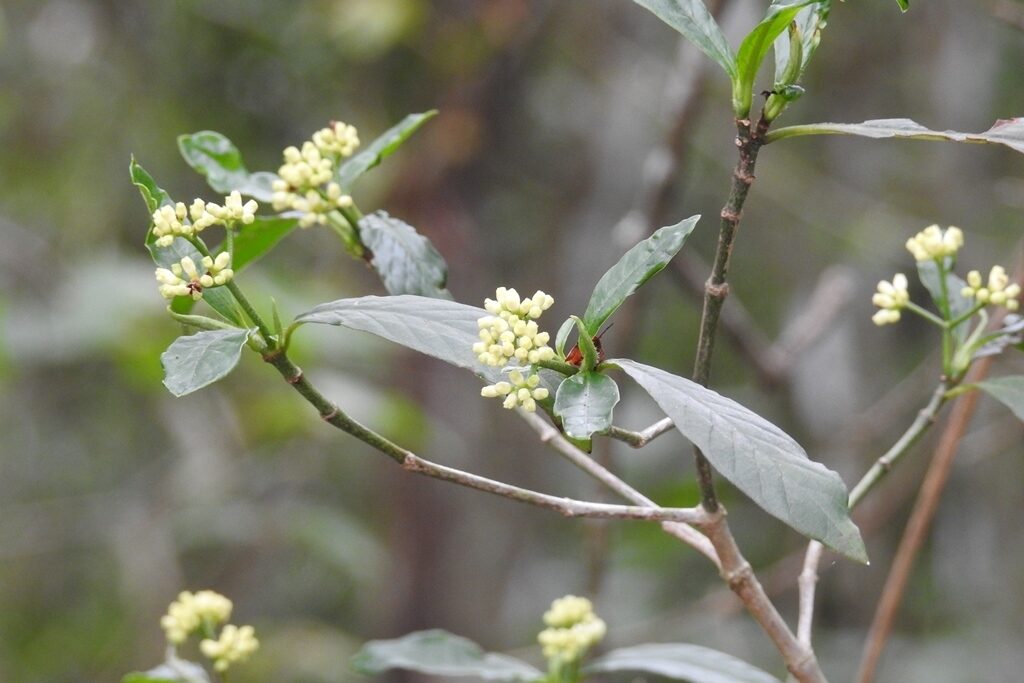
This is a shrub or, at most, a slender treelet of 2 to 4 meters, a permanent resident of the forest understory rather than a tree of the canopy. Its young stems are finely hairy (puberulent) and become smooth with age. Like other members of the coffee family, it carries its leaves in opposite pairs, and at each node the two leaf bases are joined by interpetiolar stipules, the small flaps of tissue between the petioles that are a defining feature of the Rubiaceae. In P. costivenia these stipules are small (about 4 to 10 mm), ovate, briefly pointed at the tip, and they drop early, a detail that turns out to matter a great deal when telling this plant from its close relatives.
Leaves
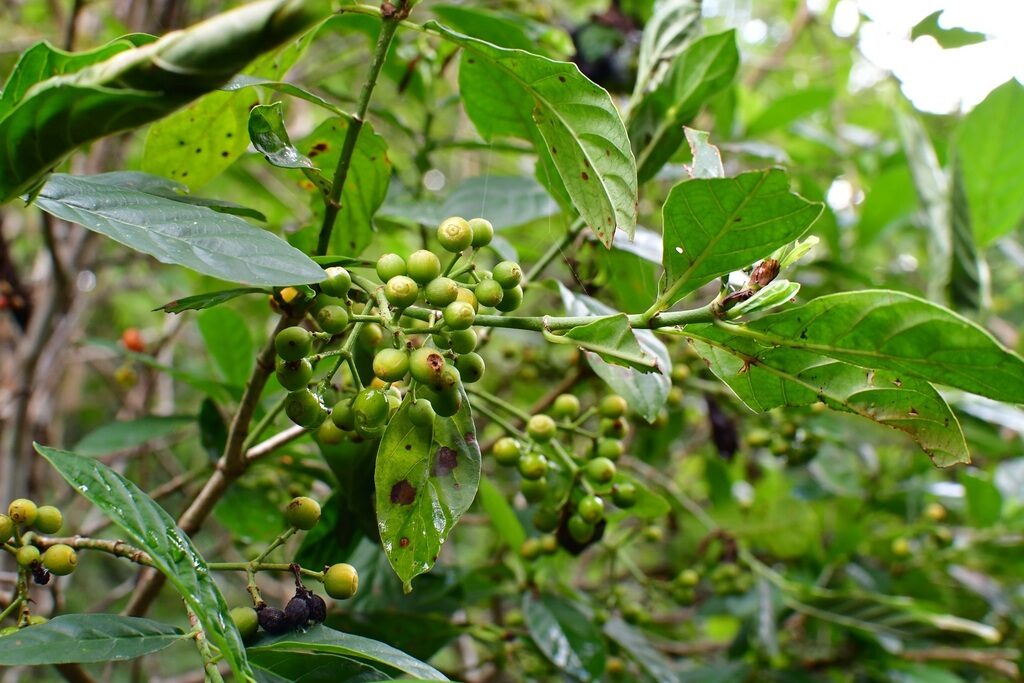
The species epithet, costivenia, comes from the Latin costa (a rib) and vena (a vein), and the leaves earn the name. The blade runs 9 to 21 cm long, occasionally to 35 cm, and 3 to 12.5 cm wide, obovate to elliptic-oblong or oblanceolate, on a petiole of 0.5 to 2 cm. Each side of the midrib carries 9 to 17 secondary veins, raised enough to give the leaf its ribbed character. Two negative features help confirm an identification: there are no domatia (the tiny pockets in vein axils that some plants offer to mites), and there is no well-developed submarginal vein running parallel to the leaf edge, a presence-or-absence character that separates it from the otherwise similar P. clivorum.
Flowers
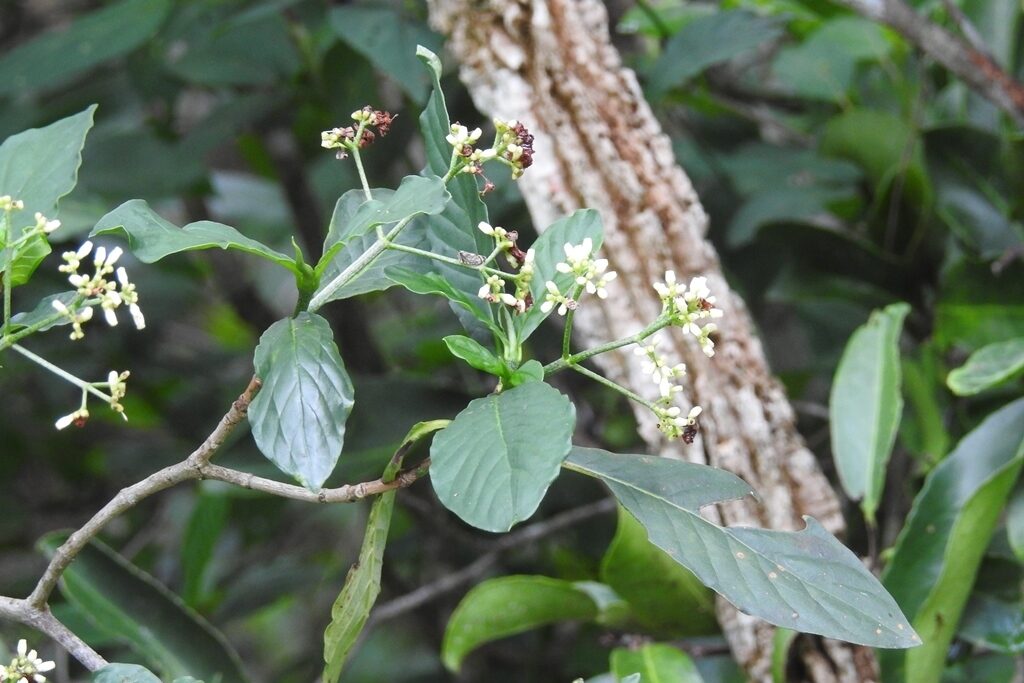
The flowers are small and white, shaped like a trumpet flaring into a shallow funnel, with a corolla tube of 2.5 to 3 mm and five spreading lobes about 1.2 to 1.5 mm long. They sit nearly stalkless in a branched, thyrsoid inflorescence 6 to 12 cm long and 5 to 14 cm wide, in which the side branches are often arranged in whorls of four at a node, in unequal pairs. In Costa Rica flowering has been recorded in April, May, and July. Like most of its enormous genus, P. costivenia is very likely distylous, producing two flower forms on separate plants, a long-styled "pin" and a short-styled "thrum," each able to fertilize only the other. No one has documented the two morphs in this particular species, so the trait is inferred from the genus rather than confirmed in the field.
Fruits
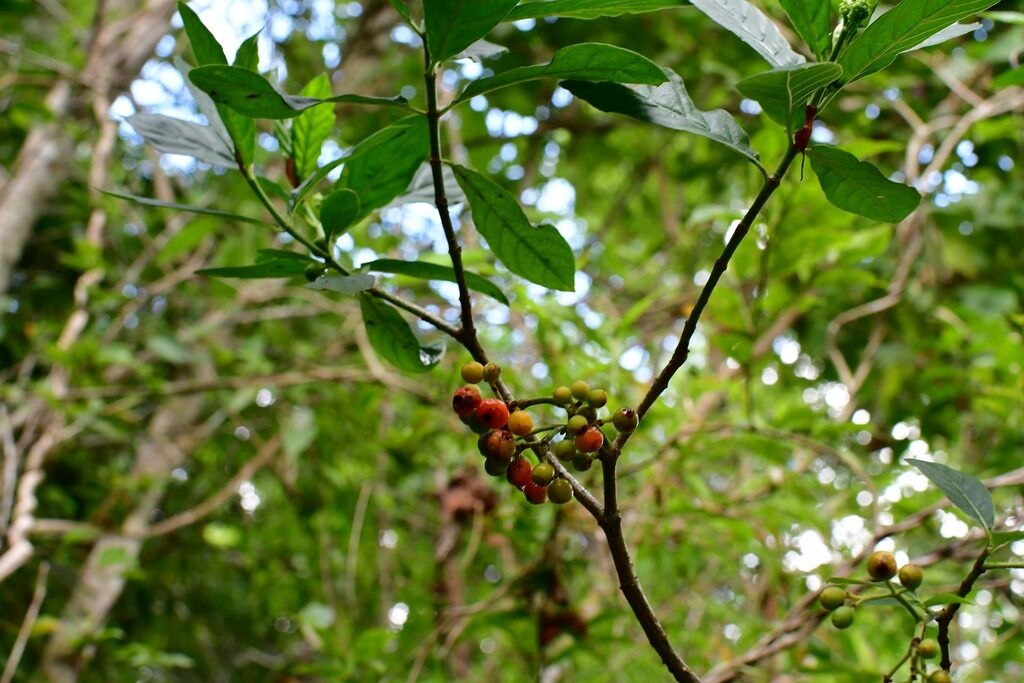
The fruit is a drupe, the same fleshy, single-stone structure as a cherry or a coffee bean, here 6 to 7 mm in every dimension and ellipsoid to subglobose. It ripens through green and yellow to a clear red, and each drupe contains two pyrenes (the hard seed-stones), lightly ribbed on the outer face in Costa Rican material. The combination of a red ripe fruit and leaves that dry grayish or reddish marks the plant as a member of subgenus Psychotria, the section of the genus to which it belongs. The ribbing on the pyrenes, more pronounced in some populations than others, is one of the small characters that has historically been used to tell this entity apart, and one of the characters now in doubt.
Herbarium Specimens
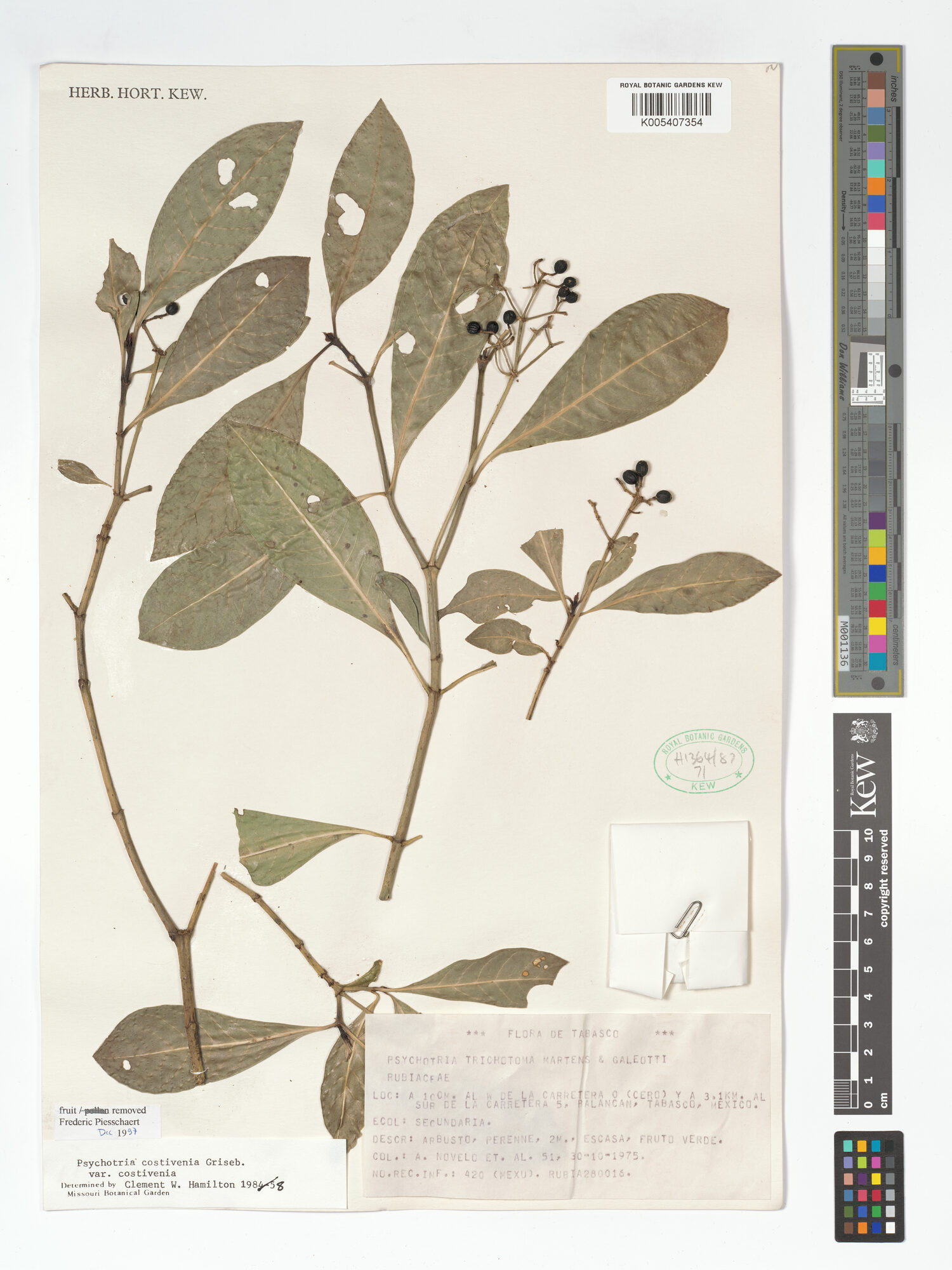
Because the living plant is so easily confused with its relatives, the herbarium record carries much of the weight of its identity. The Kew sheet shown here, gathered in Tabasco in 1975 and annotated by the Psychotria specialist Clement Hamilton, illustrates the working material behind the name: a leafy stem, the paired leaves, and the branched fruiting heads, the same features a botanist measures with a ruler and a hand lens when deciding whether a Costa Rican collection belongs here or with P. grandis.
The Metal in Its Leaves
Most plants treat nickel the way they treat any heavy metal, as a poison to be kept out. A handful do the opposite. A nickel hyperaccumulator concentrates more than 1,000 micrograms of the metal per gram of dry leaf, ten times the level that already counts as elevated, and P. costivenia belongs to this rare club. The trait was first documented in Cuba, whose eastern provinces hold extensive serpentine (ultramafic) soils, rocks weathered from the Earth's mantle that are naturally rich in nickel, chromium, and magnesium and hostile to ordinary vegetation. Cuba's serpentine flora is famous for its specialists, and in a 1999 survey Roger Reeves and colleagues found leaves of this species running 25,480 to 38,530 micrograms per gram, between 2.5 and 3.9 percent of dry weight, comparable to the textbook nickel plant Psychotria douarrei of New Caledonia.
For a long time the trait was thought to be a Cuban peculiarity. That changed in 2019, when Carrie McCartha, the genus monographer Charlotte Taylor, the hyperaccumulation specialist Antony van der Ent and their coauthors ran a portable X-ray fluorescence scanner over 565 herbarium specimens of eight Psychotria species. They found that P. costivenia hyperaccumulates nickel across its entire mainland range, from Mexico to Costa Rica, and not only on serpentine. That makes it a facultative hyperaccumulator, one that concentrates the metal even on ordinary soils that hold relatively little of it, which is the more unusual and more interesting case. The same study cleaned up the record by showing that earlier reports of nickel accumulation in a relative, P. glomerata, were mistaken. The closest relative of P. costivenia, the widespread P. grandis, is itself the other major Neotropical nickel hyperaccumulator, so the capacity appears to run in this small corner of the family.
Distribution
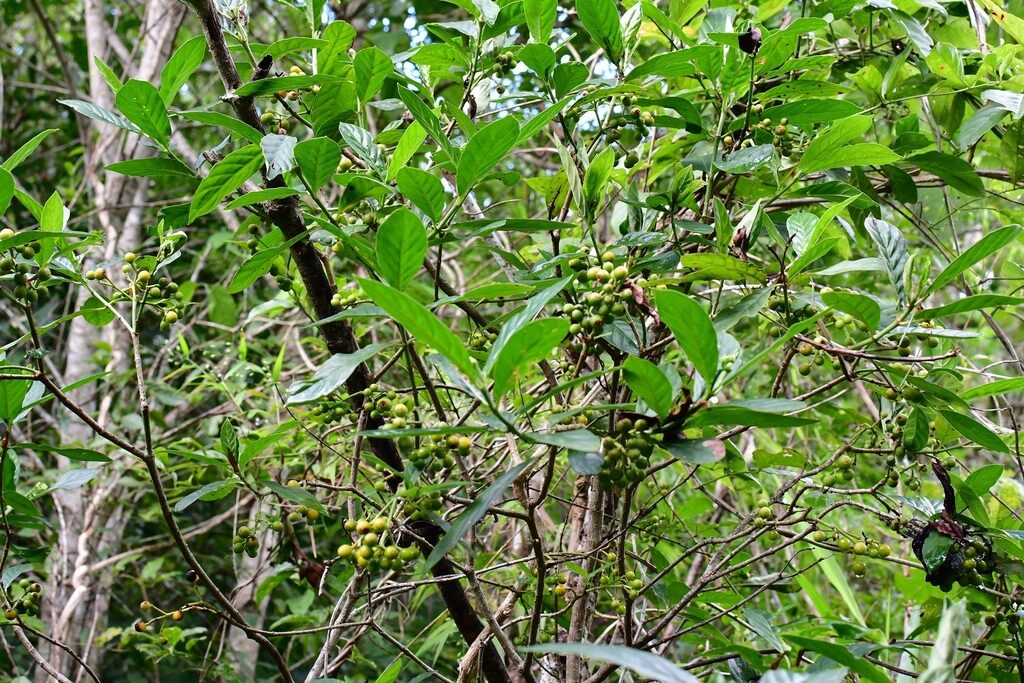
The accepted range, as treated by Plants of the World Online, runs from Mexico through Belize, Guatemala, El Salvador, Honduras, and Nicaragua to Costa Rica, with a separate population in Cuba. (Occurrence databases also plot scattered points in Colombia and Jamaica, but these fall outside the accepted distribution and are best read as errors or misidentifications, some of them probably the South American P. grandis.) In Costa Rica the plant is uncommon and local, known from roughly fifteen localities concentrated on the southern Pacific slope, from near sea level up to about 675 meters.
Most Costa Rican records come from the Brunca region in the deep south: the Osa Peninsula and Corcovado National Park, where it has been collected repeatedly around the Sirena station; the Golfo Dulce forests around La Gamba and Piedras Blancas (Esquinas) National Park; and Finca Las Delicias near Ciudad Cortés. Collections also reach north along the Pacific into the Carara region, in the foothills near Quebrada Chonta. The plants grow in the understory of very wet, mostly primary forest, the kind of intact lowland and foothill forest that is now scarce on the Pacific side of the country.
The Costa Rican presence is itself recent in the botanical record. When William Burger and Charlotte Taylor wrote the Rubiaceae for Flora Costaricensis in 1993, they did not include this plant in the Costa Rican flora at all; they mentioned it only in passing under P. grandis, as a species ranging "from Mexico and Cuba into southern Nicaragua" and "smaller in its parts." It was the 2014 treatment in volume seven of the Manual de Plantas de Costa Rica, again by Taylor, that brought the Costa Rican Pacific collections under this name, and even then provisionally.
Ecology
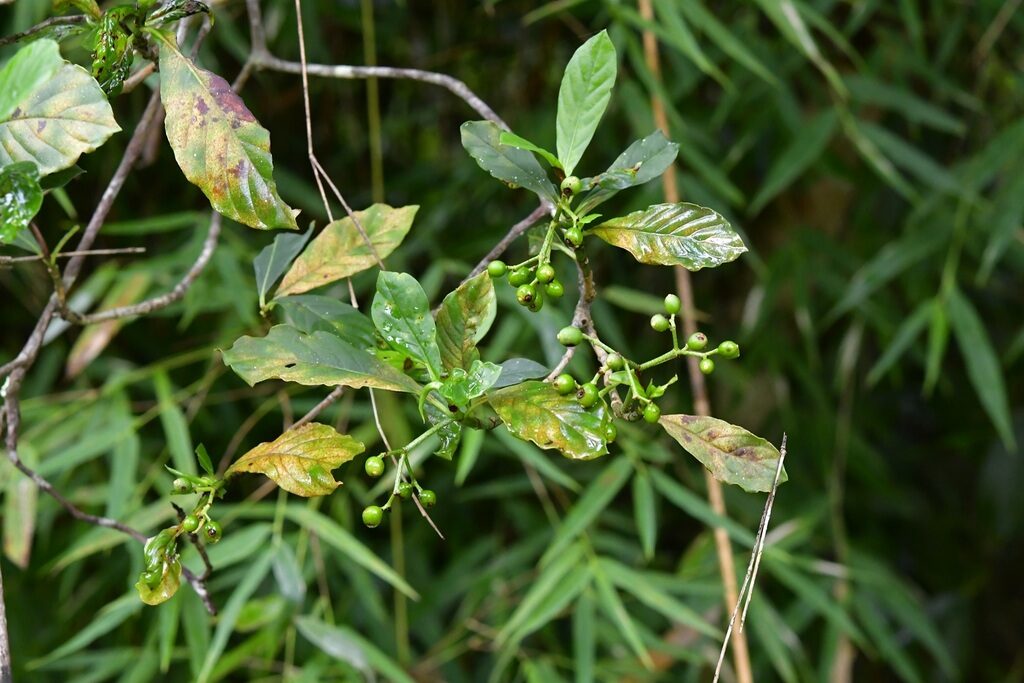
No one has published a study of pollination or seed dispersal for this species specifically, so its ecology has to be read from what is known of its relatives. The small white flowers of Psychotria are insect-pollinated, typically by bees, and the genus is one of the largest distylous lineages on Earth, a reproductive system that enforces cross-pollination between separate plants. The red drupes are classic bird food. A detailed study of two understory Psychotria in the Brazilian Atlantic forest recorded their fruit being taken by cotingas, motmots, and saltators; in Costa Rican forests the equivalent dispersers would be the understory frugivores, the manakins, thrushes, and tanagers that work the shaded interior. The red signal of the ripe fruit advertises a reward to exactly these birds.
One famous trick of the genus does not apply to this plant, and the distinction is an easy one to get wrong. Many Psychotria carry colonies of bacteria in tiny nodules on their leaves, partners that supply the plant with protective compounds and are passed from one generation to the next inside the seed. That leaf-nodule symbiosis is confined to about eighty species, all of them in tropical Africa. As a Neotropical member of the genus, P. costivenia has no such bacterial gardens in its leaves. What stands out in its leaves is the nickel it pulls from the soil, the work of the plant itself rather than a resident microbe.
Taxonomic History
The name traces back to one of the great collecting stories of the nineteenth century. The American botanist Charles Wright, a Connecticut classicist who had collected across Texas on the United States–Mexican Boundary Survey, sailed between 1853 and 1856 as botanist on the United States North Pacific Exploring Expedition, gathering plants from Cape Town and Hong Kong to Japan and the western Bering Strait. He then led three long expeditions to Cuba between 1856 and 1867, collecting more than four thousand specimens of plants, mosses, fungi, and lichens; when the American Civil War broke out, Asa Gray kept him in Cuba, out of harm's way, until 1864. His Cuban phanerogams went to Gray at Harvard, who forwarded them to the German botanist August Grisebach in Göttingen. Grisebach described them in Plantae Wrightianae e Cuba Orientali, and on pages 508 and 509 of its second part, in 1862, he published Psychotria costivenia, based on Wright's collection number 242. The lectotype, the single specimen later chosen to anchor the name, is in the Gray Herbarium at Harvard, designated by Clement Hamilton in his 1989 revision; duplicate sheets are scattered among other herbaria, including, fittingly, one in Grisebach's own herbarium at Göttingen.
Grisebach (1814–1879) was a leading plant geographer of his day, director of the Göttingen botanical garden and author of Flora of the British West Indian Islands; he is also credited with coining the word "geobotany." The genus name he used, Psychotria, was adapted by Linnaeus from an earlier Jamaican name and is usually glossed as "life-giving," a nod to the medicinal reputation of the group. There is a small irony in that for this species: the genus's fame rests on its alkaloids, the emetine of ipecac (including the Costa Rican P. ipecacuanha and P. borucana) and the dimethyltryptamine of P. viridis, yet P. costivenia has no recorded alkaloid chemistry and no recorded human use. The "life-giving" plant that interests chemists does so for its metal.
That single plant has carried a long list of names. The Danish botanist Anders Ørsted, working from Mexican material, described it twice over in the segregate genus Mapouria, as M. miradorensis and M. stipulata; William Hemsley later moved both into Psychotria; Otto Kuntze swept the whole genus into Uragoga, generating still more combinations; and Standley and Steyermark described the Central American highland plants as P. altorum. Modern authorities disagree on how to file all of this. Tropicos and the Global Biodiversity Information Facility treat the older names as plain synonyms of a single species. Plants of the World Online, following a 2016 Cuban revision by Attila Borhidi and colleagues, instead recognizes four subspecies; on that scheme the Costa Rican plant is subspecies costivenia, while the Cuban serpentine endemics are subspecies clementis and wrightiana. Either way, the upshot for a reader is the same: one widespread, variable understory shrub that botanists have repeatedly mistaken for several.
Similar Species
The real challenge is not a distant lookalike but its nearest relative, Psychotria grandis, which grows in the same forests and shares the same red fruit and white funnel flowers. P. grandis is generally larger in every part: a shrub or small tree to eight or ten meters, with leaves 18 to 40 cm long, bigger inflorescences, and large, pointed stipules that are often keeled, rolled at the margins, and persistent. P. costivenia is the smaller plant throughout, and its stipules are smaller and drop early, which is the single most useful difference in the field. Taylor is candid that this may not be enough: in the Manual de Plantas de Costa Rica she writes that the Costa Rican plants are very similar in every respect to the sometimes co-occurring P. grandis, that the Cuban-based name is being used provisionally for them, and that "more field study is needed," since the material "might rather be a form or stage of P. grandis." Two other congeners are easier to rule out: P. clivorum has a well-developed submarginal vein and smaller fruit, and P. carthagenensis has fewer secondary veins (six to ten per side) and smaller inflorescences.
Conservation Outlook
Psychotria costivenia has never been assessed for the IUCN Red List, so its formal status is Not Evaluated. Across its full range, from Mexico to Costa Rica and Cuba, it is widespread, and the genus as a whole is a dominant element of Neotropical forest understories, so the species is not globally threatened. The picture in Costa Rica is narrower. Here it is uncommon and restricted to the very wet, largely primary forests of the southern Pacific, a forest type that has been heavily cleared outside the protected areas. The strongest thing to be said for its security is geographic: several of its known localities lie inside Corcovado and Piedras Blancas national parks, which gives the Costa Rican population a measure of de facto protection.
There is also a quieter conservation argument in its biology. As a confirmed nickel hyperaccumulator, this is one of a small set of plants that scientists study for what they reveal about how vegetation copes with metal-rich ground, knowledge that bears on the restoration of mined and contaminated soils. A species whose Costa Rican identity is still unsettled, and whose chemistry is still being mapped, is worth keeping in the forest long enough to be understood.
Resources & Further Reading
Species Information
Plants of the World Online entry, with the accepted range and the four-subspecies treatment.
Global occurrence records, including the Costa Rican collections and type specimens.
Field observations and photographs from across the range.
Taxonomy & Nomenclature
Nomenclatural data, synonym list, and type specimens from the Missouri Botanical Garden.
The International Plant Names Index entry, with the protologue citation (Pl. Wright. 2: 508, 1862).
The current Costa Rican treatment, in Monographs in Systematic Botany 129; source of the formal description and the doubts about the species' identity.
The protologue work, where the species was published from Charles Wright's Cuban collections (Biodiversity Heritage Library).
Taxon 69(4); the modern reassessment of the segregate genus into which this plant was once described.
Fieldiana: Botany n.s. 33; the earlier treatment that placed the species' southern limit in Nicaragua. Part 2.
Nickel & Chemistry
American Journal of Botany 106(10); XRF screening of 565 specimens showing facultative hyperaccumulation from Mexico to Costa Rica.
Annals of Botany 83(1); the original serpentine measurements (2.5–3.9% nickel by dry weight).
J. Braz. Chem. Soc. 27(8); a review of the alkaloid chemistry that makes the genus famous, context for what this species lacks.
Revista Colombiana de Química 49(2); shows ipecac's emetine alkaloids concentrate in the roots (8.55 mg/g), not the leaves.
Ecology & Biology
PeerJ; on the pin/thrum breeding system across one of the largest distylous genera in the world.
Scientific Reports 11; on the bacterial leaf nodules confined to the African species, which this plant lacks.
Brazilian Journal of Biology 66(1a); a field study of cotingas, motmots, and saltators feeding on Psychotria drupes.
Related Reading
The American collector behind the type specimen, his voyage on the North Pacific Expedition, and his three expeditions to Cuba (1856–1867).
The German phytogeographer who described the species and coined the term "geobotany."