Cativo del Pacifico
A giant legume of the Osa Peninsula, hidden for decades under the name of its Caribbean sister species until a 2022 taxonomic revision recognized it as distinct.
On the ridges and upper slopes of the Osa Peninsula, among the tallest trees in Corcovado National Park and Piedras Blancas, stands a massive legume that went unrecognized as its own species until 2022. For decades, botanists collecting in the Pacific lowlands of southern Costa Rica identified these trees as Prioria copaifera, the cativo of Caribbean estuaries and Panamanian floodplains. But when Reinaldo Aguilar, Daniel Santamaria-Aguilar, and Erick M. Flores examined the specimens closely, they found consistent differences in flowers, fruits, and seeds. The Pacific trees had short-pedicellate flowers where P. copaifera had sessile ones, ovoid-ellipsoid fruits rather than laterally compressed pods, and massive, ruminate, globose cotyledons rather than flat, lenticular seeds. In a 2022 paper in Brittonia, they described Prioria peninsulae as a new species, named for the peninsula where it grows.
The genus Prioria is best known through its Caribbean sister species, P. copaifera, which forms near-monodominant forest stands called cativales along seasonally flooded rivers from Nicaragua to Colombia. Those forests represent one of the most extreme cases of tropical monodominance documented anywhere. P. peninsulae occupies a different habitat: montane ridges and slopes on the Pacific side of southern Costa Rica, from near sea level to around 745 m elevation. Whether this species forms stands comparable to cativales is unknown. Much of what can be said about the ecology and biology of P. peninsulae must be inferred from studies of the genus and its better-documented sister, and this article is transparent about where that line falls.
Identification
Habit
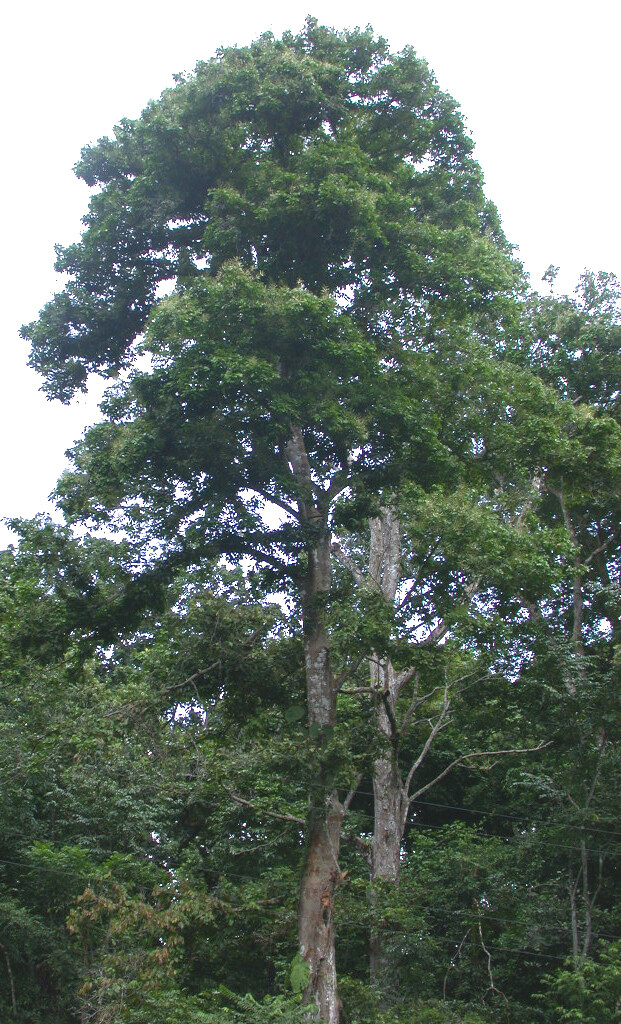
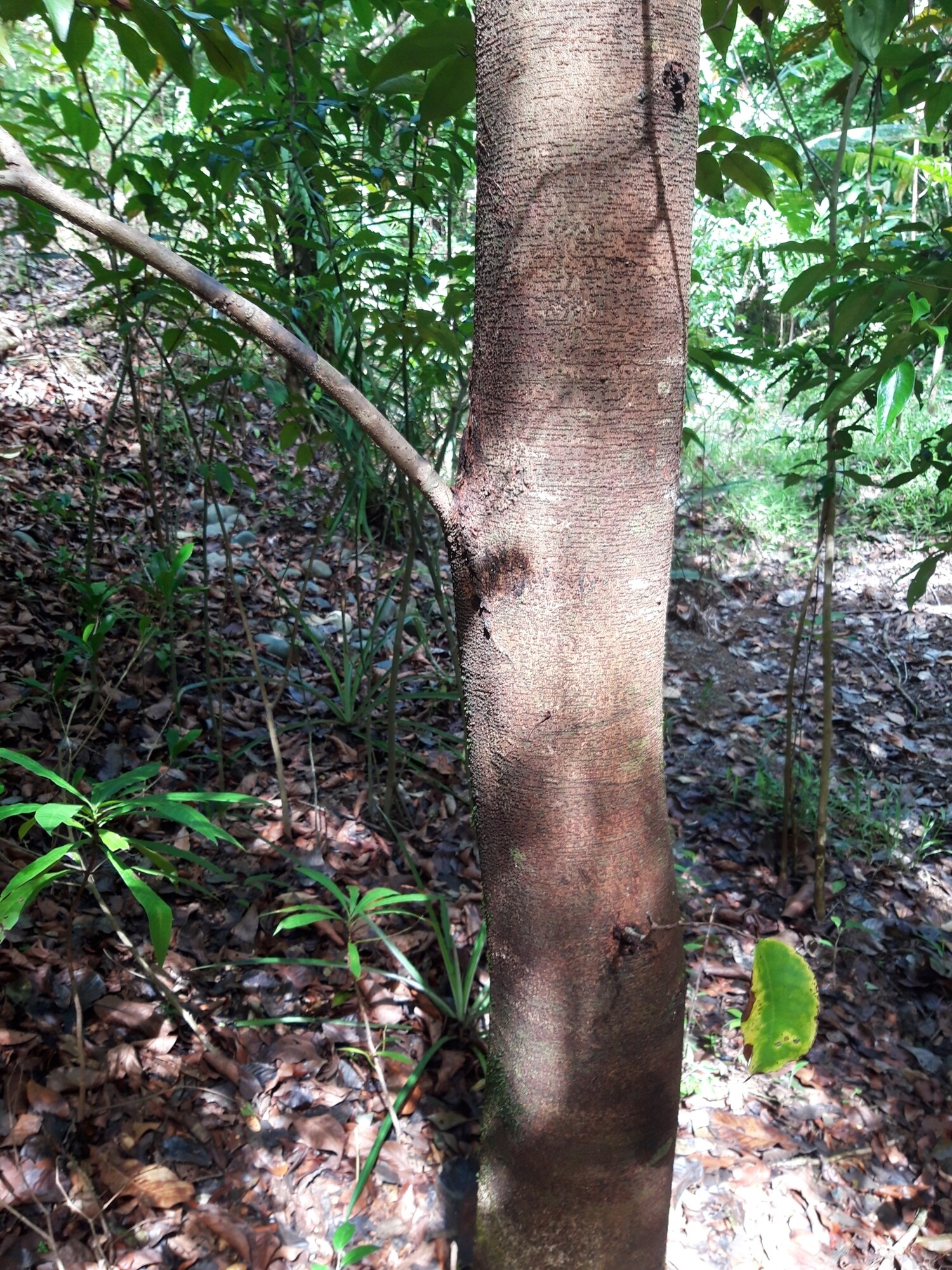
Prioria peninsulae is an evergreen canopy tree and one of the largest species in the forests of the Osa Peninsula. Trees of the genus Prioria can reach 40 to 55 meters in height, with straight, unbuttressed boles typically clear of branches for 23 to 30 meters and diameters commonly between 45 and 100 cm, occasionally exceeding 150 cm. Specific measurements for P. peninsulae have not been published outside the type description, but field collectors describe it among the true giants of Corcovado. The crown is deep and very dense, allowing little light to reach the forest floor. Bark is grey to brownish-grey and scaly, smooth on younger trunks. When cut, the heartwood exudes a copious black gum that is sticky and resinous, a trait shared across the genus.
Leaves
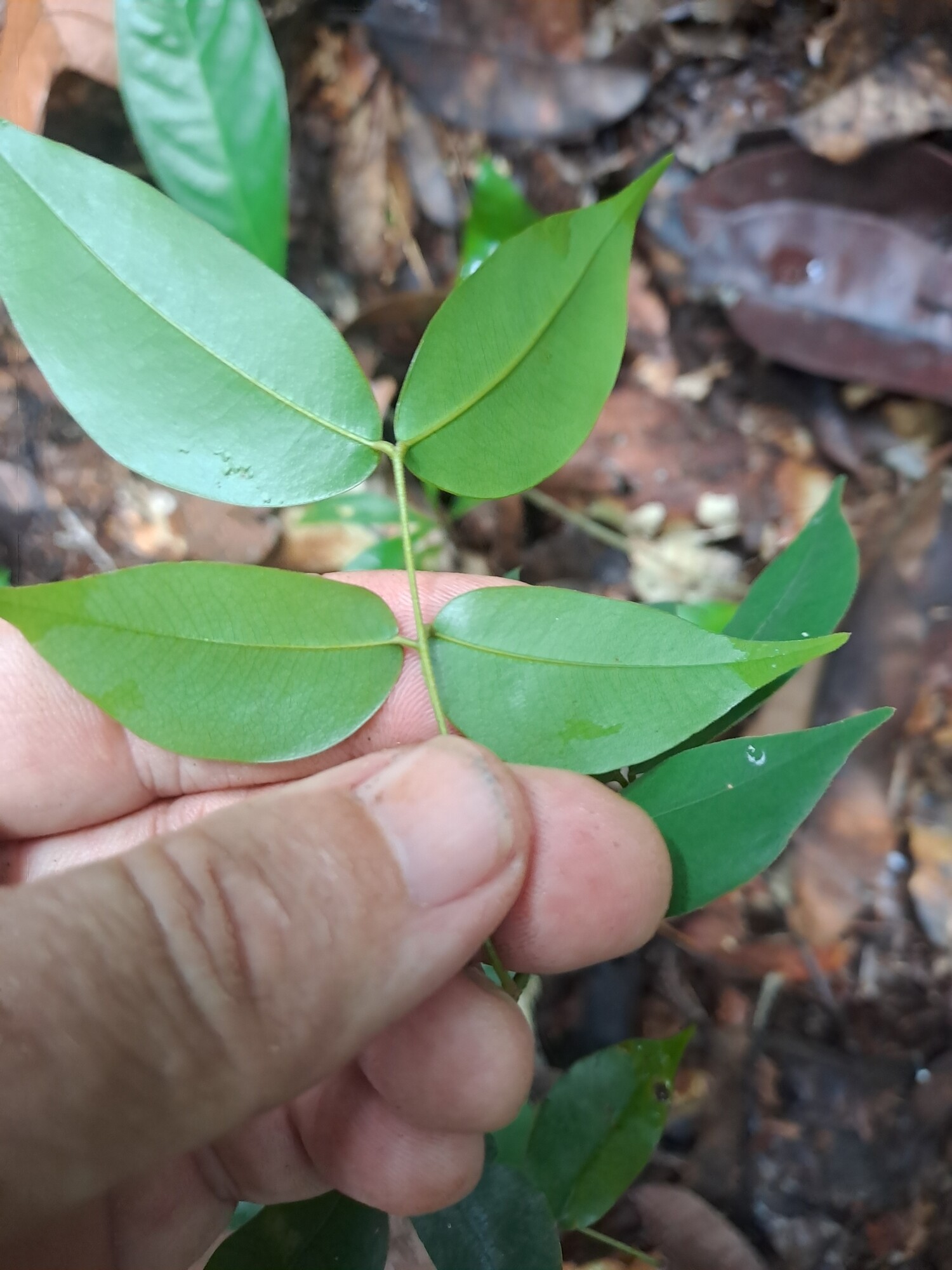
The leaves are paripinnately compound, bearing an even number of leaflets with no terminal leaflet. Each leaf has one to two pairs of opposite leaflets, most commonly two pairs. The leaflets are elliptic-lanceolate to asymmetrically ovate-elliptic, measuring 6 to 16 cm long and 4 to 8 cm wide. They are rounded-obtuse and somewhat unequal at the base, bluntly short-acuminate at the apex, and glabrous on both surfaces. Under magnification, the leaflets show a reticulate venation pattern with translucent dots visible when held against light. The petiole is 1 to 2 cm long with a callous-rugose base, and the rachis measures 2 to 5 cm. Stipules are scale-like and deciduous. No diagnostic leaf differences between P. peninsulae and P. copaifera have been reported; the leaf description above applies at the genus level.
Flowers
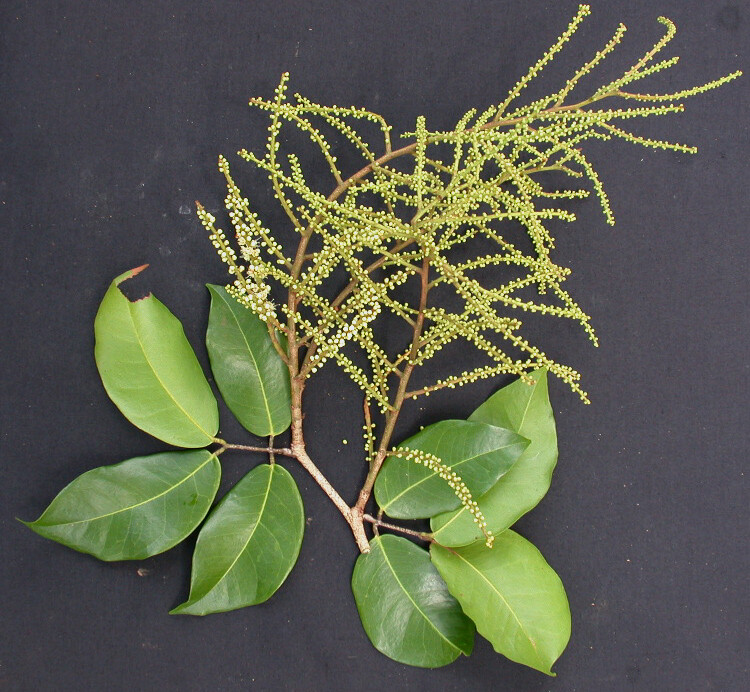
The inflorescence in Prioria is a panicle composed of many flower-bearing spikes, each up to 10 cm long. Individual flowers are small, yellowish-white, and apetalous (lacking petals), an unusual condition among legumes. In P. peninsulae, the flowers are short-pedicellate (borne on short stalks), which is the key floral difference from P. copaifera, where flowers are sessile (stalkless). Each flower sits within a pair of large bracteoles that are broadly orbicular, about 1.5 mm long, and ensheath the base of the flower. The sepals are scarious-margined and ciliate, about 2.5 mm long. Ten stamens extend to about 5 mm, and the ovary is subsessile with a short attenuate style. Flowering phenology specific to P. peninsulae has not been published; in P. copaifera, flowering in Costa Rica occurs in November based on Caribbean herbarium collections.
Fruits
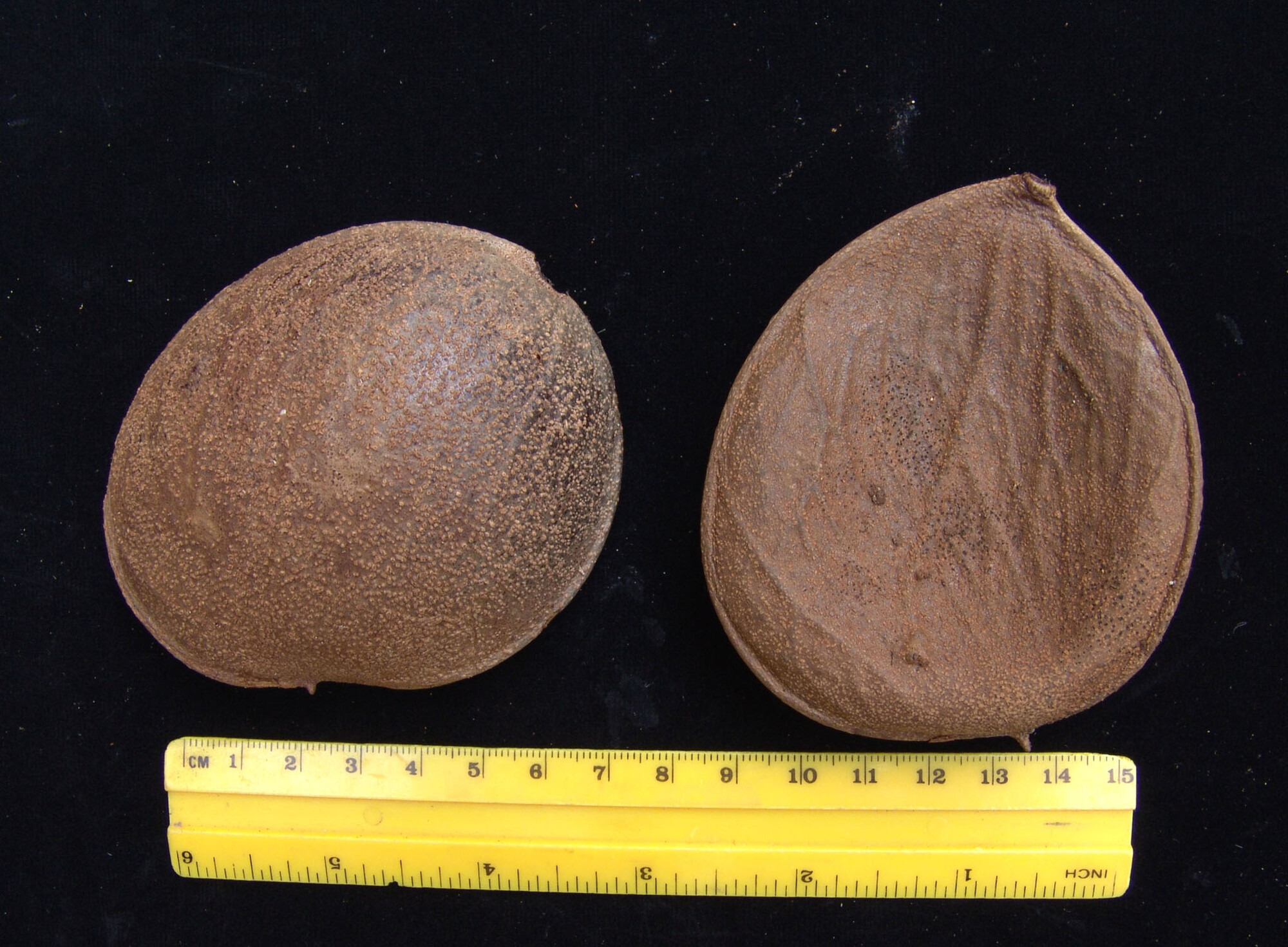
The fruit of P. peninsulae is an ovoid-ellipsoid legume, differing from the suborbicular, laterally compressed pod of P. copaifera with its prominent vertical veins. Each pod contains a single large seed. The most distinctive reproductive feature of P. peninsulae is its cotyledons: massive, ruminate, and globose-round, in contrast to the flat, lenticular seeds of its Caribbean sister. In P. copaifera, the seeds are buoyant and water-dispersed, and the species exhibits viviparous germination, with the seed sprouting inside the pod in a pattern more commonly associated with mangroves. Whether P. peninsulae shares viviparous germination or hydrochory is unknown; its ridge-top habitat, far from seasonally flooded rivers, suggests a different dispersal ecology. Research on P. copaifera at Barro Colorado Island in Panama found that seeds tolerate up to 60% removal of cotyledonary mass and still germinate normally, and seedlings can resprout up to four times after having shoots cut.
Trunk and Bark
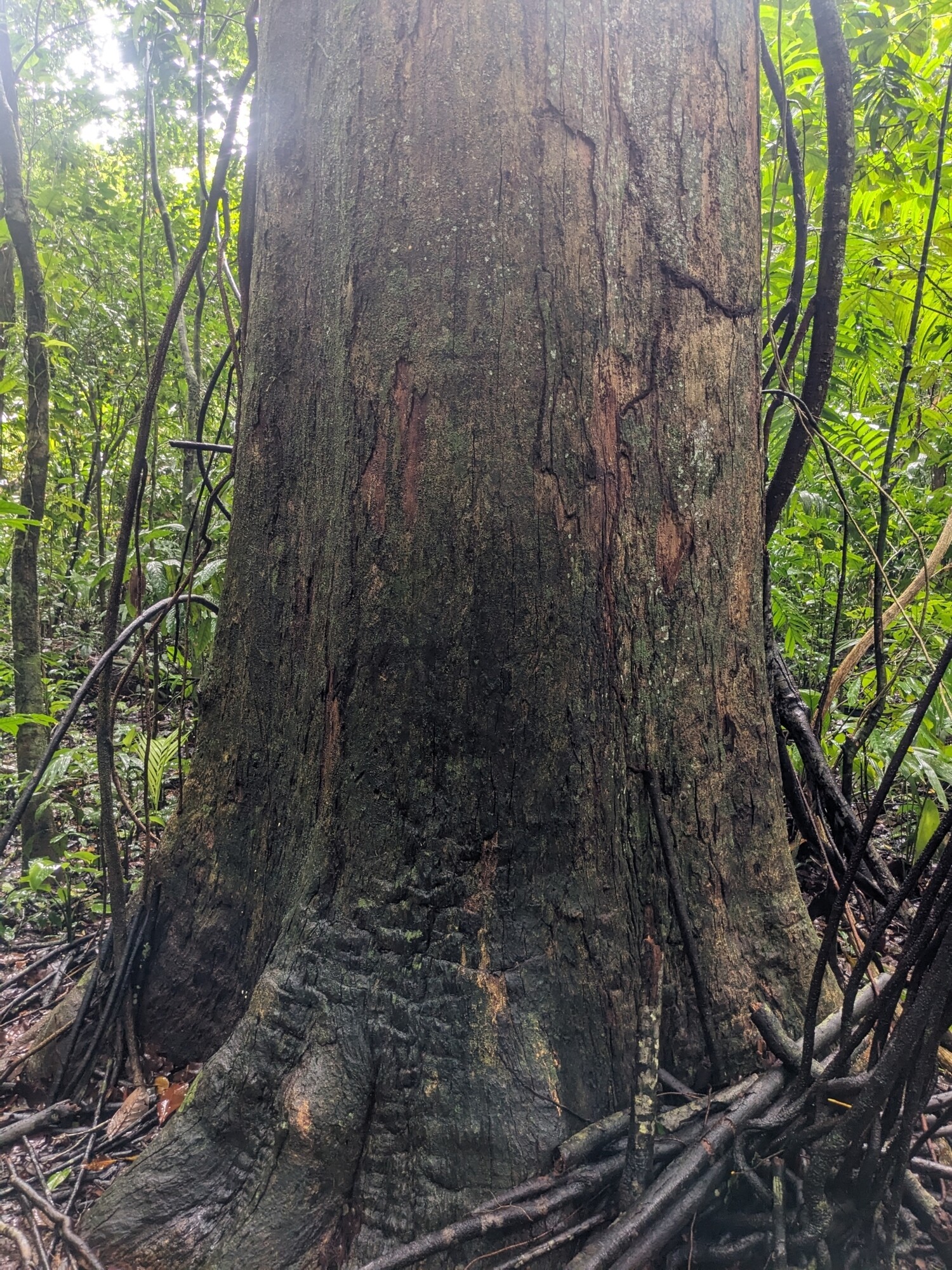
The bark is grey to brownish-grey, scaly on mature trunks but relatively smooth on younger trees. When slashed, the trunk exudes a copious black gum that was compared in the 1918 US Dispensatory to "a thick, adhesive liquid resembling copaiba, usually turbid on account of a greenish substance, which finally subsides, leaving a clear, brownish-yellow liquid." This resin gives the sister species its epithet (copaifera = "bearing copaiba") and much of the genus's ethnobotanical significance. The trunk lacks buttresses, which is notable for such a large tree. The wood of P. copaifera is light-medium brown heartwood, often attractively streaked, with pinkish to white sapwood, a fine uniform texture, straight grain, and a golden luster. The specific gravity is 0.40 to 0.52. Wood properties specific to P. peninsulae have not been characterized.
Distribution
Prioria peninsulae is endemic to the southern Pacific slope of Costa Rica. It is known from the Osa Peninsula (including Corcovado National Park and the Refugio Nacional de Vida Silvestre Osa), Piedras Blancas National Park, and ridges at Playa Cativo. All confirmed localities fall within the Brunca conservation area. The species grows on montane ridges and upper slopes from near sea level to approximately 745 m, a habitat strikingly different from the seasonally flooded river floodplains occupied by P. copaifera across its range from Nicaragua to Colombia.
Before 2022, specimens of P. peninsulae were identified as P. copaifera in herbarium collections from the Pacific slope. The taxonomic revision by Santamaria-Aguilar, Aguilar, and Flores restricted true P. copaifera in Costa Rica to the Caribbean lowlands: the Rio Gandoca and Rio Colorado in Gandoca-Manzanillo Wildlife Refuge, the canals near Tortuguero, the Cahuita area, and Moin. The Manual de Plantas de Costa Rica describes P. copaifera as "infrequent" in Caribbean coastal estuaries. The full extent of P. peninsulae's range on the Pacific slope remains to be mapped; additional populations may exist in the forests between the Osa Peninsula and the Golfo Dulce hinterland.
Ecology
Monodominant Cativales
The defining ecological feature of the sister species P. copaifera is its ability to form near-monodominant forest stands. In tropical ecology, monodominance is defined as a single species comprising more than 60% of canopy stems, and P. copaifera routinely exceeds this threshold. The most extreme case on record, along the Balsas River in Darien, Panama, reached 96.6% of total arboreal basal area. These cativales occur along seasonally flooded river floodplains, where the water table fluctuates dramatically between wet and dry seasons.
For years, researchers assumed the explanation was straightforward flood tolerance. But work by Omar Lopez at the Smithsonian Tropical Research Institute demonstrated that monodominance depends on P. copaifera's ability to withstand both flooding and drought. The large seeds provide resources for seedlings to construct deep root systems during the wet season, maintaining growth even under waterlogged conditions and giving access to groundwater when the dry season arrives. Seedling mortality was actually greater during dry spells than during flooding. Whether P. peninsulae exhibits analogous ecological dominance on Pacific ridges is unknown; its upland habitat lacks the seasonal flooding regime that drives catival formation in P. copaifera.
Torti, Coley, and Kursar proposed in 2001 that tropical monodominance results from an array of reinforcing traits rather than any single advantage. In P. copaifera, the dense, uniform canopy creates deep shade that suppresses most competitors; thick leaf litter decomposes slowly, changing soil chemistry; mast fruiting overwhelms seed predators; and poor dispersal keeps seeds close to parent trees. The ectomycorrhizal networks sometimes invoked to explain monodominance in African Detarioideae such as Gilbertiodendron dewevrei do not appear to apply to Prioria; the specific mycorrhizal associations of the genus remain unclear.
Interactions
The black resin that oozes from cut heartwood of Prioria attracts orchid bees (Euglossini), particularly species of Euglossa and Eulaema, which collect the resin for nest construction. The sticky, aromatic gum appears to be a valued resource for female orchid bees lining their brood cells. Specific flower pollinators have not been documented for either Neotropical species; the apetalous, many-stamened flowers suggest generalist insect or wind pollination. In P. copaifera, seeds are primarily water-dispersed and no vertebrate seed dispersers have been identified. The dispersal biology of P. peninsulae is unstudied.
In P. copaifera forests, the leguminous liana Dalbergia brownei is a significant competitor, particularly in logged areas where canopy gaps promote liana growth. A five-year study in Darien found that cutting all lianas doubled the mean annual diameter growth of cativo trees compared to control plots. Whether liana competition shapes the ecology of P. peninsulae on Pacific ridges has not been investigated.
Fossil Record
The Prioria lineage has occupied similar habitats for far longer than any living forest stand. Three fossil wood specimens from the lower Miocene Cucaracha Formation in the Panama Canal Zone, dating to approximately 18 to 20 million years ago, have been assigned to the Prioria-clade based on wood anatomy. Two fossil species were described: Prioria hodgesii and Prioria canalensis. These fossils occurred in tidally influenced fluvial channel deposits, demonstrating that the lineage has inhabited tidal-estuarine habitats for at least 18 million years. The Panama Canal widening project, which commenced in 2007, provided rare access to these Miocene strata. The divergence between the Caribbean P. copaifera and the Pacific P. peninsulae presumably occurred more recently, though no molecular dating has been published.
Lifespan and Growth
No growth or lifespan data specific to P. peninsulae have been published. Dendrochronological studies of P. copaifera from Colombia's Atrato River floodplains provide the best available insight into growth patterns for the genus. Giraldo and del Valle estimated P. copaifera's lifespan at 614 years using von Bertalanffy growth models, with a mean diameter growth rate of 0.31 cm per year. However, Herrera-Ramirez and colleagues demonstrated through radiocarbon measurements that P. copaifera can produce more than one ring per year, with offsets of up to 40 years between ring counts and radiocarbon dates. The true lifespan may therefore be shorter than 614 years, though the species is clearly long-lived. On Barro Colorado Island, mortality rates were 0.5 to 0.6% per year, and growth rates of larger trees (8-16 mm per year in diameter) increased after a severe 1983 El Nino drought opened the canopy. The species was also found to produce more vessels and grow thicker when water levels rise, a response documented through 130 years of vessel chronology from the Atrato River.
Taxonomic History
Prioria peninsulae was described in 2022 by Daniel Santamaria-Aguilar, Reinaldo Aguilar, and Erick M. Flores in a paper published in Brittonia. The holotype (R. Aguilar, R. Araya & Joel Stewart 9699, collected 22 March 2005) is from the Refugio Nacional de Vida Silvestre Osa and is deposited at the Herbario Nacional de Costa Rica (CR). The epithet peninsulae, Latin for "of the peninsula," refers to the Osa Peninsula, the center of the species' known range. The species was separated from P. copaifera on the basis of three consistent morphological differences: short-pedicellate rather than sessile flowers, ovoid-ellipsoid rather than laterally compressed fruits, and massive ruminate globose cotyledons rather than flat lenticular seeds. The habitats also differ: P. peninsulae grows on Pacific-slope mountains and ridges, while P. copaifera occupies Caribbean lowland floodplains and estuaries.
The genus Prioria was established by August Heinrich Rudolf Grisebach (1814-1879) in his Flora of the British West Indian Islands, published in installments from 1859 to 1864. The type species, P. copaifera, appears on page 215 of the section issued in 1860, based on a Jamaican specimen housed at Kew (K000555224). Grisebach named the genus in honor of Richard Chandler Alexander Prior (1809-1902), an English physician and botanist best known for On the Popular Names of British Plants (1863). The epithet copaifera means "bearing copaiba," from Latin copaiba + -fera, referring to the trunk resin's resemblance to the oleoresin of the genus Copaifera.
For most of its history, Prioria was a monotypic genus in the Americas. In 1999, F. J. Breteler published a revision that united the African genera Gossweilerodendron and Oxystigma, the Asian-Pacific Kingiodendron, and Pterygopodium under Prioria, expanding it from one to 14 species spread across three continents. This broad circumscription is not universally accepted. With the description of P. peninsulae in 2022, there are now two recognized Neotropical species in the genus.
Similar Species
The primary distinction is from Prioria copaifera (Caribbean slope), the sister species from which P. peninsulae was separated. Key differences: P. copaifera has sessile flowers, laterally compressed fruits with prominent vertical venation, and flat lenticular seeds; P. peninsulae has short-pedicellate flowers, ovoid-ellipsoid fruits, and massive ruminate cotyledons. The two species also differ in habitat: P. copaifera grows in seasonally flooded lowland forests and estuaries, while P. peninsulae occurs on Pacific-slope ridges. On the Osa Peninsula, P. peninsulae can also be confused with Copaifera camibar, which shares the common name "camibar," belongs to the same subfamily (Detarioideae), and produces resin. Copaifera is distinguished by its imparipinnate leaves (with a terminal leaflet) and well-developed petals, in contrast to the paripinnate, apetalous flowers of Prioria.
Uses and Ethnobotany
No uses specific to P. peninsulae have been documented, but the genus Prioria has been used by indigenous and local communities across its range for centuries. The large seeds of P. copaifera contain edible embryos, gathered from the wild and sold in Panamanian markets under the names "cativa" and "amansa mujer." The Choco people of the Colombia-Panama border region use the trunk gum to caulk piraguas (dugout canoes), exploiting the resin's thick, adhesive consistency. The gum has been applied as a wound antiseptic and used as a flytrap. The resin's resemblance to Copaifera oleoresin brought the genus early pharmacological attention; the 1918 US Dispensatory includes a detailed entry on the "oil tree."
Commercially, cativo timber (P. copaifera) has been one of the most important tropical hardwoods of Central America and northern South America. The wood is used for interior trim, furniture, joinery, veneer, plywood, and picture frames. It is one of the few neotropical species that occurs in sufficient abundance and stand homogeneity for commercial-scale exploitation. The timber dries rapidly with minimal checking, machines well, and has dimensional stability comparable to mahogany. However, the wood is not durable against decay or insects, limiting it to interior applications. Its Janka hardness is approximately 440 to 630 lbf (1,960 to 2,800 N). There is no record of P. peninsulae having been commercially harvested.
Conservation Outlook
Prioria peninsulae has not been assessed by the IUCN. It is known from very few localities, all within the protected areas of the Brunca conservation region: Corcovado National Park, the Osa Wildlife Refuge, Piedras Blancas National Park, and Playa Cativo. Its narrow known range and endemic status suggest it may warrant formal evaluation. A complicating legal question involves Costa Rica's veda (logging ban) under Decreto Ejecutivo 25700-MINAE, which lists Prioria copaifera among protected species. Since P. peninsulae was described after the decree was enacted, it is unclear whether the ban's protection extends to the Pacific species. As a practical matter, the species' occurrence within national parks and wildlife refuges provides de facto habitat protection.
The conservation history of the genus is dominated by P. copaifera. The IUCN assessed that species as Least Concern globally in 2021, but Colombia's national red list classifies it as Endangered under criteria A2acd, reflecting population reductions driven by decades of overexploitation. The most extensive cativales in the Americas, along the Atrato and Leon river floodplains in Choco and Antioquia departments, originally covered 363,000 hectares. For over seventy years, cativo has been the primary timber species of the Colombian Darien, and the industry became entangled with armed conflict, forced displacement of Afro-Colombian communities, and illegal logging. A 2025 Environmental Investigation Agency report found that an estimated 94% of wood flooring and decking exports from Colombia between 2020 and 2023 lacked legal certification, with much of the timber sourced from Choco-Darien forests. In the Curvarado and Jiguamiando river basins, NGOs documented 113 deaths linked to disputes over natural resources and forced displacement. In Panama, of 30,000 hectares of cativo-dominated forest in Darien in 1987, an estimated 15,000 hectares remained by 1999. The species is subject to logging restrictions in both Colombia (CORANTIOQUIA Resolution 3183) and Costa Rica (Decreto 25700-MINAE).
Resources & Further Reading
Species Information
Original species description by Santamaria-Aguilar, Aguilar & Flores, with diagnostic characters and type information.
Comprehensive review chapter covering genus-level ecology, monodominance, and conservation. Mentions P. peninsulae.
Detailed genus-level account with uses, habitat, and morphological description (covers the sister species).
Taxonomy & Nomenclature
Plants of the World Online entry for the type species, with accepted name, distribution, and synonymy.
Nomenclatural data and specimen records from Missouri Botanical Garden.
Taxonomic revision expanding the genus to include Gossweilerodendron, Kingiodendron, Oxystigma, and Pterygopodium.
Original description of Prioria copaifera (page 215). Biodiversity Heritage Library.
Ecology & Research
General multi-trait framework for tropical monodominance, widely applied to Prioria. American Naturalist 157: 141-153.
Evidence that drought tolerance drives monodominance in P. copaifera. Oecologia 154: 35-43.
Demographic study from Barro Colorado Island. Forest Ecology and Management 62: 107-122.
Liana cutting doubled diameter growth over five years. Forest Ecology and Management 190: 99-108.
Seeds germinate even with 60% cotyledon mass removed. Journal of Tropical Ecology.
Miocene fossil wood from the Panama Canal Zone. Review of Palaeobotany and Palynology 246: 44-61.
Dendrochronology
Estimated 614-year lifespan for P. copaifera using growth models. Revista de Biologia Tropical 59(4): 1813-1831.
Radiocarbon evidence that Prioria can produce multiple rings per year. Ecology and Evolution 7: 6334-6345.
130-year vessel chronology from the Atrato River. Tree Physiology 34(10): 1079-1089.
Conservation & Timber Trade
Investigation finding 94% of Colombian wood flooring and decking exports lacked legal certification (2020-2023).
Historical pharmacological description of the "oil tree" resin and edible seeds.
Wood properties and commercial applications (P. copaifera).