Chumico
Pourouma bicolor — The guarumo's larger cousin produces grape-like fruits that feed toucans and monkeys, while its rough leaves once served as the sandpaper of the rainforest.
If the guarumo is the common pioneer of Costa Rica's disturbed forests, its cousin the chumico is the quiet giant of the wet lowlands. Both belong to the Urticaceae family, both bear palmate leaves that catch the light, and both provide food for an army of fruit-eating animals. But where the guarumo races to colonize gaps and roadsides, the chumico takes a different approach: it grows taller, lives longer, and produces fruits so sweet that locals once cultivated it for food.
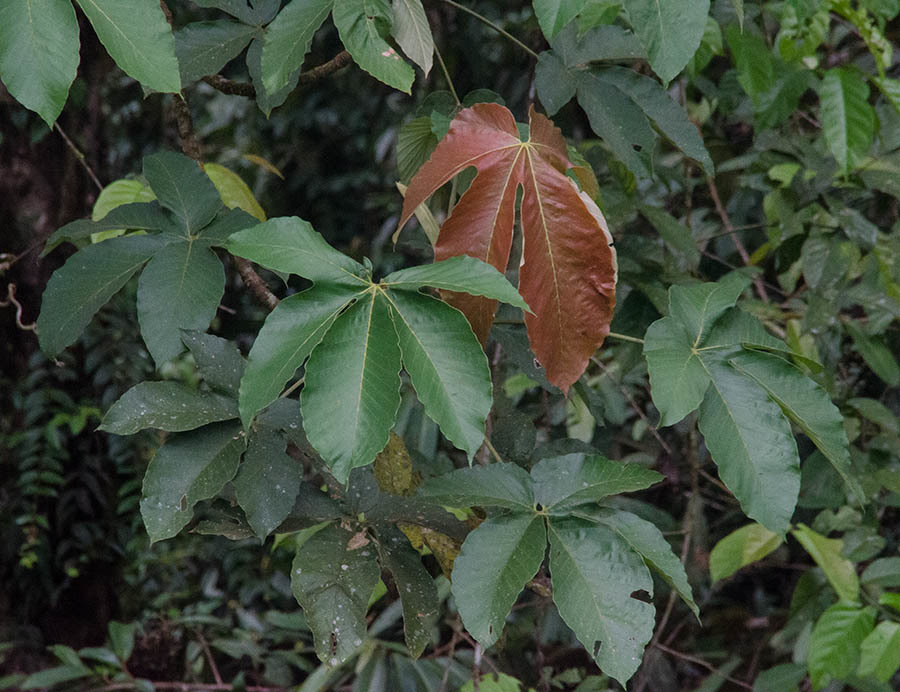
The chumico is a tree of primary and old secondary forest, rising to 35 meters with a trunk that can reach 60 centimeters in diameter. Its reddish-brown bark and bicolored leaves, dark green above and silvery-gray below, give it the name bicolor. In the Osa Peninsula and surrounding wet forests, the chumico is a common sight in the canopy, its umbrella crown emerging above the tangle of vines and smaller trees.
Identification
The genus Pourouma contains about 20-30 species distributed from Central America to South America. The chumico can be distinguished from its close relatives and from the superficially similar guarumo by several features: it typically grows larger, lacks the hollow ant-housing stems of Cecropia, has a reddish-brown bark, and produces distinct grape-like fruit clusters rather than the finger-like catkins of Cecropia.
Botanists recognize five subspecies of Pourouma bicolor, classified by C.C. Berg and E.C.H. van Heusden in their 1990 monograph of the Cecropiaceae. In Costa Rica, the typical subspecies bicolor is most common, found throughout the humid lowlands of both slopes. The species' range extends from southern Mexico through Central America and across northern South America to Brazil and Bolivia.
Physical Characteristics
Trunk: Straight and cylindrical, with a distinctive reddish-brown bark that becomes fissured with age. Unlike the guarumo, the trunk is solid, not hollow, which is the most reliable way to distinguish Pourouma from Cecropia in the field. Another key difference: Pourouma lacks the prominent horizontal leaf scar rings that make Cecropia trunks look like stacked segments. Small stilt or adventitious roots sometimes form at the base, particularly in wet soils.
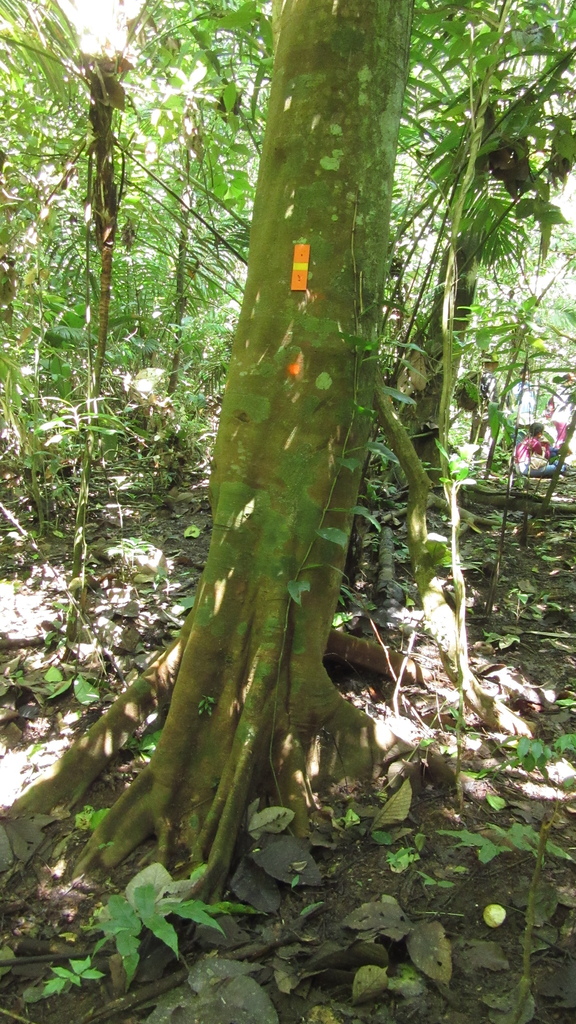
The wood has a specific gravity of approximately 0.28 g/cm³, nearly identical to Cecropia and among the lightest of any tropical tree. This soft, lightweight wood has no commercial timber value but contributes significantly to forest carbon cycling as it decomposes relatively quickly after death. In related species like Pourouma cecropiifolia, wood density appears to decrease further under cultivation, suggesting that wild populations maintain denser wood as an adaptation to competition in the forest canopy.
Crown: Umbrella-shaped and open, similar to Cecropia but typically larger and more developed. Branches radiate horizontally from the main trunk, each ending in clusters of large palmate leaves.
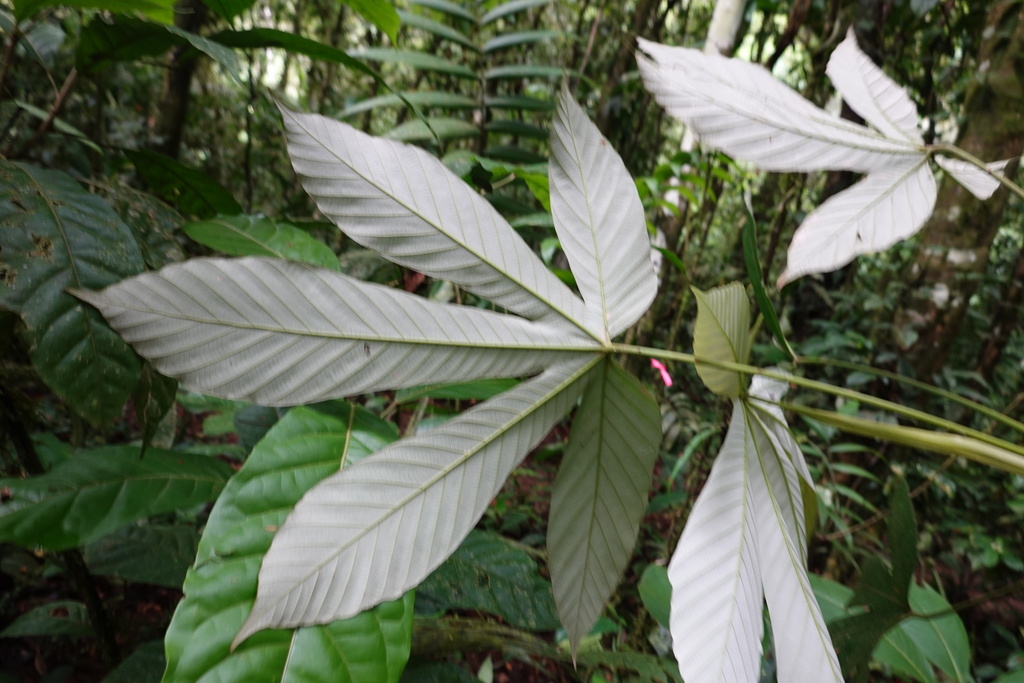
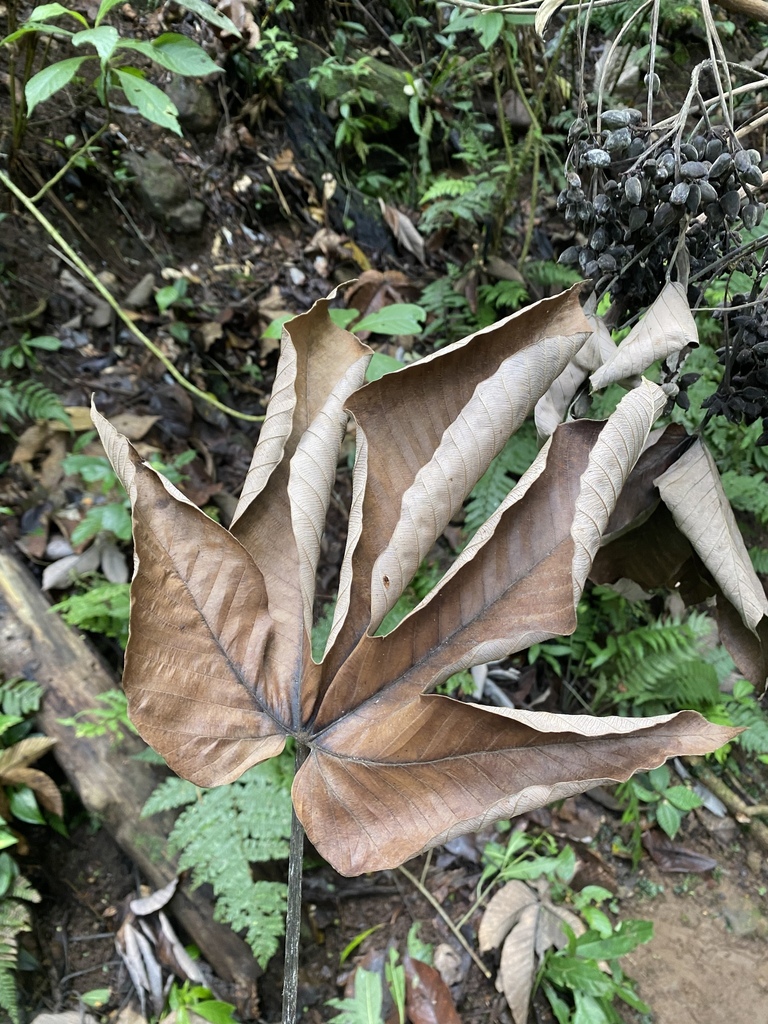
Leaves: Variable in shape—some entirely unlobed (ovate, 5-25 cm), others palmately lobed with 3-9 lobes (up to 42 cm across). Lobed leaves have broader, less deeply divided lobes than Cecropia. The upper surface is dark green and distinctly rough to the touch, almost like fine sandpaper. The underside is covered with dense grayish-white hairs that give it a silvery appearance, hence "bicolor." Long petioles connect the leaves to the branches, often with stipules at the base.
This variation between entire and lobed leaves is not random. A detailed study of the related species Pourouma tomentosa in French Guiana—which also produces both entire and lobed leaves on the same tree—found that leaf shape varies systematically with canopy position. In the shaded lower canopy, 62% of leaves were entirely unlobed, but at the sunlit crown only 38% were unlobed. Sun leaves are more likely to develop lobes, perhaps because the divided shape dissipates heat more efficiently and reduces self-shading. Shade leaves remain entire to maximize light capture in the dim understory. The study also found that fruiting branches produce more entire leaves. Though P. bicolor has not been studied directly, the same pattern likely applies: look for entire leaves in shaded parts of the tree and more deeply lobed leaves near the crown.
Flowers: The chumico is dioecious, with male and female flowers on separate trees. Flowers are small and inconspicuous, borne in clusters at the branch tips. Male flowers are whitish; female flowers develop into the characteristic fruit clusters.
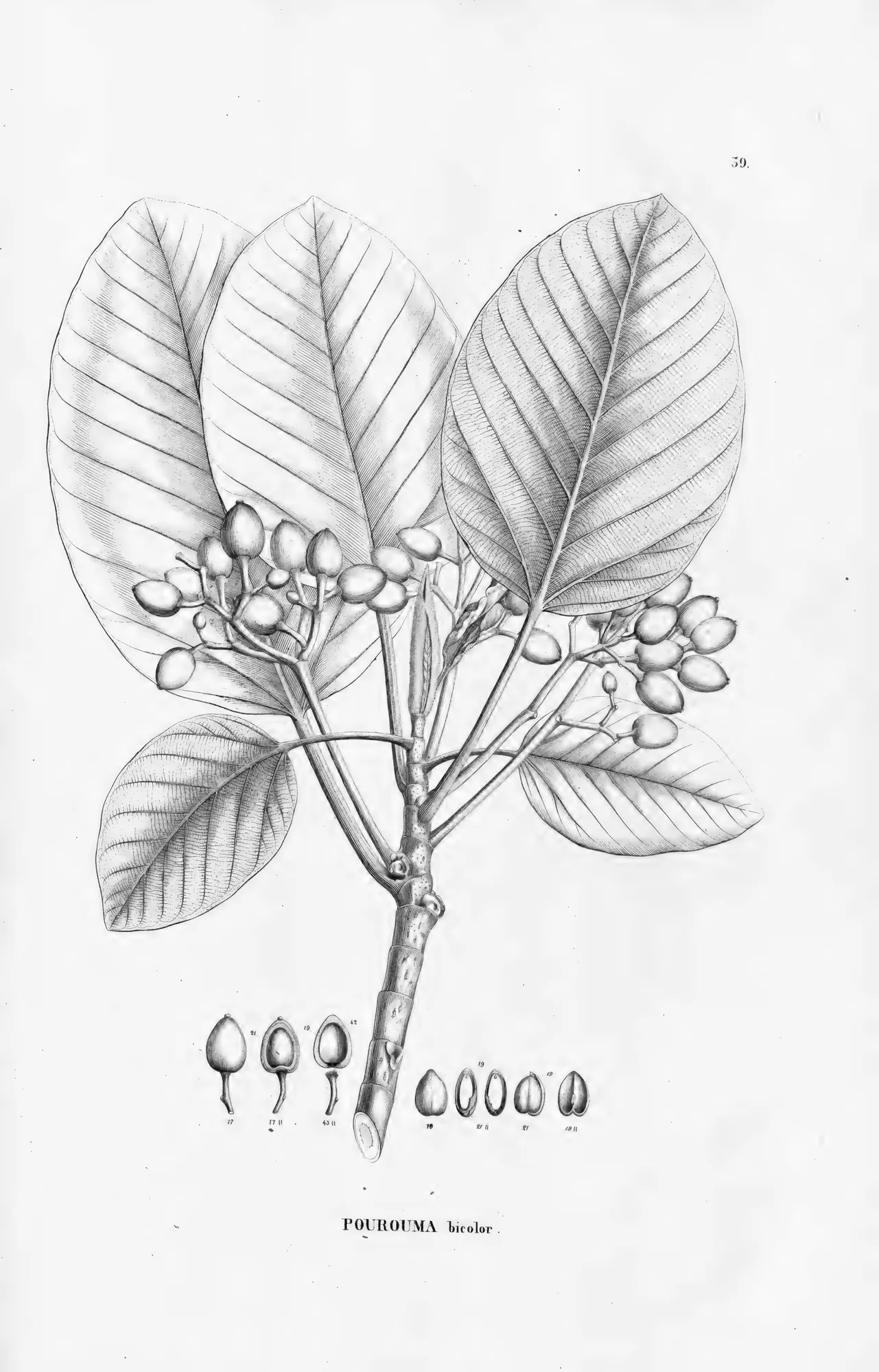
Fruits: Perhaps the most distinctive feature. Unlike the finger-like catkins of Cecropia, the chumico produces clusters of round, grape-like drupes about 1-2 cm in diameter. The fruits mature to dark purple or black and contain a sweet, edible pulp surrounding a single seed. They ripen during the wet season, from June to September in most of Costa Rica.
The Rainforest's Sandpaper
The rough texture of chumico leaves has made them useful tools for centuries. The surface is covered with specialized cells called cystoliths, microscopic structures containing both calcium carbonate and silica. Under the microscope, these appear as tiny dots or linear markings on the dried leaf surface. The combination of minerals creates an abrasive quality that rivals commercial sandpaper. Indigenous peoples across the Neotropics used these leaves to polish wood, smooth gourds, clean pots, and finish craftwork. The common name "lija," Spanish for sandpaper or file, reflects this traditional use that persists in some communities today.
Cystoliths are a defining feature of the Urticaceae family. Research has shown that both silica and calcium are essential for their development: experiments with related species found that plants grown without silica in the soil failed to produce cystoliths entirely. The silica appears to form a structural scaffold onto which calcium carbonate accumulates. In Pourouma, these cystoliths concentrate in the upper epidermal cells, creating the scabrous (rough to the touch) surface that botanists use to describe the genus.
These mineral defenses also protect the leaves from herbivores. Many insects and mammals find the rough, mineralized surface difficult to chew and digest. The silica particles wear down insect mandibles and mammalian teeth, making the leaf an unappealing meal. Combined with the chemical defenses common to the Urticaceae family, this physical barrier helps explain why chumico leaves, though not immune to damage, suffer relatively less herbivory than softer-leaved species in the same forest.
A Feast for Frugivores
When the chumico fruits ripen, its crown becomes a gathering place for the forest's fruit-eaters. Toucans, especially the chestnut-mandibled and keel-billed species, are among the most conspicuous visitors, their oversized bills perfectly suited for plucking the grape-like drupes. Aracaris, smaller relatives of toucans, feed in the same trees. Parrots, cotingas, and dozens of other bird species join the feast.
Monkeys are equally attracted. Spider monkeys swing through the branches to harvest fruits, while howler monkeys consume both ripe fruits and young leaves. Kinkajous visit at night, their prehensile tails allowing them to hang while they feed. Below the tree, peccaries and agoutis wait for fallen fruits, playing their role as ground-level seed dispersers.
The fruits are edible to humans as well. The sweet, grape-like taste led to the name "uva de monte" (mountain grape) and prompted some cultivation in indigenous communities. The related species Pourouma cecropiifolia, native to the western Amazon, has been semi-domesticated and is grown for its fruits in parts of South America.
Habitat & Distribution
Pourouma bicolor ranges from Costa Rica through Panama and into South America, reaching Brazil. In Costa Rica, it is found primarily on the Caribbean slope and the southern Pacific slope, including the Osa Peninsula, Golfo Dulce, and the wet lowlands of Limón. It occurs from sea level to approximately 1,000 meters elevation.
Ecosystem: Unlike its pioneer cousin the guarumo, the chumico is a species of mature forest. It grows in primary wet forest and old secondary forest where the canopy has closed. While it can tolerate some disturbance, it does not aggressively colonize open areas. It is a component of the mid-to-upper canopy, reaching above the general forest level.
Climate requirements: The chumico requires consistently wet conditions with annual rainfall exceeding 2,500 mm. It does not tolerate prolonged dry seasons and is therefore absent from the dry Pacific northwest of Costa Rica. High humidity year-round is essential.
Soil preferences: Grows on well-drained forest soils with high organic content. It tolerates the acidic, nutrient-poor soils common in tropical wet forests but requires adequate drainage. It is not found in permanently waterlogged areas.
No Ants Required
One of the key differences between Pourouma and Cecropia is the absence of the ant mutualism. While Cecropia trees house Azteca ants in their hollow stems, Pourouma trunks are solid. The chumico relies on other defenses: the rough, silica-laden leaves deter herbivores, and the tree invests more resources in growth and longevity rather than maintaining an ant colony.
This different strategy allows the chumico to persist in mature forest where Cecropia cannot. While the guarumo needs constant disturbance to create the bright gaps where it thrives, the chumico regenerates in the shade of the canopy, growing slowly but steadily toward the light. It is a longer-lived tree, potentially reaching 100 years or more, compared to the 20-30 year lifespan of most Cecropia species.
Conservation
The chumico faces no immediate conservation threat, but its dependence on mature wet forest makes it vulnerable to habitat loss. Unlike the guarumo, which thrives on disturbance, the chumico requires intact or recovering forest. As deforestation continues in some parts of its range, populations in unprotected areas may decline.
In Costa Rica, the chumico is well-protected within the national park system. Corcovado, Piedras Blancas, and other protected areas of the Osa Conservation Area harbor healthy populations. As secondary forests age across the country, chumico is likely to become more common as these regenerating areas develop the mature conditions the species prefers.
For visitors to Costa Rica's wet forests, the chumico offers a lesson in the diversity of ecological strategies. Where its cousin the guarumo races to colonize disturbance, the chumico demonstrates that patience and persistence offer another path to success. Its rough leaves and sweet fruits are testimony to the many ways that tropical trees have evolved to defend themselves and disperse their seeds across the forest.
Key Sources & Resources
Species Information
Authoritative taxonomic reference including subspecies classification and distribution data.
Species account from the Osa Peninsula with local ecological information.
Overview of the Pourouma genus including taxonomy, distribution, and uses.
Costa Rican botanical database with morphological descriptions and specimen data.
Leaf Morphology & Chemistry
Landmark study documenting how leaf lobe number varies with canopy position and reproductive status in Pourouma.
Ecological data including wood density (0.28 g/cm³) and growth form characteristics.
Research on the structure and composition of cystoliths in Urticaceae leaves.
Frugivore Interactions & Domestication
Comparative study of wild vs. domesticated Amazon grape trees, with data on fruit size, dispersers, and wood density.
Information on the related cultivated species, including fruit characteristics and human uses.
Community observations with photographs documenting the species across its range.