Flor Blanca
The Brunca "flor blanca" whose dusk-opening pinwheels perfume living fences, supply nectar to hawkmoths, and host giant caterpillars that feed cuckoos along the Osa-Golfito corridor.
In Brunca towns people simply call this species “flor blanca,” because leafless bundles of twisted flowers appear exactly when late dry-season heat hits. Botanists recognize a wide native swath from Mexico to Costa Rica and western Panama, with wild trees clinging to basalt outcrops and drought-prone ridge tops while volunteers sprout in patios, cemeteries, and coastal dunes. Despite its ubiquity in ornamental plantings, the species still seeds naturally inside Nicoya dry forest remnants, Palo Verde floodplains, and river levees bordering the Térraba.
The combination of succulent branches, a latex-rich bark, and pale undersides that reflect heat allows Plumeria rubra to ride out seven-month droughts without shedding cambial tissue. Those same traits make it a favorite for living fences: farmers push an unrooted pole into a pasture boundary and it leafs out within weeks, then flower heads pump out a jasmine-and-almond fragrance that hawkmoths can detect from hundreds of meters away.
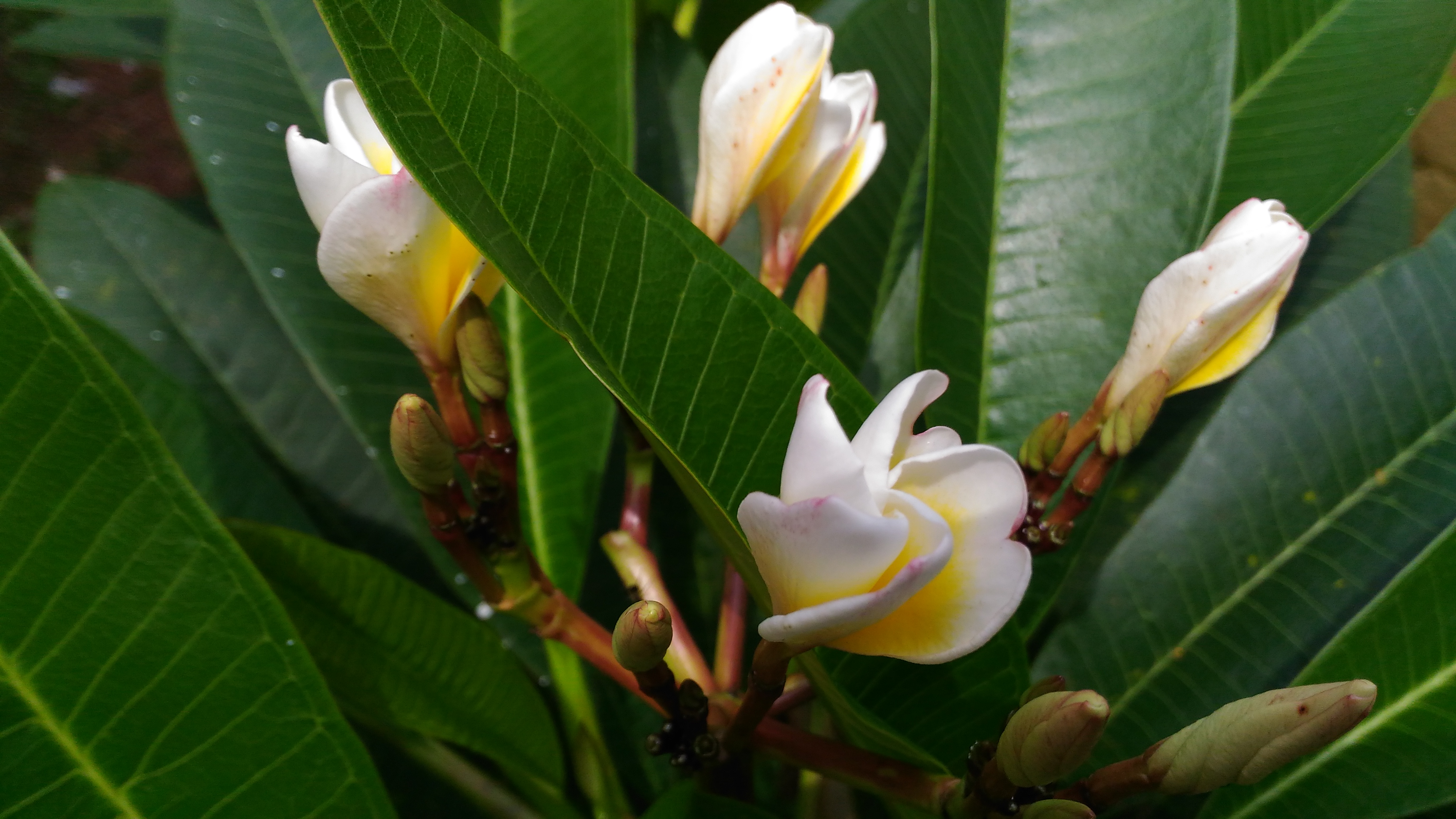
Identification
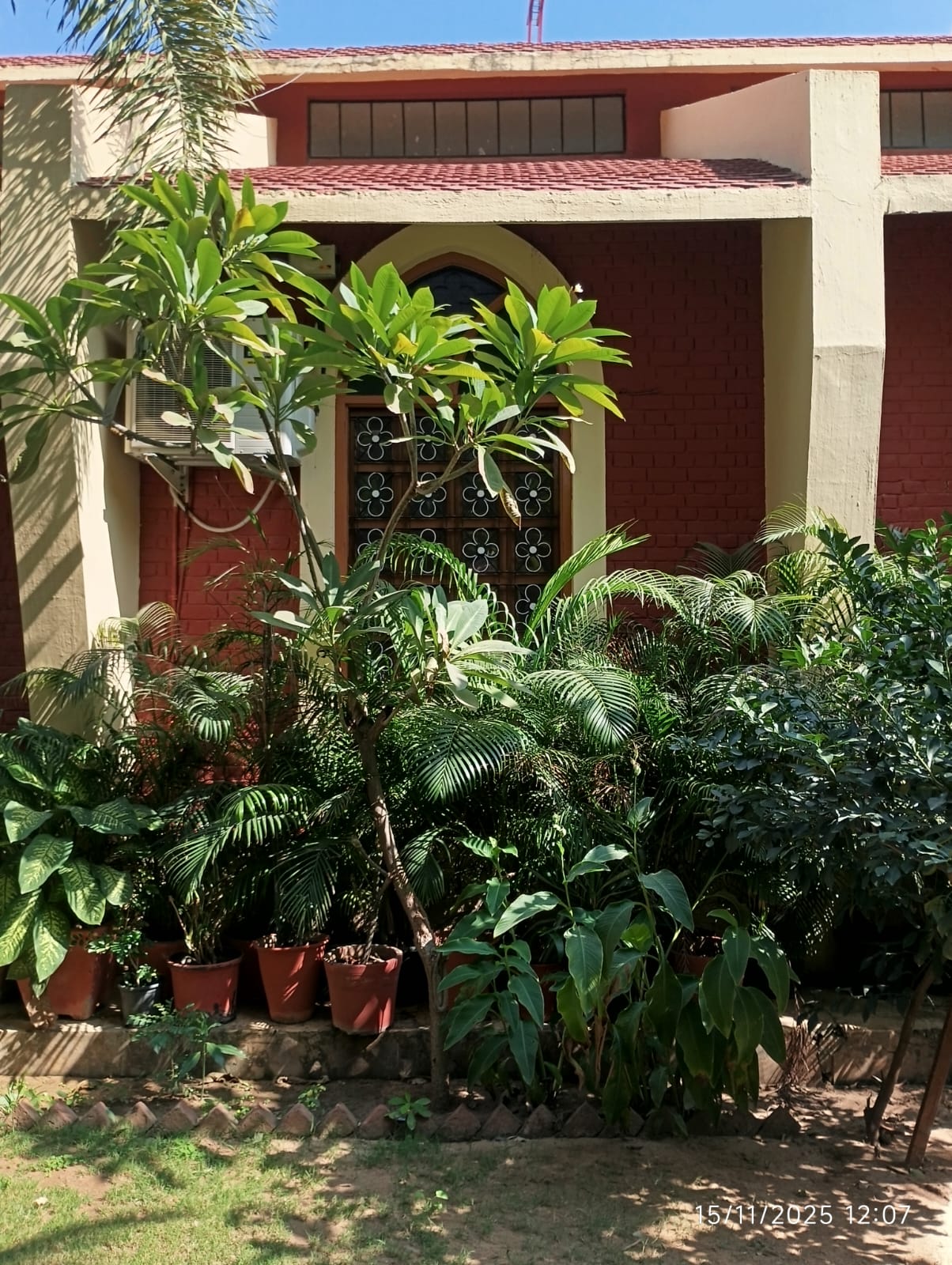
Trunk & Bark
The trunk is short and thick, rarely exceeding 25 cm in diameter, with smooth gray bark that becomes slightly roughened with age. When cut, the bark exudes copious white latex that can irritate skin and eyes. The wood is soft and spongy, storing water that sustains the tree through prolonged dry seasons. Branches are thick, succulent, and brittle, breaking easily but rooting readily when stuck into moist soil.
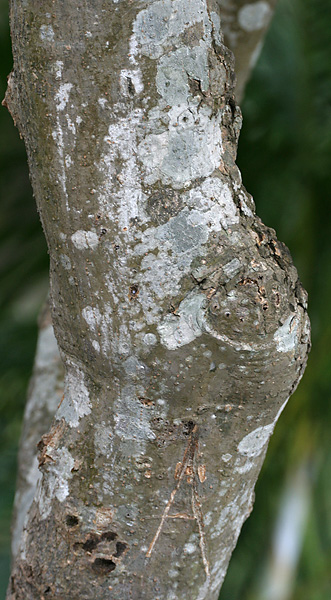
Leaves
Leaves are spirally arranged at branch tips, oblong to oblanceolate, 15–30 cm long, with prominent midribs and pointed tips. They are deciduous, dropping during the dry season to reveal the characteristic candelabra branching. New leaves emerge with the first rains, often alongside or shortly after the flowers.


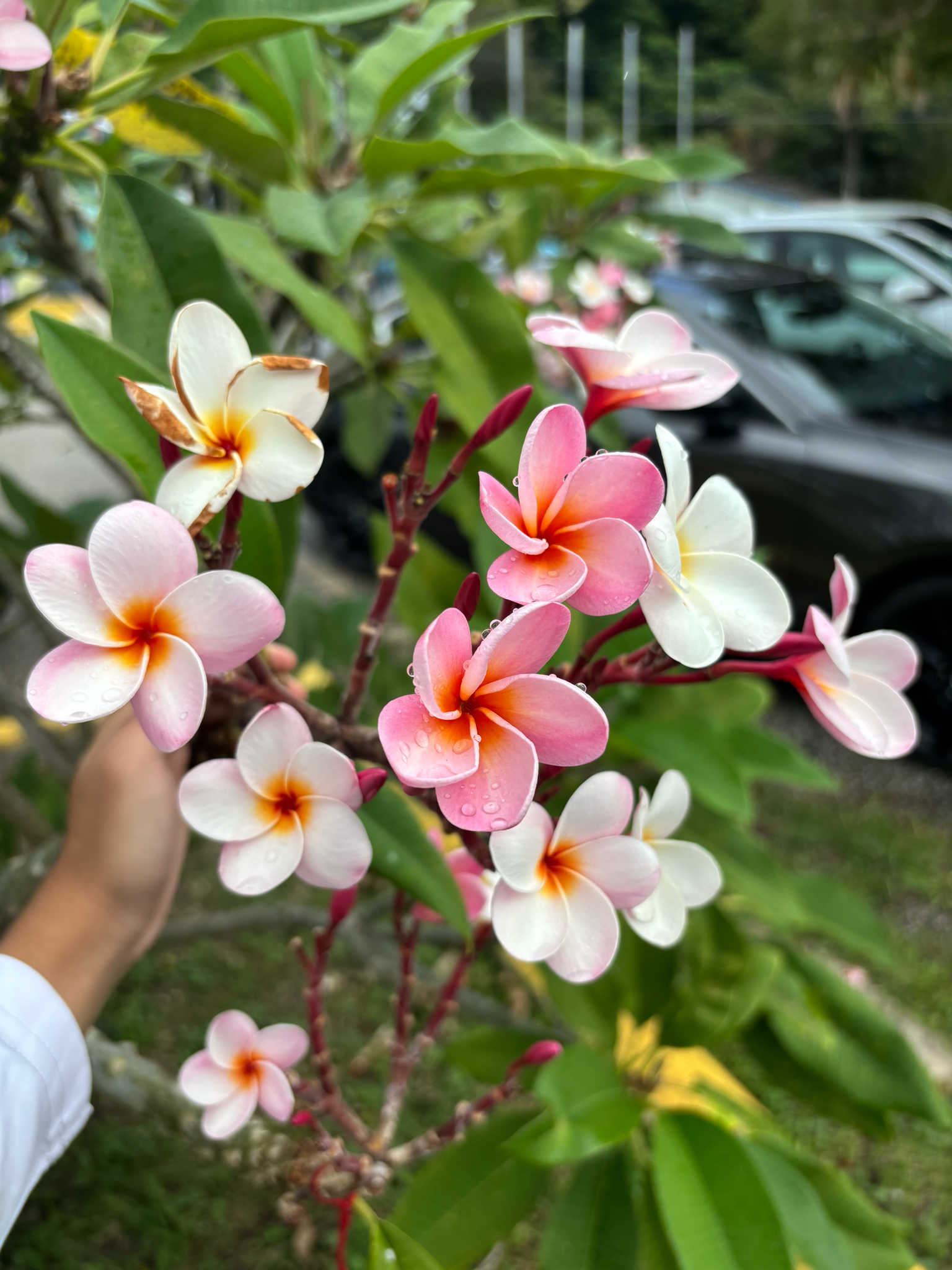
Flowers
Flowers appear in terminal clusters at branch tips, each with five waxy, overlapping petals that spiral in bud and open into pinwheel-like corollas 5–8 cm across. Colors range from pure white with yellow throats to pink, red, and multicolored forms. The tubular throat is 3–4 cm long, excluding most pollinators except long-tongued hawkmoths. Flowers open progressively over several weeks, releasing their strongest fragrance at dusk.
Fruits & Seeds
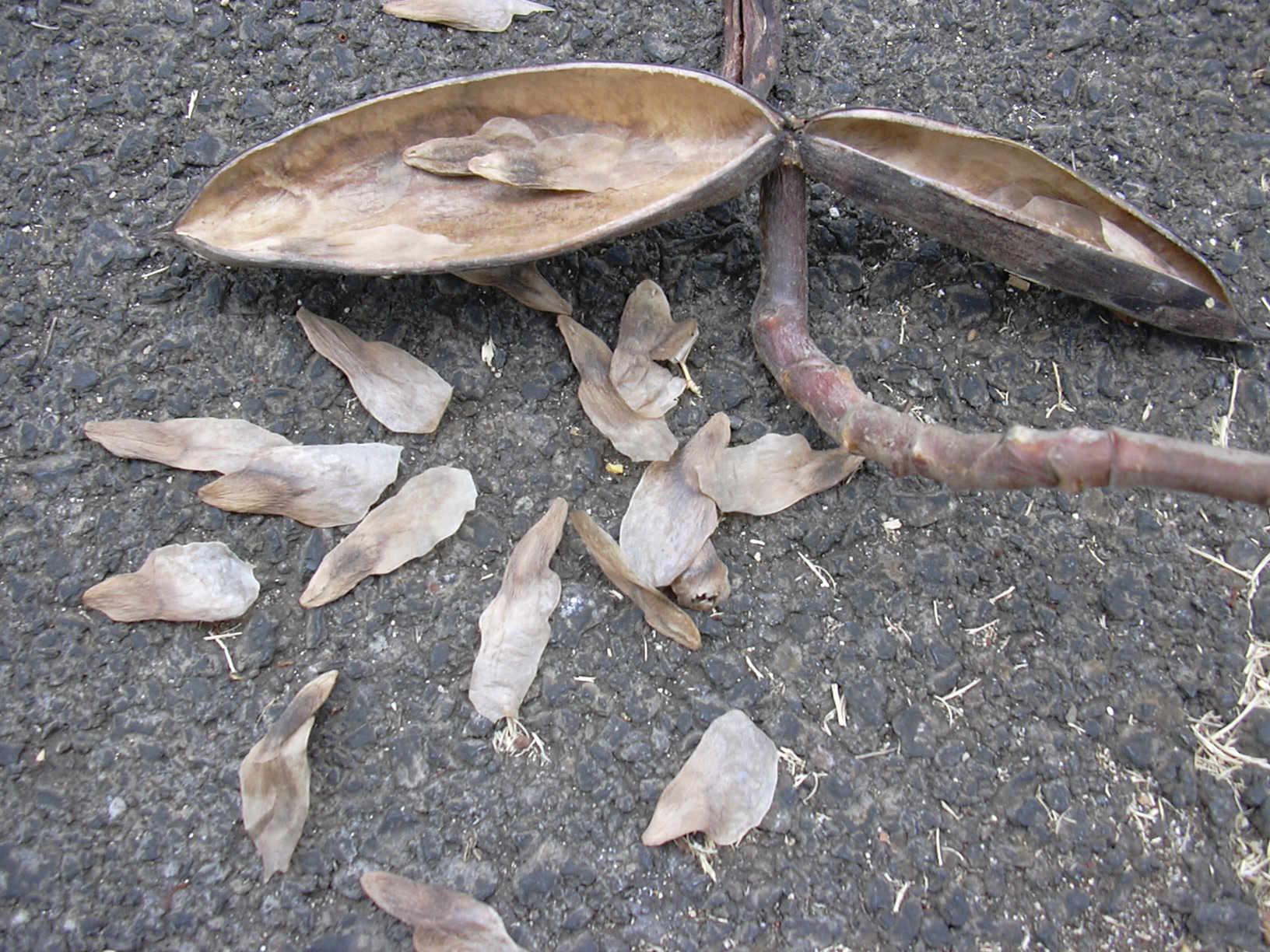
The fruit consists of paired follicles that develop in opposite directions, resembling boat hulls. Each follicle contains dozens of winged seeds with papery margins that aid wind dispersal. Farmers in Pérez Zeledón collect these seeds and string them into bracelets for planting along new fence lines the following rainy season.
Distribution
Flor blanca grows wild from Mexico through Central America to Colombia and Venezuela, with cultivated specimens now spanning every tropical shore. In Costa Rica, it appears along both coasts and throughout the Central Valley, from sea-level mangroves to dry forest edges at 1,500 meters. Wild trees cling to basalt outcrops in Guanacaste and Nicoya, while volunteers sprout in patios, cemeteries, and coastal dunes. The species seeds naturally inside Palo Verde floodplains and river levees bordering the Térraba.
Flowering surges between March and May during the late dry season, with a second pulse in October once rains resume. The common name "flor de mayo" in Guanacaste references this timing. CATIE's living-fence trials found Plumeria rubra achieved the highest survival (92%) after two dry seasons compared to Gliricidia and Bursera stakes, requiring no coppicing while keeping canopy density low enough for pasture grasses to thrive.
Ecology
The Cheating Flower
For all its intoxicating perfume, the frangipani offers hawkmoths nothing in return. Plumeria flowers produce no nectar whatsoever. Ecologist William Haber documented this "pollination by deceit" in a 1984 Biotropica study at Palo Verde: the flowers mimic the visual cues and scent profiles of nectar-producing species so effectively that sphingids visit them repeatedly, transferring pollen from flower to flower in a fruitless search for dinner. The strategy works because hawkmoths forage over large areas and cannot afford to memorize every empty flower; the tree exploits their optimism, essentially freeloading on the pollination economy of the dry forest.
Plumeria's floral morphology excludes most bees; only long-tongued hawkmoths reach deep into the 3–4 cm tube. Haber and Frankie's nocturnal watch in Palo Verde logged Xylophanes tersa, Erinnyis ello, and Manduca sexta hovering at fence lines between 20:00 and 23:00, dusted with yellow pollen from the anther cap. The evening perfume is dominated by 2-phenylethanol and benzaldehyde, volatiles that mimic night-blooming jasmine.
Herbivores and Their Predators
Despite milky latex loaded with fulvoplumierin and other iridoids, the tree hosts dramatic herbivores. The tetrio hawkmoth (Pseudosphinx tetrio) lays eggs on cultivated trees each June; caterpillars grow to 15 cm and can defoliate a hedge overnight, yet they in turn fuel Mangrove Cuckoos, groove-billed anis, and even tayras stalking fence lines. On the Osa Peninsula, latex dripping from fresh cuts attracts stingless bees (Melipona beecheii) which gather the resin to waterproof their hives.
Flor blanca's fence-line presence forms a corridor linking mangrove edges to upland villages. Hawkmoths service coffee and cacao blossoms after visiting Plumeria, while birds pick through dried follicles for insect prey. The latex discourages cattle chewing yet hosts arthropods that become food for insectivores, making every 100-meter stretch a micro-wildlife overpass.
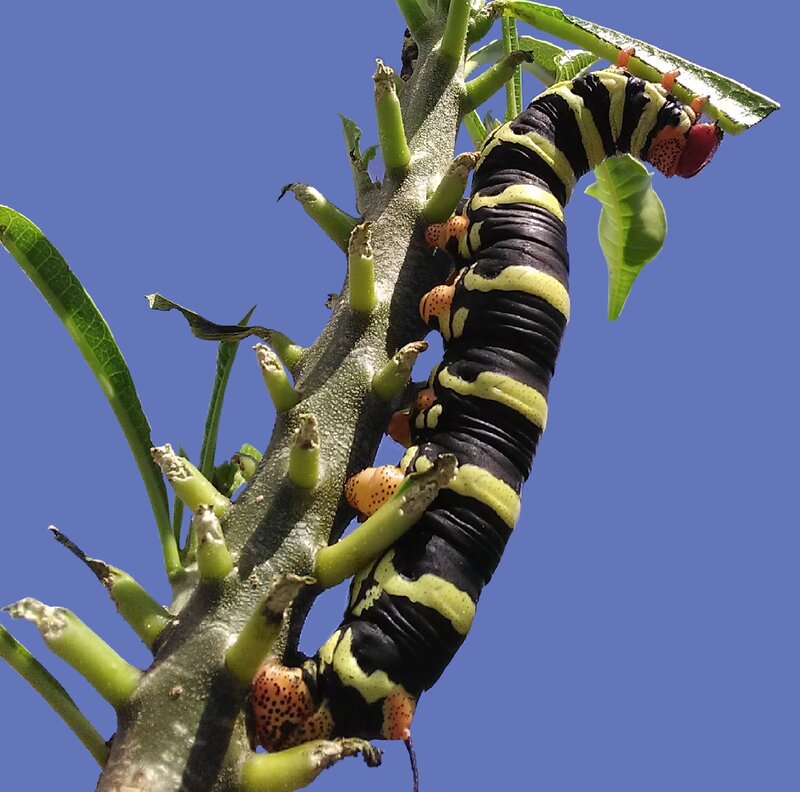
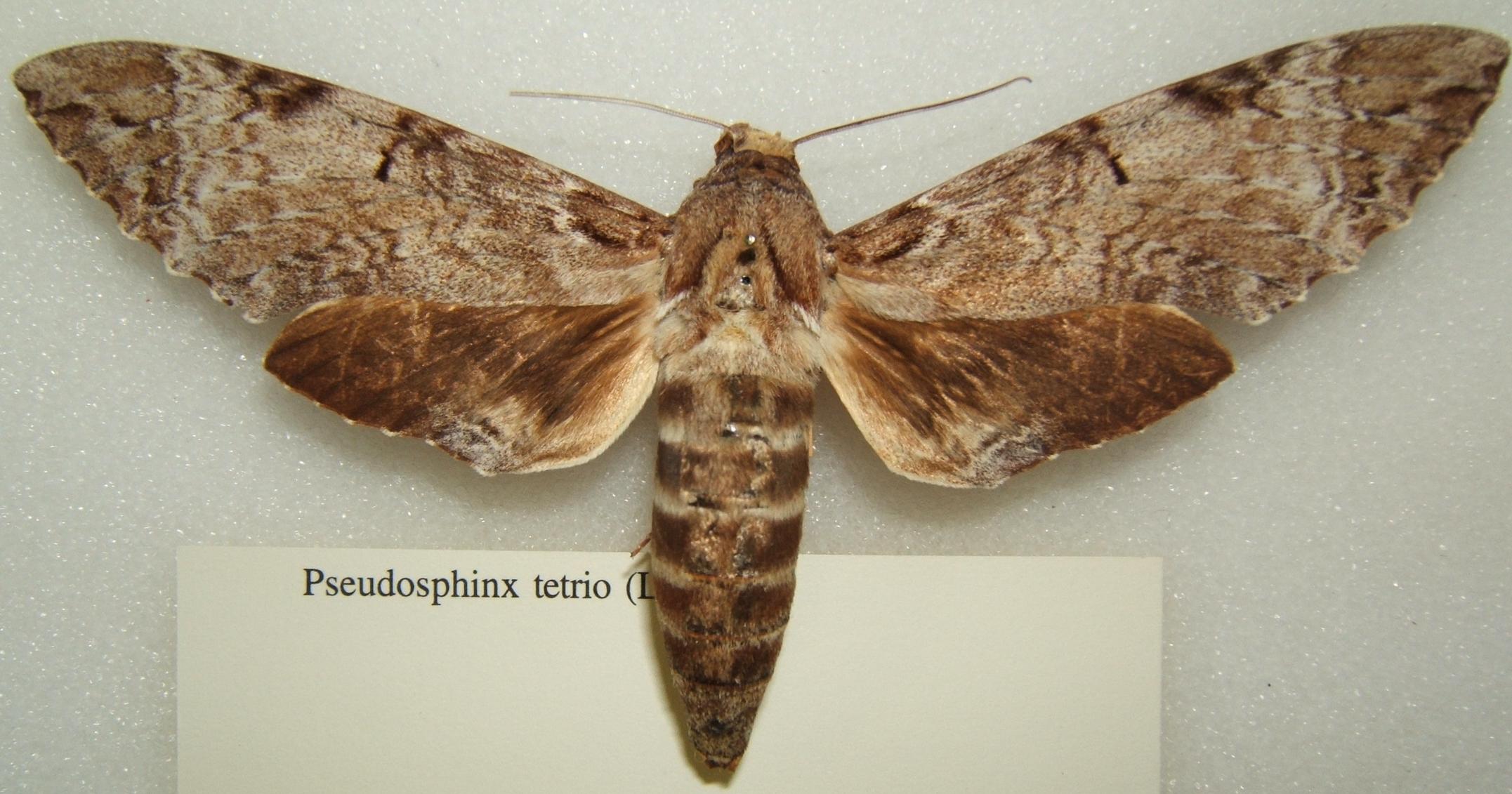
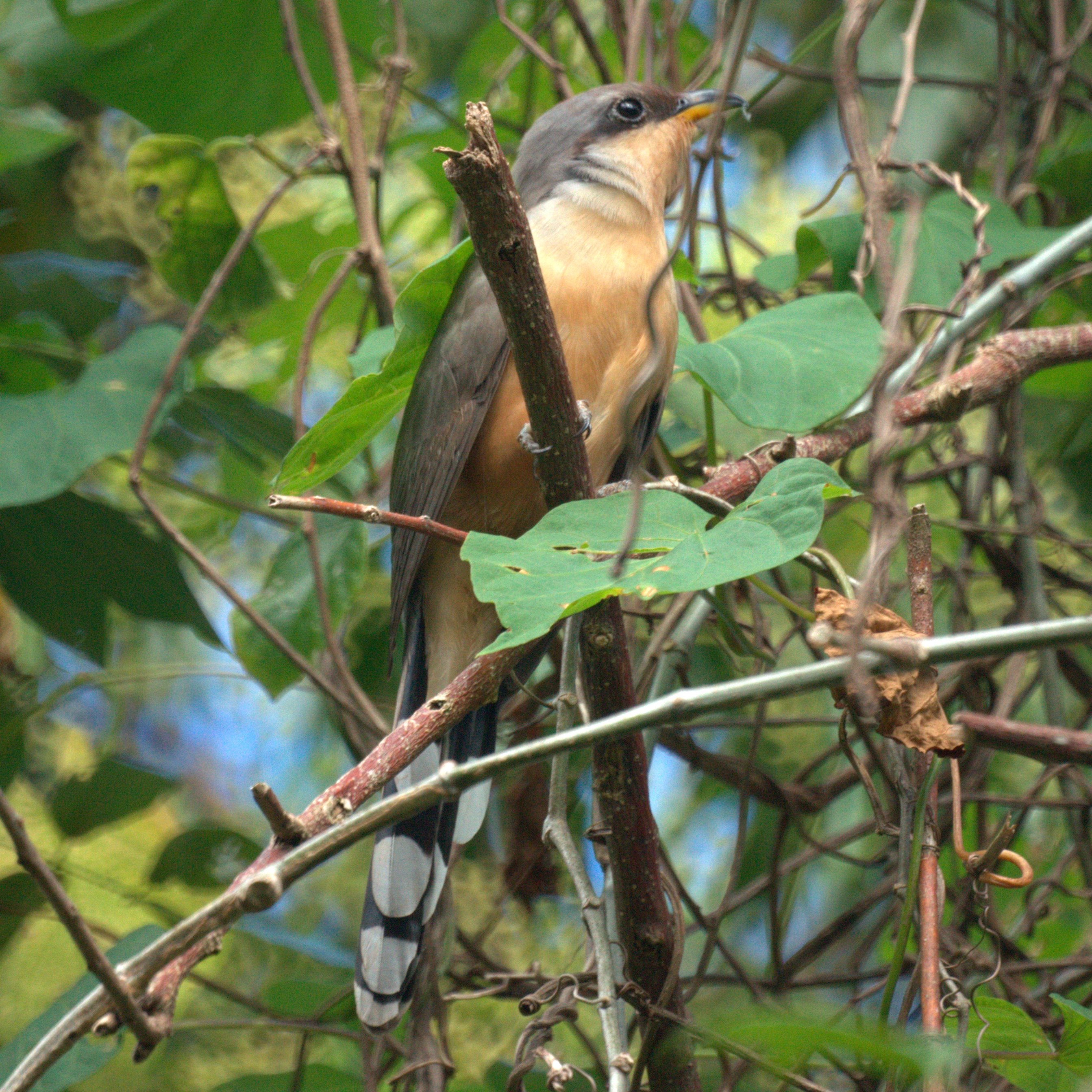
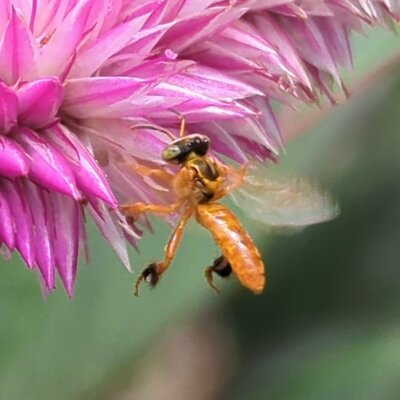
Photos (clockwise from top left): Pseudosphinx tetrio caterpillar (ImagePerson, CC BY 4.0), Pseudosphinx tetrio adult (S. James Hetrick, CC BY-SA 2.5), Tetragona ziegleri stingless bee (mettcollsuss via iNaturalist, CC BY), and Mangrove Cuckoo (Mike's Birds, CC BY-SA 2.0).
Cultural Heritage
Long before European botanists arrived, the Maya venerated this flower as nicté or nikte. Lacandon Maya myths from Chiapas state that certain gods were born from the nicté flower, making it a symbol of divine creation. The Aztecs planted Plumeria groves for nobles to stroll through and enjoy, linking the fragrance to royalty and sacred ceremony. Even the paired follicles carried meaning: the Maya interpreted the twin pods emerging from a single stem as representing male and female, fertility and duality woven into the tree's biology.
Nicaragua adopted Plumeria as its national flower in 1971, calling it sacuanjoche, a name derived from Nahuatl words meaning "beautiful yellow petals." The flower appears on Nicaraguan banknotes and is strung into garlands for festivals and weddings. On Brunca fincas, the main practical use remains the living fence: cuttings 5–8 cm thick are installed every 3 meters and tied with two wires. Within two years they deliver shade for cattle, emergency fodder, and latex-rich bark historically chewed to treat toothache.
The frangipani's journey from Mesoamerica to every tropical shore began with the Manila galleons. Spanish ships carried cuttings from Mexico to the Philippines in the 1560s, where the tree became kalachuchi and spread throughout Southeast Asia, adorning Buddhist and Hindu temples as the "temple tree." In Laos, Plumeria alba is the national flower, known as dok champa. Hawaii's connection came in 1860 when German biologist Wilhelm Hillebrand introduced the species; today Hawaiian growers produce millions of flowers annually for lei-making. From Mesoamerican sacred symbol to global emblem of tropical hospitality, the frangipani has traveled farther than almost any other New World ornamental.
Taxonomic History

The genus honors Charles Plumier (1646–1704), a French Minim monk who became one of the greatest botanical explorers of his era. Plumier made three expeditions to the Caribbean between 1689 and 1695, visiting Martinique, Guadeloupe, and Hispaniola as royal botanist to Louis XIV. He documented over 4,000 plants and 1,000 animals, leaving behind 6,000 drawings at his death. Among the genera he discovered: Begonia, Fuchsia, Lobelia, and Magnolia, each named for a fellow naturalist.
Plumier died in 1704 in Spain while preparing to sail for Peru to find the cinchona tree, source of quinine for malaria. He never reached the Andes, but his own name was immortalized in the fragrant tree he encountered on Caribbean hillsides. A century and a half later, another botanist, Richard Spruce, would complete the cinchona quest. The parallel is fitting: both men dedicated their lives to documenting New World plants, and both are remembered in the names of trees that still line the fences and temple grounds of the tropics.
Resources & Further Reading
Floristic & Ecological References
Provides accepted taxonomy, synonymy, and native range from Mexico through Central America.
Summarizes survival rates, shading impacts, and management tips for Plumeria stakes in Costa Rican pastoral systems.
Details horticultural practices, rooting, and pest management relevant to Brunca nurseries.
Explains the biochemical pathway that generates the evening fragrance attracting hawkmoths.
Documents the role of Flor Blanca in urban restoration projects and pollinator corridors.
Highlights the tetrio hawkmoth caterpillar outbreaks and management considerations.
Describes the insect-rich diet—including Plumeria-feeding caterpillars—that supports these coastal birds.
Classic study documenting that Plumeria flowers produce no nectar, instead exploiting hawkmoths through scent and visual mimicry.
Cultural History & Ethnobotany
Documents the role of nicté (Plumeria) in Lacandon Maya mythology, where gods are said to have been born from the flower.
Biography of the French Minim monk who explored the Caribbean for Louis XIV and discovered Begonia, Fuchsia, Lobelia, and Magnolia.
Explains the sacuanjoche's status as Nicaragua's national flower since 1971 and its appearance on banknotes.
Overview of the genus's introduction to Hawaii (1860), Southeast Asia (1560s), and use in lei-making and temple decoration.
Data Sources
Used to summarize Costa Rican totals, Brunca-specific records, and monthly phenology.