Pilón
Hieronyma alchorneoides — The blood-sapped timber giant of Costa Rica's wet forests. Cut into this tree and crimson sap bleeds from the wound. Its wood is among the densest and most durable of any native species, prized for marine construction and heavy beams. Yet ecologists argue the pilón is worth more standing: its fruits feed monkeys and birds throughout the year.
Walk through the lowland forests of the Osa Peninsula or the Caribbean slopes and you will encounter pilón rising through the canopy, its trunk straight as a column, its crown spreading wide above the surrounding trees. This is one of Costa Rica's most valuable timber species, and also one of its most ecologically important. The tension between these two values has shaped the pilón's fate.
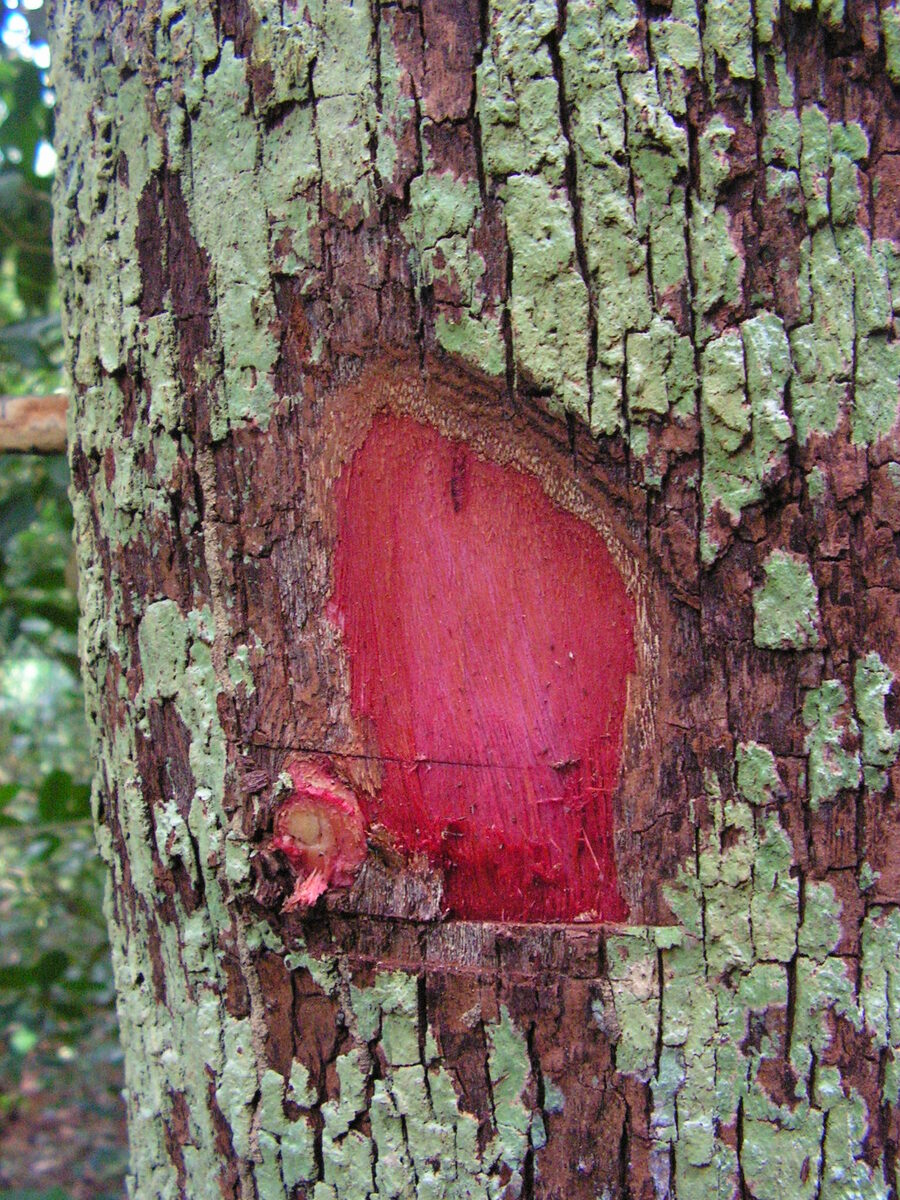
The tree's signature is visible from a distance. Throughout the year, scattered leaves in the canopy turn brilliant red or yellow before falling, creating a mottled pattern that distinguishes pilón from its neighbors. But the true surprise comes when you cut into the bark. A thick, blood-red sap wells up from the wound, staining the blade and dripping down the trunk. This crimson sap runs through the entire tree, from the bark to the dark heartwood.
Identification
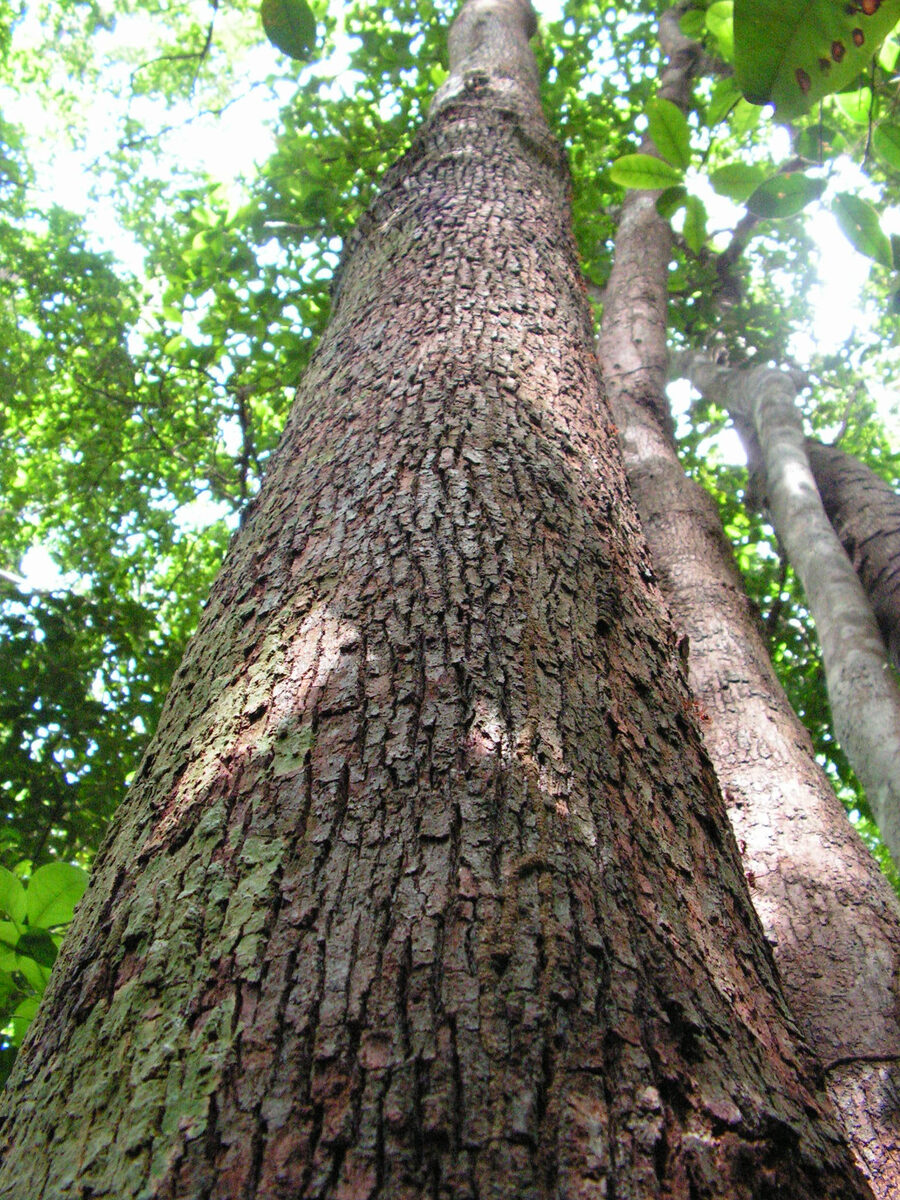
Pilón is among the largest trees in Costa Rica's wet forests, capable of reaching 50 meters in height with trunk diameters exceeding 2 meters. The bole is stout, cylindrical, and remarkably straight, rising unbranched for up to 20 meters before the crown begins. At the base, spreading rounded buttresses anchor the giant to the forest floor, while large surface roots trace snake-like paths across the ground.
The bark is thick and vertically fissured, displaying what foresters call a "hallmark rusty or burnt-orange hue" most visible in the deep grooves and near the base. This coloration alone can identify the tree from a distance. The crown is characteristically hemispherical and wide, with upwardly-angled limbs that concentrate foliage on the outermost layer of twigs.
Leaves
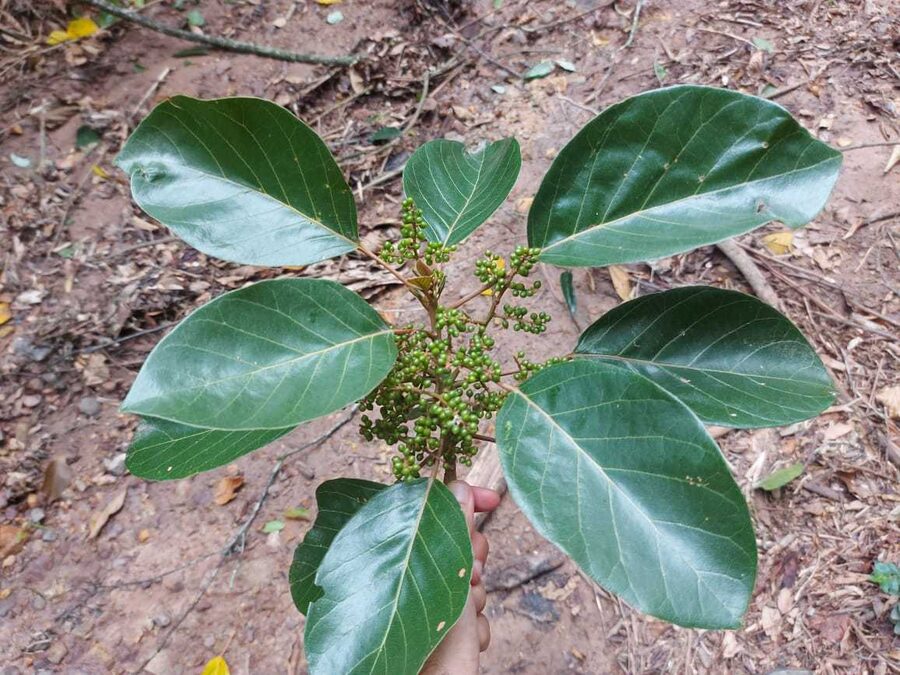
The leaves are simple, alternate, and arranged in whorl-like clusters at the branch tips. Each blade measures 13-22 cm long by 6-11 cm wide, elliptical to orbicular in shape. A distinctive feature is the long, grooved petiole measuring 3-6 cm, which has a characteristic elbow-shaped bend where it meets the blade. The upper surface is glossy green; the underside bears tan pubescence and shows prominent pinnate venation.
Flowers and Fruits
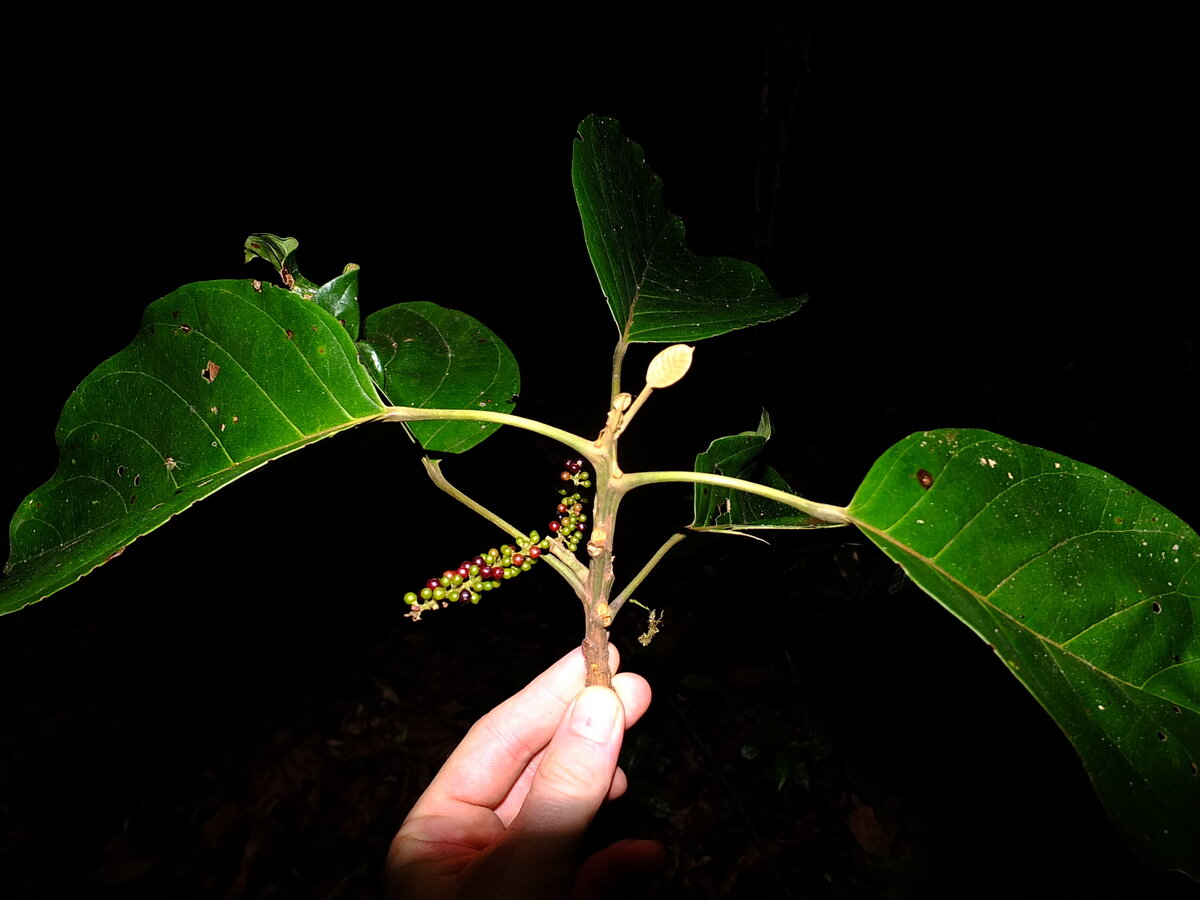
Pilón is dioecious, meaning male and female flowers grow on separate trees. The flowers are tiny (about 2 mm), green, and lack petals, appearing in branched panicles about 7 cm long. Male trees flower from August to November and again from February to April, while female trees bloom only in late September to October and late February. Pollination is by insects.
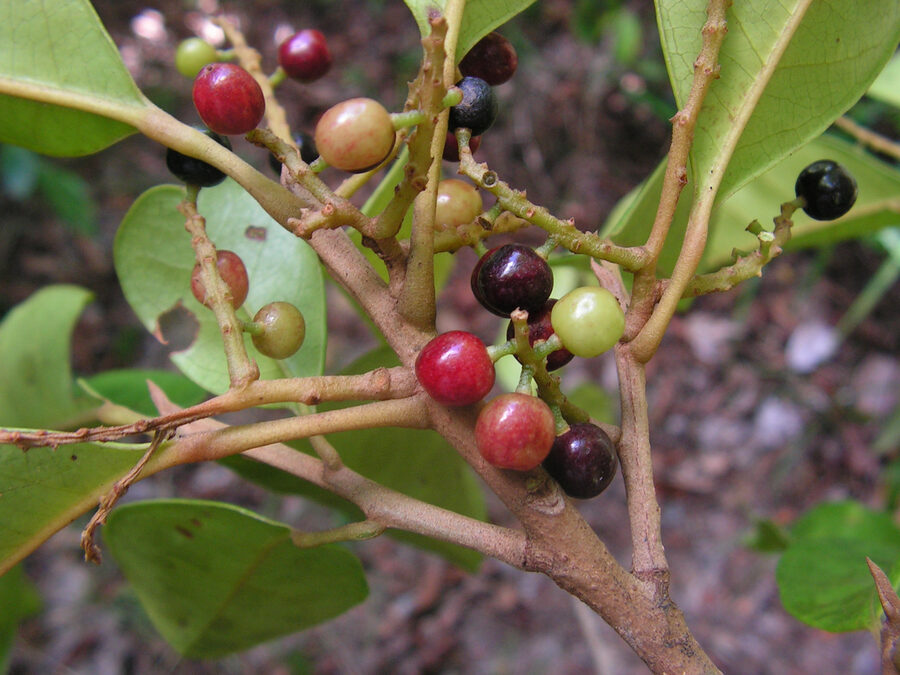
The fruits are small spherical drupes about 3 mm in diameter, ripening from green through deep wine-red to purple. Each contains a single white seed measuring about 1.5 mm. Harvest times occur December to January and mid-May through mid-June. The fruits are a critical food source for wildlife; birds and monkeys consume them avidly and disperse the seeds throughout the forest.
Name Origins
The genus name Hieronyma derives from the Latin Hieronymus, itself from the Greek Hierōnymos meaning "sacred name." This name is most famously associated with Saint Jerome (c. 347-420 CE), the scholar who translated the Bible into Latin, creating the Vulgate that remained the standard text for centuries. The Brazilian botanist Francisco Freire Allemão described this genus in 1848, though the reason he chose to honor Saint Jerome remains unclear.
The species epithet alchorneoides means "resembling Alchornea," another genus of tropical trees that was formerly placed in the same family. The suffix "-oides" in botanical nomenclature indicates resemblance. Alchornea itself was named for Stanesby Alchorne, an 18th-century English botanist.
The common name "pilón" is used throughout Central America. "Zapatero," meaning "shoemaker," is another widely used name, likely referring to the use of the bark's tannins in leather working. In South America the tree goes by "suradan" and "urucurana," while "mascarey" and "nancitón" are used in some regions.
Habitat and Distribution
Pilón grows as a canopy or emergent tree in moist and wet mixed forests, almost exclusively in primary formations. It thrives in the lowlands from sea level to about 900 meters elevation. The species prefers alluvial, clayey, acidic soils and tolerates poor, seasonally waterlogged conditions that would stress many other trees. Optimal rainfall is 3,500 to 4,500 mm annually, though it tolerates a range from 2,000 to 6,000 mm.
The tree's native range extends from southeastern Mexico through Central America and into South America as far as Brazil and Bolivia. In Costa Rica, pilón grows on both the Atlantic and Pacific slopes. Protected populations exist within Manuel Antonio National Park on the central Pacific coast and Corcovado National Park on the Osa Peninsula, where some of the country's finest specimens still stand in undisturbed primary forest.
Ecological Importance
Despite its value as timber, many ecologists argue that pilón is worth more left standing. The tree provides critical food resources for a wide variety of wildlife. White-faced capuchins and squirrel monkeys seek out the fruiting trees, spending hours feeding in the crown. Saltators, tanagers, and numerous other bird species consume the small purple fruits and disperse the seeds throughout the forest. The twice-yearly fruiting means pilón provides food during multiple seasons.
Beyond its role as a food source, pilón contributes to soil health. A landmark study comparing pilón plantations to pine (Pinus) found that pilón allocated 2.4 times more carbon to belowground productivity than pine. This high investment in roots helps explain the species' role in soil amelioration, leading to increases in soil organic carbon. Fine root studies revealed that pilón roots decay at moderate rates (1.36 year⁻¹), helping to cycle nutrients and build soil structure over time.
Another key ecological trait is pilón's exceptional tolerance for aluminum toxicity. In the acidic soils where it thrives, high aluminum concentrations stress or kill many tree species. Pilón not only survives these conditions but grows vigorously, making it invaluable for reforesting degraded lands with challenging soil chemistry. Its high allocation of fine roots helps it extract nutrients even under low-fertility conditions.
Four Decades of Scientific Research
Pilón holds a unique place in tropical forest science. Since 1983, it has been one of the species monitored by the TREES Project at La Selva Biological Station in Costa Rica, making it part of the longest-running annual census of tree performance anywhere in the tropics. Every year for over four decades, researchers have measured approximately 2,500 individual trees of ten species, including pilón, tracking their growth, survival, and responses to environmental conditions.
This long-term research has revealed troubling patterns. Trees, including pilón, show reduced wood production in years with higher nighttime temperatures, suggesting that warming-induced increases in respiration are negatively affecting their carbon balance. High daytime vapor pressure deficit during dry seasons further inhibits growth. As climate change accelerates, these findings raise questions about the future of pilón and other lowland tropical trees.
Wood and Timber
The wood of pilón is exceptional. The heartwood is very dark brown to reddish-brown, almost maroon in color, while the sapwood is lighter with a pinkish hue. The texture is medium to coarse and sometimes uneven. What makes pilón timber distinctive is the interlocked grain, which gives sawn boards a striped or ribbon-grain appearance prized in decorative work.
But durability and strength are pilón's greatest assets. The wood density ranges from 736 to 849 kg/m³ when air-dried, with a specific gravity of 0.59 to 0.86. This places it among the heaviest plantation-grown timbers available. The strength is comparable to true hickory, one of North America's toughest hardwoods. Pilón is rated moderately to very durable in ground contact and shows strong resistance to both subterranean and dry-wood termites.
Traditional uses reflect these properties. Pilón has long been employed for heavy construction including railway sleepers, bridges, columns and beams, fence posts, stakes, and piles. The wood also finds use in furniture, cabinetwork, flooring, decorative veneers, and turnery. Working properties are favorable: despite its density, pilón machines well and causes minimal dulling of blades. Pre-boring is recommended when using fasteners.
Timber Flies: An Unusual Pest
One unusual threat to pilón plantations comes from timber flies (Pantophthalmus spp.), the world's largest flies with wingspans reaching 100 mm. Unlike most flies, their larvae bore into living wood, a habit otherwise dominated by beetles. First recorded in Costa Rican pilón plantations in 2015, these insects represent one of only about 20 species in a family restricted to Central and South American lowland rainforests. While not a major economic threat, their presence highlights the need to monitor plantation health.
Traditional Uses
Beyond timber, pilón has served several traditional purposes. The bark yields tannins that have been used for dyeing and leather tanning, which likely explains the common name "zapatero" (shoemaker). In traditional medicine, a root decoction serves as an energetic depurative and has been included in patent medicines. The oil from seeds is said to be effective against intestinal parasites, while a bark decoction has been used to relieve coughs.
Conservation and Reforestation
The IUCN lists pilón as Least Concern due to its wide distribution and relatively stable populations. However, the species faces ongoing pressure from illegal logging in many areas, attracted by the high value of its timber. The paradox of pilón is that its very excellence as timber makes it a target, while its ecological importance argues for protection.
Increasingly, the solution lies in cultivation. Pilón is now one of the most widely used native species in Costa Rican commercial timber plantations and is increasingly planted throughout its Central and South American range. The species grows fast, reaching 5 meters in just three years under plantation conditions. Its tolerance of poor and acidic soils makes it suitable for recovering degraded pasturelands where other species struggle.
Long-term studies at La Selva Biological Station compared pure pilón plantations to mixed-species stands over 15-16 years. The results favor diversity: pilón and other native trees perform better in mixed plantations than in monocultures for diameter growth, height, and carbon sequestration. Economically, pure pilón plantations yielded a respectable Net Present Value of $2,654/ha with an Internal Rate of Return of 10.8%, but mixed plantations outperformed them with NPV ranging from $1,124 to $8,155/ha depending on species combinations.
Mixed plantations also support greater biodiversity. Studies found that the highest number of woody species regenerating in the understory occurred under mixed-species plantations, followed by pilón and Vochysia ferruginea monocultures. Pilón's high shade tolerance makes it particularly compatible with other species. In monocultures, its dense crown intercepts 90% of incoming sunlight by age two, suppressing undergrowth, but in mixtures this competitive trait is moderated by canopy gaps from other species.
Costa Rica's Payment for Environmental Services program has made pilón reforestation economically attractive for small farmers. With an estimated rotation of 25 years and projected timber volumes of 175 m³/ha, pilón plantations provide both income and ecosystem services. The tree that was once targeted for extraction is becoming a tool for forest recovery, carbon storage, and rural livelihoods.
Key Sources & Resources
Species Information
Detailed species account focusing on Costa Rica's Pacific slope populations, with information on identification, ecology, and distribution.
Species profile from the Osa Peninsula arboretum, including phenology, uses, and conservation status.
Authoritative taxonomic information and distribution data from the Royal Botanic Gardens, Kew.
Comprehensive database entry covering cultivation requirements, traditional uses, and propagation.
Restoration & Agroforestry
Information on using pilón in tropical forest restoration projects, with links to relevant research.
Research on the environmental services and productivity of native species plantations including pilón in Central America.
Wood Properties
Technical specifications and working properties for pilón timber.
Research on steaming and heating treatments to reduce warping and splitting in plantation-grown pilón lumber.
Scientific Research
Overview of the longest-running tropical tree census (since 1983), which includes pilón among its monitored species at La Selva Biological Station.
15-16 year study comparing growth and economic viability of pilón in pure versus mixed-species plantations at La Selva.
Research showing pilón allocates 2.4 times more carbon to belowground productivity than pine plantations.
Study of fine root decay rates including pilón, revealing species-specific differences in belowground nutrient cycling.
Research documenting spider monkey dispersal of pilón seeds in Ecuador's Yasuní rainforest.
First record of wood-boring timber fly larvae in Costa Rican pilón plantations.