Bactris gasipaes (Pejibaye)
Bactris gasipaes — The peach palm has fed the peoples of tropical America for at least four thousand years. Its multi-stemmed growth makes it the sustainable solution to the palmito harvest that once devastated single-stemmed palms across the region.
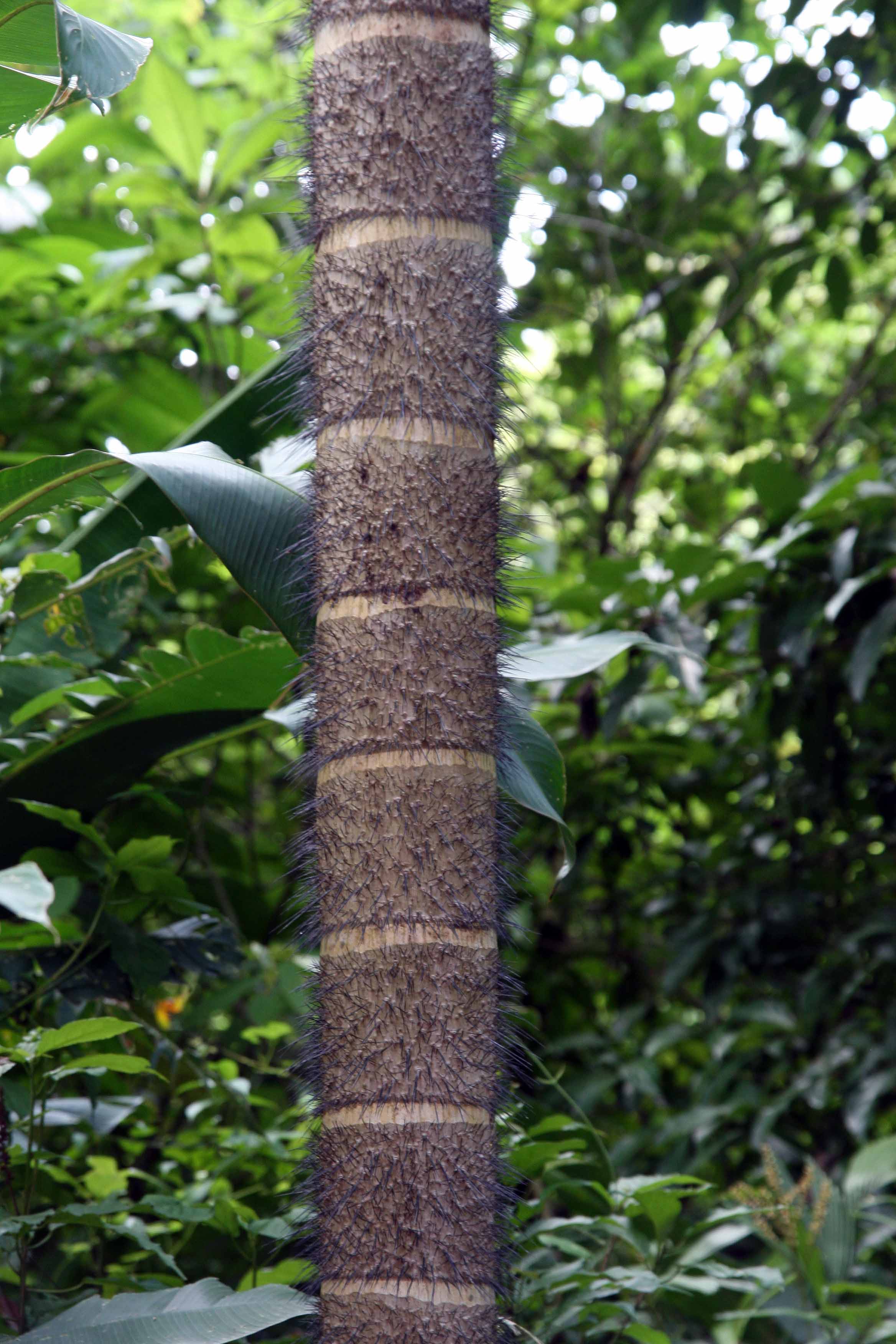
Walk through any farmers' market in Costa Rica during harvest season and you will find piles of orange and red fruits that look almost like small peaches. These are pejibayes, the boiled fruits of Bactris gasipaes, one of the most important domesticated plants of the pre-Columbian Americas. The palm that produces them stands armored in rings of black spines, its multiple stems rising from a single base in a clump that can regenerate indefinitely when individual trunks are harvested.
This clumping growth habit has made the pejibaye the answer to one of tropical agriculture's sustainability challenges. When palm hearts (palmito) are harvested from single-stemmed species like Welfia regia, the tree dies. But Bactris gasipaes produces three to five new shoots for every stem cut, allowing continuous harvest for decades. Costa Rica, Brazil, Colombia, and Ecuador now cultivate the peach palm extensively for canned hearts of palm, relieving pressure on wild populations of other species.

Identification
The genus Bactris contains over 200 species of spiny palms distributed throughout the Neotropics, but B. gasipaes stands alone as the only species that has been fully domesticated. The wild ancestor is believed to be Bactris gasipaes var. chichagui, which still grows in forests from Panama to Bolivia. Through thousands of years of selection, indigenous peoples developed the cultivated varieties with larger fruits, fewer spines, and the clumping growth habit that defines the modern crop.
Physical Characteristics
Trunk: Traditional pejibaye varieties bear dense rings of black spines that encircle the trunk. These spines can reach 5-8 cm in length and make harvesting dangerous work. The pejibaye shares its spiny habit with other palms in the region: wild Bactris species, the towering Astrocaryum palms (whose spines can exceed 20 cm), and the coyol (Acrocomia aculeata). In response to the hazards of traditional varieties, breeders have developed spineless pejibaye cultivars for commercial plantations. The trunks are slender, reaching 10-30 cm in diameter, and multiple stems emerge from the base of the plant.
Leaves: The crown bears feather-like (pinnate) leaves reaching about 3 meters in length. Each leaf is composed of numerous linear leaflets arranged along a central rachis, giving the palm its characteristic feathery appearance.
Fruit: The fruits grow in large clusters below the crown, ripening to shades of orange, red, or yellow depending on the variety. Each fruit is roughly the size of a small egg, with a thin skin, starchy flesh, and a single hard seed. The flesh ranges from dry and mealy to oily and soft, again varying by cultivar. Importantly, the raw fruit contains toxic alkaloids and must be boiled in salt water for 30-60 minutes before eating.
Domestication History
The peach palm ranks among the most ancient domesticated plants of the Americas. Genetic research points to a single initial domestication event in southwestern Amazonia, likely in the region where Peru, Bolivia, and Brazil meet, occurring between 4,000 and 3,000 years ago. From this origin, the cultivated palm spread along two routes: one dispersal moved through western Amazonia into Colombia, Ecuador, and eventually Central America; another followed the Madeira River into eastern Amazonia.
Remarkably, the oldest archaeological evidence of peach palm cultivation comes not from Amazonia but from Costa Rica, where remains dating to 2300-1700 BC document its presence in pre-Columbian settlements. This suggests that the palm spread rapidly once domesticated, carried by indigenous peoples who recognized its value as a crop that could produce abundant calories on poor tropical soils.
The Sustainable Palmito
The heart of palm industry was once an ecological disaster. Throughout tropical America, harvesters felled wild palms by the millions to extract the tender growing tip, destroying mature trees that had taken decades to grow. Single-stemmed species like Euterpe edulis in Brazil and Welfia regia in Central America were driven to local extinction in many areas.
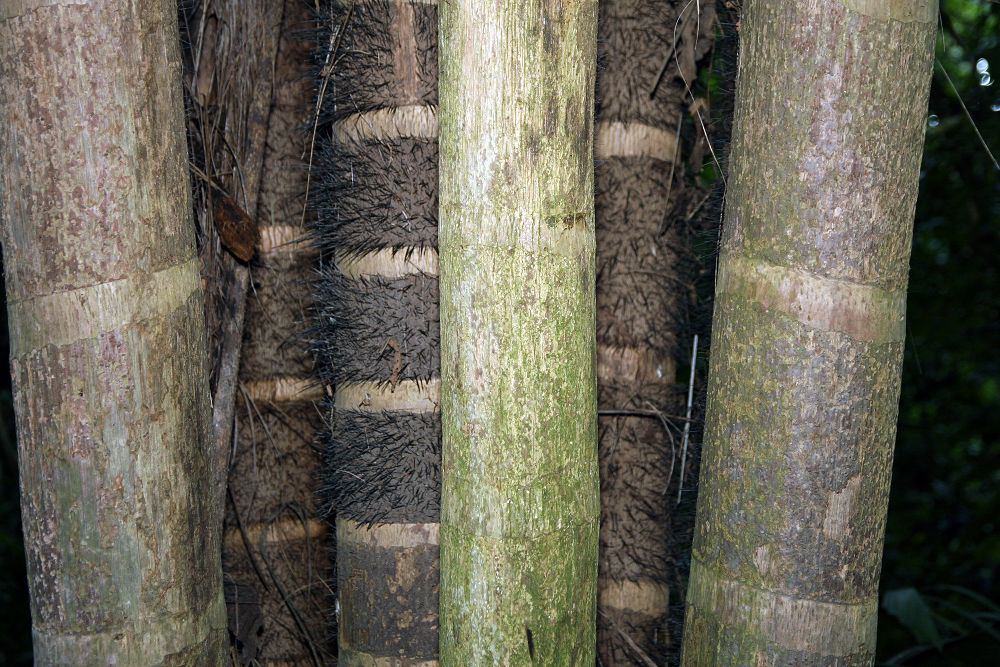
Bactris gasipaes offered a solution. Because the palm produces multiple stems from a single root system, harvesters can cut individual trunks without killing the plant. Each clump can support 10-15 stems, and when one is removed, the plant responds by producing 3-5 new suckers. For palmito production, workers select young shoots that have reached about 1.2-1.5 meters in height and 3-5 cm in diameter, cutting them before they mature. This fast-growing palm reaches harvestable size just 18-24 months after planting, and the same clump can produce hearts continuously for 50 years or more. (Fruit production, by contrast, requires mature stems and begins 3-5 years after planting.)
Costa Rica has become one of the world's largest producers of cultivated palmito, with peach palm plantations replacing the destructive harvest of wild palms. The industry provides income for thousands of rural families while protecting the single-stemmed palms that once bore the brunt of demand.
Uses
Every part of the peach palm finds use. The fruit, once boiled to neutralize its alkaloid content, becomes a staple food with the texture of a chestnut and a mild, slightly sweet flavor. It can be eaten whole, mashed into a paste, ground into flour for baking, or fermented into chicha, a traditional beverage throughout its range. The flesh is highly nutritious, rich in carbohydrates, protein, beta-carotene, and all essential amino acids.
The seeds yield an edible oil (oil of macanilla) with a high proportion of unsaturated fatty acids and no cholesterol, suitable for cooking and with potential for cosmetic applications. The wood is exceptionally hard and strong, traditionally used for bows, arrows, fishing poles, and construction. Even the male flowers can be cooked as a condiment, and their ash serves as a salt substitute in some indigenous communities.
Cultivation
The peach palm thrives in lowland tropical climates with heavy rainfall and can tolerate the poor, acidic soils that limit many other crops. It requires annual rainfall of at least 1,500 mm, temperatures that never drop below 10°C, and grows best below 800 meters elevation. In Costa Rica, peach palm is often grown in agroforestry systems alongside coffee and banana, providing multiple products from the same land.
Plants begin flowering at 3-5 years of age and can produce two fruit crops annually for 50-75 years. Yields vary widely depending on variety and management, from 2-3 tonnes per hectare in traditional systems to 10-30 tonnes in intensive cultivation. The development of spineless varieties has made commercial harvest safer and more efficient, though these cultivars lack the dramatic spiny appearance of traditional pejibayes.
Cultural Significance
In Costa Rica, pejibaye holds a special place in the national cuisine. The boiled fruits appear at farmers' markets throughout the harvest season, sold by the dozen to be eaten plain or with mayonnaise. They are as much a part of Costa Rican food culture as gallo pinto or casado. The palm connects modern Costa Ricans to an agricultural tradition stretching back more than four thousand years, a living link to the indigenous peoples who first selected and cultivated this remarkable tree.
Throughout its range, the peach palm appears under different names and in different culinary traditions. In Colombia it is chontaduro, sold on street corners with honey and salt. In Brazil it is pupunha, increasingly valued as the source of sustainable palm heart. In Ecuador and Peru it is pijuayo or pifuayo. Each culture has developed its own relationship with this palm, but all share in the inheritance of those first Amazonian farmers who recognized its potential.
Key Sources & Resources
Species Information
Overview of taxonomy, description, cultivation, and uses.
Comprehensive information on cultivation, uses, and propagation.
Domestication & History
Genetic research on the origin and dispersal of the cultivated peach palm.
Recent review of the species' history, uses, and potential applications.
Sustainable Palm Heart
Research on the environmental and nutritional benefits of peach palm cultivation.