Olla de Mono
Lecythis ampla — The monkey pot tree, named for its remarkable fruit that resembles a clay cooking pot and inspired folklore about trapping greedy monkeys.
High in the canopy of Costa Rica's Caribbean lowland forests, a tree produces one of the most distinctive fruits in the Neotropics. The olla de mono, or monkey pot, drops woody capsules the size of coconuts to the forest floor. Each fruit resembles a round cooking pot with a detachable lid. When ripe, the lid falls away, releasing edible seeds that scatter across the leaf litter. This curious fruit gave the tree its name and inspired centuries of folklore about monkeys, greed, and the perils of not letting go.
The olla de mono belongs to the Lecythidaceae, the Brazil nut family, one of the most ecologically important tree families in tropical America. Its relatives include the famous Brazil nut (Bertholletia excelsa) and the cannonball tree (Couroupita guianensis). These trees share a common trait: large, woody fruits that protect their seeds within thick shells. In the olla de mono, this architecture has been refined into something that looks almost manufactured, as if a potter had shaped it on a wheel.

The Monkey Pot Legend
The name "olla de mono" translates to "monkey's pot," and the story behind it has been told across Central and South America for centuries. According to folklore, hunters would bait an empty fruit capsule with sugar or other treats and fix it to a low branch. A monkey could easily insert its paw through the opening to grab the prize, but once its fist closed around the food, it could not withdraw through the narrow hole.
The heavy woody fruit would prevent the animal's escape. Young monkeys, the story goes, would refuse to release their prize and be captured, while wise old monkeys learned to let go. An 1849 account in Hooker's Journal of Botany describes how enslaved people in French Guiana used this technique, filling emptied capsules with sugar to trap monkeys whose "greediness forbids the opening of the paw and loss of the sugar." Whether this method was ever widely practiced remains uncertain, but the parable of the monkey who could not let go has endured as a lesson about attachment and freedom.
Identification
The Lecythidaceae is among the most spectacular plant families in the Neotropics, comprising about 200 species across 10 genera in tropical America alone. The family name derives from the Greek lekythos, meaning oil flask, referring to the pot-shaped fruits. Lecythis ampla represents one of 26 species in its genus, all characterized by their distinctive dehiscent fruits that open via a lid.
Taxonomic History
The genus Lecythis first entered Western science through the work of Jean-Baptiste Christophore Fusée Aublet (1720-1778), a French botanist who served as Apothecary Botanist in French Guiana. During his two-year tenure there, Aublet gathered material for his 1775 masterwork Histoire des Plantes de la Guyane Françoise, which included the first scientific descriptions of several monkey pot species. Nearly a century later, British botanist John Miers described Lecythis ampla in his 1874 monograph "On the Lecythidaceae," published in the Transactions of the Linnean Society of London. Miers worked from a single fruit specimen collected by Jervis in Antioquia, Colombia, with no leaves, flowers, or field notes attached. The specific epithet ampla, meaning "large" or "ample," reflects what impressed him most: this species produces the largest fruits of any Lecythidaceae throughout its range.
The species has accumulated several synonyms over the years, reflecting independent discoveries across its range. Henri Pittier, the Swiss botanist who worked extensively in Costa Rica and Panama, described what he believed were new species: Lecythis costaricensis from Costa Rica and L. armilensis from Panama. These were later recognized as the same widespread species. Molecular studies now place L. ampla within section Pisonis, the sapucaia group, which some researchers suggest may warrant recognition as a separate genus based on both morphological and genetic evidence.
Physical Characteristics
A useful field character distinguishes this species from other large rainforest trees: when bruised or cut, the leaves, flowers, and immature fruits turn a distinctive bluish-green color. Combined with the deeply fissured bark, wavy leaf margins, and massive pot-shaped fruits, this makes the olla de mono identifiable even without flowers.
Trunk: Large and cylindrical, reaching 100-160 cm in diameter. The trunk rises straight and branchless for the lower two-thirds of the tree's height, a common adaptation in emergent rainforest trees competing for light. The base features short, thick buttresses rather than the dramatic flanges seen in some other species. Bark is brown with deep vertical fissures.
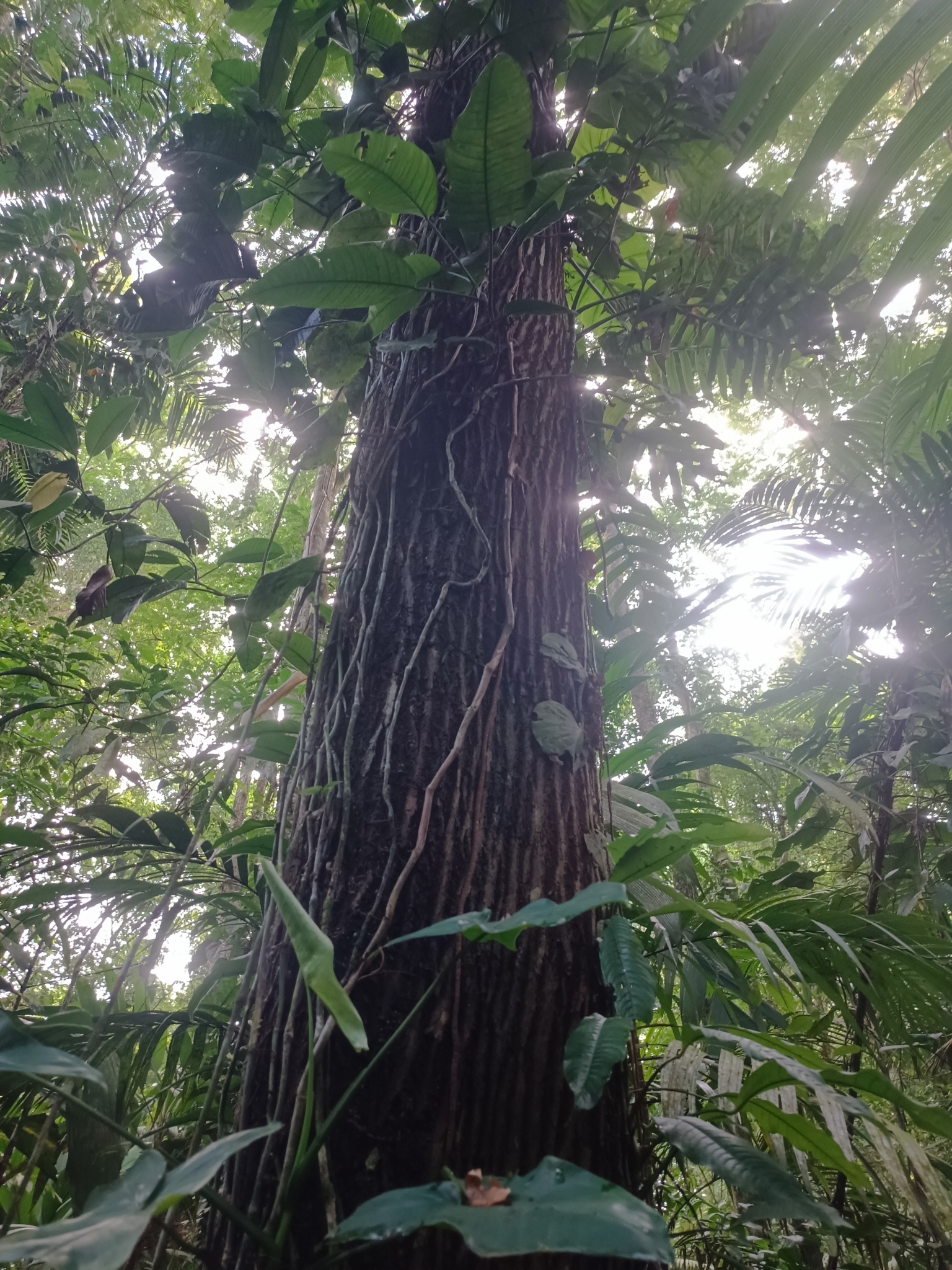
Leaves: Simple, alternate, and clustered near branch tips. Leaf blades are narrowly to widely elliptical, 6-17 cm long, with distinctively wavy or crenate margins. The tree is briefly deciduous, dropping most leaves before flowering, with new foliage emerging in flushes alongside the blooms.

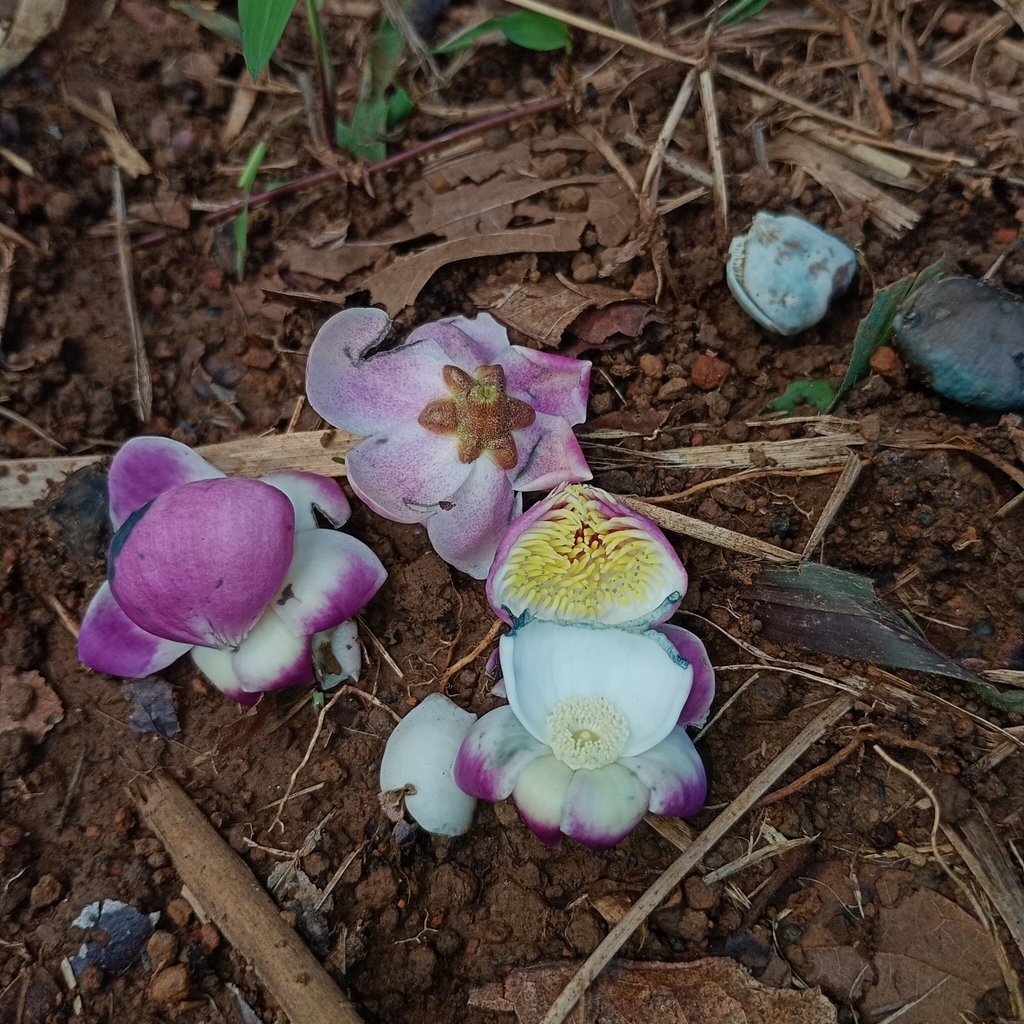
Flowers: Produced during the rainy season, typically May through July in Costa Rica. Flowers measure about 3 cm in diameter, with pale pink or purple petals that fade to white as they wilt. Like other Lecythidaceae, the flowers feature an elaborate hood-like structure (the androecial hood) that curls inward over the stamens. This hood contains sterile "fodder pollen" that bees collect as a reward, while the fertile pollen sits in the staminal ring below. When large carpenter bees (Xylocopa) and bumblebees (Bombus) force their way into the hood to gather the sterile pollen, their backs brush against the fertile anthers, picking up the pollen that will fertilize the next flower they visit. This division of labor between feeding reward and reproductive function represents one of the most sophisticated pollination mechanisms in the plant kingdom.
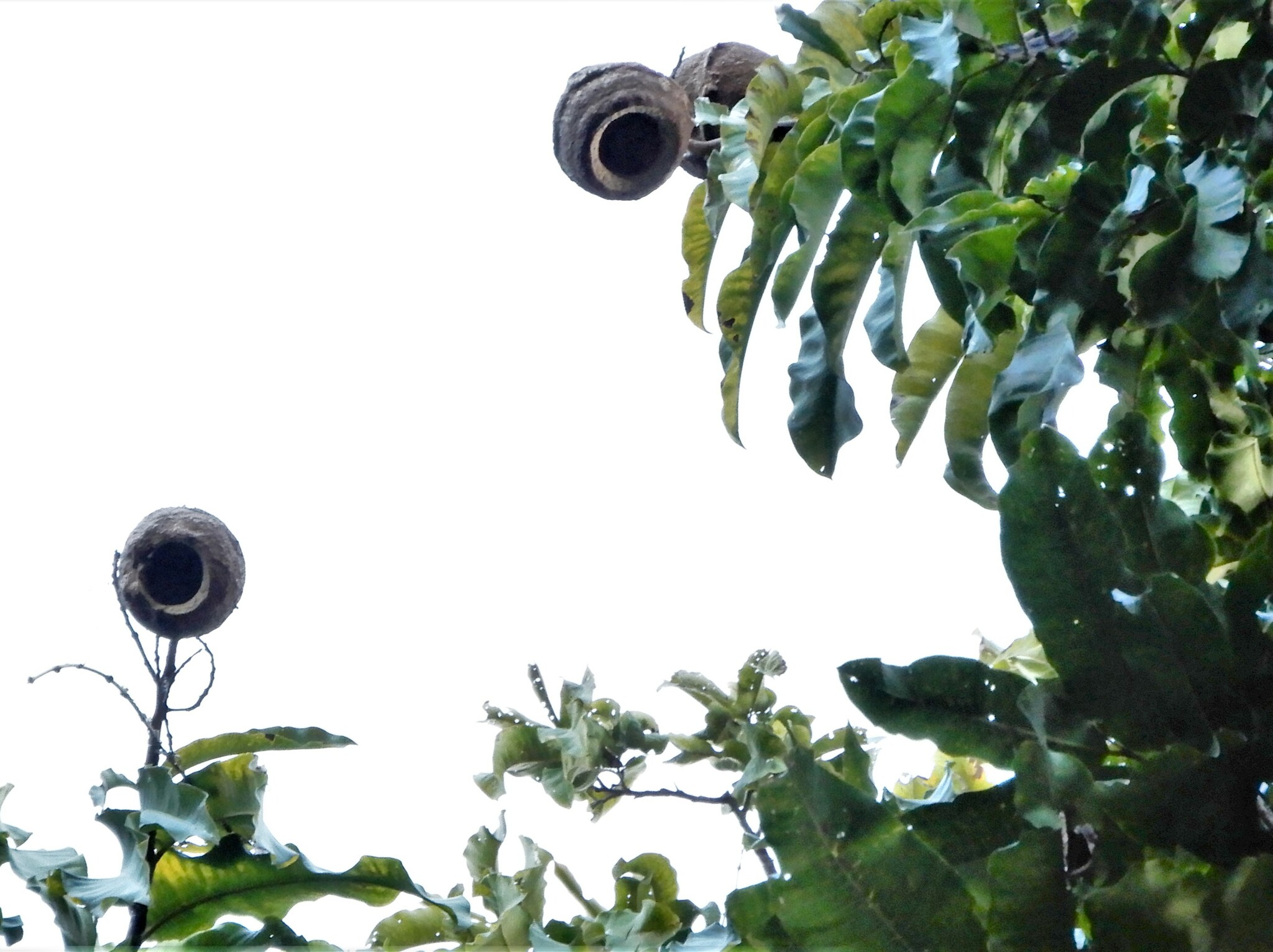
Fruit: The signature feature. Globose woody capsules measuring 10-25 cm in diameter with walls 1.5-3 cm thick. The fruit takes approximately 10 months to mature after flowering, with seeds dispersing from March to June. When ripe, a circular lid (operculum) detaches from the top, creating the pot-like opening. Inside, numerous seeds are arranged in compartments, each seed rich in oils and protein.
Habitat & Distribution
Lecythis ampla ranges from Nicaragua through Costa Rica and Panama into Colombia and extreme northwestern Ecuador. In Costa Rica, it occurs primarily on the Caribbean slope, from the foothills of the Central Volcanic Range down through the San Carlos plains to the Tortuguero lowlands. It is notably absent from the Pacific slope.
Ecosystem: Very humid tropical forest, typically receiving more than 3,500 mm of annual rainfall. The species prefers well-drained alluvial, sandy, or clayey soils and avoids seasonally flooded areas.
Elevation: Sea level to 500 meters, occasionally reaching 800 meters on favorable slopes.
Abundance: Low density in forest stands. The species grows as an emergent, towering above the main canopy, but individual trees are widely spaced. It frequently associates with other Caribbean lowland giants including Pentaclethra macroloba (gavilán), Dipteryx panamensis (almendro), and Carapa guianensis (caobilla).
Ecological Importance
Despite low population densities, the olla de mono plays an important role in forest food webs. The protein-rich seeds attract a suite of mammalian consumers. Pacas, agoutis, and deer crack open the thick-walled fruits to reach the nutritious seeds inside. Some seeds escape predation through scatter-hoarding: rodents bury them for later retrieval but forget their caches, enabling germination at new sites away from the parent tree.
The fleshy fruit pulp attracts different consumers at different stages. Parrots and parakeets feed on developing fruits in the canopy, while peccaries consume fallen fruit pulp on the forest floor. But the primary seed dispersers may be fruit-eating bats, which consume the fleshy arils surrounding each seed and carry the seeds away from the parent tree before dropping them. This bat-mediated dispersal helps explain why olla de mono trees appear widely scattered through the forest rather than clustered beneath parent trees.
Seedlings are notably shade-tolerant, germinating and persisting beneath the closed canopy while waiting for a gap in the forest to open above them. This patience pays off: once light becomes available, the olla de mono grows rapidly toward the canopy. Natural regeneration rates are high despite the tree's low adult density.
Uses & Conservation
The olla de mono produces exceptionally durable timber. The heartwood is reddish-brown, fine-grained, dense, and extremely hard. Most importantly, it resists attack by marine boring invertebrates, making it historically prized for shipbuilding, dock pilings, and marine construction. It has also been used for bridges, railroad ties, heavy flooring, and agricultural tool handles.
The bark contains high tannin levels and has been used in leather tanning. Bark fiber serves as cigar rolling paper in some regions, and indigenous peoples have used it for cordage and clothing. The seeds are edible and have been used to make sweets and caramels in northern Costa Rica. In Panama, seeds have been used in folk medicine to treat pneumonia and diarrhea. The seed oil has been extracted for soap-making in Brazil and burned as a light source.
The IUCN listed Lecythis ampla as endangered in Costa Rica in 1988. The species' naturally low density, combined with selective logging pressure and habitat loss, has reduced populations throughout its range. However, the tree's shade-tolerant seedlings and high germination rates offer hope for recovery where mature forest remains protected.
The olla de mono survives today primarily in protected areas of Costa Rica's Caribbean lowlands, including Tortuguero National Park and Braulio Carrillo National Park. In these reserves, the monkey pot trees continue to drop their distinctive fruits, perpetuating a cycle that has shaped these forests for millennia.
A New Life in Aquariums
The empty fruit capsules have found an unexpected second life far from the rainforest. In the aquarium hobby, monkey pot pods have become popular additions to "blackwater" tanks that replicate the tannin-stained streams of tropical forests. When submerged, the thick woody shells slowly release tannins that soften water, lower pH, and create the tea-colored conditions favored by many South American fish species. The pods also develop biofilms that shrimp and suckermouth catfish graze on, while their hollow interiors provide hiding places for territorial fish. A single pod can last five to ten years in an aquarium. Indigenous peoples used these same capsules as water vessels and plant containers for centuries; now they serve a similar function in glass boxes around the world, connecting aquarists to the forests where monkey pots still fall.
Key Sources & Resources
Species Information
Species page with observations, photographs, and distribution maps.
Comprehensive botanical information including uses, timber characteristics, and cultivation.
Authoritative taxonomic information from the world's leading Lecythidaceae research program.
The Brazil Nut Family
Comprehensive resource on the Lecythidaceae family including identification guides and ecology.
Overview of monkey pot trees in the genus Lecythis.
Selenium & Toxicology
Medical case study documenting hair loss and other symptoms from selenium toxicity in Lecythis seeds.
Analysis of selenium-containing proteins in monkey pot seeds and their exceptionally high selenium content.
Historical Sources
Historical account including the 1849 Hooker's Journal of Botany description of the monkey trap and Aublet's 1775 botanical work.
Costa Rica Distribution
Local information from Costa Rica including distribution and phenology.