Quizarrá Caca
Ocotea sinuata — A Pacific-slope laurel whose velvety leaves and large pink flowers light up seasonally dry forests from Chiapas to Costa Rica's Valle del General.
The species entered science in 1889 as Nectandra sinuata, but modern Lauraceae specialists now place it in Ocotea. Burger and van der Werff describe it as a mid-elevation tree of seasonally dry forests on Costa Rica’s Pacific slope, particularly the Santa María de Dota–Valle del General region where coastal trade winds create brief dry seasons.
Records extend north through Guatemala, El Salvador, Honduras, and southern Mexico, yet Costa Rica still hosts the densest documented stands. GBIF lists more than 550 collections overall, with clusters around Pérez Zeledón, San José, Cartago, and Puntarenas, plus historical trees near Turrialba that may date from planted windbreaks.
Identification
Leaves
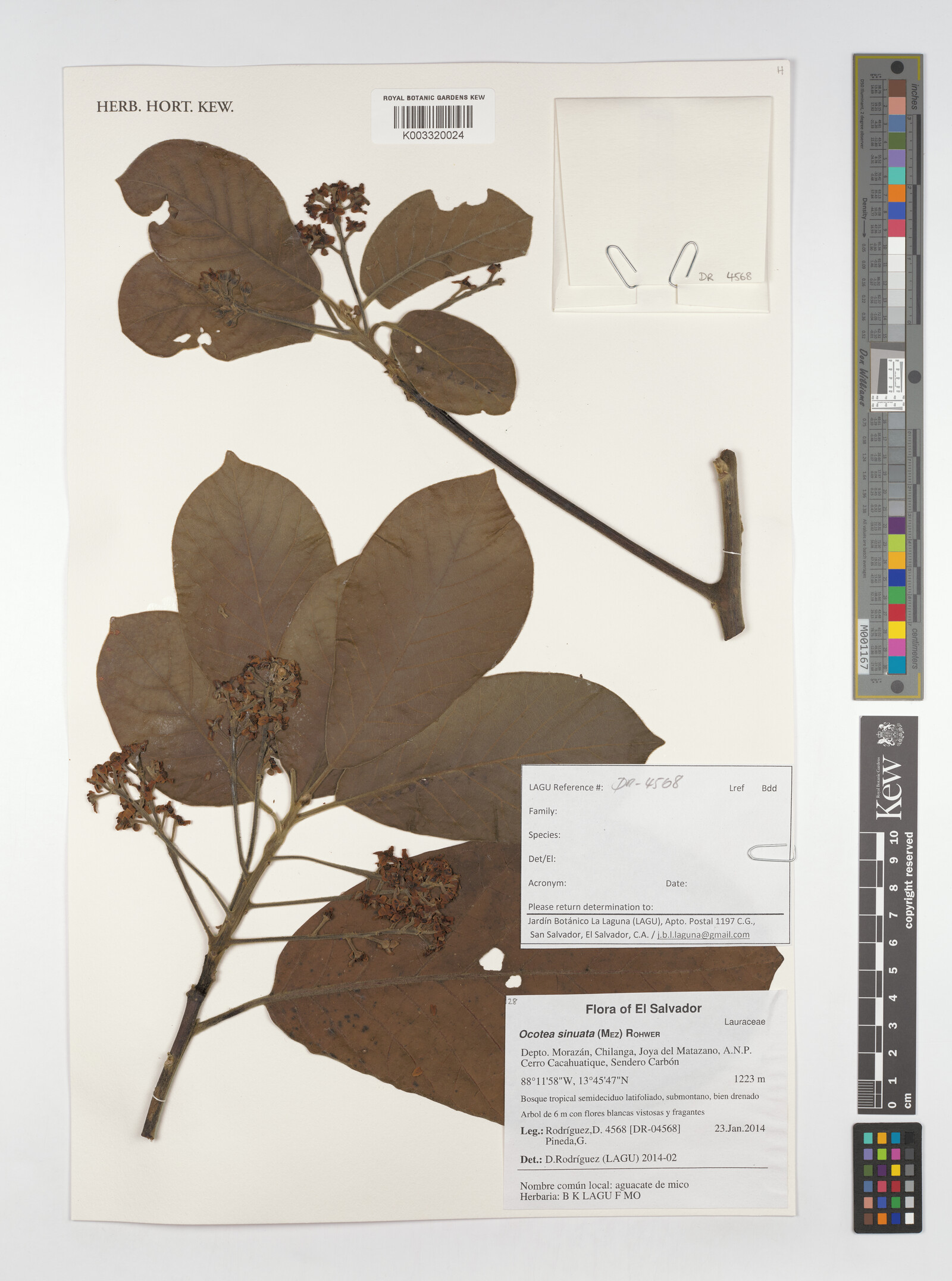
Leaves are instantly recognizable by their velvety indument (covering of fine hairs). Blades measure 10–22(–30) × 3.5–12 cm, oblong-elliptic, with rounded tips and bases. The upper surface is dark green and smooth, while the underside is densely clothed in tawny hairs 0.3–1 mm long. Petioles are 8–32 mm and equally pubescent (hairy).
Flowers
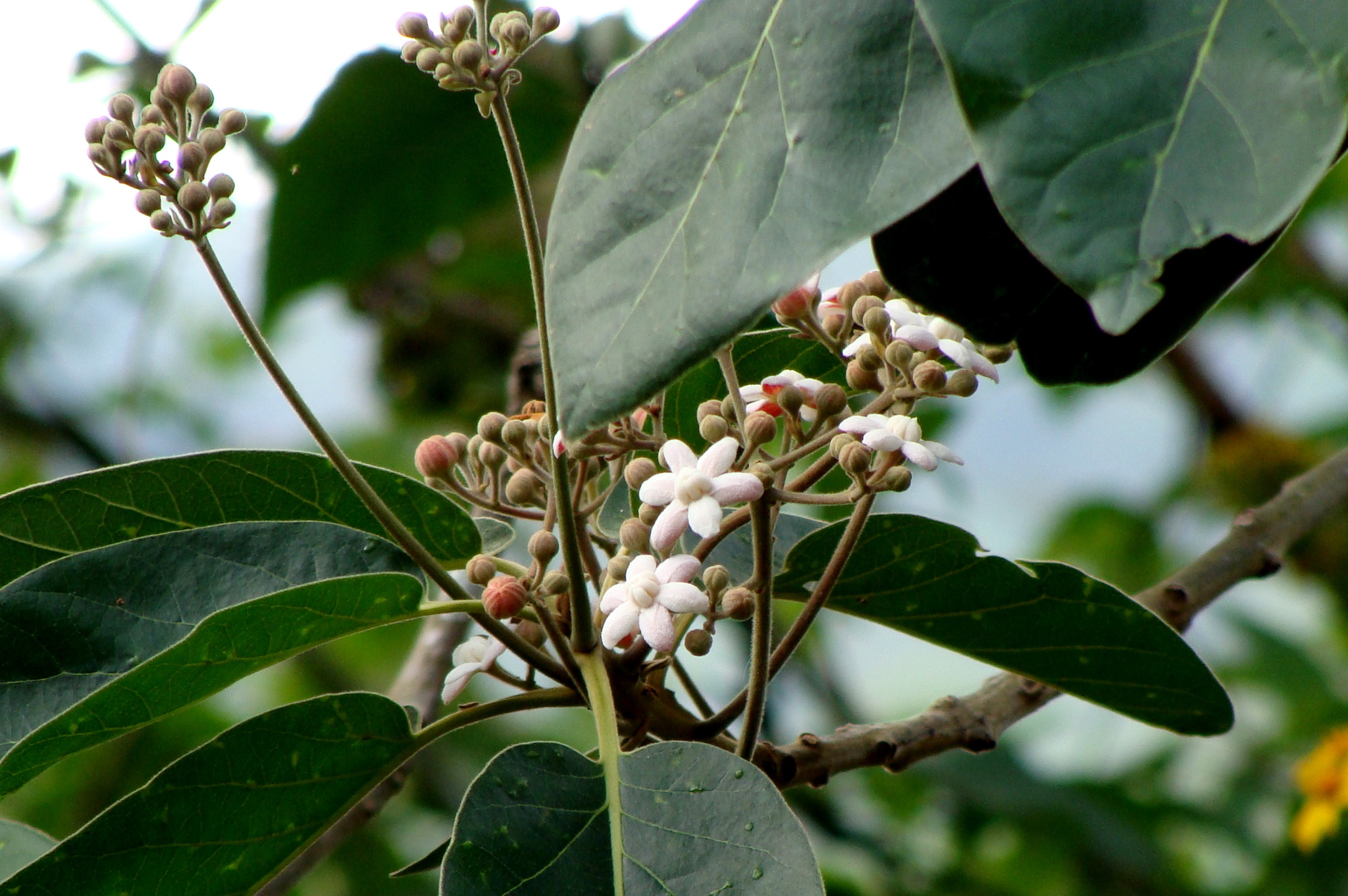
Inflorescences are large panicles up to 30 cm long with peduncles (main stalks) reaching 16 cm, all cloaked in golden-brown fuzz. Flowers are unusually large for the genus, 10–20 mm across, and often open pink or white before drying reddish-brown. The outer anthers have a connective (tissue connecting the anther halves) expanded into a petal-like flap, a distinctive trait that helped taxonomists recognize the species.
Fruits
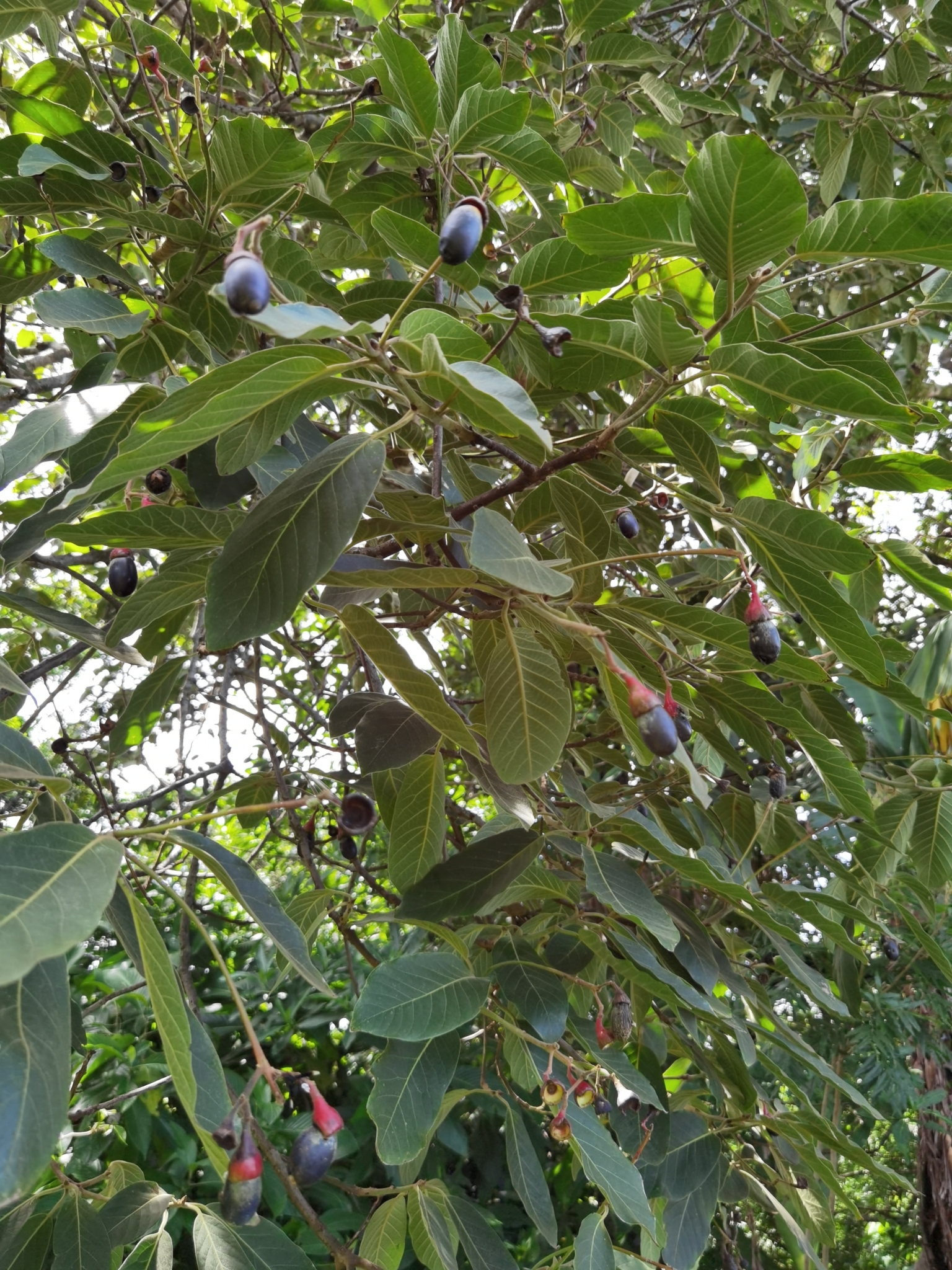
Fruits mature into 2–2.5 cm ellipsoid drupes perched on large cupules (cup-like receptacles) about 20 mm across. The lower half of the cupule remains clothed in silky hairs even at maturity, making this one of the most recognizable Ocotea fruits in Central America.
Distribution and Habitat
The tree favors evergreen and partially deciduous forest formations between 300 and 1,500 meters, though collections span from near sea level to over 2,400 meters. In Costa Rica it is most common in the Valle del General, Santa María de Dota, and the lower Pacific slopes of the Central Valley provinces, with occasional plantings on the Caribbean side near Turrialba. Northward it follows the Pacific cordillera through Guatemala, El Salvador, Honduras, and Chiapas, where it reaches its highest densities.
Herbarium vouchers at UCR, INB, and MO often bear the label "quizarrá caca," noting that flowering peaks just before the first rains. Those annotations help survey crews distinguish the velvety leaves from sympatric Nectandra and track which populations along the Valle del General and Fila Costeña still produce seed. Flowering peaks during the dry season (January through April), providing nectar for bees and butterflies when few other laurels bloom. Fruits ripen as rains return, feeding motmots, toucans, and peccaries that disperse the large seeds into regenerating gaps.
A Chemical Arsenal
Few Costa Rican laurels have had their volatile chemistry studied as thoroughly as O. sinuata. Researchers at the Universidad de Costa Rica identified 88 distinct compounds from leaves, bark, and twigs collected near Monteverde. The leaf oil proved especially rich in sesquiterpenes: germacrene D dominated at 30.6%, followed closely by β-caryophyllene at 30.1%, with viridiflorol contributing another 8.9%. Bark samples showed a more balanced profile, with α-pinene (10.1%) and camphene (10.3%) rivaling the sesquiterpenes, while twig oils favored caryophyllene oxide.
These volatiles are more than taxonomy footnotes. β-caryophyllene functions as a chemical signal both above and below ground. Studies on maize show that damaged roots release this sesquiterpene to attract nematodes that attack root-feeding beetle larvae, while leaf-damaged plants use the same compound to summon parasitic wasps. Germacrene D adds its own defenses: laboratory tests confirm repellent activity against aphids and ticks, plus insecticidal effects on mosquitoes. For O. sinuata, the pungent cocktail likely deters leaf-chewing beetles and moth caterpillars while potentially recruiting predatory insects to patrol the canopy.
The common name "quizarrá caca" almost certainly derives from this volatile load. Crushing a leaf releases the sharp, resinous scent that herbarium collectors have noted for decades. Whether the name arose from the smell's intensity or its unflattering qualities, it serves as a useful field character: no other mid-elevation Pacific laurel produces quite the same aromatic punch when foliage is bruised.
Shade Coffee and the Pollinator Connection
The Valle del General, where O. sinuata reaches its Costa Rican stronghold, is also the heart of the country's southern coffee belt. Here the species persists not only in forest fragments but along windbreaks and inside traditional shade-grown plantations where farmers retain native trees for canopy cover. This coexistence is more than accidental: research from organic farms in southern Costa Rica shows that pollinator diversity climbs sharply in plots with greater canopy cover and flowering shade trees.
Native bees dominate these pollinator communities, and their abundance rises where flowering trees break up the coffee monoculture. When O. sinuata blooms from January through April, its large pink-white flowers provide nectar during the dry season lean period when few other laurels offer anything. The timing aligns with coffee flowering in the region, suggesting that wild bees shuttling between "quizarrá" and coffee may boost fruit set on both crops. Farmers have long known what ecologists are only now quantifying: keeping laurels in the shade canopy pays dividends beyond erosion control.
Conservation Outlook
The species' wide Central American range and tolerance of secondary forests keep it in the IUCN's Least Concern category, but local pressures remain. Coffee expansion and road building fragment the mid-elevation Pacific slope, reducing the continuous canopy on which this species depends. Conservation efforts focus on protecting riparian buffers along the Río Savegre and Río Térraba and encouraging landowners to keep standing "quizarrá" trees inside shade-grown coffee blocks.
Wildlife Connections
Seasonally dry forests that harbor O. sinuata still depend on toucans, magpie-jays, squirrels, and howler monkeys to move seeds. Keel-billed Toucans and White-throated Magpie-Jays gulp the silky fruits in the canopy, variegated squirrels cache windfall drupes in the leaf litter, and mantled howler monkeys carry seeds along riparian strips each dawn.
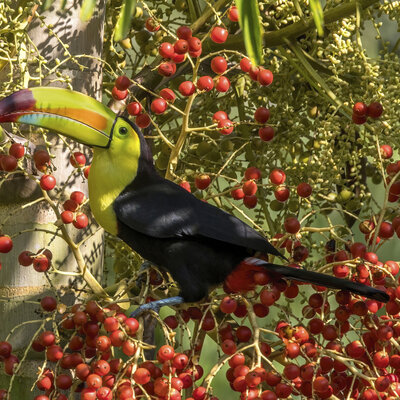
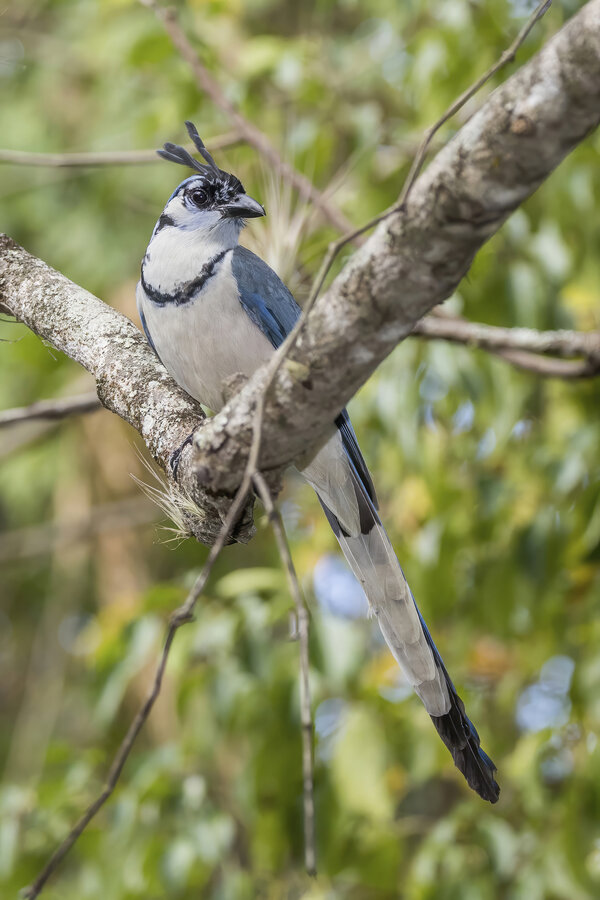
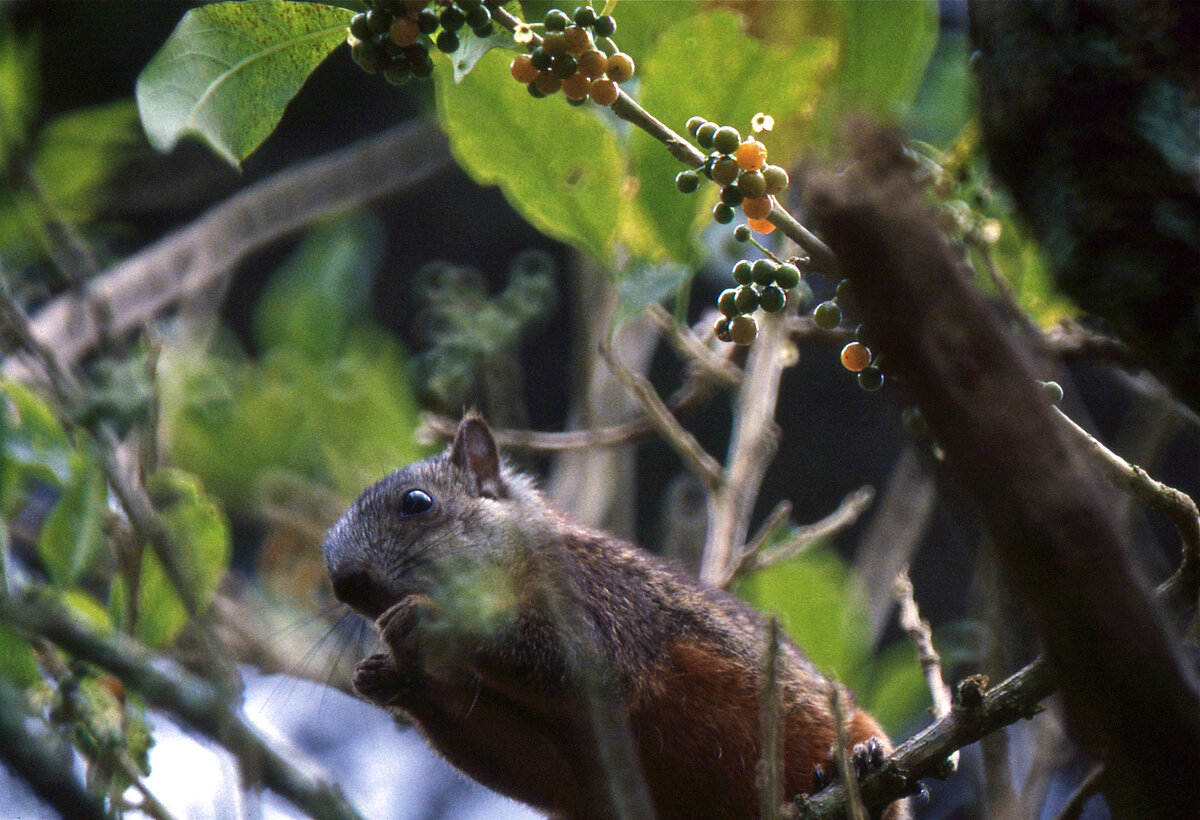
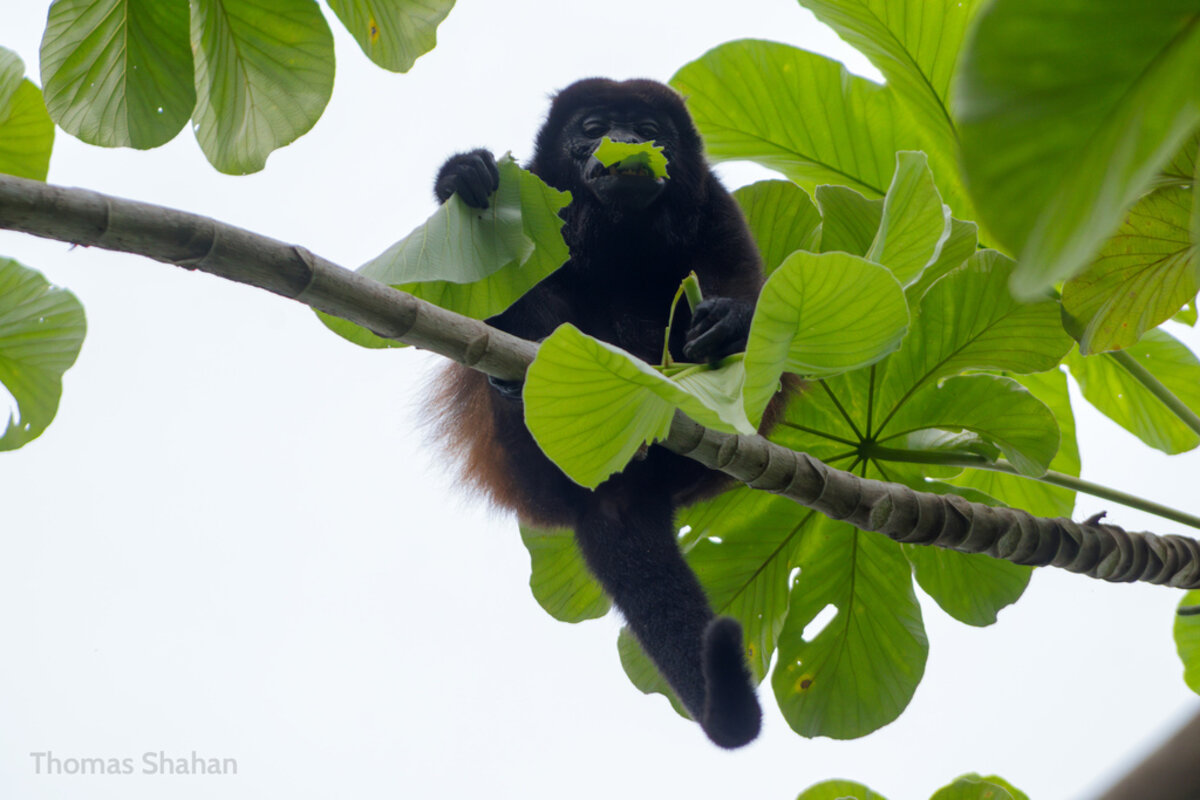
Photos (clockwise from top left): Keel-billed Toucan (Wikimedia Commons, CC BY-SA); White-throated Magpie-Jay (Wikimedia Commons, CC BY-SA); Variegated Squirrel (Bernard DUPONT via Flickr, CC BY-SA 2.0); Mantled Howler Monkey (Thomas Shahan via iNaturalist, CC BY-NC 4.0).
Taxonomic History
Carl Mez described this species in 1889 as Nectandra sinuata, placing it in a genus characterized by anthers with four pollen sacs arranged in an arc. His type specimen came from Guatemala. Nearly a century later, Jens G. Rohwer revised New World Lauraceae and transferred the species to Ocotea, a move reflecting updated understanding of anther structure and tepals (petal-like perianth segments) in these genera.
The epithet "sinuata" refers to the sinuate (wavy-edged) leaf margins. Burger and van der Werff's 1990 treatment in Fieldiana established the Costa Rican distribution and common name "quizarrá caca," likely a reference to the strong scent of crushed foliage or bark. Despite its distinctive velvety leaves and large flowers, the species has attracted little focused research beyond floristic surveys.
Resources & Further Reading
Species Information
Latest taxonomic placement and distribution summary across Mesoamerica.
565 georeferenced collections show clusters in Chiapas, Guatemala, El Salvador, and Costa Rica.
Lists the species as Least Concern and highlights its broad Pacific-slope range.
Floristic & Taxonomic References
Provides detailed morphology, phenology, and Costa Rican locality data for O. sinuata.
Essential Oil Chemistry
Identified 88 compounds from leaves, bark, and twigs; leaves dominated by germacrene D (30.6%) and β-caryophyllene (30.1%).
Comparative study showing O. sinuata rich in sesquiterpenes; principal compounds include α-pinene, β-pinene, β-caryophyllene, and germacrene-D.
Demonstrates how β-caryophyllene attracts natural enemies of herbivores, explaining the ecological function of this compound in O. sinuata leaves.
Coffee Agroforestry & Pollinators
Shows that pollinator diversity increases with shade canopy cover and flowering trees on organic coffee farms in the Valle del General region.
Overview of ecosystem services from shade coffee systems, including pollination, pest control, and habitat for wildlife.