Quizarrá de Domacios
Ocotea pullifolia — A shining-leaved laurel from the Caribbean foothills and Osa Peninsula whose perforated leaf domatia and flared cupules shelter pollinators, birds, and monkeys alike.
Botanists long referred to this tree as “Ocotea jorge-escobarii” in herbaria until Henk van der Werff formally described it in 2001 under the name Ocotea pullifolia. The epithet honors the leaf domatia that look like tiny pulls or perforations near the base of the secondary veins. In Costa Rica the species anchors super-humid foothill forest between 200 and 700 meters: on the Caribbean slope around Turrialba and the Central Cordillera, and on the southern Pacific slope in the Osa Peninsula and the ridges above Golfito. Panama shares the species, and the IUCN assessment counts more than 50 collections spread across an extent of occurrence above 30,000 km².
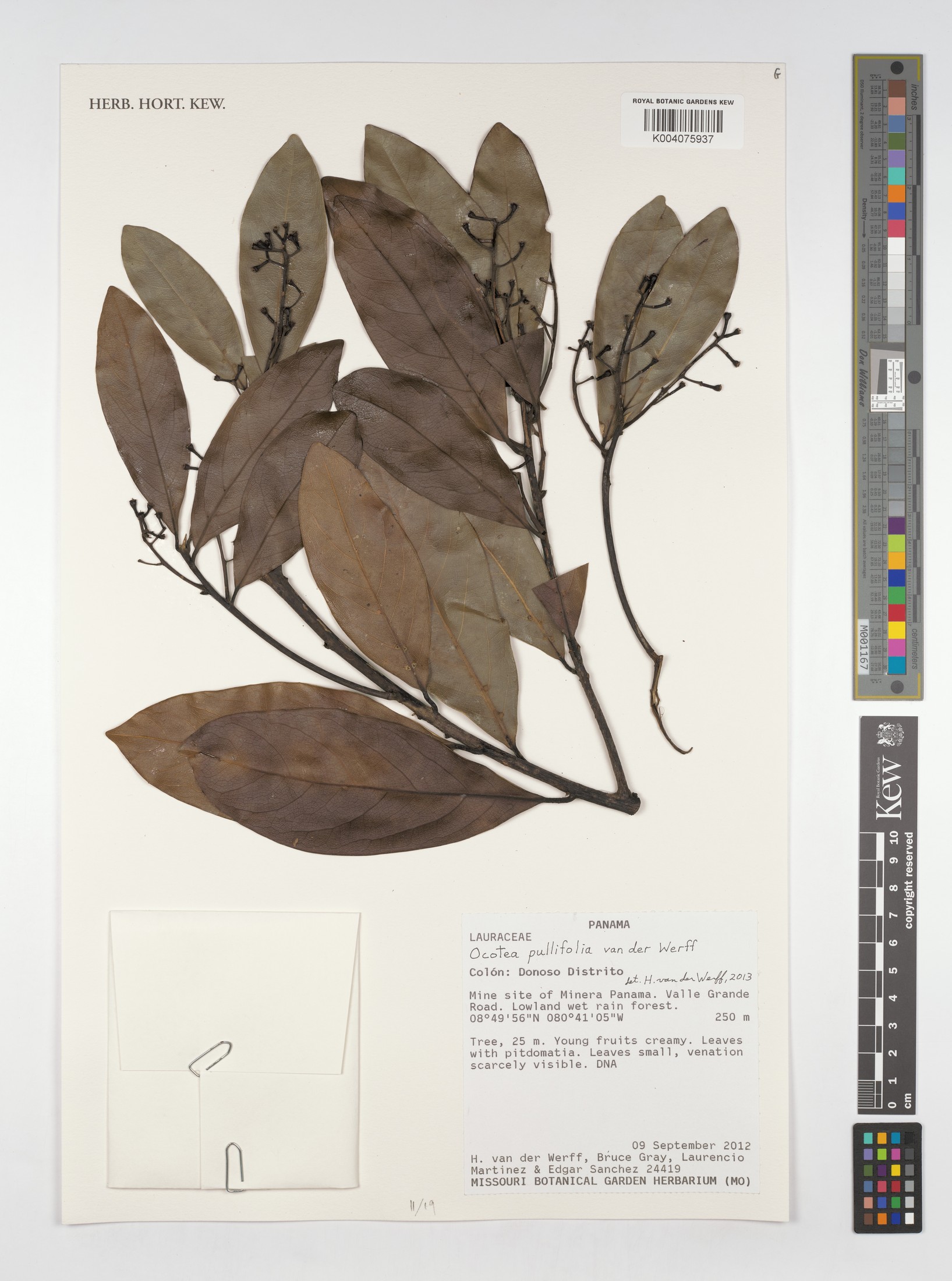
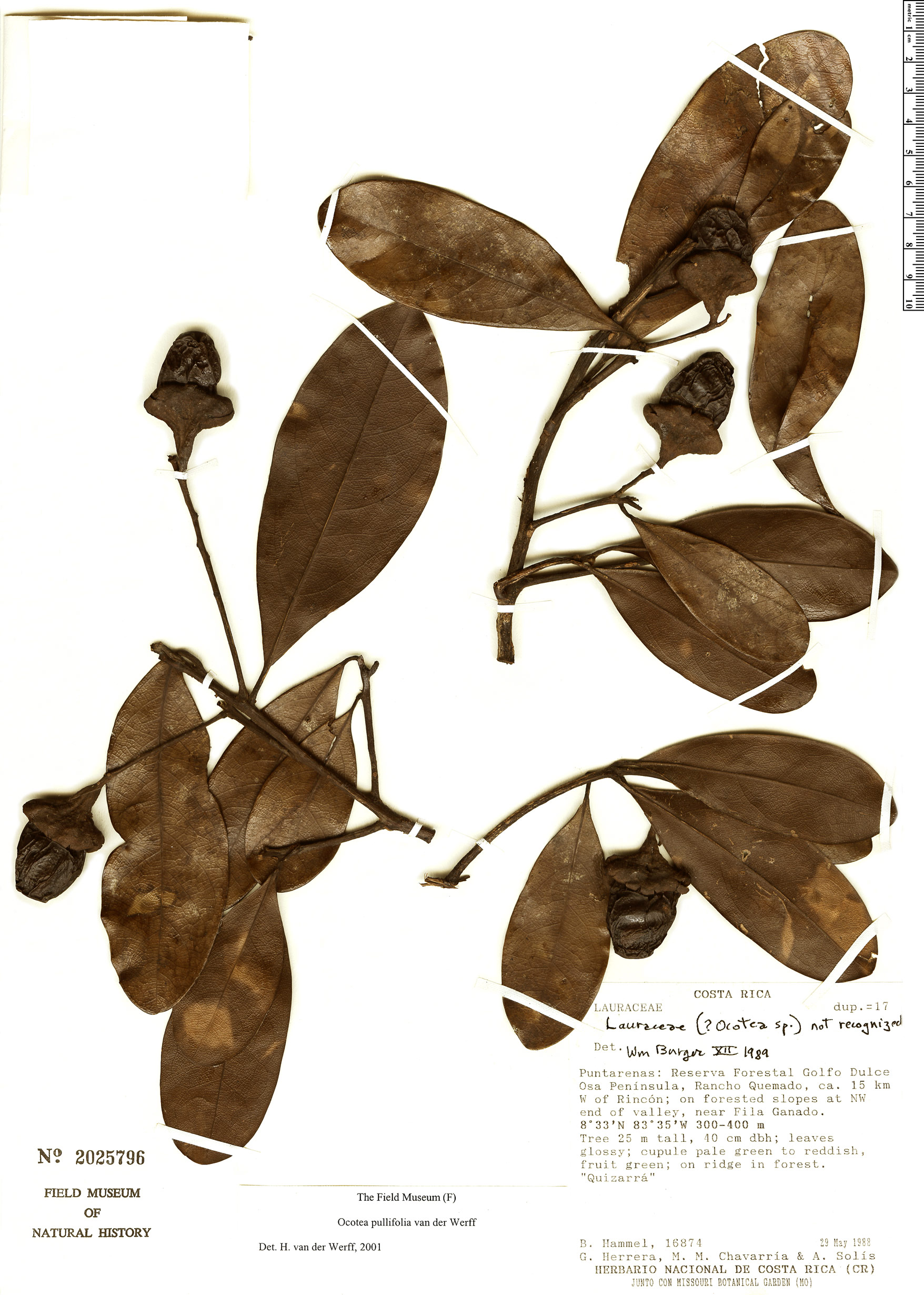
Foothill Range
The Manual de Plantas places O. pullifolia in super-humid forest between 200 and 700 meters on both slopes, but collections cluster in two areas: 1) the Caribbean foothills around Turrialba and the Reventazón watershed, and 2) the southern Pacific foothills from Golfito toward Cabo Matapalo. Panama adds a handful of records in Bocas del Toro. This split distribution mirrors the migration routes of Costa Rica’s lowland frugivores, which follow Lauraceae crops up and down the mountains each season.
Identification
Leaves are 5–14 × 2–6.5 cm, oblong-elliptic to oblong-obovate, and notably obtuse or rounded at the tip. The blade surfaces are glossy and nearly glabrous, though the underside may carry sparse adpressed hairs along the midrib, and the domatia appear as tiny perforations in the axils of the inner secondary veins. Petioles measure 0.6–1.1 cm. Secondary veins number 4–7 per side, with elevated tertiary veins forming a conspicuous net on the upper surface. Inflorescences are 3–6 cm paniculiform cymes that are almost glabrous, unlike many other lowland Ocoteas. Flowers are bisexual, 4–5 mm across, with patent 1.8 mm tepals that lack outer hairs. Fruits reach about 3.5 cm, resting atop conical cupules 1–2 cm tall that flare near the top to a full 3 cm diameter, giving the tree dramatic “candlestick” drupes.
Seasonal Rhythms
Flowering is recorded mainly in August (with occasional late-season specimens), and fruits mature soon after, just in time for the onset of the Caribbean and southern Pacific rains. That timing lines up with the movements of toucans, aracaris, and primates that follow Lauraceae crops down from the cloud forests.
Wildlife Connections
In the Turrialba foothills, Keel-billed Toucans (Ramphastos sulfuratus), Collared Aracaris (Pteroglossus torquatus), and Turquoise Cotingas (Cotinga ridgwayi) strip O. pullifolia trees when other fruits are scarce. Farther south, Yellow-throated Toucans (R. ambiguus), Fiery-billed Aracaris (P. frantzii), Scarlet Macaws (Ara macao), and troops of white-faced capuchins (Cebus imitator) do the same around Golfito and Matapalo. Spider monkeys (Ateles geoffroyi) and howler monkeys (Alouatta palliata) swallow the small drupes whole, digesting the oily pulp and dropping the seeds beneath roosts, while toucans ferry the seeds to canopy perches along the mangrove-fringed lowlands.
Conservation
The 2019 IUCN assessment lists O. pullifolia as Least Concern thanks to its wide extent of occurrence (≥30,000 km²) and dozens of records. Nevertheless, foothill forests around Turrialba and Golfito face ongoing pressure from cattle pasture, smallholder agriculture, and road expansion, so protecting secondary Lauraceae groves remains important for lowland wildlife corridors.
Resources & Further Reading
Floristic References
Primary field description, range, and morphological details for O. pullifolia.
Taxonomic placement, synonymy, and distribution summary.
Original publication describing the species as a new Costa Rican endemic.
Data Sources
Extent of occurrence, record counts, and justification for the Least Concern status.
Synthesizes how toucans, cotingas, and primates move Lauraceae seeds in Costa Rican lowlands.
Profiles frugivorous birds and mammals whose diets include foothill Lauraceae.