Aguacatillo Oblongo
Ocotea oblonga — A gynodioecious canopy tree with a rare breeding system: some individuals are female, others hermaphrodite. Tiny mites live in leaf pockets called domatia, keeping fungal pathogens at bay.
Most trees are either male or female, or bear perfect flowers with both sexes. Ocotea oblonga does something rarer: it is gynodioecious. Some individuals produce only female flowers, while others are hermaphrodites bearing bisexual blooms. A three-year study in Panama found 19 females and 45 hermaphrodites among 64 flowering trees, with females producing more fruit despite the hermaphrodite-biased population. No tree ever switched sex.
Turn a leaf over and you will find another story. Pit domatia (tiny chambers at the vein axils) shelter predatory mites that keep fungal spores and herbivorous mites in check. This plant-mite mutualism, found in roughly 10% of woody species worldwide, is especially common in the Lauraceae. O. oblonga ranges from Belize through the Guianas to Bolivia, reaching 40 meters in lowland forest where trade winds bring year-round moisture.
Identification
Twigs & Bark
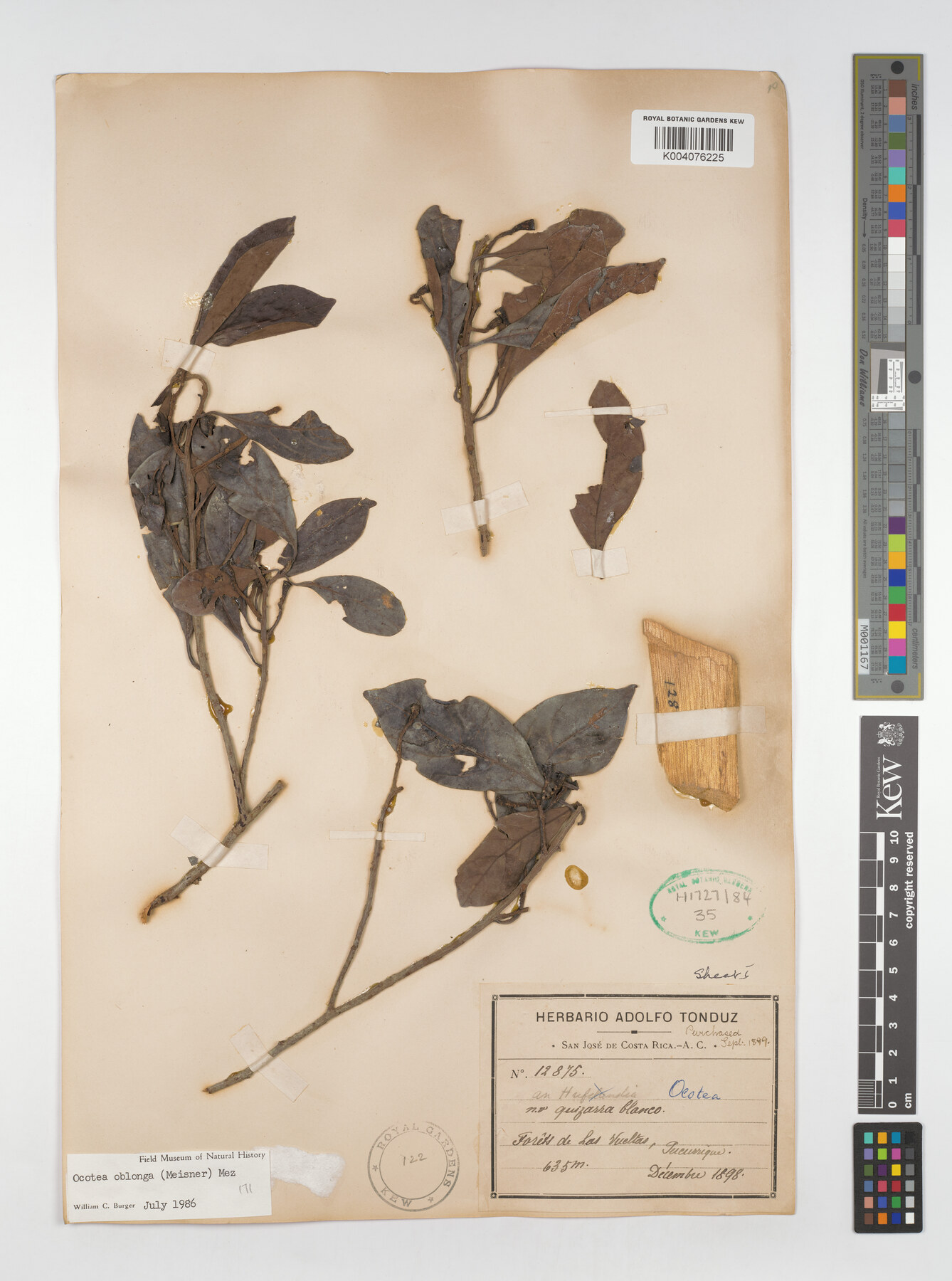
Young twigs are ridged and cinnamon-brown, becoming smooth and gray with age. Bark on mature trunks is grayish-brown with shallow fissures. The species can reach 40 meters in optimal conditions, making it a true canopy emergent in lowland forests.
Leaves
Leaves are 10–23 × 3–7.5 cm, narrowly oblong with an abrupt, short acumen (a drip-tip) and a decurrent base (the blade running down onto the petiole). The undersides dry pale yellow or gray and carry pit domatia (tiny chambers at vein axils) near the midrib. These chambers shelter predatory mites that keep leaf surfaces clean of fungal spores and herbivorous mites.
Flowers
Ocotea oblonga is gynodioecious: some individuals produce only female flowers, while others are hermaphrodites bearing bisexual blooms. Flowers are tiny (barely 2 mm long), greenish, and covered in microscopic hairs. A three-year study in Panama found roughly 30% female trees and 70% hermaphrodites, with females producing more fruit despite being less common.
Fruits
Fruits develop on saucer-like cupules (cup-like receptacles) only 4–6 mm across that sit atop a thickened pedicel (fruit stalk). The drupes themselves are ellipsoid, 9–18 × 7–9 mm, turning purplish-black as they ripen. This flattened cup, combined with the presence of leaf domatia, distinguishes O. oblonga from similar Costa Rican laurels such as O. whitei or O. cuneifolia, whose fruits have larger, more deeply concave cupules.
Distribution and Habitat
Few Neotropical laurels match the geographic spread of Ocotea oblonga. The species occurs from Belize to Bolivia, thriving in Caribbean lowlands barely above sea level and on Andean foothills approaching 2,700 meters. Bolivia and Colombia hold the largest populations, but scattered stands persist across Central America, Venezuela, the Guianas, and Brazil.
In Costa Rica, the species favors the northern volcanic slopes and Caribbean foothills. Collectors have found it near Volcán Rincón de la Vieja, in the San Carlos lowlands, around Tucurrique and Juan Viñas on the Turrialba massif, and along the Sarapiquí corridor where female and hermaphrodite trees flower side by side. The species also reaches the Osa Peninsula and Coto Brus, where specimens collected at 30 to 300 meters place it firmly in the Brunca region.
The tree favors evergreen forest on well-drained ridges, typically between 600 and 1,000 meters in Costa Rica, though it drops to near sea level in the Caribbean lowlands and can climb higher on Andean slopes.
Conservation Outlook
The IUCN categorizes O. oblonga as Least Concern because of its broad Neotropical range, but in Costa Rica it persists mainly inside protected areas such as Rincón de la Vieja, Tapantí, and Corcovado. Maintaining continuous forest along foothill corridors keeps female and hermaphrodite trees close enough for effective pollination. On the Osa Peninsula, O. oblonga likely benefits from the same protected-area connectivity that safeguards the region's other Lauraceae.
Wildlife Connections
Foothill forests that host O. oblonga still harbor a rich disperser guild. Collared Aracaris and Green Jays swallow the small drupes whole, Variegated Squirrels cache windfall fruits in the leaf litter, and Slaty-tailed Trogons commute between Lauraceae crowns and secondary forest gaps. These mixed flocks keep seeds circulating between the species' scattered gynodioecious individuals, connecting female trees to hermaphrodite pollen sources that may stand hundreds of meters away.
A subtler partnership unfolds on the leaf surface. Pit domatia, tiny pouches where secondary veins meet the midrib, shelter predatory mites smaller than a pinhead. These mites patrol the leaf, consuming fungal spores and the eggs of herbivorous insects before they can establish. In return the tree provides shelter and, according to some researchers, trace nutrients in the domatia lining. The mutualism is ancient: domatia appear in roughly 10% of woody species worldwide, but the Lauraceae have embraced the strategy with particular enthusiasm. For a gynodioecious species that depends on long-distance pollen and seed movement, healthy leaves may be the difference between surviving a wet season and succumbing to fungal blight.
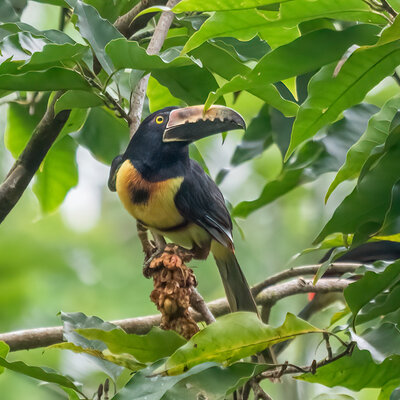

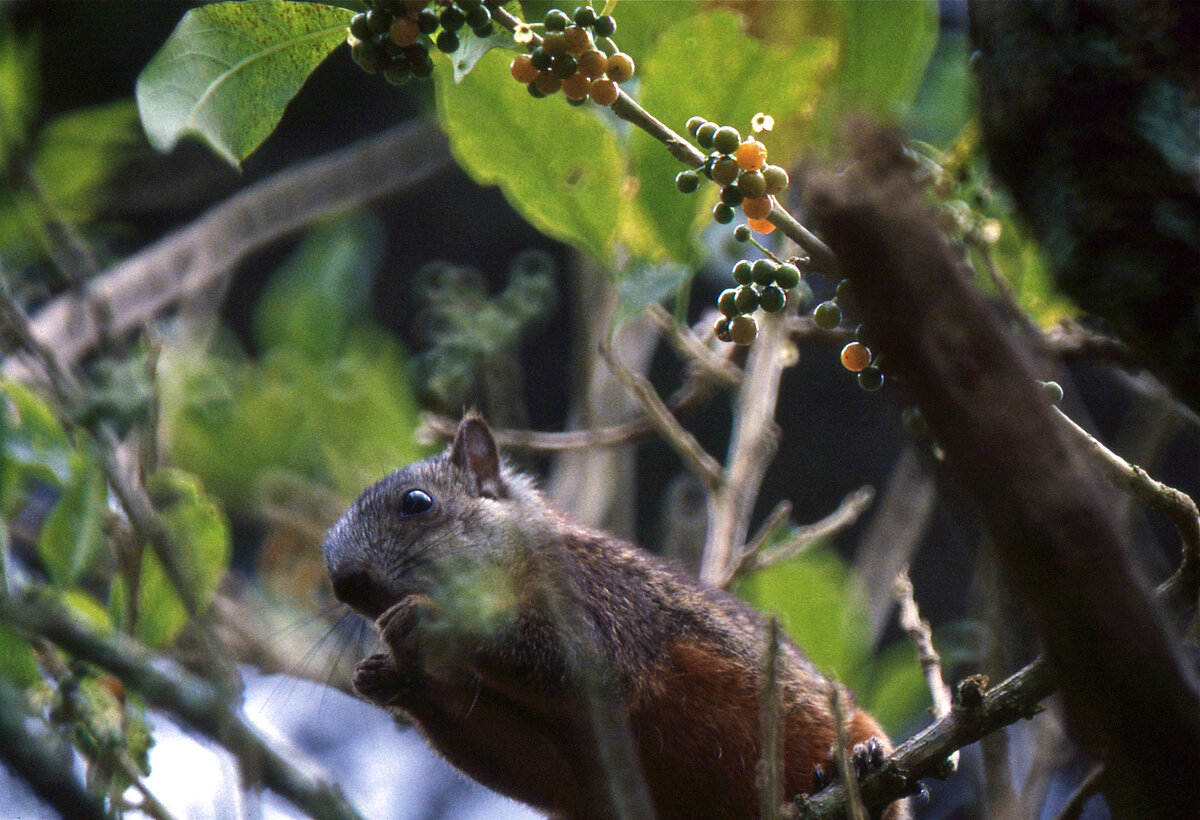

Photos (clockwise from top left): Collared Aracari by Michael Woodruff (CC BY 2.0), Green Jay by Dario Sanches (CC BY-SA 2.0), Slaty-tailed Trogon (CC BY), and Variegated Squirrel by Bernard DUPONT (CC BY-SA 2.0).
Taxonomic History
Carl Meissner first described this species in 1866 as Mespilodaphne oblonga based on collections from South America. Carl Mez transferred it to Ocotea in 1889, recognizing its affinity with other Neotropical laurels. Over the following century, botanists described the same species under at least 29 different names as they encountered it across its vast range from Mexico to Bolivia.
Key synonyms include Cinnamomum mayanum, Ocotea cuprea, Ocotea mayana, and Phoebe mayana. The specific epithet "oblonga" (Latin for "oblong") refers to the leaf shape. The genus name Ocotea derives from an indigenous Guyanese name for aromatic trees. Modern molecular work confirms O. oblonga as a distinct species, though some populations may warrant further study as the genus undergoes revision.
Resources & Further Reading
Species Information
Taxonomic authority with full synonymy and Neotropical distribution summary.
Nearly 900 georeferenced records from Belize to Bolivia.
Missouri Botanical Garden nomenclatural database with 29 recorded synonyms.
Taxonomy & Nomenclature
Primary morphological description and Costa Rican locality records.
Ecology & Reproduction
Three-year study documenting gynodioecious breeding system and female reproductive advantage.
Conservation
Assessment listing the species as Least Concern with notes on population stability.