Aguacatillo de Osa
Ocotea multiflora — A canopy laurel confined to Costa Rica’s Golfo Dulce forests, where thin coppery leaves and a cloud of tiny flowers reveal one of the rarest lowland Ocoteas.
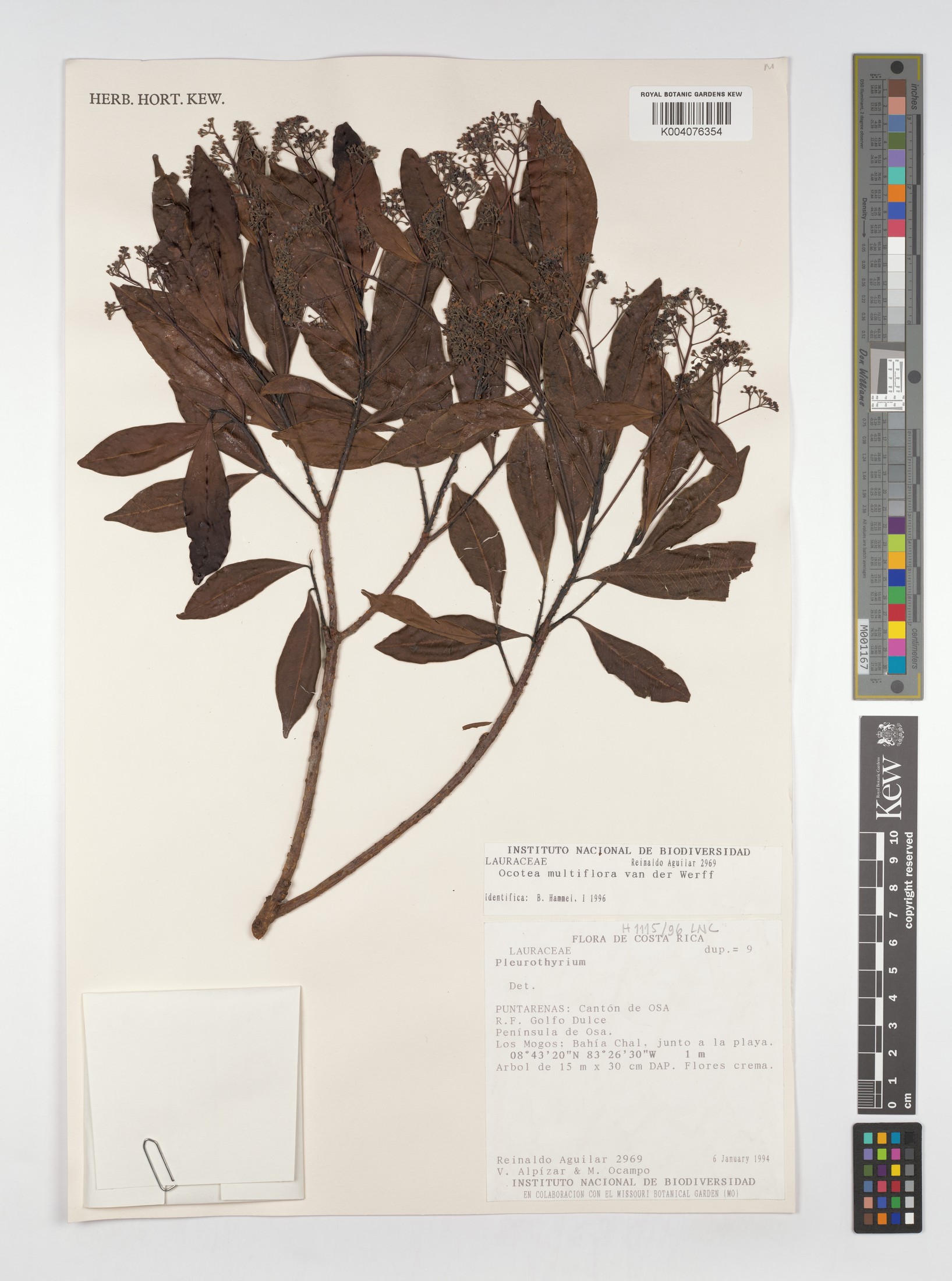
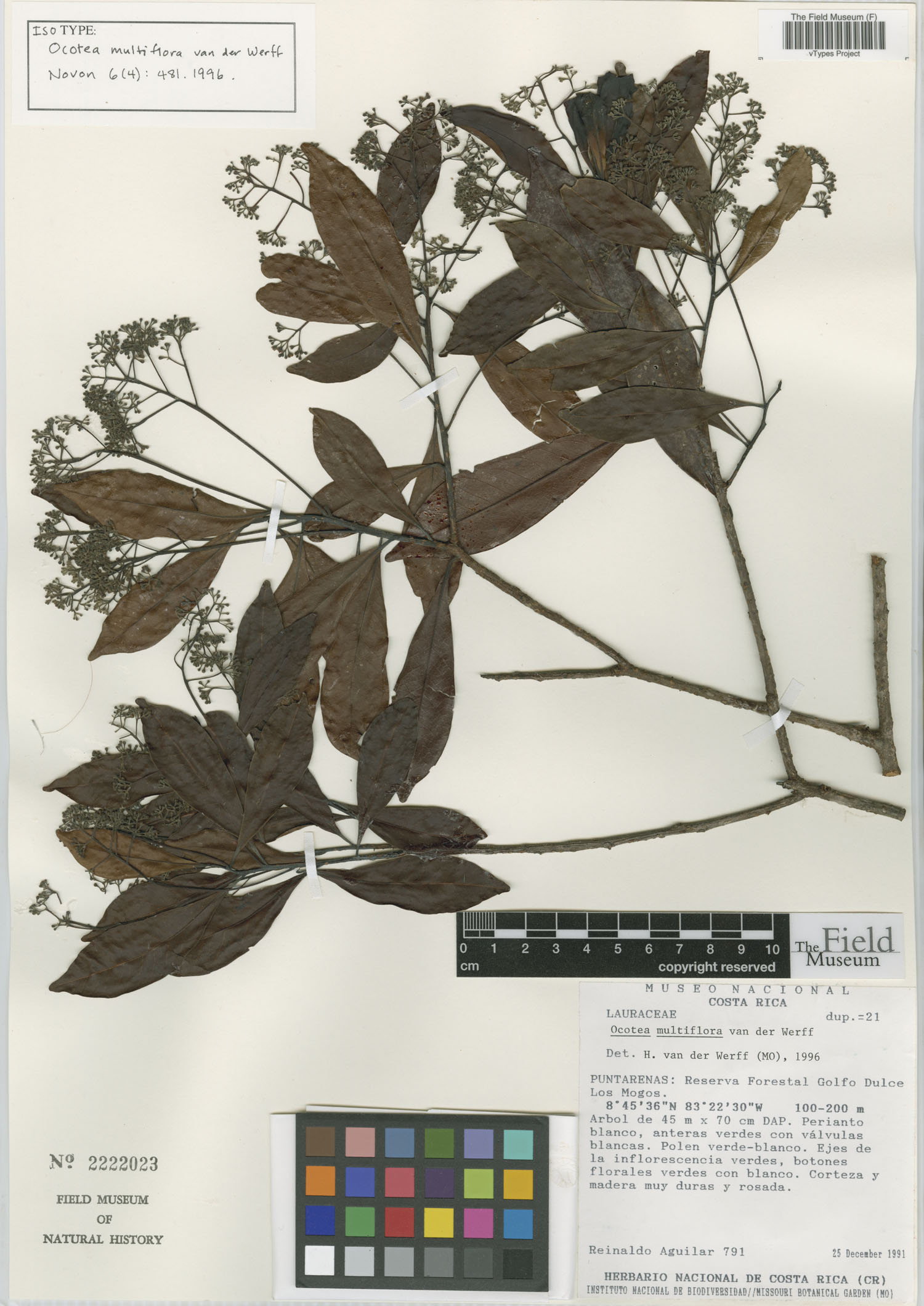
When Dutch Lauraceae specialist Henk van der Werff studied the Osa Peninsula collections in the 1990s, he realized that the specimens nicknamed “Ocotea sp. B” by Burger & van der Werff represented an undescribed tree. His 1996 paper in Novon christened it Ocotea multiflora, an apt name for a species whose long peduncles carry clusters of minute, pale flowers. Today the species is known only from the rainforests ringing Golfo Dulce and Corcovado, where it grows as a 15–45 meter canopy tree in ever-wet lowlands.
Lowland Specialist
The Manual de Plantas de Costa Rica notes that O. multiflora inhabits super-humid forest between sea level and 300 meters, restricted to the south Pacific slope from Piedras Blancas to the tip of the Osa Peninsula. Collections are concentrated near Corcovado National Park, the Golfo Dulce Forest Reserve, and private reserves in the Los Mogos–La Gamba corridor, underscoring how tightly linked the species is to the last intact tracts of very wet lowland forest. To date, it has not been recorded outside of this narrow range in Puntarenas.
The IUCN Red List assessment (2020 field data, published 2022) calculates an extent of occurrence of only 679 km² and an area of occupancy of 68 km² spread over roughly a dozen locations. Illegal logging and land clearing for agriculture and cattle remain active threats outside of the protected core, so the species is listed as Vulnerable despite occurring inside Corcovado and Golfo Dulce reserves.
Identification
Leaves are remarkably small for a canopy Ocotea: 3.6–10 × 1.3–3 cm, elliptic to elliptic-oblanceolate, subacute at the tip, and completely glabrous. Herbarium sheets dry to a reddish-brown color, and each side of the blade carries 12–17 very fine secondary veins that branch before reaching the margin. Inflorescences are long-pedunculate panicles 8–11 cm long whose grayish pubescence gives flowering branches a frosted look. The flowers measure just 1.5–2.5 mm across, with ~1 mm tepals. Fruits are ellipsoid, 1.7–3 cm long, perched on a thickened pedicel above a minimal 0.2 cm cupule—more a narrow collar than the deep cups seen in mountain Ocoteas. Van der Werff noted that the anther valves form a broad arc, hinting at a relationship to the genus Nectandra.
Seasonal Rhythms
Herbarium phenology shows flowering in January, February, and December—the heart of the lowland dry season when canopy insects and bats abound—followed by fruiting in April and May as the rains surge in from the Pacific. Because the cupules remain tiny even in fruit, field botanists watch for the distinctive reddish leaves and the faintly hairy flower clusters to separate this species from sympatric Ocotea.
Conservation Outlook
Although O. multiflora occurs inside Corcovado National Park and the Golfo Dulce Forest Reserve, the IUCN review highlights active deforestation for crops and cattle on the remaining private lands, plus ongoing illegal logging in buffer zones. Conservation botanists recommend continued protection of the Osa lowlands, seed banking, and targeted surveys to locate additional stands beyond the dozen currently known.
Wildlife Connections
The Osa lowlands teem with frugivores—from Scarlet Macaws (Ara macao) and Yellow-throated Toucans (Ramphastos ambiguus) to Fiery-billed Aracaris (Pteroglossus frantzii), Turquoise Cotingas, spider monkeys (Ateles geoffroyi), white-faced capuchins (Cebus imitator), and howler monkeys (Alouatta palliata)—that gorge on Lauraceae drupes when the first rains arrive. While direct observation of dispersal events for O. multiflora is rare, its morphology—small, lipid-rich drupes—fits the classic ornithochory (bird dispersal) syndrome common to the genus. As with other Ocoteas, the small “mini-avocado” fruits of O. multiflora are swallowed whole, the pulp digested, and the seeds deposited beneath perches throughout Corcovado’s canopy trails and beach ridges. This relay allows a species with only a dozen known groves to keep leapfrogging along ridge lines and mangrove edges despite habitat fragmentation.
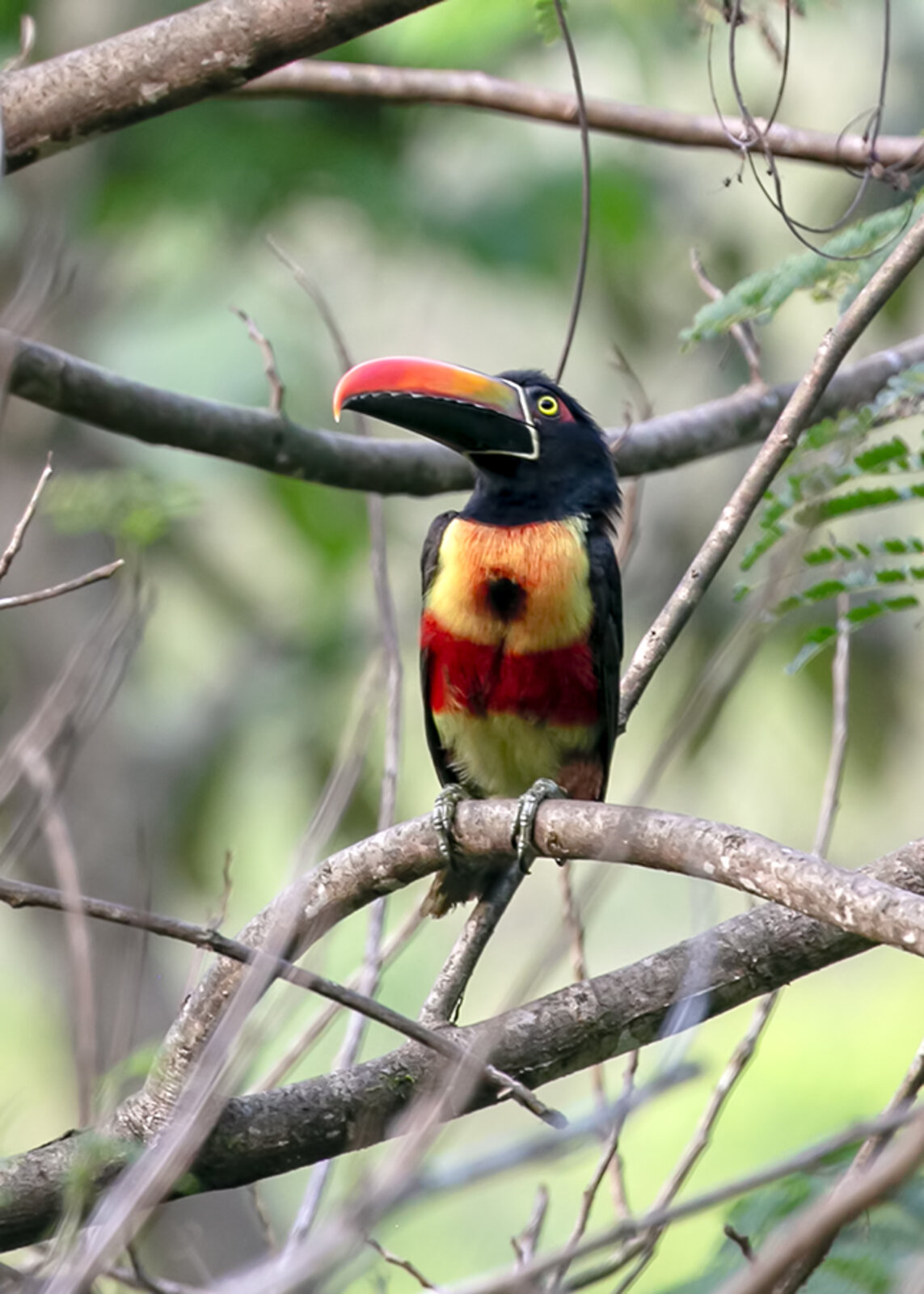

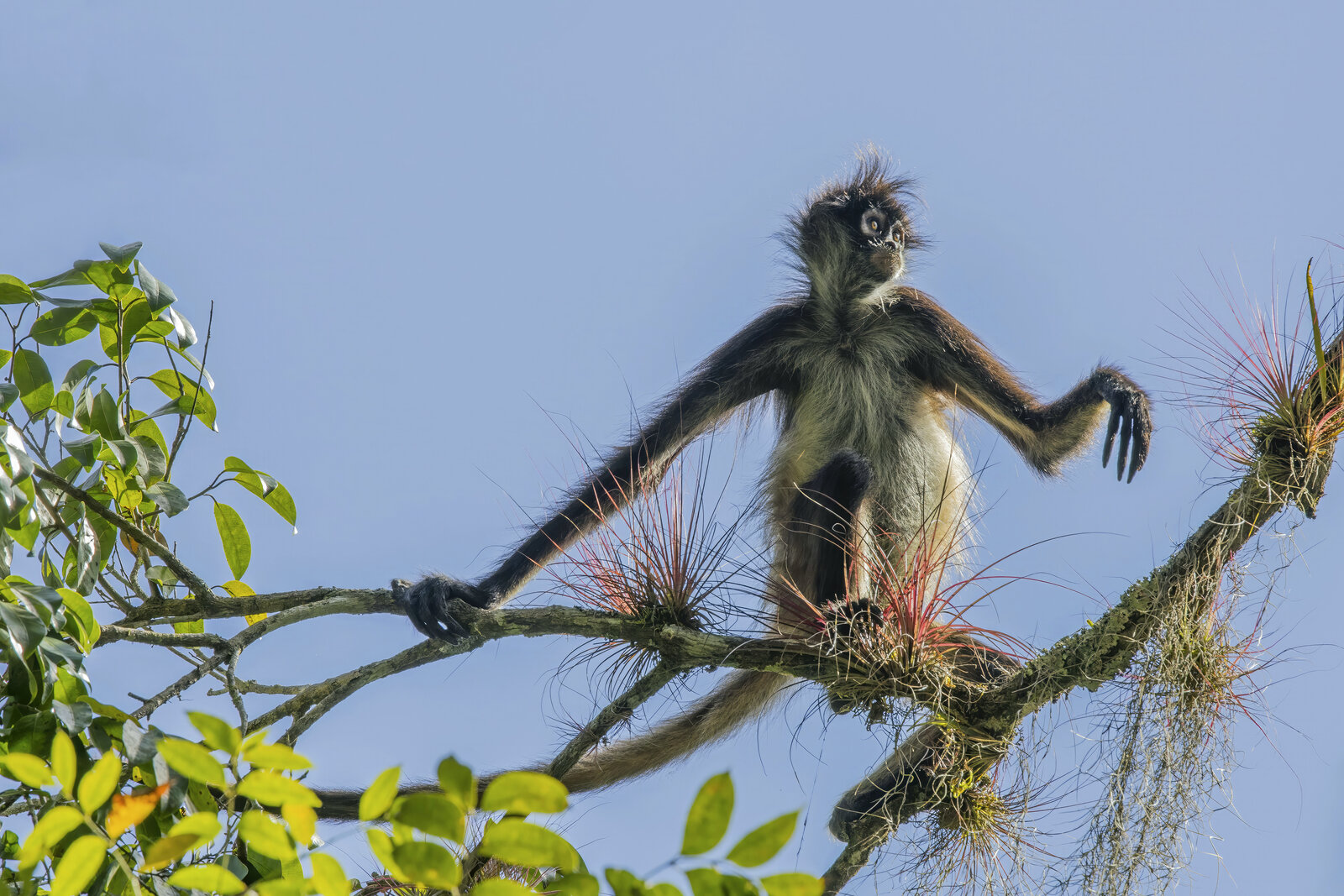
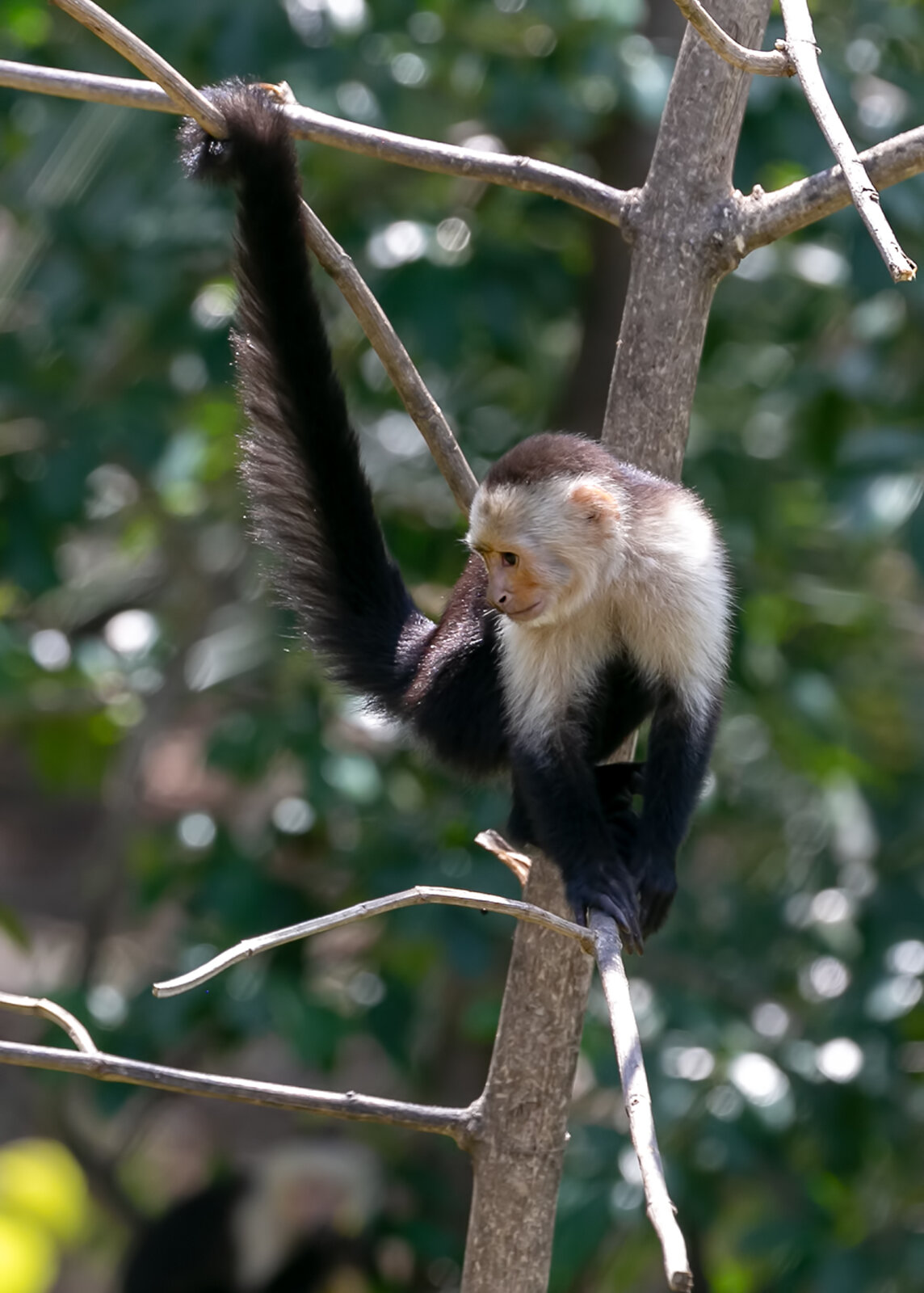
Photos (clockwise from top left): Fiery-billed Aracari, Turquoise Cotinga, white-faced capuchin, and spider monkey. Credits: Charlie Jackson (CC BY 2.0), Randall Leonardo Ortega Chaves (CC BY-SA 4.0), Charlie Jackson (CC BY 2.0), Charles J. Sharp (CC BY-SA 4.0).
Resources & Further Reading
Floristic References
Detailed field description, habitat notes, and phenology for O. multiflora.
Taxonomic placement, life-form notes, and Kew herbarium imagery.
Original publication, "Notes on Costa Rican Lauraceae", describing O. multiflora (“Ocotea sp. B”) from the Osa Peninsula.
Data Sources
Extent of occurrence (679 km²), area of occupancy (68 km²), threat summary, and recommended conservation actions.
Summary entry consolidating distribution and bibliography for the species.
Explains how toucans, cotingas, and primates move lipid-rich Lauraceae fruits through lowland forests like Osa.
Profiles of Scarlet Macaws, toucans, and monkeys whose diets include lowland Lauraceae fruits.