Aguacatillo de Holdridge
Ocotea holdridgeiana — A cloud forest tree from Monteverde named after the American botanist who gave Costa Rica the language to describe its forests.
In the cloud forests of Monteverde, where mist drifts through the canopy and epiphytes cling to every branch, grows a tree that carries the name of the man who taught the world how to classify such places. Ocotea holdridgeiana honors Leslie Holdridge, the American botanist whose life zones system became the foundation for understanding Costa Rica's extraordinary ecological diversity. The species belongs to the Lauraceae, the laurel family that includes avocados and cinnamon, and like its relatives it produces the lipid-rich fruits that sustain the quetzals, bellbirds, and toucans of the cloud forest.
Identification
Leaves
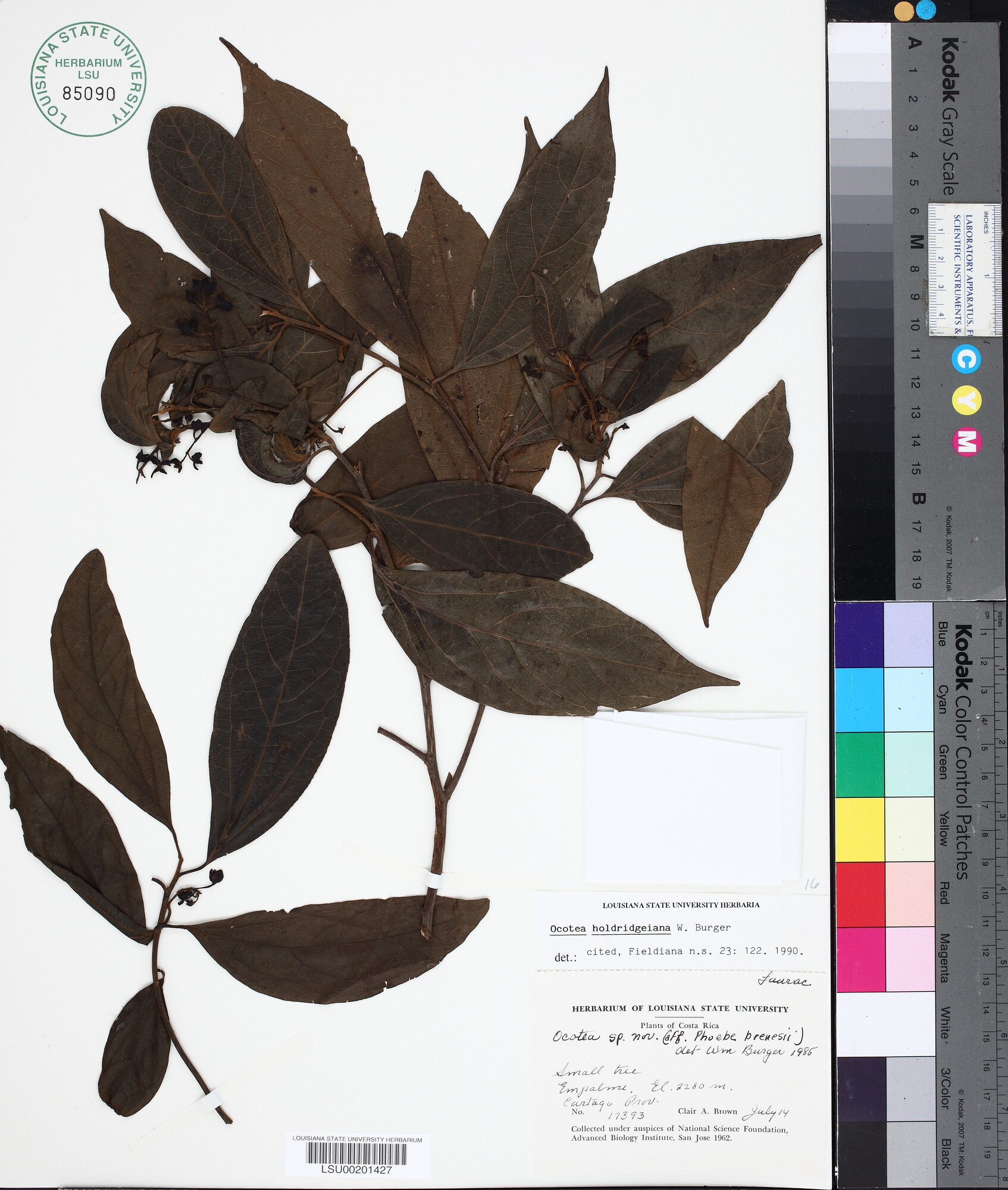
The leaves are alternate, elliptic to obovate, with entire margins and a leathery texture typical of cloud forest laurels. They measure roughly 8-15 cm long and 4-7 cm wide, with a rounded to acute tip and a base that tapers gradually into the petiole. The upper surface is glabrous (hairless) and dries to a dark brownish color, while the underside may show sparse fine hairs along the midrib. Secondary veins are pinnate, curving upward toward the leaf margins. Like other cloud forest Ocotea species, the leaves contain aromatic oils that release a faint fragrance when crushed.
Flowers
The flowers are small and inconspicuous, arranged in axillary panicles (branched clusters arising from leaf axils). Like other Ocotea species, each flower has six tepals (petal-like structures) surrounding nine fertile stamens in three whorls, with the innermost whorl bearing glands at the base of the filaments. The flowers produce modest amounts of nectar that attract small generalist pollinators, primarily stingless bees of the genus Trigona. Flowering occurs during the dry season, though precise timing varies with elevation and local conditions.
Fruits
The fruits are small drupes (fleshy fruits with a single seed), typical of the Lauraceae. Each fruit sits in a shallow cupule (cup-shaped structure) formed from the persistent base of the flower. The oily, lipid-rich pulp makes these fruits highly nutritious for frugivorous birds. Based on studies of related species like O. endresiana, the primary dispersers are likely large forest birds including the resplendent quetzal, three-wattled bellbird, emerald toucanet, and black guan, all of which depend on Ocotea fruits during the fruiting season.
A Name for the Dictionary Maker
The species was described in 1990 by William Carl Burger (born 1932), Curator Emeritus of Vascular Plants at the Field Museum of Natural History in Chicago. Burger, who joined the museum in 1965 to lead the Flora Costaricensis project, would spend his career documenting the country's flora. He described 104 new plant species, primarily in the notoriously difficult Lauraceae and Moraceae families. His treatment of the Lauraceae, published with Dutch botanist Henk van der Werff in Fieldiana: Botany, recognized nearly 100 species of the family in Costa Rica alone.
Burger named the species after Leslie Rensselaer Holdridge (1907-1999), an American botanist who had arrived in Costa Rica in 1949 and would spend half a century shaping tropical ecology and conservation in the country. The epithet holdridgeiana follows the Latin convention for naming species after people, adding "-iana" to indicate "of or belonging to Holdridge."
Holdridge's contribution was conceptual but profound. In 1947, he published a two-page paper in Science that reduced the complexity of Earth's vegetation patterns to an elegant formula based on three variables: mean annual biotemperature, total annual precipitation, and the ratio between them. From these measurements, you could predict whether a location would support rainforest or desert, cloud forest or savanna. For Costa Rica, which packs twelve distinct life zones into a territory smaller than West Virginia, the system became indispensable. It gave conservationists a language to describe what they were protecting.
Ocotea holdridgeiana is not the only species to bear Holdridge's name. Perhaps the most famous is Holdridge's Toad (Incilius holdridgei), a small amphibian endemic to Costa Rica's Barva Volcano in the Cordillera Central. First described in 1952, the toad was declared extinct by the IUCN in 2008 after not being seen since 1987. In a remarkable turn, a Costa Rican herpetologist rediscovered the species in 2010. It remains critically endangered, known from a tiny area at 1,900-2,200 m elevation. Other species honoring Holdridge include the orchid Quisqueya holdridgei from Hispaniola and the myrtle Eugenia holdridgei.
Distribution and Habitat
Ocotea holdridgeiana is known from two of Costa Rica's principal mountain ranges. In the Cordillera de Tilarán, it occurs in the Monteverde region at 1,200-1,800 m elevation, where trade winds push moisture-laden air up the slopes and create the conditions for one of the world's most famous cloud forests. Holdridge himself surveyed Monteverde in 1968 and recommended its protection. More recently, botanical surveys have also recorded the species in the Cordillera de Talamanca, where it occurs at higher elevations (2,300-2,800 m) in upper montane oak forests. In these Talamancan forests, it grows as scattered trees alongside oaks (Quercus spp.), Magnolia sororum, and other montane species.
The Monteverde cloud forest falls within Holdridge's lower montane rain forest and montane rain forest life zones, characterized by high rainfall, persistent cloud cover, and relatively cool temperatures. These forests are extraordinarily rich in epiphytes, with orchids, bromeliads, and ferns covering nearly every surface. They harbor exceptional Lauraceae diversity, with over 70 species of the family reported from the region, making up around 30% of woody species alongside Rubiaceae, Melastomataceae, Asteraceae, and Ericaceae. The genus Ocotea alone includes at least 12 species in these forests. Lauraceae fruits, rich in lipids, form the foundation of the diet for many cloud forest birds.
Ecological Role
While no studies have focused specifically on Ocotea holdridgeiana's seed dispersal, research on related Ocotea species in Monteverde reveals the critical role of large frugivorous birds. The seeds of Ocotea endresiana, a close relative, are dispersed predominantly by five bird species: the Black Guan (Chamaepetes unicolor), Resplendent Quetzal (Pharomachrus mocinno), Emerald Toucanet (Aulacorhynchus prasinus), Three-wattled Bellbird (Procnias tricarunculata), and Mountain Robin (Turdus plebejus). These same birds likely disperse O. holdridgeiana as well.
Among these dispersers, bellbirds play a unique role. Research published in PNAS found that while most frugivorous birds drop seeds within 20 meters of the parent tree, bellbirds carry seeds to their favorite song perches, often more than 40 meters away and frequently in forest gaps. Seeds dispersed by bellbirds showed significantly higher survival rates, likely because the open canopy gaps reduced mortality from fungal pathogens. This "directed dispersal" to favorable microsites may influence forest regeneration patterns across the landscape.
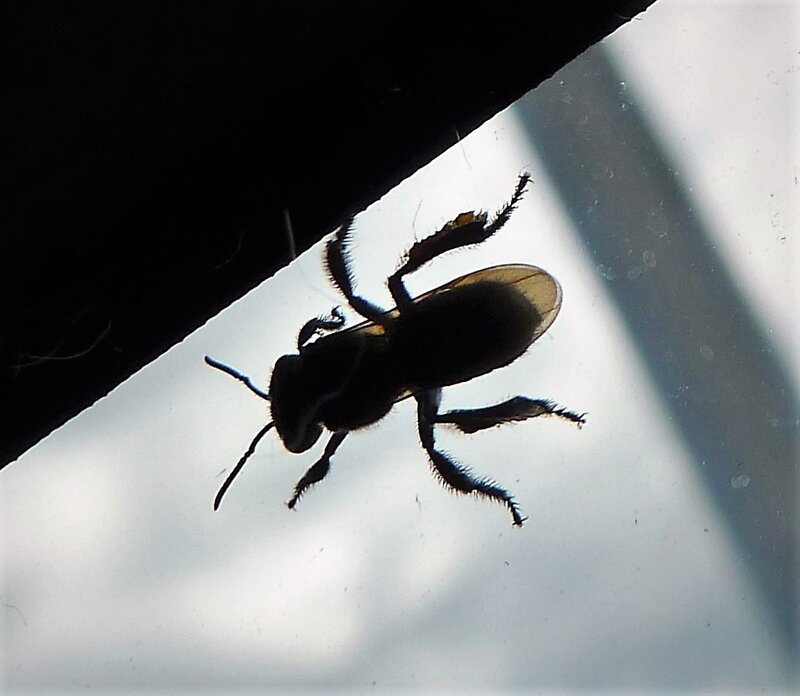
Ocotea flowers are pollinated by generalist small insects, including flies (Diptera), wasps and bees (Hymenoptera), and butterflies and moths (Lepidoptera). The primary pollinators are stingless Trigona bees of the family Meliponinae. The small flowers produce modest amounts of nectar that attract these visitors during flowering periods that vary by species and elevation.
Some Ocotea species exhibit an unusual reproductive system called gynodioecy, meaning they have both female individuals (producing only ovules) and hermaphrodite individuals (producing both pollen and ovules). Female trees typically invest more energy in fruit and seed production than hermaphrodites. This mating system is relatively rare in tropical trees and affects population genetic structure, as female trees can only receive pollen while hermaphrodites can both donate and receive.
Chemistry and Research
Like many Lauraceae, Ocotea holdridgeiana produces aromatic compounds in its leaves and bark. Scientific analysis of the leaf essential oils has revealed a complex mixture of terpenes. The principal components are α-pinene, β-pinene, β-caryophyllene, and germacrene-D, compounds common to many species in the family. These aromatic oils likely serve defensive functions, deterring herbivores and pathogens.
Phytochemical studies have also identified several alkaloids in the leaves. The aporphine alkaloids isocorydine, O,O-dimethylcorytuberine, 3-methoxynuciferine, and 3-hydroxynuciferine have been isolated from O. holdridgeiana, along with the common flavonoids quercetin and catechin. Notably, isocorydine has attracted significant pharmacological interest. Research has shown that isocorydine and its derivatives can inhibit the growth of human lung, gastric, and liver cancer cell lines in laboratory studies. The compound targets cancer stem cells and induces apoptosis through specific biological pathways. While these findings come from studies of isocorydine from other plant sources, they suggest that the alkaloids found in O. holdridgeiana may warrant further pharmacological investigation.
Resources & Further Reading
Original Description & Taxonomy
Burger, W.C. & van der Werff, H. (1990). Fieldiana: Botany, n.s. 23. The original publication describing Ocotea holdridgeiana, covering nearly 100 Lauraceae species in Costa Rica.
Regional monograph for the Lauraceae family in Mesoamerica.
Chemistry & Pharmacology
Setzer et al. (2007). Analysis of essential oil composition including α-pinene, β-pinene, β-caryophyllene, and germacrene-D in Monteverde Ocotea species.
Castro & Ruiz (1994). Isolation of isocorydine, O,O-dimethylcorytuberine, 3-methoxynuciferine, 3-hydroxynuciferine, quercetin, and catechin from the leaves.
Molecules (2014). Review of isocorydine's pharmacological potential, including inhibition of lung, gastric, and liver cancer cell lines and targeting of cancer stem cells.
Ecology & Seed Dispersal
Wenny, D.G. & Levey, D.J. (1998). PNAS 95(11): 6204-6207. Landmark study showing bellbirds carry Ocotea seeds to favorable microsites, increasing seedling survival compared to other dispersers.
Conservation & Related Resources
Biography of the American botanist after whom this species is named, creator of the life zones classification system.
Conservation efforts for Monteverde's endemic and threatened Ocotea species, including the critically endangered O. monteverdensis.