Ocotea endresiana
Ocotea endresiana — A cloud forest tree that became famous for revealing how bellbirds shape tropical forests. Seeds deposited beneath bellbird song perches are twice as likely to survive as those dropped by other birds.
In 1998, ecologists Daniel Wenny and Douglas Levey published a study that changed how scientists think about seed dispersal. Working in the Monteverde Cloud Forest, they discovered that three-wattled bellbirds do not scatter seeds randomly. Instead, these birds carry fruits to habitual song perches on the edges of forest gaps, depositing seeds in locations that happen to be ideal for germination and growth. The tree at the center of this discovery was Ocotea endresiana, a member of the avocado family found in cloud forests from Costa Rica to Panama.
This research documented what scientists call "directed seed dispersal," the clearest link ever demonstrated between a disperser and the reproductive success of a tropical forest tree. The bellbird-Ocotea relationship has become a textbook example of how frugivores can actively shape forest structure, not merely scatter seeds at random.
Identification

Ocotea endresiana is one of over 100 Ocotea species found in Mesoamerica, all members of the Lauraceae or laurel family. Like its relatives, including the cultivated avocado (Persea americana), it produces oily, nutritious fruits that birds must swallow whole. Distinguishing between Ocotea species requires careful attention to leaf and flower details.
Physical Characteristics
Form: A medium to large tree, typically 5-30 meters tall. In the cloud forest understory it may remain shrubby, but in favorable conditions it develops into a full canopy tree. The species is shade-tolerant and common in undisturbed lower montane rain forest.
Leaves: Subsessile (nearly lacking a petiole), 10-21.5 cm long and 5-11.5 cm wide, obovate to elliptic-obovate in shape. The leaf base is markedly rolled under (revolute), and the apex is obtuse to rounded. The underside may be glabrous or minutely hairy, often with conspicuous tufts of hairs (domatia) in the vein axils. Each leaf has 5-9 secondary veins per side. Like all Lauraceae, the leaves are aromatic when crushed.
Flowers: Small and bisexual, 3-4 mm in diameter, produced in broadly paniculate inflorescences 7-18 cm long. The tepals are erect, about 1.5 mm, glabrous on the outside. Unlike some Ocotea species that are dioecious (separate male and female trees), O. endresiana has perfect flowers containing both male and female parts.
Fruits: Drupes 1.1-1.8 cm long, seated in a cupule (cup-shaped structure) 0.5-1.5 cm in diameter. Like other aguacatillos, the fruit is rich in lipids, making it a high-energy food source for frugivorous birds. The cupule is often reddish, serving as a visual signal to attract dispersers.
The Bellbird Connection
Five bird species disperse Ocotea endresiana seeds in Monteverde: the resplendent quetzal, three-wattled bellbird, emerald toucanet, black guan, and mountain robin. Four of these species, the quetzal, toucanet, black guan, and mountain robin, behave similarly. After eating the fruit, they regurgitate or defecate the seeds within 20 meters of the parent tree, typically under closed forest canopy where the parent tree stands.
The bellbird behaves differently. After swallowing fruits, male bellbirds fly to habitual song perches, dead branches on the edges of treefall gaps, where they spend hours calling to attract mates. While perched, they digest their meal and regurgitate the seeds. These song perches are typically more than 40 meters from the parent tree, in locations that receive more sunlight than the closed forest understory.
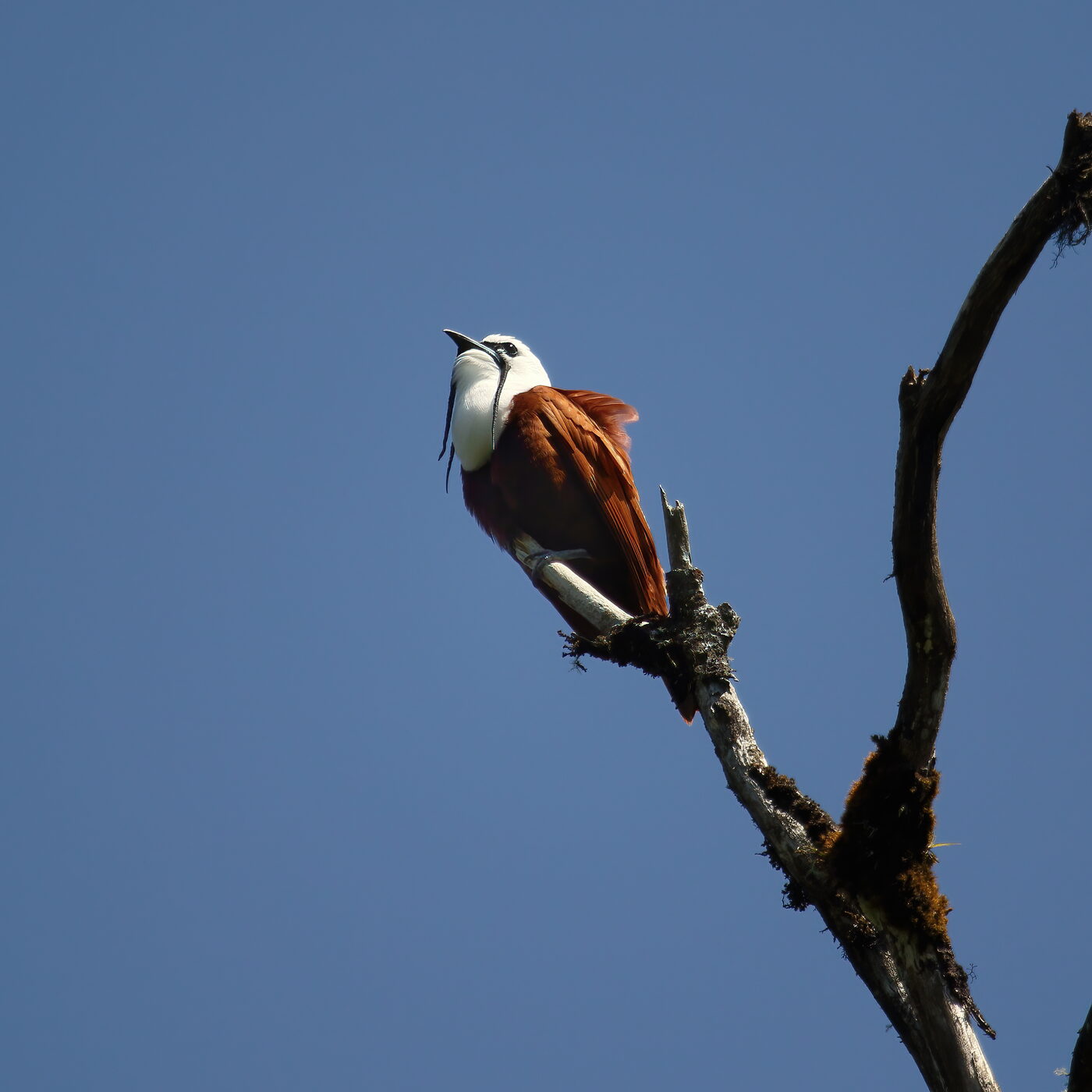
Why Location Matters
Seeds that land beneath parent trees face two problems. First, soil pathogens that specialize on Ocotea concentrate near adult trees, attacking seeds and seedlings. Second, the deep shade beneath closed canopy limits the light available for seedling growth. Most seeds deposited by quetzals, toucanets, guans, and robins end up in these unfavorable conditions.
Bellbird perches offer something different. Located on gap edges more than 40 meters from parent trees, they escape the zone where pathogenic soil microbes concentrate. The canopy is more open, providing the light that seedlings need to grow. Wenny and Levey found that seedlings from bellbird-dispersed seeds were significantly more likely to survive their first year compared to seeds deposited by other birds. Fungal pathogen mortality was significantly lower at bellbird perch sites.
This pattern, where a disperser deposits seeds in locations that favor germination and growth, is called directed seed dispersal. While ecologists had theorized about such relationships, the Ocotea-bellbird system provided the first rigorous demonstration. The bellbirds are not consciously helping the tree; they simply prefer perch sites that happen to be ideal for Ocotea regeneration. Evolution has aligned the bird's courtship behavior with the tree's reproductive needs.
The Full Picture: Seed Predation and Survival
Wenny's comprehensive 2000 study in Ecological Monographs revealed a fuller picture of Ocotea endresiana seed ecology. Seed predation during the first 12 months after dispersal was remarkably high: 99.7% of seeds were consumed. At least half of this predation was attributable to small rodents, particularly the Mexican deer mouse (Peromyscus mexicanus). Unlike agoutis, which sometimes cache and forget seeds (inadvertently planting them), these mice showed no evidence of scatterhoarding. Seeds removed by mice were consumed, not dispersed.
Seeds that escaped predators had excellent germination potential. When protected from mammals, 70-90% of seeds germinated regardless of microhabitat or seed size. Seeds regurgitated by birds and seeds experimentally removed from fruits by hand germinated equally well (98%), but seeds left inside intact fruits failed to germinate. This indicates that passage through a bird's digestive tract, while not strictly required, effectively removes the fruit pulp that otherwise inhibits germination.
Distribution
Ocotea endresiana ranges from Costa Rica to Panama, occurring on both Caribbean and Pacific slopes. In Costa Rica, it is found in the Cordillera de Tilaran (including Monteverde), the Cordillera Central, and the Cordillera de Talamanca. It also occurs in the Tortuguero lowlands and the eastern Pacific slope of Talamanca. The species grows in very humid forest, pluvial forest, and cloud forest, typically at elevations from 750 to 1,600 meters, though it can occur as low as sea level in some areas.
The species is described as common within its range. It is a characteristic component of undisturbed lower montane rain forest, where it grows as a shade-tolerant tree in the forest understory and mid-canopy. The type specimen was collected by A.R. Endres in Costa Rica, though the specific locality was not recorded. The species name honors this collector.
The Names Behind the Species
The species name endresiana honors Auguste R. Endres (born November 27, Herbitzheim, Alsace), one of the most remarkable botanical explorers to work in Costa Rica. Between late 1866 and early 1874, Endres traversed the country's mountains and forests, becoming what historians call "the greatest orchidologist to ever visit Costa Rica." Though orchids were his primary focus, he collected broadly, and his specimens formed the basis for numerous species descriptions.
Endres' botanical legacy amounts to an astonishing 3,518 herbarium sheets, including 1,127 with detailed illustrations. His meticulous drawings of orchids, preserved at the Natural History Museum of Vienna, remain valuable scientific documents. Besides plants, he collected birds, sending hummingbird specimens preserved in spirits to the Smithsonian. His premature death sometime after January 1874, just months before he planned to return to Europe, cut short a brilliant career. His work was largely neglected until modern scholars rediscovered his contributions.
Carl Christian Mez (1866-1944), who formally described Ocotea endresiana in 1889, was a German botanist who made the Lauraceae family his specialty. Coming from an industrial family in Freiburg im Breisgau, Mez earned his doctorate at Berlin with a thesis on Lauraceae morphology, then published "Lauraceae Americanae" in 1889, the monograph in which O. endresiana first appeared. He later pioneered the use of serology to study plant relationships and served as Professor of Systematic Botany at Halle and later Konigsberg. Two plant genera, Mezia and Meziella, were named in his honor.
Uses and Phytochemistry
The wood of Ocotea endresiana is used locally for construction and fence posts. Like other Lauraceae, the leaves contain aromatic essential oils rich in volatile compounds.
Research by Agius and colleagues (2007) analyzed the essential oil composition of O. endresiana and nine other Monteverde Ocotea species. The leaf oil of O. endresiana was dominated by pinene monoterpenoids, with the sesquiterpene alpha-humulene comprising 14.3% of the total. This chemical profile proved biologically significant.
The cruzain inhibitory activity is particularly noteworthy. Cruzain is a cysteine protease essential for the survival of Trypanosoma cruzi, making it a target for antiparasitic drug development. The sesquiterpenes found in O. endresiana, including alpha-copaene, beta-caryophyllene, alpha-humulene, and germacrene D, show activity both alone and in synergistic combinations. While these findings do not translate directly to medical applications, they highlight the potential pharmaceutical value of cloud forest Lauraceae species that remain largely unexplored.
Conservation
The IUCN lists Ocotea endresiana as Least Concern. The species is common within its range and occurs in protected areas including the Monteverde Cloud Forest Reserve, La Amistad International Park, and various biological corridors in the Talamanca region.
However, the tree's reproductive success depends on its dispersers, particularly bellbirds. The three-wattled bellbird is classified as Vulnerable by the IUCN, with populations that experienced dramatic decline in the late 20th century. At Monteverde, breeding male counts fell from over 350 individuals in the early 1990s to significantly lower numbers by the 2000s. Recent surveys suggest a possible recovery, though populations remain fragile.
Bellbirds are altitudinal migrants, breeding in cloud forests like Monteverde but spending part of the year in lowland forests on the Caribbean slope. Deforestation in these lowland areas eliminated critical non-breeding habitat, driving the population decline. Conservation efforts, including establishment of the Bellbird Biological Corridor connecting highland and lowland forests, aim to restore the habitat connectivity these birds require.
Climate change adds another layer of concern. Lauraceae species in tropical montane forests are shifting their distributions upslope as temperatures rise, a pattern documented by researchers tracking forest composition over decades. For Ocotea endresiana and its bellbird dispersers, these shifts could disrupt the finely tuned relationship between bird behavior and tree regeneration, potentially altering where and how successfully the species reproduces.
Resources & Further Reading
Species Information
Authoritative taxonomic information and distribution data from Kew Gardens.
Detailed species profile with distribution information for Costa Rica.
Global flora database with taxonomic details and description.
Specialized database for the Lauraceae family with nomenclatural history.
Seed Dispersal Ecology
The landmark study documenting directed seed dispersal of Ocotea endresiana by three-wattled bellbirds.
Comprehensive study documenting 99.7% seed predation rates and the complete reproductive ecology of O. endresiana.
Accessible overview of the bellbird-Ocotea relationship from ongoing research in Monteverde.
Overview of the Ocotea-frugivore relationship for general audiences.
Phytochemistry and Bioactivity
Research on essential oil chemistry and biological activity of ten Monteverde Ocotea species including O. endresiana.
History and Nomenclature
Biographical research on A.R. Endres, the collector honored by the species name.
Biography of the German botanist who described O. endresiana in 1889.
Bellbird Conservation
Conservation status assessment for the primary seed disperser of O. endresiana.
Distribution maps, sightings data, and population trends for the three-wattled bellbird.